
7 Top Telecom Services Near Me in Atlanta (2026 Guide)


Your Atlanta business is growing. Can your internet keep up?
Your team is finally moving fast, but the connection isn’t. Video calls freeze. Cloud backups drag. Large file uploads sit in a queue while staff wait and refresh. If that sounds familiar, searching for telecom services near me isn’t a casual errand anymore. It’s an infrastructure decision that affects productivity, customer experience, and how confidently you can scale.
Atlanta companies run into this at different stages. A law office outgrows basic cable. A clinic needs more predictable uptime. A multi-site company wants one provider standard across offices, but every address has a different service story. The right answer usually isn’t the “fastest” plan on a homepage. It’s the service type, support model, and upgrade path that fits how your business operates.
Use this short screen before you sign anything:
Telecom Provider Selection Checklist:
- Speed & Symmetry: Do you need strong upload performance for cloud apps, backups, VoIP, and large file sharing, or is download-heavy service enough?
- Reliability & SLA: What does one hour offline cost your business? If the answer is “too much,” ask about contractual uptime guarantees and response commitments.
- Scalability: Can you increase bandwidth without replacing everything six months from now?
- Service Type: Shared broadband works for many offices. Dedicated internet, Ethernet, or fixed wireless may fit better for critical sites or backup paths.
- Support: If your network goes down at night, who answers?
- Security: Ask whether managed firewall, DDoS protection, or segmented business services are available.
If your project is bigger than a simple turn-up, it helps to pair connectivity planning with end-to-end network build expertise.
1. AT&T Business
AT&T is one of the first providers Atlanta companies check, and for good reason. It spans a wide range of business needs, from straightforward fiber internet for office suites to dedicated internet and Ethernet for sites that need stronger guarantees. That range matters when you’re trying to avoid a second migration after your first growth spurt.
For businesses that expect higher cloud usage, regular large uploads, or steady video traffic, AT&T’s business fiber options are often easier to justify than cable. For organizations with stricter operational requirements, the dedicated side of AT&T’s portfolio is where the conversation gets more serious. Static IP needs, compliance expectations, and multi-site standardization are all easier to handle when one provider can support both entry-level business internet and more formal enterprise connectivity.
Where AT&T fits best
AT&T tends to make sense in a few recurring scenarios:
- Growing offices: A company starts on shared fiber, then upgrades to dedicated services as traffic and uptime expectations rise.
- Multi-location rollouts: Standardizing one provider can simplify support, billing, and escalation.
- Compliance-sensitive environments: Healthcare, finance, and other regulated teams often prefer a provider with deeper enterprise options.
One broader market signal is worth noting. In Baton Rouge, dedicated fiber providers including AT&T offer symmetric speeds up to 5,000 Mbps in select areas, which reflects the larger industry push toward gigabit-capable infrastructure across U.S. telecom markets, as noted in Statista’s overview of telecoms in the U.S.. That doesn’t mean every Atlanta address gets the same outcome. It does mean the carrier is investing where business demand supports it.
Practical rule: If your office depends on cloud apps all day, ask AT&T to quote both shared fiber and dedicated internet. The price gap can be justified quickly if downtime or inconsistent upload performance hurts operations.
One operational detail many IT teams overlook is the hardware left behind after the upgrade. Firewalls, routers, switches, handsets, and retired network appliances tend to pile up in storage. If that’s already happening in your office, fold decommissioning into the project plan using this Atlanta business technology recycling guide.
You can review local service options directly on the AT&T Business Atlanta page.
2. Comcast Business
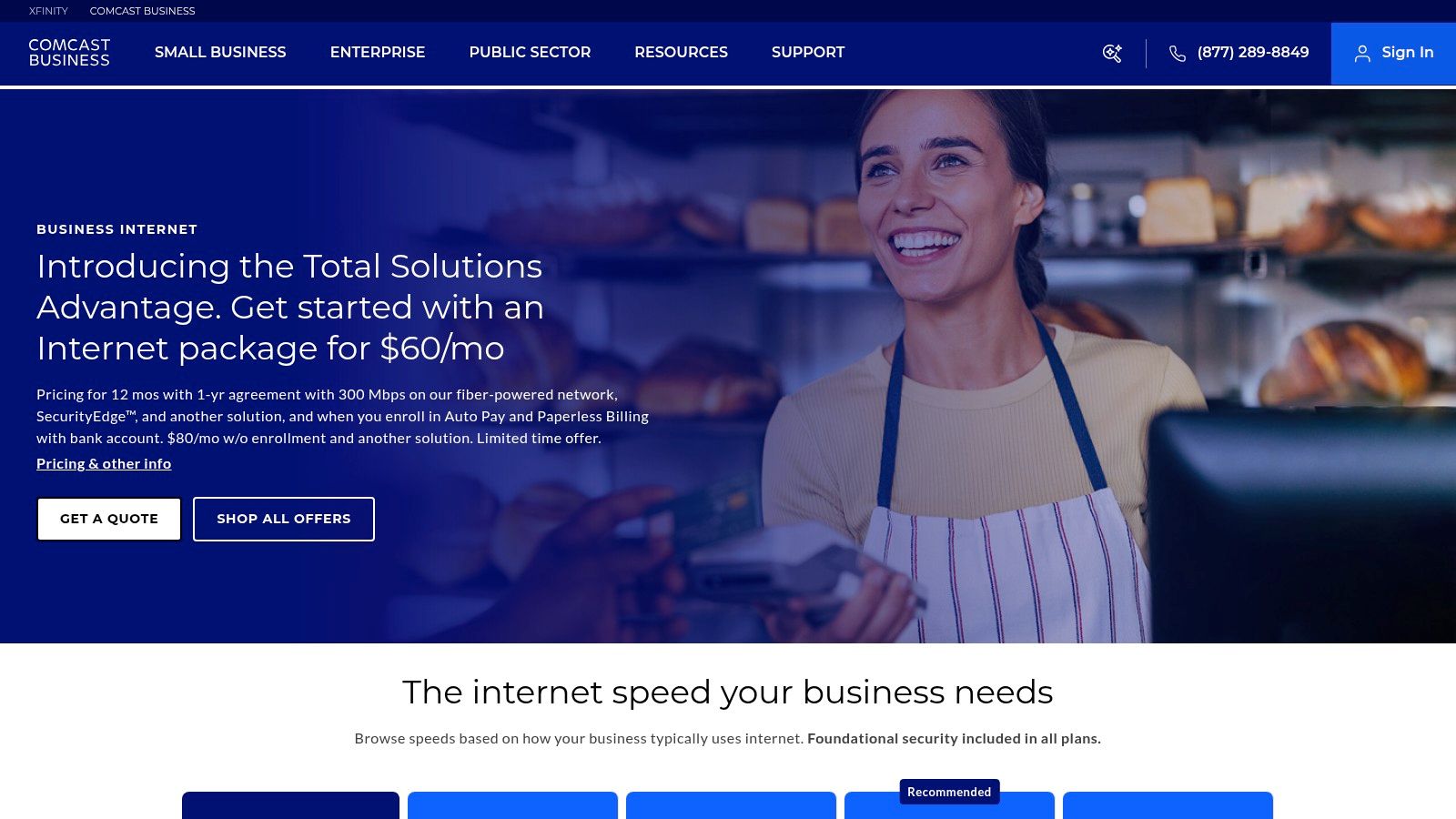
Your office lease starts in 30 days, the phones need to ring on day one, guest Wi-Fi has to work, and the accounting team wants one bill instead of four. That is the kind of situation where Comcast Business usually gets a serious look from Atlanta companies.
Its appeal is practical. Comcast can be a strong fit for small and midsize offices that want internet, voice, managed Wi-Fi, and wireless backup from one provider without a long fiber construction cycle. For businesses opening a second location, relocating, or standardizing service across several ordinary office sites, that convenience has real value.
The trade-off sits in the access method. Many Comcast Business deployments still rely on cable infrastructure, which is often faster to install and easier to price than dedicated fiber, but less attractive for heavy upstream traffic, latency-sensitive workloads, and sites where performance consistency matters all day. A law office using cloud apps and VoIP may do well here. A media team pushing large files to clients every hour should test other options before signing.
A few strengths show up repeatedly in real projects:
- Faster installs for standard offices: Good option when the business cannot wait through longer construction or permitting timelines.
- Simple bundling: Internet, voice, Wi-Fi, and continuity services are easier to buy and support under one contract.
- Useful for relocations: If your business moves offices periodically, Comcast is often easier to re-establish than a custom fiber build.
- Practical failover options: Wireless backup can keep front-desk operations, card processing, and basic communications running during an outage.
I usually advise clients to ask Comcast two direct questions before they compare monthly price alone. First, what service levels apply at this address and on this product tier? Second, what hardware is included, rented, or required for the installation? Those details affect the actual cost and the day-two experience more than a promotional rate.
There is also a second-step issue that belongs in the same buying conversation. Upgrading telecom service often leaves behind old gateways, desk phones, access points, switches, and UPS units. If those assets hold business data or came from multiple branch offices, they need documented handling, not a storage room pile. Atlanta teams planning a provider change can pair the rollout with enterprise electronics recycling services in Atlanta so the upgrade closes the loop on compliance, chain of custody, and community impact.
Review current offers and service details on the Comcast Business website.
3. Spectrum Enterprise
Spectrum Enterprise is where the conversation shifts from “internet for the office” to “network service for the business.” That distinction matters. This is usually not the cheapest option on the list, and it isn’t trying to be. It’s built for organizations that need dedicated fiber, Ethernet, cloud connectivity, and support structures that make sense for critical operations.
Hospitals, government contractors, financial institutions, and larger distributed businesses tend to look at Spectrum Enterprise differently than a small retail office would. The service model, quoting process, and support expectations are more enterprise-oriented. If your team is comparing telecom services near me because uptime, escalation, and documented support matter as much as throughput, Spectrum Enterprise belongs on the shortlist.
Best use cases
This provider tends to fit when your network is tied closely to business continuity.
- Regulated environments: Teams that need stronger support posture and cleaner separation from consumer-style broadband.
- Cloud-focused architecture: Ethernet and cloud on-ramp products can help when multiple sites rely on centralized systems.
- Regional rollouts: Good fit for organizations that need consistency beyond one office.
In regulated settings, the provider is only half the answer. The other half is how you retire the equipment that network upgrade displaces.
That’s where a lot of businesses lose the plot. They negotiate a clean new circuit, then leave old switches, retired security appliances, aging edge devices, and storage media sitting in a staging room. For healthcare systems, education groups, and public-sector teams, that’s not just clutter. It’s a compliance problem waiting for a bad inventory audit.
There’s also a broader market gap behind this. Consumer-facing search results for telecom services rarely address how hospitals, data centers, or government agencies verify support for secure decommissioning workflows, audit trails, and compliance-aligned handling during equipment retirement. That gap is described well in HighSpeedInternet’s Chicago broadband page context, which highlights how standard broadband availability discussions miss the enterprise-grade compliance question.
If your Atlanta organization is replacing infrastructure as part of a larger refresh, pair carrier selection with a downstream asset plan. This is especially important for facilities with racks of retired networking hardware and media. For that second step, enterprise electronics recycling in Atlanta is the practical handoff.
You can evaluate service offerings on the Spectrum Enterprise Atlanta page.
4. Lumen Technologies
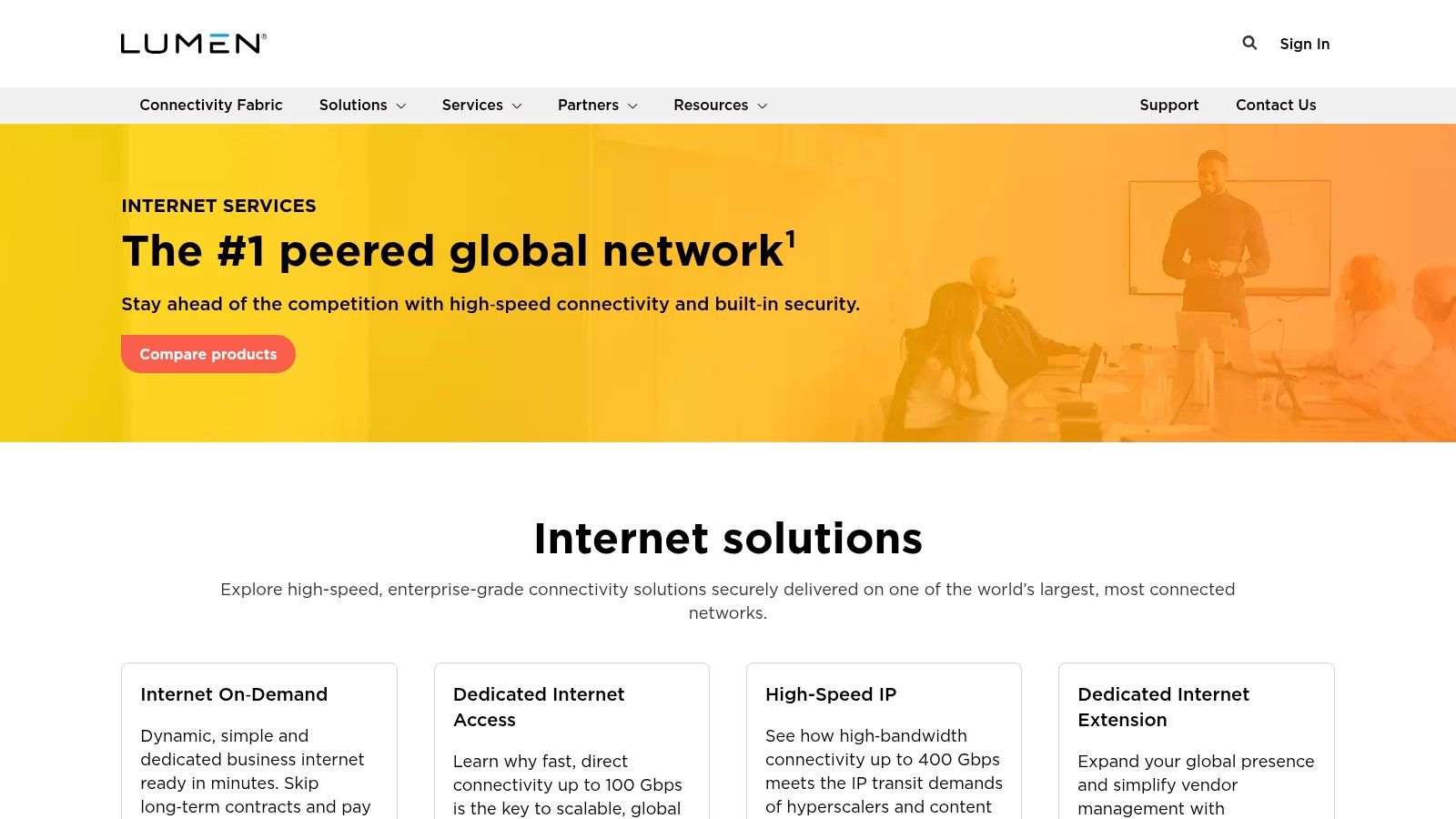
Lumen isn’t the provider most small offices call first, but for enterprise environments, it can be one of the most capable. Atlanta organizations with data center presence, heavy transport needs, or more complex WAN design often look at Lumen because it offers far more than basic internet access. Dedicated internet, Ethernet, wavelengths, dark fiber, and on-demand network services put it in a different category from entry-level business broadband.
That matters when your network team needs flexibility instead of a fixed package. If your environment changes often, if you’re connecting high-value sites, or if your workloads are concentrated around data movement rather than ordinary office browsing, Lumen’s portfolio can be appealing.
Why larger teams consider Lumen
Lumen fits best when your connectivity roadmap is layered.
- Data center and interconnect needs: Useful when internet access is only one part of a larger transport design.
- Elastic demand: On-demand services can be attractive where traffic profiles shift.
- Compliance-heavy sectors: Managed network and security services can help unify connectivity and operational controls.
The larger market backdrop supports why providers like Lumen remain relevant. Grand View Research projects the global telecom services market will reach USD 2,223.97 billion in 2026 and USD 3,584.32 billion by 2033, with a 7.1% CAGR from 2026 to 2033, and notes that the wireless segment accounts for 78.6% of market revenue in 2025 in its global telecom services market analysis. For IT departments, that points to ongoing infrastructure refresh cycles, not static environments.
That refresh cycle has a consequence inside server rooms and network closets. Every new transport deployment, edge upgrade, or routing redesign tends to push older hardware out of service. In data center environments especially, retired appliances, servers, rails, PDUs, storage media, and network gear need planned disposition. Otherwise, the migration is only half done.
Field note: The more sophisticated the new network is, the less acceptable it is to treat old equipment disposal as an afterthought.
Atlanta teams decommissioning racks, cages, or telecom-heavy infrastructure should tie the carrier project to server recycling for Atlanta data centers.
For product details, start with Lumen Internet Services.
5. Zayo
Zayo is not the “best internet provider” for a typical office suite. It’s a specialist. That’s exactly why it matters in Atlanta. If your business depends on route diversity, high-capacity metro transport, interconnection between critical facilities, or resilient data center links, Zayo deserves a serious look.
I’d put Zayo in the category of strategic network infrastructure rather than everyday business broadband. It’s a strong fit when your team already knows why dark fiber, lit transport, or resilient metro paths matter. If you don’t need those things, Zayo can feel like too much provider for the job. If you do need them, the options are narrower and the decision is more critical.
When Zayo is the right call
Zayo tends to stand out in this area:
- Data center interconnects: Good fit for businesses moving large volumes of traffic between facilities.
- Resiliency projects: Route diversity matters when one backhoe strike or one single-provider dependency is unacceptable.
- Very high throughput needs: AI, replication, backup, and disaster recovery traffic can outgrow ordinary business internet.
The challenge with providers in this class is that construction and lateral planning can shape the whole project. A strong design on paper still needs building access, pathway review, and a realistic cutover plan. For that reason, Zayo works best for teams that treat telecom as part of infrastructure engineering, not office procurement.
There’s also a lifecycle issue that shows up quickly in these deployments. Higher-capacity networking projects often retire transceivers, appliances, storage devices, security hardware, and old backbone equipment in batches. Some of those assets still hold sensitive data or configuration history. Boxing them up for “later” without addressing these issues creates risk.
A broader domestic trend helps explain why this won’t slow down. Grand View Research values the U.S. telecom services market at USD 468.08 billion in 2023 and projects it will reach USD 725.68 billion by 2030, a 6.6% CAGR, in its U.S. telecom services market report. More investment usually means more infrastructure turnover.
For Atlanta organizations replacing backbone hardware, don’t stop at the cutover. Build the data-bearing asset plan at the same time. Atlanta Green Recycling handles that step through hard drive disposal services for Atlanta businesses.
You can explore the company’s network portfolio on the Zayo website.
6. Verizon Business 5G Business Internet
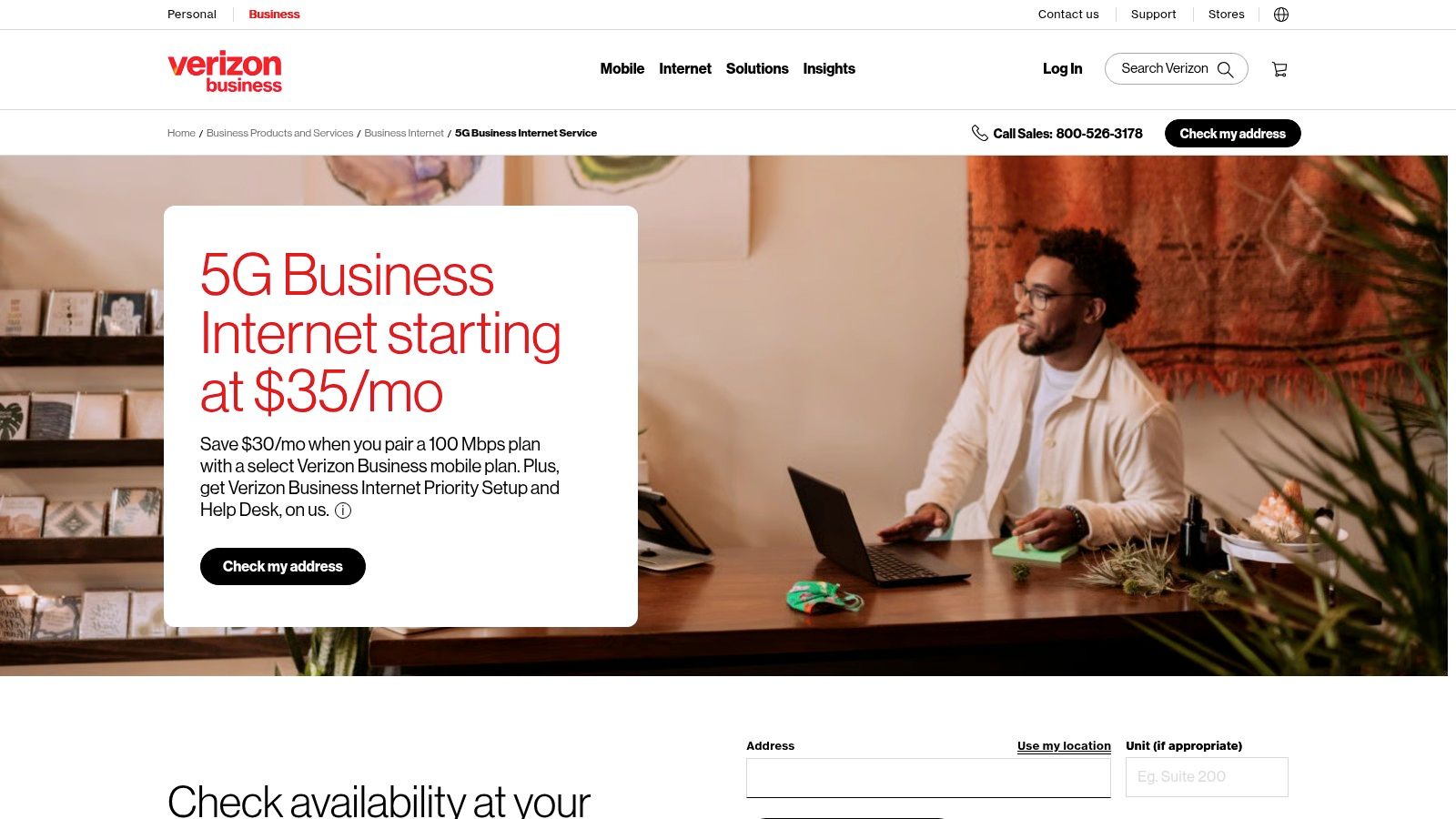
Verizon Business 5G Business Internet solves a different problem than fiber. It’s about speed of deployment, path diversity, and flexibility. For some Atlanta sites, that makes it the smartest option on the list. Not the most elegant on paper, but the smartest in practice.
If you’re opening a temporary office, adding a pop-up location, standing up a small branch quickly, or trying to protect a primary wired circuit with a second path, fixed wireless is often the fastest way to get there. It can also be a workable primary connection for lighter-duty locations that qualify well for service.
What to watch before you buy
Fixed wireless rewards good testing and punishes assumptions.
- Check the address carefully: Qualification is highly location-specific.
- Test during business hours: RF conditions can vary in ways a sales quote won’t fully show.
- Decide whether it’s primary or backup: Those are different design conversations.
This category matters because telecom has become a multi-technology ecosystem, not just cable versus fiber. The verified market data notes that 5G home internet options from T-Mobile and Verizon are adding flexibility for renters and underserved populations in the broader U.S. telecom market. That same flexibility is what makes Verizon useful for business continuity and rapid deployment scenarios.
What doesn’t work is treating 5G fixed wireless like dedicated fiber with a different box. It isn’t the same product. Throughput and latency can shift with local conditions, and that matters for voice quality, remote desktop responsiveness, and heavy cloud workflows. For many offices, though, it’s excellent as a diverse backup path.
Use Verizon 5G Business Internet when waiting on a fiber build hurts more than living with some performance variability.
That’s especially true during relocations and phased upgrades. A branch can come online quickly, then transition later if a wired service becomes available and makes more sense for the long term.
For direct product details, review Verizon Business 5G internet options.
7. GFiber Business
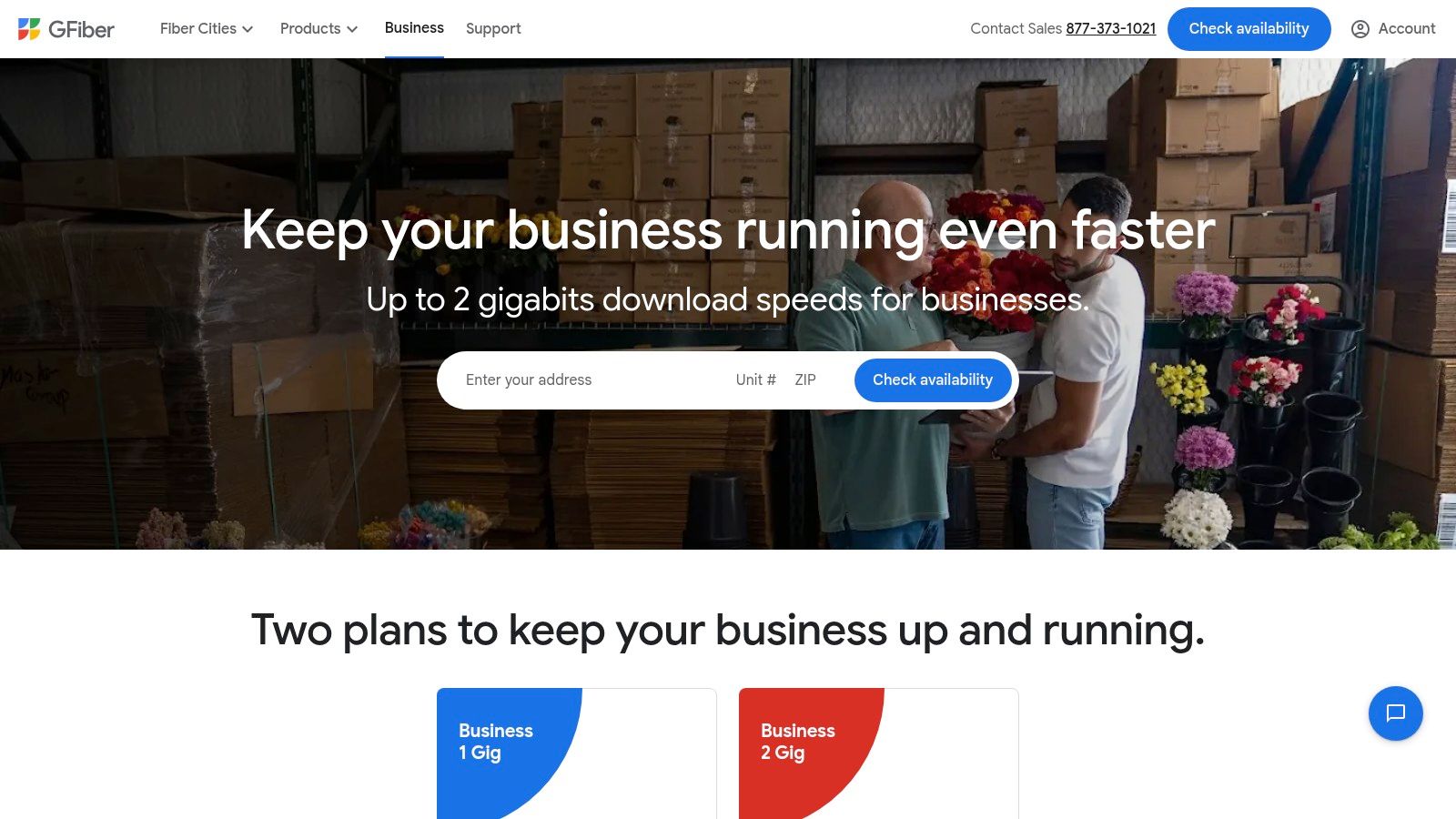
A small Atlanta team moves into a new office, orders internet, and wants three things. Fast uploads, predictable billing, and an install process that does not turn into a month-long project. GFiber Business can fit that brief well if the address qualifies.
Its value is straightforward. Symmetrical fiber helps firms that live in Google Workspace, Microsoft 365, Zoom, cloud backups, and large file transfers. The buying process is usually simpler than what many enterprise carriers require, which matters for agencies, retail operators, coworking suites, and professional offices that need reliable service without a long design cycle.
GFiber works best for businesses with standard commercial needs, not highly customized network requirements.
Where GFiber makes sense
- Creative and marketing teams: Upload-heavy work, shared assets, and frequent video meetings benefit from symmetrical speeds.
- Small professional offices: Law firms, accountants, consultants, and clinics often want stable connectivity and easier month-to-month budgeting.
- Single-site businesses: One location with a qualified address can often get what it needs without layering on enterprise-grade complexity.
- Teams replacing cable: Moving from asymmetrical service to fiber often improves day-to-day responsiveness for cloud apps and backups.
The trade-off is coverage. Address qualification decides everything, and that can rule GFiber out before pricing or features even matter. For Atlanta businesses, that means checking the exact suite and building, not just the street address. Multi-tenant buildings can produce surprises.
Support model and network design also matter. Businesses that need formal SLAs, complex failover design, deep carrier coordination, or broad multi-site contracting usually fit better with providers higher on this list. GFiber is strongest when the requirement is clear and focused. Get fast fiber in place, keep operations simple, and avoid buying more carrier structure than the site needs.
That decision has a second phase many teams miss. Upgrading to a cleaner telecom setup often leaves behind old routers, handsets, switches, access points, and modems. Those assets should not sit in a closet or go into the trash, especially if they hold data or fall under disposal requirements. For Atlanta companies, responsible telecom planning includes selecting the new circuit and setting a compliant, community-minded path for the old gear.
Review current offerings on the GFiber Business site.
Telecom Providers Near Me, 7-Point Comparison
| Provider | Implementation complexity 🔄 | Resource requirements ⚡ | Expected outcomes ⭐📊 | Ideal use cases 💡 | Key advantages |
|---|---|---|---|---|---|
| AT&T Business | Moderate 🔄, address‑dependent fiber builds possible | Moderate ⚡, standard CPE; DIA install lead times | ⭐⭐⭐⭐, high bandwidth and SLA options | Multi‑site standardization, compliance, static IP needs | Broad metro footprint; clear upgrade path to DIA |
| Comcast Business | Low–Moderate 🔄, coax quick; fiber may need construction | Low–Moderate ⚡, bundled CPE, LTE backup options | ⭐⭐⭐, reliable metro coverage; good bundled outcomes | Small businesses, bundled internet/voice/Wi‑Fi, simple failover | Extensive coverage; simple bundles & backup |
| Spectrum Enterprise (Charter) | Moderate–High 🔄, enterprise provisioning and builds | High ⚡, enterprise hardware and quoted services | ⭐⭐⭐⭐, strong SLAs and 24/7 enterprise support | Regulated industries, multi‑location DIA and cloud on‑ramps | Strong SLAs; US‑based enterprise support; cloud connect |
| Lumen Technologies | High 🔄, complex onboarding for on‑demand/wavelengths | High ⚡, high‑capacity transport and advanced CPE | ⭐⭐⭐⭐, scalable to very high capacity; rapid scale on‑net | Data centers, AI/edge workloads, large enterprise networks | Internet/Ethernet On‑Demand; wavelengths & dark fiber |
| Zayo | High 🔄, wholesale/enterprise processes; possible construction | High ⚡, dark/lit fiber, DC interconnect requirements | ⭐⭐⭐⭐, resilient routes and very high throughput | Data‑center interconnects, DR, high‑volume transport | Route diversity; DC footprint; scales to 400G/800G |
| Verizon Business (5G) | Low 🔄, rapid fixed‑wireless turn‑up (address‑qualified) | Low ⚡, portable CPE; minimal construction | ⭐⭐, fast deployment; RF‑dependent performance | Quick‑turn sites, backup/resiliency, small primary circuits | Fast deployment; price‑lock and no‑throttling on plans |
| GFiber (Google Fiber) Business | Low–Moderate 🔄, simple FTTP install where available | Low ⚡, simple CPE; flat‑rate plans | ⭐⭐⭐, symmetric speeds good for cloud/VoIP | Small offices, retail, MDUs where FTTP exists | Straightforward pricing; high upload; static IP add‑ons |
Upgrade Done Turn Old Telecom Gear into Hope with Atlanta Green Recycling
Selecting a provider is only the first half of the project. The second half is what happens to the equipment you replaced. Old routers, switches, phones, firewalls, servers, drives, access points, and cabling don’t become harmless just because they’re unplugged. They still create environmental exposure, and some of them still hold sensitive data.
That’s where Atlanta Green Recycling fits. The company helps Atlanta businesses close the loop after a telecom upgrade with secure, compliance-minded IT asset disposition services. For hospitals, schools, government agencies, offices, and data centers, that means secure data destruction, hard drive wiping to DoD sanitization standards, physical shredding for obsolete media, pickup logistics, de-installation support, and documentation that supports internal controls and audit needs.
Recycle for a Cause
Atlanta Green Recycling isn’t just another e-waste vendor. Its mission-driven position is the differentiator. The “Recycle for a Cause” message connects your retired technology to two outcomes that people remember: support for veterans and tree planting.
That matters for internal buy-in. IT leaders care about chain of custody and compliance. Executive teams and employees also care about whether a disposal partner reflects the company’s values. Messaging like “Your old tech can house a veteran and grow a forest” gives a routine disposal project a human outcome that’s easy to rally around.
A few ways this works well in practice:
- Seasonal campaigns: Veterans Day, Earth Day, and Arbor Day are natural times to run office cleanouts, surplus drives, and public-facing sustainability pushes.
- Impact visibility: Website counters, impact summaries, and post-pickup reporting help keep the mission tangible.
- Stronger internal adoption: Staff are more likely to participate in cleanup and recycling drives when the program feels meaningful.
A practical ESG and CSR partner
For Atlanta companies trying to improve ESG and CSR documentation, electronics recycling can be an easy operational win if the partner is organized enough. Atlanta Green Recycling can support corporate recycling drives, provide pickup for larger device volumes, and issue documentation that helps companies show what was processed and how the initiative supported broader sustainability goals.
The social impact angle also makes this easier to share externally. Plant-a-tree certificates, veteran support reporting, and a “Recycled with Purpose” style badge can turn a behind-the-scenes disposal job into something marketing, HR, operations, and compliance teams all care about.
The best recycling partner doesn’t just remove equipment. They make the project defensible to auditors and meaningful to people.
Built for Atlanta organizations with real compliance pressure
This matters most for regulated environments. Healthcare organizations need confidence around HIPAA-sensitive data. Government agencies and contractors care about documented chain of custody. Schools and universities often need bulk pickup, practical logistics, and clear inventory handling. Data centers need decommissioning support that respects timelines and site operations.
Atlanta Green Recycling is built around those realities. The company serves organizations across the Atlanta metro area with turnkey end-of-life management for IT assets, including server recycling, bulk equipment removal, onsite packing, and fleet-based pickup. That’s a better answer than leaving retired gear in a back room until someone “gets to it.”
If you’ve finished your telecom upgrade, don’t stop at the install. Finish the lifecycle properly. Protect the data, document the disposition, keep electronics out of the landfill, and turn the project into something that benefits both the community and the environment. That’s how an infrastructure upgrade becomes a better business decision.
If your Atlanta business is upgrading connectivity, relocating offices, decommissioning equipment, or cleaning out years of retired telecom gear, Atlanta Green Recycling can help you finish the job responsibly. Schedule a pickup, plan a compliant IT asset disposition project, or build a recycling program that supports both your operational goals and your broader community impact.