
Telecommunications Company Near Me: An Atlanta IT Guide


The search for a telecommunications company near me usually starts the same way in Atlanta. Leadership approves a telecom upgrade, someone needs better fiber or a cleaner VoIP setup, and the team opens a browser. Then the full project shows up. Old handsets are still on desks, network closets are full of retired switches, and nobody has decided who will remove, sanitize, document, and recycle the gear that the new provider is about to replace.
That’s where telecom projects often drift off course. Teams spend weeks comparing carriers, but they treat decommissioning like a cleanup task for later. In practice, it belongs in the first round of planning because it affects security, building access, user downtime, audit readiness, and how much clutter your team inherits after cutover.
In Atlanta, that matters even more in larger offices, healthcare sites, schools, warehouses, and multi-location organizations where telecom isn’t just internet service. It’s cabling, demarc extensions, routers, firewalls, handsets, conference room hardware, backup circuits, and often a stack of legacy devices that still hold data or configuration details.
Useful planning starts with the full lifecycle. If your team is evaluating new connectivity, it also helps to review outside resources on telecom infrastructure solutions alongside your own resiliency planning, especially if your organization already maintains a formal disaster recovery planning framework.

A strong upgrade does two jobs at once. It gets the new service live, and it closes out the old environment in a way that protects data, satisfies compliance, and gives the company something useful to report in its CSR and ESG work. Old telecom gear doesn’t have to end as a storage-room problem. Managed properly, it becomes part of a cleaner operational story.
Introduction
If you're searching telecommunications company near me from an Atlanta office, you're probably not browsing casually. A move, contract expiration, bandwidth issue, phone system replacement, or cloud migration has forced the decision. The urgency is usually real, and so is the temptation to pick the first provider whose rep returns the call fastest.
That’s understandable, but it creates a blind spot. The service order is only half the project. The other half is what happens to the equipment and infrastructure being replaced. I’ve seen otherwise solid telecom upgrades get messy because nobody owned the old phones, unused circuits, racks of aging network gear, or the documentation needed after removal.
Practical rule: Treat a telecom upgrade as a procurement project and a disposition project at the same time.
That shift changes the quality of decisions you make. Instead of asking only, “Who has the best monthly rate?” you ask better questions. Which provider can install cleanly in this building? What has to stay live during cutover? Which devices need secure data destruction? Who tracks chain of custody once the old environment comes out?
Atlanta businesses also have a local reputation to manage. A rushed migration that leaves retired gear in closets or sends equipment to an unknown hauler creates avoidable risk. A disciplined migration creates a cleaner facility, better records, and a stronger internal story for leadership.
Map Your Needs Before You Search Atlanta Telecom
The fastest way to waste time is to search telecommunications company near me before you've mapped what the business needs. Sales reps are good at filling in blanks for you. That sounds helpful until you realize every proposal is built around the provider’s preferred package, not your operating requirements.
Start with your own internal audit. The telecom industry operates at enormous scale. Giants such as Verizon at $134 billion in revenue and AT&T at $122.4 billion in revenue manage infrastructure supporting over 400 million U.S. smartphone users, which underscores how much equipment gets deployed and retired across the sector, and why upgrades create real e-waste obligations for local businesses too, as noted by telecommunications industry statistics.
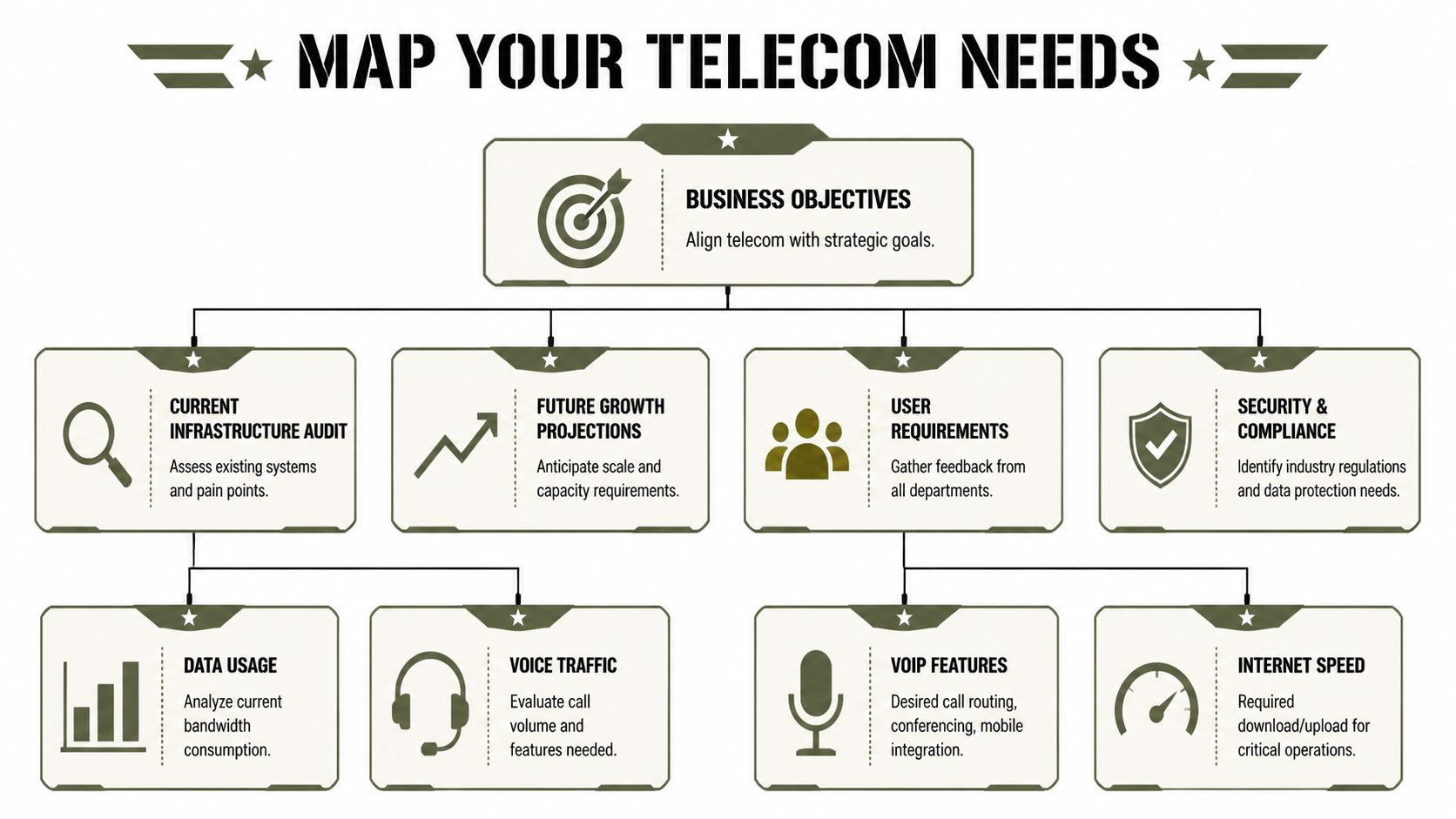
Audit what you have, not what you think you have
Most organizations have more telecom complexity than the inventory suggests. There may be active circuits nobody uses, handsets assigned to former staff, analog lines tucked into elevators or alarms, and network hardware that stayed in production because “it still works.”
A practical audit should include:
- Internet and WAN services: List current carriers, contract dates, service addresses, demarc locations, and any known chronic issues.
- Voice environment: Capture handset counts, call flows, auto attendants, fax dependencies, call recording, and any contact center needs.
- On-site hardware: Document routers, switches, firewalls, PBX components, access points, UPS units, racks, and structured cabling notes.
- Business dependencies: Note which departments cannot tolerate downtime, and which applications fail first when network performance drops.
If you need a tighter process for inventory discipline before procurement, align this work with established IT asset management best practices.
Define future state requirements
A lot of bad telecom buying starts with a backward-looking question. “What do we have now?” matters, but the better question is, “What will this environment need to support after the next change?”
Use these prompts:
| Area | What to define internally |
|---|---|
| Connectivity | Core bandwidth needs, remote office support, cloud application sensitivity, guest network demands |
| Voice and collaboration | VoIP, UCaaS, mobile app use, call queueing, voicemail handling, conference room integration |
| Resilience | Primary and backup circuits, failover expectations, after-hours support, acceptable outage windows |
| Compliance | Data handling requirements, logging expectations, secure disposal obligations for retired gear |
Build an RFP that forces apples-to-apples comparison
Without a structured request, providers answer different questions and every quote looks cheaper than it really is. Your RFP doesn’t need legal drama. It needs clarity.
Include site details, required installation timeline, handoff expectations, support hours, escalation path, service credits, and building constraints. If your office tower has difficult riser access or strict management rules, say so up front. If your healthcare clinic still has legacy voice dependencies, state that plainly. Hidden complexity doesn't disappear. It just shows up later as change orders, delays, or finger-pointing.
A useful RFP makes the provider prove fit. It doesn't ask the buyer to infer it from marketing language.
How to Vet a Local Telecommunications Company
Once your requirements are clear, the search for a telecommunications company near me becomes much more disciplined. You’re no longer shopping by headline speed claims. You’re testing whether a provider can deliver in your building, support your users, and coordinate well with your internal team during migration.
That matters because telecom upgrades fail for organizational reasons as much as technical ones. Over 70% of digital transformation projects fail to meet their objectives, often because commitment is incomplete and vendors aren’t aligned. TM Forum also points to the value of a central control tower for real-time monitoring and data-driven decisions during complex transformations, as discussed in five pitfalls that sabotage telco transformations.

Look beyond the website
Provider websites tend to flatten important differences. Every carrier says it offers responsive service, reliable connectivity, and business-grade solutions. The useful details are local.
Check whether the provider has technicians who routinely work in your part of metro Atlanta. Ask whether they’ve installed in your building or campus before. Confirm how they handle property management coordination, inside wiring responsibility, and after-hours cutovers. If they outsource major parts of implementation, ask who owns mistakes when scheduling slips.
For teams comparing service providers and downstream removal partners in the same initiative, it also helps to understand the broader field of IT asset disposition companies before you finalize responsibilities.
Read SLAs like an operator, not a buyer
A service-level agreement can look reassuring and still leave you exposed. The key is translating telecom terms into business impact.
To put it in simple terms:
- Uptime language: Ask what happens operationally when service fails, not just what the credit policy says.
- Dedicated versus shared service: Ask whether bandwidth performance changes during peak demand and how contention is handled.
- Mean time to repair: Ask who is dispatched locally, what the escalation ladder looks like, and how after-hours incidents are staffed.
- Support model: Ask whether your account team stays involved after installation or disappears once billing begins.
Use a checklist in every provider interview
Different stakeholders hear different promises. Standardize your questions so every provider answers the same set.
Evaluation checklist
- Local building experience: Have you installed service in this building type or nearby facilities with similar constraints?
- Escalation ownership: Who owns the ticket when service is down at 7 a.m. on a Monday?
- Cutover planning: What does your migration runbook include, and who validates service before the old carrier is disconnected?
- Industry references: Can you provide references from organizations with similar compliance or uptime needs?
- Hardware responsibilities: Which devices are provider-managed, which are customer-owned, and who removes replaced equipment?
- Support continuity: Will the same implementation contacts stay available through post-install stabilization?
The best providers answer cleanly. The weaker ones pivot back to promotions, bundle pricing, or vague confidence. That usually tells you enough.
The Critical Step After You Choose Your Telecom Provider
The project isn’t over when the new circuit tests clean and users can make calls. It isn't even close. The point where many teams relax is exactly where security, compliance, and sustainability risk starts to concentrate.
There’s a real content gap here. Businesses can find endless pages about bundled internet and phone service, but very little guidance explains how to document e-waste processing for ESG audits when old servers, phones, networking hardware, and cabling come out of service, as highlighted in this analysis of the corporate sustainability content gap around telecom transitions.
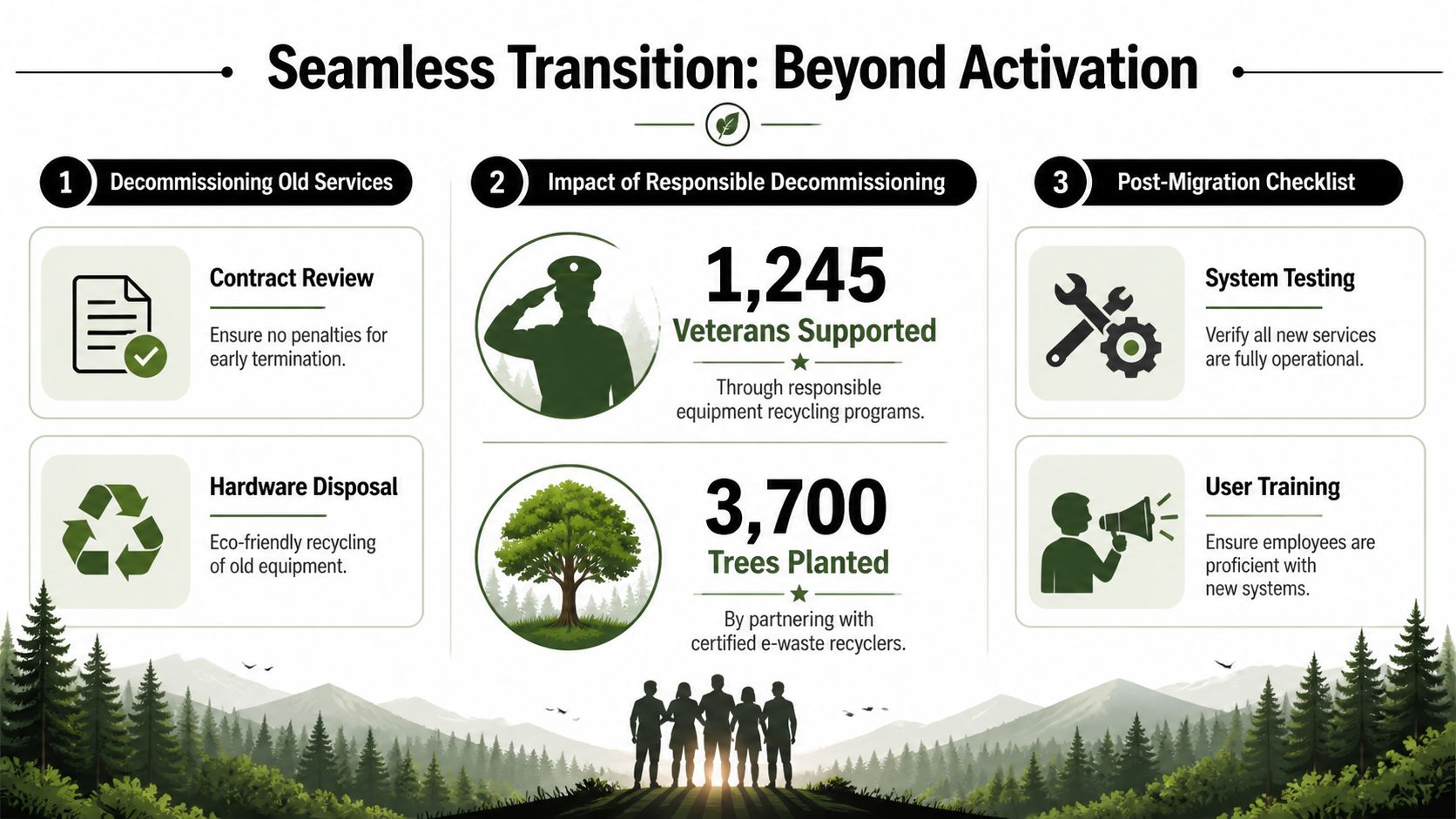
Decommissioning is a separate workstream
Retired telecom gear creates three immediate issues.
First, some devices contain data or configuration details. Firewalls, unified communications appliances, voicemail hardware, and certain network devices may hold credentials, logs, phone directories, or stored settings. That means retirement requires secure sanitization, not casual disposal.
Second, old equipment clogs operations. I’ve seen network closets where active and retired gear sat side by side for months because nobody wanted to risk unplugging the wrong unit. That confusion slows troubleshooting and complicates future audits.
Third, disposal now affects corporate reporting. Leadership teams increasingly want documentation that shows what was removed, how it was handled, and whether the process supports broader sustainability goals. For regulated organizations, a formal certificate of destruction often becomes part of the records package.
What a qualified recycling and ITAD partner should provide
You don't want a junk hauler for this part of the project. You want a partner that can handle chain of custody, secure destruction, logistics, and reporting.
Ask for these items:
- Secure data destruction: Confirm the partner can wipe drives to DoD sanitization standards or physically shred media when appropriate.
- Serialized tracking: Make sure devices and media can be tracked from pickup through processing.
- Onsite de-installation support: If racks, handsets, switches, and cabling need to be removed from production spaces, that should be planned, not improvised.
- Documentation for audits: The handoff should produce usable records, not just a pickup receipt.
- Environmental accountability: Ask how downstream processing is managed and documented.
When the recycler can’t explain chain of custody in plain language, stop the conversation there.
Turn a cleanup task into a CSR asset
A routine telecom upgrade can become more valuable internally. Decommissioning doesn't have to end with “disposed responsibly.” It can support a broader cause-based message that employees, leadership, and customers can understand.
A useful framework is a Recycle for a Cause model. The message is simple: your old tech can support veteran aid and tree planting. That gives the business a concrete narrative for sustainability and community impact without dressing up a compliance task as marketing fluff.
Here’s what works well in practice:
- Impact reporting: Ask whether your recycling partner can provide veteran support impact reports and tree-planting documentation for CSR files.
- Digital recognition: A badge such as Recycled with Purpose gives marketing and sustainability teams something legitimate to display on websites or reports.
- Seasonal campaigns: Telecom upgrades and office cleanouts often cluster around calendar deadlines. Tying recycling drives to Veterans Day, Earth Day, or Arbor Day gives the company a stronger reason to communicate the effort.
- Employee engagement: Internal campaigns land better when staff understand that retired office tech isn’t just leaving the building. It’s being handled securely and connected to a community outcome.
The image above includes the figures 1,245 veterans supported and 3,700 trees planted because those are part of the publisher’s stated impact positioning. In the project workflow, the key is to insist on documentation, not slogans. If a partner promises social impact, ask how they verify it and how your team can use it in audit and CSR materials.
Budgeting for the Full Telecom Lifecycle and Spotting Red Flags
A telecom proposal can look affordable right up until implementation starts. Monthly recurring cost gets all the attention because it’s easy to compare. The expensive surprises live elsewhere.
That’s why I push teams to budget the full lifecycle. Improper telecom audits can lead to 20 to 30% in unnecessary expenses, ignoring legacy workflows is a pitfall in 60% of projects, and many teams benefit from a 10 to 20% risk buffer for delays and related issues, according to the review of telecom problems for businesses.

Budget for more than service
A realistic telecom budget should include costs that never show up in the ad copy.
Consider these categories:
- One-time implementation costs: Installation, project management, porting, and onsite labor.
- Building-related work: Inside wiring, riser work, conduit access, landlord coordination, and any required construction.
- Parallel run period: Temporary overlap where old and new services stay active during testing.
- User transition costs: Training, support tickets, headset swaps, handset replacement, and conference room changes.
- End-of-life handling: De-installation, packing, secure destruction, and compliant recycling of retired equipment.
If your organization has a large site or multiple offices, this end-of-life line item shouldn't be an afterthought. Build it into the approval request from the start so procurement doesn't treat it like an unplanned extra later.
Watch for these red flags during sales and disposal review
Cheap telecom deals and careless disposal vendors often use the same tactic. They hide complexity until you’re committed.
Warning sign: If the quote feels simple but your environment isn't, the missing detail is probably where the future cost sits.
Telecom provider red flags
- Vague SLA language: Credits are defined, but response ownership and restoration process are murky.
- Pressure to sign fast: The rep pushes urgency before conducting a real site review.
- No clear migration runbook: They describe the outcome, not the steps.
- Unclear hardware boundaries: You can’t tell what they manage, what you own, and who removes replaced equipment.
- No building-specific validation: They talk about service availability in the area but not your actual suite, floor, or facility constraints.
Recycler or ITAD red flags
- No chain of custody explanation: They can pick up equipment, but they can’t explain tracking and accountability.
- No formal destruction documentation: They promise secure handling but offer weak paperwork.
- Generic disposal language: They say “eco-friendly” without describing actual process controls.
- No experience with de-installation: They’re comfortable hauling pallets, but not removing equipment from active business spaces.
- No local coordination discipline: They can’t describe arrival windows, access procedures, or onsite point-of-contact requirements.
For companies planning larger removals in metro Atlanta, it helps to review local IT asset disposition in Atlanta GA as part of budgeting and vendor scoping, especially when telecom retirement overlaps with office moves, data closet cleanouts, or infrastructure refresh cycles.
Conclusion Your Holistic Atlanta Telecom Strategy
A smart search for telecommunications company near me starts with service, but it shouldn’t end there. The strongest Atlanta telecom projects come from teams that define requirements clearly, vet providers with discipline, and treat migration as an operational process instead of a sales event.
That mindset changes outcomes. You get cleaner proposals because providers respond to a real requirement set. You get fewer surprises because budget planning includes installation realities, user transition costs, and the retirement of old infrastructure. You also reduce the chance that retired hardware sits in a closet for months, creating confusion and compliance risk.
The final piece is the one teams often skip. Responsible decommissioning gives the project a proper finish. It protects data, supports audit readiness, and gives leadership something better than a line item saying the old gear was removed. Done well, it also supports a stronger CSR and ESG story by tying secure recycling to documented community impact.
Atlanta organizations don’t need to choose between operational discipline and public-facing values. A well-run telecom transition can deliver both. The right provider gets your new environment online. The right disposition process makes sure the old one leaves the business securely, responsibly, and with a result your company can stand behind.
If your Atlanta team is planning a telecom upgrade, office move, data closet cleanup, or full infrastructure refresh, Atlanta Green Recycling can help close the loop with secure IT asset disposition, compliant electronics recycling, data destruction, and documentation that supports both audit requirements and CSR reporting.