
7 Top Telecom Providers Near Me in Atlanta (2026)


Your office internet drops twice during a client call. Voice quality breaks up, the VPN slows to a crawl, and the meeting ends with your team promising a follow-up instead of closing the issue. That is usually the point where Atlanta operations leaders start searching for telecom providers near me.
The hard part is not finding providers. It is separating business-grade service from consumer marketing. Many carrier pages push headline speeds, but speed alone does not tell you whether the circuit comes with a meaningful SLA, static IPs, usable support after hours, clear install commitments, or a realistic failover path if the primary line goes down.
Atlanta gives buyers plenty of options. National carriers, cable providers, enterprise fiber operators, and 5G fixed wireless services all compete here, often on the same block. A Midtown law firm, an airport-area warehouse, a Decatur clinic, and an Alpharetta company moving large files will not have the same risk tolerance, traffic profile, or compliance requirements, so they should not buy connectivity the same way.
The market is also shifting in ways that affect local buying decisions. According to the GSMA mobile economy research, 5G adoption continues to expand globally, which helps explain why wireless backup and fixed wireless internet now show up in more business telecom evaluations. But address-level serviceability still decides the shortlist. A provider can look strong on paper and still fail your building on construction cost, port availability, or install timing.
That is why this guide focuses on the details that affect uptime, security, and total contract value. If you are replacing circuits, phones, firewalls, or network gear during the change, plan the retirement side too. Responsible IT equipment disposal for companies in Atlanta keeps old hardware out of storage closets and can support a local cause at the same time.
If you're also reviewing firewalls, segmentation, and managed access during a carrier change, Splash Access network security insights are worth a look.
1. AT&T Business
A common Atlanta scenario is a company outgrowing basic internet after one outage, one phone cutover problem, or one failed cloud backup window. AT&T Business usually makes the shortlist in that situation because its wireline, fiber, voice, wireless, and managed network services are sold as one business portfolio through AT&T Business.
That matters for companies that care about more than monthly price. If procurement wants one master agreement, legal wants clearer accountability, and IT wants internet, voice, and backup connectivity that can be managed together, AT&T is often easier to buy than stitching together three separate vendors.
Where AT&T works best
AT&T is a practical fit for multi-site offices, healthcare groups, legal firms, and any business that expects network needs to grow during the contract term. A site might start with business fiber, then add DIA, mobility backup, SD-WAN, or managed security later without replacing the carrier relationship. That can reduce change management pain, but only if the initial contract leaves room for upgrades without expensive resets.
The trade-offs are real. Serviceability is still building-specific, especially in older office stock and multi-tenant properties where fiber access, riser rights, or construction approval can slow an order. AT&T can also feel slower to scope and price than SMB-first providers because higher-grade circuits, SLA terms, and install requirements often move through a custom quote process.
Buyers should press on the details that affect uptime and budget.
- Best fit: Multi-site businesses, regulated organizations, and teams that want one provider for connectivity, voice, and wireless backup.
- Watch closely: SLA terms, install intervals, construction charges, contract minimums, and whether the quote is shared business fiber or true dedicated internet access.
- Smart question to ask: What credits apply if latency, packet loss, or time-to-repair targets are missed?
- Good add-on strategy: Price wireless failover for sites where even a short circuit outage creates revenue loss or compliance risk.
A simple rule helps avoid bad comparisons. If a quote says "fiber," ask whether it includes dedicated bandwidth, defined repair targets, and written SLA language. Shared fiber broadband and DIA solve different problems and should not be judged by the same price-per-megabit math.
Carrier changes also tend to expose another neglected issue: old hardware. If an AT&T install replaces routers, switches, phones, drives, or firewall appliances, pair the project with secure business electronics disposal in Atlanta so retired gear leaves the office securely and supports a responsible local outcome instead of sitting in storage.
2. Comcast Business
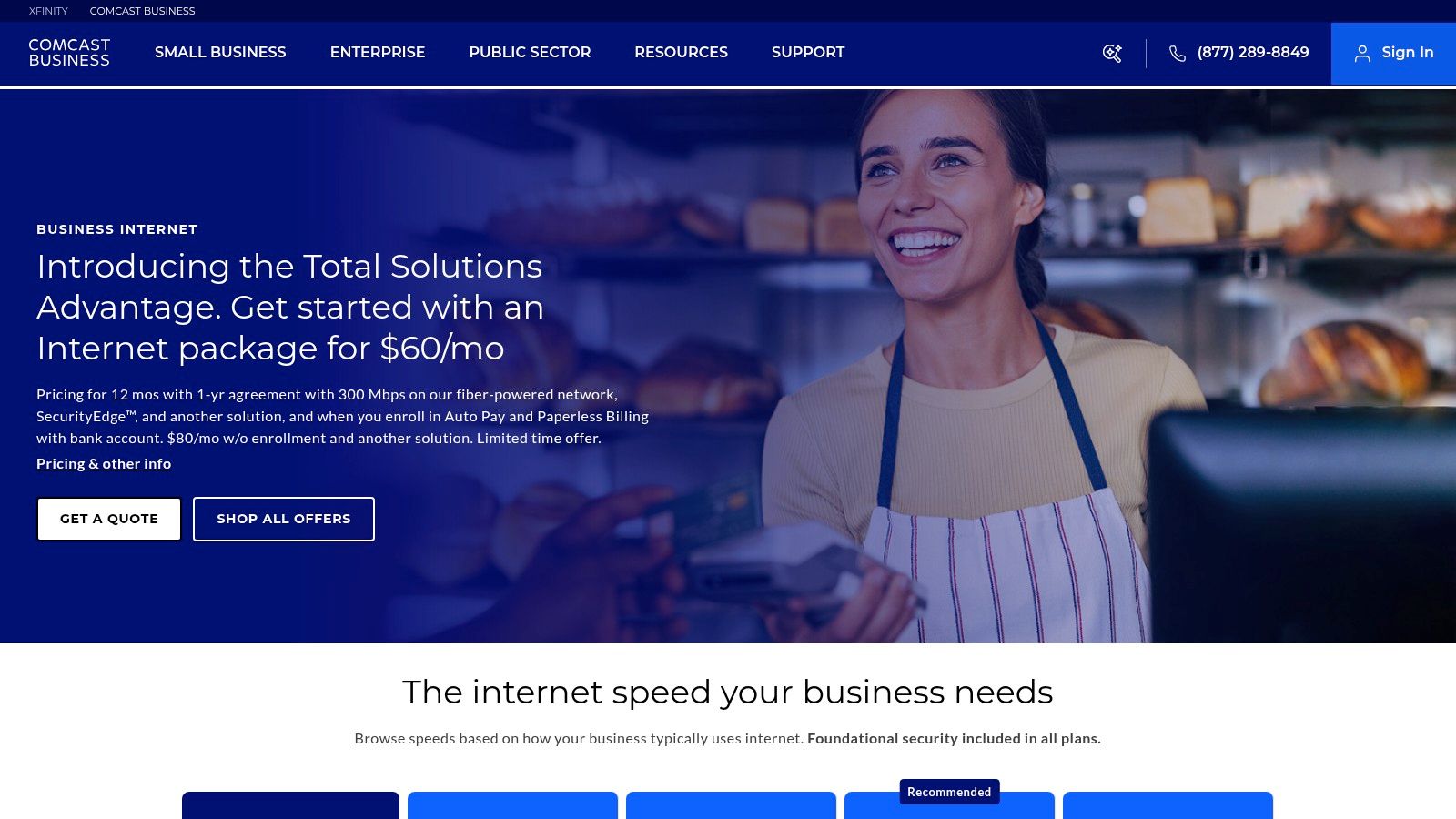
If speed to install matters, Comcast Business is often the practical answer. In many Atlanta office buildings, coax-based business internet can go live faster than a new fiber build, which makes Comcast a strong option for relocations, short lease terms, and companies that need service now and optimization later.
This is also one of the easier providers to use when you want a phased network plan. Start with cable-based business internet, then move up to fiber DIA or Ethernet as the site grows, the budget expands, or application demands become less forgiving.
The real trade-off with Comcast
The upside is broad metro reach and a broad menu. The downside is that cable-based tiers can have lower or more variable upload behavior than fiber, which matters if your office leans hard on cloud backups, large file sync, hosted phones, or outbound video. That doesn’t make Comcast a bad choice. It means you should buy it for the right workload.
Comcast Business is also appealing for companies that want simplified bundles. Managed security options and term-based structures can be easier for office managers to evaluate than fully custom enterprise telecom proposals.
- Best fit: Small and midsize offices, professional services firms, retail sites, and branch locations that need reliable business internet without waiting on major construction.
- Best question to ask sales: What are the upload expectations on this exact service tier, and what is the upgrade path to dedicated fiber at this address?
- Potential miss: Data-heavy creative teams and backup-intensive environments may outgrow coax faster than they expect.
A fast download number doesn't fix weak upload performance. For VoIP, cloud storage, and camera exports, upload capacity changes day-to-day user experience.
When old cable modems, access points, desktop gear, and retired phones come out during the cutover, route them into a documented disposal process through secure business electronics disposal in Atlanta.
See service options and address qualification at Comcast Business.
3. Google Fiber for Business
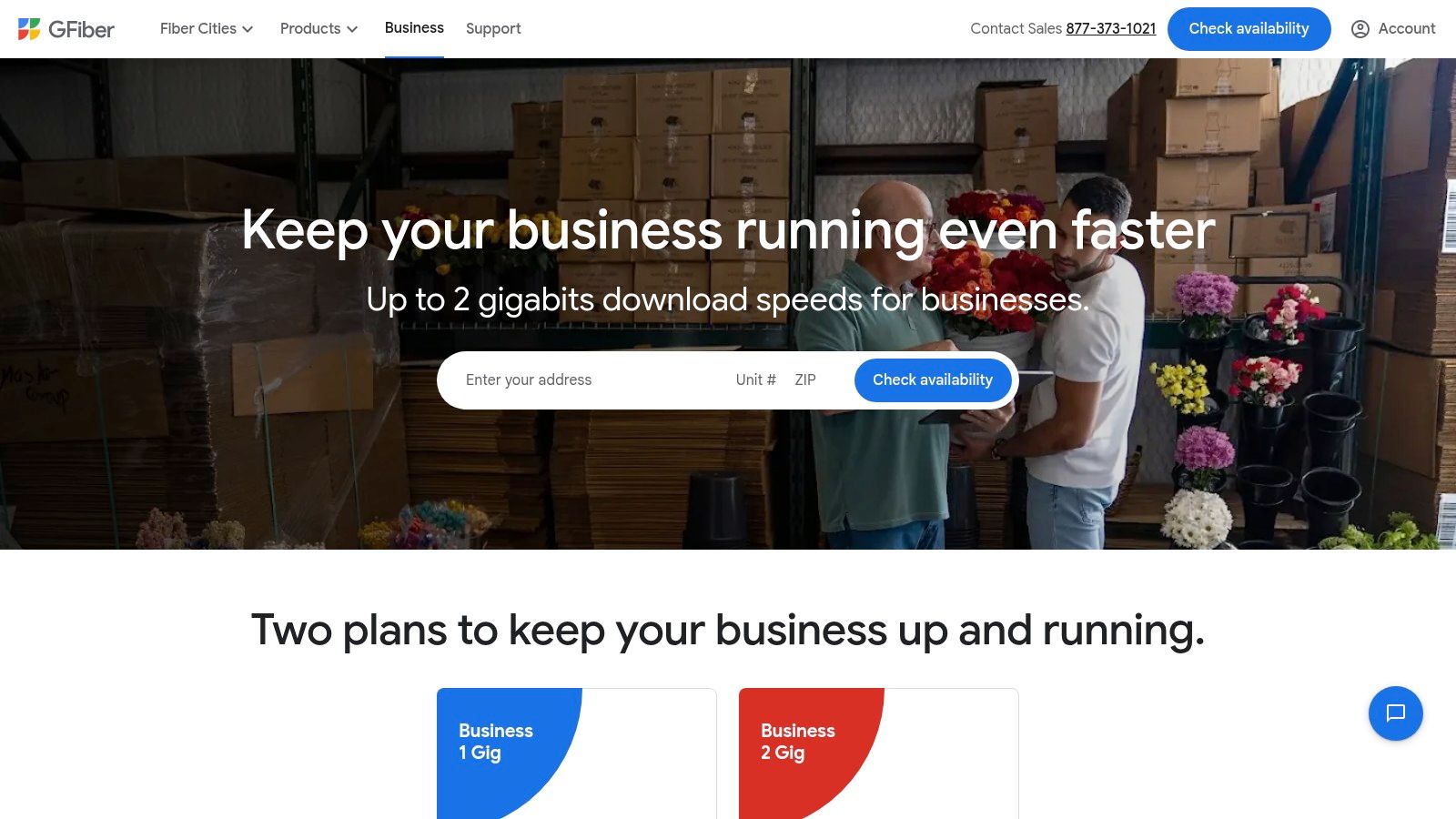
Google Fiber for Business appeals to Atlanta SMBs for one reason above all others. It cuts down friction. If you’re tired of long quote cycles, complicated bundles, and unclear service packaging, Google Fiber is one of the cleaner business internet buys when your address qualifies.
The value isn't just speed. Symmetrical service is a serious advantage for teams using Microsoft 365, Google Workspace, cloud file sync, hosted phones, offsite backup, and constant video meetings. Offices feel that difference more in uploads and latency consistency than in headline marketing claims.
Why SMB teams like it
Google Fiber for Business is straightforward. Professional installation is part of the appeal, and included network equipment can reduce the amount of hardware you need to source on day one. Some businesses will still prefer to layer their own firewall, switching, and Wi-Fi design on top, but for smaller offices, simple is useful.
The limitation is portfolio depth. If you need carrier-managed SD-WAN, broader voice integration, cellular backup from the same vendor, or highly customized enterprise contracting, Google Fiber won't match the incumbents and enterprise carriers.
That doesn't make it a weak option. It makes it a focused one.
- Best fit: Small offices, startups, agencies, and satellite locations that want strong symmetrical performance without enterprise complexity.
- Less ideal for: Heavily regulated environments that want one provider for internet, voice, WAN, and managed security under a single procurement path.
- Buying advice: Confirm static IP eligibility and ask what support looks like if your office has after-hours operational needs.
Google Fiber is often the easiest recommendation when an Atlanta business asks for a clean answer to “telecom providers near me” and doesn't need a large enterprise wrapper. If your office qualifies, it's one of the least painful ways to get high-quality fiber into a business location.
Check serviceability and business plans at Google Fiber for Business.
4. Lumen Technologies

Lumen is for companies whose connectivity decisions tie directly to infrastructure strategy. If your applications live across clouds, your traffic moves into data centers, or your compliance posture requires stronger control over WAN architecture, Lumen deserves a serious look.
This is not the provider I’d call first for a ten-person office that just needs basic internet next week. It is the provider I’d call when the network is part of a broader architecture decision involving colocation, interconnection, cloud access, transport, or edge presence in Atlanta.
Strong choice for enterprise traffic patterns
Lumen’s appeal is in enterprise-grade services. Dedicated internet, Ethernet, transport, cloud connectivity, and related infrastructure services can support environments where application performance, path design, and resiliency have board-level impact. Atlanta businesses with data-center adjacency or multi-cloud requirements often fit here.
The drawback is procurement speed. Lumen solutions are usually custom-quoted and require a buyer who knows what they’re asking for. Office managers looking for a standard package may find that process heavy.
Buy Lumen when your network design starts with application flows and compliance requirements, not when your only question is “what's the cheapest gigabit plan?”
A practical buying test is simple. If your team is discussing BGP, cloud on-ramps, path diversity, or transport into regional facilities, Lumen is in the conversation. If your team is comparing simple small-office internet packages, it probably isn’t the first fit.
For organizations retiring cages, racks, servers, optics, and network appliances as part of a telecom redesign, pair the cutover with data center equipment recycling in Atlanta.
Review enterprise services at Lumen Technologies.
5. Windstream Enterprise
Windstream Enterprise tends to make sense when one location isn't the whole story. If you’re managing branch offices, clinics, warehouses, or distributed teams around metro Atlanta and beyond, the value is less about a single access circuit and more about how the provider assembles a full WAN.
That matters because local availability is often uneven. The best multi-site provider isn't always the one with perfect fiber at every address. It's the one that can standardize policy while mixing different underlays where needed.
Why hybrid WAN buyers look here
Windstream Enterprise has a solid reputation for managed SD-WAN, SASE-oriented approaches, dedicated internet, Ethernet, and multiple access methods. That’s useful when some sites can get fiber, others need broadband, and a few need fixed wireless backup. For IT teams trying to enforce consistent security and application policy across messy real estate, that flexibility helps.
The trade-off is complexity in both pricing and rollout. Local loop costs, partner involvement, and build complexity can all shape the final proposal. Customer experience can also vary more when several access paths and local partners are involved.
- Best fit: Healthcare groups, regional businesses, finance offices, and organizations with many sites and centralized IT policy.
- Where it stands out: Hybrid WAN design, managed deployment support, and resilience planning when every site can't get the same circuit type.
- Where to be careful: Ask who owns support for each layer. Managed overlay, local access, and on-site dispatch can involve different parties.
Windstream is rarely the flashiest answer in a telecom providers near me search. It is often one of the more practical answers for distributed business networks that need managed consistency more than a pretty pricing page.
See its enterprise networking offerings at Windstream Enterprise.
6. Verizon Business 5G Business Internet
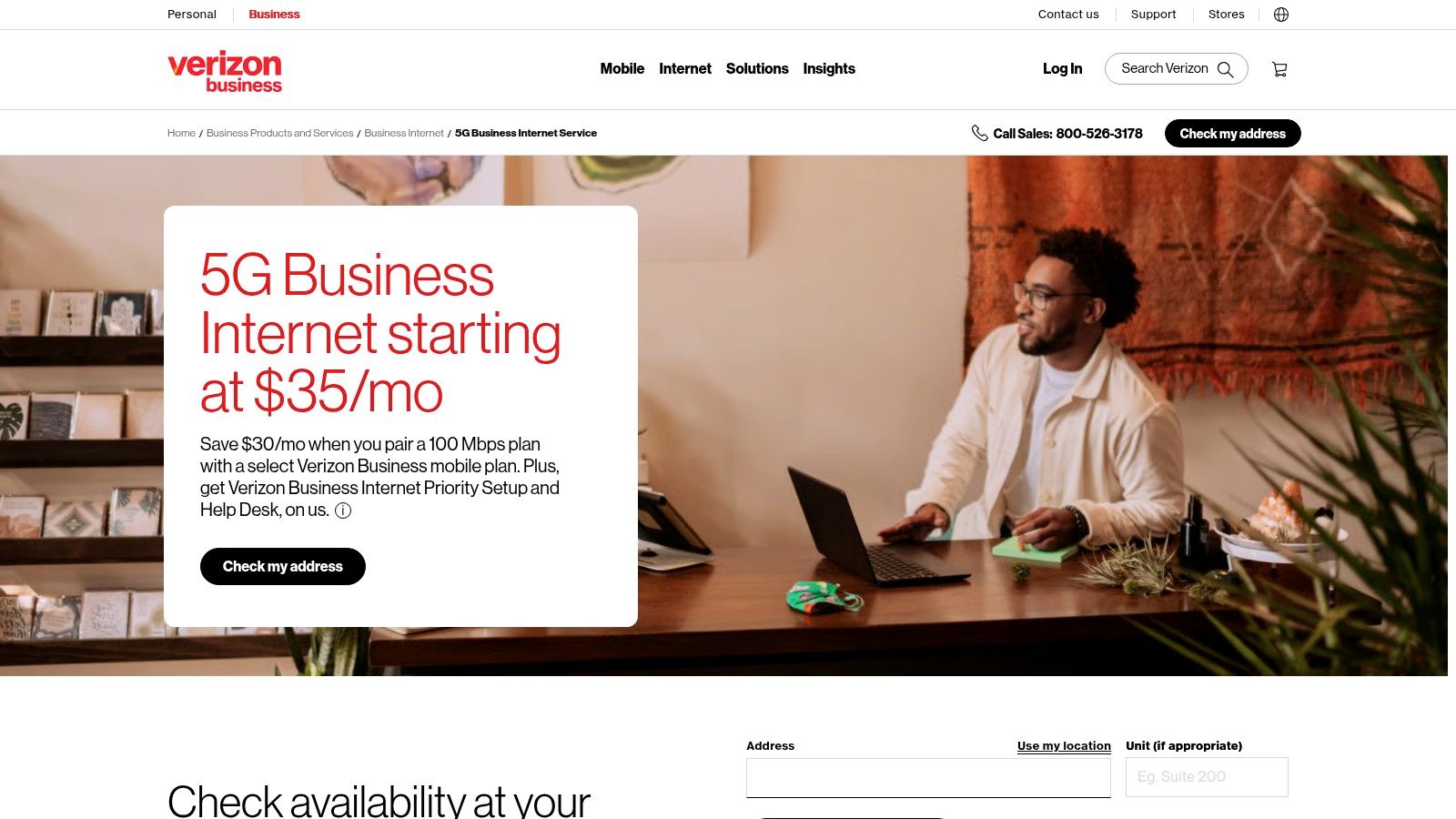
A branch office lease is signed, the staff starts next week, and the fiber install date is still a month out. That is the kind of situation where Verizon Business 5G Business Internet earns its place on a short list.
The value is speed to deployment and path diversity. Fixed wireless can get a site online without waiting for trenching, landlord approvals, or a second wired circuit from the same local plant. Ookla’s analysis of U.S. 5G performance shows Verizon can deliver strong download speeds and low latency in the right coverage conditions, which helps explain why fixed wireless now works for more than temporary connectivity in some business settings (Ookla 5G performance analysis).
The catch is consistency. Performance depends on signal quality, building materials, nearby tower load, and even where the receiver is mounted. I treat 5G as a site survey decision, not a paper exercise.
For many businesses, the smartest use is business continuity. Pair it with fiber or cable, test failover, and confirm whether your firewall, voice platform, VPN, and cloud apps behave well during a circuit switch. Ask Verizon about service expectations, equipment management, and how support works if the issue is signal related versus router related. Those details matter more than the headline speed.
- Best fit: New locations, temporary offices, retail sites, construction trailers, and small branches that need quick turn-up.
- Strongest business case: Secondary WAN for continuity and faster opening timelines.
- Watch closely: Signal testing, CGNAT or public IP needs, security policy alignment, and contract terms if you plan to use it as a primary link.
There is also a practical end-of-life angle here. If a Verizon rollout lets you retire aging branch gear, plan secure disposal at the same time. Teams replacing racks, servers, or network hardware should review Atlanta data center recycling and disposition options so the upgrade also closes out the old equipment responsibly.
Check availability at Verizon Business 5G Business Internet.
7. Zayo

A business signs a lease, orders internet, and then realizes the requirement is far beyond office connectivity. The team needs diverse fiber paths to a data center, low-latency links between sites, or capacity for replication and large media transfers. That is the point where Zayo enters the conversation.
Zayo fits companies that buy transport with a network engineer, infrastructure manager, or IT director at the table. Its value is not simplicity. Its value is control. Dark fiber, private fiber, wavelength services, Ethernet, and dedicated internet make sense when the business has clear performance targets, redundancy requirements, and a plan for how traffic will move between offices, cloud environments, and facilities.
The trade-off is time and complexity. A Zayo project can involve construction reviews, building access questions, laterals, cross-connect coordination, and handoff planning inside the suite, meet-me room, or cage. That can produce a better long-term result, but it usually requires more patience and more internal coordination than a standard business internet install.
This also changes how you evaluate the deal. Check the SLA in detail. Review repair commitments, escalation paths, diversity language, and what happens if the route you expected is not physically available at the building. Security matters too. Confirm who manages the demarc, how access to fiber handoff points is controlled, and whether your team or a managed partner will monitor the circuit after turn-up. Those details affect downtime risk and operating cost more than a headline speed figure.
Atlanta businesses with data center presence should pay especially close attention here. Zayo is often strongest where network architecture and facility strategy overlap, particularly for firms connecting offices to colocation space or linking multiple environments with private transport. If a migration or carrier change also means retiring old switches, optics, appliances, or rack hardware, pair the rollout with Atlanta data center decommissioning support so the upgrade closes the loop on equipment disposal responsibly.
- Best fit: Data centers, high-growth SaaS firms, media and engineering workloads, and enterprises that need private transport or high-capacity fiber.
- Strongest business case: Custom network design, low-latency interconnection, and circuits where SLA terms and path options matter as much as bandwidth.
- Watch closely: Construction timelines, cross-connect fees, diversity assumptions, contract length, and who owns monitoring and incident response after install.
Explore carrier and fiber options at Zayo.
Top 7 Business Telecom Providers Comparison
| Provider | Implementation Complexity 🔄 | Resource Requirements ⚡ | Expected Outcomes 📊⭐ | Ideal Use Cases 💡 | Key Advantages ⭐ |
|---|---|---|---|---|---|
| AT&T Business | Medium, address-specific quoting, multi-service integration | Medium–High, fiber/DIA provisioning, SD‑WAN/voice add‑ons | Reliable symmetrical speeds, strong SLAs for compliance | Multi-site enterprises, regulated industries | Broad portfolio (fiber, DIA, SD‑WAN), local support |
| Comcast Business | Low–Medium, fast coax installs; higher for fiber/DIA | Medium, coax for quick installs; fiber for DIA | Fast turn-up on cable, upgrade path to DIA/Ethernet | SMBs needing quick installs or bundled security | Extensive local footprint, price‑lock options |
| Google Fiber for Business | Low, simple plans and included professional install | Low–Medium, fiber availability varies by address | Transparent pricing, symmetrical gigabit speeds | Small–medium offices needing straightforward service | Clear pricing, included equipment, strong symmetrical performance |
| Lumen Technologies | High, custom quotes, complex enterprise integrations | High, data‑center interconnects, colocation and transport | Enterprise‑grade connectivity, multi‑cloud interconnect | Data‑center bound traffic, large/regulatory workloads | Deep interconnection, edge/colocation services |
| Windstream Enterprise | Medium–High, white‑glove implementations for multi‑site | Medium, managed SD‑WAN, multiple underlays (fiber/fixed wireless) | Resilient hybrid WANs with managed security overlays | Multi‑location networks requiring managed services | Flexible underlays, strong SD‑WAN/SASE offerings |
| Verizon Business – 5G Business Internet | Low, rapid turn‑up, minimal construction | Low, fixed‑wireless CPE; dependent on signal quality | Quick deployment; good backup/redundant path | Temporary sites, rapid office turn‑up, failover links | Fast deployment, transparent pricing where coverage exists |
| Zayo | High, dark fiber builds and contract lead times | Very High, dark fiber, wavelength and long‑haul transport | Ultra‑high bandwidth, low latency, direct peering | Data centers, high‑bandwidth enterprises, carriers | Dark fiber/wavelength options, dense metro/data‑center footprint |
Upgrade Complete Now Recycle Your Old Tech for a Cause
The new circuit is live, phones are cut over, and the failover test passes. Then the old gear ends up in a closet.
That last step deserves the same attention as the provider selection. Retired routers, firewalls, switches, access points, phones, servers, and storage still carry business risk. Some hold data. Some contain client or employee information in logs, configs, or cached files. Some create audit trouble when nobody can show where they went.
Disposal should be part of the migration plan, not a cleanup task after the fact. If you just spent time comparing SLAs, uptime commitments, contract terms, installation lead times, and security controls, finish the project with the same discipline. Decommissioning old telecom and network equipment affects compliance, chain of custody, sustainability reporting, and the total ROI of the upgrade.
Atlanta Green Recycling gives Atlanta businesses a practical way to close out that work. The company handles secure IT asset disposition, pickup logistics, de-installation support, and documented recycling workflows for offices, schools, hospitals, government teams, and data-center environments. The mission also stands out. Retired hardware can support homeless veterans and reforestation through a cause-driven recycling model.
That changes the conversation inside the business.
Operations teams get a documented process instead of a pile of equipment waiting for someone to deal with it. Compliance and security teams get a clearer record of sanitization and downstream handling. Leadership gets a sustainability story that is specific enough to stand up in front of customers, staff, and auditors.
A solid recycling partner should cover four things:
- Data protection: Ask for sanitization workflows and physical destruction options for obsolete drives and media.
- Documentation: Get records your compliance, audit, procurement, and CSR teams can use.
- Project coordination: Fold pickup and decommissioning into the carrier migration, office closure, or hardware refresh plan.
- Community impact: If your company reports on ESG or local giving, cause-based recycling creates a concrete outcome, not a vague claim that equipment was recycled.
For larger pickups, Atlanta Green Recycling offers free pickup for 50+ devices. That makes it easier to remove old telecom and IT hardware in one scheduled event instead of storing it for months. The company also provides Plant-A-Tree certificates and Veteran Support Impact Reports for organizations that want documentation tied to sustainability and community benefit.
I usually advise clients to treat old equipment as a security and operations issue first, and a recycling issue second. Once that mindset is in place, the handoff becomes much cleaner.
If your Atlanta business is switching carriers, closing an office, upgrading network hardware, or decommissioning old servers and telecom gear, Atlanta Green Recycling can handle the pickup, secure data destruction, and responsible downstream recycling. It’s a practical way to turn e-waste into community impact. Your old tech can help support veterans and grow forests while giving your team the documentation it needs for compliance and CSR reporting.