
Professional IT Equipment Recycling Atlanta GA

Old laptops in a storage room rarely look urgent. A rack of retired servers in a data closet doesn’t look expensive either. But for Atlanta businesses, both can turn into a security problem, a compliance problem, and a missed value recovery opportunity at the same time.
That’s why Professional IT Equipment Recycling Atlanta GA has become a business function, not a janitorial task. The companies that handle it well don’t just clear space. They control data risk, document chain of custody, support audit readiness, and turn retired equipment into measurable environmental and social impact.
Turning Atlanta E-Waste into a Strategic Opportunity

A common Atlanta scenario goes like this. An office move is coming up, a hardware refresh is halfway done, and nobody wants to touch the pile of desktops, monitors, docking stations, drives, and aging network gear sitting behind a locked door. Facilities wants the room back. IT wants assurance that nothing leaves without controls. Finance wants to know whether any of it still has value.
That pile exists because electronics disposal changed. The e-waste recycling industry’s formalization began with the Resource Conservation and Recovery Act in 1976, and by 2007 the EPA reported that over 63 million computers were discarded annually in the U.S., which pushed professional IT Asset Disposition services into the mainstream in hubs like Atlanta, according to Atlanta computer recycling history and industry context.
Why the old disposal mindset fails
Throwing everything into one outbound stream is what creates avoidable risk. Some assets should be refurbished and remarketed. Some need certified wiping. Some require physical shredding because the media is obsolete, damaged, or too sensitive for anything else. When a company treats all retired electronics the same, it usually pays more and documents less.
The better approach is to treat end of life equipment as a managed project with three goals:
- Protect data: Every device with storage has to be identified before pickup.
- Protect the organization: Audit trails, certificates, and environmental handling need to stand up to review.
- Protect reputation: Stakeholders increasingly notice whether a company’s sustainability claims match its operational practices.
A lot of organizations stop at the first two. That’s a mistake.
Recycling can carry a public purpose
Responsible disposal can also support a broader story. For a mission-driven recycler, the outcome isn’t limited to avoiding landfill. A recycling program can support veteran aid and reforestation, which gives companies a more meaningful answer when employees, customers, or procurement teams ask what happens to retired tech.
Practical rule: If your company already publishes sustainability or community impact updates, retired IT equipment should be part of that story.
That’s the difference between basic removal and strategic disposition. One clears a room. The other gives you a documented operational process with a clear environmental and social outcome. If you want a broader view of why organizations are taking this more seriously, the benefits of e-waste recycling go well beyond disposal convenience.
Vetting Your Atlanta IT Recycling Partner
The most important decision happens before a single monitor is unplugged. If the vendor’s controls are weak, everything that follows is weak too.
Certifications are risk controls, not marketing badges
In Atlanta, buyers often hear the same promises from every recycler. Secure. Certified. Green. Compliant. Those words don’t mean much unless the provider can show exactly what standards govern its process.
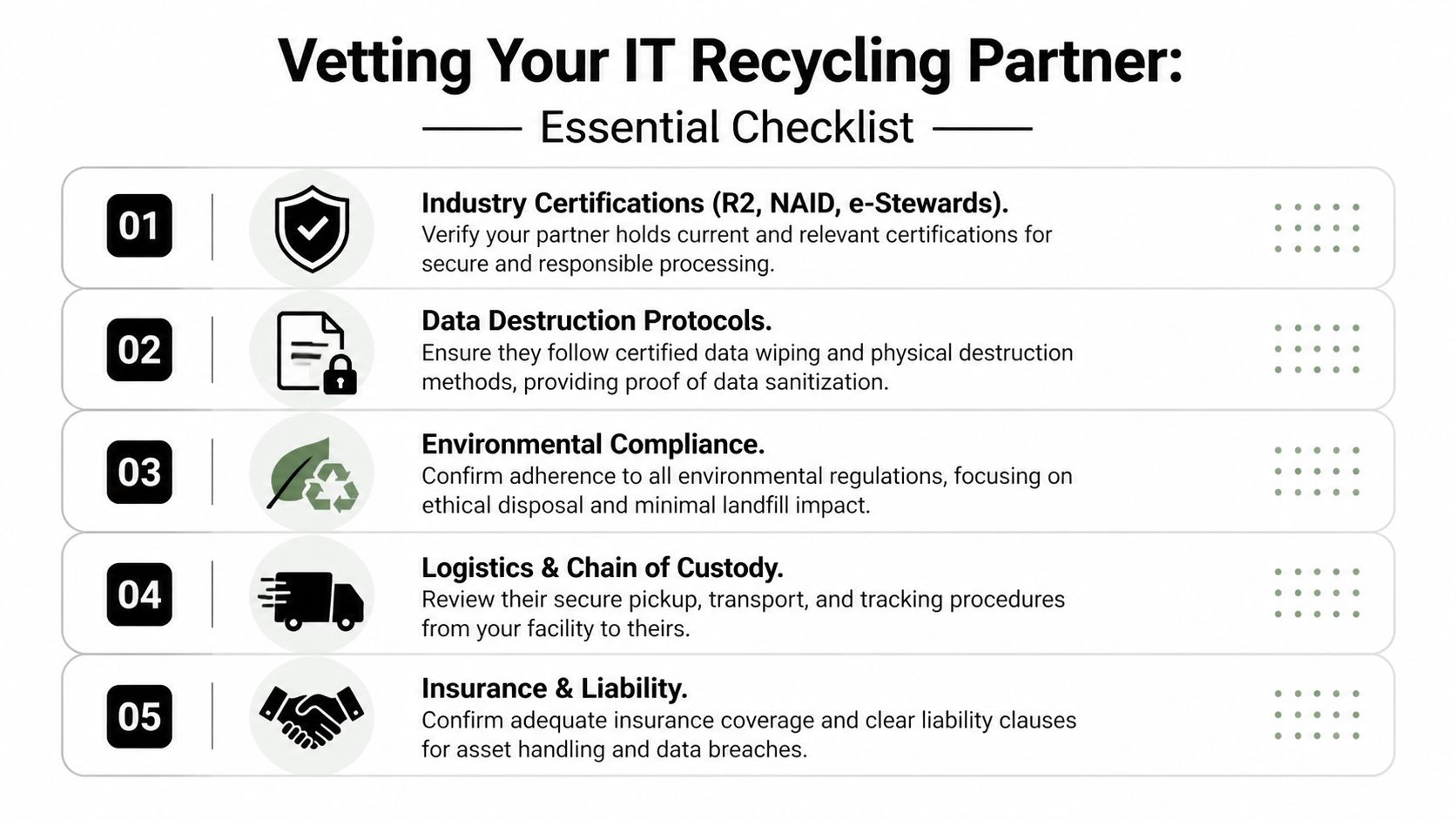
For data destruction, NAID AAA matters because it reflects a disciplined destruction environment and documented handling expectations. For responsible recycling operations, R2 and RIOS matter because they signal process maturity around downstream handling, environmental controls, and operational accountability. In regulated sectors, that distinction matters more than sales language.
A useful way to look at certifications is this:
| Area | What you need to confirm | Why it matters |
|---|---|---|
| Data destruction | NIST 800-88 and documented destruction workflows | Protects confidential and regulated data |
| Recycling operations | R2 or RIOS process discipline | Reduces environmental and downstream handling risk |
| Chain of custody | Serialized tracking and manifesting | Prevents asset loss and weak audit trails |
| Liability | Insurance and clear responsibility terms | Limits exposure during transport and handling |
Ask what they do with functional drives versus failed media
A credible provider should explain the difference without hesitation. Functional drives can go through NIST 800-88 software sanitization when reuse or remarketing makes sense. Obsolete or nonfunctional media should move to physical shredding when wiping isn’t appropriate.
That distinction is not academic. According to Atlanta technology reuse guidance on secure data destruction, professional ITAD services ensure zero data breach incidents in certified programs, and rushing the destruction process can create 5 to 10% failure rates with incomplete erasure. That’s why process discipline matters more than speed claims.
The right question isn’t “Do you wipe drives?” It’s “Which drives do you wipe, which do you shred, and what proof do I receive for each outcome?”
Watch for red flags during the sales conversation
Some warning signs show up early:
- Vague documentation answers: If a vendor can’t describe what appears on a Certificate of Destruction, expect weak reporting later.
- One-size-fits-all destruction language: Sensitive laptops, failed SSDs, and resale-ready servers should not all follow the same path.
- No clear pickup controls: If they can’t explain locked containers, loading procedures, and serial tracking, chain of custody may be loose.
- Overfocus on “free”: Free pickup can be legitimate in some cases, but it should never replace a conversation about security, process, and downstream accountability.
What a serious partner sounds like
A serious recycler speaks in operational terms. They’ll talk about device counts, media classes, de-installation scope, who scans serials, how exceptions are handled, and when documentation is issued. They won’t hide behind broad statements.
For companies comparing vendors, the most practical next step is to review providers that specialize in these workflows. A list of IT asset disposition companies can help frame what services and credentials should be on your shortlist.
Planning Your Corporate IT Recycling Project
The quality of a recycling project is set long before the truck arrives. Internal preparation determines whether the job is clean, secure, and cost-aware, or whether it turns into a rushed removal with missing assets and weak documentation.
Start earlier than most teams think
A formal ITAD methodology begins with asset inventory 6 to 12 months pre-retirement, not the week before an office move. With proper cataloging and classification, 80 to 90% of IT assets can be recovered through refurbishment or resale, while poor inventory planning can cause a 20 to 30% loss in potential value, according to Reconext guidance on measuring success in data center IT asset recycling.
That timing matters because internal teams need room to answer basic questions. What still has useful life? Which devices hold regulated data? Which assets are leased? Which systems require backup confirmation before removal? If you wait until retirement is urgent, you force decisions that should have been made calmly.
Build an inventory that operations can actually use
Good inventory work isn’t just counting boxes. It means creating a disposition-ready record with enough detail for security, finance, and logistics to act on it.
Include at minimum:
- Asset identity: Serial number, asset tag, device type, and current location.
- Condition notes: Working, damaged, obsolete, incomplete, or missing accessories.
- Data status: Data-bearing or non-data-bearing, plus sensitivity level under internal policy.
- Disposition intent: Candidate for resale, redeployment, recycling, or destruction.
Teams that already follow IT asset management best practices usually adapt faster here because their records are cleaner before retirement starts.
Classify by risk before you classify by value
At this point, many projects go wrong. People get interested in recovery value before deciding how data risk changes handling requirements. In practice, risk comes first.
For example, a hospital, law firm, school district, or finance team may decide that certain laptops and removable media should go directly to destruction because the data sensitivity outweighs resale upside. By contrast, newer servers, monitors, and peripherals may be suitable for refurbishment if chain of custody and sanitization standards are met.
Operational advice: If your policy is unclear on which assets require shredding versus wiping, resolve that internally before the vendor walkthrough.
Create a short internal decision map
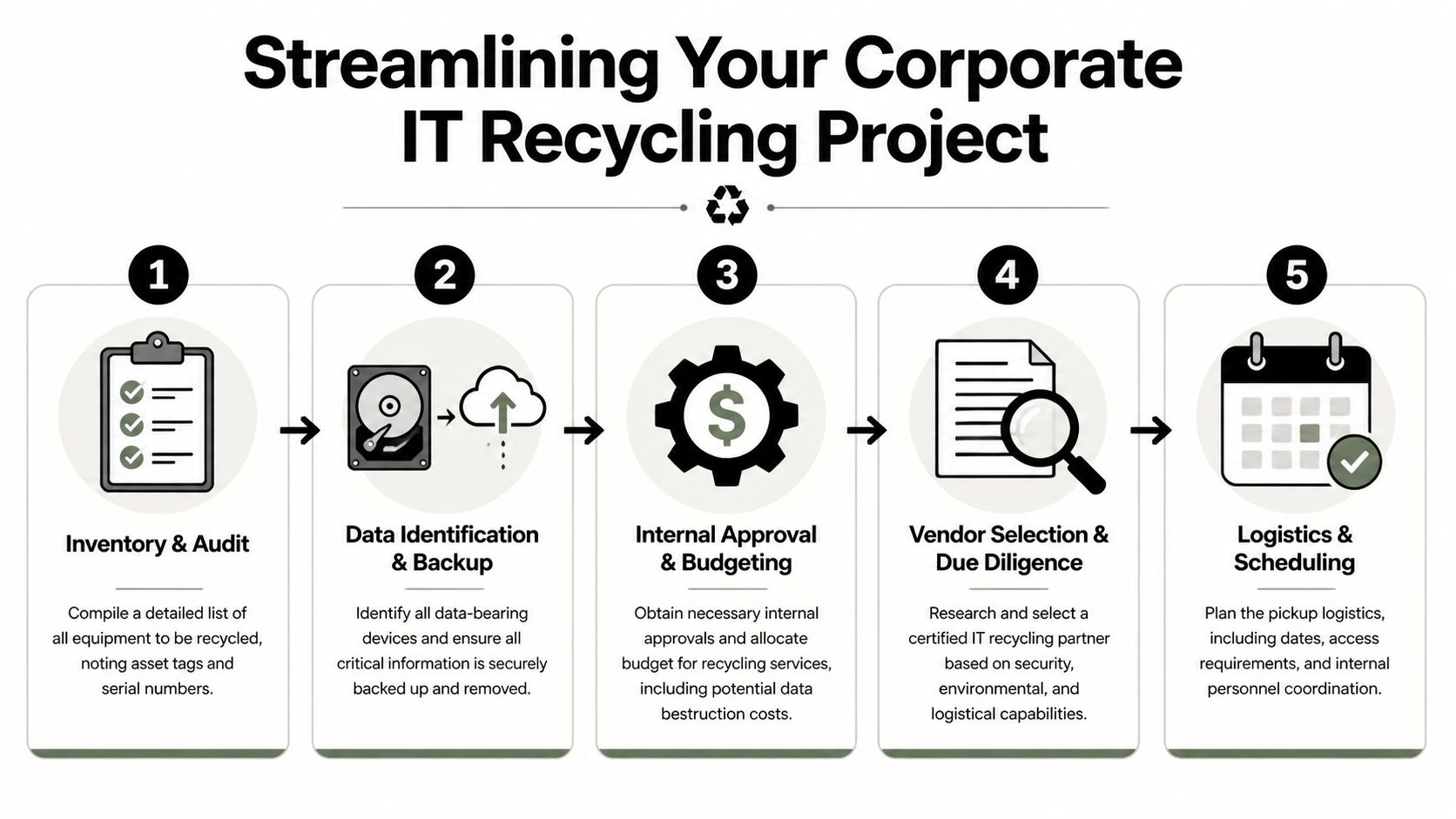
A simple project map keeps the work moving:
- Inventory the equipment
- Validate backups and user separation
- Classify media by data sensitivity
- Get approval from IT, compliance, and facilities
- Schedule pickup with site access details
That preparation makes vendor coordination much easier. It also improves internal trust because every stakeholder can see who approved what.
For Atlanta organizations handling office moves, refresh cycles, or data center retirements, a practical planning reference is this Atlanta business IT asset disposal guide.
Maximizing Value Beyond Compliance with ESG Reporting
Most organizations still treat electronics recycling as a back-office necessity. That’s too narrow. If your company is already investing in sustainability reporting, supplier standards, or community impact, retired technology should contribute to that effort in a way that’s visible and documented.

Why documentation now needs to do more than prove disposal
The compliance file used to be enough. A manifest, a destruction certificate, maybe a recycling summary. That’s still necessary, but for many Atlanta companies it’s no longer sufficient.
According to Atlanta e-waste and ESG reporting trends, Georgia e-waste regulations effective Q1 2026 mandate R2/RIOS certifications for state contracts, and 68% of Fortune 500 firms now require ESG metrics from vendors. The same source notes that 75% of Atlanta enterprises seek CSR differentiators. That changes the role of recycling documentation. It now supports procurement, reporting, and brand positioning, not just disposal records.
The stronger story is purpose plus proof
A standard recycling report says what left your building. A stronger ESG-ready report says what your company enabled.
That’s where cause-based recycling becomes useful. If your recycler supports veteran aid and tree planting, your retired IT equipment can be tied to a narrative employees and stakeholders will remember. “Your old tech can house a veteran and grow a forest” is more concrete than a generic sustainability sentence because it connects an operational act to a human result.
This only works if it’s documented clearly. Good ESG support can include:
- Plant-A-Tree certificates for sustainability files or employee communications
- Veteran support impact reports that connect the recycling event to community benefit
- Digital badges such as Recycled with Purpose for websites, supplier portals, or sustainability pages
- Recycling summaries formatted for internal ESG teams so the data can move into larger reporting workflows
A recycling partner that understands ESG won’t stop at “we processed your assets.” They’ll think about what procurement, compliance, marketing, and CSR teams each need to show.
Social impact works best when it’s operationalized
Many companies like the idea of purpose-driven recycling but never build it into their process. The practical fix is to attach it to recurring events you already control.
A few examples work well in Atlanta:
| Business moment | Cause-based angle | Internal use |
|---|---|---|
| Office refresh | Recycle for a Cause campaign | Employee engagement and internal comms |
| Data center retirement | Recycled with Purpose badge | ESG reports and vendor reporting |
| Veterans Day drive | Veteran support tie-in | Community relations and local PR |
| Earth Day or Arbor Day collection | Tree planting documentation | Sustainability updates |
That gives facilities, IT, and HR a shared project instead of a siloed disposal event.
One recycler can be a process vendor and a CSR contributor
This is one of the few places where vendor choice materially affects the public story your company can tell. A provider such as Atlanta Green Recycling’s business sustainability strategy support can fit into that model when a company wants secure disposition plus reporting that supports sustainability and community impact efforts.
The broader point is simple. If your recycler only removes equipment, you get a closed ticket. If your recycler provides secure processing plus ESG-ready outputs, you get something operations, procurement, and communications can all use.
Navigating Pickup Logistics and Chain of Custody
Pickup day is where confidence is either reinforced or lost. A well-run job feels orderly. People know where the crew should stage, who signs what, which assets are leaving, and how each item is accounted for.
What a secure pickup looks like on site
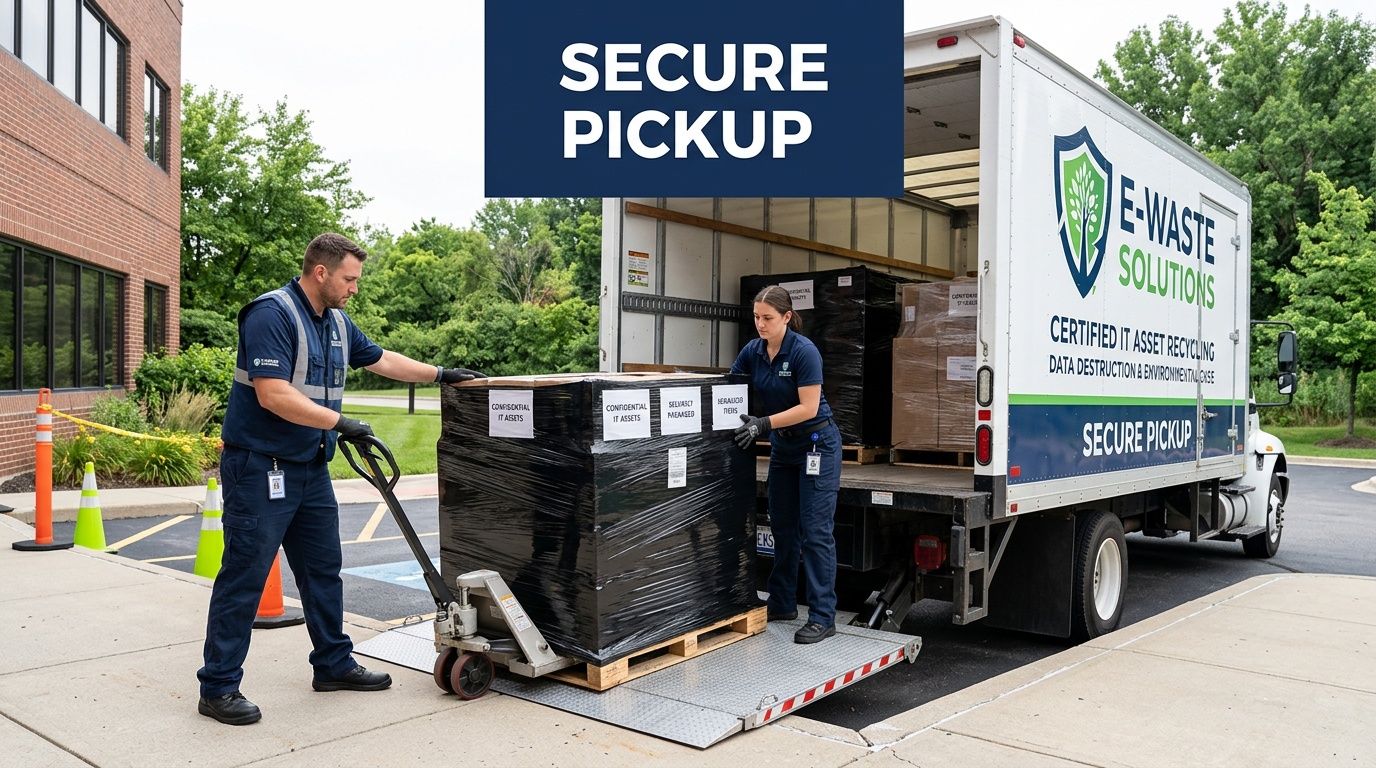
The best pickups are quiet and procedural. The crew arrives with the right containers, confirms scope against the approved list, and stages equipment in a controlled sequence. Laptops and loose media don’t get mixed casually with general peripherals. Serialized assets are checked as they move.
For larger projects, especially in buildings with freight elevator rules or loading dock restrictions, access planning matters as much as technical handling. That’s one reason site teams often coordinate in advance around loading dock access and pickup logistics, rather than trying to solve it while equipment is already in motion.
Chain of custody should stay unbroken
A chain of custody is only useful when it’s specific. “We picked up your equipment” is not a chain of custody. A credible record shows what was collected, who released it, how it was secured, and how it moved to processing.
On a disciplined project, you should expect to see:
- Controlled staging: Assets remain in monitored areas until transfer.
- Locked or tamper-evident containment: Especially for drives and data-bearing devices.
- Manifest verification: The released equipment matches the scheduled scope.
- Transport accountability: The vendor can explain how items remain secured in transit.
- Final documentation: What was received and processed can be tied back to the pickup event.
The handoff matters more than people think
Problems often happen during transitions, not processing. A laptop left beside a dock door, a box loaded without verification, a device count adjusted informally at departure. Those are the moments that weaken the record.
Keep one internal owner on site for the full handoff. Not for labor, but for accountability.
That person doesn’t need to direct the crew. They need to validate scope, note exceptions, and make sure the outbound event matches internal expectations. In healthcare, legal, education, and government environments, that internal witness matters.
What good documentation feels like afterward
When the project is handled properly, the follow-up packet should make sense without a long explanation. The asset list should align with what left the building. Destruction records should map to the applicable devices. Recycling and disposition records should be usable by compliance staff without translation.
That’s the difference between a pickup service and a managed ITAD workflow. One moves hardware. The other preserves control from your office floor to the final processing record.
Your Vendor Selection Checklist for Atlanta Businesses
When Atlanta companies compare recyclers, they often ask broad questions and get polished answers. That doesn’t create a reliable comparison. What does work is a disciplined scorecard with pointed questions that force clarity.
The market itself is getting bigger, but that doesn’t make vendor quality uniform. The global electronics recycling market is projected to reach USD 147.9 billion by 2035, while the formal e-waste collection rate is under 20% and projected to fall, according to enterprise electronics recycling market projections and collection trends. In a market like that, certified process matters because demand alone won’t protect your organization.
Data security questions
Ask these first. If the answers are weak, the rest doesn’t matter.
How do you decide between software sanitization and physical shredding?
You want a process answer, not a slogan. The vendor should explain how they treat working drives, failed drives, SSDs, and high-sensitivity assets.Can you provide a sample Certificate of Destruction tied to individual assets?
If the certificate is generic, it may not support audits well.How do you maintain control of loose drives, laptops, and removable media during pickup?
This reveals whether their chain of custody is operational or theoretical.What happens when an asset arrives in a condition different from the original manifest?
Exception handling tells you how they operate under pressure.
Environmental compliance questions
A compliant recycling program should be traceable past the first handoff.
- Which certifications govern your recycling operations today?
- How do you document downstream processing for non-resalable materials?
- What is your landfill policy for retired IT equipment and components?
- How do you separate reusable devices from scrap material?
If the vendor can’t explain downstream responsibility clearly, your sustainability claim may be weaker than it sounds.
Logistics and on-site service questions
This category matters more in Atlanta than many buyers expect because building access, traffic, campus layout, and de-installation scope can complicate an otherwise simple job.
| Category | Ask this | What you learn |
|---|---|---|
| Pickup readiness | Who manages on-site de-installation and packing? | Whether they can handle more than curbside removal |
| Asset control | How are serials or counts verified during release? | Whether they document the transfer accurately |
| Site access | What do you need from us for docks, elevators, or after-hours access? | Whether they plan around real building constraints |
| Transit | How is equipment secured from pickup to facility arrival? | Whether transport risk is controlled |
Reporting and audit questions
Many vendors sound solid until you ask what the final reporting package contains.
- Will I receive documentation suitable for compliance review, internal audit, and sustainability reporting?
- Can you separate destruction reporting from recycling summaries?
- How are serial numbers, manifests, and disposition outcomes reconciled?
- How quickly do you issue final documentation after processing?
A polished pickup with weak paperwork still leaves the client holding the risk.
If compliance staff has to rebuild the project record from emails, the vendor didn’t finish the job.
Social impact and ESG value questions
This category is often ignored, which is exactly why it’s useful. If your company cares about community impact, employee communications, or sustainability storytelling, ask directly.
- What verifiable impact documentation can you provide beyond standard recycling paperwork?
- Do you offer project-level certificates that support CSR or ESG reporting?
- Can our company reference the recycling event in public sustainability materials?
- Do you support campaigns tied to Veterans Day, Earth Day, or Arbor Day?
- Is there a digital badge or recognition format our team can use on a website or report?
These questions separate transactional vendors from partners who understand how disposal decisions affect procurement, communications, and brand trust.
A practical way to score responses
Don’t rate vendors on charm. Rate them on specificity.
Use three simple labels during interviews:
- Clear and documented
- Clear but undocumented
- Vague
Anything in the third bucket should concern you. Anything in the second bucket needs follow-up before approval. The strongest vendors can answer in operational detail and provide examples of the documentation they issue.
Conclusion Turning E-Waste into Hope and Restoration
Atlanta companies don’t have a disposal problem. They have a decision problem.
They can treat retired IT equipment as clutter that needs to disappear, or they can manage it as an end-of-life process that protects data, supports compliance, preserves asset value, and strengthens the company’s public commitments. The second approach takes more planning, but it produces far better outcomes.
That matters across the Atlanta market. Hospitals need a defensible data destruction path. Schools and universities need organized bulk removals. Corporate offices need clean refresh cycles. Data centers need disciplined decommissioning. Government-related work demands documentation that can stand up to review. In every case, the quality of the recycler’s process determines the quality of the result.
The stronger opportunity is bigger than secure removal. A well-structured program can turn routine electronics recycling into something stakeholders can see and understand. Veteran support. Tree planting. Better ESG documentation. A clearer story for employees, procurement teams, and community partners. Those outcomes don’t replace compliance. They build on it.
That’s why Professional IT Equipment Recycling Atlanta GA should sit closer to IT strategy, facilities planning, and sustainability leadership than many companies assume. Done well, it clears risk off the books and puts purpose in its place.
Old technology doesn’t have to end as a liability. With the right process and the right partner, it can become a documented act of stewardship for data, for the environment, and for the people your company wants to support.
Recycling That Restores Lives and the Environment.
If your organization needs a structured path for secure pickup, data destruction, compliant IT asset disposition, and cause-based recycling in the Atlanta metro area, Atlanta Green Recycling is one option to evaluate. Their services are geared toward businesses, schools, hospitals, government agencies, and data-heavy operations that need practical documentation, responsible processing, and a recycling model that can also support veteran aid and tree planting.