
Data Center Equipment Recycling Atlanta GA: ESG Solutions


A data center refresh usually starts as an infrastructure decision and ends as an exposure review. The old servers are out of warranty, the storage arrays no longer fit the workload, network gear is stacked on pallets, and someone needs a disposition plan that won’t create a security problem six months from now.
In Atlanta, that decision carries more weight than many teams expect. Atlanta stands as the sixth-largest data center market in North America, and Georgia’s data center sector recorded the second-largest investments nationwide, which means more hardware turnover, more retired equipment, and more pressure to handle end-of-life assets correctly, as noted by STS Electronic Recycling’s overview of Atlanta’s networking equipment recycling market. For IT leaders, facilities teams, compliance officers, and procurement managers, Data Center Equipment Recycling Atlanta GA isn’t a cleanup task. It’s part of governance.
Your Atlanta Data Center Refresh A Risk and An Opportunity
Most organizations reach this point under time pressure. A migration wraps up. A colocation footprint changes. A merger leaves duplicate equipment in racks and storage rooms. The practical temptation is to move the retired gear out fast and let someone “recycle it.”
That’s where bad outcomes start.
If data-bearing assets leave your control without a documented process, you’re exposed to security, audit, and vendor-management risk. If equipment goes to a scrap handler instead of a compliance-focused ITAD workflow, you can also lose residual value, chain-of-custody visibility, and the documentation your legal or procurement team may need later. In Atlanta’s market, that’s not a fringe issue. It’s part of operating in a region with a dense concentration of enterprise infrastructure, hyperscale growth, healthcare systems, universities, and regulated businesses.
What the wrong approach looks like
A weak process usually has the same warning signs:
- No asset-level inventory: Teams know they removed “about a rack” of hardware, but they can’t match serials to final disposition.
- Loose pickup practices: Equipment is loaded onto a truck with no clear custody record.
- Unclear data handling: The vendor says drives will be wiped, but can’t explain the standard or provide destruction records.
- Commodity-first thinking: Everything gets treated like scrap, even when some assets may still have reuse or parts value.
The cost of that mistake isn’t always immediate. Sometimes it shows up during an audit. Sometimes it appears when a business unit asks for proof that a retired storage device was sanitized. Sometimes it becomes a reputational issue after leadership has already published sustainability goals.
What the better path looks like
Handled correctly, the same refresh becomes operationally useful. A disciplined recycling and ITAD process can reduce internal workload, preserve documentation, support legal defensibility, and align with broader sustainability reporting. For many Atlanta businesses, it also creates a cleaner story around responsible decommissioning in a region where infrastructure expansion is accelerating.
Practical rule: If your recycler can’t explain custody, sanitization, downstream handling, and reporting in plain language, they’re not ready for enterprise data center work.
That’s why the disposal decision shouldn’t sit only with facilities or only with IT. The strongest outcomes usually come when infrastructure, security, procurement, and compliance review the project together. The actual recycling step is the end of the process. The risk management starts much earlier.
For organizations planning a refresh or retirement cycle in Georgia, it helps to think of disposition as part of the broader data center lifecycle in Georgia, not an afterthought after the migration is complete.
The Anatomy of Secure Data Destruction
Deleting files isn’t data destruction. Reformatting a drive usually isn’t either. In practice, both actions are closer to removing labels from file folders than destroying the files themselves. A proper sanitization process has to make the underlying data non-recoverable.
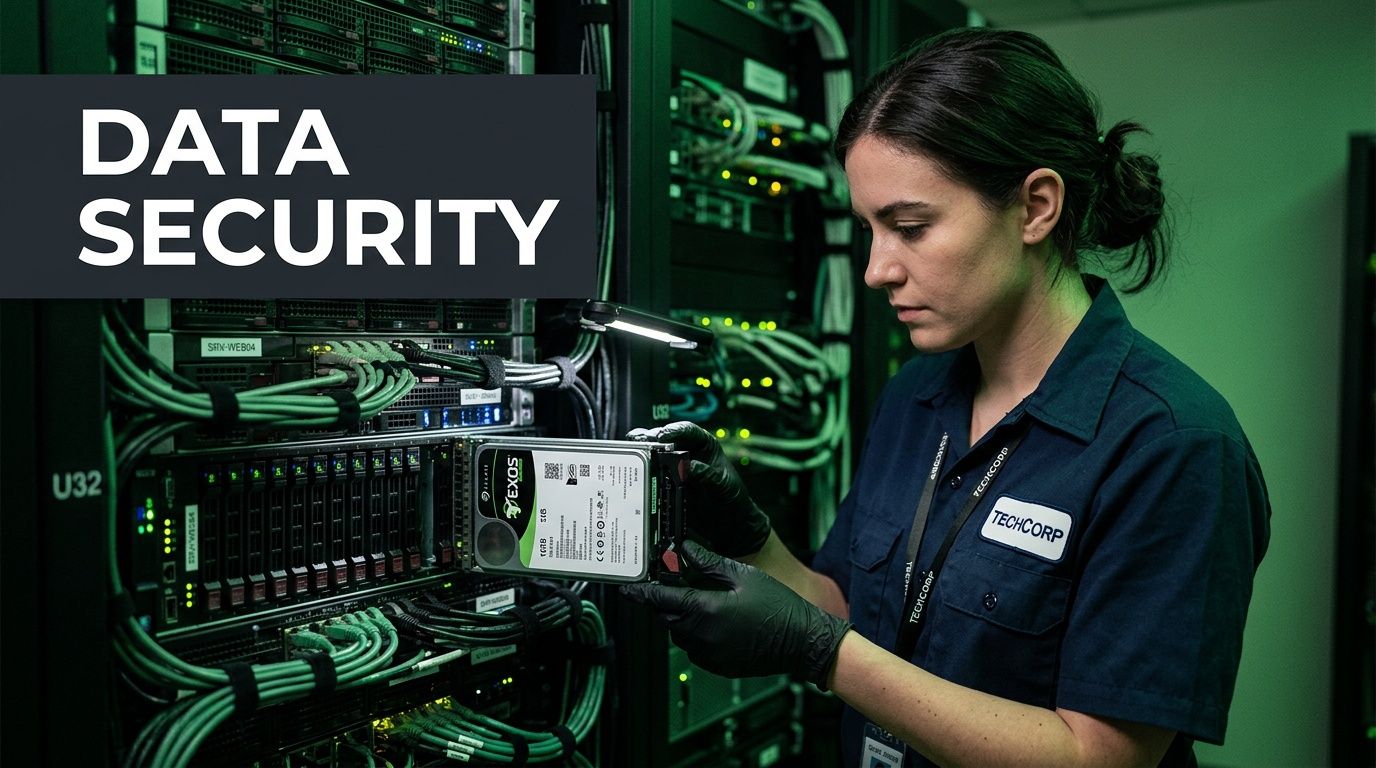
That’s why NIST 800-88 matters. It sets the framework most serious ITAD providers use when they sanitize hard drives, SSDs, and related media. The accepted methods include overwrite, cryptographic erase, and physical destruction, depending on the asset type and its condition.
Why drive type changes the method
Hard disk drives and solid-state drives don’t fail the same way, and they can’t be sanitized the same way.
For HDDs, multi-pass overwrites remain a common method. According to Atlanta Computer Recycling’s explanation of data center disposal standards, multi-pass overwrites for HDDs can reduce magnetic signatures to below 1% readability. That matters when a business wants to preserve reuse value while still meeting a recognized sanitization standard.
For SSDs, the issue is different. Wear-leveling means data isn’t always stored in one predictable physical location, so a basic wipe can miss data in unmapped blocks. The same source notes that SSDs can retain up to 90% of data in unmapped blocks if improperly wiped, which is why ATA Secure Erase or another appropriate NIST-aligned purge method is required.
What teams should choose in the real world
The right method depends on the asset.
Overwrite
Works for functional media when resale or redeployment is realistic. It preserves asset value better than shredding, but only if the process is documented and verified.Cryptographic erase
Best when encrypted media supports it and the key destruction process is properly managed. Fast, effective, and useful in the right environment.Physical destruction
Necessary when media is failed, damaged, nonfunctional, or too sensitive to leave intact. Shredding is common for drives that can’t be reliably sanitized by software.
A common mistake is using one method for every device because it feels simpler administratively. That often reduces value recovery or creates weak spots. Storage teams know this already. An array with failed members, mixed media types, and partial inventory almost always needs a segmented approach.
Secure destruction isn’t a single event. It’s a chain of documented decisions about media type, condition, sensitivity, and final verification.
The documentation matters as much as the wipe
Good sanitization isn’t only technical. It’s evidentiary. If your organization handles patient records, legal files, financial data, HR records, or customer information, you need proof that each data-bearing asset was processed correctly.
Look for:
- Serialized tracking: Each drive, server, or appliance should map to an asset record.
- Method identification: The certificate should state whether the device was wiped, purged, or physically destroyed.
- Exception handling: Failed drives shouldn’t disappear into a miscellaneous pile.
- Audit-ready reporting: Security and compliance teams need records they can retain.
If your organization needs local support for media handling, onsite collection, or documented destruction, it’s worth reviewing options for secure hard drive destruction services in Atlanta GA before the refresh starts, not after racks are already empty.
Your Data Center Recycling Workflow From Pickup to Reporting
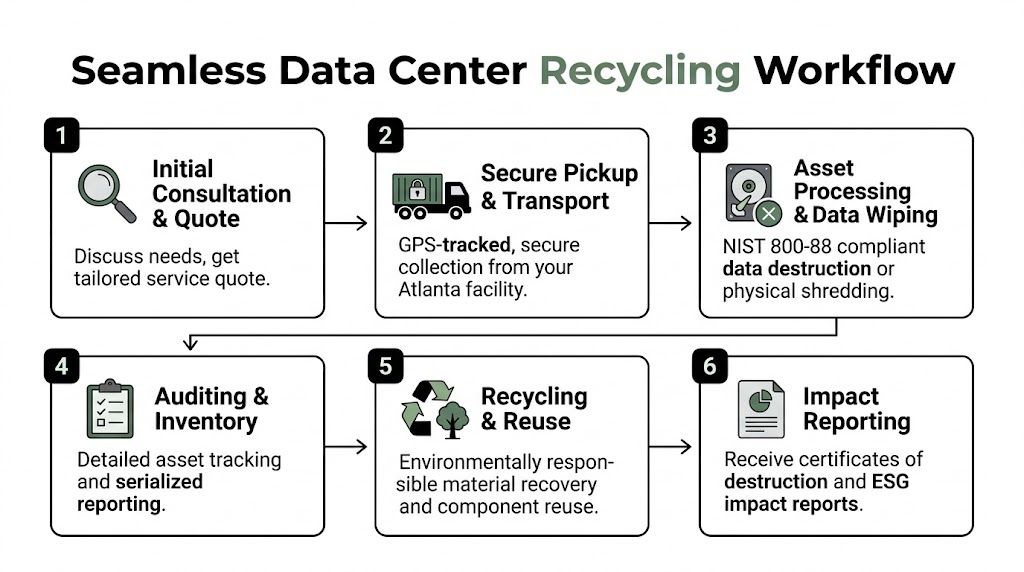
A professional recycling project should feel controlled from the first call to the final report. If the process feels improvised, it probably is. The strongest vendors run decommissioning work like a custody-sensitive logistics project, not a junk haul.
Step one starts before anything is unplugged
The first stage is scoping. That means identifying what’s leaving service, what still has redeployment potential, what contains data, and what requires special handling. In a data center, “equipment” isn’t just servers. It may include switches, routers, storage shelves, rails, PDUs, racks, failed media, and miscellaneous parts that no one has touched in years.
A capable provider will ask practical questions early:
- What equipment is in production versus already retired?
- Which assets contain data-bearing media?
- Does the removal require onsite de-installation or un-racking?
- Are there loading dock, access, scheduling, or security constraints?
- What reporting format does your procurement, audit, or compliance team require?
This early planning avoids the most common project delays. The main issue usually isn’t transport. It’s incomplete inventory, unclear site access, or uncertainty over who owns final approval.
Onsite work should be organized and quiet
When pickup day arrives, the goal is simple. Remove assets without disrupting adjacent operations or damaging equipment that still has reuse value. That usually means staged de-installation, controlled packing, and a clear separation between data-bearing items and general electronics.
The best onsite teams don’t create drama. They label consistently, photograph when needed, and keep client signoff tight. If a provider can’t explain how they handle rack removal, cable separation, mixed asset classes, and custody transfer, they’re not set up for a serious environment.
A typical field workflow looks like this:
| Workflow stage | What should happen |
|---|---|
| Initial inventory review | Asset lists are reconciled against what’s physically onsite |
| De-installation | Servers, storage, and network gear are removed without unnecessary damage |
| Packing and staging | Assets are palletized, containerized, or segregated by process path |
| Custody handoff | Pickup records are created before transport leaves the site |
Transport and facility intake are where weak vendors slip
A lot can go wrong between pickup and processing. That’s why chain of custody matters. Once equipment leaves your building, you still need to know where it went, how it was logged, and who accepted it.
At the facility, intake should include verification against shipment records and separation by final path. Some assets will be tested for remarketing or parts harvest. Others will move directly to sanitization or shredding. Commodity recycling should be the last stage, not the first instinct.
The easiest way to spot a weak process is to ask what happens in the first hour after the truck reaches the facility. Strong vendors answer clearly. Weak ones stay vague.
Reporting closes the loop
The project isn’t complete when the truck pulls away. It’s complete when your organization receives records that support internal retention, audit preparation, and vendor oversight.
That usually includes:
- Asset-level reporting for what was received and processed
- Certificates of data destruction for data-bearing devices
- Recycling or disposition summaries for sustainability and procurement teams
- Exception logs for missing serials, failed media, or nonstandard items
This is also where impact reporting can become useful. Many companies now want a cleaner narrative around end-of-life hardware, especially when sustainability teams, board committees, or customers ask how retired technology is handled. A mission-oriented recycler may add ESG documentation that goes beyond basic destruction certificates.
If you’re evaluating process maturity before a rack shutdown or relocation, a useful reference point is a documented data center decommissioning process that shows how inventory, logistics, destruction, and reporting connect.
How to Select a Compliant Recycling Partner in Atlanta
The hardest part of vendor selection isn’t finding someone who says they recycle electronics. Atlanta has plenty of companies that will pick up equipment. The hard part is finding a partner that can survive legal, procurement, security, and sustainability scrutiny at the same time.
That’s why the cheapest quote rarely tells you much.
Start with the non-negotiables
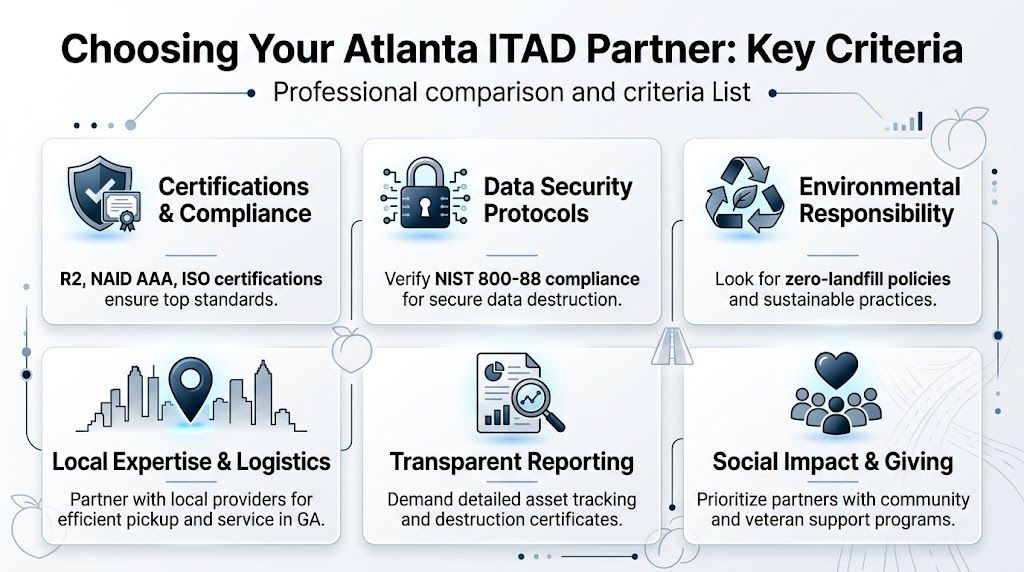
A compliant vendor should be able to discuss certifications, downstream controls, and sanitization standards without resorting to marketing language. In this market, the baseline usually includes R2v3 or e-Stewards alignment, documented chain of custody, and the ability to provide serialized reporting for data-bearing assets.
The broader compliance context matters too. The formalization of e-waste recycling in the United States was catalyzed by RCRA of 1976, and by the early 2000s, standards like R2 emerged with requirements for 100% traceable chains of custody and controls that prevent hazardous exports, according to Atlanta Computer Recycling’s history of Atlanta computer recycling. That history matters because mature ITAD work is built on accountability, not informal hauling.
Here’s the shortlist I use when vetting a recycler for enterprise work:
- Certification proof: Ask for current certification details, not just logos on a website.
- Data destruction records: They should provide serialized certificates, not a generic service summary.
- Insurance and liability readiness: Your legal team may want proof before pickup is scheduled.
- Downstream transparency: If they can’t explain where commodities and residuals go, keep looking.
- Local service capability: Atlanta pickups are easier when the vendor has real regional operating capacity.
Ask harder questions about money
One of the biggest gaps in the Atlanta market is pricing transparency. As noted by Beyond Surplus on data center decommissioning and recycling, providers often mention free pickups, but clear benchmarks around value recovery and disposal fees are often missing. That leaves IT managers without a realistic ROI model unless the vendor performs a detailed custom audit.
That doesn’t mean every quote should be rejected for lacking a flat price card. Data center projects vary too much for that. It does mean you should ask sharper questions:
| Question | Why it matters |
|---|---|
| What assets qualify for resale or buyback? | Prevents everything from being treated as low-value scrap |
| What triggers extra logistics charges? | Site access, labor, and packing can change the total cost |
| How are failed drives priced? | Shredding and special handling may follow a different fee path |
| What reports are included? | Some vendors treat documentation as an add-on |
Mission and reporting can matter too
For many organizations, a recycling vendor is no longer just an operations decision. CSR teams, ESG committees, and communications staff may all care how end-of-life electronics are handled. That doesn’t replace security requirements. It adds another layer to selection.
A vendor such as Atlanta Green Recycling’s IT asset disposition services in Atlanta GA may fit when a company needs pickup, secure handling, data destruction, bulk removal, and documentation in one workflow. The main point is to choose a partner whose process stands up under internal review.
If a vendor’s proposal talks more about “convenience” than accountability, it’s probably built for office cleanouts, not data center disposition.
Turn E-Waste Into a Powerful ESG and Brand Story
Compliance gets the project approved. Story gives it internal and external value.
A lot of companies still treat electronics recycling as a back-office disposal event. That misses a real opportunity. If your organization already has ESG commitments, community investment goals, or employee volunteer programs, retired technology can support that work when you choose a partner with a credible mission model.

Why mission changes the conversation
Most executive teams understand the compliance side of ITAD. Fewer see how to communicate it. That’s where cause-based framing works. Instead of saying, “We disposed of obsolete servers,” a company can say the refresh supported responsible material recovery, data security, community benefit, and environmental action.
That’s a stronger message for:
- Annual ESG reports
- Customer questionnaires
- Board and audit committee updates
- Recruiting and employee engagement
- Local media and community relations
For a mission-driven model, the language should stay concrete. The most effective messaging ties the hardware retirement event to visible outcomes. “Your old tech can house a veteran and grow a forest” works because it connects disposal to people and place. It takes an invisible back-end activity and makes it meaningful.
What useful ESG deliverables look like
A good partner shouldn’t leave your sustainability team to invent the narrative from scratch. The operational records may already exist. What’s often missing is translation into brand-ready material.
Look for deliverables such as:
- Plant-a-tree certificates that procurement or CSR teams can include in internal recaps
- Veteran support impact reports that connect recycling activity to community outcomes
- Digital badges such as “Recycled with Purpose” for websites or sustainability pages
- Seasonal drive support tied to Earth Day, Arbor Day, or Veterans Day campaigns
This is also where communications teams can benefit from guidance on telling a compelling brand story. The strongest narratives don’t turn routine operations into hype. They show how a practical business decision reflects company values.
A recycling program becomes more credible when legal, IT, and marketing can all describe it without contradicting each other.
Why traceability still has to come first
The social story only works if the underlying process is credible. That’s why the compliance foundation matters. The formal structure of modern e-waste recycling, built from RCRA and later standards like R2, established the expectation of traceable chains of custody and responsible downstream handling. Without that, the ESG layer is just decoration.
For organizations that want a broader framework for communicating those outcomes internally, it helps to connect disposition work to the wider benefits of e-waste recycling rather than treating it as a single one-off pickup. That creates continuity between operations, sustainability, and community impact.
Atlanta Companies Recycling with Purpose
The best way to evaluate a recycling approach is to watch how it plays out in real business settings. The details change by industry, but the pattern is consistent. Teams want less disruption, better documentation, and a cleaner way to show that the work meant something beyond “assets removed.”

A law firm with a small server room and a big audit concern
A downtown Atlanta law firm retires a mix of rack servers, backup devices, old switches, and loose hard drives after moving key workloads to a hosted environment. The volume isn’t huge by data center standards, but the risk is high because the equipment touched client records and internal case files.
The firm doesn’t need a flashy sustainability campaign. It needs certainty.
What works in this situation is a narrow, documented workflow. Asset inventory first. Data-bearing media separated early. Clear destruction records at the serial level. For legal operations teams, that audit trail does more than satisfy internal policy. It gives firm leadership a defensible answer if a client ever asks how retired infrastructure was handled.
The extra benefit comes later. The same firm may already support veterans through pro bono work or community programs. When the recycling partner also ties the project to veteran aid and tree planting, the disposal event becomes consistent with the firm’s public values instead of remaining an invisible facilities task.
A healthcare system that wants staff engagement, not just compliance
A metro Atlanta healthcare organization usually starts with HIPAA concerns. The IT group wants secure removal of retired workstations, servers, storage devices, and networking equipment from multiple sites. Security and compliance officers want documentation that survives scrutiny. Facilities wants the equipment gone without disrupting patient-facing operations.
That’s the baseline.
The more interesting part is what happens when the organization uses the recycling effort as a broader employee engagement program. Earth Day and Veterans Day become natural moments for internal drives, awareness campaigns, and department participation. The story is no longer just about what left the building. It’s about how responsible disposal supported a local mission.
A university balancing budget pressure with public accountability
Colleges and universities often sit in the middle. They’re cost conscious, decentralized, and highly visible. One campus may have a central data room, aging lab equipment, surplus departmental hardware, and a sustainability office that wants measurable environmental progress.
In that setting, the most useful recycling partner is usually the one that can handle mixed streams without turning the project into administrative chaos. Universities benefit when a single workflow can cover pickup scheduling, media handling, environmental reporting, and community-facing messaging.
The organizations that get the most from recycling don’t treat it as a one-day event. They build it into refresh cycles, move projects, and annual sustainability routines.
Frequently Asked Questions About Equipment Recycling
Teams usually ask the same practical questions before they approve a pickup. The answers below reflect how experienced organizations approach Data Center Equipment Recycling Atlanta GA when security, compliance, and ESG all matter.
| Question | Answer |
|---|---|
| What types of data center assets can be recycled? | Most projects include servers, storage devices, switches, routers, racks, rails, peripherals, and loose media. The exact scope should be confirmed during inventory because data-bearing and non-data-bearing assets often follow different processing paths. |
| Is deleting files enough before recycling equipment? | No. File deletion doesn’t equal verified sanitization. Organizations should require a documented process that matches the media type and produces records for audit retention. |
| When should drives be shredded instead of wiped? | Shredding makes sense when media is failed, damaged, too sensitive to remarket, or unsuitable for software sanitization. Functional media may be eligible for secure wiping if the organization wants to preserve value. |
| Do we need chain-of-custody documentation for every pickup? | If the equipment came from a business environment, especially a regulated one, the answer is usually yes. The more sensitive the data and the larger the project, the more important serialized tracking becomes. |
| Can equipment still have value after decommissioning? | Sometimes yes. Functional servers, network gear, and components may support resale or reuse, but the value depends on age, condition, configuration, and current demand. That’s why a custom audit matters. |
| What should be included in final reporting? | At minimum, expect an inventory summary, data destruction records for media, and disposition documentation. Sustainability or CSR teams may also want environmental and impact summaries. |
| Is local pickup important in Atlanta? | It can be. Local capability often makes scheduling, site coordination, and project communication easier, especially for multi-site businesses or time-sensitive decommissions. |
| How can recycling support ESG goals without sounding forced? | Keep the story tied to real operational action. If the partner provides traceable recycling, responsible downstream handling, and a mission outcome like veteran support or tree planting, the ESG narrative feels earned. |
A good rule is to involve more than one internal stakeholder before approving a vendor. Security cares about sanitization. Procurement cares about contract clarity. Sustainability cares about reporting. Facilities cares about execution. The right provider can answer all four.
If your organization is staring at stacked servers, retired drives, or a pending decommissioning project, the next step is simple. Build the asset list, define your security requirements, and choose a recycler that can document every handoff and final outcome.
Atlanta businesses that need a practical path for secure pickup, data destruction, compliant recycling, and mission-aligned impact can review services from Atlanta Green Recycling. For organizations that want end-of-life IT management to do more than remove equipment, a partner that combines custody controls with veteran support and tree-planting initiatives can turn a necessary disposal project into a stronger ESG outcome.