
Expert IT Asset Disposition Services Atlanta GA

Old laptops in a locked closet feel harmless until an office move, a lease cleanup, a server refresh, or an audit turns that pile into a real business problem. In Atlanta, I’ve seen the same pattern across law offices, clinics, school districts, warehouses, and growing tech firms. Equipment gets retired faster than anyone has time to document it. Then one day somebody asks a simple question: where did all that data-bearing equipment go?
That’s when IT Asset Disposition Services Atlanta GA stops being an afterthought and becomes an operational decision. The issue isn’t just getting rid of hardware. It’s protecting data, documenting custody, recovering value where possible, and keeping unusable electronics out of the wrong downstream channels.
The stronger approach is to treat retired IT like any other controlled business asset. You inventory it. You decommission it properly. You sanitize or destroy data according to the device and the risk profile. You generate documentation that stands up to internal review and outside scrutiny. And if you care about corporate citizenship, you can also make the process do more than reduce risk. You can turn surplus tech into environmental and social good.
Your Atlanta Office's Tech Graveyard Has a New Purpose
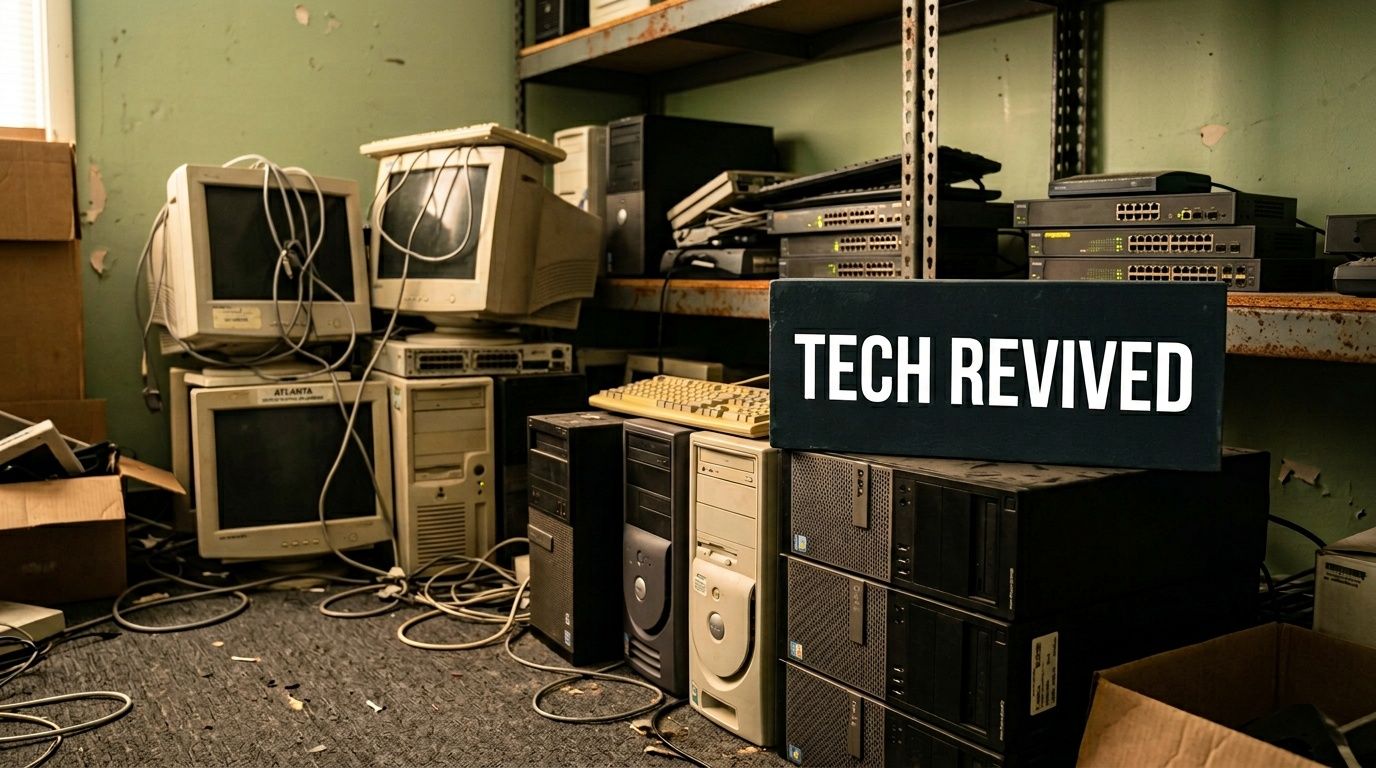
An office manager in Buckhead, a hospital IT lead near Midtown, and a school administrator in DeKalb often describe the same scene. There’s a storage room with old desktops under tables, monitors stacked in corners, a few retired switches, maybe a server or two, and a banker’s box full of loose hard drives no one wants to touch.
That pile isn’t dead inventory. It’s unfinished work.
For many Atlanta organizations, the danger shows up in two places. First, there’s the data risk. Retired laptops, SSDs, and servers still carry patient records, employee files, contracts, credentials, and internal documents if they weren’t properly sanitized. Second, there’s the disposal risk. A rushed cleanout can push equipment into informal recycling channels that don’t provide the chain of custody, destruction records, or environmental handling that regulated businesses need.
Atlanta’s importance in this space isn’t hypothetical. The USA IT Asset Disposition market reached USD 2.9 billion in 2023 and is projected to reach $4.90 billion by 2032, growing at a 6.2% CAGR, driven by data privacy regulation and ESG pressure, according to Ken Research’s USA IT Asset Disposition market analysis. That matters locally because Atlanta is a major hub for healthcare, education, logistics, government, and data center activity. Those sectors generate a lot of retired tech, and they can’t afford sloppy end-of-life handling.
What the closet full of equipment usually means
In practice, that backlog usually points to one of these conditions:
- A delayed refresh cycle that left old assets sitting after new deployments
- An office move or consolidation where no one owned final disposition
- A data center cleanup that prioritized uptime over end-of-life planning
- A compliance blind spot where teams tracked procurement well but retirement poorly
Old equipment becomes expensive the moment no one can say what’s on it, where it is, or who last touched it.
There’s also a more useful way to look at that closet. Those devices can support a documented, secure disposition program and, with the right partner model, contribute to a broader mission. That’s the part many Atlanta businesses miss. Disposal doesn’t have to end with “gone.” It can become part of a sustainability and community-impact story that your team can stand behind.
If your organization is trying to clean up aging equipment across offices, clinics, campuses, or warehouses, the local business recycling workflows outlined on Atlanta Green Recycling’s business services page show what a structured intake process should include.
What is IT Asset Disposition and Why It Matters in Atlanta
IT Asset Disposition, usually shortened to ITAD, is the controlled retirement of business technology. That includes desktops, laptops, servers, networking gear, mobile devices, storage media, and related peripherals. It’s not the same thing as tossing electronics into a recycling stream.
A simple way to think about it is this: basic e-waste recycling asks, “How do we get rid of this responsibly?” ITAD asks four questions at once. What data is on it? What can be reused or resold? What documentation is required? What has to happen so the asset leaves the organization safely?
ITAD is broader than recycling
A recycler may focus on material recovery. An ITAD workflow starts earlier and reaches further. It begins when equipment is identified for retirement and doesn’t end until the organization has final records showing what was picked up, how data was handled, what was remarketed, and what was recycled.
That difference matters most in Atlanta organizations with distributed operations. A hospital system may retire equipment across multiple departments. A university may have assets spread across labs, admin offices, and storage. A logistics company may have devices across yards and field sites. If the process is informal, assets disappear into gray areas.
For readers who want a foundational overview, this explanation of what IT asset disposition means is a useful baseline before comparing vendors.
The four outcomes a strong ITAD program should deliver
A good ITAD program should create four business outcomes, but they don’t all carry equal weight in every environment.
| Priority | What it means in practice | Where it matters most |
|---|---|---|
| Data security | Drives are wiped or destroyed using a documented standard | Healthcare, finance, government, legal |
| Compliance support | Chain of custody and final records can be produced during reviews | Schools, hospitals, public agencies |
| Value recovery | Reusable equipment is graded for refurbishment or resale | Enterprises, data centers, fast-refresh IT teams |
| Environmental handling | Non-reusable materials are processed through proper downstream channels | ESG-focused organizations, public institutions |
The mistake I see most often is treating all retired equipment the same. That doesn’t work. A reusable laptop with no physical damage should move through a different path than a failed SSD from a decommissioned server. The right question isn’t “Do we recycle this?” It’s “What is the correct disposition path for this specific asset?”
What works and what doesn’t
What works is a policy-driven process tied to inventory, de-installation, secure transport, and final reporting. What doesn’t work is ad hoc cleanout day, where old IT gets mixed with office junk and someone assumes the recycler will sort everything out later.
- Works well when IT, facilities, and compliance agree on asset release procedures
- Breaks down fast when loose drives, unlabeled pallets, and undocumented pickups enter the process
- Creates value when reusable gear is identified before it’s damaged in handling
- Creates headaches when organizations wait until a move deadline forces rushed disposal
ITAD matters in Atlanta because this market has a high concentration of organizations that face both security pressure and sustainability pressure. The right process answers both.
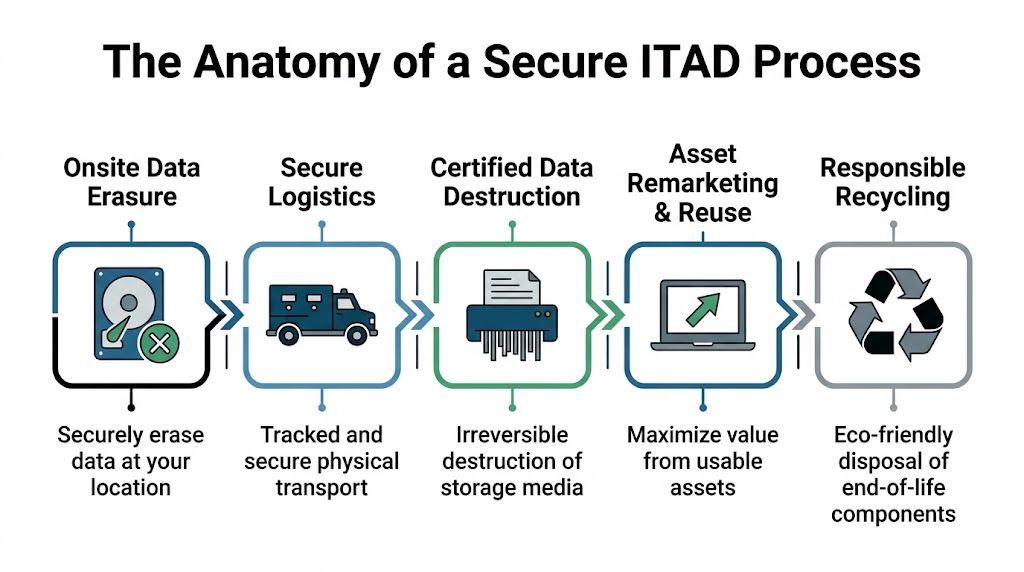
The Anatomy of a Secure ITAD Process
A secure ITAD process should feel boring in the best way. Every stage should be documented, repeatable, and easy to verify later. If a provider can’t explain the chain from your loading dock to final certificate, that’s a problem.
Step one starts on your site
The process usually begins with onsite inventorying and decommissioning. Technicians create a serialized asset list that records make, model, specifications, and condition. That list matters more than many teams realize. It becomes the backbone for chain of custody, downstream processing decisions, and final reporting.
At this point, the provider should also separate reusable assets from clearly end-of-life equipment. You don’t want working gear damaged during removal because nobody planned the loadout. For server rooms and data centers, rack-by-rack staging and careful de-installation prevent confusion later.
Chain of custody is the hinge point
Once assets leave your floor, the integrity of the entire project depends on custody controls. Devices should move through a documented handoff, not a casual pickup. Containers, pallets, serialized lists, signed transfer records, and tracked transportation all matter.
Practical rule: If your organization would document who touched a production server while it was live, document who touched it after retirement too.
For many regulated organizations, transport is where anxiety spikes. That’s why some teams prefer onsite sanitization for certain classes of equipment before anything is moved.
Wiping and shredding are not interchangeable
In Atlanta ITAD work, secure data destruction relies on NIST 800-88 compliant wiping or physical shredding. For reusable assets, DoD 5220.22-M 3-pass wiping is used, while non-functional drives are physically shredded to particles smaller than 2mm, making data 99.9% unrecoverable and supporting audit trails for HIPAA and GDPR, as described in Atlanta Computer Recycling’s overview of IT asset disposition.
That sentence contains the key trade-off. If an asset may be reused or resold, wiping preserves value. If the media is failed, suspect, or too risky to release, shredding ends the question entirely.
Here’s the practical decision logic:
- Use wiping when the asset is functional, destined for reuse, and your policy permits sanitized remarketing
- Use shredding when the drive is damaged, the risk tolerance is low, or the organization requires physical destruction
- Use onsite execution when transport risk is a major concern or internal policy requires it
If you need a more detailed view of wipe and destruction options, secure destruction of data practices for retired IT assets lays out the operational side.
What happens after data destruction
After sanitization or shredding, the stream splits again. Reusable assets move into grading, refurbishment, or resale channels. End-of-life units are dismantled for responsible recycling. During these processes, a disciplined provider protects both value and environmental handling.
The reporting stage closes the loop. Your organization should receive itemized documentation that ties the original inventory to the final outcome. That may include serial references, destruction records, and disposition summaries.
What good process discipline looks like
A secure ITAD project usually includes:
- Asset identification before anything is unplugged
- Controlled de-installation so gear isn’t damaged or mixed
- Recorded custody transfers from site to processing
- Device-appropriate data destruction based on reuse status and policy
- Final documentation that an auditor or internal reviewer can follow without guesswork
What doesn’t work is skipping straight to hauling. Once equipment leaves without a clean inventory and custody trail, you’ve already made reporting harder than it needs to be.
Navigating Atlanta's Compliance Maze for E-Waste
Compliance pressure around retired technology doesn’t hit every organization the same way. A hospital worries about patient data. A school worries about student records and inventory accountability. A government office worries about public-sector controls, retention expectations, and procurement rules. The disposal method may look similar from the outside, but the compliance logic behind it is very different.
Why Atlanta organizations need tighter documentation
For Atlanta hospitals and government agencies, sector-specific compliance needs are a major issue. One gap in the market is audit-ready reporting for NIST 800-88 and adherence to local Georgia e-waste laws, especially as 30% of Atlanta firms seek ESG-verified partners to meet rising sustainability and data privacy standards for 2026, according to Transpere’s Atlanta ITAD service area page.
That fact points to a practical shift in buyer behavior. It’s no longer enough for a vendor to say, “We destroy data.” Buyers increasingly want proof they can file, review, and hand to risk, legal, procurement, or sustainability teams.
Sector by sector risk looks different
Healthcare organizations usually need the deepest paper trail. If a clinic, imaging center, or hospital retires laptops, workstation towers, backup media, or storage arrays, the records around sanitization and final disposition matter almost as much as the physical service itself.
Schools and universities often have a different challenge. Their retired devices may be spread across campuses, departments, labs, and storage rooms. The compliance issue isn’t only data. It’s also asset control, repeatable policy, and making sure surplus property doesn’t drift into informal channels.
Government offices usually need stricter procedural discipline. They may require documented pickups, serialized reporting, and destruction certificates that align with internal purchasing and records workflows.
The documents that actually matter
When evaluating IT Asset Disposition Services Atlanta GA, ask whether the provider can produce these records cleanly:
- Serialized asset lists that match what left your site
- Chain-of-custody records that show who handled equipment and when
- Data destruction documentation tied to device or media identifiers
- Final disposition summaries showing reuse, resale, or recycling pathways
A strong example of the final reporting standard is the kind of documentation discussed in certificate of destruction requirements for electronics disposal.
If your compliance team can’t match a destroyed drive to a specific record, the destruction may have happened, but the proof gap still hurts you.
What fails under scrutiny
Several patterns tend to break down when organizations are audited or internally reviewed.
| Weak practice | Why it creates trouble |
|---|---|
| Bulk pickups with no serialized intake | You can’t easily reconcile what was removed |
| Generic “data destroyed” statements | Auditors usually need more than broad language |
| Mixed office cleanouts and IT disposal | Data-bearing devices get lost in non-IT workflows |
| No ESG or recycling records | Sustainability claims become hard to support |
The smartest Atlanta organizations now treat retired IT as a compliance workflow, not a janitorial event. That shift reduces friction later when procurement, privacy, legal, or sustainability teams ask for evidence.
The Business Case for Mission-Driven ITAD
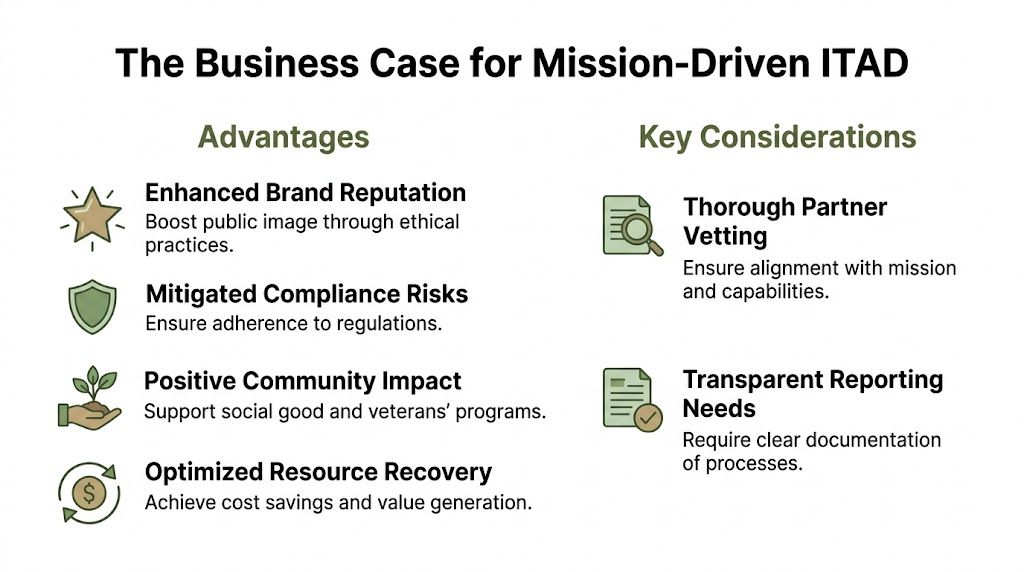
The old way to justify ITAD was simple. Avoid risk. Remove clutter. Stay compliant. That still matters, but it’s incomplete. A stronger business case ties secure disposition to cost control, asset recovery, and brand value.
ROI starts with honest asset triage
One overlooked issue in Atlanta is that many providers don’t give buyers clear financial models. As noted by Beyond Surplus in its Atlanta ITAD services discussion, a key underserved angle is ROI visibility. The same source notes that value recovery for servers can average 20-40%, and that IT managers often lack the cost benchmarks needed to compare disposition choices against potential EPA fines of $50,000+.
That doesn’t mean every retired server is valuable. Many aren’t. The point is that organizations need a disciplined way to separate what still has remarketing potential from what should move straight to destruction and recycling. Without that triage, companies either destroy assets that still had recoverable value or store them so long that market value disappears.
A better way to evaluate ITAD economics
Instead of asking only “What does pickup cost?” ask a wider set of questions.
- What can still be resold or reused after proper testing and sanitization?
- What internal labor are we spending to store, move, and repeatedly revisit old equipment?
- What is the downside cost if undocumented disposal creates a compliance issue?
- What reporting value does this create for sustainability, procurement, and governance teams?
That broader frame changes the conversation. ITAD stops looking like a disposal expense and starts looking like lifecycle management.
Where mission changes the equation
Mission-driven ITAD adds another layer. If your company already publishes CSR or ESG reporting, retired electronics can become one of the easiest stories to document. Equipment leaves securely. Materials avoid landfill channels. Reuse is maximized where policy allows. Then the disposition event also supports veteran aid and reforestation.
That’s not a marketing gimmick when it’s documented properly. It gives operations teams, HR, sustainability leaders, and communications teams a shared story around one practical action. A spring refresh, a warehouse cleanup, a campus surplus event, or a data center decommission can support internal controls and external impact at the same time.
Some companies treat e-waste as a mess to hide. Smarter companies treat it as proof that operational discipline and community impact can live in the same workflow.
What a mission-driven program can include
A company building this model in Atlanta might use a package like this:
| Program element | Business use |
|---|---|
| Corporate recycling drives | Simplifies large-volume cleanouts across offices |
| Plant-a-tree certificates | Supports CSR documentation and employee engagement |
| Veteran support impact reports | Gives leadership a tangible social impact record |
| Digital “Recycled with Purpose” badges | Extends the story to websites and sustainability reports |
Atlanta Green Recycling is one local option that combines business electronics recycling, secure data destruction, and cause-based messaging around veteran support and tree planting. For organizations that want their disposition process to serve both compliance and community goals, that model is worth evaluating alongside more conventional providers.
What works and what falls flat
Mission-driven ITAD works when the underlying controls are solid. If chain of custody, sanitization, and reporting are weak, the social mission won’t rescue the program. It also works best when the impact outputs are usable by the client. Certificates, summaries, and reporting artifacts matter because internal teams need something concrete.
What falls flat is vague feel-good language with no operational backbone. Buyers in healthcare, education, government, and enterprise IT don’t need sentiment first. They need secure execution first. The mission becomes powerful after that.
Choosing Your Atlanta ITAD Partner A Checklist for Success
A provider meeting should leave you with confidence, not more ambiguity. If a vendor talks in broad promises but gets fuzzy when you ask about drive handling, custody, reporting, and downstream recycling, keep looking.

The technical checklist
Use this list when comparing IT Asset Disposition Services Atlanta GA providers.
- Ask how inventory is created. You want serialized intake, not a rough item count.
- Ask where data destruction happens. Some projects call for onsite wiping or shredding before transport.
- Ask how they decide between wiping and shredding. The answer should depend on device condition, reuse potential, and your policy.
- Ask what final documentation looks like. If they can’t show sample reporting structure, expect trouble later.
- Ask about logistics control. Pickup, de-installation, packing, and transport should be deliberate, not improvised.
The partnership checklist
Technical competence is the floor. The better question is whether the provider improves your program.
Here are the questions buyers often forget to ask:
- Can they support multiple sites across the Atlanta metro area without losing reporting consistency?
- Can they adapt to hospitals, schools, public agencies, or enterprise approval workflows?
- Can they provide material your sustainability or communications team can use?
- Do they have a clear mission that aligns with your company’s public commitments?
For a broader comparison of vendor types and service models, this overview of IT asset disposition companies is a practical starting point.
A short scorecard for vendor conversations
| Question | Strong answer | Weak answer |
|---|---|---|
| How is chain of custody maintained? | Specific steps and records | “We handle that” |
| What happens to reusable assets? | Clear grading and disposition path | “It depends” with no detail |
| What reporting do we receive? | Itemized, audit-ready records | Generic certificate only |
| How do you support our ESG goals? | Defined outputs and impact documentation | Marketing language without proof |
The best selection process balances security, compliance, logistics, recovery, and mission fit. If one of those is missing, the partnership usually becomes harder over time.
Recycling That Restores Lives and Landscapes in Atlanta
A lot of companies want their sustainability program to feel real. They’re tired of symbolic gestures that never touch operations. Retired electronics are one of the few areas where a routine business process can produce visible good when it’s designed intentionally.
That’s why cause-based ITAD resonates. Your old tech doesn’t have to end as a liability story. It can become part of a better local story. The message is simple and memorable: your old tech can house a veteran and grow a forest.
Why this message lands
Employees understand it immediately. Leadership can explain it without jargon. Clients and community partners can see the connection between responsible disposal and practical impact. A device leaves your office through a secure, documented process, and the outcome reaches beyond compliance.
That model becomes even stronger when the reporting is transparent. Impact counters on a website, seasonal drives around Veterans Day or Earth Day, and post-project impact summaries give organizations something tangible to share internally and externally. Even without citing numbers, the principle matters. People respond when they can see that routine cleanup work supports restoration.
What this can look like in practice
A mission-driven Atlanta program can take several forms:
- Corporate recycling drives tied to office refreshes or campus cleanouts
- School and city collection partnerships under a Greener Atlanta theme
- Veteran and environmental nonprofit collaborations that turn disposal events into community events
- Impact certificates and newsletters that keep one-time clients engaged as long-term partners
Turning e-waste into hope only works when the process is disciplined enough to earn trust and human enough to inspire action.
The strongest part of this model is that it doesn’t ask businesses to bolt on a separate charity initiative. It takes a task they already need to complete and gives it social and environmental meaning. That’s why it fits so well in Atlanta. This is a city full of growth, redevelopment, healthcare expansion, education systems, logistics infrastructure, and constant technology turnover. There’s no shortage of retired equipment. The better question is what kind of downstream story that equipment will create.
For companies that want their disposal program to do more than clear space, mission-driven ITAD offers a rare combination. It protects the organization, supports sustainability, and contributes to people and places that need help.
Frequently Asked Questions About ITAD in Atlanta
How do I schedule a business pickup in Atlanta
Start by assembling a rough list of what you have. Include device types, approximate quantities, whether any items still hold data, and whether equipment is onsite at one location or spread across several. That information helps the provider determine whether the project needs basic pickup, onsite de-installation, or a more controlled data destruction plan.
What kinds of equipment are usually included in ITAD
Most business ITAD projects include laptops, desktops, servers, monitors, hard drives, SSDs, networking gear, phones, and related peripherals. Some projects also include loose storage media, rack equipment, and gear left over from office moves or data center changes. The important distinction is whether the item is data-bearing, reusable, or strictly end-of-life.
Do I need wiping or physical shredding
It depends on the device and your policy. If the equipment is functional and suitable for reuse, wiping may preserve value while still meeting your security requirement. If the media is failed, highly sensitive, or your organization requires physical destruction, shredding is the cleaner answer. A good provider should recommend the method based on risk, condition, and compliance needs, not convenience.
What should I prepare before pickup day
Gather loose drives, separate business electronics from general office junk, and identify any equipment that needs to stay in service until the last minute. If your team has asset tags or internal inventory records, keep them available. The smoother your internal handoff, the cleaner the final reporting will be.
What does a Certificate of Destruction usually include
A useful certificate should do more than say data was destroyed. It should connect the destruction event to identifiable assets or media, reference the destruction method, and support your internal records. If the certificate is too generic, ask for stronger itemization or supporting inventory documentation.
Is ITAD only for large enterprises
No. Mid-sized companies, clinics, schools, professional offices, and public agencies all generate retired technology that needs proper handling. The scale may differ, but the core questions stay the same: what data is on the equipment, who is responsible for custody, what can be recovered, and what proof will you have at the end.
Can ITAD support our CSR or ESG reporting
Yes, if the provider offers usable documentation. That may include recycling summaries, destruction records, and impact materials tied to mission-based programs. The key is whether the outputs are clear enough for your sustainability, communications, procurement, and compliance teams to use without rebuilding the story themselves.
If your organization is ready to clear out retired devices without creating a security headache, Atlanta Green Recycling offers business-focused electronics recycling, secure data destruction, and IT asset disposition support across the Atlanta metro area. It’s a practical next step for companies that want compliant disposal, cleaner operations, and a mission their team can feel good about.