
Business Electronics Recycling Services Atlanta GA

The call usually comes after a move, a refresh, or an audit. An IT manager opens a locked storeroom and sees old laptops stacked beside dead monitors, a few retired switches, loose hard drives in banker boxes, and a server nobody wants to claim ownership of. Operations wants the space back. Finance wants the assets gone. Legal wants proof that nothing with data leaves the building exposed.
That’s the moment when business electronics recycling stops being a housekeeping task and turns into a risk decision.
In Atlanta, that decision also sits inside a much bigger waste problem. The United States generates over 3.5 million tons of e-waste annually, the fastest-growing segment of municipal solid waste, yet only 15-20% is properly recycled, according to Reworx Recycling’s summary of EPA-linked Atlanta e-waste data. For businesses, the practical issue isn’t just landfill diversion. It’s chain of custody, data destruction, internal signoff, and whether the recycler can handle real-world pickups without disrupting your team.
A good provider solves those basics. A smarter program does more. In Atlanta, more companies are looking at Business Electronics Recycling Services Atlanta GA as part of a broader ESG and CSR story. If the same pickup that clears your storage room can also support veterans and fund tree planting, the project moves from “dispose of old gear” to “document a positive community outcome from an operational necessity.”
That shift matters because employees notice it, procurement notices it, and leadership can use it in sustainability reporting. The work still has to be compliant first. But when it’s done well, old tech doesn’t just leave your site safely. It can become part of a stronger brand narrative.
From Cluttered Storeroom to Community Impact
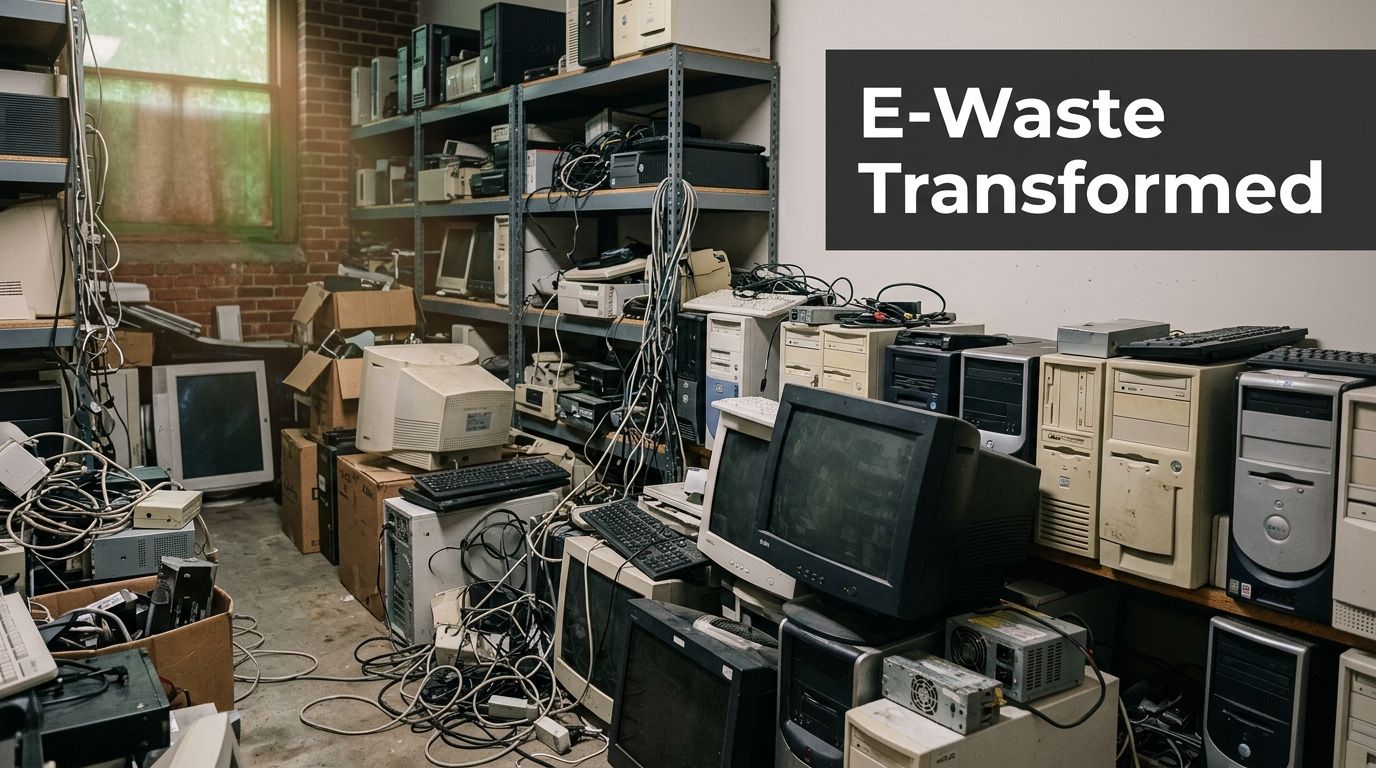
A Midtown office manager recently described a scene every Atlanta operations team knows well. One room held years of deferred decisions: docking stations from three laptop cycles ago, a row of obsolete desktops, cracked screens, badge readers, printers, and cables that nobody could confidently classify as scrap or reusable inventory. The room had become a storage tax on the business.
That kind of backlog creates three problems at once. Data-bearing devices sit longer than they should. Departments lose usable floor space. Nobody has a clean record of what left service, what still has resale value, and what needs certified destruction.
What the storeroom is really telling you
A cluttered e-waste room usually means the organization has outgrown an informal disposal process. What worked when your office retired five laptops a year doesn’t work when you’re handling mixed loads from remote returns, office consolidations, clinic upgrades, or a data center refresh.
The operational signs are easy to spot:
- Unlabeled devices mean your team can’t quickly separate data-bearing assets from low-risk peripherals.
- Mixed-condition equipment slows decision-making because some gear may be remarketable while other items need immediate recycling.
- No documentation trail turns a simple cleanout into a compliance headache during audits or internal reviews.
Practical rule: If equipment has been sitting untouched for months because nobody wants to own the disposal process, the real issue isn’t storage. It’s process design.
Turning a disposal job into a visible ESG action
The strongest recycling programs don’t ask a busy IT manager to choose between compliance and community value. They build both into the same workflow. Devices are inventoried, secured, removed, and processed properly. Then the client gets documentation that can support internal reporting and public-facing CSR communication.
That’s where a cause-based approach changes the conversation. Instead of telling staff that old hardware was “disposed of,” leadership can say the company completed a secure recycling program that also supported veterans and reforestation efforts. That framing is more than marketing language. It gives a routine operational project a human outcome employees can understand.
For local organizations in healthcare, education, logistics, finance, and tech, Business Electronics Recycling Services Atlanta GA can do two jobs at once. The first is obvious: reduce risk and clear space. The second is more strategic: turn end-of-life IT into a social and environmental asset.
“Turning E-Waste into Hope” works because it’s grounded in a real business need. Nobody is inventing a cause to justify a campaign. The e-waste already exists. The question is whether your recycler treats it like a burden or like an opportunity to restore lives and environments while keeping your compliance posture intact.
Core Business Electronics Recycling Services Explained
Most business clients don’t need a lecture on recycling theory. They need a provider that can show up, secure the material, destroy data properly, separate value from scrap, and leave behind paperwork the auditors won’t argue with.
That work usually falls into three service pillars.
Secure data destruction
Data destruction is where many internal teams get stuck. They know drives can’t just leave the building untouched, but they’re less certain about which destruction method fits which asset class.
Think of it this way. Wiping is the digital equivalent of removing the contents of a file cabinet so the cabinet can be reused. Physical shredding is destroying the cabinet itself because reuse no longer makes sense or policy requires final destruction. Both methods have a place.
Leading Atlanta operators use NIST 800-88 protocols as part of compliant data destruction workflows, and R2-certified processing environments matter because they tie data handling to environmental and chain-of-custody controls. If you want a deeper primer on how this fits into disposition planning, this guide on what IT asset disposition involves is a useful starting point.
A practical sorter inside most programs looks like this:
- Reusable assets go to sanitization, testing, and potential remarketing.
- Sensitive failed media goes to physical destruction.
- Low-value non-data equipment moves into commodity recycling streams.
Pickup and on-site logistics
The second pillar is logistics. The practical success or failure of projects hinges on it.
A business recycler should be able to do more than accept drop-offs. Enterprise clients often need on-site de-installation, packing, palletization, loading dock coordination, and fleet pickup across the Atlanta metro. That matters when your team can’t spare technicians to carry old UPS units down a freight elevator or sort hundreds of devices into neat categories before the truck arrives.
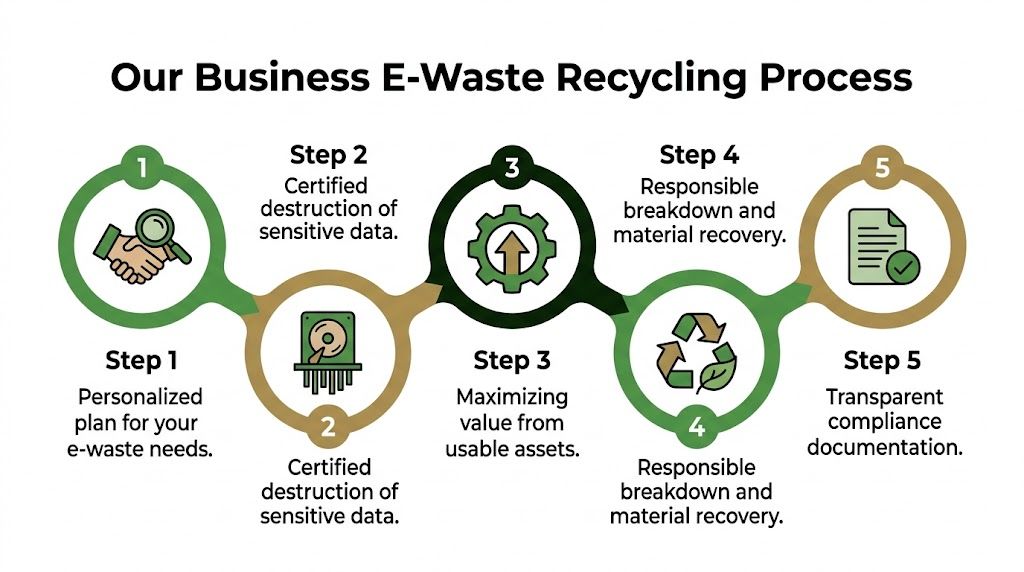
The cleanest projects usually follow a simple field process:
- Pre-pickup scoping identifies what has data, what needs labor, and what can be staged.
- On-site segregation keeps drives, servers, monitors, cables, batteries, and network gear from becoming one messy load.
- Controlled loading preserves chain of custody from room to truck.
A provider such as Atlanta Green Recycling handles secure data destruction, bulk IT equipment removal, on-site de-installation, and fleet pickup for Atlanta-area organizations. That’s the kind of turnkey model many IT managers prefer because it reduces handoffs.
Data center decommissioning and large refresh projects
The third pillar is project-based decommissioning. This is a different animal from clearing a single office closet.
Data center work requires coordination. Racks come down in sequence. Assets may need tagging against internal inventories. Drives often need separate handling from chassis. Some equipment has resale value. Some has no market value but still needs documented processing.
What works in these jobs is discipline, not speed alone.
A rushed decommissioning creates avoidable mistakes. A structured decommissioning creates traceability.
For Atlanta businesses planning relocations, mergers, floor reductions, or infrastructure upgrades, the right recycler functions like a logistics and compliance partner. That’s what separates a real business electronics recycling service from a company that only hauls away unwanted equipment.
Navigating Atlanta's E-Waste Compliance Landscape
Compliance is where a lot of recycling conversations get vague. Vendors say “secure recycling” or “certified data destruction,” but busy IT and compliance teams need to know what those phrases mean in practice. In Atlanta, that usually starts with two standards that matter immediately: R2 certification and NIST 800-88 data sanitization.
According to STS Electronic Recycling’s Atlanta certificate of destruction overview, leading Atlanta recyclers operate R2-certified facilities and follow NIST 800-88 data destruction protocols, which is especially important for healthcare organizations subject to HIPAA and for government agencies with strict data handling rules.

Why R2 matters beyond the logo
R2 isn’t just a badge for a website footer. For a business client, it signals that the recycler operates inside a formal framework for downstream control, environmental management, worker safety, and documentation. If your team has ever tried to answer basic internal questions like “Where did the equipment go?” or “Who handled the drives?” you already know why that matters.
A compliant recycler should be able to support:
- Chain-of-custody records that show who took possession and when
- Certificates of destruction that map to the sanitization or destruction work performed
- Documented downstream handling so you’re not sending hazardous material into unknown channels
For companies comparing providers, local operational knowledge matters too. City access, building rules, loading constraints, and municipal disposal habits all affect execution. This overview of City of Atlanta recycling considerations is helpful for teams trying to align internal disposal practices with local expectations.
NIST 800-88 and what it changes on the ground
NIST 800-88 gives structure to data sanitization. It pushes the conversation past vague promises and into a repeatable method. That’s useful because not every device should be handled the same way.
A practical field interpretation looks like this:
| Asset type | Typical handling question | Compliance-focused response |
|---|---|---|
| Laptops and desktops | Can the drive be wiped and the asset reused? | Sanitize under a documented protocol, then test for reuse or remarketing |
| Failed hard drives | Is the media readable or trustworthy enough to release? | Physically destroy if sanitization can’t be verified |
| Servers from regulated environments | Does the asset contain sensitive organizational data? | Maintain chain of custody and document sanitization or shredding before remarketing or recycling |
Many generic haulers fall short. They can remove equipment, but they can’t always explain why a wipe was sufficient for one class of device and shredding was required for another.
The right recycler doesn’t just tell you a drive was destroyed. They can show how it was identified, controlled, processed, and documented.
HIPAA is where details matter
Healthcare creates a more demanding version of the same problem. Hospitals, clinics, imaging centers, labs, and specialty practices don’t just retire laptops. They also retire patient monitors, diagnostic workstations, storage arrays, thin clients, printers, and mixed biomedical support equipment that may intersect with protected health information workflows.
The underserved issue in Atlanta is specificity. Many providers mention “secure data destruction,” but fewer explain how that translates into HIPAA-aware handling, internal risk assessment support, and audit-ready paperwork. The background brief supplied for this article highlights that gap and notes a need for stronger guidance around chain of custody and risk assessment expectations for PHI-bearing devices.
For healthcare teams, the practical questions should be direct:
- Which items may contain PHI or cached credentials
- Whether serial-level or asset-tag-level tracking is needed
- What certificate format your compliance team expects
- Whether on-site destruction is necessary for selected media
A hospital IT director and a compliance officer rarely need more jargon. They need a recycler who can fit the disposal workflow into the organization’s audit process without creating new uncertainty.
What works and what doesn’t
What works is a documented process that starts before pickup. Assets are scoped, data-bearing devices are identified, and destruction decisions are made intentionally.
What doesn’t work is waiting until the truck arrives to decide which devices have data, which can be reused, and which require witnessed destruction. That approach creates delays, weakens documentation, and forces your internal team to make policy decisions under pressure.
For Atlanta organizations, especially in healthcare and government-adjacent sectors, compliance in electronics recycling is less about dramatic risk language and more about disciplined execution. If the recycler can’t explain chain of custody, sanitization protocol, certificate format, and downstream handling in plain English, keep looking.
Your ESG Advantage Recycling for Veterans and Forests
Most recycling vendors stop at compliance. They’ll remove the equipment, issue documentation, and close the ticket. This addresses the operational need, but it leaves a lot of value on the table for companies that want disposal projects to support a wider ESG story.
A stronger model connects the same pickup to visible community outcomes. In practical terms, your retired tech can support veteran aid and tree planting while still moving through a secure, compliance-minded recycling process. That’s what makes cause-based electronics recycling more than a slogan. It gives leadership something credible to communicate after the equipment is gone.
Recycle for a Cause in practice
The phrase that tends to resonate most with decision-makers is simple: your old tech can house a veteran and grow a forest. It works because it translates abstract ESG language into something employees, customers, and boards can grasp quickly.
That matters during office moves, refresh cycles, and bulk clear-outs. Those projects already require internal approvals. When procurement, facilities, IT, and leadership are aligned on the operational side, adding a visible social and environmental outcome makes the project easier to champion internally.
What clients can actually use after the pickup
The ESG value only matters if it becomes usable documentation, not just feel-good messaging. Companies typically need artifacts they can hand to HR, communications, leadership, or sustainability teams.
Useful outputs include:
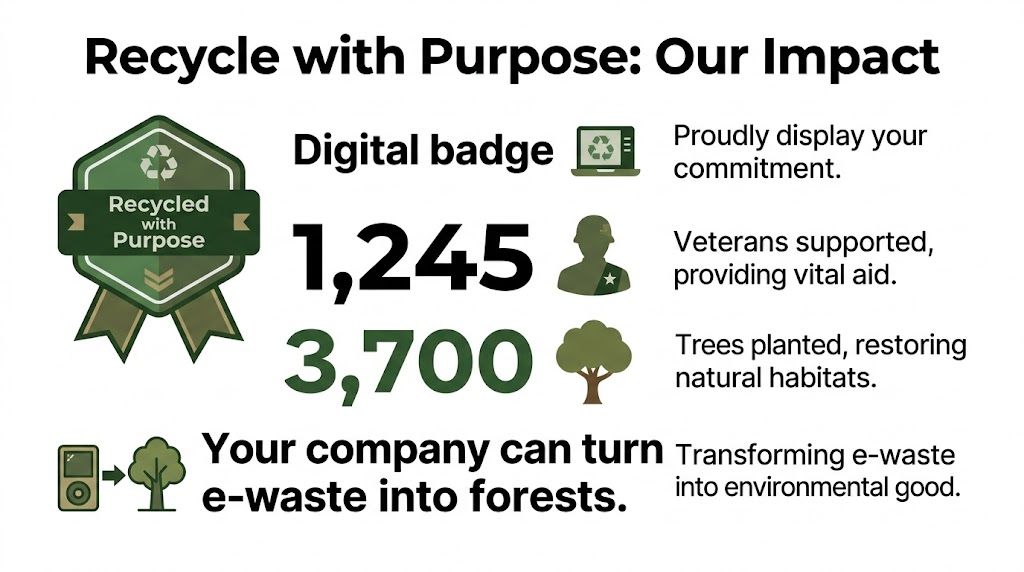
- Plant-A-Tree certificates for sustainability files, employee communications, or event recaps
- Veteran Support Impact Reports for CSR summaries and internal storytelling
- Recycled with Purpose badges that partners can place on websites, proposal decks, or sustainability materials
For organizations building local sustainability messaging, this page on Atlanta recycling services and community impact fits naturally into that conversation.
Why this lands with employees and stakeholders
Employees usually don’t get excited about “asset disposition.” They do respond to tangible outcomes. When a company explains that an obsolete device collection supported local good while keeping electronics out of improper disposal channels, the project becomes legible to the broader workforce.
That’s also why seasonal campaigns work well. Veterans Day, Earth Day, and Arbor Day give companies a natural reason to run internal collection drives, refresh dormant storage rooms, and attach the project to a broader civic message. For marketing and HR teams, those campaigns are easier to tell than another generic sustainability post.
“Recycling That Restores Lives and Landscapes” is stronger than a generic promise because it connects disposal to a concrete human result.
The strategic point is simple. Business Electronics Recycling Services Atlanta GA can satisfy compliance requirements and strengthen public-facing CSR at the same time. If your company already spends time writing ESG updates, it makes sense to choose operational vendors that produce a story worth reporting.
Planning Your Pickup Logistics Pricing and Procurement
At 4:30 p.m. on a Thursday, the questions usually get practical fast. The storeroom has to be cleared before a lease inspection, procurement wants a quote that finance can defend, and IT wants written proof that every drive was handled correctly. That is the point where pickup planning stops being a cleanup task and becomes an operations project.
The companies that get this right define three things before they request pricing: what is being removed, how data-bearing assets will be controlled, and whether any equipment still has resale value. If one of those pieces is vague, the quote usually is too.
Scope the job before you shop the market
A recycler can price a clean inventory. A recycler has to pad risk into a vague one.
Start with the inventory and the building conditions together, not as separate workstreams. A list of 60 laptops means one thing if they are boxed near a dock and something very different if they are spread across three floors with no carts, limited elevator access, and a two-hour pickup window. Teams working through internal transport constraints often borrow useful ideas from broader guides on optimizing pickup and delivery logistics, especially when timing, staging, and handoff controls all affect chain of custody.
A practical intake checklist should cover:
- Device mix such as laptops, desktops, servers, switches, monitors, printers, and loose drives
- Access conditions such as dock reservations, freight elevator rules, stair carries, and after-hours restrictions
- Labor requirements such as de-installation, packing, palletizing, or carting equipment from multiple departments
- Data handling requirements such as on-site shredding, witnessed destruction, serialized asset tracking, or certificates of destruction
- Scheduling constraints such as blackout dates, office move deadlines, or coordination with facilities and security
If facilities needs a reference before pickup day, this guide to loading dock planning for equipment removal helps prevent the delays that turn a two-hour job into an all-day one.
Price the service by asset type, not by wishful thinking
Mixed loads rarely price out cleanly because they contain different cost profiles. Usable laptops and late-model networking gear may offset part of the service cost after testing and remarketing. Commodity material such as broken monitors or obsolete peripherals usually has little recovery value. Items that require extra labor or stricter destruction controls add cost.
That is why "free pickup" is not a procurement standard. It is a marketing phrase tied to volume, asset mix, and access conditions.
A stronger quote separates the load into value classes:
| Asset class | Typical outcome | Cost implication |
|---|---|---|
| Reusable equipment | Sanitized, tested, remarketed | May offset service costs |
| Commodity recycling material | Processed for material recovery | Usually neutral to low-value |
| Special handling items | Destroyed or processed under tighter controls | May increase labor or processing cost |
In practice, the cheapest quote often leaves out labor assumptions, data destruction detail, or reporting requirements. That gap usually shows up later as change fees, delays, or weak documentation.
Give procurement an RFP that exposes process quality
Procurement does not need more vague sustainability language. It needs decision points that stand up to audit, legal review, and finance scrutiny.
Use questions like these:
| Verification Area | Key Question to Ask | Why It Matters |
|---|---|---|
| Certification | Are you operating through an R2-certified facility? | Confirms the downstream process follows a defined environmental and operational standard |
| Data destruction | Do you follow NIST 800-88 sanitization protocols, and when do you shred instead of wipe? | Shows how the vendor handles different risk levels across data-bearing devices |
| Chain of custody | What documentation do you provide from pickup through final processing? | Gives IT and compliance a defensible record |
| On-site services | Do you provide de-installation, packing, and dock-side loading support? | Reduces internal labor and scheduling friction |
| Value recovery | Which assets are evaluated for resale or remarketing? | Helps finance estimate whether service costs can be offset |
| Minimum volume | What happens if our load does not meet a free-pickup threshold? | Prevents avoidable surprise charges |
| Reporting | What certificates, serialized reports, or ESG summaries do we receive after completion? | Determines whether the project supports compliance records and sustainability reporting |
The last line matters more than many buyers expect. If your company reports ESG progress, the vendor should be able to document not only where equipment went, but also what community outcome the project supported. In Atlanta, that can turn a routine refresh into a measurable CSR action tied to veterans support and reforestation, not just waste removal.
How small and mid-sized businesses should evaluate the bid
Smaller organizations usually have less volume, tighter staffing, and less tolerance for a complicated pickup day. That changes the buying decision. The right question is the net result after service fees, internal labor time, scheduling burden, data handling requirements, and any resale credit on usable equipment.
I usually tell IT managers to compare bids against the internal alternative. If your staff has to spend half a day boxing gear, escorting a truck, tracking serials by hand, and answering follow-up questions from finance, that labor has a cost even if the pickup line item looks low.
The stronger procurement choice is the vendor with a clean process, clear scope, and documentation your company can use later in an audit, an ESG report, or a board update. That is how retired electronics stop being a storage problem and start producing operational, environmental, and social value.
Atlanta Success Stories From Compliance to Community
A lot of companies understand the theory of secure recycling but don’t see what the project looks like inside a real organization. The details vary, but the turning points are usually the same: an office move, a refresh cycle, or a regulated equipment retirement that can’t wait any longer.
A tech firm clearing an office before relocation
An Atlanta software company preparing for a downsizing move had accumulated years of retired hardware in a former training room. The pile included laptops, docking stations, monitors, small network gear, and a handful of old servers that had stayed in place because no one wanted to own the chain-of-custody risk.
Their first instinct was to ask facilities to remove everything in one sweep. That would have been faster on paper, but it would have mixed data-bearing equipment with low-risk peripherals and created unnecessary uncertainty. Instead, the company split the project into two streams. IT identified what needed sanitization or destruction. Operations handled access, staging, and dock timing.
The result wasn’t dramatic in a flashy sense. It was orderly. The room was cleared. The devices that still had residual use potential were separated from scrap. The leadership team then used the resulting community impact documentation in an internal ESG update and employee announcement about the move.
Staff members usually don’t celebrate “disposition completed.” They do respond when a company shows that secure recycling also supported a wider cause.
That internal response matters more than many firms expect. A relocation already creates disruption. Tying the cleanup effort to a veterans-and-reforestation story gave the company a better way to communicate the transition.
A healthcare system handling retired clinical equipment
A metro Atlanta healthcare organization faced a different challenge. They were rotating out patient monitors, workstation equipment, and older back-office systems tied to clinical workflows. Their compliance team didn’t want broad assurances. They wanted clarity on which devices might hold sensitive data, how the equipment would be tracked, and what documentation would come back.
What worked was early coordination. Biomedical staff, IT, and compliance reviewed the retired inventory before pickup. That prevented a common problem in healthcare environments, where devices are physically removed before anyone settles the data handling question.
The recycler’s role in a situation like this isn’t just transportation. It’s process discipline. The healthcare team needed a documented destruction path for storage media, a clear chain of custody, and records that fit their audit file. They also wanted the environmental side of the project reflected in a way leadership could share without overselling it.
Once the equipment left service through a controlled workflow, the organization was able to close the compliance loop and still fold the recycling effort into a broader “Greener Atlanta” style sustainability message. That combination is what many hospitals want. They don’t need a marketing spectacle. They need low-drama execution with community value attached.
The lesson from both
The corporate story and the healthcare story look different on the surface. One centers on a move. The other centers on regulation. But both projects succeeded for the same reason: the teams treated electronics recycling as an operational program, not an afterthought.
When that happens, Business Electronics Recycling Services Atlanta GA becomes easier to justify internally. Compliance gets documentation. IT gets control. Facilities gets space back. Leadership gets a community outcome worth sharing.
Transform Your E-Waste into a Strategic Asset
Old electronics are easy to ignore until they become a security concern, an audit issue, or a space problem. The smarter move is to treat them as a managed asset stream from the start.
That means choosing a recycling partner that can handle secure data destruction, controlled logistics, and documentation without forcing your staff to improvise on pickup day. It also means recognizing that end-of-life IT can support a broader business goal. Done correctly, the same project that removes retired gear can strengthen your compliance posture, support ESG reporting, and create visible value for the community.
If some of your retired equipment still has remarketing potential, this guide on old electronics for cash is a useful next step.
The core idea is simple. E-waste doesn’t have to sit in a storeroom as a liability. With the right process, it becomes a controlled, documented, and socially useful part of your operations.
If your Atlanta organization is planning a refresh, an office move, a clinic upgrade, or a data center decommissioning project, now’s the right time to scope the load, define the data requirements, and schedule a compliant pickup.
Frequently Asked Questions
What types of business electronics can be recycled?
Business recycling programs usually accept desktops, laptops, servers, monitors, switches, phones, printers, cables, batteries, and loose drives. The practical screening question is whether the item contains data, regulated components, or both.
For Atlanta IT managers, that matters more than the basic acceptance list. A broken laptop and a retired firewall may both be recyclable, but they do not move through the same chain of custody or documentation process. Schools, clinics, manufacturers, and corporate offices also tend to generate mixed loads, so it helps to sort data-bearing devices from general peripherals before pickup.
Do Atlanta businesses always qualify for free pickup?
No. Pickup cost usually depends on load size, equipment mix, building access, packing condition, and the labor required onsite.
A pallet of business-grade laptops is different from a scattered storeroom of CRT monitors, printers, and loose cables. Some loads have resale value that can offset service costs. Others require enough handling and downstream processing that a fee is appropriate. Ask for the exact pickup threshold, any minimums, and whether serialized assets or labor-intensive removal will change the quote.
What’s the difference between wiping and shredding?
Wiping sanitizes a drive or device under an approved process so the hardware may be reused if it still has value. Shredding destroys the media physically.
The right choice depends on your policy, the data class, and the condition of the asset. If a device is heading to reuse, wiping may preserve value and support a stronger ESG outcome because the equipment stays in service longer. If the media is damaged, highly sensitive, or your policy requires physical destruction, shredding is the cleaner answer.
Can a recycler support healthcare and HIPAA-related disposal needs?
Yes, if the recycler can document control at each step. For healthcare clients, broad promises about secure disposal are not enough.
Ask how assets are identified, how chain of custody is maintained, what destruction records are issued, and whether the team is used to working with clinic managers, compliance staff, and third-party auditors. The process should fit your internal retention and incident-response requirements, not force your staff to fill the gaps later.
What paperwork should a business expect after pickup?
The standard package often includes pickup records, chain-of-custody documentation, certificates of destruction, and a final disposition summary. If you need serialized reporting by asset tag, request it before the truck is scheduled, not after the load has been processed.
That upfront step saves time during audits, lease returns, and internal ESG reporting.
How do ESG and CSR documents fit into a recycling project?
They work best as an added reporting layer on top of compliance records. The core file should still document what was picked up, how data-bearing items were handled, and what final disposition occurred.
If your recycler supports veteran-focused programs or reforestation, the project can also produce usable CSR material such as planting confirmation, community impact summaries, or campaign-ready sustainability language for your internal team. For many Atlanta businesses, that changes the project from routine disposal into a documented ESG action with visible local and social value.
If your team needs a compliant, practical way to clear retired IT equipment in Metro Atlanta, Atlanta Green Recycling can help you scope the load, schedule pickup, document data destruction, and turn routine e-waste removal into a cleaner operational and community outcome.