
10 Where to Recycle Computers in Atlanta GA (2026 Guide)


Old laptops pile up fast after a lease refresh, office move, clinic upgrade, or school lab replacement. What looks like a simple cleanup job usually turns into a decision about data security, chain of custody, and where the equipment goes after it leaves your building.
For Atlanta organizations, computer recycling is part risk management and part operations discipline. Devices often hold employee records, patient information, customer data, saved credentials, or licensed software. If a recycler cannot document pickup, destruction, and downstream handling, the low-cost option can become the expensive mistake.
There is also a broader business opportunity here. The right recycling partner does more than remove clutter and wipe drives. It can support ESG and CSR goals with measurable outcomes, especially if the provider connects electronics recovery to community benefit, veteran support, or reforestation. That gives companies a stronger story for internal reporting, board updates, and sustainability communications without forcing IT and facilities teams to run separate programs.
Atlanta’s provider market is wide enough to create real trade-offs. Some recyclers are built for enterprise pickups, serialized asset tracking, and audit-ready reporting. Others are better for household drop-offs, occasional office cleanouts, or nonprofit donation channels. If you are planning a refresh or shutdown, this detailed guide to computer recycling steps in Atlanta will help you set the process up correctly before you choose a vendor.
The shortlist below focuses on that distinction. Some options fit regulated businesses and large decommissioning projects. Others make more sense for residents, small offices, and anyone who needs a practical local drop-off solution.
1. Atlanta Green Recycling
Atlanta Green Recycling stands out because it treats computer recycling like an IT disposition project, not a junk removal task. That distinction matters if you’re dealing with servers, employee laptops, backup devices, or equipment from a regulated environment.
The service mix is built for organizations that need secure handling and workable logistics. Atlanta-area providers in this category commonly offer free pickups for 50+ devices for organizations such as hospitals, schools, and data centers, according to this Atlanta computer recycling market summary. Atlanta Green Recycling is positioned directly in that lane, with pickup, de-installation, packing, hard drive wiping, and physical destruction options that fit larger projects better than simple drop-off shops do.
Why it’s the best fit for business recycling
The strongest part of Atlanta Green Recycling’s offer is how the pieces fit together. DoD-standard wiping, physical shredding for failed media, audit-minded documentation, and local project coordination all belong in the same workflow. If a team has to call one vendor for pickup, another for destruction, and a third for reporting, mistakes creep in.
Their approach works well for:
- Corporate IT teams: Office closures, refresh cycles, and storage cleanouts with mixed equipment.
- Healthcare groups: HIPAA-conscious handling and records that support internal review.
- Schools and universities: Bulk removals where staff need help boxing, staging, and moving gear.
- Government and public sector teams: Documented disposition for audit trails and due diligence.
Practical rule: If the devices ever held regulated, confidential, or employee data, choose a recycler that can document the process from pickup through destruction or remarketing.
There’s also a practical customer experience angle here. Scheduling is straightforward, accepted-item guidance is clear, and the company emphasizes free DoD-method hard drive wiping for collected items. If you’re comparing Atlanta vendors, that kind of clarity reduces back-and-forth for office managers who already have enough on their plate.
Where the ESG angle becomes useful
Most recyclers talk about landfill diversion. Atlanta Green Recycling has room to do more with that story, especially for companies trying to connect disposal with broader CSR goals. That’s where cause-based positioning can become a differentiator. “Recycle for a Cause” messaging, veteran-support framing, tree-planting certificates, and client-ready sustainability narratives can help a routine disposition project land better internally and externally.
That won’t matter to every buyer. It does matter to companies that want an easy ESG win attached to a practical operational task.
For teams that want a stronger process before scheduling, their guide to essential steps for computer recycling in Atlanta is worth reviewing.
Pros
- Compliance-focused handling: DoD-standard wiping, physical shredding, and workflows suited to regulated environments.
- Project logistics: Onsite de-installation, packing, and fleet-supported pickups.
- Audit support: Documentation that helps with internal controls and external reviews.
- CSR-friendly positioning: Easy to align recycling with sustainability, reforestation, or veteran-support messaging.
- Business specialization: Built for organizations, not just one-off drop-offs.
Cons
- Primarily commercial focus: Best for business and institutional clients, not casual residential pickup.
- No public pricing: You’ll need a quote for project-specific scope.
Use Atlanta Green Recycling if you need secure, documented, locally managed recycling with enough operational depth to handle real business disposal.
2. Live Thrive CHaRM
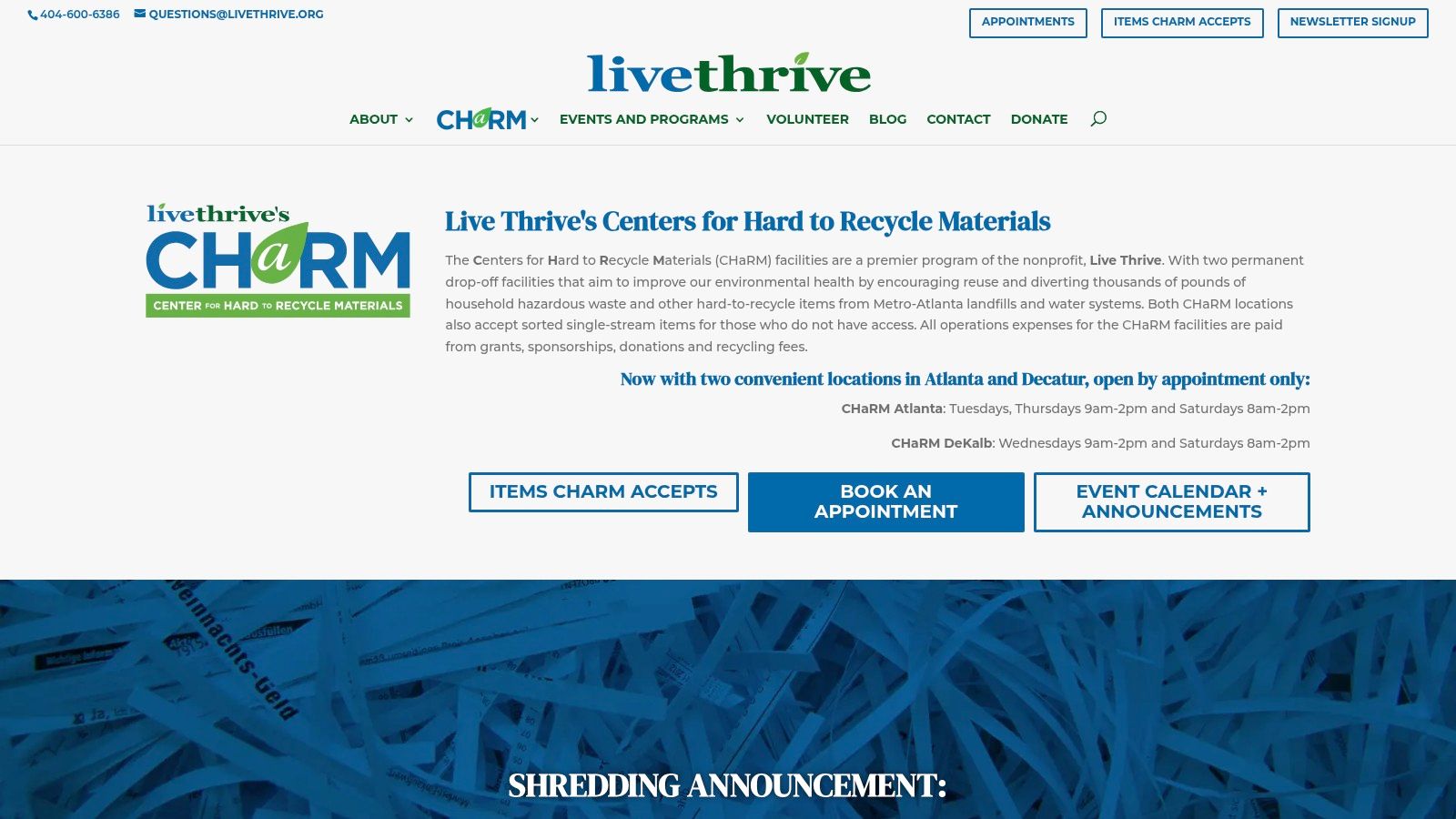
If you’re a resident or a very small office, Live Thrive CHaRM is one of the cleanest answers to Where to Recycle Computers in Atlanta GA. It’s a nonprofit drop-off model, and that shows in the way the service is structured. You book a slot, review the accepted-items list, and show up prepared.
That appointment requirement is a trade-off, but it’s often a good one. It reduces confusion at drop-off and gives people a better idea of what the center will take. CHaRM also publishes item guidance and pricing details, which is more transparent than many recycling sites.
Best for organized drop-offs
This option works best when you already know what you have. A couple of laptops, old accessories, or a small batch of office electronics is manageable here. It’s less ideal if you need onsite labor, de-installation, or a full business pickup.
The environmental case for using a recycler like CHaRM is straightforward. E-waste contains materials that shouldn’t end up in general disposal streams, and a detailed explainer on the environmental impact of electronic waste is a useful reminder of why proper separation matters.
Small offices often underestimate labor, not disposal. The hard part usually isn’t finding a recycler. It’s sorting, boxing, and transporting the equipment without disrupting the workday.
Trade-offs to know before you go
CHaRM is a good fit when transparency matters more than speed. If you want published fees, accepted-item specifics, and a community-oriented organization, it’s a strong option.
If you need a bigger narrative for grants, sustainability programming, or community partnerships, it also aligns naturally with local environmental work, including groups active around environmental grants.
Pros
- Published guidance: Clear accepted-items information and transparent pricing.
- Community credibility: Nonprofit model with a strong local profile.
- Good for small volumes: Practical for residents and small office cleanouts.
Cons
- Appointment required: Not ideal for last-minute disposal.
- Less suited to enterprise logistics: Businesses with larger projects will usually need a pickup-based provider.
Visit Live Thrive CHaRM if you want a structured local drop-off experience and don’t need enterprise ITAD support.
3. Regency Technologies
A familiar Atlanta scenario goes like this: an office refresh leaves 150 laptops in storage, finance wants a clean asset list, IT needs proof of data destruction, and sustainability leadership wants more than a landfill-diversion talking point. Regency Technologies fits that kind of project well. Its Austell presence helps with local logistics, but the larger advantage is process discipline for bulk IT asset disposition, including intake, tracking, sanitization, remarketing, and recycling.
For businesses, that distinction matters. A recycler that handles consumer drop-offs and a provider that supports formal chain-of-custody are solving different problems. If equipment still has resale value, the right ITAD partner can help recover some of that value while keeping data risk and documentation gaps under control. That turns recycling from a cleanup task into part of a broader ESG and CSR program. The strongest programs do not stop at responsible disposal. They connect retired equipment decisions to measurable environmental and social outcomes.
Where Regency fits best
Regency is a better match for companies, schools, healthcare groups, and public-sector teams than for someone clearing out a home office. If your project includes pallets of equipment, multiple locations, or devices that need triage between reuse and scrap, a structured ITAD workflow saves time later in audit, procurement, and reporting.
I usually point teams in this direction when the question is not just "Where can we drop this off?" but "How do we document this properly and avoid destroying value we could have recovered?" If your inventory includes newer laptops and desktops, this practical guide on how to recycle old laptops responsibly is a useful starting point before you scope the vendor conversation.
Their strengths are clearest in a few areas:
- Enterprise ITAD focus: Built for repeatable processes, scheduled pickups, and larger refresh cycles.
- Data sanitization controls: Better suited to organizations that need formal destruction and disposition records.
- Remarketing capability: Useful when part of the batch can be resold or redeployed instead of scrapped.
- Metro Atlanta access: The Austell location can simplify coordination for local projects.
Trade-offs to understand
The trade-off is convenience. Regency is less appealing for a resident with one desktop than for an operations team managing a decommission, lease return, or hardware refresh. Pricing is generally quote-based, and that is normal for projects where volume, device mix, pickup needs, and reporting requirements affect scope.
That extra structure has real value. It supports internal controls, reduces the chance of missed assets, and gives sustainability teams better records for reporting. Businesses that want their recycling partner to contribute to ESG or CSR goals should also ask a harder question during vendor review: does the provider only process material, or does it create visible environmental and social impact you can stand behind? In practice, that can be the difference between checking a compliance box and building a disposal program that supports broader company commitments.
Pros
- Built for larger projects: A practical fit for office closures, refreshes, and multi-department cleanouts.
- Compliance support: Helpful for teams that need documented processes and risk review.
- Potential cost recovery: Resale channels may offset part of the disposition cost.
Cons
- Less consumer-friendly: Better for managed business projects than casual drop-offs.
- Sales-led scoping: You will usually need a quote rather than published pricing.
For larger Atlanta-area IT disposition work, Regency Technologies is a credible option to compare against providers with stronger local nonprofit access or stronger dual-impact ESG positioning.
4. Full Circle Electronics Georgia
Full Circle Electronics has a Georgia location in Alpharetta and sits in the middle ground between local accessibility and enterprise-grade controls. For Atlanta businesses that want a certified recycler with local coordination, that’s a useful balance.
I’d look at Full Circle when the project includes both secure destruction and possible reuse. Some equipment is scrap. Some still has resale or redeployment value. Providers with remarketing capabilities can handle both paths under one program, which simplifies the disposition decision.
Good choice for mixed-value assets
Full Circle becomes particularly attractive. If your retired inventory includes recent laptops, business desktops, networking gear, or peripherals, a recycler that can sort for resale versus scrap can be more efficient than a pure destruction-first vendor.
Their broader certification posture also helps with internal approvals. For organizations that need to map an old inventory pile into a more organized process, this short guide on how to recycle old laptops gives a practical baseline before you start vendor conversations.
If a recycler can only destroy, you may leave value on the table. If a recycler only talks about resale, you may underweight data risk. The right provider can do both and document which path each asset took.
Where it may not fit
Full Circle isn’t the first option I’d suggest for a resident with a few household devices. Consumer walk-in details aren’t always the clearest on enterprise-oriented sites, so contact first if your project is small.
Pros
- Certification support: Helpful for compliance-heavy environments.
- Local Georgia location: Easier to coordinate than an entirely remote processor.
- Remarketing plus recycling: Better handling for mixed-value inventory.
Cons
- Consumer intake may be limited: Confirm before making a trip.
- Program pricing: Expect quote-based engagement rather than published rates.
For business pickups, secure destruction, and reusable asset sorting, Full Circle Electronics Georgia is a solid Atlanta-area option.
5. CompuPoint USA
A common Atlanta cleanout goes like this. IT boxes up retired laptops, finance asks for proof they were handled correctly, and legal wants records that will stand up in an audit months later. CompuPoint USA, based in Norcross, is the kind of provider that appeals in that situation because its public messaging stays focused on chain of custody, serialized auditing, and logistics discipline.
That matters for more than operational neatness. In regulated settings, weak documentation creates business risk even when the physical recycling itself was handled properly. The U.S. Environmental Protection Agency’s guidance on electronics donation and recycling stresses using reputable recyclers and asking how equipment is tracked, managed, and documented through the process, which is the right standard to apply during vendor review.
Strong choice for regulated workflows
CompuPoint stands out for organizations that need records as much as pickup service. Healthcare groups, schools, professional firms, and public-sector teams usually need a clear paper trail for intake, data handling, asset disposition, and final reporting. A vendor that can remarket reusable equipment and document what was resold versus what was recycled also supports a better ESG story. You reduce landfill risk, recover some asset value, and can show stakeholders that disposition decisions followed a defined process.
The practical question to ask is straightforward: what document do we receive at each stage? I would want to see intake confirmation, serialized asset reports, data destruction confirmation when drives are sanitized or destroyed, and downstream recycling records.
For teams building that checklist, Atlanta Green Recycling’s overview of data destruction requirements and vendor questions in Atlanta is a useful reference point.
Main trade-off
CompuPoint looks better suited to account-based business work than casual consumer drop-offs. The site reads like an operations and compliance service, which often means a stronger fit for scheduled pickups, recurring programs, and larger batches of equipment.
That focus can be a real advantage for companies trying to turn recycling into more than a disposal task. A disciplined ITAD partner helps with compliance, but it also gives sustainability and CSR teams cleaner reporting for internal ESG goals. If your company wants recycling decisions to support broader social and environmental commitments, the right partner selection has strategic value, not just operational value.
Pros
- Process-first positioning: Strong fit for audit-sensitive organizations.
- Norcross location: Practical for metro Atlanta business service.
- Reuse plus recycling approach: Better than scrap-only disposition for mixed inventories.
Cons
- Limited public pricing detail: Expect a quote-based process.
- Less consumer-oriented: Small one-off household loads may not be the best fit.
If your priority is chain of custody, documentation, and a business-ready workflow, CompuPoint USA is worth shortlisting.
6. Atlanta Recycling Solutions
A common Atlanta scenario looks like this. An office is closing a floor, laptops and monitors are stacked in a conference room, and the primary risk is not hauling the gear out. It is making sure every drive is accounted for, every device is dispositioned correctly, and the company can prove what happened after pickup.
Atlanta Recycling Solutions fits that kind of job. Its positioning is clearly B2B, with pickup, transport, data destruction, and reporting under one vendor. The connection to the Full Circle Electronics group also signals a more established operating model than a small drop-off only program.
Where it fits best
This provider makes the most sense for companies that want a conventional business recycler with documented outputs. Procurement teams usually care less about a simple public price sheet and more about chain of custody, certificates, scheduling reliability, and whether the vendor can handle a large office clear-out without creating extra work for internal IT or facilities staff.
That trade-off matters. A business-focused recycler often feels less accessible for a resident dropping off one old desktop, but it can be the better choice for organizations with compliance obligations or board-level ESG reporting needs.
Why that matters beyond disposal
For Atlanta businesses, computer recycling can support more than risk reduction. A well-run program creates cleaner records for environmental reporting, keeps reusable equipment out of landfill streams, and gives CSR teams a stronger story about responsible end-of-life handling.
Atlanta Recycling Solutions is more traditional in how it presents that value. The emphasis is on execution and documentation, not on a dual-impact social mission. For some companies, that is exactly the right fit. For others trying to tie vendor choice to broader goals such as community impact, veteran support, or reforestation, it may feel less differentiated than mission-led alternatives elsewhere on this list.
Pros
- Business-first service model: Well suited to office cleanouts, recurring pickups, and multi-device projects.
- Documented destruction and recycling workflow: Helpful for compliance reviews and internal reporting.
- Established local presence: A practical option for companies that want a familiar Atlanta-area vendor.
Cons
- Less appealing for one-off household recycling: The service model is aimed at business accounts.
- Limited public pricing detail: Expect a quote and scope discussion before scheduling.
For companies that need a straightforward B2B recycler with audit-ready outputs, Atlanta Recycling Solutions is a credible local option.
7. Beyond Surplus
A common Atlanta scenario looks like this. A company has a stack of retired laptops, a few servers, and a hard deadline from IT or facilities to clear the space. Some assets still have resale value. Others need documented destruction because they held client data, employee records, or regulated information. Beyond Surplus is built for that mixed job.
What stands out is the combination of IT asset recovery, recycling, and data destruction in one service path. That matters because the wrong recycler can force a bad early decision. Equipment that could be reused gets scrapped, or valuable devices sit longer than they should because no one has resolved the data security question first.
Beyond Surplus is also one of the clearer examples in this list of recycling as more than a disposal task. For Atlanta businesses with ESG or CSR goals, a partner that can extend device life, document downstream handling, and support social impact programs creates a stronger story than basic haul-away service alone. The company also highlights mission-driven outcomes tied to veteran support and reforestation, which will matter more to some organizations than a standard commodity recycler.
Where it fits best
This is a practical option for businesses that want to sort equipment by outcome instead of treating everything as waste. Reusable machines can go through remarketing or buyback. Obsolete or damaged assets can move into recycling. Drives and storage media can be destroyed under tighter controls.
For security-sensitive projects, on-site witness shredding is a serious feature, not a marketing extra. It gives legal, healthcare, finance, and public-sector teams a higher level of visibility during destruction. Companies comparing vendors should still verify whether the exact service, chain-of-custody documentation, and certification support match internal policy. Industry standards such as R2 are maintained by SERI, which is a more credible reference point than generic roundup sites.
Trade-offs to check before scheduling
Beyond Surplus is not the simplest fit for someone who just wants a quick, retail-style drop-off experience. The model makes more sense for planned pickups, office decommissions, and projects where data handling, reporting, or asset value recovery affect the decision.
Smaller users should confirm minimums, fees, and pickup terms in advance.
Pros
- Mixed disposition options: Supports resale, recycling, and destruction within the same project.
- Strong fit for compliance-minded organizations: Useful when audit trails and secure handling matter.
- Clear ESG and CSR angle: A better match for companies that want recycling to support social and environmental goals, not just clearance.
Cons
- Less casual for one-off consumer use: The process is better suited to scheduled projects.
- Service economics depend on asset mix: Low-value equipment may not qualify for the same pickup or recovery terms as reusable hardware.
If your priority is secure handling with the option to recover value and document broader impact, Beyond Surplus deserves a close look.
8. eWaste ePlanet
eWaste ePlanet is a local option I’d put in the “confirm details, then use if it matches” category. It offers a wide ITAD-style scope, including electronics recycling, serialized data destruction, buyback, and local logistics, which makes it potentially useful for both businesses and individuals.
That breadth is appealing. A lot of Atlanta recyclers force you into one lane. eWaste ePlanet appears willing to work across different project sizes and equipment types.
Why it can be a practical local choice
The main benefit is range. If you have a mix of computers, peripherals, networking gear, and maybe some reusable assets, a company with both recycling and buyback programs is easier to work with than multiple specialized vendors.
I especially like this type of provider for small-to-mid-sized business cleanouts where the inventory isn’t large enough for a national ITAD contract but too large for a household drop-off.
The catch
Local recyclers with evolving location details and hours need a quick confirmation call or email before you load a truck. That’s not a flaw so much as a reality. Don’t assume every listing is current.
Pros
- Broad intake scope: Can handle a variety of electronics and IT assets.
- Certificates available: Important for proof of destruction and disposition.
- Local presence: Useful for Atlanta-area coordination.
Cons
- Confirm location details first: Hours and intake specifics may vary.
- Pricing isn’t broadly published: You’ll need direct contact for scope.
For Atlanta users who want a local recycler with buyback and destruction capabilities, eWaste ePlanet is a credible option.
9. Goodwill of North Georgia
A common Atlanta scenario looks like this. A family has an old tower in the closet, two dead laptops, a box of cables, and no interest in setting up a business recycling account just to get rid of them responsibly. Goodwill of North Georgia fits that job well.
Its value is convenience paired with community impact. For residents and very small home offices, that combination matters. The recycling decision becomes more than basic disposal. It supports a nonprofit channel while keeping electronics out of the waste stream, which is a practical ESG-aligned choice at the household level and a reasonable CSR option for tiny businesses that want a simple, local donation path.
Goodwill also sits in a different category from specialist IT asset disposition vendors. The process is easier, but the controls are lighter. That trade-off is fine for low-risk equipment with no reporting requirement and no sensitive data left on the device.
Best fit for donation-driven recycling
I recommend Goodwill for small, straightforward drop-offs where convenience and mission are the priority. Old monitors, accessories, consumer PCs, and similar items are usually a better match here than equipment from a regulated office environment.
For businesses, the key question is data handling. If a company needs serialized tracking, certificates tied to specific assets, or documented chain of custody, a dedicated recycler is the safer route. If the comparison you are making is convenience versus control, this overview of whether Best Buy recycles computers helps frame the retailer-style option against more specialized services.
What to verify before you go
Acceptance can vary by location, especially for less common items or larger quantities. Confirm the store details first. That small step prevents wasted trips and helps you decide whether a donation network or a specialist recycler is the better fit.
Pros
- Easy drop-off process: Good option for households and very small loads.
- Clear social benefit: Donation supports a community-focused nonprofit mission.
- Familiar and accessible: Many people already know the Goodwill process.
Cons
- Limited auditability: Poor fit for regulated organizations or sensitive business assets.
- Location-level variation: Accepted items and intake rules may differ by site.
For simple public donation and recycling, Goodwill of North Georgia remains one of the easiest choices in metro Atlanta.
10. Best Buy
A common Atlanta scenario is a small office manager with three retired laptops, a dead printer, and no time to set up a formal IT asset disposition project. In that case, Best Buy can be a practical outlet. It gives households and very small businesses a familiar drop-off path without the onboarding, pickup scheduling, or documentation that a specialist recycler would typically provide.
That convenience is the point. Best Buy’s program fits low-volume, lower-risk recycling jobs where speed matters more than audit depth.
Best for quick, low-volume drop-offs
Best Buy works well for consumer electronics, home office equipment, and occasional cleanouts. It is less suitable for businesses that need serialized reporting, proof of destruction tied to specific assets, or documented chain of custody for compliance reviews. Those requirements usually push an organization toward an ITAD vendor.
That trade-off matters beyond convenience. Responsible recycling affects data security, environmental outcomes, and ESG reporting. A retailer program helps keep devices out of the trash stream, but it does not usually contribute much to a company’s broader CSR goals. If your leadership team wants recycling to support measurable social or environmental outcomes, such as reuse programs, local job impact, veteran support, or reforestation, a mission-driven recycler will usually offer more than a retail counter can.
If you are weighing a store drop-off against a specialist, this guide on whether Best Buy recycles computers gives a useful side-by-side starting point.
What to check before using Best Buy
Review the accepted item list, quantity limits, and any applicable fees before you load the car. Retail programs are standardized, but store experience can still vary by item type and volume. For a few personal devices, that is usually manageable. For business equipment with hard drives, regulated data, or internal reporting requirements, the safer move is a recycler that can document exactly what happened to each asset.
Pros
- Easy access: Convenient for households and very small offices.
- Simple service model: In-store drop-off, with other program options for certain items.
- Good for fast disposal: Useful when the priority is clearing a small number of devices responsibly.
Cons
- Limited documentation: Weak fit for compliance-driven organizations.
- Rules may vary by item: Fees, exclusions, and quantity caps can apply.
- Minimal ESG value beyond diversion: Retail recycling rarely offers the dual social and environmental impact some Atlanta businesses now want from disposal partners.
For basic public recycling, Best Buy’s recycling program remains a useful option.
10-Point Comparison: Computer Recycling Options in Atlanta
| Provider | Core services | Security & Quality ★ | Logistics & Scale | Target audience 👥 | Price & USP 💰✨ |
|---|---|---|---|---|---|
| 🏆 Atlanta Green Recycling | Turnkey ITAD: DoD wiping, shredding, onsite de‑installs, data‑center decomm. | DoD‑standard wiping, HIPAA workflows, audit docs ★★★★★ | Own fleet, local pickup, project management | 👥 Enterprises, hospitals, gov, schools, data centers | 💰 Quote-based; free DoD wiping for pickups; ✨Mission-driven (Plant‑a‑Tree & veteran support) 🏆 |
| Live Thrive CHaRM | Nonprofit drop‑off for hard‑to‑recycle electronics | Transparent processing info; limited enterprise controls ★★★☆☆ | Two metro facilities; appointment required | 👥 Residents, small offices | 💰 Published fees; ✨Community nonprofit and clear guidance |
| Regency Technologies (Austell) | Enterprise ITAD, remarketing, high‑volume processing | R2 / ISO credentials; enterprise security ★★★★★ | Local Austell facility for large decommissions | 👥 Fortune 500, government, large enterprises | 💰 Contract/volume pricing; ✨Strong resale/value recovery |
| Full Circle Electronics – Georgia | Certified ITAD, remarketing, program setup | R2 & ISO stack; certified processing ★★★★☆ | Local intake site; program coordination | 👥 Businesses needing compliance | 💰 Quote-based; ✨Remarketing & audit support |
| CompuPoint USA (Norcross) | Asset mgmt, secure sanitization, reuse programs | R2v3 & RIOS; serialized auditing ★★★★☆ | Norcross presence; statewide coverage | 👥 SMBs & enterprises | 💰 Quote/contract; ✨Reuse-focused value recovery |
| Atlanta Recycling Solutions | End‑to‑end B2B ITAD, audits, remarketing | R2, ISO14001, ISO45001; audit-ready ★★★★☆ | Backed by larger certified group; packing/transport | 👥 Business accounts, large clients | 💰 Program quotes; ✨Scale + documented compliance |
| Beyond Surplus (Metro Atlanta) | Business pickups, shredding, buyback programs | Certificates of destruction; buyback options ★★★★☆ | Fleet with business minimums (pallets) | 👥 Atlanta businesses, some residential | 💰 Minimums/fees; ✨Asset recovery + secure destruction |
| eWaste ePlanet (Norcross/Doraville) | Recycling, serialized data destruction, buyback | Certificates provided; local warehouse team ★★★★☆ | Local warehouses; verify hours/locations | 👥 Businesses & individuals | 💰 Contact for quotes; ✨Buyback & remarketing |
| Goodwill of North Georgia (Dell Reconnect) | Donation centers for reuse/recycling via Dell Reconnect | Reuse-first channel; limited chain‑of‑custody ★★☆☆☆ | Many convenient donation sites; walk-in friendly | 👥 Consumers, micro home‑offices | 💰 Free/no-cost drop-off; ✨Convenient reuse option |
| Best Buy (Metro Atlanta) | In-store drop-off, mail-in boxes, haul‑away & trade‑in | Consumer program; item limits & some fees ★★★☆☆ | Wide store network; mail & pickup options | 👥 Households, small offices | 💰 Often free for small items; fees for TVs/haul‑away; ✨Trade‑in promos |
Final Thoughts
Where to Recycle Computers in Atlanta GA depends less on the computer itself and more on the context around it. A home user with one old laptop should optimize for convenience. A company with retired desktops should optimize for security and documentation. A hospital, school system, or government office should optimize for chain of custody, data destruction, and audit support.
That’s the first sorting question I use with clients. The second is whether the equipment still has reuse value. Some providers are strongest at secure destruction. Others can also handle remarketing or buyback. If you don’t ask about both paths, you can either over-destroy useful equipment or under-manage sensitive assets.
Atlanta has enough recycling capacity to support both consumer and enterprise needs. The city’s broader infrastructure includes multiple drop-off and pickup pathways across the metro, and Atlanta’s B2B recyclers have been shaped by compliance demands, office moves, healthcare requirements, and data-center growth. That’s why the local market now includes nonprofit drop-off centers, retailer programs, scrap-focused operations, and specialized ITAD firms.
There’s also a larger strategic point that gets missed. Computer recycling isn’t just a cleanup task anymore. For many organizations, it belongs inside ESG, CSR, and internal governance conversations. A well-run recycling project can support sustainability goals, reduce legal and reputational risk, and give operations teams a cleaner way to handle office changes, asset refreshes, and storage-room backlogs.
That’s where provider choice really matters. If all you need is a drop-off counter, Goodwill, CHaRM, or Best Buy may be enough. If you need local logistics, audit-ready reports, and secure destruction, you should stay in the ITAD lane with providers such as Atlanta Green Recycling, CompuPoint USA, Full Circle Electronics, Beyond Surplus, or Regency Technologies.
For Atlanta businesses, I’d put the most weight on four questions:
- What happens to the data: Ask about wiping standards, shredding options, and destruction records.
- What proof do you receive: Ask for certificates, serialized reporting, and chain-of-custody documentation.
- Who handles the logistics: Ask whether the recycler can box, de-install, stage, and pick up equipment.
- How does the project support your broader goals: Ask whether the recycler can help frame the work for sustainability or CSR reporting.
That last point is where a mission-driven provider has an edge. If your company can tell employees and stakeholders that retired equipment was handled securely, diverted responsibly, and tied to a broader social or environmental benefit, the recycling project stops being invisible back-office work. It becomes a concrete example of responsible operations.
That’s especially relevant for companies trying to build more authentic local impact in Atlanta. A cause-based model that ties electronics recycling to veteran support, tree planting, community drives, or a “Recycled with Purpose” style partnership gives office cleanouts and refresh cycles more meaning than a generic haul-away ever will. It also gives marketing and HR teams something real to talk about, instead of treating sustainability as a separate initiative disconnected from day-to-day operations.
If you’re choosing one provider for a business project, don’t just ask who will take the equipment. Ask who will make the process safer, easier to document, and more useful to your organization after the pickup is done.
If your team needs a secure, local, business-focused partner for computer recycling, Atlanta Green Recycling is the strongest place to start. They handle pickup, hard drive wiping, physical destruction, de-installation, and documented disposition for Atlanta-area organizations, and they’re especially well suited to offices, hospitals, schools, agencies, and data centers that can’t afford loose processes or data risk.