
Does Best Buy Recycle Computers? A Guide for Atlanta Businesses

Yes, Best Buy does recycle computers. It’s a great, convenient option for individuals looking to get rid of an old personal laptop or a few random cables. But for an Atlanta business? That’s a whole different story.
The Short Answer and The Big Catch
Best Buy has done a fantastic job of becoming a go-to spot for consumer electronics recycling. They kicked off their program back in 2009, and it's been a massive success in keeping e-waste out of our landfills. Most of their stores will take up to three items per household per day for free—a limit that can sometimes stretch to five laptops.
It's an impressive effort. As of their FY26 ESG report, the company has collected and recycled over 2.5 billion pounds of electronics and appliances, including everything from old PCs and monitors to motherboards and hard drives. For the average person with a dusty desktop in the garage, it’s a simple, no-fuss solution.
Here’s the catch, though. This entire program was built for consumers, not companies. And those differences create serious risks for any Atlanta organization trying to use it for their IT asset disposition.
The Business Disconnect: Why Best Buy Isn't a B2B Solution
Thinking you can just drop off your company's old computers at a Best Buy is a bit like using a public mailbox to ship sensitive legal documents. Sure, both get the item from point A to point B, but one completely lacks the security, tracking, and proof of delivery that are non-negotiable for professional needs.
The recycling path for a consumer is fundamentally different from the one a business must follow.
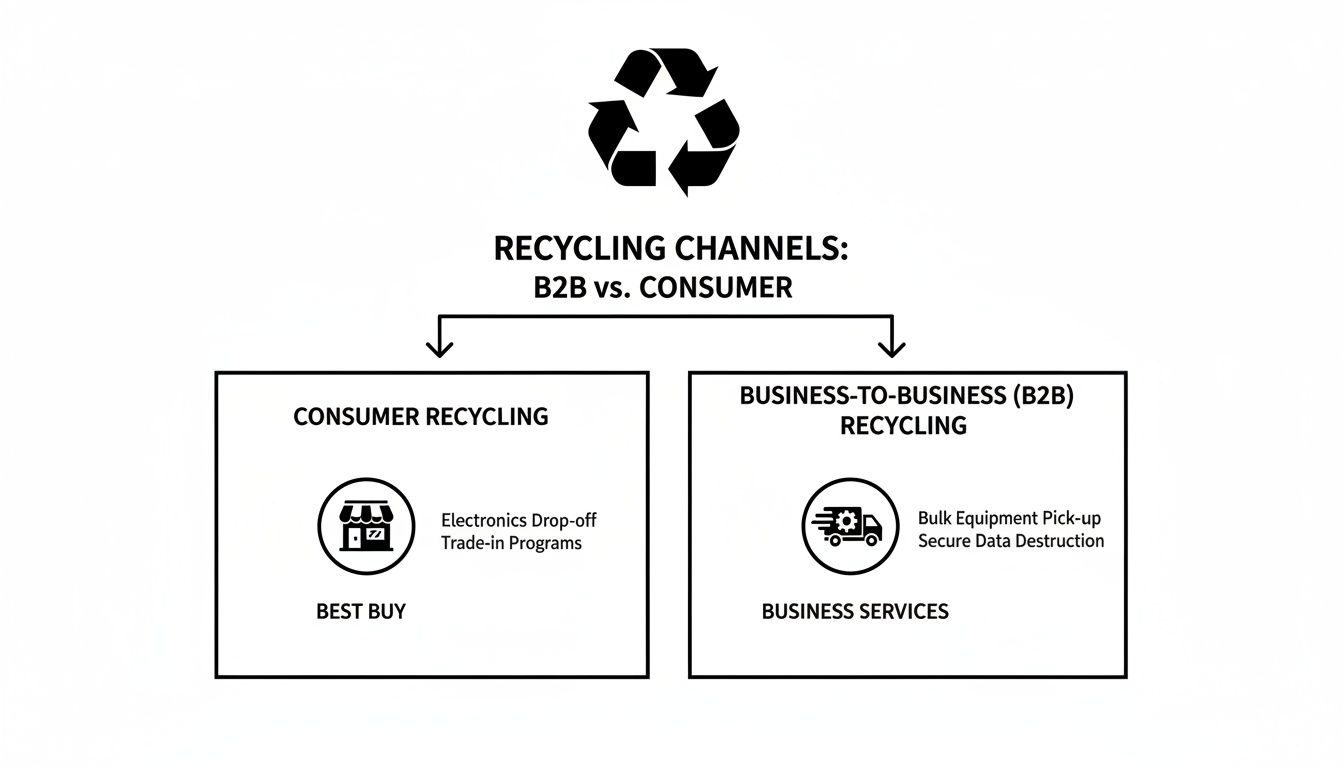
While dropping off a personal laptop at a retail store is fine, businesses operate under a different set of rules. The Best Buy program simply wasn't designed to meet these critical professional requirements.
To see just how different these two approaches are, let's break it down in a side-by-side comparison.
Best Buy's Retail Drop-Off vs. Professional Business Recycling
| Feature | Best Buy (Consumer Program) | Atlanta Green Recycling (B2B Service) |
|---|---|---|
| Data Security | Customer is responsible for wiping data. No certified destruction. | Certified Data Destruction (wiping, degaussing, shredding) provided. |
| Compliance | No documentation provided. Not compliant with HIPAA, GDPR, etc. | Issues a Certificate of Data Destruction for audit and compliance trails. |
| Logistics | Customer must transport all items to the store. | Secure, GPS-tracked pickup from your Atlanta location. Packing services available. |
| Volume Limits | Strict limit of 3 items per day per household. | No limits. Can handle hundreds or thousands of assets at once. |
| Asset Tracking | No serialized tracking of individual devices. | Detailed inventory and serialized reporting for every single asset. |
| Social Impact | Standard material recovery. | Recycling That Restores: Funds veteran aid and reforestation projects. |
As the table shows, the gaps in a consumer-facing program are significant. These aren't just minor inconveniences; they represent major security vulnerabilities and compliance failures for any Atlanta business.
Where The Consumer Program Falls Short for Businesses
The core issues really boil down to a few key areas:
- No Certified Data Destruction: Best Buy’s policy is clear: you are responsible for wiping your own data. For a business subject to privacy laws like HIPAA, this is an instant dealbreaker. It’s not a legally defensible data destruction method.
- Impractical Item Limits: The three items per day rule just doesn't work for a business. Imagine trying to decommission an entire office three devices at a time. It’s a non-starter.
- Zero Logistical Support: The program is entirely self-service. You have to haul everything to the store yourself. There’s no help with de-installation, packing, or professional transport.
- A Lack of Compliance Documentation: When auditors come knocking, you need proof. A professional recycler provides a Certificate of Data Destruction—an essential document that proves you handled sensitive data correctly. Best Buy offers nothing of the sort.
These aren't just small details; they're the very things that protect your business from data breaches, fines, and reputational damage. If you're looking for a provider that understands these needs, our guide on how to recycle computers near me is a great place to start.
What Happens to Your Computer After You Drop It Off
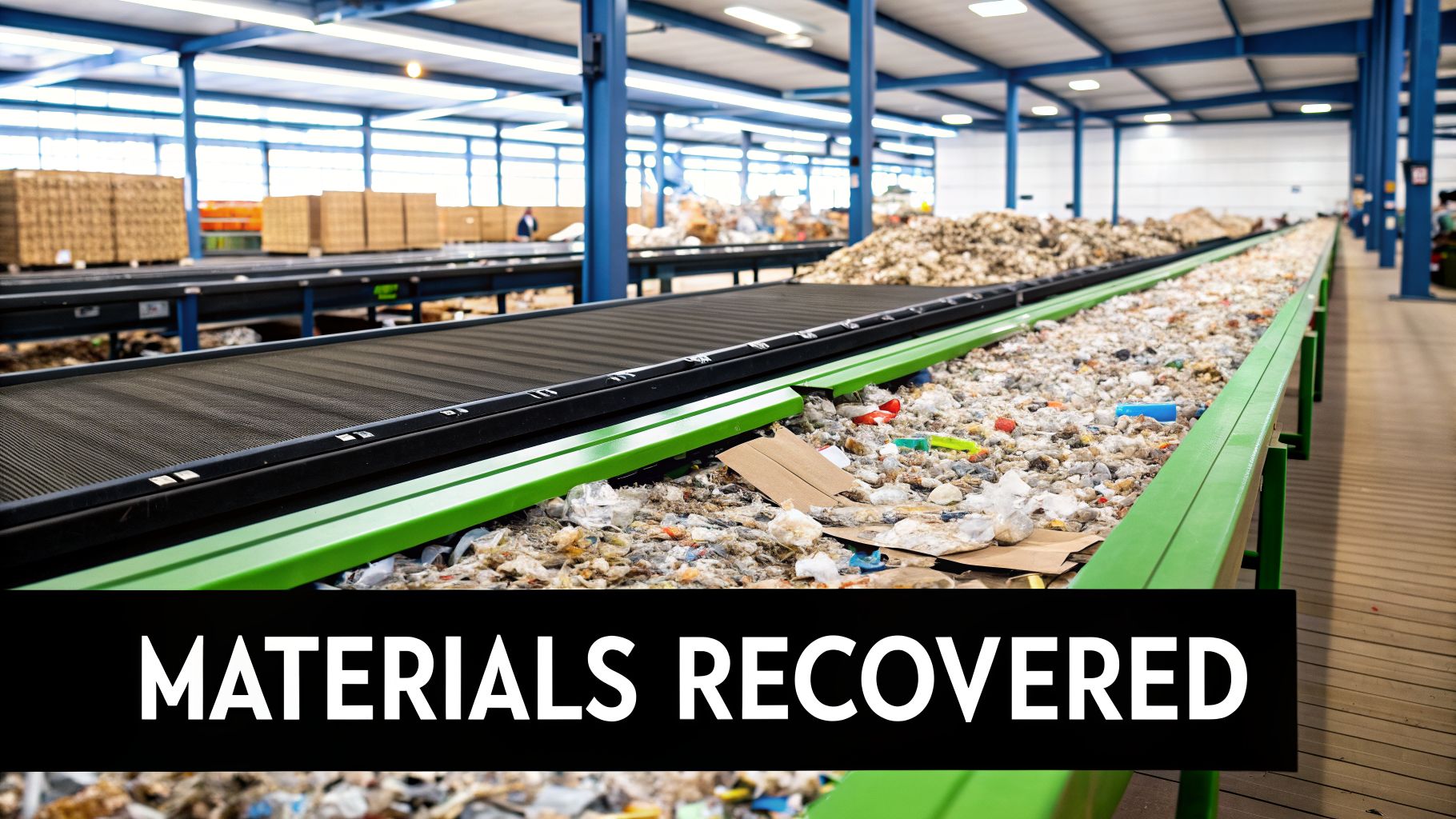
When you hand over your old computer at Best Buy, it doesn’t just disappear into some back room. It’s actually the first step into a massive, well-oiled reverse logistics network. The whole point of this system is responsible material recovery. So, if you're asking, "Does Best Buy recycle computers?" the answer is yes, but it's the how that really matters.
Your old device gets bundled with thousands of others and shipped off to a certified processing partner. Think of it like a city recycling plant, but built exclusively for electronics. The goal here isn't to fix up your specific laptop; it's to efficiently break down a mountain of mixed e-waste into its core, valuable materials.
The Certification and Material Recovery Process
A real strength of Best Buy's program is that they don't just work with anyone. They have a roster of highly vetted partners who hold top-tier industry certifications, which guarantees the electronics are handled ethically and securely from start to finish.
For example, one of their key partners, ERI, was the very first in the world to be certified for both R2 and e-Stewards. These aren't just fancy labels; they are the gold standards in electronics recycling, ensuring that hazardous materials aren't illegally shipped overseas and that workers are kept safe. Since 2009, this network has responsibly processed over 2 billion pounds of e-waste—a staggering figure that speaks to the program's scale.
Once your computer arrives at one of these facilities, the real work begins:
- Shredding: The devices are fed into huge industrial shredders that tear everything down into small, uniform pieces.
- Separation: A clever combination of powerful magnets, eddy currents, and optical scanners sorts the shredded fragments into clean streams of plastic, steel, aluminum, and precious metals.
- Re-entry into Manufacturing: These raw commodities are then sold back to manufacturers to be used in new products, which is a perfect example of the circular economy in action.
The Critical Gap for Businesses
This process is fantastic for the environment. No question. But it also shines a bright light on a major gap for any business or organization that needs to dispose of old equipment. The entire system is built for bulk material recovery, not for tracking individual computers.
Your company's specific laptop, which once held sensitive financial data or client information, effectively becomes anonymous the moment it enters this stream. It is shredded and mixed with countless other devices.
This complete lack of a serialized chain of custody is an absolute non-starter for any business needing to prove compliance. You simply can't get a report confirming that asset number "XYZ-123" was securely destroyed. While the process is environmentally responsible, it offers none of the auditable proof required for business-level security and governance.
For a deeper dive into what a professional B2B recycling process looks like, you can explore our guide on what happens to recycled electronics in a secure, compliant setting.
The Critical Risks for Atlanta Businesses: Data Security and Compliance
Best Buy's recycling program is a great initiative for the environment, no question about it. But for an Atlanta business, relying on that same consumer drop-off service is a massive gamble. When it comes to company computers, recycling isn't just about being green—it's about managing serious risk. Using a retail program for corporate IT assets is like putting your company's most sensitive client files in a public recycling bin and just crossing your fingers.
The problem boils down to one thing: data security. Best Buy is very clear that you, the customer, are responsible for wiping your own data before you drop anything off. For any Atlanta business bound by privacy laws like HIPAA, financial regulations, or data protection acts, this "do-it-yourself" model is a complete non-starter. It's simply not a legally defensible way to handle data destruction.
The High Cost of a Data Breach
Every old company laptop or server drive that isn't properly sanitized is a data breach just waiting to be discovered. A single device can hold thousands of sensitive files, from your employees' personal information (PII) to confidential client data and your company's intellectual property.
If that data gets out, the fallout is severe.
- Catastrophic Fines: Regulatory bodies don't mess around. Fines for compliance failures can easily run into the millions.
- Loss of Customer Trust: A data breach can permanently tarnish your brand's reputation, sending customers straight to your competitors.
- Legal Liability: You could be facing lawsuits from every single person whose data was exposed.
For any Atlanta business, a quick look at these 10 Major Data Breach Examples makes it painfully clear. The risk of using a consumer-grade solution for your end-of-life IT assets is just far too high.
Certified Data Destruction: The Only Real Solution
The only acceptable path for a business is professional, certified data destruction. This isn't about dragging files to the trash bin; it’s about using proven methods to make data completely and permanently unrecoverable. This is where a consumer-focused service like Best Buy’s simply can't measure up.
While Best Buy's program is impressive—having collected over 2.5 billion pounds of electronics since 2009—its entire structure is built for recovering materials, not securing data. They partner with certified handlers for the physical recycling, but the core responsibility for data removal remains with the consumer.
Professional data sanitization provides the proof your business needs. Methods include:
- DoD 5220.22-M Wiping: This is a software-based process that overwrites a hard drive’s data multiple times with specific patterns. It effectively sanitizes the disk to Department of Defense standards.
- Physical Shredding: For the ultimate level of security, hard drives and other storage media are fed into an industrial shredder. This process reduces them to tiny, unsalvageable fragments of metal and plastic.
Here’s the fundamental difference: A self-service wipe at a big-box store is a liability. A certified destruction process is a guarantee. It provides you with an auditable paper trail, including a Certificate of Data Destruction, that proves your company fulfilled its legal and ethical obligations. For any organization, understanding the critical need for secure hard drive recycling is the first step toward genuine data security.
How to Choose the Right E-Waste Partner for Your Atlanta Business
Okay, so we've established the risks. Choosing an e-waste partner is a serious business decision, not just a matter of logistics. When you're dealing with sensitive company data, moving past consumer-level drop-offs like Best Buy is essential. For any Atlanta business, but especially those in healthcare, finance, or tech, the liability is simply too high to leave to chance.
This isn’t just about getting rid of old computers. It’s about finding a partner who acts as an extension of your own security and compliance team. To make the right call, you have to ask the right questions—the kind that dig deep into data security, legal compliance, and operational integrity.
Vetting Your E-Waste Partner: A Checklist
As you look at different electronics recycling companies in Atlanta, this checklist will help you identify a truly professional service. A "no" to any of these questions should be a major red flag.
1. Certification and Compliance
- Are you R2 or e-Stewards certified? Think of these as the gold standards in the electronics recycling world. These certifications aren't easy to get; they prove a vendor meets the highest requirements for environmental safety, data security, and worker health. You should never, ever partner with an uncertified recycler.
- Can you provide a Certificate of Data Destruction (CoDD)? This document is your official, auditable proof that every data-bearing device was properly sanitized or physically destroyed. A simple pickup receipt won't cut it—you need a serialized certificate for every single hard drive.
2. Security and Chain of Custody
- What does your secure chain of custody look like? Ask for a step-by-step walkthrough of their entire process, from the moment their team steps into your office. Look for details like locked trucks, GPS tracking, secure facilities with 24/7 surveillance, and strict access controls.
- Do you offer onsite services? For companies with the highest security needs, destroying data before the devices even leave the building is the best option. A top-tier partner will offer services like onsite hard drive shredding or wiping right at your location.
3. Logistics and Operations
- Do you handle logistics and pickup? A professional service should bring everything needed to do the job right. This means providing the labor and equipment for de-installing servers, packing assets, and safely transporting everything from your office or data center.
- What is your process for asset tracking and reporting? At the end of the process, you should get a detailed inventory report. This report should list every single asset by its serial number, confirming exactly what was picked up and what was destroyed.
Finding a partner who can confidently say "yes" to all of these questions means you're doing more than just clearing out old equipment—you're actively protecting your business's reputation and future. For anyone weighing their options, the next step is to explore the landscape of certified e-waste disposal companies to build a secure and compliant IT asset disposition program.
Recycling That Restores: A Better Alternative for Corporate E-Waste
When your Atlanta company is ready to part with old IT equipment, the process often feels like just another compliance task—a box you have to check to sidestep fines and data leaks. While a program like Best Buy’s handles basic material recovery, what if your retired assets could do more?
What if your outdated servers and laptops could become a powerful force for good, turning a simple disposal task into an action your whole company can be proud of?
This is the whole idea behind our “Recycle for a Cause” campaign. Instead of just disappearing into a standard recycling stream, your old tech gets a second life as a source of positive impact. It generates real, tangible benefits for both the community and the environment, transforming a cost center into a powerful story for your corporate social responsibility (CSR) goals.
Imagine this: your company's old tech can help house a veteran and grow a forest. This isn’t just recycling; it’s restoration.
Turning E-Waste into ESG Wins for Atlanta Companies
The right recycling partner can help you turn your e-waste into a compelling narrative for your ESG reports, company culture, and public brand. This model moves way beyond simple compliance to create positive outcomes you can actually measure and target local keywords like “Atlanta tech recycling” and “corporate sustainability electronics disposal.”
It’s a straightforward process, but the results are profound. For example, when an Atlanta company partners with Atlanta Green Recycling, we offer businesses a free pickup of 50+ devices. Afterward, you get Plant-A-Tree certificates and Veteran Support Impact Reports you can use for your CSR documentation. This transforms your IT asset disposition from a logistical headache into a verifiable act of social good.
This approach delivers a clear "ESG win" by directly connecting your company’s actions to two critical causes: veteran support and reforestation. The result is a powerful, authentic story you can share with stakeholders, employees, and customers alike.
From Pickup to Powerful Impact
The whole process is designed to be seamless for your business while maximizing your philanthropic footprint. It's about turning every single device into an opportunity for positive change.
Schedule a Corporate Pickup: The first step is to arrange for a professional team to securely de-install and transport your old IT assets. This ensures all your data security and logistical needs are met right from the start.
Receive Impact Reports: After the equipment is processed, your company receives detailed documentation. This includes not only the standard Certificates of Data Destruction but also Veteran Support Impact Reports and Plant-A-Tree certificates.
Share Your Story: Now you can use these tangible results in your ESG reporting, internal communications, and marketing campaigns. We’ve even seen clients develop a digital badge—“Recycled with Purpose”—that they proudly display on their websites and sustainability reports.
This model is more than just a service; it's a partnership. We partner with Atlanta schools, universities, and municipalities to collect devices under a "Greener Atlanta" initiative. By choosing a partner with deep local roots and a powerful social mission, you position your organization as a community leader that looks beyond the bottom line to make a real, lasting difference. For more information on recycling specific devices, you can check out our guide on IT equipment recycling.
Your Top Questions About Computer Recycling, Answered
When it's time to part with old computers, a lot of questions pop up. It's easy to get tangled in the details of cost, data security, and which items are even accepted. We get it.
Let's cut through the noise and get you some straight answers. Here, we’ll tackle the most common questions we hear, clearing up the path for both individuals and Atlanta businesses looking to recycle their electronics the right way.
Is It Free to Recycle a Computer at Best Buy?
For the most part, yes. If you’re an individual dropping off a personal computer or laptop, Best Buy’s program is typically free. They do have a limit, though— three items per household per day.
Keep in mind that some items, like certain monitors, might come with a recycling fee. More importantly, this program isn't set up to handle the volume or security needs of a business with a stack of old office equipment.
Does Best Buy Wipe the Data from Recycled Computers?
No, they do not. This is a critical point that’s often missed. Best Buy's own policy is clear: you are responsible for removing all data from your devices before you hand them over.
For a business, this is a major security red flag. They don't provide the certified data destruction or chain-of-custody documentation that protects you from liability, which is exactly where a professional ITAD vendor steps in.
What Should My Atlanta Business Do Instead of Using Best Buy?
Your best move is to partner with a certified B2B electronics recycler right here in Atlanta. You'll want to find a provider holding an R2 or e-Stewards certification. This ensures they meet the highest industry standards for security and environmental responsibility.
Look for a partner who offers secure onsite pickup, a fully documented chain of custody, and provides a Certificate of Data Destruction for every single hard drive and server.
Better yet, choosing a recycler with a "Recycle for a Cause" campaign turns a simple compliance task into an easy ESG win. Imagine getting Plant-A-Tree certificates and Veteran Support Impact Reports for your company's CSR files—all from recycling the equipment you were already getting rid of.
Can I Recycle Other Electronics Besides Computers?
Absolutely. Both consumer-facing programs and professional recyclers are equipped to handle a wide variety of electronics. This includes monitors, printers, keyboards, tangled cables, and old mobile phones.
A professional B2B service takes it a step further. We can manage an entire office's worth of IT equipment in a single, secure pickup, from massive server racks down to individual workstations and all the peripherals that go with them.
How Can I Be Sure My Donation Makes a Difference?
True, mission-driven recyclers don't just talk about their impact—they prove it with total transparency. They provide real, tangible evidence of the good your e-waste generates, which is how one-time recyclers become long-term advocates for the cause.
At Atlanta Green Recycling, we believe in showing, not just telling. Our system is built to turn your recycling into a story of restoration you can be proud of.
We make sure you see the results of your contribution through a few key methods:
- Impact Certificates for Individuals: After a donation, we send a personalized email certificate detailing the positive outcome, like ‘You planted 3 trees and helped 1 veteran’.
- Referral Program: When you refer someone to us, we plant another tree in your name as a thank you, growing the collective good.
- Monthly Impact Newsletter: We share the real stories of the veterans we’ve supported and show the progress of our reforestation projects, connecting your old tech to real-world results.
By choosing a partner committed to this level of transparency, you can see exactly how your old computers help restore lives and landscapes. Find out more by visiting our website.
Ready to transform your company's e-waste from a liability into a source of community and environmental good? Partner with Atlanta Green Recycling for secure, compliant, and impactful IT asset disposition. Schedule your corporate pickup today and see how your old tech can build a better future. Learn more and get started.