
Recycle Computers Near Me: Your Guide to Atlanta’s IT Disposal

When you're an Atlanta business with a pile of old IT assets, the thought to recycle computers near me isn't just about clearing space. It’s about finding a certified, local partner who can handle your old equipment securely and responsibly. A professional recycler is your best bet for making sure your data is properly destroyed and you're staying on the right side of environmental regulations.
Why Your Atlanta Business Needs a Computer Recycling Partner
Every organization in Atlanta, from the tech hubs at Ponce City Market to the healthcare giants in the Perimeter, eventually has to retire old IT gear. This process is far more than a simple storage closet cleanout. It’s a critical task that touches on data security, environmental compliance, and ultimately, your company's reputation.

The Risks of Improper Disposal
What happens if you don't have a formal IT asset disposition (ITAD) plan? You're leaving your company open to some serious threats. The most immediate risk is a data breach. A single forgotten laptop or server can be a goldmine of sensitive customer data, financial records, or your own trade secrets. Falling short of compliance with regulations like HIPAA or FACTA can lead to crippling fines.
Beyond the data, there are stiff environmental penalties. You can't just toss old computers into a commercial dumpster—it's illegal and incredibly harmful. Electronics are packed with hazardous materials like lead and mercury, which can leach into our local soil and water. If your company gets caught breaking disposal laws, you're looking at major fines and a PR nightmare.
That brings us to your brand. In a world where customers and partners genuinely care about sustainability, news that you're handling e-waste irresponsibly can shatter trust and send people looking elsewhere.
From Compliance Chore to Strategic Advantage
Here’s the good news. Working with a certified, mission-driven recycler can turn this whole process from a logistical headache into a key part of your company's Environmental, Social, and Governance (ESG) strategy. You’re not just dodging risks; you’re creating real, tangible benefits that build up your brand and connect with the community.
Think about the power of a "Recycle for a Cause" approach. When your recycler has a dual philanthropic impact, your routine IT refresh suddenly does a lot more.
- Support for Veterans: Proceeds from the recycled materials could go toward funding programs for housing, job training, and other vital services for local veterans.
- Environmental Restoration: Through partnerships with groups like the National Forest Foundation, every ton of electronics you recycle can help plant new trees and restore critical habitats.
This approach transforms a standard operational cost into a story worth telling. Imagine being able to say, “Your old tech can house a veteran and grow a forest.” This is cause-based marketing at its best, turning your search to "recycle computers near me" into a genuine community investment.
The global e-waste problem is massive. Projections show it will blow past 82 million metric tons by 2030, while the documented recycling rate is expected to fall to just 20%. As detailed in The Global E-waste Monitor 2024, this creates a huge opportunity for businesses to step up and lead the way with responsible partners.
By transforming e-waste into a resource for community support and environmental renewal, your business turns a liability into a legacy. It's a clear win for your ESG goals, your brand, and your bottom line.
A true recycling partner does more than just pick up your old gear—they provide proof. You’ll get official Certificates of Data Destruction for your compliance audits and detailed Impact Reports for your CSR files. These reports quantify your contribution, showing exactly how many trees were planted or how your equipment helped support veteran aid programs. This is the new standard for Atlanta companies that want to make a real difference. To see how this plays out for other companies, take a look at our insights on business sustainability strategy in Atlanta.
Preparing Your Computers for Secure and Compliant Recycling
Before a single piece of equipment leaves your office, what you do next is your first and most important line of defense against data breaches and compliance headaches. For any business looking to recycle computers locally, this prep work is non-negotiable. It’s what guarantees a smooth, secure, and fully auditable handover to your recycling partner.
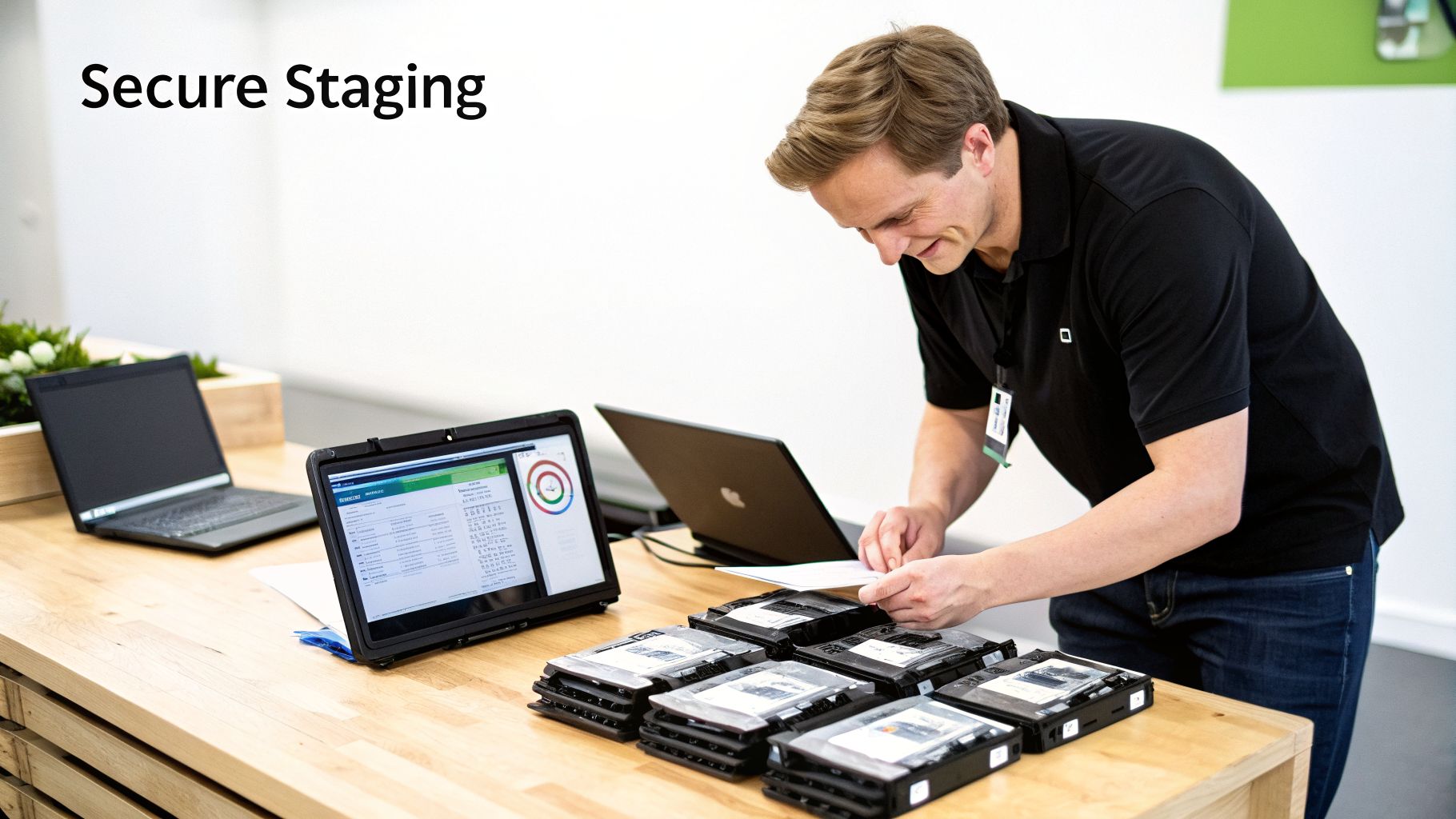
This isn't just about making a quick list of what you have. A solid preparation strategy means creating a detailed asset inventory, carrying out certified data destruction, and labeling everything clearly to maintain an unbreakable chain of custody.
Start With a Detailed Asset Inventory
Simply telling your recycler you have "25 laptops" isn't going to cut it for security or compliance. A proper inventory is the foundational document that tracks every single asset from the moment it leaves your building to its final certified destruction.
Your inventory log needs to be specific. Make sure it includes:
- Asset Type: (e.g., Laptop, Desktop, Server, Monitor)
- Manufacturer and Model: (e.g., Dell Latitude 7420)
- Serial Number: This is the unique identifier for each device.
- Internal Asset Tag: Your company’s own tracking number, if you use one.
- Data Sensitivity Level: Classify each device (e.g., Low, Confidential, Regulated) to determine how its data needs to be handled.
This detailed record is absolutely essential. It acts as the primary manifest for your recycling partner and becomes the basis for your final Certificate of Destruction, giving you proof that every asset was accounted for and managed correctly.
Pro Tip: Use a simple spreadsheet to build your inventory. Having this ready before you even call for a pickup will speed up the entire process and ensure total accuracy from the get-go.
Understand Your Data Sanitization Options
Just hitting 'delete' or doing a standard reformat on a hard drive is a recipe for disaster—your data is still easily recoverable. For corporate IT assets, especially in regulated fields like healthcare or finance, data sanitization must be absolute and verifiable. Knowing your options is the key to protecting your organization from massive risk.
When you're getting old computers ready for recycling, you have to think beyond just the physical equipment. It's about understanding the broader digital security vulnerabilities that could expose your company. A good recycler will walk you through the best methods for your specific needs, but it's crucial to know the lay of the land yourself.
Choosing Your Data Sanitization Method
To help you decide on the right level of security, here’s a quick breakdown of the most common data destruction methods.
| Method | Description | Best For | Security Level |
|---|---|---|---|
| Software Wiping | Uses specialized software to overwrite data with random characters, meeting NIST 800-88 Purge standards. | Devices you plan to refurbish and reuse; data with lower sensitivity. | High |
| Degaussing | Exposes magnetic media (like HDDs) to a powerful magnetic field, scrambling the data beyond recovery. | End-of-life magnetic tapes and hard drives; it's not effective on SSDs. | Very High |
| Physical Shredding | Physically destroys the drive by shredding it into tiny, unrecoverable pieces of metal and plastic. | Highly sensitive or regulated data (HIPAA, DoD); any damaged or non-functional drives. | Absolute |
While all methods have their place, physical shredding offers the highest level of security and complete peace of mind for most businesses. It completely removes any chance of data recovery, providing a definitive end to the data lifecycle.
If you’re still sorting through the details, our guide on how to properly wipe a hard drive can give you some more in-depth pointers.
Label and Segregate for a Perfect Handover
Once your inventory is locked in and you have a plan for data sanitization, the last step is getting everything physically organized. This is what makes the actual pickup seamless and error-free, protecting the integrity of your chain of custody.
Start by labeling each individual device with the asset tag from your inventory spreadsheet. This simple action is what connects the physical item to its digital record.
Next, you'll want to segregate your assets into obvious groups:
- Items for Data Destruction: Stack all computers, servers, and loose hard drives slated for shredding together on a pallet. Then, label that pallet clearly: “TO BE DESTROYED.”
- Items for Reuse/Recycling: Group monitors, keyboards, mice, and other peripherals separately. These items don't hold data and can be processed for commodity recycling or potential resale.
- Loose Media: Keep any loose media like backup tapes or external drives in their own secured container, also clearly marked for destruction.
This level of organization prevents costly mistakes. When the recycling team arrives, they can instantly identify and securely load the assets marked for destruction, ensuring a documented and compliant transfer of custody right from your loading dock. This is what a professionally managed IT asset disposition program looks like.
Finding and Vetting a Certified Recycler in Atlanta
When you search for “recycle computers near me” in Atlanta, you’re bound to get a flood of results. The real challenge isn't finding a company—it's sorting through them to find a partner that genuinely protects your business from the massive risks of data breaches and environmental non-compliance.
Frankly, choosing the right certified recycler is the single most critical decision you'll make in this entire process.
You need to look past a basic promise to take your old equipment. What you're really looking for is a partner with verifiable credentials that guarantee a secure, responsible, and documented process from the moment your assets leave your office. This is where industry certifications become your most important vetting tool.
Why Certifications Like R2v3 and e-Stewards Matter
These certifications aren't just logos for a website footer. They are hard-earned proof that a recycler meets strict, internationally recognized standards for handling electronics. They're your assurance against data liability and environmental headaches down the road.
R2v3 (Sustainable Electronics Recycling International): This is one of the most respected standards in the business. An R2v3-certified recycler is regularly audited on data security, environmental protection, and worker safety. Crucially, they are required to have a transparent policy for managing the entire downstream recycling chain, so you know your e-waste isn’t just ending up in an overseas landfill.
e-Stewards: Developed by the Basel Action Network, the e-Stewards standard is famous for its rigor. It includes a complete ban on exporting hazardous electronic waste to developing countries and mandates some of the most stringent data destruction protocols in the industry.
When a recycler holds these certifications, it means they’ve invested heavily in the infrastructure and processes to manage your assets the right way. It’s the difference between hoping your data is safe and knowing it is. Our guide to Atlanta e-waste disposal companies offers more context on how these certifications separate the professionals from the rest.
Essential Questions to Ask Any Potential Recycler
Once you've got a shortlist of certified vendors, it's time to dig deeper. How they answer the following questions will tell you everything you need to know about their service quality and if they're the right fit. A transparent, professional partner will welcome these questions.
Think of it as an interview for a critical business function—because that's exactly what it is.
A recycler who gives you vague responses or can't provide clear, confident answers about their process is a major red flag. Those vague answers often hide serious gaps in security, compliance, or downstream accountability.
Here are the non-negotiable questions you need to ask:
Do you provide serialized Certificates of Data Destruction and Impact Reports? A generic receipt is worthless. You need an official certificate that lists every single hard drive by serial number, confirms its destruction, and an impact report that details the trees planted and veteran aid supported.
Can you detail your downstream recycling process? Ask them exactly where the different materials—plastics, metals, circuit boards—go after they leave their facility. A responsible recycler will have a vetted, documented network of downstream partners and can prove this chain of custody.
Do you use your own fleet and employees for pickups? Using their own trucks and background-checked employees creates a much more secure chain of custody than outsourcing to a random third-party logistics company. GPS tracking on their fleet is another huge plus.
Do you offer onsite hard drive shredding? For any organization with highly sensitive data, this is the gold standard. The ability to witness the physical destruction of your drives at your own facility provides the ultimate peace of mind.
What is your policy on landfill diversion? The only acceptable answer is a strict zero-landfill policy. They should be able to provide documentation on how they recycle, refurbish, and reuse materials to maximize value and avoid sending anything to a landfill.
By asking these direct, specific questions, you empower yourself to choose a partner who does more than just recycle computers near you. You'll find one that truly safeguards your business, your data, and your reputation.
From Pickup to Final Documentation: The Recycling Journey
Ever wonder what actually happens after your old computers are loaded onto the truck? For many businesses, the process after pickup can feel like a bit of a black box. You need to know your assets are handled securely and responsibly, from start to finish.
Let's pull back the curtain and follow a typical batch of corporate IT assets from the moment they leave your facility to the moment you get that final, auditable documentation in your hands.
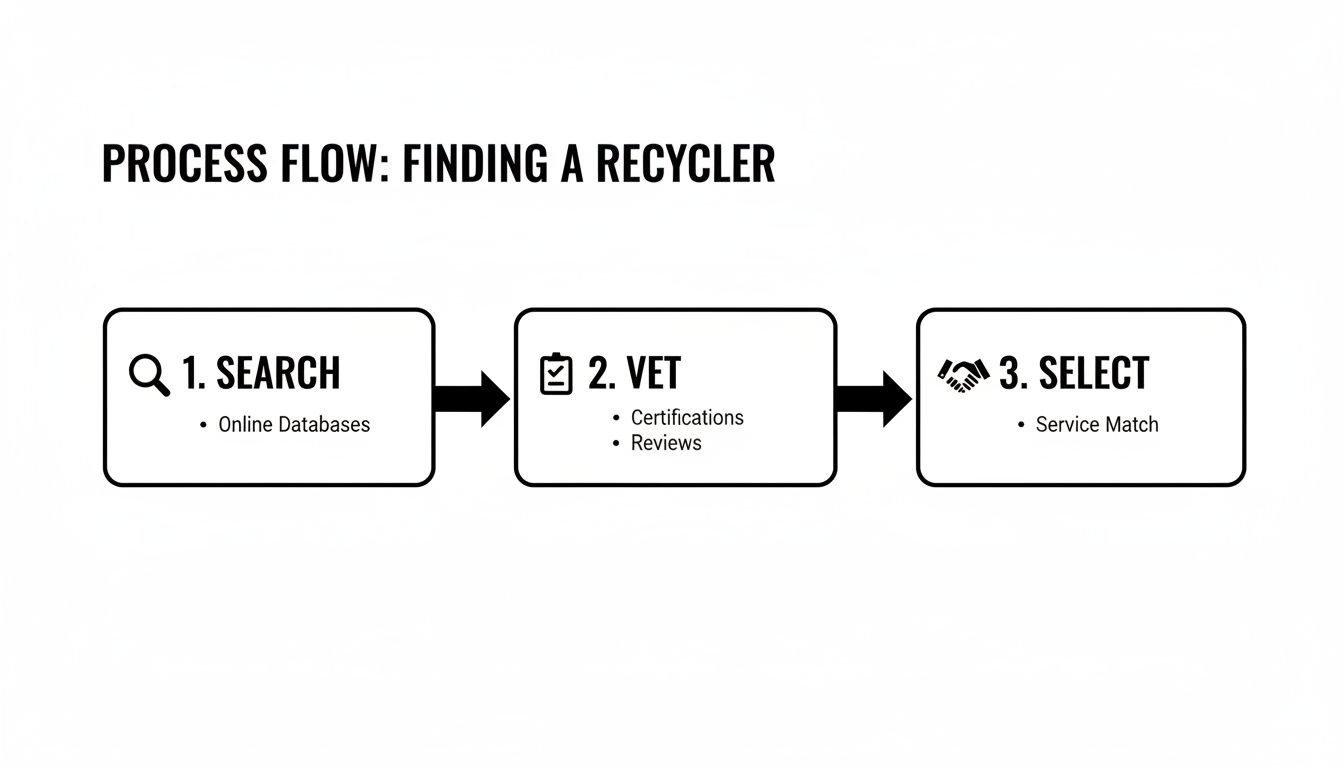
Of course, this journey really starts with choosing the right partner. It's a foundational step that involves finding, vetting, and ultimately selecting a certified recycler you can trust.
Once you've made that critical choice, the real work begins.
Secure Logistics and Initial Check-In
It all starts with the pickup. A reputable recycler will never use third-party couriers for this crucial step. Instead, they'll dispatch a secure, company-owned vehicle operated by their own background-checked employees. This maintains a strict chain of custody right from your loading dock. These trucks are often GPS-tracked for another layer of security.
When your assets arrive at the certified facility, they aren't just tossed into a pile. They're immediately moved to a secure, access-controlled receiving area where the official check-in process kicks off.
Each pallet is weighed, and the security seals are inspected for any signs of tampering. The receiving team then carefully matches the physical hardware against the inventory list you provided. Every single device gets scanned, creating a digital record that follows it through the entire process.
The Moment of Truth: Data Destruction and Dismantling
This is the step that matters most for your data security. Any assets you've marked for destruction are taken to a dedicated, monitored area for one purpose: total data elimination. For hard drives, that almost always means one thing—physical shredding.
The drives are fed into an industrial shredder that pulverizes them into tiny, irrecoverable bits of metal and plastic. This isn't just deleting files; it's the complete and utter obliteration of the storage media itself. For any business dealing with HIPAA, FACTA, or DoD compliance, this is the gold standard.
For organizations that require the highest level of security, many certified recyclers offer onsite shredding. They'll bring a mobile shredding truck directly to your location, allowing you to witness the destruction of your hard drives before they even leave your property.
Once all data-bearing components are verifiably destroyed, the equipment is moved to the dismantling line. Here, trained technicians manually de-manufacture every computer, server, and peripheral. They expertly separate everything into clean commodity streams, including:
- Plastics from casings and keyboards
- Metals like steel, aluminum, and copper
- Circuit Boards full of precious metals
- Cables and power supplies
- Glass from monitors
This meticulous sorting is what makes responsible recycling possible. It ensures hazardous materials are managed safely and that valuable commodities can be returned to the manufacturing supply chain instead of a landfill.
Final Documentation: Your Proof of Compliance and Impact
The last step of the journey is arguably the most important for your business's compliance records. Within a few business days, your recycling partner should provide a comprehensive documentation package. This isn't just a receipt—it's your auditable proof of a job done right.
This package must include a Certificate of Destruction. A legitimate certificate isn't a generic piece of paper; it lists every single asset by serial number and confirms the exact date and method of destruction. To get a better sense of what this involves, you can see what goes into a proper Certificate of Destruction template.
But for a mission-driven recycler, the documentation doesn't stop there. You should also receive an Impact Report. This document transforms your recycling project from a simple compliance task into a powerful story for your ESG and CSR initiatives. It shows you the tangible, positive outcomes of your decision, detailing exactly how your old tech helped restore both lives and landscapes. Imagine getting a report that says, "Your company's e-waste planted 35 trees and helped support veteran aid programs." This turns a routine operational task into a powerful statement about your corporate values.
Turning E-Waste into an ESG Win for Your Company
In the modern business world, Environmental, Social, and Governance (ESG) goals are much more than a box to check on an annual report. They've become a genuine driver of competitive advantage. This is where your search to "recycle computers near me" shifts from a simple operational task into a powerful strategic move.
By choosing a mission-driven recycler, your company can score an easy ESG win. This simple decision can build loyalty with your customers, boost morale within your teams, and even catch the eye of savvy investors. It’s all about turning a standard process into a compelling story of corporate responsibility.
More Than a Certificate: A Story of Impact
Imagine your next IT asset retirement project ending not with a generic Certificate of Destruction, but with real proof of your company's positive impact. A mission-driven partner gives you documentation that actually tells a story. You'll get things like:
- A Plant-A-Tree Certificate: Showing exactly how your old equipment helped support reforestation efforts.
- A Veteran Support Impact Report: Quantifying how proceeds from your assets provided housing, training, or other critical aid to local veterans.
- A Digital “Recycled with Purpose” Eco-Badge: A certified mark you can proudly display on your website and in your annual sustainability reports.
This transforms a routine equipment refresh into a powerful narrative. Your company isn't just getting rid of e-waste; it's actively helping to restore both lives and landscapes.
The message becomes simple but incredibly profound: "Our old tech is helping house a veteran and grow a forest." This is cause-based marketing at its best, connecting an everyday business function to a tangible, emotional outcome that creates a brand story people remember.
The demand for this kind of integrated service is booming. The global electronics recycling market is expanding fast, reflecting a major shift in how businesses view their old IT assets. This growth is directly linked to corporate sustainability goals and tougher regulations, making a professional, mission-driven recycling partner more essential than ever.
Activating Your Impact for Corporate and Community Engagement
Once you have this powerful story, the next step is to share it. A true recycling partner will work alongside you to get maximum visibility and engagement, both inside and outside your company walls.
Corporate Recycling Drives: A fantastic way to start is by organizing a company-wide collection event. Many partners, including Green Atlanta, offer free pickups for qualifying bulk disposals of 50+ devices. This makes it incredibly easy to rally your team around a shared goal and generate a significant first impact.
Community and PR Engagement: This dual-impact model—supporting both veterans and the environment—is a story local media loves. Pitching these initiatives to outlets like the Atlanta Journal-Constitution or local sustainability blogs can generate incredible positive press. Better yet, co-hosting recycling drives with community groups like local VFW chapters or environmental nonprofits builds grassroots credibility and deepens community connections.
Digital Marketing and SEO Focus: Your new ESG credentials should become a cornerstone of your digital presence. Targeting keywords like “corporate sustainability electronics disposal” and “electronics recycling for veterans” will attract like-minded customers and partners. This strategy also provides rich material for video storytelling, from showing USDA reforestation footage to highlighting the veterans who have directly benefited from your company’s participation.
To see how these efforts can be woven into a larger plan, explore our detailed guide on building an effective business sustainability strategy.
Fostering Long-Term Advocacy
The goal here isn't a one-time transaction. It's about transforming your organization and its employees into long-term advocates for responsible recycling. You can achieve this through continuous engagement and transparent reporting.
Personalized impact certificates can be automatically emailed to employees who participate in a drive, showing them they personally "planted 3 trees and helped 1 veteran." This creates a direct, personal connection between the employee and the company's mission.
A referral program can amplify this effect even further. By rewarding employees who refer other businesses with an extra tree planted in their name, you can gamify the process and encourage powerful peer-to-peer advocacy.
Finally, a monthly impact newsletter that shares real stories of supported veterans and shows reforestation progress keeps the mission top-of-mind. It constantly reinforces the value of your partnership and showcases the ongoing positive change your company is helping to create. This is how an operational decision becomes a source of immense corporate pride.
Your Questions About Recycling Computers in Atlanta Answered
When Atlanta businesses start looking to “recycle computers near me,” a lot of questions pop up. We get it. Making the right choice for your company requires clear, straightforward answers.
Here, we'll tackle the most common questions we hear. Our goal is to help you navigate the process and find a partner that ticks all your boxes—from security and compliance to your social impact goals.
What Types of Computers and Electronics Can We Recycle?
Most certified IT recyclers in Atlanta can handle a wide variety of your old tech. It goes far beyond just desktops and laptops. We’re talking about:
- Servers and networking gear like switches and routers.
- Monitors, printers, keyboards, and mice.
- Mobile devices, including tablets and smartphones.
- Data center hardware, such as server racks and uninterruptible power supplies (UPS).
The important thing is to confirm any specific restrictions with your recycler. Some older items, like those bulky CRT monitors, might have special handling fees. A good partner will always provide a detailed list of what they accept, which makes your job of inventorying and staging everything much easier.
How Much Does It Cost to Recycle Computers for a Business?
The answer really depends on what you have, how much of it there is, and the level of data destruction you need. While certain items might have a small fee because of hazardous materials, many recyclers offer free pickup for qualifying bulk disposals—think 50 or more devices.
It’s best not to see this as just an expense. Think of it as a vital investment in your company's data security and compliance. A transparent quote should always break down every potential charge, including any value-added services like on-site hard drive shredding. This allows you to weigh the cost against the huge financial and reputational hit of a data breach.
Is It Safe to Recycle Computers with Sensitive Data?
Absolutely, yes—but only if you partner with a certified recycler who can guarantee secure, total data destruction. Just deleting files or reformatting a hard drive isn’t enough; that data is often still recoverable. A professional recycler will offer several levels of data sanitization to match your specific security requirements.
These options range from software-based wiping that meets NIST 800-88 standards all the way to complete physical destruction. For any organization in a regulated field like healthcare (HIPAA) or finance, physical shredding is the only way to be 100% sure that data is gone forever. Always demand a serialized Certificate of Destruction as your final, auditable proof that every single data-bearing device was properly destroyed.
How Does Recycling Our Computers Help Veterans and the Environment?
When you work with a cause-based recycler, your old e-waste is transformed into a resource for philanthropic missions. The value recovered from recycled commodities directly helps fund these important initiatives.
For instance, a portion of the proceeds from your company’s recycled assets can go straight to supporting programs that provide housing, employment, and essential aid to veterans right here in our community. This turns a simple IT hardware refresh into a direct contribution to "Turning E-Waste into Hope."
At the same time, through our partnerships with environmental groups like the National Forest Foundation, every ton of electronics you recycle helps plant new trees in America's forests. Once your service is complete, you'll receive a detailed impact certificate. This document quantifies your company's unique contribution—"You planted 3 trees and helped 1 veteran"—giving you a powerful story of community and environmental stewardship for your ESG reports.
Ready to turn your old IT assets into a positive impact for veterans and the environment? GreenAtlanta.com offers secure, compliant, and mission-driven electronics recycling—Recycling That Restores Lives and Landscapes—for businesses across the Atlanta area. Schedule your free corporate pickup today at https://www.greenatlanta.com.