
Expert Elevator Inspection Company in Atlanta: Ensure Safety


An elevator inspection company isn't just another vendor—they are your partner in providing a critical, legally required third-party assessment to certify your elevators are safe for public use. This service is entirely separate from your regular maintenance crew and acts as an independent, unbiased check on all your safety systems, making sure you're compliant with both local Atlanta codes and national standards.
Why Your Choice of Elevator Inspector Really Matters
Picking an elevator inspection company is one of the most important decisions you'll make as a facility manager in Atlanta. Honestly, it goes way beyond just checking a box for compliance. It’s about protecting your tenants, shielding your property from liability, and keeping your building running without a hitch.
Think of it this way: a top-tier inspection partner is your first line of defense against catastrophic failures and the messy, expensive lawsuits that always follow.
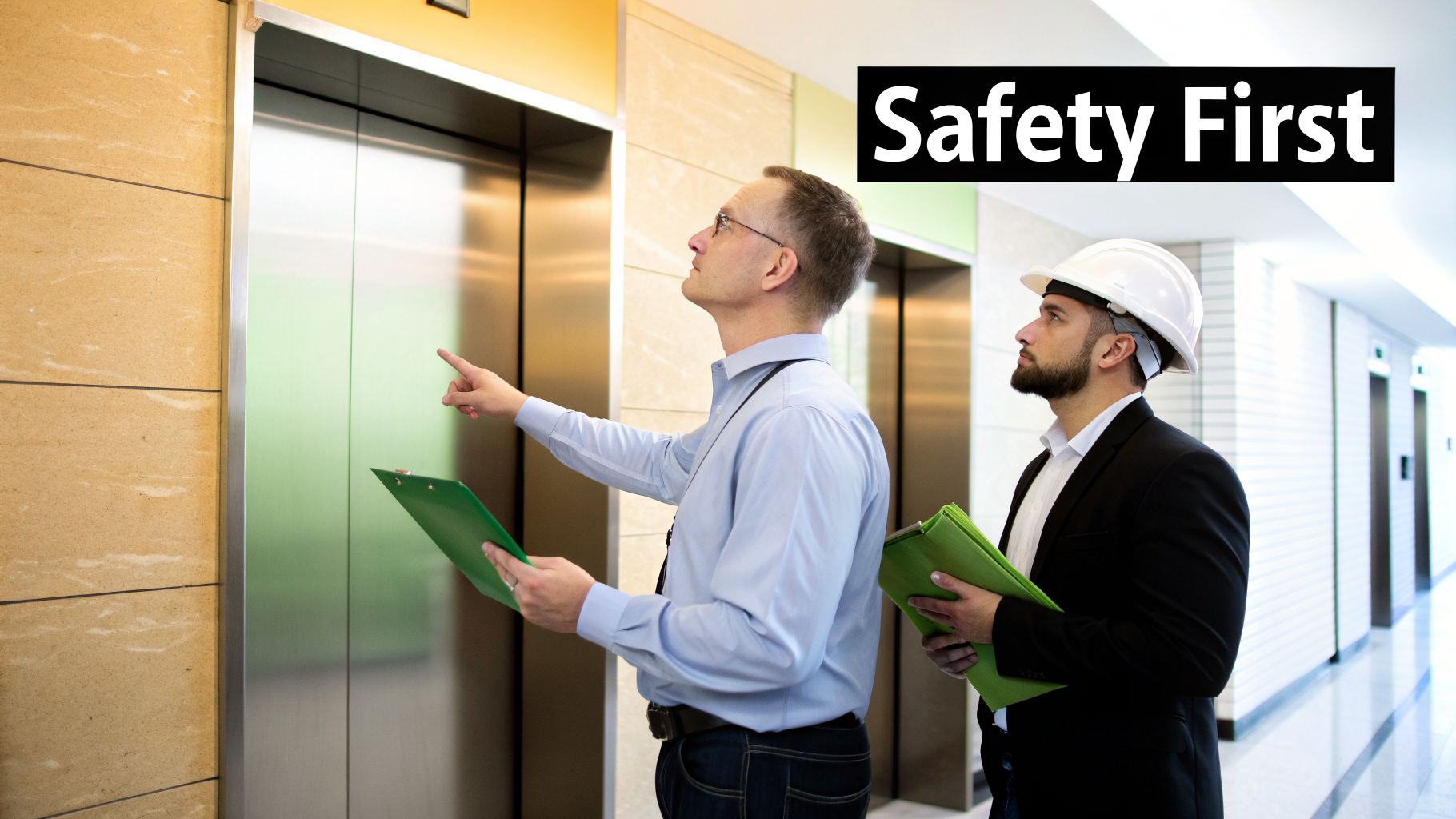
This decision carries real weight. A small oversight during an inspection can snowball into huge consequences. We're talking everything from unexpected downtime that frustrates tenants to serious accidents that can end in tragedy and legal nightmares. The inspector you choose has a direct impact on the safety of every single person who walks into your building.
The Critical Difference Between Maintenance and Inspection
One of the biggest points of confusion I see is the difference between the company that services your elevators and the one that inspects them. It's absolutely crucial to understand that these two roles must be separate to avoid any conflict of interest.
Many building managers in Atlanta get tripped up on this, but the distinction is simple when you break it down. Your maintenance team keeps things running day-to-day, while the inspector's job is to verify that everything is legally and functionally safe.
Let's look at a clear comparison.
Inspection vs. Maintenance: What Your Building Really Needs
| Aspect | Routine Elevator Maintenance | Official Elevator Inspection |
|---|---|---|
| Primary Goal | Preventative care and operational uptime. Keep the elevator running smoothly. | Regulatory compliance and public safety. Certify the elevator is safe by code. |
| Who Performs It | An elevator service company you hire on contract (e.g., your mechanic). | A licensed, third-party inspection company (e.g., the safety auditor). |
| Key Activities | Lubricating parts, making adjustments, replacing worn components, responding to service calls. | Testing safety features (brakes, doors, alarms), verifying code compliance (ASME A17.1), issuing official certificates. |
| Conflict of Interest | The company doing the work cannot legally inspect and certify their own repairs in most jurisdictions. | Must be an independent, unbiased entity with no financial stake in the maintenance work. |
This separation isn't just bureaucratic red tape; it’s a fundamental safety principle designed to protect the public.
In short, your maintenance company fixes the equipment, while the inspection company certifies that it’s safe. You need both, and they can't be the same.
Grasping this difference is the first step toward building a solid safety protocol for your property. A quality inspection company doesn't just hunt for problems. They provide the impartial, official verification you need to protect your assets, your tenants, and your reputation. Their certificate is the official green light confirming your elevators aren't just working—they're verifiably safe.
Navigating Atlanta's Elevator Codes and Certifications
When you're responsible for a building in Atlanta, making sure your elevators are safe and compliant isn't just a box to check—it's a serious legal and financial responsibility. The world of elevator codes can feel like a maze of regulations, but there’s one credential that cuts through the confusion: the QEI (Qualified Elevator Inspector) certification.
This isn’t just a nice-to-have; it’s the absolute baseline. Never, ever hire an inspection firm that can’t prove its team is QEI-certified.
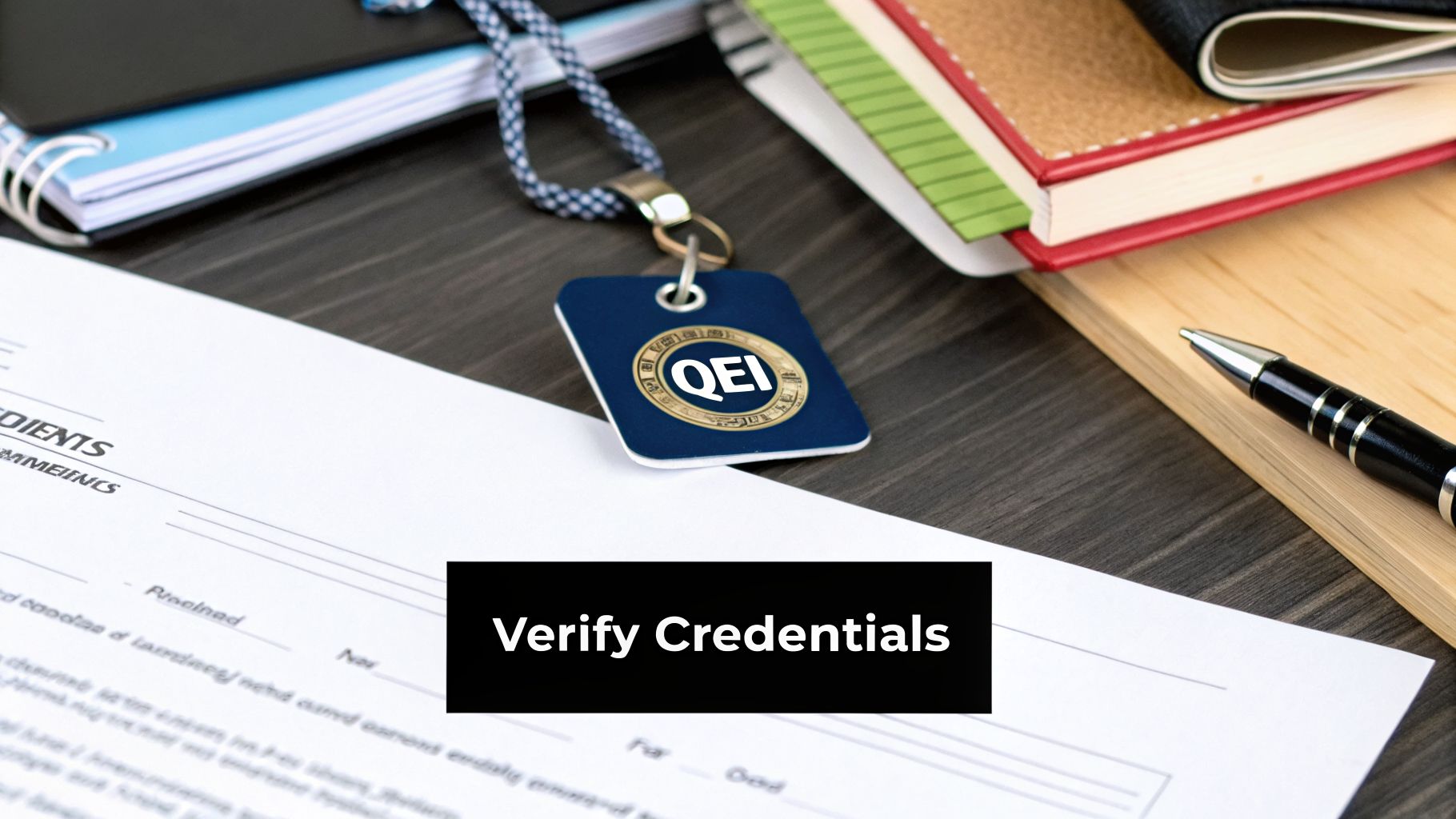
A QEI-certified pro has been through the wringer—rigorous training and exams that cover every detail of elevator safety. Their certification is your proof that they have mastered the ASME A17.1 Safety Code for Elevators and Escalators. This is the national standard that both Georgia and the City of Atlanta have adopted.
Skipping this step and hiring a non-certified inspector is a recipe for disaster. You could end up with an invalid report, leading to hefty fines, forced shutdowns, and staggering liability if an accident ever happens on your watch.
Local Atlanta Requirements
While national standards like ASME A17.1 set the stage, the real action happens at the local level. The City of Atlanta, along with surrounding counties like Fulton, DeKalb, Gwinnett, and Cobb, all have their own specific rules and filing procedures. This is where a true Atlanta-based inspection company really proves its worth.
Local expertise is more than just a convenience; it’s a critical advantage. These folks know exactly which forms the local Authority Having Jurisdiction (AHJ) needs, how to file everything electronically to prevent delays, and who to call to resolve an issue. They’ve built relationships with the city officials you’ll never have to meet.
A local inspector’s real value is their boots-on-the-ground knowledge of how Atlanta’s codes are actually enforced. They know the common quirks of older buildings in Midtown and the specific demands for new high-rises going up in Buckhead.
Your Vetting Checklist for Certifications
Before you sign on the dotted line, run through this simple checklist. Taking a few minutes to verify an inspection company's credentials is the best thing you can do to protect your building and ensure total compliance.
- QEI Certification: Ask for proof that their inspectors hold current QEI certifications. Don't just take their word for it—ask to see the credentials for the actual inspector who will be working in your building.
- State of Georgia Licensing: The company must be licensed to perform inspections in Georgia. This is a fundamental requirement for any legitimate provider.
- Certificate of Insurance (COI): Always request a current COI. Make sure it lists not only General Liability but also Errors & Omissions (E&O) coverage. E&O is what protects you if they make a mistake that costs you money.
- Local Experience: Ask for references from buildings like yours right here in the Atlanta area. This confirms they're familiar with your type of equipment and know their way around the local code enforcement landscape.
For facility managers, the full scope of an inspection can be a lot to take in. You can get a better handle on the process by exploring our comprehensive guide on elevator inspection services.
By working through these qualifications, you're doing more than just hiring a vendor. You're bringing on a partner who is technically skilled, properly insured, and legally cleared to certify your elevators, letting you focus on managing your facility with complete peace of mind.
Getting a Handle on Your Building’s Inspection Schedule
Not all elevator inspections are created equal, and honestly, that’s a good thing. As a facility manager, getting a feel for the rhythm of your building's inspection schedule is a total game-changer for staying on top of things. Different checks are required at different times, and knowing the "what" and "when" is the key to proactive management.
When you have this knowledge, you shift from just reacting to deadlines to strategically managing your vertical transportation. It gives you the power to budget more accurately, schedule work with the least possible disruption to your tenants, and have real, confident conversations with your elevator inspection company.
The Annual Periodic Inspection
Your most common and essential check-in is the Annual Periodic Inspection. This is the yearly exam your elevator has to pass to earn its Certificate of Operation. During this inspection, a qualified professional will verify that all the critical safety features are working exactly as they should.
Think of it as a comprehensive annual physical for your elevator. The inspectors are meticulous, checking things like:
- Door Operations: They'll make sure the doors open and close without a hitch, and that safety edges or sensors properly reverse the doors if something gets in the way.
- Emergency Systems: This is a big one. They test the in-car alarm, the two-way phone system, and the emergency lights to confirm they'll work when you need them most, like during a power failure.
- Leveling Accuracy: They confirm the elevator car stops flush with the floor. Even a small misalignment can be a serious trip hazard.
- General Condition: A thorough visual check of the machine room, the hoistway, and inside the car itself for any red flags like wear and tear, damage, or unapproved modifications.
This yearly review is your main tool for documenting ongoing safety. For anyone operating an elevator in Atlanta, it's completely non-negotiable.
The Five-Year Load and Safety Test
Every five years, your elevator is due for a much more intense evaluation: the Full-Load Safety Test. This is worlds away from the annual check-up; it's a far more rigorous and involved process designed to test the system's core safety components under the most extreme conditions.
For this test, the elevator car is loaded with weights matching its maximum rated capacity. Inspectors then trigger the safeties and braking systems to see if they can stop a fully loaded car at what’s called governor-tripping speed. It's a dramatic but critical test of the emergency braking system that's designed to prevent a free-fall.
This five-year test is the ultimate proof that your elevator can handle a worst-case scenario. It verifies that the emergency systems you hope to never use will absolutely perform when called upon, providing the highest level of assurance for passenger safety.
The growing focus on these tough tests is part of a bigger industry trend. The global market for elevator testing is expanding, pushed by strict regulations and a desire to prevent costly failures before they happen. You can see more data on this in a recent elevator inspection service report.
Understanding these different timelines is crucial. It lets you plan ahead for major expenses like the five-year test and work with your service provider to get the equipment ready. If you want to dive deeper into the specific rules right here at home, you can read our posts covering various Atlanta elevator codes. A well-informed facility manager is an effective one, fully capable of ensuring safety and compliance with confidence.
How to Vet and Interview Potential Companies
Finding a company with the right certifications is just the first box to check. The real work begins when you need to find a long-term partner whose operations mesh perfectly with your building’s unique needs. A company might look great on paper, but you need to dig deeper to see if they’re the right fit for your property right here in Atlanta.
This all comes down to a thoughtful interview process. You have to move past the standard sales pitch and ask sharp, specific questions that show you how they really operate. This is how you find a reliable partner who gets what you need, not just another vendor who can run a test.
Key Questions for Your Interview Process
When you sit down with a potential elevator inspection company, your questions should zero in on their direct experience and how they handle day-to-day operations. If you get vague answers, that’s a red flag. You're looking for concrete details that prove their expertise and reliability.
Here are a few essential questions to get the ball rolling:
- Experience with Your Equipment: "What's your team's specific experience inspecting [Your Elevator Manufacturer and Model, e.g., Otis Gen2 or Schindler 3300] elevators? Can you walk me through some common issues you see with this model?"
- Communication Protocols: "How do you typically communicate inspection schedules, findings, and any delays? Who would be our main point of contact?"
- Failed Inspection Management: "If one of our elevators fails an inspection, what's your process for reporting it? How fast can you get us the detailed report we need to start repairs?"
- Local Relationships: "How familiar are you with the filing requirements for the City of Atlanta compared to, say, Cobb or Gwinnett County?"
These questions steer the conversation away from generic claims and toward practical, real-world situations that will directly impact your building’s compliance and operations. Their answers will tell you a lot about their depth of knowledge and how easily they'll fit into your facility management workflow.
Verifying References and Spotting Red Flags
References are your best shot at getting the unfiltered truth about a company's performance. When you call a reference—and you absolutely should, preferably another facility manager in the Atlanta area—ask them about responsiveness, the clarity of their reports, and overall professionalism. Were reports on time? Were the inspectors easy to work with?
A great elevator inspection company will have a roster of happy clients ready to vouch for them. If a company hesitates to provide local references from buildings similar to yours, you should see that as a major red flag.
Other warning signs include confusing pricing structures and a fuzzy understanding of the local authorities. A confident, experienced local firm will be upfront about their costs and will know exactly how to navigate the bureaucracy of local AHJs (Authorities Having Jurisdiction).
This flowchart gives you a good look at the different tests your elevators will go through over time.
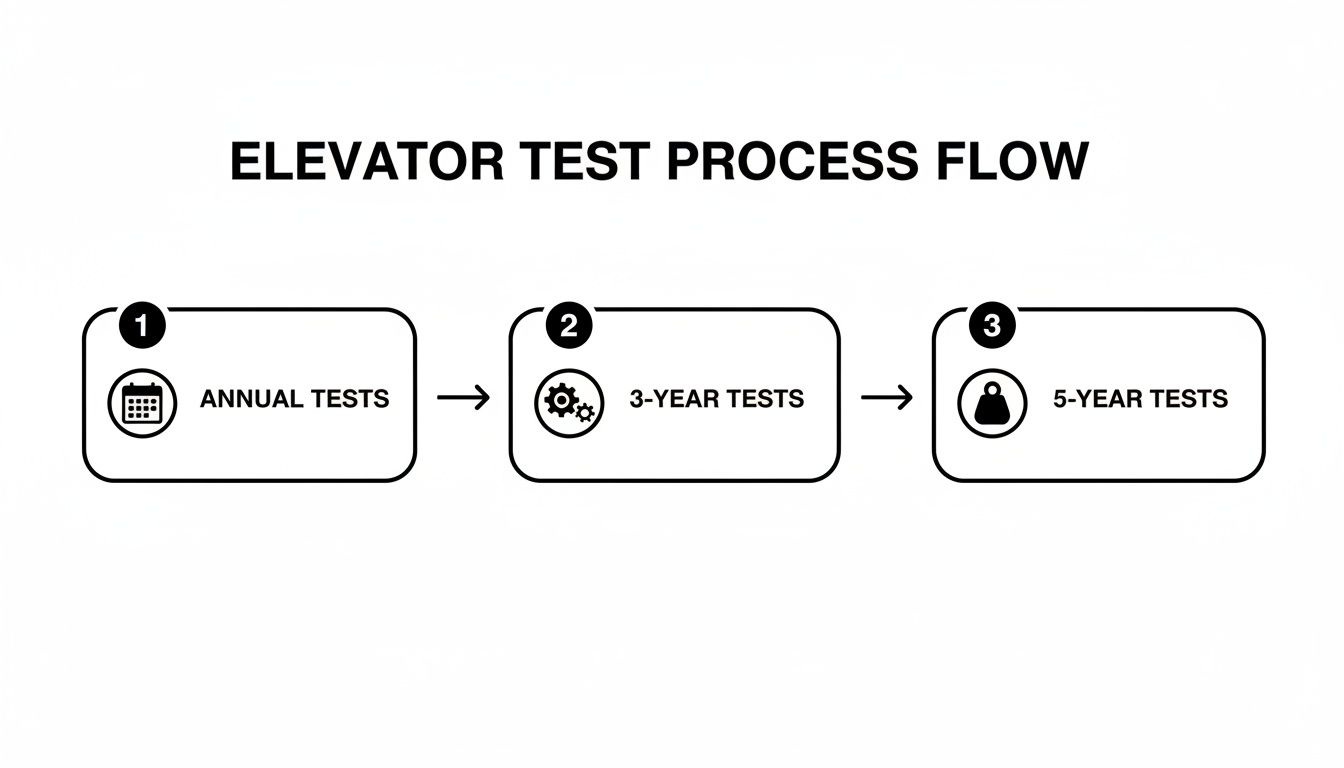
As you can see, the annual tests cover routine safety checks, but the 3-year and 5-year tests are much more intensive, involving heavy-duty mechanical and load-bearing evaluations.
The broader maintenance and inspection industry is only getting bigger. In fact, the global market for elevator maintenance is expected to climb past $46.1 billion by 2026, thanks to new construction and modernization projects in offices and hospitals.
A comprehensive commercial property inspection checklist is an invaluable asset for any facility manager looking to stay on top of maintenance and safety standards. You can also learn more about what to expect from our elevator inspection services here in Atlanta. Putting in the time to vet a company thoroughly ensures you find a partner truly dedicated to your building's safety and long-term success.
Decoding Contracts, Pricing, and Documentation
The service agreement is where the rubber meets the road. Getting this part right is what protects your budget, limits your liability, and ensures you get exactly what you’re paying for—no excuses. Think of it less as a formality and more as the rulebook for your entire relationship with the inspection company.
A vague or poorly written contract is an open invitation for surprise fees, blown deadlines, and a massive headache if an auditor ever comes knocking. Let’s break down what you need to look for before signing on the dotted line.
Analyzing Common Pricing Structures
When the quotes start coming in, you’ll likely see one of two pricing models. Knowing the difference is crucial for making a true apples-to-apples comparison.
- Flat Per-Elevator Fee: This is as straightforward as it gets. You pay a set price for each specific inspection—one cost for the annual test, another for the five-year test. It’s clean, simple, and makes budgeting a breeze.
- Bundled Service Contract: Some companies will offer a package deal that covers all required inspections over a certain period. This can sometimes save you a bit of money, but you have to read the fine print. What isn't included? Most importantly, are re-inspection fees covered if an elevator fails?
Always, always ask for a complete breakdown of costs. Are travel fees extra? What happens if they need to come back out? A reputable partner will be transparent about every single potential charge. For managers juggling multiple vendors, you might find our guide on hiring an office relocation company useful, too.
Essential Contract and Documentation Clauses
Your contract, which you might see called a Service Level Agreement (SLA), is your primary line of defense. It needs to spell out responsibilities, timelines, and exactly what you’ll receive. Before you even think about signing, make sure it has these critical elements locked down.
Key Documentation to Demand:
- Certificate of Insurance (COI): This is non-negotiable. They must have General Liability, but the key is confirming they also carry Errors & Omissions (E&O) insurance. E&O is what protects you if a mistake on their part ends up costing you money.
- Proof of QEI Certification and State Licensing: The contract should state that every inspection will be performed by a QEI-certified inspector who is fully licensed to work in Georgia. No exceptions.
- Final Compliance Certificates: The agreement must clarify that the company is responsible for filing all required paperwork with the local AHJ (like the City of Atlanta) and for giving you a copy of the final, approved certificate for your records.
The reporting process is just as important. Your contract should define the timeframe for receiving reports, especially for a failed inspection. You need that information in your hands immediately to line up repairs and prevent unnecessary downtime.
A strong contract is your best defense. It needs to clearly define the scope of work, list all deliverables, and confirm the provider is carrying the right insurance. Without these protections, you’re flying blind.
This focus on verification isn't just a local trend; it's an industry-wide push. The market for elevator safety systems is projected to climb from $15.65 billion in 2026 to $21.98 billion by 2030. That’s a powerful signal of the industry’s commitment to safety standards like ASME A17.1. Plus, properly inspected elevators have been shown to reduce accident risks by a staggering 90%. You can dig deeper into these elevator controls industry insights to see what’s shaping the market.
Key Questions for Atlanta Facility Managers
When you're narrowing down your choices for an elevator inspection company, asking the right questions can make all the difference. It's always smart to have a list of essential questions to ask when hiring a company, but let's tackle a few of the most common ones we hear from facility managers right here in Atlanta.
What Happens If My Elevator Fails an Inspection in Atlanta?
An elevator failing its inspection can feel like a major headache, but the process is pretty straightforward. The inspector will give you a detailed report that outlines every violation, big or small. If it’s a critical safety issue, they’ll "red-tag" the elevator right then and there, taking it out of service immediately until the problem is fixed.
From there, it's on you to bring in your separate elevator maintenance company to perform all the necessary repairs. Once everything is fixed, you'll schedule a re-inspection. Only after the elevator passes this second check can it legally be put back into public use.
Is a Local Atlanta Company Better Than a National One?
This is a classic "pros and cons" situation. A big national firm certainly has deep resources, but a local Atlanta company often brings a personal touch and an invaluable understanding of our local Authorities Having Jurisdiction (AHJs).
An established local inspector has likely built relationships with city officials, which can help streamline the filing and compliance process. They understand the nuances between different jurisdictions, from the City of Atlanta to surrounding counties, which a national firm might miss.
Your best bet? Evaluate both options. Look at their QEI certifications, how responsive they are, and most importantly, ask for references from other Atlanta-area properties similar to yours.
Can My Regular Maintenance Provider Also Do the Official Inspection?
The short answer is a firm no. In Georgia, like in most places that follow the ASME A17.1 safety code, this is considered a major conflict of interest. The legally required safety inspection has to be done by a neutral, third-party certified inspector.
This rule is a cornerstone of public safety. It ensures complete objectivity by preventing a company from essentially "grading its own homework." This separation is what protects you, your tenants, and your property from liability. For facility managers looking for more insights, feel free to explore our other posts on Atlanta facility management.
When your office has old IT equipment and electronics that need to be retired, Atlanta Green Recycling offers secure and responsible e-waste disposal solutions. We provide certified data destruction and environmentally compliant recycling to help your business meet its sustainability goals while supporting veterans and reforestation efforts. Schedule your pickup at https://www.greenatlanta.com.