
Elevator inspection services: Your Atlanta safety and compliance guide

For any building manager in Atlanta, elevator inspection services are an absolute must. These aren't just optional check-ups; they are mandatory safety and compliance reviews for your vertical transportation systems. Think of it as a crucial part of facility management, one that helps you prevent dangerous failures and sidestep major legal trouble.
Keeping Your Building Safe and Compliant in Atlanta
As a building manager in Atlanta, you know that keeping your elevators running smoothly is a non-negotiable part of the job. But this goes so much deeper than just tenant convenience—it’s a foundational piece of public safety, legal compliance, and protecting your asset's long-term value. Managing your elevators proactively is a cornerstone of a solid business sustainability strategy, showcasing your commitment to operational excellence.
It helps to think of these regular inspections like a required health screening for your building's circulatory system. Their entire purpose is to spot small issues that are just starting to develop, long before they can turn into hazardous malfunctions or incredibly expensive failures. If you skip these checks, you're not just taking a chance on passenger safety—you're opening up your entire organization to serious liability.
Why Elevator Inspections Matter in Atlanta
In a bustling city like Atlanta, elevators are the workhorses of almost every commercial and residential high-rise. How well they run has a direct effect on your property’s reputation and day-to-day function. Letting this critical piece of maintenance slide can kick off a domino effect of negative outcomes.
At their core, professional elevator inspection services serve a few key purposes:
- Ensuring Tenant and Visitor Safety: This is, without a doubt, the number one priority. Inspections are there to confirm that every single safety feature—from the door sensors to the emergency brakes—is working exactly as it should.
- Maintaining Legal Compliance: The city of Atlanta and the state of Georgia have very specific, strict codes that dictate how elevators must operate. Passing your inspections is the only way to get the operating certificates you legally need.
- Preventing Costly Breakdowns: A good inspector can spot wear and tear on crucial parts like cables and pulleys. This allows you to schedule preventive maintenance, which is always far cheaper than dealing with emergency repairs and the resulting downtime.
- Protecting Property Value: A building that has a clean, documented history of safe, properly maintained elevators is simply a more valuable and appealing asset for any potential tenants or buyers.
A failed inspection isn't just a piece of paper; it's a direct warning that your equipment poses a risk. It’s an action plan for immediate remediation to protect everyone in your building.
To keep your entire building safe and on the right side of regulations, it’s vital for facility managers to understand essential safety and compliance best practices. This guide will give you a clear roadmap for navigating the whole process. We're going to break down everything you need to know, turning the often-confusing world of elevator regulations into a strategic, manageable part of your plan to keep your building safe, operational, and penalty-free.
Navigating Atlanta's Elevator Codes and Local Regulations
For any building manager in Atlanta, trying to make sense of elevator regulations can feel like getting lost in a maze. But it’s a critical part of the job. Falling out of compliance doesn't just risk steep fines; it opens the door to serious liability. These aren't just bureaucratic suggestions—they are legal mandates put in place to protect every single person who steps onto your elevators.
The best way to think about the rules is like a waterfall. National standards are at the top, and they flow down to the state and then local levels, with each adding its own specific requirements. This ensures a consistent baseline of safety everywhere while giving cities like Atlanta the flexibility to address their own unique building landscapes.
The Hierarchy of Elevator Safety Rules
Staying on the right side of compliance means knowing who sets the rules. In Georgia, it’s a team effort between several governing bodies to enforce a single, high standard of safety.
- ASME A17.1 Safety Code: This is the bedrock of elevator safety across North America. It covers everything from design and installation to ongoing maintenance, and it serves as the foundational document for almost all state and local codes.
- Georgia Office of Insurance and Safety Fire Commissioner: At the state level, this is the agency that officially adopts and enforces the safety codes, including ASME A17.1. They’re the ones who issue operating certificates and oversee compliance across Georgia.
- City of Atlanta Requirements: While the state handles the main rulebook, Atlanta can and does add its own specific mandates. These often relate to things like fire service access or requirements for older, historic buildings. You can find updates and news relevant to commercial buildings in Atlanta that might affect your compliance strategy.
This layered system is exactly why a professional eye is so crucial. It’s also why the market for expert elevator inspection services is expanding so rapidly. The global market was valued at around $7,500 million by 2025 and is on track to grow at a compound annual growth rate (CAGR) of 8.5% through 2033, thanks to increasing urbanization and stricter safety rules.
Who Is Responsible for Compliance
The law is refreshingly clear on this point: the building owner or their designated agent (like a facility manager) is ultimately responsible for ensuring the elevator is safe and compliant. This is one responsibility you can't fully outsource. Even with a top-tier maintenance contract, the legal buck for holding a valid, current operating certificate stops with you.
That means you are on the hook to:
- Schedule and pay for all required inspections with a qualified, third-party inspector.
- Make sure any repairs flagged during an inspection are completed quickly.
- Keep organized, detailed records of every inspection, maintenance visit, and repair.
- Display the current, valid operating certificate in or near the elevator where it can be easily seen.
Simply put, if an accident happens because of a deficiency you knew about but didn't fix, the liability lands squarely on the building’s ownership and management. A proactive approach to elevator inspection services isn't just good practice; it’s your best defense against legal and financial disaster.
Staying on top of these regulations is all about diligence. You need to keep a comprehensive file for each elevator, packed with past inspection reports, maintenance logs, and a copy of that all-important current operating certificate. This file is the first thing an inspector will ask for and acts as your official proof of due diligence.
The Different Types of Elevator Inspections
When it comes to elevators, not all inspections are the same. For any Atlanta building manager, getting a handle on the different types is key to staying compliant, managing your budget, and planning maintenance without any surprises. Think of it this way: your car needs quick oil changes, a more detailed annual service, and maybe an occasional major overhaul. Your elevator operates on a similar principle.
This tiered approach, involving different elevator inspection services, ensures your equipment is held to the highest safety standards from the day it’s installed and every year after. Each assessment has its own distinct purpose and schedule, dictated by a hierarchy of codes.
This system flows from national standards all the way down to our local Atlanta rules.
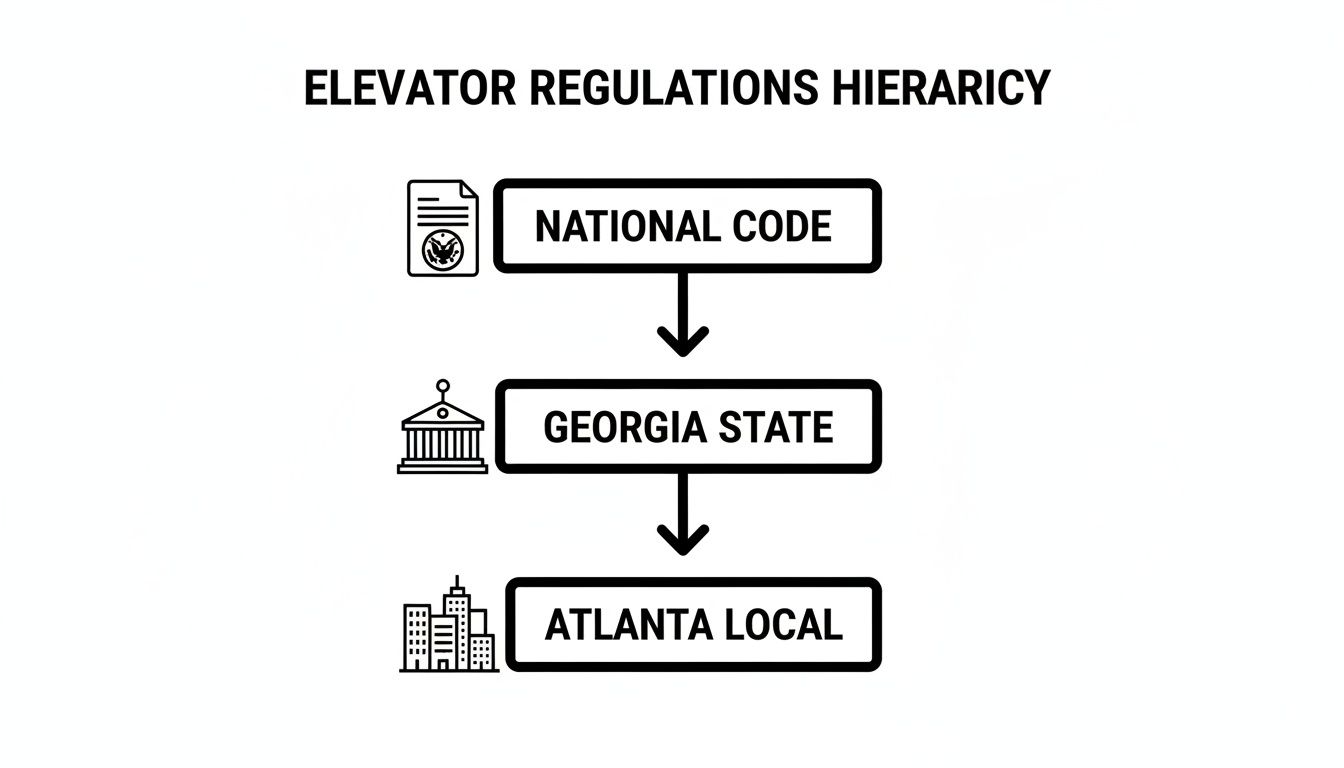
As you can see, while national codes like ASME A17.1 provide the foundation, it’s Atlanta's specific requirements that are the final word for your building's compliance. Let's break down what that means for you.
Routine or Periodic Inspections
This is the one you'll see most often. The routine or periodic inspection is essentially your elevator's annual health checkup. It’s a thorough visual and operational review meant to catch common wear-and-tear issues before they become bigger problems and is the primary step to renewing your annual certificate of operation.
During this yearly inspection, a certified QEI (Qualified Elevator Inspector) focuses on the components passengers interact with daily, along with the core machinery:
- Doors and Sensors: Checking that they open, close, and reverse properly without any hitches or excessive force.
- Emergency Systems: Testing the in-cab emergency phone to ensure it connects, verifying the alarm button, and making sure backup lighting works.
- Leveling and Travel: Making sure the car stops flush with each floor (no tripping hazards!) and travels between floors smoothly, without any odd noises or jarring movements.
- Machine Room: A visual scan of the controller, motor, and general housekeeping to spot potential fire hazards or mechanical red flags.
This inspection is mandatory every year. If you skip it, your operating certificate expires, and it becomes illegal to operate your elevator for public use.
Acceptance Inspections for New or Altered Equipment
Any time you install a brand-new elevator or give an existing one a major upgrade—like a new controller, motor, or cab—an acceptance inspection is non-negotiable. This is a one-time, incredibly detailed assessment that happens before the equipment is ever opened to the public.
Its purpose is to confirm that the new gear was installed exactly according to the approved plans and meets every current code. It’s the ultimate quality control check. No new or significantly altered elevator gets its first operating certificate without passing this rigorous test.
An acceptance inspection is the final gatekeeper between construction and public service. It's an independent stamp of approval confirming the equipment isn't just new, but installed correctly and safely right from the start.
Five-Year Load and Safety Tests
Every five years, your elevator faces its most intensive exam: the full-load five-year safety test. This goes way beyond a routine annual check. We're talking about a comprehensive test designed to stress the elevator's most critical safety systems under simulated worst-case scenarios.
For this test, the inspector works alongside your elevator maintenance technician to perform several critical verifications:
- The emergency braking system is tested by loading the car with its maximum rated weight and performing a controlled stop.
- The governor and safety mechanisms, which prevent the car from over-speeding or falling, are put through their paces.
- In hydraulic elevators, the pressure relief valves are tested to ensure they work correctly under a full load.
This is the test that confirms the systems you hope are never needed will work flawlessly in an actual emergency. It's more time-consuming and costly than an annual inspection because it requires test weights and specialized procedures, but it's an absolutely critical part of long-term elevator safety.
To help you keep track, here’s a quick overview of the main inspection requirements in Atlanta.
Atlanta Elevator Inspection Schedule at a Glance
| Inspection Type | Purpose | Frequency | Key Checks |
|---|---|---|---|
| Routine/Periodic | Annual renewal of operating certificate and general safety check. | Annually | Doors, emergency phone/alarm, cab leveling, machine room visuals. |
| Acceptance | Verifies new or modernized equipment is code-compliant before public use. | One-time | Installation matches approved plans, all systems meet current code. |
| Five-Year Test | Stress-tests critical safety components under a full load. | Every 5 Years | Brakes, governor (over-speed device), and hydraulic pressure systems. |
These three inspections form the backbone of elevator safety and compliance. By understanding their distinct roles and schedules, you can better prepare your building, manage your budget, and ensure you’re always providing a safe ride for your tenants and visitors.
How to Prepare for a Smooth Inspection

Nothing throws a wrench in your day quite like a failed elevator inspection. It's the start of a domino effect: frustrating downtime, unexpected costs for re-inspections, and a whole lot of scheduling headaches. The best way to sidestep this mess is with a little proactive prep.
Think of it as a pre-flight check for your vertical transportation. By tackling a few simple but critical steps beforehand, you can drastically boost your chances of passing on the very first try. This isn't just about saving money; it’s about demonstrating your commitment to safety and keeping your building running like a well-oiled machine.
Assemble Your Documentation
The first thing any inspector will ask for is your paperwork. Having everything organized and ready to go makes their job easier and immediately sets a professional tone. A scramble for missing documents, on the other hand, starts things off on the wrong foot.
Before your appointment, get these key documents together in a single, dedicated file:
- Current and Past Inspection Reports: These show a consistent history of compliance and prove that any previous issues have been resolved.
- Maintenance Logs: This is your detailed record of every service visit, repair, and routine check performed by your elevator maintenance company.
- Operating Certificate: Your current, valid certificate of operation should be easily accessible.
This file is essentially the official medical history for your elevator, and it speaks volumes about your diligence as a facility manager.
Prepare the Physical Space
An inspector needs a clean, clear, and safe environment to do their job properly. A cluttered or dirty machine room is more than just an eyesore—it’s a safety hazard and a red flag suggesting a general lack of care.
1. Clean and Clear the Machine Room: Make sure the room is completely free of stored items, debris, and especially flammable materials. The space needs to be well-lit and provide unobstructed access to the controller, motor, and all other equipment.
2. Verify Safe Access: Check that the path to the machine room is clear. If a ladder is needed to access it, ensure it's secure and meets safety standards. The door should be unlocked and ready for the inspector when they arrive.
3. Check Car-Top and Pit Conditions: The top of the elevator car and the pit at the bottom of the shaft must be clean and dry. Get rid of any trash or water that might have collected, as these are critical inspection points.
These are simple tasks, but they signal to the inspector that you take safety and maintenance seriously, allowing them to conduct a much more efficient evaluation.
Coordinate with Key Personnel and Tenants
A smooth inspection day isn't a one-person show. Clear communication with both your maintenance provider and your building’s tenants is absolutely essential.
The single most effective strategy for passing an inspection is to have your elevator maintenance technician on-site. They can often fix minor issues—a flickering light, a small programming adjustment—on the spot. This can prevent an automatic failure and the need for a costly re-inspection.
Don’t forget to give your tenants plenty of notice about the inspection. Let them know which elevators will be out of service and provide an estimated timeframe. This simple courtesy goes a long way in managing expectations and preventing complaints. It’s the same kind of detailed coordination that goes into complex projects like specialized office relocation services.
By preparing your documents, the physical space, and your people, you set the stage for a quick, successful, and stress-free inspection.
Choosing the Right Elevator Inspector in Atlanta
Getting your elevators inspected isn't just about checking a box on your compliance to-do list. The person you hire holds the safety of your tenants and the health of your budget in their hands. For Atlanta facility managers, this decision is about finding a true partner, not just another vendor.
Think of it this way: a great inspector acts like a specialized auditor for your building's most critical vertical transportation. Their one and only job is to give you an unbiased, expert assessment against incredibly strict safety codes. The quality of elevator inspection services you receive comes down entirely to the inspector's qualifications and, just as importantly, their independence.
The market for elevator maintenance is growing fast—it’s projected to top $46.1 billion worldwide by 2026. This isn't just due to new buildings going up; it's driven by the hard fact that diligent safety checks can prevent as many as 30% of incidents. You can discover more insights about elevator market trends on ResearchAndMarkets.com.
Non-Negotiable Vendor Criteria
When you're vetting potential inspectors here in Atlanta, your checklist needs to be firm. A few qualifications are simply non-negotiable—they're your first line of defense against shoddy work. Remember, a low-ball price is never worth the risk to safety or the headache of non-compliance.
Your evaluation has to start with these core attributes:
- QEI Certification: Your inspector absolutely must hold a current Qualified Elevator Inspector (QEI) certification. This is the industry’s gold standard, proving they’ve passed rigorous exams and know the code inside and out. No QEI, no deal.
- Local Code Expertise: The provider needs to live and breathe Georgia’s state requirements and Atlanta's specific city ordinances. Ask them point-blank how they stay current on changes to the ASME A17.1 code and local enforcement nuances.
- Transparent Pricing: A reputable firm will give you a clear, itemized quote that spells out exactly what's included. Be skeptical of vague pricing that could hide surprise fees for travel, report generation, or follow-up calls later on.
The Critical Red Flag: Conflict of Interest
Here’s one of the most important things to look out for: a conflict of interest. When a company offers both inspection and repair services, you have an inherent problem. Their incentive can easily shift from giving you an honest assessment to "finding" problems that their own repair team can conveniently fix—for a price.
A truly independent third-party inspector has only one job: to ensure your elevator is safe and compliant. Their loyalty is to the safety code, not to a service department's sales quota.
This clear separation of duties is a cornerstone of ethical service. When you choose an inspection-only firm, you're guaranteeing that the report you get is objective and trustworthy. Their findings are based purely on the condition of your equipment, not on generating more business for themselves. This is a recognized best practice in many industries, including for Atlanta-based IT asset disposition companies that must provide unbiased data destruction certificates.
Key Questions to Ask Potential Inspectors
To make a confident choice, you need to go into the conversation armed with direct questions that cut right through any sales pitch.
- Can you provide proof of your QEI certification and current liability insurance?
- How many years have you been inspecting elevators specifically in the Atlanta metro area?
- Does your company also perform elevator repairs or modernization services? (This is the big one!)
- What’s your process if a minor, fixable issue is found during the inspection?
- What does your standard inspection report include, and how quickly can I expect to receive it?
The way they answer these questions will tell you everything you need to know about their experience, their independence, and their professionalism. It’s how you find a partner truly dedicated to your building's safety.
Responding to Common Inspection Deficiencies
Getting an inspection report back with a list of deficiencies isn't a failing grade—it's your action plan. While seeing violations listed out can be stressful, knowing what they mean and how to fix them turns a surprise problem into a manageable project to improve your building's safety.
Think of that report as a diagnostic tool. Each item an inspector flags points directly to a component that’s either out of code or showing early signs of wear. Your job is to team up with your maintenance provider to tackle each point, bringing your equipment back into full compliance with Atlanta and Georgia safety standards.
What Inspectors Usually Find
Every elevator system has its quirks, but over the years, we see the same handful of issues pop up time and again. If you know what they are, you can often get ahead of them before an inspection.
Here are some of the most common deficiencies:
- Malfunctioning Door Protection: These are the sensors or rubber edges that stop doors from closing on someone. If they aren't working right, it’s a direct and immediate injury risk.
- Worn Hoist Ropes or Sheaves: Inspectors are trained to spot any fraying, corrosion, or stretching in the steel ropes that lift the cab. This is a serious one—worn ropes can lead to catastrophic failure if left unaddressed.
- Inadequate Emergency Communication: That emergency phone in the cab has to provide clear, reliable, two-way communication. A phone that’s dead, has a bad connection, or is garbled is a critical failure. It’s the only lifeline for passengers if they get trapped.
- Outdated Fire Service Operation: Firefighters rely on the "Firefighters' Service" mode (Phase I and Phase II) to take control of the elevator in an emergency. If this system fails to activate or operate correctly, it can seriously hinder a rescue.
The Fix-It and Re-Inspect Process
Once that report is in your hands, the clock starts. The process for clearing these deficiencies is straightforward, but you have to manage it carefully to avoid fines or extended downtime.
1. Review and Prioritize: The first thing you should do is get the report to your elevator maintenance company. Go through it with them to understand how severe each violation is and map out a plan. Critical safety issues, like failing brakes or door locks, need to be fixed immediately.
2. Schedule Repairs: Give your maintenance provider the green light to handle the repairs and replace any necessary parts. Make sure you get documentation for every single action they take—this paperwork is your proof of compliance.
3. Schedule a Re-Inspection: After every last item has been corrected, you’ll need to schedule a re-inspection with the same third-party inspector. They will come back out specifically to verify that all the original violations have been properly fixed.
4. Obtain Your New Certificate: Only after you pass that re-inspection will the inspector sign off, clearing the way for the state to issue a new certificate of operation. Accurate documentation here is everything; it’s just like needing a proper certificate of destruction form to prove you’ve handled sensitive materials correctly.
Don’t look at a deficiency report as a penalty. See it as a roadmap. It gives you clear, expert-driven directions on what to fix to keep your elevators safe. It's your legal and ethical responsibility to address these items promptly.
Turning a failed inspection around quickly keeps your tenants safe, minimizes elevator downtime, and shows your commitment to being a proactive facility manager. You can transform a potentially negative event into a real opportunity to reinforce the safety and integrity of your building.
Atlanta Elevator Inspection FAQs
Diving into the world of elevator compliance can feel a little overwhelming. As a building or facility manager in Atlanta, you've got a lot on your plate, and elevator safety is a big one. To help you get a handle on it, we've put together answers to some of the most common questions we hear about professional elevator inspection services.
What’s the Average Cost for Elevator Inspection Services in Atlanta?
This is usually the first question on everyone's mind, and for good reason—you need to budget. While costs can shift depending on the inspector and your specific type of elevator, you can get a pretty solid estimate.
For a standard commercial elevator in Atlanta, plan to budget somewhere between $300 and $800 for a routine annual inspection.
That more intensive five-year load and safety test is a different story. It’s a much more involved process, so the cost reflects that, typically ranging from $1,200 to $2,500. My best advice? Always get detailed, itemized quotes from several QEI-certified providers. This lets you compare apples to apples and helps you avoid any surprise fees down the road.
How Long Does a Typical Elevator Inspection Take?
A routine annual inspection is usually pretty quick, taking about 1 to 3 hours for each elevator. The key thing to remember is that the elevator has to be taken out of service during this time so the inspector can work safely.
The five-year test, on the other hand, is a much deeper dive and can easily take up a full day (4 to 8 hours) to get everything done. A little planning and clear communication with your tenants go a long way in minimizing disruptions during these essential safety checks.
What Happens if My Elevator Fails an Inspection in Atlanta?
If an elevator doesn't pass, the inspector will give you a detailed report listing every violation. If there are serious safety hazards, the inspector has the authority to shut the elevator down on the spot—a process known as "red-tagging"—until the problem is resolved.
A "red-tagged" elevator is a clear and immediate signal of a critical safety failure. It cannot legally be operated until the identified hazard is corrected and it passes a re-inspection, protecting both passengers and the building owner from significant risk.
For less critical issues, you’ll usually be given a specific window, often 30 days, to make the necessary repairs. After the work is finished, you'll need to schedule a re-inspection. Passing that is the final step to getting your operating certificate renewed.
When major elevator problems demand a huge capital investment for repairs or a full replacement, figuring out the financial side can be a challenge. For COA boards, it might be helpful to review resources on navigating a condominium special assessment in Georgia to better prepare for these large-scale projects.
Can My Maintenance Company Perform My Official Inspection?
No. This is a very common point of confusion, but the answer is a firm "no." In Georgia, just like with national best practices, the official safety inspection has to be performed by a qualified and independent third-party inspector.
This rule is all about preventing a conflict of interest. Think of it this way: your maintenance company’s job is to keep your equipment running and fix what’s broken. The inspector’s job is to provide a completely unbiased assessment of whether your equipment is safe and up to code. Keeping these duties separate ensures the whole safety process is objective and trustworthy.
At Atlanta Green Recycling, we understand that compliance and responsible management are core to every part of your business. That’s why we offer a simple way for facility managers to meet their ESG goals through electronics recycling that restores lives and landscapes. Our "Recycle for a Cause" campaigns and corporate partnerships turn your e-waste into tangible support for veterans and reforestation projects, complete with impact certificates for your CSR reports. By targeting local keywords like "electronics recycling for veterans" and "corporate sustainability electronics disposal," we connect with Atlanta businesses looking to make a difference. Schedule your electronics pickup today at https://www.greenatlanta.com.