
Electronics Recycling for Businesses in Atlanta GA: A Guide

Your storage room probably has a few rows of retired laptops, a stack of monitors nobody wants to claim, and maybe a pallet of servers waiting for “the next cleanout.” In most Atlanta businesses, that pile sits longer than anyone planned. IT knows it contains risk. Operations sees a space problem. Leadership often sees it as a disposal task to handle later.
That’s the mistake.
For corporate teams, Electronics Recycling for Businesses in Atlanta GA isn’t just about removing obsolete equipment. It’s about controlling data exposure, creating an audit trail, keeping hazardous material out of the wrong waste stream, and turning a routine ITAD event into something your compliance team and sustainability team can both use.
Why Smart Electronics Recycling is Non-Negotiable for Atlanta Businesses

A closet full of retired electronics looks harmless until you ask three questions. What data is still on those devices? Who’s responsible if they disappear? Where do they go when they leave the building?
Those questions matter because the waste stream is much more dangerous than most companies assume. Globally, e-waste represents only 2% of landfill waste by volume but accounts for nearly 70% of all toxic waste. The EPA also estimates that only 15-20% of the 3.5 million tons of e-waste generated annually in the U.S. is properly recycled according to First America’s e-waste statistics summary. That’s not just an environmental issue. It’s a business handling issue.
What makes old electronics a business liability
When businesses wait too long to deal with obsolete devices, the risks pile up fast:
- Data exposure: Old desktops, servers, network gear, mobile devices, and external drives often still contain recoverable business information.
- Compliance gaps: Healthcare groups, schools, public agencies, and financial operations can’t treat end-of-life devices like ordinary junk removal.
- Operational drag: Storage rooms, IDF closets, and warehouse corners become informal graveyards for equipment nobody has officially released or documented.
- Environmental harm: Improper disposal pushes hazardous materials into the wrong downstream channels.
Atlanta companies feel this acutely because the metro area has a dense mix of hospitals, logistics firms, universities, public sector offices, and data-heavy private businesses. Most of them cycle through hardware on a steady schedule. Every refresh leaves behind assets that need a defensible disposition path.
What works and what fails
What works is simple in principle. Build a repeatable process for inventory, pickup, sanitization, documentation, and responsible recycling. Treat retired devices as controlled assets until final disposition is complete.
What fails is the casual approach:
Practical rule: If a device once stored sensitive business data, it should never leave your control without documented handling and documented destruction or sanitization.
A lot of companies still rely on ad hoc office cleanouts, donation assumptions, or “free haul-away” vendors that can’t clearly explain chain of custody. That’s where trouble starts.
If your team needs a deeper look at the environmental side of the issue, the environmental impact of electronic waste is worth reviewing before the next refresh cycle. It helps frame why a secure ITAD policy belongs in normal business operations, not just in annual spring cleaning.
Navigating Atlanta's E-Waste Compliance and Data Security Maze
The compliance side of electronics recycling usually gets oversimplified. Businesses hear “we wipe drives” or “we shred hard drives” and assume that covers everything. It doesn’t.
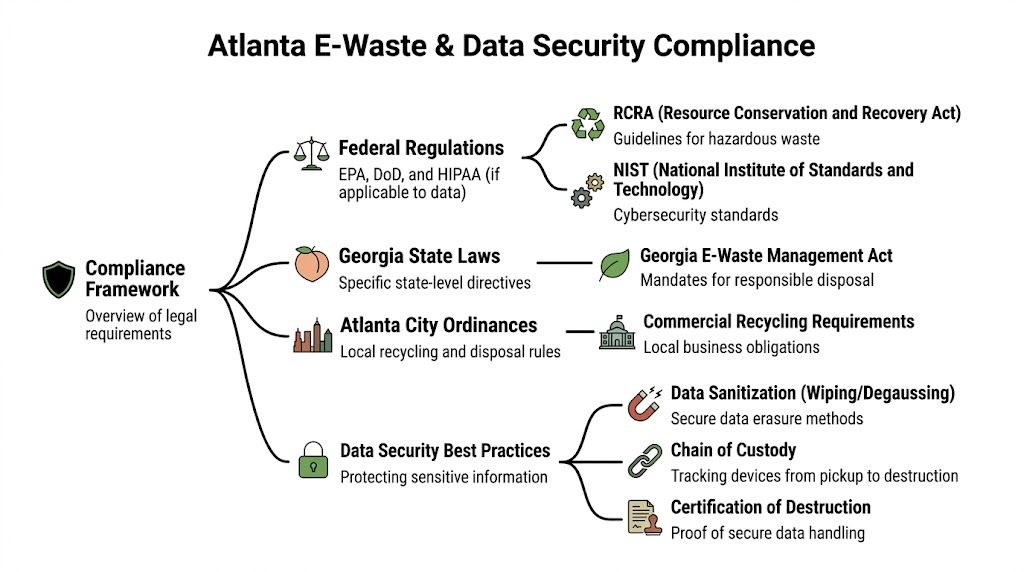
Different industries need different controls, but the common requirement is the same. You need a documented process that stands up to scrutiny after the assets leave your building.
The standards that matter in practice
For organizations handling sensitive information, DoD-compliant hard drive sanitization uses NIST 800-88 standards with multi-pass overwriting to render data irrecoverable. Certified shredding to a <2mm particle size ensures zero data remanence, and data breaches affect 60% of corporate e-waste disposals that lack certification according to Reworx Recycling’s Atlanta e-waste guidance.
That matters in real-world terms:
- Healthcare providers need end-of-life handling that supports HIPAA obligations when devices may contain patient data.
- Public agencies and contractors often need stronger documentation and stricter media sanitization practices.
- Public companies and finance-related operations may need records that support audit requirements tied to internal controls and retention policies.
- Data centers and software firms need assurance that proprietary code, customer records, credentials, and infrastructure data won’t survive on retired media.
Multi-pass overwriting is useful when reuse is appropriate and the media type supports that path. Physical shredding is the cleaner option when reuse doesn’t matter, the drive is failed, or the risk tolerance is low. The right choice depends on asset value, media type, and the regulatory sensitivity of the data.
What decision-makers should ask before pickup
The fastest way to spot a weak vendor is to ask specific operational questions. If the answers are vague, move on.
| Compliance question | Why it matters |
|---|---|
| Can you document chain of custody from pickup through final processing? | Without this, your audit trail has holes. |
| Do you sanitize according to NIST 800-88 and provide method-level documentation? | “We wipe everything” isn’t enough. |
| When do you shred instead of wipe? | A serious vendor should explain the trade-off clearly. |
| Can you support onsite services for highly sensitive media? | Some environments shouldn’t send data-bearing assets offsite intact. |
| What proof do you issue after destruction and recycling? | Certificates matter only when the underlying process is disciplined. |
If a recycler can’t explain who handles the assets, how serials are tracked, and when physical destruction is used, they’re not ready for regulated work.
Security teams should also think beyond device disposal itself. If you’re trying to prevent data breaches, end-of-life hardware handling belongs in the same conversation as access control, system hardening, and audit readiness. Retired assets are often the overlooked edge of the security perimeter.
For Atlanta businesses comparing service models, reviewing local IT asset disposition companies can help separate commodity junk removal from actual compliance-focused ITAD.
The End-to-End Recycling Process From Pickup to Impact Report
A professional electronics recycling engagement should feel controlled from the first call to the final report. If it feels improvised, it probably is.
The demand for that control is only growing. The volume of electronics requiring disposal in Georgia increased from 2,000 units documented in 2013 to over 55,000 in 2017, according to Montclair Crew’s Georgia electronics recycling summary. In Atlanta, that shows up as office closures, hospital refreshes, school surplus programs, and data center turnover all needing organized asset disposition.
Step one through step three
Most business projects start with scoping. The recycler needs to know what asset types are involved, where they’re located, whether de-installation is required, and whether any items need onsite handling before transport.
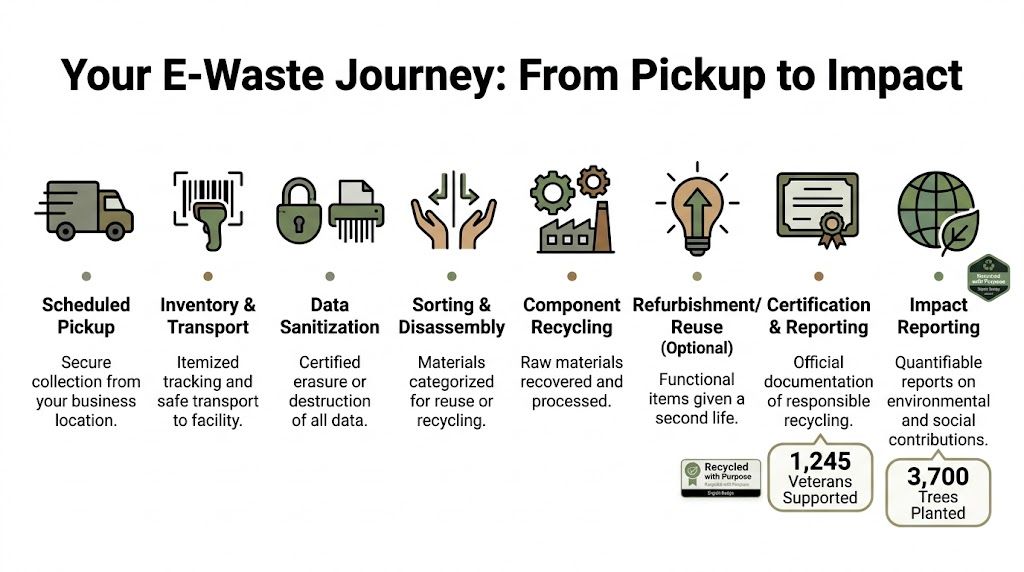
From there, the process should move in a clear sequence:
Pickup scheduling
Coordinate access, loading conditions, pallet requirements, elevator use, dock restrictions, and contact roles. For many organizations, electronic recycling with free pick up is practical when the volume is high enough to justify a planned route.Inventory control
Assets should be tagged, counted, or scanned at a level that fits the project. For a small office lot, category-level counts may be enough. For a hospital, university, or data center, serial-level tracking is often the safer standard.Secure transport
Once loaded, the devices should stay inside a documented chain of custody. That includes who loaded them, when they left, and where they were received.
What happens inside the facility
A credible ITAD workflow doesn’t stop at unloading. The essential work begins at that point.
- Asset triage: Separate devices for reuse, parts harvesting, shredding, or material recycling.
- Data sanitization: Apply the proper destruction path based on media type, condition, and sensitivity.
- Disassembly and segregation: Sort boards, metals, plastics, cables, batteries, and peripheral components into the right streams.
- Responsible downstream processing: Move commodities and components into approved recycling or refurbishment channels.
This is also where one option in the Atlanta market, Atlanta Green Recycling, fits. The company provides business-focused services including secure data destruction, hard drive wiping to DoD sanitization standards, onsite de-installation, bulk equipment removal, fleet pickup, and data center decommissioning support.
The documents that actually matter
The paperwork is not an afterthought. It is the evidence that the work happened the way your compliance team expects.
Keep every disposal record the same way you’d keep security or audit records. If a question comes up later, memory won’t protect you. Documentation will.
A well-run project usually ends with a package that may include:
- Bill of lading or pickup record
- Inventory summary
- Certificate of destruction
- Certificate of recycling
- Impact reporting for sustainability or internal reporting needs
Accepted business assets typically include desktops, laptops, servers, switches, storage arrays, monitors, printers, mobile devices, telecom gear, and in some projects, medical or lab equipment. The exact acceptance list varies, so operations teams should confirm edge cases before the truck arrives.
Transforming E-Waste into a Powerful ESG and CSR Asset
A lot of companies still treat electronics recycling as a back-office chore. That leaves value on the table.
Handled correctly, end-of-life IT management can support both the E and the S in ESG. It keeps hazardous material out of bad disposal channels, and it gives companies a practical way to tie a necessary operational task to visible community impact.

Why reporting support matters now
The reporting gap is real. A 2025 EPA report indicates that 70% of U.S. corporations struggle with verifiable Scope 3 emissions data from e-waste, according to All Green Recycling’s Atlanta analysis. That creates an opening for recycling partners that can provide usable documentation rather than a simple pickup receipt.
For corporate sustainability teams, the difference is huge. “We removed old electronics” isn’t a strong ESG narrative. “We recycled retired business technology through a documented program that supports environmental outcomes and community initiatives” is much more useful internally and externally.
That’s where a cause-based model gets interesting.
A better way to frame recycling internally
The strongest programs don’t stop at recycling certificates. They connect the project to outcomes employees and stakeholders can understand.
Examples include:
- Veteran support reporting: A business recycling event can be tied to a veteran aid initiative, then summarized in a client-facing or employee-facing impact report.
- Tree planting certificates: A corporate pickup can trigger a reforestation contribution that becomes part of sustainability communications.
- Digital recognition tools: A “Recycled with Purpose” badge can give marketing and CSR teams something concrete to place on a website, recruiting page, or annual responsibility summary.
- Seasonal campaigns: Veterans Day, Earth Day, and Arbor Day create natural windows for office cleanouts and public-facing impact storytelling.
This approach works especially well in Atlanta because many companies already run employee volunteer programs, annual giving campaigns, and community partnerships. Electronics disposal can plug into those systems instead of sitting outside them.
What decision-makers should ask for
If your company wants more than simple pickup, ask the recycler whether they can provide documentation your ESG team can use. Ask whether they can separate environmental reporting from social impact reporting. Ask whether they can support a “recycle for a cause” campaign without turning it into vague branding language.
The best ESG recycling programs don’t ask employees to care about scrap logistics. They show people that a cleanout supported a mission they already believe in.
For companies exploring that angle, the benefits of e-waste recycling go well beyond waste reduction. The right program can give legal, operations, HR, and sustainability teams something they all consider worthwhile.
Your Checklist for Choosing an Atlanta Electronics Recycling Partner
Vendor selection gets easier when you stop thinking like a buyer of hauling services and start thinking like an owner of risk. A recycler isn’t just moving equipment. They’re taking custody of assets that may carry regulated data, audit relevance, and environmental liability.
Use the checklist below to pressure-test any provider serving the Atlanta metro area.
Vendor Selection Checklist for Atlanta Businesses
| Evaluation Criterion | Why It Matters | What to Ask For |
|---|---|---|
| Certifications and standards alignment | Certifications can indicate that a vendor follows repeatable controls rather than informal practices. | Ask which certifications they hold, how they handle audits, and whether their process aligns with your industry obligations. |
| Data destruction options | Different assets call for different methods. Wiping, shredding, and onsite destruction are not interchangeable. | Request a clear explanation of when each method is used and what documentation follows. |
| Chain of custody discipline | If the handoff trail is weak, your compliance story is weak. | Ask for sample pickup records, asset tracking examples, and transfer procedures. |
| Downstream transparency | You need to know whether materials are responsibly processed after initial intake. | Ask where commodities and reusable assets go after sorting and whether they can describe downstream controls. |
| Insurance and liability coverage | Electronics recycling can create exposure if damage, loss, or environmental issues arise. | Request proof of relevant business insurance and ask how claims are handled. |
| Onsite service capability | Some projects require de-installation, packing, or destruction before anything leaves the premises. | Ask whether they handle onsite work directly and what their field procedures look like. |
| Metro Atlanta logistics coverage | A vendor may sound capable but struggle with scheduling, building access, or multi-site pickups. | Ask about service coverage, fleet control, and support for offices, hospitals, schools, and data centers. |
| ESG and CSR reporting support | Many vendors stop at a destruction certificate. That may not help your sustainability team much. | Ask whether they provide impact summaries, cause-based reporting, or partner-ready recognition assets. |
Red flags that deserve attention
A weak recycler usually reveals itself fast. Watch for these signs:
- Generic answers: If every question gets answered with “we handle that,” expect gaps later.
- No sample documents: Serious vendors should be able to show the structure of their audit trail.
- Confusion about media types: SSDs, HDDs, servers, and mobile devices shouldn’t all be handled as if they’re identical.
- No clear downstream story: If they can’t explain what happens after pickup, that’s a problem.
- Overreliance on “free”: Price matters, but “free” should never be the main proof of competence.
For Atlanta businesses comparing options, this list is a good filter before contacting e-waste disposal companies. The goal isn’t to find the cheapest truck. It’s to find a partner whose process still looks solid after legal, compliance, IT, and sustainability all review it.
Impact in Action Case Studies from Atlanta Organizations
The value of business recycling is easier to see in context than in a feature list. Two common Atlanta scenarios show where the right process makes a difference.
A hospital system handling retired clinical equipment
A hospital in the Piedmont area needed to clear out retired workstations, patient-room devices, monitors, and storage media tied to a renovation. The facilities team wanted the rooms emptied fast. Compliance wanted assurance that any data-bearing equipment would be handled under a documented process.
The project worked because the hospital treated it like a controlled disposition event, not a surplus pickup. Devices were grouped by sensitivity, pickup access was planned around clinical operations, and final records were retained as part of the hospital’s compliance file. The sustainability team also wanted the project to support a stronger community narrative, so the hospital requested an impact summary that could be used in broader community-benefit communications.
One lesson stood out. Internal alignment matters as much as vendor capability. Legal, compliance, facilities, and IT all had different priorities, but the project moved smoothly because everyone agreed on documentation requirements before removal began.
An Alpharetta tech firm decommissioning server assets
A growing tech company in Alpharetta had a different problem. It was shutting down infrastructure after a migration and didn’t want proprietary data leaving the site without strict controls. The delay wasn’t unusual. A 2025 Georgia Tech study found that 25% of local firms delayed data center decommissioning because of offsite data security concerns, according to Beyond Surplus.
The company’s security team pushed for a provider that could support strong chain of custody and a decommissioning process that matched the sensitivity of the assets. Procurement also had to evaluate the vendor itself, not just the service description. That’s where a structured approach to third party due diligence becomes useful. It helps teams ask better questions about controls, documentation, and operational trustworthiness before signing anything.
The result was straightforward. The firm completed the decommissioning, gave leadership confidence that end-of-life assets were handled correctly, and shared the social-impact side of the recycling project with employees afterward. That final piece mattered more than many operations teams expect. People respond when old equipment doesn’t just disappear, but contributes to a visible purpose.
Frequently Asked Questions About Business E-Waste Recycling
What are the typical costs for business electronics recycling in Atlanta
Costs depend on the mix of assets, volume, pickup complexity, de-installation needs, and whether you need wiping, shredding, or onsite work. Working monitors, newer business hardware, and reusable equipment can affect program economics differently than obsolete or damaged items. The safest approach is to request a scope-based quote tied to your actual inventory and compliance requirements.
What types of electronic equipment do businesses usually recycle
Most business programs accept common IT and office electronics such as desktops, laptops, servers, monitors, networking gear, storage devices, printers, telecom equipment, cables, and accessories. Many projects also include specialized commercial assets such as lab devices or medical equipment, but those categories should always be confirmed in advance. Batteries, lamps, and other special handling items may follow separate acceptance rules.
Is free electronics recycling really free, and is it safe for businesses
Sometimes it’s legitimate. Sometimes it’s a warning sign.
A “free” service can make sense when the asset mix, resale potential, route density, and project scale support it. But if a vendor can’t explain data handling, chain of custody, or documentation, the price point shouldn’t reassure you. It should make you ask harder questions. That caution is especially relevant for data center projects, where offsite handling concerns have already caused delays for local firms, as noted in the earlier Georgia Tech finding.
What documentation should my business receive
At minimum, most companies should expect records showing what was picked up, when custody transferred, and what happened to the material afterward. Depending on the project, that may include inventory summaries, chain-of-custody records, certificates of destruction, and certificates of recycling. If your company tracks sustainability or community impact, ask whether the recycler can also provide reporting your ESG or CSR team can use.
If your organization needs a practical plan for secure, compliant, and purpose-driven electronics recycling, Atlanta Green Recycling provides business-focused IT asset disposition, data destruction, pickup logistics, and recycling support across the Atlanta metro area. It’s a useful option for companies that want one process to satisfy IT, compliance, facilities, and sustainability at the same time.