
The Data Center Decommissioning Process: Turning E-Waste into Hope

Retiring a data center is so much more than just an IT cleanup project. I’ve seen firsthand how it can be a critical business operation loaded with both serious risks and incredible opportunities. An unplanned data center decommissioning process can leave a company wide open to devastating data breaches, steep non-compliance fines, and significant environmental penalties.
Let me be clear: a strategic, documented approach isn't just a good idea—it's completely non-negotiable for protecting your business.
From Cost Center To Strategic Advantage
For many companies in Atlanta and beyond who are upgrading their infrastructure, decommissioning feels like a final, annoying chore. This perspective misses the whole point. A well-executed decommissioning plan isn't just about dodging bullets; it’s about turning a logistical headache into a powerful strategic move that reinforces your brand's integrity and commitment to corporate responsibility. This is where tech meets trees and transformation.
This process goes way beyond just unplugging servers. It’s a full-blown strategy that involves data security, regulatory compliance, financial management, and environmental stewardship. The sheer complexity and importance of this field are clear when you look at the market itself; the global data center decommissioning service market hit USD 6.1 billion and is on track to blow past USD 15 billion by 2033. The rapid expansion tells you everything you need to know about how seriously businesses are taking this.
Aligning Decommissioning with ESG Goals
These days, everyone from investors to customers wants to see that companies have a real commitment to Environmental, Social, and Governance (ESG) principles. Your data center decommissioning project is a perfect, yet often completely overlooked, chance to prove it. Instead of ending up as another pile in a landfill, retired IT assets can be given a brand-new purpose.
This is where a mission-driven mindset turns a standard procedure into a story worth telling. Picture this:
- Your old servers and networking gear are securely wiped clean and responsibly recycled.
- The value recovered from these assets goes directly to funding programs that help local veterans.
- At the same time, another portion of the proceeds helps with reforestation, planting new trees in America's national forests.
By reframing the end-of-life stage for your IT hardware, you’re not just disposing of e-waste; you are creating tangible social and environmental good. Your old tech can literally house a veteran and help grow a forest.
This dual-impact model transforms a necessary cost into a verifiable "ESG win" you can proudly feature in your annual Corporate Social Responsibility (CSR) reports. It’s a powerful narrative that connects with the community and shows what your company truly values. Exploring the benefits of e-waste recycling really drives home how this one process can create a positive ripple effect, turning potential liabilities into assets that restore lives and landscapes.
Building Your Decommissioning Blueprint And Asset Inventory
A solid data center decommissioning project is built on a meticulous blueprint, not a last-minute checklist. Think of this phase as pouring the foundation for the entire project—any cracks here will turn into massive headaches down the road. It all begins by getting your core team together and aligning every stakeholder on a single set of goals, from IT and finance to facilities and legal.
This initial alignment is absolutely critical. Sure, your IT team knows the hardware inside and out, but finance is focused on asset depreciation and potential resale value. Meanwhile, facilities is worried about the power-down sequence and site safety, and legal needs to make sure every step complies with mandates like HIPAA or SOX. If you don't get everyone to the table from day one, you’re just asking for silos that lead to expensive delays and dangerous security gaps.
We saw this play out with a healthcare provider in Atlanta. Before touching a single server in a room full of patient health information (PHI), they brought IT security, compliance officers, and facilities managers into one room. This early collaboration meant their blueprint covered every HIPAA requirement for data sanitization and chain of custody, helping them sidestep potential six-figure fines.
Mastering The Asset Inventory Process
With your blueprint drafted, it’s time for what is easily the most labor-intensive—and most vital—part of the planning stage: a complete and accurate asset inventory. This is the bedrock of your project. Every single device, from servers and switches to power distribution units and individual hard drives, has to be accounted for.
And this inventory has to be more than a simple device count. A truly effective asset log captures:
- Unique Asset Tag: A specific identifier for every piece of equipment.
- Serial Number & Model: Essential for tracking and potential resale.
- Physical Location: The exact rack and U-position where it lived.
- Data Sensitivity Level: Classifying assets holding PII, PHI, or other critical data.
- Intended Disposition: Tagging each item for recycling, resale, or physical destruction.
A detailed inventory isn't just about logistics; it’s the very first link in an unbroken, auditable chain of custody. If you can't prove where every single data-bearing device went from the moment it was unplugged, you've created a massive security risk.
This diagram shows exactly what’s at stake when a decommissioning plan goes wrong, starting with a data breach.
The chain reaction is simple but severe: a failure in security or inventory leads directly to a data breach. That breach results in regulatory fines and a damaged reputation, undermining your company's ESG commitments.
From Inventory To Actionable Plan
Once you have a comprehensive asset list, you can finally build a realistic project timeline. Now you can accurately estimate how long data sanitization will take, coordinate the logistics for secure transport, and give the finance team a clear picture of expected costs and potential returns from asset remarketing.
This level of detail is a cornerstone of strong IT governance. In fact, many organizations find it useful to review established best practices for inventory management from other industries to refine their own approach. The core principles of tracking, verification, and auditing are universal.
Ultimately, this foundational work transforms a potentially chaotic teardown into a controlled, predictable, and secure operation. To help streamline this crucial stage, our guide on IT asset management best practices offers additional frameworks and tools you can apply directly to your decommissioning blueprint.
Executing Secure Data Sanitization And Destruction
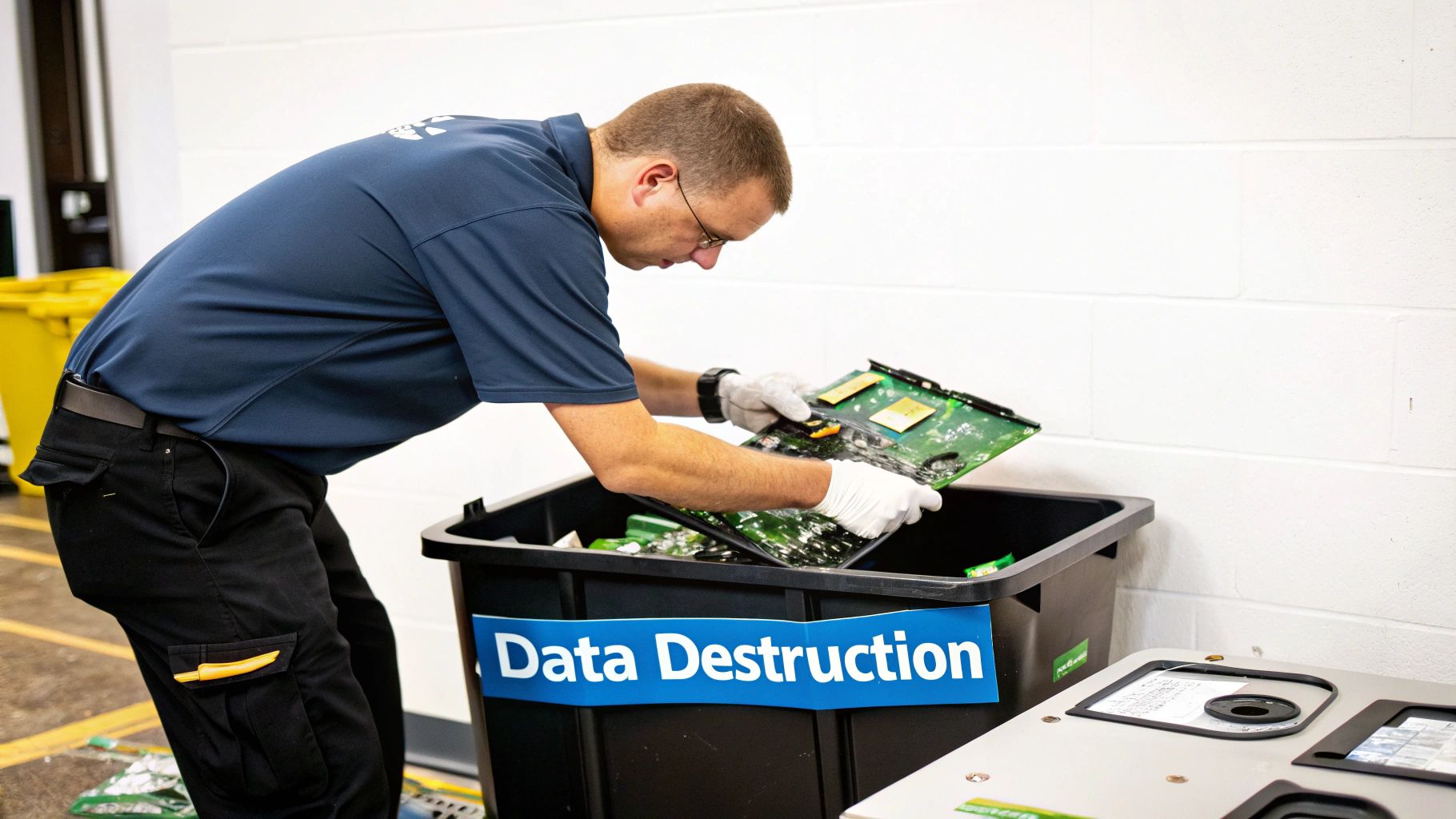
Once you have a handle on your inventory, it's time to tackle the single most critical step in any data center decommissioning process: making absolutely sure every last bit of sensitive data is permanently destroyed. We're not just talking about deleting files. This is about making data completely, forensically unrecoverable.
Skipping this step, or even just getting it slightly wrong, is like moving out of a bank but leaving the vault door wide open. A single drive that slips through the cracks can snowball into a catastrophic data breach, attracting massive regulatory fines and causing irreversible damage to your brand. This is why your method for what data sanitization truly entails isn't just a choice—it's a foundational part of your project plan.
Core Methods of Data Destruction
In the field, you'll run into three main ways to handle data destruction. The right one for you really boils down to your security needs, what kind of media you're dealing with, and whether you plan to reuse or resell the hardware.
- Data Wiping (Erasure): This is a software-based approach that overwrites all the data on a drive with random characters, usually in several passes. It's the perfect solution for assets you want to redeploy or sell because the hardware remains perfectly functional.
- Degaussing: This method uses an incredibly powerful magnetic field to scramble the data on magnetic media. Think traditional spinning hard drives (HDDs) and old backup tapes. Just remember, it’s completely useless on modern solid-state drives (SSDs), which don't use magnetism to store data.
- Physical Shredding: When there's no room for doubt, you shred it. This is exactly what it sounds like—a massive industrial shredder grinds drives, tapes, and other media into tiny, useless fragments. This is the final answer for any end-of-life assets or hardware that held your most sensitive information.
Understanding NIST 800-88 and Other Standards
When you start talking with vendors, you'll hear the term NIST 800-88 thrown around a lot. This isn't just industry jargon; it’s a crucial set of guidelines from the National Institute of Standards and Technology that outlines the official best practices for sanitizing media.
Following NIST 800-88 means your destruction process is rigorous, verifiable, and can stand up to an audit. The standard breaks down sanitization into three levels:
- Clear: Wipes data to prevent simple, non-invasive recovery methods.
- Purge: A more intense process that protects data from being recovered even with advanced, laboratory-grade tools.
- Destroy: Renders the media totally unusable and the data gone forever through physical means, like shredding or incineration.
For most businesses I work with, especially in finance or healthcare, the conversation starts and ends with Purge or Destroy. It's the only way to be certain you're compliant and protected.
Onsite vs. Offsite Destruction: Which is Right for You?
One of the biggest logistical decisions you'll make is where the data destruction actually happens. You can have it done at your facility (onsite) or have a certified vendor transport the assets to their secure facility (offsite). Each has its pros and cons, usually trading off between absolute control, cost, and convenience.
Choosing between onsite and offsite destruction is ultimately a question of your organization's risk tolerance. If you need an unbroken chain of custody and the ability to witness the destruction firsthand, nothing provides more peace of mind than having it done right at your own facility.
Here's a quick breakdown to help you decide.
Onsite vs. Offsite Data Destruction Methods
| Factor | Onsite Destruction | Offsite Destruction |
|---|---|---|
| Security | The gold standard. You witness everything, completely eliminating transport risks from the chain of custody. | Secure, but relies on trusting your vendor's transport and facility protocols. The chain of custody has more links. |
| Cost | Typically costs more. You're paying for the convenience of mobile shredding trucks and personnel coming to you. | Generally the more cost-effective option, as the vendor can process assets in large batches at their facility. |
| Convenience | Incredibly convenient. The whole process happens under your roof, minimizing the logistical burden on your team. | Requires careful planning for secure packing, scheduling a pickup, and managing the transportation of assets. |
| Verification | Instantaneous. You can watch the shredding happen and often receive Certificates of Destruction on the spot. | Delayed verification. You receive documentation after the assets have been processed at the vendor's facility. |
For many businesses here in Atlanta, particularly in the heavily regulated financial and healthcare sectors, the choice is easy. They almost always opt for certified, on-site hard drive shredding to satisfy strict compliance mandates like GLBA and HIPAA.
There's something uniquely reassuring about watching a mobile shred truck pull up and turn every single one of your hard drives into a bin of metal fragments. That tangible, witnessed proof of destruction is priceless when the auditors come calling.
Managing Physical De-Installation And Logistics
Once your data is gone for good, the real hands-on work begins. This is the part of the data center decommissioning process where all that careful planning turns into action. We’re talking about turning humming racks of servers into neatly packaged assets, ready for whatever comes next. It’s all about precision, safety, and maintaining an iron-clad chain of custody.
But let's be clear: this isn't just a matter of yanking plugs and unscrewing servers from their racks. It’s a systematic tear-down that should start before anyone even picks up a tool. Every single cable needs to be labeled, and its connection point should be documented against your asset inventory. This might seem tedious, but it’s an absolute lifesaver if any of that gear is being sold or moved to another facility.
Safety is a huge deal here. Servers, storage arrays, and especially those big uninterruptible power supplies (UPS) are ridiculously heavy and awkward. A pro team won’t cut corners; they’ll follow strict protocols, using the right lifting gear to keep their people safe and your assets from getting damaged.
The Critical Role of Secure Transportation
With everything de-racked and packaged, your assets are ready to hit the road. This is a point where security risks can jump if you're not careful. The logistics plan has to be airtight, ensuring that from the moment a server leaves your building to the second it arrives at its destination, it's never compromised.
This is exactly why finding a partner who uses their own dedicated fleet is such a game-changer. It cuts out the variables and security holes that pop up when you rely on standard third-party freight carriers.
A dedicated logistics partner brings a lot to the table:
- Vetted Personnel: You get drivers and handlers who are background-checked and actually trained in how to move sensitive IT assets securely.
- Locked, Secure Vehicles: Think unmarked, hard-sided trucks that are GPS-tracked and locked down with security seals.
- Direct Transit: The route is point-to-point. No unnecessary stops or transfers that create opportunities for something to go missing.
A well-managed logistics plan is the bridge that connects secure on-site processes with certified off-site disposition. Any weakness in this bridge undermines the entire project, creating risks of asset loss, damage, and security breaches during transit.
Chain of Custody Beyond the Data Center Walls
That secure chain of custody doesn't stop when the truck pulls away from your loading dock. It has to cover every single logistical step. As assets get loaded onto the truck, they are scanned one last time and checked against the original inventory list. This gives you a final, verified count of everything that's leaving.
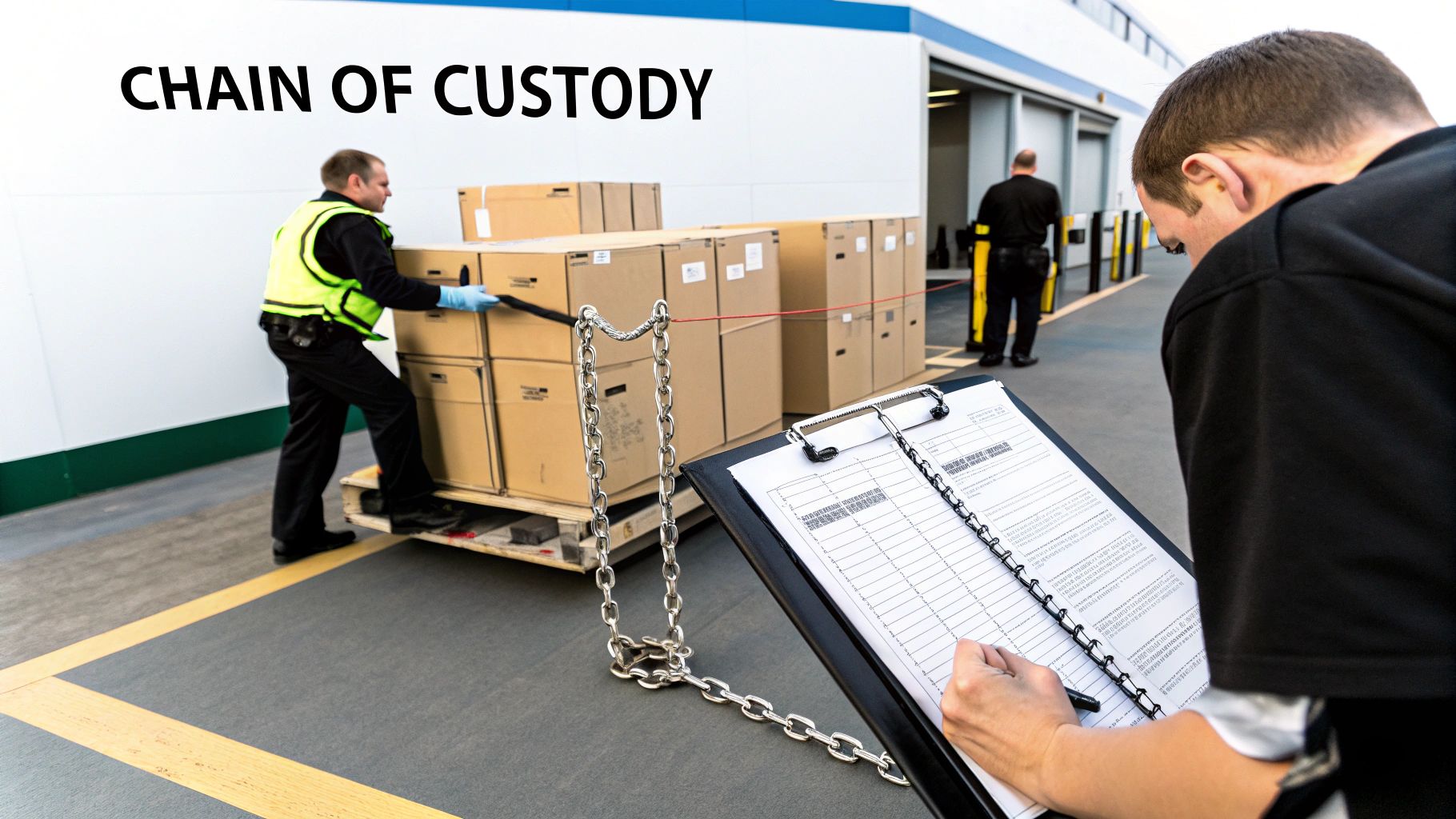
Then, when the shipment arrives at the secure processing facility, the whole process happens in reverse. The truck's security seals are inspected before being broken, and every asset is scanned again to confirm it made the trip. This double-verification process creates a clean, auditable record of your equipment’s entire journey.
If you're planning this phase, checking out a modern logistics 3PL playbook can offer some great strategic ideas on transport best practices. While our world is IT assets, the core principles of secure handling and verified transport apply everywhere.
Ultimately, a flawlessly executed logistics strategy is non-negotiable. For companies here in Atlanta, teaming up with a local reverse logistics company that gets these details right is key. It ensures your assets are handled with the security they demand, turning a high-risk transition into a controlled and documented final chapter for your retired hardware.
Closing The Loop With Responsible Recycling And Documentation
The last leg of any data center decommissioning project is all about proving you did everything right. This is where the rubber meets the road—it’s not just about hauling away old gear, but about demonstrating your company’s commitment to environmental responsibility and locking down compliance with cold, hard proof.
Think of it as the final, critical chapter in your project's story. Skipping this step is like running a marathon and walking off the track 10 feet from the finish line. E-waste is a serious problem; junked equipment left in landfills can leach toxic materials like lead and mercury, a scenario that modern regulations are specifically designed to stop.
The Power of Certified Electronics Recycling
To sidestep environmental damage and the hefty fines that come with it, Atlanta businesses absolutely must partner with a certified electronics recycler. Look for certifications like R2 (Responsible Recycling) and e-Stewards. These aren't just fancy logos; they are your guarantee that a vendor meets the highest industry standards for protecting the environment, keeping workers safe, and ensuring data security through the entire disposal chain.
Choosing a certified partner gives you confidence that your old assets are being handled correctly. Here’s what you get:
- Zero-Landfill Policies: A promise that no part of your decommissioned hardware will ever end up polluting a landfill.
- Secure Downstream Tracking: Verifiable proof that all materials are sent only to audited, approved facilities for processing.
- Data Security: A commitment to strict protocols that ensure any data-bearing components missed during sanitation are found and destroyed.
Make R2 or e-Stewards certification a non-negotiable requirement for your recycling partner. This simple step is your best defense against downstream liability and ensures your brand is associated with genuine environmental stewardship, not just talk.
Turning Decommissioning Into A Powerful ESG Story
This is where a data center decommissioning project can transform from a logistical headache into a major win for your company's ESG (Environmental, Social, and Governance) goals. Instead of being just another operational cost, your end-of-life hardware can become a source of real social good. It all comes down to picking a partner whose mission reflects your own corporate values.
Imagine this: your old servers, professionally sanitized and ready for recycling, are handled by a vendor with a dual-impact mission. The value they recover from those assets doesn't just pad a bottom line. It gets channeled directly into programs that provide critical assistance to veterans or fund reforestation efforts in America’s national forests.
Your old tech can literally help house a veteran and plant a forest. This "Recycle for a Cause" approach completely changes the narrative of your project. It's no longer just about retiring hardware; it's about restoring lives and landscapes.
The Final Word: Documentation And Verifiable Proof
Once all the physical work is done, the most important deliverables are the documents that prove you complied with every regulation. These aren't just administrative box-checking exercises; they are your legal shield.
Your partner must provide these key documents:
- Certificate of Destruction (CoD): This is your auditable record proving all data-bearing devices were sanitized or physically destroyed according to standards like NIST 800-88.
- Certificate of Recycling: This document confirms that your non-data-bearing assets were processed in an environmentally sound manner by a certified facility.
- Detailed Asset Reporting: You should receive a final, serialized list that matches your initial inventory, closing the chain-of-custody loop for every single asset.
These documents are your definitive proof of compliance for regulations like HIPAA, SOX, and GLBA. They provide the third-party verification you need to satisfy both internal stakeholders and external auditors, giving you total peace of mind.
For a deeper dive into the specifics of handling different types of hardware during this final stage, take a look at our quick guide on recycling data center equipment. It’s packed with actionable tips to make sure every component is handled responsibly.
Common Questions We Hear About Data Center Decommissioning
If you're staring down a data center decommissioning for the first time, it’s only natural to have a long list of questions. It's a massive undertaking. To help clear things up, here are the answers to some of the most common things we’re asked by Atlanta businesses getting ready to retire their old IT gear.
How Long Does a Typical Decommissioning Project Take?
This is the big one, but the honest answer is: it depends. There’s no magic number. A small server closet with maybe a dozen racks could be wrapped up in a week. On the other hand, a full-scale enterprise data center might take several months of meticulous planning before we even unplug a single server.
It really boils down to a few key things:
- Sheer Volume of Assets: The number of servers, switches, storage arrays, and network cables all add up. More gear means more time for inventory, de-installation, and transport.
- Data Destruction Methods: If you need us to shred thousands of hard drives on-site, that's a much more time-intensive process than shipping a smaller batch to our facility for secure wiping.
- Site Logistics: Simple things can have a big impact. Are there freight elevators? Is there easy loading dock access? How far is the drive to the processing facility?
That’s why we always start with an in-person site assessment. It lets us build a realistic timeline from day one, ensuring we work around your schedule and minimize any disruption.
What’s the Single Most Important Thing to Look for in a Decommissioning Partner?
While there are plenty of factors, security and compliance are completely non-negotiable. Your number one job is to find a partner with certified, auditable processes for destroying your data and recycling the hardware. This is what protects you from a devastating data breach or a hefty fine for improper disposal.
Drill down on the specifics. Ask any potential vendor to show you proof of:
- Data Destruction Certification: They must follow strict standards like NIST 800-88. Don’t settle for anything less.
- Environmental Certification: Look for credentials like R2v3 (Responsible Recycling) or e-Stewards. This guarantees they’re handling e-waste ethically and legally.
- Secure Chain of Custody: They need a rock-solid, documented process that tracks your assets from the moment they leave your facility to their final destruction or recycling.
Once you’ve checked those boxes, look for a partner whose mission aligns with your own company's ESG goals. Turning a necessary project into a story of positive community and environmental impact is a smart strategic move.
The right partner doesn't just haul away your hardware; they eliminate your risk. They give you the confidence that comes from knowing every single asset is handled securely and ethically, with a verifiable paper trail to back it all up.
Is It Possible to Get Any Money Back From Our Old Equipment?
Absolutely. You can often recover a surprising amount of value from retired equipment through a process called IT Asset Value Recovery (ITAVR). While a lot of gear might be at the end of its useful life, some components can still fetch a good price on the secondary market.
A good partner will audit your entire inventory to pinpoint any remarketable assets, which often include:
- Newer-generation servers
- High-performance CPUs
- Enterprise-grade memory (RAM)
- Networking gear from top brands
The money generated from selling these components can be used to offset the total cost of the decommissioning project. Of course, a reputable ITAVR provider will ensure every single data-bearing device is sanitized to NIST standards before it ever gets considered for resale.
How Does Your Process Help Us Meet Our Company's ESG Goals?
We specifically designed our entire business model to turn your decommissioning project into a powerful win for your ESG (Environmental, Social, and Governance) program. When you work with us, your old hardware makes a direct, measurable contribution to social and environmental causes. You turn e-waste into hope.
Once the project is done, we don’t just send you an invoice. We provide you with a detailed Veteran Support Impact Report and official Plant-A-Tree certificates. This documentation quantifies your positive impact, showing exactly how many veterans were supported and how many trees were planted in our national forests through our partnership with the USDA Forest Service.
We also give you a “Recycled with Purpose” digital badge for your website and sustainability reports. It’s a simple, verifiable way to show the world your company is serious about corporate social responsibility. Your old tech really can help restore lives and landscapes.
Ready to transform your data center decommissioning from a complex cost into a powerful ESG story? Atlanta Green Recycling offers a secure, compliant, and mission-driven process designed for Atlanta's leading businesses. We turn your retired IT assets into tangible support for veterans and vital reforestation efforts. Schedule your free consultation today and discover how your old tech can build a better future. Learn more at https://www.greenatlanta.com.