
Choosing a Reverse Logistic Company in Atlanta: Recycling That Restores Lives and Landscapes

When you hear "supply chain," you probably picture a straight line: raw materials become a product, that product gets shipped to a store, and a customer buys it. But what happens after that? What about when a company's laptops reach the end of their life, or an entire data center needs to be decommissioned?
That's where the supply chain runs in reverse, and a reverse logistic company steps in.
Think of it as managing the lifecycle of your products and assets after they've done their job. For businesses in Atlanta, this isn't just about hauling away old junk; it's a strategic process for securely and sustainably handling retired IT assets like servers, laptops, and networking gear. The right partner turns a massive operational headache into a real advantage—one that can even house a veteran and grow a forest.
Understanding the Role of a Reverse Logistic Company
At its heart, a reverse logistic company specializes in the "aftermarket" journey of your business assets, especially electronics. Their expertise isn't in getting products to a customer, but in efficiently bringing those items back from the field for proper disposal, recycling, data destruction, or even reselling them to recover value.
This process is critical for locking down your data security, staying compliant with environmental regulations, and finding cash in equipment you thought was worthless.
What used to be a minor operational cost has absolutely exploded into a global powerhouse. The worldwide reverse logistics market is on track to hit over $1 trillion in the next decade. The biggest driver of that growth? B2B and commercial returns, especially IT asset recovery and electronics recycling. It's a clear sign that businesses are finally getting serious about what happens at the end of a product's life.
More Than Just Disposal
A modern reverse logistics partner is far more than a disposal service—they're a comprehensive end-of-life asset management solution. The goal isn't just to get rid of old hardware. It's about doing it securely, in full compliance with regulations, and in a way that often puts money back in your pocket. You're turning a potential liability into a documented asset with a positive community impact.
So, what does that actually look like in practice? Let’s break down the core services.
Key Services of a Reverse Logistic Company for IT Assets
Here's a quick look at the core functions a reverse logistics partner provides for businesses managing end-of-life electronics.
| Service Area | Business Value | Example Application |
|---|---|---|
| Secure Logistics & De-installation | Minimizes internal resource drain and ensures a secure chain of custody from the moment assets leave your site. | A team arrives at your office to professionally uninstall, inventory, and securely transport 500 employee laptops for an upgrade project. |
| Certified Data Destruction | Eliminates the risk of a data breach from retired hard drives, meeting compliance standards like HIPAA or DoD 5220.22-M. | All hard drives from decommissioned servers are either wiped using certified software or physically shredded, with a certificate of destruction provided. |
| Refurbishment & Remarketing | Recovers financial value from functional equipment, turning an expense into a revenue stream and reducing your total cost of ownership. | Gently used monitors and PCs are tested, cleaned, and resold on secondary markets, with a portion of the profits returned to your company. |
| Certified E-Waste Recycling | Ensures environmental compliance by responsibly processing non-functional items, recovering raw materials, and preventing toxic waste. | Broken printers and outdated networking gear are broken down into their base components (plastic, metal, circuit boards) for proper recycling. |
As you can see, a true partnership streamlines all your complex environmental and data security obligations into one managed process.
By handing over the management of this backward flow of goods, a reverse logistic company helps your business operate more sustainably and securely. It’s about transforming old tech into a strategic asset that can even bolster your corporate social responsibility goals.
For a deeper dive into how these services come together, you can explore our complete reverse logistics solutions.
Turning Old Tech into a Strategic Asset
When it's time for a technology upgrade, the old equipment can quickly become a logistical headache and a massive security risk. But what if you could flip that script? With the right strategy, that pile of retired IT inventory can transform from a liability into a genuine asset.
It all starts the moment a professional team arrives to handle the de-installation and secure, GPS-tracked transport. This creates a documented chain of custody from your facility to ours, giving you peace of mind from the very beginning.
This secure handoff is critical, but the real make-or-break stage is ensuring every last bit of sensitive information is permanently gone. A true reverse logistic company doesn’t just promise data destruction; they prove it with certified processes that are matched to your specific security needs and the hardware's condition.
From Data Destruction to Value Creation
The specific path your old tech takes depends on its age, condition, and your compliance requirements. For any device that holds data, there are generally two routes, each with its own level of security and potential for value recovery.
- DoD-Standard Wiping: For functional, newer hard drives with resale potential, we use software that meets the Department of Defense (DoD 5220.22-M) standard. This process overwrites the entire drive multiple times with random characters, making the original data impossible to recover while keeping the hardware intact for remarketing.
- Physical Shredding: When drives are broken, old, or your organization demands the highest possible level of security, physical destruction is the only answer. We use industrial shredders that chew hard drives, SSDs, and other media into tiny, unsalvageable pieces. This guarantees the data is gone for good and is often the required method for meeting strict regulations like HIPAA.
This flowchart breaks down how we turn retired IT assets into secure, valuable, and sustainable outcomes.
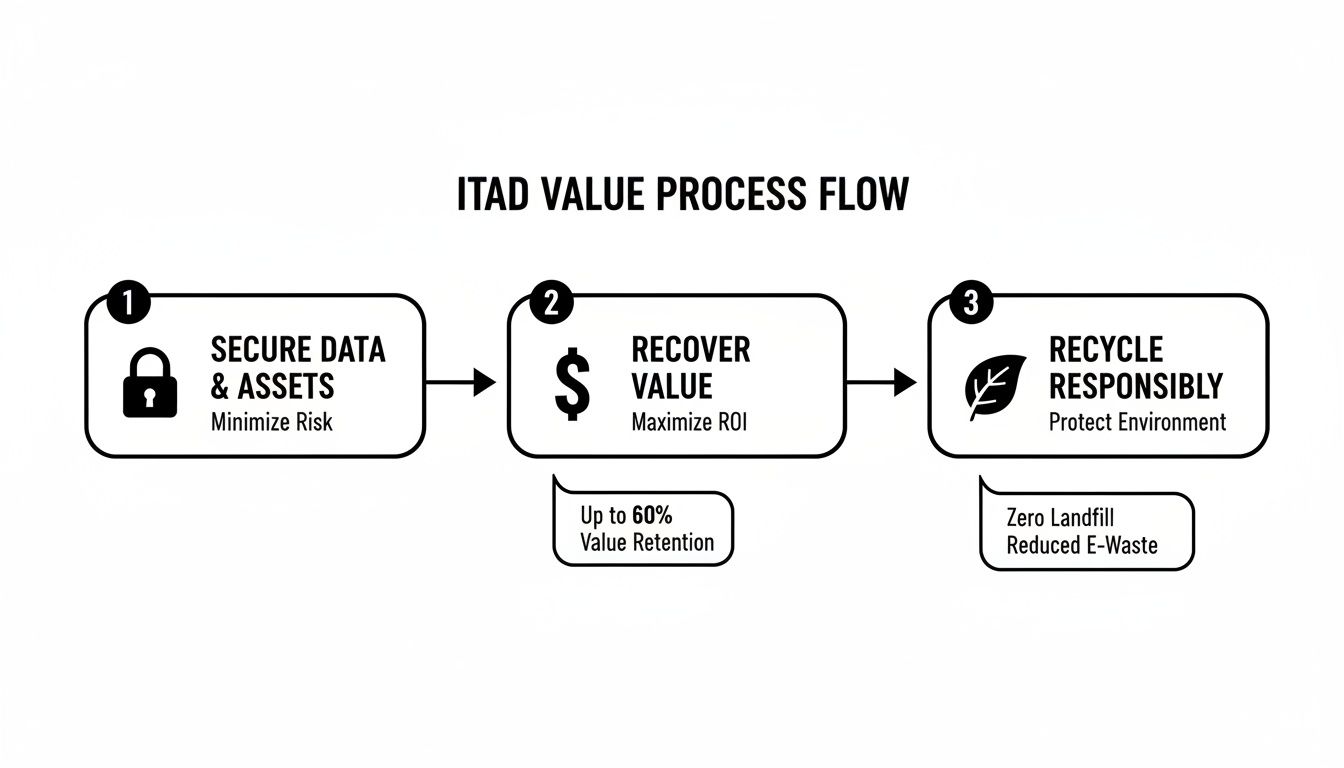
As you can see, it’s all about how security, value recovery, and responsible recycling weave together to create a powerful asset disposition strategy.
Unlocking Financial Returns Through Remarketing
Once we’ve confirmed the data is secure, the focus shifts to recovering value. Let's be clear: not all old equipment is "waste." Functional devices like laptops, servers, and networking gear often have plenty of life left and retain significant value on the secondary market.
Our team tests, cleans, and refurbishes this gear, preparing it for resale. The revenue we generate is then shared back with you, which can directly offset the cost of the entire project. In many cases, it even creates a new revenue stream from assets you had already written off the books.
This process of value recovery is a core component of a modern ITAD program. It shifts the perception of old tech from a disposal expense to a financial opportunity, directly improving the total cost of ownership for your IT infrastructure.
The Foundation of a Circular Economy
What about the equipment that’s truly reached the end of the line? For anything broken, obsolete, or non-functional, responsible e-waste recycling is the final, crucial step. This is about so much more than just keeping electronics out of a landfill; it's about actively participating in a circular economy.
Certified recycling ensures that hazardous materials like lead and mercury are managed safely and never contaminate the environment. At the same time, valuable raw materials—gold, copper, aluminum, and plastics—are recovered and reintroduced into the manufacturing supply chain. This cuts down on the need for destructive mining, conserves our natural resources, and lowers the carbon footprint of making new electronics. This entire structured process is the cornerstone of what we do. To get a better handle on the big picture, you can learn more about what IT Asset Disposition is in our detailed guide.
By partnering with a certified reverse logistic company, you’re not just getting rid of old tech. You’re ensuring every single piece follows a path that is secure, profitable, and environmentally sound—turning a simple disposal task into a strategic win for your entire organization.
Navigating Critical Security and Compliance Rules
When your company retires its IT assets, you’re not just clearing out old hardware; you’re handling containers packed with sensitive data. For any organization, especially in a competitive market like Atlanta, compliance isn't just a friendly suggestion—it’s a non-negotiable part of staying in business. Think of a professional reverse logistic company as your front-line defense against devastating data breaches and eye-watering regulatory fines.
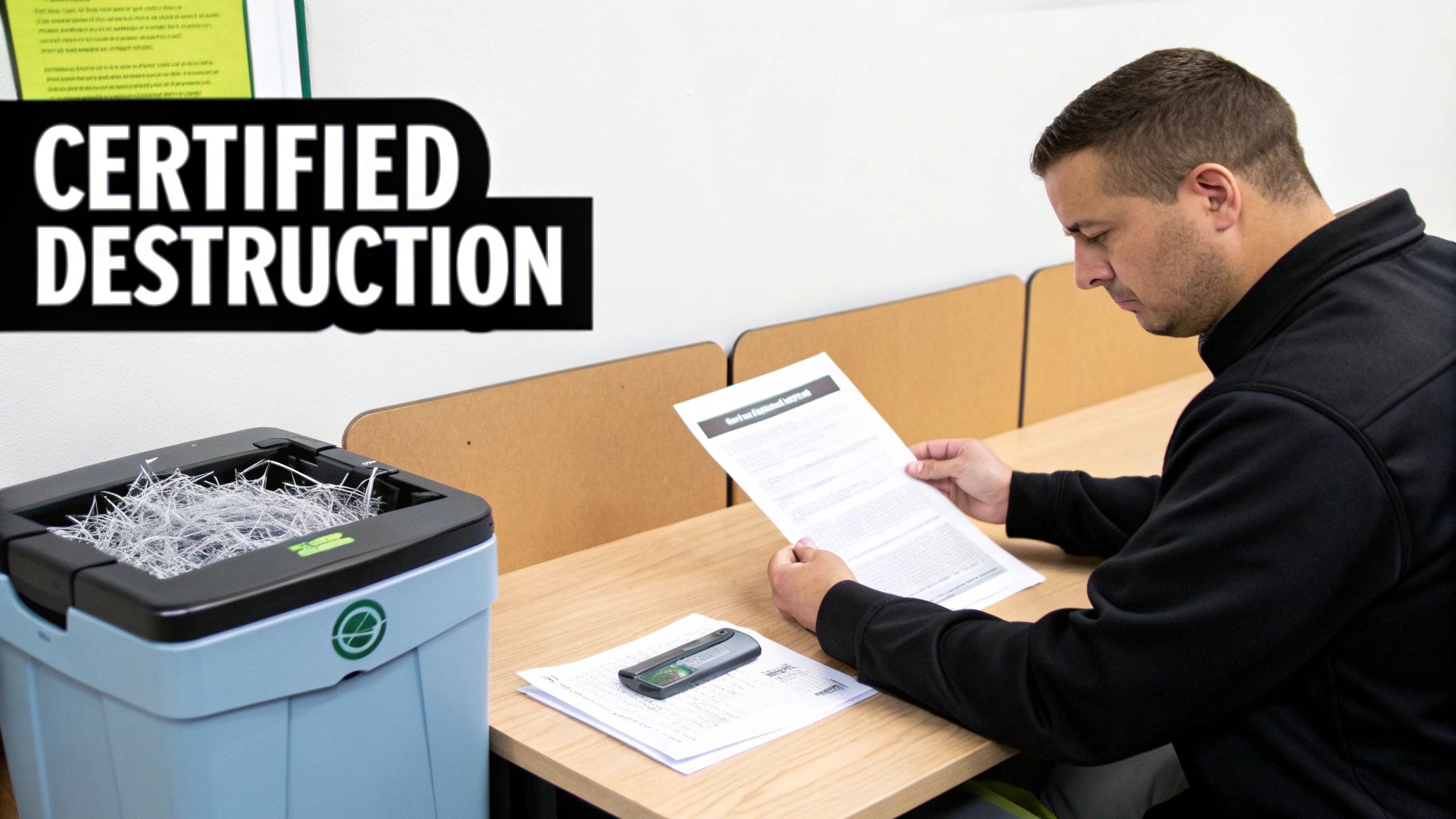
The world of data privacy is a tangled web of regulations, and one wrong move can have severe consequences. We’re talking about violations that can cost millions, not to mention the kind of damage to your brand's reputation that you can't just fix with a press release. This is exactly why your IT asset disposition (ITAD) process has to be built on a foundation of solid security and proven compliance.
Decoding Key Data Protection Regulations
Several federal laws dictate exactly how companies must protect customer and patient information, even when it’s on a device headed for the recycling pile. Getting a handle on these rules is the first step toward building a reverse logistics strategy that holds up under scrutiny.
- HIPAA (Health Insurance Portability and Accountability Act): This is the big one for healthcare. For providers, insurers, and their partners, HIPAA demands that all Protected Health Information (PHI) be made completely unreadable and unusable before a device is disposed of. No exceptions.
- FACTA (Fair and Accurate Credit Transactions Act): Created to combat identity theft, FACTA requires any business that handles consumer credit information to destroy that data before discarding it. This applies to banks, retailers, and any company storing customer financial records.
- GLBA (Gramm-Leach-Bliley Act): Aimed squarely at financial institutions, GLBA mandates that companies have a clear, actionable plan for protecting clients' nonpublic personal information. This absolutely includes the secure disposal of any hardware that has ever stored that data.
The common thread here? Every one of these regulations hinges on the absolute requirement for certified data destruction. Simply dragging files to the trash bin is never enough. The data has to be permanently and verifiably wiped out, a job that calls for specialized tools and real expertise.
Your Best Defense: Certified Destruction and Credentials
To make sure your data is handled the right way, you need to work with a partner who can prove their process is sound. This is where industry certifications become your most reliable guidepost. They act as a third-party seal of approval, verifying that a provider’s methods meet the highest standards for both security and environmental responsibility.
When you’re vetting a reverse logistic company, keep an eye out for these crucial credentials:
- R2 (Responsible Recycling): An R2 certification shows a deep commitment to environmentally safe practices, worker safety, and airtight data security protocols across the entire recycling chain.
- e-Stewards: This is another top-tier certification focused on preventing hazardous e-waste from being exported to developing countries while ensuring the highest level of data security.
These certifications aren't just fancy logos for a website; they represent a tough, ongoing audit process that confirms your partner is truly walking the talk. When it comes to reverse logistics, understanding the importance of secure communication compliance is non-negotiable.
Essential Documentation: The Audit Trail You Need
In the world of compliance, proof is everything. A partner you can trust will provide an ironclad paper trail that documents every single step of the process. This documentation is your proof of due diligence if an auditor ever comes knocking.
Your checklist must include:
- Serialized Certificate of Data Destruction: This is much more than a generic receipt. It should list the unique serial number of every single hard drive or data-bearing device that was destroyed, linking it directly back to your inventory list.
- Comprehensive Asset Tracking Reports: From the moment your assets leave your facility to their final disposition, you should have a detailed report that confirms a secure chain of custody.
This level of detail is critical for both staying compliant and for your own peace of mind. For a deeper dive into our methodologies, feel free to explore our guide on the secure destruction of data, where we break down our standards and processes.
Finding the Right Logistics Partner in Atlanta
When it comes to your reverse logistics needs, choosing a partner based on price alone is a huge mistake. For any Atlanta business, the right firm is so much more than a vendor—they're a strategic ally. They protect your data, safeguard your brand reputation, and most importantly, reflect your company's core values. This isn't just a simple transaction; it's a careful evaluation of capabilities, certifications, and mission alignment.
A local Atlanta partner brings some obvious perks to the table. You get faster pickups, lower transportation costs, and a team that just gets the regional business landscape. That kind of proximity builds a real working relationship, turning a simple service into a genuine collaboration.
But the most important thing? Finding a provider whose mission clicks with your own. When your routine operational tasks also create a positive ripple effect in the community, you've got a powerful story to tell—one that resonates with employees, customers, and investors.
Building Your RFP Checklist
To really dig in and vet a potential reverse logistics company, your Request for Proposal (RFP) needs to cut through the noise. This checklist covers the non-negotiables to make sure you find a partner you can truly trust.
- On-Site Security Protocols: What happens to your assets once they leave your sight? Ask about 24/7 surveillance, strict access control, and whether they have a completely enclosed, secure area for processing. Don't settle for vague answers.
- Logistical Capabilities: Do they run their own fleet of trucks? An owned fleet means far greater control over scheduling, security, and the all-important chain of custody. It's also critical to ensure they know how to choose a reliable DOT compliance company to handle the complex regulations governing their fleet.
- Environmental & Security Certifications: Look for R2 or e-Stewards certifications. Think of these as the gold standard—they are third-party proof that a company is serious about responsible recycling and data security.
- Reporting Transparency: What kind of paper trail will you get? Insist on seeing sample serialized Certificates of Data Destruction and detailed asset tracking reports. This documentation is your evidence of compliance.
Beyond the Checklist: Mission and Impact
Technical skills are the baseline, but a truly strategic partnership is built on something more: shared values. This is where a cause-driven partner can become a massive differentiator for your brand. Instead of just getting rid of e-waste, you can be part of something bigger.
Think of it this way: your old tech can do more than just be recycled. It can be a catalyst for good. For instance, at Atlanta Green Recycling, we’ve built our model around a dual-impact mission—every device we process helps support veterans and funds reforestation efforts.
This transforms a standard operational line item into a powerful piece of your Corporate Social Responsibility (CSR) and Environmental, Social, and Governance (ESG) strategy. When you recycle with a purpose-driven partner, your company isn't just ticking a compliance box; you're actively turning e-waste into tangible hope and environmental restoration.
Make this a key part of your evaluation. Ask potential partners these questions directly:
- How do you actually measure your social and environmental impact?
- Can you give us impact reports we can use for our own CSR documentation?
- Do you offer co-branded marketing materials or digital badges we can share?
Finding a partner who can answer these questions with confidence is crucial. For more help evaluating your options, our overview of IT asset disposition companies provides more detailed insights. Ultimately, the right choice isn't just about meeting your operational needs—it's about finding a partner who helps you tell a story of positive change.
How Reverse Logistics Powers Your ESG Goals
These days, Environmental, Social, and Governance (ESG) goals aren't just a footnote in an annual report; they're a core part of how modern companies operate. A smart reverse logistic company can be one of your most powerful allies in this mission, turning what used to be a simple disposal task into a major win for your corporate responsibility initiatives.

The link between reverse logistics and the "E" in ESG is incredibly direct. When you partner with a certified ITAD provider, you're guaranteeing that hazardous e-waste stays out of landfills. This is a huge boost for the circular economy, as it helps recover valuable materials and stops toxic chemicals from contaminating the environment.
Turning E-Waste into a Powerful ESG Story
But responsible recycling is just the beginning. A truly strategic partnership also elevates the "S" (Social) part of your ESG goals, and this is where a cause-driven program really changes the game. Imagine your decommissioned servers providing tangible support for a veteran, or turning a stack of old company laptops into a newly planted forest.
This approach connects a routine operational need to a compelling, human-centric story. You can showcase this commitment in a few different ways:
- Corporate Recycling Drives: Offer your business free pickup for 50+ devices and give your employees a chance to recycle their personal electronics alongside company assets. It’s a great way to amplify the collective impact.
- Seasonal Campaigns: Line up your recycling initiatives with key dates like Earth Day, Arbor Day, or Veterans Day to get more visibility and community engagement.
The whole point is to reframe how you think about e-waste disposal. It’s not just an obligation; it’s an opportunity to create measurable good.
Measuring and Showcasing Your Impact
To make your ESG story credible, you need solid, verifiable data. A modern reverse logistics partner goes way beyond simple disposal receipts, providing a full suite of tools that prove your positive impact. This turns your efforts into documented wins you can use in sustainability reports and share with stakeholders.
Reverse logistics is increasingly intertwined with corporate ESG goals, as companies can save 20–40% on raw material costs through better material recovery and reuse. Integrating impact metrics—such as veterans supported or trees planted—can convert obligatory programs into measurable social-impact wins. Discover more insights on the connection between reverse logistics and ESG from PTScorp.com.
To bring this to life, your partner should deliver tangible proof you can share.
- Veteran Support Impact Reports: These documents quantify the social good generated from your recycled assets, which is perfect for CSR documentation.
- Plant-A-Tree Certificates: Get personalized certificates detailing how many trees were planted in your company’s name. This creates a fantastic, shareable asset for marketing.
- "Recycled with Purpose" Eco-Badge: A digital badge that partners can display on their websites and sustainability reports to show their commitment to a dual-impact mission.
By using these tools, you transform a back-end process into a front-facing story of corporate citizenship. It’s a clear demonstration that your company’s values extend through its entire operational lifecycle. Exploring the tangible benefits of e-waste recycling can give you even more compelling data for your reports. When you choose a partner with a dual-impact mission, your ESG reporting becomes far more powerful and authentic.
Your Questions About Reverse Logistics Answered
Jumping into the world of reverse logistics can feel a little complicated. If you're like most Atlanta businesses we talk to, you probably have a few practical questions. Let's clear those up right now so you can feel confident about your next steps.
What Kinds of Equipment Can You Handle?
Just about everything with a plug or a battery. A true reverse logistic company should be a one-stop shop for all your old tech. We take the full range of standard office IT—desktops, laptops, servers, monitors—plus all the specialized stuff like networking gear, data center infrastructure, non-biohazard medical equipment, and telecom systems.
The whole point is to make your life easier. You shouldn't have to call three different vendors to get rid of your assets. We manage it all under one roof, giving you a single, secure, and fully documented process from start to finish.
How Can I Be Certain My Sensitive Data Is Destroyed?
This is non-negotiable, and it’s our highest priority. We use methods that meet or exceed strict government standards, so you can have complete peace of mind.
For any hard drives that still have life in them and could be remarketed, we use specialized software that performs a multi-pass wipe, compliant with DoD 5220.22-M standards. This makes the data completely unrecoverable. For drives that have failed or for clients who require the ultimate security guarantee, we go straight to physical destruction with our industrial shredders.
After the job is done, you receive a formal Certificate of Data Destruction. This isn’t just a piece of paper; it’s a legal document for your audit trail, listing the unique serial number of every single drive we destroyed. It's your proof of due diligence.
Is Hiring a Professional Service Expensive?
Think of it less as an expense and more as an investment in protecting your business. The cost of a data breach, a hefty compliance fine, or an environmental penalty is massively higher than the service fee. A good partner doesn't just cost you money—they can often generate revenue for you.
When we find functional equipment that can be refurbished, we sell it on your behalf and share the recovered value right back with you. We always provide clear, transparent quotes and even offer free pickups for qualifying loads of 50 or more devices. It's all about delivering real value that protects your bottom line.
How Does This Help My Company's Social Impact Goals?
This is where we really stand out. We designed our entire service to turn your e-waste from a simple line item into a powerful story for your ESG and CSR reports. We don't just recycle; we recycle with a clear purpose.
On the environmental side, we ensure every asset is processed responsibly, keeping hazardous materials out of landfills. But our social mission is what truly drives us.
Our dual-impact model means every device you recycle with us directly helps fund housing for local veterans and supports critical reforestation projects. We give you the tangible proof to back it up, including:
- Plant-A-Tree Certificates: Showing exactly how many trees were planted in your company’s name.
- Veteran Support Impact Reports: Quantifying the direct social good your old tech generated.
You can take this documentation straight to your marketing team or include it in your annual sustainability reports. It turns a routine task into a compelling message you can share with pride: “Your old tech can house a veteran and grow a forest.”
Ready to partner with a reverse logistic company that turns your old technology into a force for good? Atlanta Green Recycling offers turnkey, cause-driven solutions for Atlanta businesses.