
Data Center in Georgia A Guide to Trends and Regulations in 2026

Georgia, especially the metro Atlanta area, is turning into one of the world's most important locations for data centers. This isn't happening by accident. A perfect storm of powerful economic incentives, solid infrastructure, and a pro-business attitude is drawing in the biggest names in tech.
Understanding Georgia’s Data Center Boom

The Peach State has practically rolled out the red carpet for the digital age, creating the ideal environment for the facilities that power our connected lives. So, what does this boom mean for your Atlanta business? It's a major shift in our local tech scene, bringing both huge opportunities and new headaches.
Several key ingredients are behind this incredible growth:
- Powerful Economic Incentives: Georgia has put some very attractive tax breaks on the table, which dramatically cuts the cost of building and outfitting these massive server farms.
- Robust Infrastructure: The state’s reliable power grid, miles of fiber optic cable, and a world-class airport make it a logistics dream.
- Business-Friendly Climate: A straightforward regulatory process and a growing pool of tech talent make it easy for companies to set up shop and plan for the long haul.
The Scale of Expansion and Its Economic Impact
The numbers behind this expansion are truly eye-opening. The state has offered up significant financial incentives to fuel this development. Let's look at the data.
Here's a quick look at the key metrics for Georgia's data center ecosystem as of 2026.
| Georgia Data Center Ecosystem at a Glance (2026) | |
|---|---|
| Metric | Figure |
| Projected Lost Revenue (Sales Tax Exemptions FY2026) | $2.5 billion |
| Construction Jobs Created (2025) | 28,350 |
| Construction Economic Impact (2025) | $3.4 billion |
| Ongoing Operations Jobs | 5,471 |
| Ongoing Operations Economic Impact | $823 million |
While the state is projected to miss out on $2.5 billion in revenue from tax breaks in fiscal year 2026, the economic return is massive. In 2025 alone, data centers created 28,350 construction jobs—a $3.4 billion boost to the economy. On top of that, 5,471 permanent operations jobs add another $823 million annually.
This construction frenzy directly affects every business in the area. As new facilities pop up and existing ones upgrade their tech, a constant stream of servers, storage equipment, and networking gear is retired. We're seeing huge investments, like the recent Amazon Atlanta data center land purchase, which only accelerates this trend.
This cycle of innovation and retirement creates a critical question for every organization: what’s the plan for managing our old IT hardware securely and responsibly?
The Ripple Effect on IT Asset Management
Think about it. For every brand-new server rack that gets installed in a data center in Georgia, an older one is probably being unplugged somewhere else. This isn't as simple as hauling old equipment to the curb; it's a complicated process loaded with risk.
This constant hardware turnover creates a huge demand for secure, compliant, and sustainable IT asset disposition (ITAD). Every company now has to think about:
- Protecting sensitive company and customer data living on old hard drives.
- Staying compliant with regulations like HIPAA or financial privacy laws.
- Meeting sustainability goals by making sure old electronics don't end up in a landfill.
To get a sense of the bigger picture, it helps to look at guides covering data center providers and services on a global scale. Georgia's boom is part of a worldwide movement, and seeing that context helps frame what's happening locally. The strategies in this guide will help you get a handle on this new reality, turning a complex problem into a straightforward, beneficial process for your business right here in Atlanta.
Navigating Power Demands and Regulatory Headwinds
While the explosive growth of data centers is a massive economic win for Georgia, it doesn't come without some serious growing pains. Think of it like a small town suddenly being asked to host the Olympics—the existing infrastructure, especially the power grid, gets put under incredible strain. That surge in demand creates a ripple effect that touches every business in the state.
The sheer energy appetite of these facilities is staggering. Data centers run 24/7/365, guzzling electricity to power servers and, just as important, to keep them from overheating. This relentless demand has forced utilities like Georgia Power to completely tear up their old long-term energy forecasts and start fresh.
With that kind of energy requirement for a data center in Georgia, securing reliable, uninterrupted power is everything. Looking into options like an emergency natural gas for critical infrastructure can be a game-changer, providing a crucial backup. It ensures you stay online even when the main grid is stressed, which is a non-negotiable for any mission-critical facility.
The New Energy Reality in Georgia
The scale of this energy demand isn't just an abstract number; it's actively reshaping the state's power strategy. Georgia Power's forecasted energy need, driven almost entirely by data centers, shot up to 8,500 MW—a massive chunk of its total capacity. This was a wake-up call that pushed regulators to act, and act decisively.
In response, the Georgia Public Service Commission approved nearly 10,000 MW of new generation capacity. The telling detail? A remarkable 80% of this new power is specifically earmarked for data centers, which really underscores their impact. To protect residents from sticker shock, regulators also froze base residential rates through 2028, placing the financial burden for this expansion squarely on the large industrial users who need the power.
This shift puts immense pressure on all businesses, not just data centers, to operate more efficiently. When the grid is stressed, the spotlight turns to conservation and sustainability, making your company's own energy and waste practices more important than ever.
This new reality creates a powerful incentive for all companies to get serious about sustainable, ESG-friendly practices. Suddenly, responsible IT asset disposal (ITAD) isn't just a cleanup task—it's a proactive part of the solution.
Legislative Scrutiny and the Push for Sustainability
The data center boom hasn’t gone unnoticed by lawmakers, either. The generous tax incentives that helped fuel all this growth are now under a microscope, with ongoing debates in the legislature about whether they're sustainable long-term. Some regions have even floated the idea of temporary moratoriums on new data center construction just to get a handle on the environmental and infrastructural impact.
This evolving regulatory climate points to a clear trend: the era of unchecked growth is giving way to a more measured approach that balances development with sustainability and community impact. For your business, this means it's time to get ahead of the curve.
- Corporate Responsibility: Showing a real commitment to responsible operations is no longer just a nice-to-have; it's a competitive advantage.
- Proactive ESG: Aligning your ITAD strategy with environmental goals shows you're a responsible partner in Georgia's tech ecosystem, not just a bystander.
- Mission-Driven Disposal: Choosing an e-waste partner with a social mission—like supporting veterans or reforestation—turns a simple operational task into a powerful story for your brand. "Recycling that restores lives and landscapes."
By thoughtfully managing your electronic waste, you're not just complying with regulations. You're actively contributing to the very community challenges that the data center boom has brought to the forefront. This transforms ITAD from a logistical headache into a strategic ESG win.
A Practical Guide to IT Asset Decommissioning
Decommissioning a data center or even just refreshing your company's IT assets can feel like an overwhelming project. But instead of a chaotic scramble, it's best to think of it as a strategic operation with clear, manageable stages. This playbook is built for the IT managers and business leaders in Georgia who need to retire old hardware securely and without headaches.
We'll walk through the essential stages of the IT Asset Disposition (ITAD) process, focusing not just on the 'what' but the 'why.' When you understand each step, you can transform what feels like a complex chore into a smooth, secure, and even valuable activity for your company.
Stage 1: Strategic Planning and Inventory
Every successful decommissioning project starts with a plan. Before a single server is unplugged, you need a complete and accurate inventory of every asset you’re taking offline. This means servers, storage arrays, networking gear—right down to the racks they're sitting in.
Think of it like creating a detailed manifest before a ship leaves port. Each piece of equipment has to be logged with its serial number, your company's asset tag, and its exact physical location. This meticulous record-keeping is the foundation for everything else, ensuring no asset gets lost or overlooked during the move. A well-organized inventory is your best defense against logistical nightmares.
Stage 2: Safe Onsite De-installation and Packing
With a solid plan in your hands, it's time for the physical work to begin. This is much more than just pulling plugs. It requires trained technicians who know how to safely power down and dismantle complex systems, especially without disrupting any adjacent, live operations.
Each component is carefully removed from the rack, labeled to match the inventory you created, and prepped for transport. Professional packing is non-negotiable here. Assets are wrapped in anti-static materials and secured onto pallets to prevent any damage on the road. This step is what ensures the hardware arrives at the processing facility intact, preserving its potential remarketing value.
Stage 3: Secure Logistics and Chain of Custody
Once your assets are packed, getting them from your site to the processing facility securely is the top priority. This is where the concept of chain of custody becomes absolutely critical.
Think of chain of custody like the evidence handling process in a legal case. Every person who touches the asset, every location it moves to, and every action taken is meticulously documented. This creates an unbroken, auditable trail from your facility to its final disposition.
A secure chain of custody isn't just a vague promise; it involves specific, tangible measures:
- Sealed and GPS-Tracked Vehicles: Your assets travel in locked trucks equipped with real-time tracking, so you can monitor their journey from start to finish.
- Documented Handoffs: Signatures are collected at every single point of transfer, confirming who has possession of the assets and when.
- Secure Facilities: Upon arrival, assets are moved immediately into a controlled-access facility that's monitored 24/7 by surveillance cameras.
This rigorous process is your best defense against data breaches and asset loss while equipment is in transit. It’s a non-negotiable for any organization, but especially for those managing a data center in Georgia with sensitive client or corporate information. For a deeper dive into this crucial step, you can explore our complete guide on the data center decommissioning process.
Stage 4: Auditable Data Destruction
This is, without a doubt, the most important stage of the entire process. This is where all data is permanently and verifiably erased from every single storage device. Depending on how sensitive your data is and your industry's compliance rules, this is typically done through multi-pass data wiping, degaussing (using powerful magnets to scramble the data), or outright physical shredding.
The goal isn't just to delete the data, but to get a certificate proving it was destroyed. That's your audit trail.
Stage 5: Responsible Recycling and ESG Reporting
Finally, after the data is gone for good, the physical hardware is processed. Any components that still have market value are tested, refurbished, and resold to extend their useful life. The rest of the materials are responsibly recycled according to strict R2 or e-Stewards standards. This ensures that hazardous e-waste is managed properly and kept out of landfills.
A reputable ITAD partner will provide you with detailed reports, including a Certificate of Recycling and ESG impact metrics. This documentation turns your decommissioning project into a demonstrable win for your corporate sustainability goals. Imagine seeing impact counters on your partner's site showing stats like "1,245 veterans supported" and "3,700 trees planted," knowing your company contributed.
Mastering Data Destruction and Regulatory Compliance
If your business is in healthcare, finance, or government contracting, you already know that data security isn’t just a good idea—it’s the law. When it comes time to retire IT assets from your data center in Georgia, the most critical task is ensuring every last byte of proprietary and customer data is wiped clean, permanently and verifiably. This is where your day-to-day operations have to meet strict legal demands.
Navigating the standards that govern data sanitization, like DoD 5220.22-M and NIST 800-88, can feel like learning a new language. But really, these frameworks are just roadmaps showing you how to get rid of data for good. The real trick is turning those complex rules into a concrete, repeatable process that protects your organization from a potentially devastating data breach.
This whole process boils down to three core phases: Plan, Secure, and Destroy.
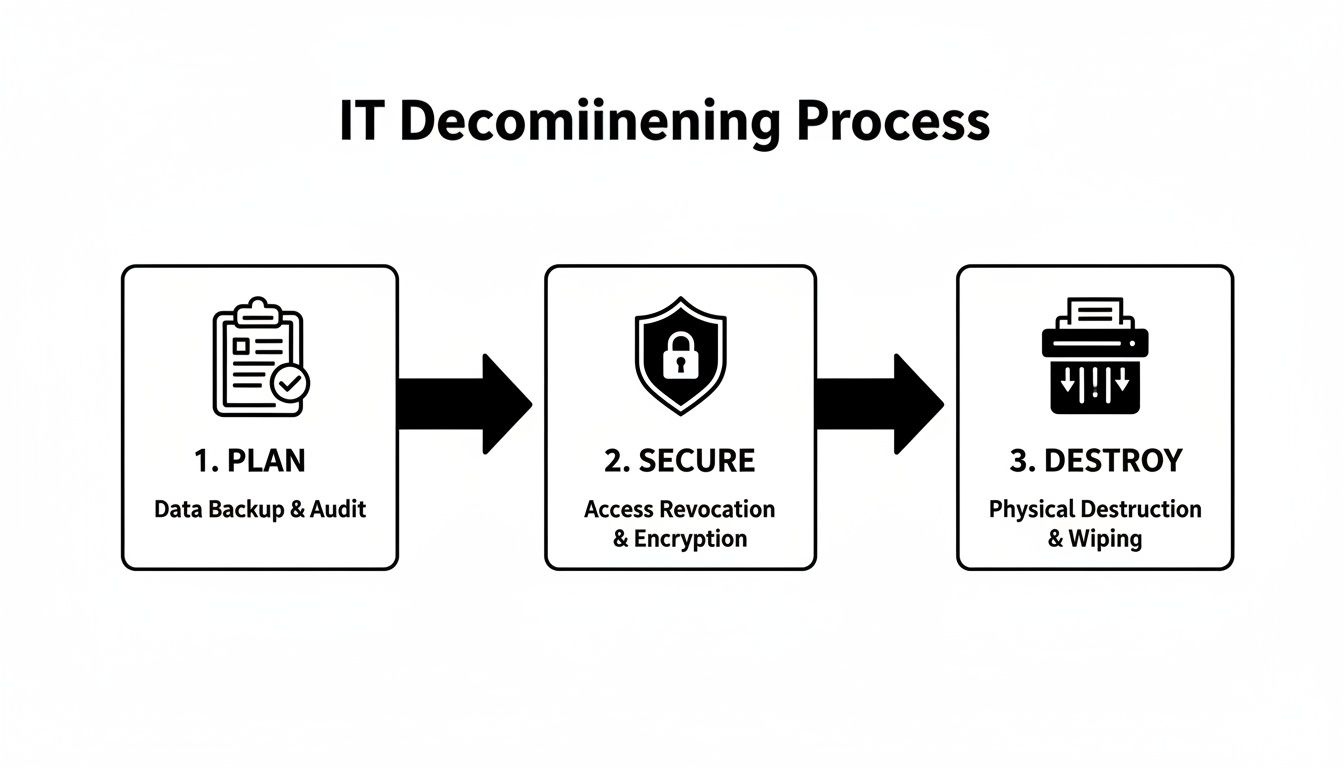
As you can see, secure asset retirement is a structured operation, not just a one-off task. It requires careful planning from the start.
Choosing the Right Destruction Method
Here's the thing: not all data destruction methods are created equal. The best approach for you will hinge on the type of media you're dealing with, how sensitive the data is, and which regulations you have to follow. Getting this choice right is all about balancing ironclad security with practical cost-effectiveness.
There are three main ways to handle data sanitization:
- Data Wiping (Software-Based): This is where specialized software overwrites all the existing data with random 1s and 0s, often in several passes. It’s the perfect choice for hard drives you plan to reuse or resell, since it leaves the hardware intact. Methods that meet DoD 5220.22-M or NIST 800-88 Clear standards are considered extremely secure.
- Degaussing (Magnetic Field): For magnetic storage like older hard drives and tapes, degaussing is a great option. It uses a powerful magnetic field to instantly and permanently scramble the data, rendering the drive totally useless. This is a go-to for media that's already failed or reached the end of its life.
- Physical Shredding (Hardware Destruction): This is the final answer in data destruction. The drives are fed into an industrial shredder that grinds them into tiny, confetti-like pieces. It's the gold standard for devices with top-secret data or when you need to meet the highest compliance levels, like the NIST 800-88 Purge and Destroy standards.
For most companies, the best strategy is actually a mix of these methods. You might wipe most drives for remarketing but shred any that fail the wiping process or held your most critical information. If you're not sure what your industry requires, our experts can walk you through the specifics of the secure destruction of data.
The Certificate of Data Destruction: Your Ultimate Proof
No matter which method you land on, the job isn't truly finished until you have a Certificate of Data Destruction in hand. This formal document is your legal proof that you followed a secure, compliant, and documented process.
Think of it as the official death certificate for your data. If an auditor ever comes knocking, this certificate is your non-negotiable evidence that you did your due diligence. It must detail the serial numbers of every device, the destruction method used, and the exact date it all happened.
This piece of paper is absolutely essential for anyone governed by regulations like HIPAA, where proving you followed the rules is just as important as the act itself.
How to Choose an Atlanta ITAD Partner
Picking the right IT Asset Disposition (ITAD) partner in Atlanta is a huge decision. This goes way beyond just finding someone to haul away your old servers and electronics. Get it right, and you're protecting your company from devastating data breaches, staying compliant, and even boosting your brand.
Get it wrong, and you're opening the door to massive risk. This isn't about finding a simple recycler; it's about finding a strategic partner. As you start looking at providers, think about finding one whose mission aligns with your own company values. When you do that, a routine task becomes a powerful story for your business.
The Core Checklist for Vetting Providers
Before you even think about missions and stories, any potential partner has to meet a strict baseline for security and compliance. These are the absolute non-negotiables.
- Industry Certifications: The first thing to look for is an R2 (Responsible Recycling) or e-Stewards certification. These are the gold standards in our industry, your guarantee that a provider follows rigorous protocols for environmental safety and data security.
- Data Destruction Protocols: Don't be afraid to ask for the gritty details. They need to offer verified data wiping that meets both DoD 5220.22-M and NIST 800-88 standards. For the highest level of security, they must also provide physical shredding, either on-site at your facility or at their own.
- Secure Logistics: How does the equipment get from your door to theirs? A provider that uses its own secure fleet controls the entire chain of custody, which drastically cuts down the risk of assets getting lost or stolen along the way.
- Detailed Reporting: What proof will you get? You must insist on a Certificate of Data Destruction and a Certificate of Recycling for every single project. This is your auditable paper trail that proves you did everything by the book.
Beyond the Basics: The Differentiator in Atlanta
So, what do you do when a few potential partners all check those security boxes? The difference lies in their mission and how it can amplify your own company’s Environmental, Social, and Governance (ESG) goals. A mission-driven partner can turn your e-waste from a liability into a real strategic asset.
A partner’s mission can be your story. Instead of just recycling, imagine “Recycling That Restores Lives and Landscapes.” This transforms a simple service into a tangible narrative of corporate social responsibility (CSR) for your stakeholders.
Think about partnering with a provider that offers a dual philanthropic impact—maybe one that supports local veterans and also contributes to reforestation efforts. This allows you to position your company as a genuine ESG leader. You could even run a “Recycle for a Cause” campaign with powerful messaging like, “Your old tech can house a veteran and grow a forest.”
This approach gives you concrete wins for your CSR documentation. Look for a partner that can deliver:
- Plant-A-Tree Certificates: Tangible proof of your positive environmental contribution.
- Veteran Support Impact Reports: Verifiable data showing the social good your retired assets helped create.
- A "Recycled with Purpose" Digital Badge: A certification you can proudly display on your website and in sustainability reports to showcase your commitment.
Choosing an ITAD provider is a major decision for any organization managing a data center in Georgia. For a deeper comparison, our guide on IT asset disposition companies can help you evaluate your options. By prioritizing both top-tier security and real social impact, you can find a partner that not only protects your business but proudly elevates your brand.
Turning E-Waste Into a Strategic ESG Win

What if disposing of old tech from your data center in Georgia was no longer just a cost of doing business, but a powerful story for your brand? Responsible IT asset disposal has moved far beyond a simple compliance chore. It’s now a real opportunity for Atlanta businesses to strengthen their Environmental, Social, and Governance (ESG) profile and connect with the community on a much deeper level.
Instead of just checking a box on a compliance form, you can turn retired assets into tangible good for the local area. This completely reframes the process from a reactive task into a proactive, mission-driven initiative.
Embracing the "Recycle for a Cause" Model
Imagine promoting your company’s sustainability commitment with a message that truly resonates: “Your old tech can house a veteran and grow a forest.” This is the heart of a “Recycle for a Cause” campaign—an approach that links the practical act of electronics recycling with emotional, verifiable outcomes.
This dual-impact model, which can support both veteran aid and local reforestation, creates a compelling narrative. It transforms routine IT hardware refreshes into a story that your stakeholders, customers, and employees can all get behind. By partnering with a mission-driven provider, your business can directly contribute to solving real, local challenges.
Making Your Impact Tangible for ESG Reporting
For any modern corporation, demonstrating a real ESG commitment is essential. A mission-aligned ITAD partner makes this incredibly straightforward by turning your recycling efforts into an easy win for your ESG reporting. The key is turning your actions into concrete, reportable metrics.
Consider the kind of documentation you could receive for your Corporate Social Responsibility (CSR) initiatives:
- Corporate Recycling Drives: Arrange a free pickup for 50+ devices and, in return, receive official documentation tailor-made for your sustainability reports.
- Plant-A-Tree Certificates: Get personalized certificates that detail the exact number of trees planted on your company's behalf through partnerships with USDA reforestation projects.
- Veteran Support Impact Reports: Receive clear, concise reports that quantify the social impact your recycled assets generated, such as the number of veterans supported.
This approach provides auditable proof of your commitment. An "Eco-Badge Certification," like a “Recycled with Purpose” digital badge, can be displayed right on your website, solidifying your brand’s position as a community and environmental leader.
Building Community Goodwill and Brand Loyalty
This mission-driven strategy goes far beyond internal reporting; it builds powerful community engagement and public relations. By co-hosting recycling drives with local VFW chapters, environmental nonprofits, or even schools, your company shows its commitment at a grassroots level.
This creates fantastic opportunities for positive press in outlets like the Atlanta Journal-Constitution, highlighting your company's unique, dual-impact model. Internally, it strengthens customer and employee engagement. Just imagine your team members or individual customers getting personalized impact certificates after a donation, stating, “You planted 3 trees and helped 1 veteran.”
This simple act can transform one-time participants into passionate brand advocates. A referral program that plants an extra tree in someone's name only deepens this connection, creating a powerful cycle of goodwill. You can learn more about the far-reaching benefits of e-waste recycling and how it truly elevates your brand.
By choosing a partner with a clear purpose, you’re not just disposing of e-waste; you’re investing in a story of restoration and hope.
Your Top ITAD Questions in Georgia, Answered
When it's time to retire your company's IT hardware or decommission a data center in Georgia, you're bound to have a few questions. We get it. This process can seem complicated, so we've put together straightforward answers to the things we're asked most often.
Our goal is to give you the clarity and confidence you need to make the right call for your organization.
What Kind of Equipment Do You Take?
We handle pretty much the full range of IT assets you'd find in any modern office or data center. Think servers, storage area networks (SANs), network-attached storage (NAS), switches, routers, and firewalls. We also handle related equipment from Atlanta tech recycling projects like laptops, desktops, and mobile devices.
But it doesn't stop there. We also take care of server racks, UPS battery backups, and all the cabling that ties it all together. It's a true single-source solution for your retired hardware, whether you're clearing out a massive data hall or just refreshing a few workstations in your Atlanta office.
How Do You Handle Data Security for Regulated Industries?
For us, data security isn't just a feature—it's the foundation of everything we do. This is especially true for clients in healthcare, finance, or any field with sensitive proprietary data. We rely on data destruction methods that meet or exceed the strict DoD 5220.22-M and NIST 800-88 guidelines, making sure your information is gone for good.
We tailor the destruction process to your exact compliance needs. Your options include:
- Multi-pass data wiping for drives and devices that still have market value.
- Degaussing, which uses powerful magnetic fields to destroy data on tapes and older hard drives.
- On-site or off-site physical shredding for the ultimate, verifiable level of data destruction.
Every project concludes with a formal Certificate of Data Destruction. This document is your proof, providing a clear and auditable record that your assets were handled securely and in full compliance. It's all about providing you with total peace of mind.
Do You Offer On-Site Services and Pickup?
Absolutely. We run our own secure fleet of vehicles, serving the entire Atlanta metro area and well beyond. Our professional team comes directly to your facility to manage the entire process on-site. We even offer free pickup for corporate recycling drives of 50+ devices.
From de-installing and tagging every asset to securely packing and transporting the equipment, we've got it covered. We maintain a strict chain-of-custody from your door to our facility, ensuring a seamless and secure handoff.
How Does Recycling with You Boost Our Company's ESG Goals?
Partnering with us does more than just check a box; it creates a powerful ESG narrative that truly connects with your employees, customers, and investors. For starters, 100% of your e-waste is diverted from landfills. But the story gets much better.
Because of our social mission, your old equipment directly helps fund housing for veterans and supports local reforestation projects. Our tagline is "Turning E-Waste into Hope."
We help you transform a routine operational task into a powerful story of corporate social responsibility. Imagine being able to say: “Your old tech can house a veteran and grow a forest.”
We arm you with all the documentation you need for your annual CSR and sustainability reports. This includes detailed Veteran Support Impact Reports, Plant-A-Tree certificates, and even a "Recycled with Purpose" digital badge for your website. We make it easy to showcase the positive impact you're making, especially through campaigns focused on electronics recycling for veterans.
Ready to turn your retired IT assets into a strategic win for your business and the community? Contact Atlanta Green Recycling today to schedule your secure electronics recycling pickup in the Atlanta area. Learn more about our services.