
A Business Guide to Securely Recycle Laptops in Atlanta

Let's be real—that storage closet full of old company laptops isn't just an eyesore. It's a ticking time bomb of security risks and a completely wasted opportunity. When businesses in Atlanta decide to recycle laptops, it’s about so much more than just being green. It's a strategic move that locks down sensitive data, keeps you compliant, and honestly, makes your brand look good.
Done right, recycling transforms a pile of old tech from a liability into a genuine asset. Our tagline says it all: “Recycling That Restores Lives and Landscapes.”
Why Smart Laptop Recycling Is a Business Imperative in Atlanta

Outdated technology presents a huge, often underestimated, challenge. Every single device holds a treasure trove of sensitive information—financials, client lists, internal communications—that becomes a massive security vulnerability if you don't handle it properly. Simply hitting "delete" or running a basic wipe on a hard drive just doesn't cut it. Data can still be recovered, leaving you wide open to breaches and hefty fines under laws like HIPAA and FACTA.
But looking at these retired devices purely as a risk means you're missing the bigger picture. Here in Atlanta, a thoughtful approach to IT asset disposition (ITAD) is fast becoming a competitive edge. Companies are realizing that a well-managed recycling program doesn't just eliminate risk; it creates real value for their brand and the community.
Turning E-Waste into a Powerful ESG Story
Today’s customers, partners, and even your own employees are looking for more than just a good product or service. They want to support brands that show a real commitment to Environmental, Social, and Governance (ESG) values. Recycling your old company laptops is the perfect chance to build a story that connects with people on a deeper level.
This is where choosing a mission-driven partner can make all the difference. Instead of your e-waste just being "disposed of," what if it could help a veteran get back on their feet or plant a new forest? Our "Recycle for a Cause" initiative lets Atlanta businesses do exactly that.
Your old tech can house a veteran and grow a forest. It's a simple, powerful message that turns your corporate social responsibility (CSR) efforts from a boring line item into a headline-worthy story.
By partnering with us, your business can:
- Support Veterans: We channel a portion of the value recovered from your old equipment directly into programs that provide housing and job support for local veterans.
- Promote Reforestation: We plant trees in your company’s name for every pickup, contributing to critical reforestation projects and giving you a Plant-A-Tree certificate to share.
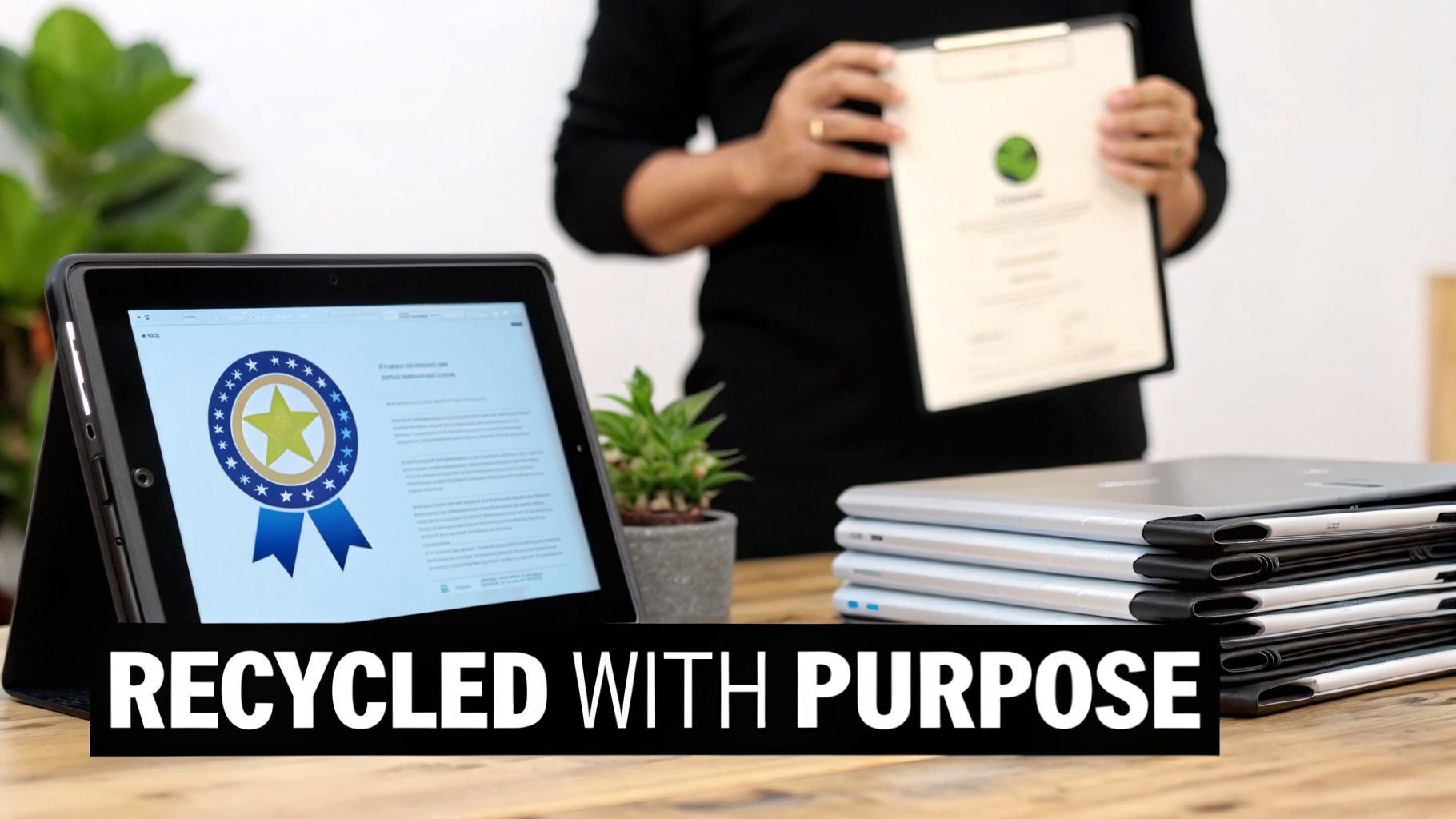
- Gain an "Eco-Badge": Our partners get a “Recycled with Purpose” digital badge to display on their website and sustainability reports, showing their commitment loud and clear.
The Growing E-Waste Challenge
The sheer scale of the e-waste problem is mind-boggling, which makes corporate action more important than ever. In 2026, the world is on track to generate over 65 million tonnes of electronic waste. Laptops and other small IT gear make up a significant 4.6 million tonnes of that—over 7% of the total pile.
Here's the really shocking part: only 22% of these devices were properly collected and recycled, meaning millions of tonnes are just sitting in landfills. Laptops are packed with valuable metals, yet barely 1% of the global demand for rare earth elements is met by recycling e-waste. This is a massive gap, and it's why businesses like ours are stepping up to provide secure ITAD services that turn your old laptops back into valuable resources.
This isn't just about feeling good or doing the right thing for the environment; it’s about smart resource management. Your outdated laptops are full of materials that can be reclaimed and put back to use, which reduces the need for destructive mining. For organizations ready to make a change, you can learn more about our process for secure computer recycling. By choosing to recycle laptops with a certified partner, your Atlanta business becomes a leader in a movement that our world desperately needs.
Preparing Your Laptops for Secure Recycling
Before you hand over a stack of old company laptops for recycling, a little prep work goes a long way. Taking a few key steps beforehand makes the entire process smoother, far more secure, and ultimately more valuable for your business. Think of it as setting the stage for a perfect, auditable handoff.
This isn't just about tidying up. This is about control. The goal is to move from a forgotten pile of equipment in a storage closet to a cataloged, secure collection of assets ready for their next chapter. Getting this groundwork right prevents last-minute scrambles and shows auditors you’ve done your due diligence.
Start with a Detailed Inventory Log
The first thing any experienced IT manager does is create a simple, thorough inventory log. This is much more than just a headcount. This log is the bedrock of your chain of custody, creating an official record of exactly what you’re handing over.
Your inventory sheet—whether it’s a quick spreadsheet or an entry in your asset management system—needs to capture a few key details for every single device. This isn't just for your own records; it's the document you’ll use to verify the Certificate of Destruction you get back later.
A solid inventory log should include:
- Make and Model: (e.g., Dell Latitude 7420, HP EliteBook 840 G8)
- Serial Number: This is the non-negotiable unique identifier for tracking each asset.
- Asset Tag Number: Your company's internal tracking number.
- Physical Condition: A quick note like "Good," "Cracked screen," or "Won't power on" adds useful context.
This simple bit of documentation turns a chaotic pile of electronics into a managed, auditable group of assets. It’s your first line of defense in a secure ITAD process.
Designate a Secure Holding Area
Once you’ve inventoried the laptops, they need a secure, central spot to live. Don't just leave them sitting in unlocked offices or a high-traffic hallway. Setting up a designated, secure holding area is absolutely critical to prevent equipment from "walking off."
A locked storage closet, a caged-off section of a warehouse, or a dedicated room with keycard access all work great. The main goal is to limit access to only the handful of authorized people involved in the project. This simple security measure prevents both theft and potential data exposure before the devices ever leave your building.
This step is especially vital in large offices, multi-tenant buildings, or during a chaotic office move where lots of people are coming and going. Securing your assets internally is just as important as picking a secure recycling partner.
Remove Old Asset Tags and Identifiers
Here's a small but crucial step: remove all old company identifiers from the laptops. That means peeling off asset tags, "property of" stickers, and any other labels that physically tie the device back to your organization.
Why bother? While your data is going to be destroyed, leaving physical tags on the equipment can cause confusion down the road, especially if any viable laptops are refurbished and resold. It ensures a clean, official break, reinforcing that the asset has been properly decommissioned. For an in-depth checklist on this process, explore our complete guide on preparing your laptop for recycling.
Vet Your Recycling Partner Upfront
Before you even think about scheduling the pickup, have a frank conversation with your potential recycling partner. This is your chance to confirm they can meet your specific security, compliance, and reporting needs. Asking the right questions now can save you from a major compliance headache later.
A few key questions to get you started:
- What documentation will I receive? You should expect a Certificate of Destruction at a minimum. With a partner like GreenAtlanta.com, you should also ask about Impact Reports that detail things like veteran support and trees planted.
- Can you provide a full chain of custody record? This is the document that tracks your assets from your door all the way to final disposition.
- Are your employees vetted and background-checked? The people handling your sensitive equipment matter. A lot.
- Do you use your own fleet for pickups? A recycler that uses its own trucks and uniformed staff—not third-party logistics—provides a much more secure and accountable chain of custody from start to finish.
Taking these steps ensures that when the time comes to recycle your company’s laptops, the process isn’t just good for the planet—it’s also ironclad from a security and compliance standpoint.
Choosing the Right Data Destruction Method
When your company’s laptops reach the end of their lifecycle, you’re faced with a crucial question: how do you protect the sensitive data on them without sacrificing the device's remaining value? This is where a smart data destruction strategy comes in. It’s the single most important decision in the IT recycling process.
Getting this right is about more than just deleting files. It's about safeguarding your business from devastating data breaches, steep legal fines, and the kind of reputational damage that’s hard to come back from. Your choice boils down to two main paths: software-based wiping or complete physical destruction. The best fit depends on your data's sensitivity and whether the laptop has a future.
This decision tree gives you a clear starting point for prepping your laptops, even before you think about data destruction. It's all about creating an organized, auditable workflow from the get-go.
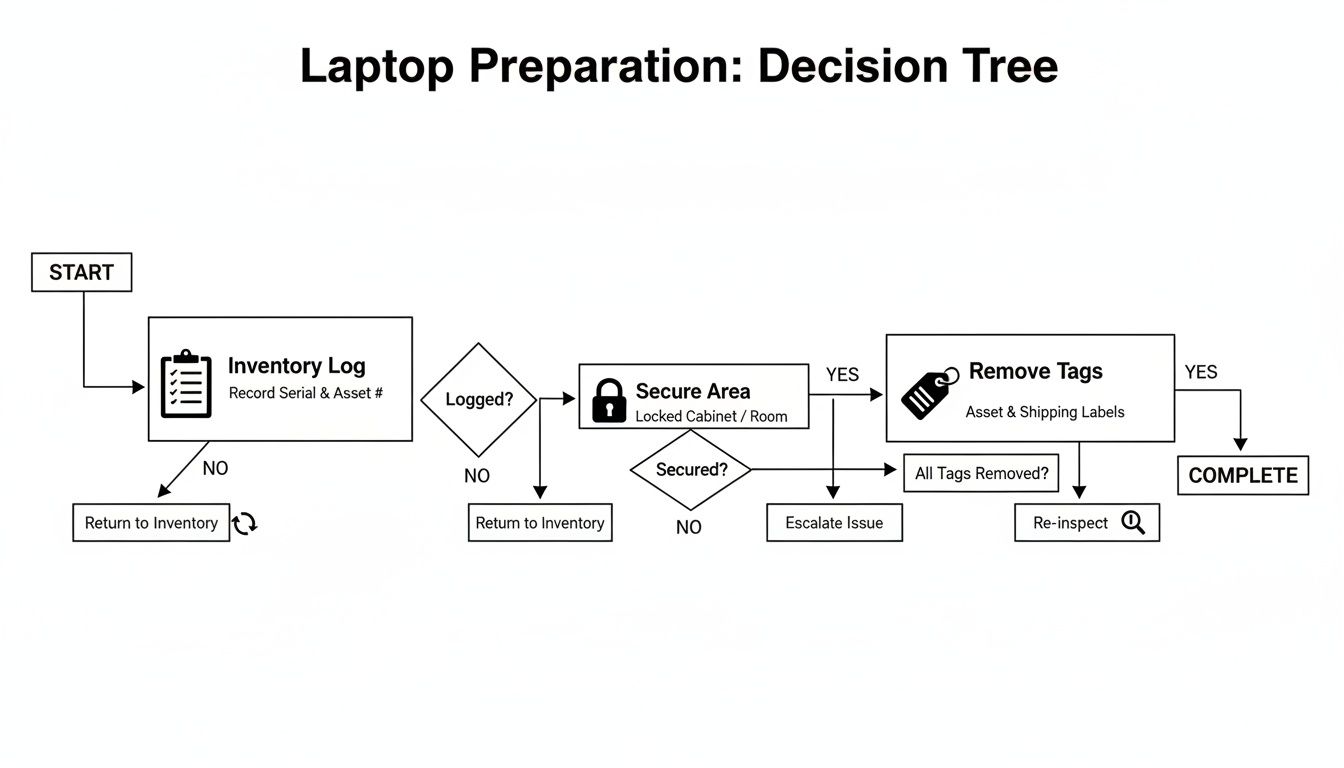
By logging, securing, and de-identifying each device first, you build a solid chain of custody before any data is ever touched.
Software Wiping for Asset Value Recovery
Software wiping, often called data sanitization, is a process where specialized programs overwrite every single sector of a hard drive with random data. This makes the original information virtually unrecoverable. The gold standard for this is the DoD 5220.22-M protocol, which uses multiple overwriting passes to ensure nothing is left behind.
This method is the perfect solution for laptops that are still in good working order and could be resold or refurbished. By keeping the hard drive intact, you give the laptop a second life, which often means you can recoup some of your original investment.
Key Takeaway: If a laptop is new enough to be resold or redeployed, DoD-standard sanitization is the way to go. It secures your data while preserving the hardware, maximizing your asset recovery.
Physical Shredding for Ultimate Security
Sometimes, there’s no room for even the slightest risk. If a laptop's hard drive held sensitive patient records (PHI), proprietary company secrets, or classified information, physical destruction isn't just an option—it's a necessity.
Physical shredding is as straightforward as it sounds. We remove the hard drive and feed it into an industrial-grade shredder that pulverizes it into tiny, mangled pieces of metal. This method provides absolute, undeniable proof that your data is gone forever. For any organization operating under strict regulations like HIPAA, FACTA, or SOX, this is the ultimate security guarantee.
The global electronics recycling market is experiencing a massive boom, projected to reach USD 22.21 billion by 2025 on the back of a 7.8% annual growth rate. This growth is fueled by advanced shredding and sorting technologies that can pull valuable materials like gold and copper right out of the shredded components. As a leader in this field, we offer services like free pickups for 50+ devices and DoD-compliant shredding designed for Atlanta's regulated industries.
Data Destruction Methods Compared
So, how do you decide? Wiping preserves value, while shredding offers total peace of mind. Many businesses we work with actually use a hybrid approach—wiping newer assets and shredding the older or more sensitive ones.
To help you get a clearer picture, our guide on the secure destruction of data dives even deeper into the technical specifics.
But for a quick overview, here's how the two methods stack up.
| Method | Process | Best For | Security Level | Compliance Fit |
|---|---|---|---|---|
| Data Wiping | Specialized software overwrites the entire hard drive with random characters in multiple passes, making data unrecoverable. | Functional laptops intended for resale, donation, or redeployment. Devices where asset value recovery is a priority. | High. Meets or exceeds NIST 800-88 "Purge" and DoD 5220.22-M standards for data sanitization. | Excellent for most regulations. Verified with a Certificate of Data Destruction. |
| Physical Shredding | The hard drive is physically removed and mechanically ground into small, unusable metal fragments. | End-of-life laptops, damaged drives, or any device containing highly sensitive IP, PHI, or financial data. | Absolute. The data and the media it was on are physically gone forever. There is zero chance of recovery. | Highest. The ultimate proof of destruction for HIPAA, FACTA, and SOX. Verified with a Certificate of Destruction. |
Ultimately, your decision should come down to your company's risk tolerance, compliance needs, and environmental goals. A certified ITAD partner can walk you through an assessment of your inventory, helping you choose the right path for each device. This ensures you’re fully secure and compliant without leaving money on the table.
Navigating Pickup Logistics in the Atlanta Metro
Getting a pallet of old laptops out of your downtown high-rise or suburban office park shouldn't be a logistical headache. The right recycling partner makes the entire process feel effortless, built on a foundation of clear communication, flexible scheduling, and an unbreakable chain of custody.
It all starts with a quick call or email, but coming prepared with a few key details will make everything run much more smoothly. Your partner needs this info to map out a timeline and see if you qualify for complimentary services. The real goal is a ‘set-it-and-forget-it’ experience that works for your schedule, not the other way around.
Preparing for Your Pickup
Before you even think about scheduling, take five minutes to gather some basic information. A little prep work from your side helps your recycling partner assign the right team and vehicle for the job. This ensures that when they show up, the pickup is fast, efficient, and doesn't throw a wrench in your daily operations.
Here’s what to have ready:
- An Approximate Device Count: You don’t need an exact number, but a solid estimate like "around 75 laptops" or "3 pallets of mixed IT gear" is crucial. This helps us know if you meet the threshold for a free pickup, which is typically around 50 or more devices.
- Location and Access Details: Is your office on the 20th floor with a hectic loading dock? Or are you in a ground-floor office park with easy access? Let your partner know about security check-ins, elevator reservations, or any other building-specific rules.
- Your On-Site Contact: Designate one person to meet the pickup crew. Having their name and direct phone number is key for seamless communication on the day of the pickup.
With this information in hand, your recycling partner can put together a clear plan, so there are absolutely no surprises when the truck arrives.
The Advantage of a Vetted Fleet and Team
When it comes to recycling laptops, who shows up at your door is a massive deal. A recycler that operates its own fleet of trucks with its own background-checked, uniformed employees gives you a security advantage you just can't get from companies that subcontract to random third-party logistics firms.
Your chain of custody begins the second those devices leave your building. Using a recycler with their own dedicated team means you have a single, accountable partner managing your assets from your office straight to the secure processing facility.
This single point of contact changes everything. There’s no finger-pointing between a recycler and a separate shipping company if something goes wrong. The team that arrives is trained specifically in handling sensitive electronics, making sure your assets are packed and transported securely. It's about maintaining the integrity of your ITAD process from the very start. To see how this works in practice, learn about our free electronic recycling pickup service for businesses across the Atlanta area.
Services That Make Your Job Easier
A top-tier recycling partner gets it—busy facility managers and IT directors need more than just a truck to show up. They provide a suite of services designed to take work completely off your plate. These options can turn a complex decommissioning project into a simple, single-vendor solution.
Look for a partner who offers valuable add-ons like these:
- On-Site Hard Drive Shredding: For ultimate peace of mind, some partners can bring a mobile shred truck right to your office. You can physically watch your most sensitive hard drives turn into fragments before they ever leave your property.
- De-installation Services: If you're clearing out a data center or refreshing an entire office floor, a full-service partner can handle all the manual labor—unplugging, disassembling, and packing every piece of equipment for you.
- Palletizing and Packing: Don't have the staff or supplies to get everything ready for transit? Your partner can show up with pallets, shrink wrap, and the muscle to get it all safely prepped for the journey.
When you choose a recycler who can manage these logistics, you free up your internal teams to stay focused on what they do best. You can rest easy knowing your retired assets are being handled professionally, securely, and efficiently.
Turning E-Waste into a Powerful ESG and CSR Win
When you recycle laptops with a mission-driven partner, the process evolves. It stops being a simple IT chore and becomes a powerful cornerstone of your brand’s story. This is your chance to turn a necessary expense into a celebrated win for your company’s Environmental, Social, and Governance (ESG) and Corporate Social Responsibility (CSR) goals.
A modern approach to IT asset disposition isn't just about secure disposal anymore. It’s about creating tangible, reportable impact. This shift lets you answer the growing demand from customers, investors, and employees who expect businesses to operate with a purpose beyond just profit.
Position Your Company for an Easy ESG Win
Partnering with a recycler like GreenAtlanta.com immediately positions your company as a leader in corporate stewardship. The whole process is designed to be an easy ESG win from the start. For example, when we collect 50 or more devices from your business in the Atlanta area, the service is completely free.
But the real value goes far beyond logistics. Once we’re done, you don't just get a standard Certificate of Destruction. You receive detailed impact documentation perfect for your CSR reporting.
This includes:
- Veteran Support Impact Reports: These documents quantify exactly how your electronics donation has helped fund programs for local veterans.
- Plant-A-Tree Certificates: You’ll also get official certificates detailing the number of trees we’ve planted in your company’s name through our reforestation initiatives.
This documentation gives you the specific data points you need for annual sustainability reports, investor briefings, and internal communications, turning a routine operational task into a measurable social good.
Amplify Your Impact Through Strategic Storytelling
Once you've made the commitment, it’s time to share that story. A dual-impact model—supporting veterans while reforesting our landscapes—is a compelling narrative that genuinely resonates with people.
“Recycling That Restores Lives and Landscapes.” This isn't just a tagline; it’s a mission statement you can adopt. That old tech, once a liability collecting dust in a storage closet, is now actively building a better community and a healthier planet.
The numbers behind e-waste make this story even more urgent. Laptops are e-waste goldmines, part of the 4.6 million tonnes of small IT equipment discarded every single year. With a global recycling rate of just 22%, businesses are sitting on a massive missed opportunity.
As the computer recycling market grows toward $50 billion in 2026, companies can either add to the problem or lead the solution. You have a chance to align with a booming ITAD sector that’s focused on positive change. You can discover more insights about ITAD trends on invrecovery.org to dig deeper into this trend.
Engage Your Community and Customers
A strong CSR program becomes a magnet for top talent, loyal customers, and positive press. By transforming how you recycle laptops, you create countless opportunities for real engagement.
Digital Badges for Social Proof
We provide all our partners with a "Recycled with Purpose" digital badge. Displaying this on your website, in email signatures, and on your sustainability pages instantly communicates your commitment. It’s a simple, visual way to build trust and set your brand apart.
Personalized Certificates and Newsletters
The impact isn't just corporate; it can be personal. Imagine emailing an individual employee a personalized certificate after a company donation drive: "You planted 3 trees and helped 1 veteran." This can turn one-time recyclers into passionate advocates for your brand. A monthly impact newsletter can strengthen that connection by sharing real stories of the veterans you’ve supported and showing progress on reforestation projects.
LinkedIn Thought Leadership
Your company's LinkedIn page is the perfect platform for case studies. Share a post detailing how your latest IT refresh helped plant 100 trees and supported a local VFW chapter. Target keywords like “corporate sustainability electronics disposal” and “electronics recycling for veterans” to reach the right audience. Don't forget to tag your recycling partner and the nonprofits involved to amplify the message and showcase your deep commitment.
This approach turns a standard operational procedure into a cycle of positive storytelling. It directly connects your IT department's work to the company's highest values, creating a narrative that resonates across every part of your business—from the server room to the boardroom.
Your Top Questions About Corporate Laptop Recycling in Atlanta
We’ve worked with hundreds of businesses across the Atlanta area, from downtown startups to sprawling suburban campuses. Over the years, we've fielded just about every question an IT manager or business owner could have.
Here are the answers to the questions we hear most often, designed to give you the clarity you need to move forward with confidence.
What Types of Devices Do You Accept Besides Laptops?
Many people think IT recycling is just for laptops, but that's just the beginning. We handle the full spectrum of corporate IT assets, making us your single point of contact for the entire hardware lifecycle. This simplifies things dramatically.
We can take almost any piece of tech off your hands, including:
- Desktop computers and workstations
- Servers and other data center hardware
- Monitors and displays
- Networking gear like switches, routers, and firewalls
- Printers, scanners, and copiers
- Mobile devices, including tablets and smartphones
Managing everything through one partner means less vendor juggling and a single, secure chain of custody for all your retired equipment.
Is There a Cost for My Business to Recycle Its Laptops?
This is usually the first thing people ask, and the answer is great news for most Atlanta businesses. If you have 50 or more devices, we can typically handle the pickup and recycling services completely free of charge.
So, how does that work? We’re able to recover enough value from the reusable components and raw materials to offset our costs for logistics, labor, and data destruction. For much smaller batches or complex projects that need a lot of on-site work, a small, transparent service fee might apply. We always provide a clear, upfront quote, so you’ll never see a surprise bill.
Key Insight: A reputable ITAD partner should see your old laptops as assets, not just trash. The value they contain should, in most cases, cover the cost of their own secure and environmentally responsible disposal.
How Do We Get Proof That Our Sensitive Data Was Destroyed?
This is absolutely non-negotiable and a cornerstone of our entire process. Once your devices have been processed, we issue a formal Certificate of Destruction. Think of this as a legal document that provides auditable proof of compliance.
The certificate is a detailed record of the service performed. It includes critical information like:
- The serial numbers of the hard drives we processed
- The exact destruction method used (e.g., DoD 5220.22-M wipe or physical shred)
- The date the service was completed
This piece of paper is your key to satisfying internal audits, proving regulatory compliance, and getting some well-deserved peace of mind. It officially closes the loop on your data security responsibilities. If you want to dig deeper into what happens after your gear leaves your office, check out our guide on where to recycle electronics.
How Does Recycling Our Tech Actually Help People?
This is what truly sets our work apart. We’ve built a model that transforms a simple recycling transaction into a real, measurable contribution to the community—what we call "Recycle for a Cause."
A portion of the revenue we generate from your old IT equipment goes directly to our vetted nonprofit partners who provide housing and employment support for local veterans. At the same time, we fund certified reforestation projects through partners like the National Forest Foundation, planting a specific number of trees for every corporate pickup.
You get a detailed Impact Report that quantifies exactly what your company accomplished—for example, "Your company's IT refresh helped support 3 veterans and planted 150 trees." It’s a powerful way to turn e-waste into genuine hope and restoration.
Ready to transform your old laptops into a force for good? At GreenAtlanta.com, we make it easy for Atlanta businesses to recycle laptops securely, compliantly, and with purpose. Schedule your free corporate pickup today!