
IT Equipment Disposal for Companies Atlanta GA: Secure Data

When a storage room starts filling with retired laptops, tower PCs, failed hard drives, old switches, and a few servers nobody wants to touch, most Atlanta IT teams already know they have a problem. What usually slows action isn't the pickup itself. It's the mix of concerns behind it: data exposure, internal signoff, environmental handling, audit documentation, and the question every operations lead eventually asks, "Can we turn this into something useful instead of just paying to make it disappear?"
That's where IT Equipment Disposal for Companies Atlanta GA becomes more than a cleanup task. Done poorly, disposal creates risk. Done well, it closes the loop on security, compliance, sustainability, and even corporate social impact. For Atlanta businesses, that matters whether you're clearing one office, retiring a lab, refreshing hospital workstations, or decommissioning a data center floor.
Why Strategic IT Disposal Matters for Atlanta Businesses
An Atlanta office move or hardware refresh often reveals the same pattern. Active devices are tracked. Retired devices aren't. They end up stacked in a closet, left under desks, or parked in a server room because nobody wants to be the person who sends out equipment before confirming the data is gone.
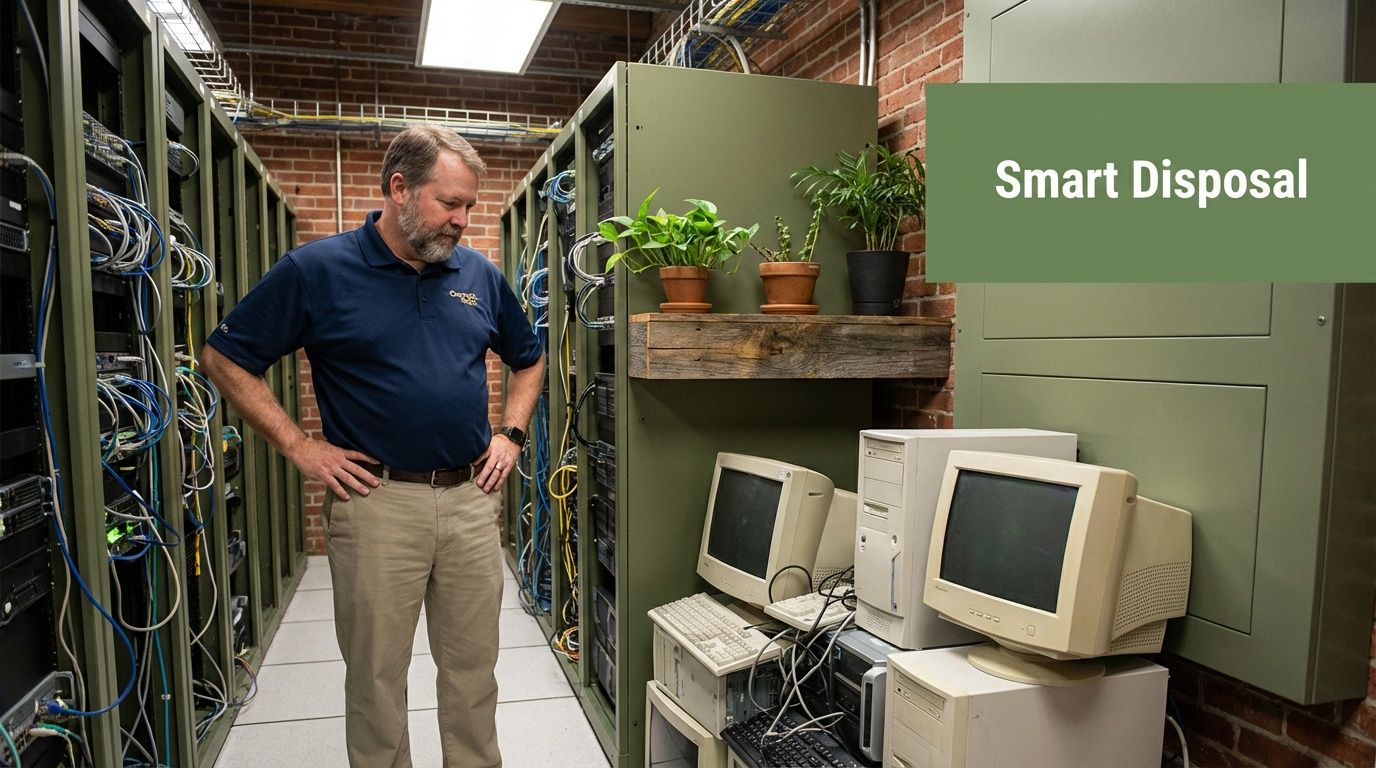
That hesitation is understandable. Old equipment still carries business risk even when it no longer has business value. A retired laptop may contain cached credentials. A failed server drive may hold regulated records. Monitors, batteries, and boards may contain materials you don't want entering the wrong waste stream.
The backlog in your office is part of a larger problem
This isn't a niche issue. The U.S. e-waste problem became impossible to ignore years ago. The EPA reported over 63 million computers being discarded annually in the United States by 2007, as noted in this Atlanta computer recycling overview. That scale helps explain why IT asset disposition became its own discipline instead of staying an afterthought under facilities or office cleanouts.
The business lesson is straightforward. Once retired electronics reached that level of volume, ad hoc disposal stopped being defensible.
Practical rule: If an asset ever stored company data, don't treat it like office junk. Treat it like a security project with an environmental chain of custody.
What strategic disposal changes
A strategic approach does three things at once:
- Protects data before assets leave your control by requiring documented sanitization or destruction.
- Reduces compliance friction because your records match what auditors, legal teams, and internal stakeholders expect to see.
- Improves sustainability outcomes by separating reusable equipment from true scrap instead of sending everything down one path.
That last point matters more than many teams realize. If you shred everything automatically, you may destroy recoverable value and eliminate reuse options. If you try to resell everything, you can expose the company to data and compliance problems. Strong IT disposal sits in the middle. It classifies assets correctly, then applies the right downstream process.
Why Atlanta companies should care now
Atlanta has a dense mix of healthcare systems, schools, logistics firms, financial operations, public agencies, and growing tech companies. Those organizations retire equipment on different cycles, but they all need the same core outcome: a process that is secure, documented, and easy to defend later.
That is why smart disposal starts before the truck arrives. The work begins with an internal plan.
Your First Step an Internal IT Asset Disposition Plan
Most disposal projects go sideways before a recycler is even contacted. The root problem isn't vendor quality. It's weak internal preparation. If your team can't answer what equipment exists, where it sits, who owns it, and what data it may contain, you'll spend more time chasing approvals than moving hardware.
Start with an asset inventory that is usable
Don't build a perfect spreadsheet. Build a decision-making spreadsheet.
For each retired or soon-to-be-retired item, capture the basics your security, finance, and operations teams need:
- Asset type such as laptop, desktop, server, firewall, switch, monitor, printer, phone, or storage array
- Make and model so your team can estimate reuse or buyback potential
- Serial number or asset tag for auditability
- Physical location including office, closet, lab, branch, or data room
- Condition such as working, damaged, non-booting, or incomplete
- Data exposure level based on whether the item contains or may have contained sensitive data
- Disposition target such as resale, recycle, donate internally, or destroy
If your organization already has lifecycle records, use them. If not, start with what your technicians can physically verify. A clean field inventory beats a stale CMDB entry every time.
A useful reference for shaping your internal process is this guide to IT asset management best practices. It pairs well with disposal planning because it helps teams connect retirement decisions to the wider asset lifecycle.
Use three buckets, not ten
I've found companies move faster when they classify assets into a small number of disposal paths. Three buckets are usually enough.
Bucket one for remarketing or reuse
Put devices here when they are functional, reasonably current, and suitable for wiping. That may include laptops from a refresh cycle, working desktops, newer network equipment, and servers with secondary market demand.
These assets deserve extra care. If data can be sanitized to the required standard, resale or reuse may offset part of the project cost and support sustainability goals.
Bucket two for recycling
This is for equipment with little market value but normal handling needs. Think damaged monitors, old peripherals, failed printers, mixed cables, obsolete desktops, broken docks, and miscellaneous electronics that don't justify special recovery effort.
The goal here is straightforward: process the material responsibly and document the handoff.
Bucket three for high-security destruction
Some assets should go directly to destruction planning. Failed drives, storage from regulated environments, devices with uncertain custody history, and media from legal or compliance-sensitive workflows belong here.
If your team can't confidently prove a drive was sanitized, act as if it wasn't.
Assign internal ownership before pickup day
A disposal project stalls when responsibility is vague. Set named owners for:
- IT operations to locate and stage assets
- Security or compliance to approve destruction requirements
- Facilities or office management to coordinate access and loading
- Finance or procurement to review resale, write-off, or asset retirement records
This doesn't need to become a committee. It just needs a clear handoff sequence.
Decide what "ready" means
Before any vendor arrives, your team should be able to say:
- the asset list is current enough to act on
- high-risk devices are identified
- pickup locations are confirmed
- internal approvals are complete
- your preferred outcome for each asset is clear
That preparation changes the vendor conversation. Instead of asking, "Can you take this stuff?" you're asking for a defined service scope with fewer surprises, better documentation, and fewer custody gaps.
Mastering Secure Data Destruction and Sanitization
Data destruction is the part nobody should guess at. It brings together legal exposure, reputation risk, and operational discipline. The right method depends on the type of device, the sensitivity of the information, and whether the asset still has reuse value.
Two main options and when each fits
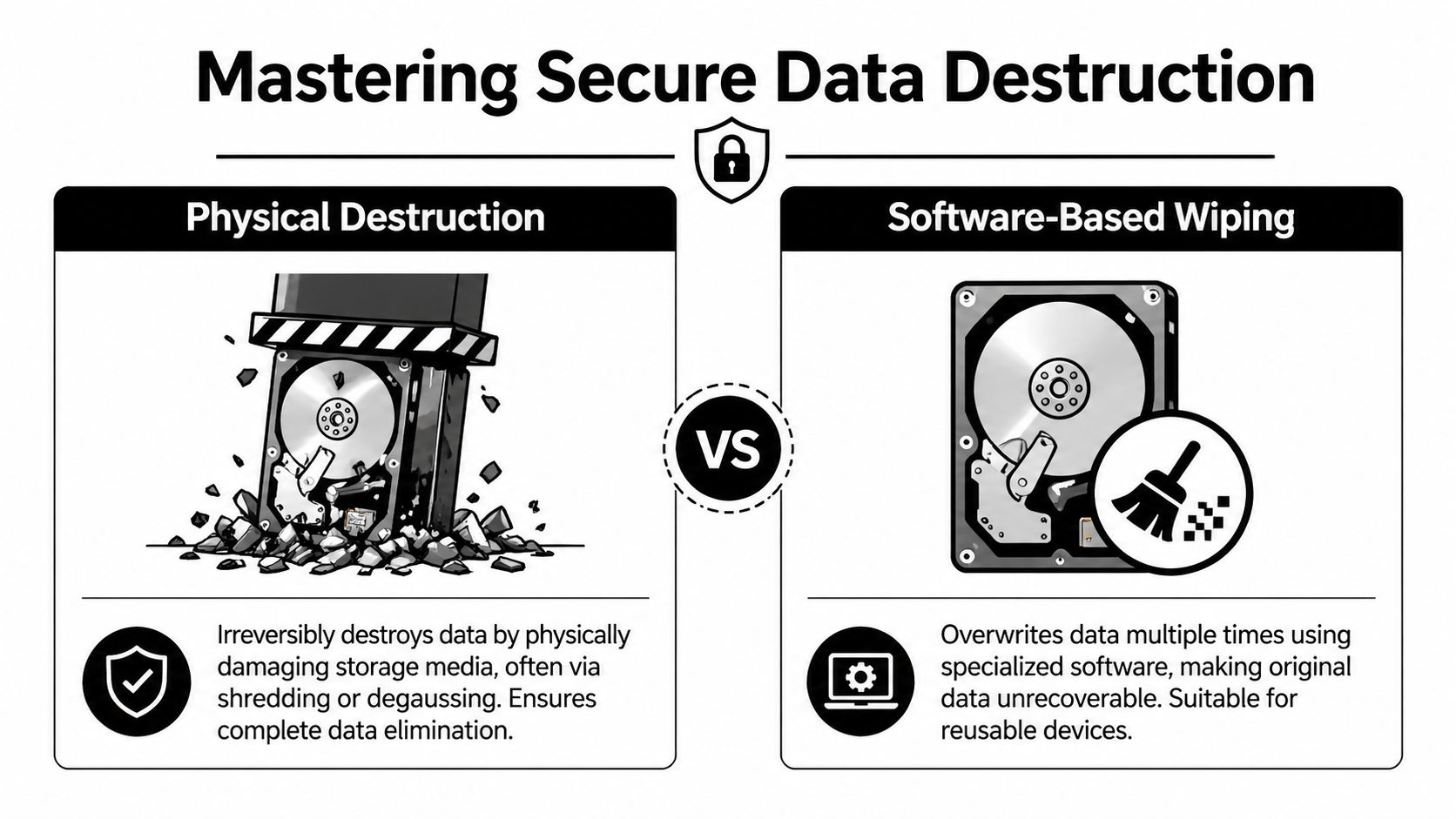
In Atlanta IT disposal workflows, certified providers typically use software wiping and physical destruction, aligned to NIST SP 800-88r1 and DoD 5220.22-M, with 100% eradication verification through audit logs and certificates, according to this Atlanta IT disposal reference.
That sounds technical, but the decision framework is simple.
Software-based wiping
Wiping overwrites the existing data so the device can be reused or sold. It's the right choice when the hardware still has value and the storage media is functioning properly.
Wiping works best when:
- The drive is healthy and can complete the sanitization process
- The equipment is intended for resale or redeployment
- You need asset value recovery instead of total destruction
- The organization accepts sanitization as compliant for that asset class
This method preserves equipment value. That's the upside.
The limitation is just as important. Wiping is only as good as the process, the tooling, the device condition, and the recordkeeping behind it. If a drive fails mid-process or can't be accessed reliably, it should move out of the wiping lane.
Physical destruction
Physical destruction removes any ambiguity. The storage media is crushed, shredded, or otherwise rendered unusable.
This method is the better fit when:
- The drive has failed and can't be wiped reliably
- The data is highly regulated or highly sensitive
- Custody history is incomplete
- The equipment has no practical reuse path
The same Atlanta data destruction source notes that industrial NSA-approved shredders can reduce drives to 2mm particles and process 500 to 1000 units per hour, which is why physical destruction is often chosen for healthcare and other tightly regulated environments.
A side-by-side view
| Method | Best use case | Main benefit | Main trade-off |
|---|---|---|---|
| Software wiping | Working devices with resale or reuse potential | Preserves asset value | Requires functioning media and strict verification |
| Physical destruction | Failed drives, regulated data, uncertain custody | Removes recovery risk through destruction | Eliminates reuse and residual value |
What good data destruction looks like in practice
A defensible process is usually more important than the marketing language around it. Ask whether the provider documents these stages:
Pre-destruction identification
Assets are scanned or logged by serial number, asset tag, or both.Method selection
Wipe where reuse makes sense. Destroy where risk or device condition requires it.Execution under controlled custody
Devices are handled through secure logistics, staged securely, and processed according to the approved method.Verification and reporting
You receive records showing what was processed, how it was processed, and what certificate supports the outcome.
A deeper operational breakdown is available in this guide to secure data destruction services in Atlanta, especially for teams choosing between onsite shredding, offsite processing, and wiping for value recovery.
The certificate matters, but the chain behind the certificate matters more. If the asset record, custody trail, and destruction method don't line up, the paper won't save you.
Common mistakes companies make
The most common mistake is choosing one method for every device. That's lazy policy, not sound security.
Another mistake is letting convenience drive decisions. For example, teams sometimes keep failed drives in storage for months because nobody knows whether they should be wiped, drilled, or shredded. That delay doesn't reduce risk. It extends it.
A third mistake is overlooking peripheral storage. Copiers, firewalls, phones, and other devices may store sensitive information even when they aren't thought of as "data devices."
What works in the field
What works is a mixed-method program. Wipe assets with recoverable value. Physically destroy storage that is failed, sensitive, or unsuitable for reuse. Demand certificates tied to asset-level reporting. Keep the decision logic documented internally so the process can be explained later.
For organizations with larger decommissions, providers such as Atlanta Green Recycling can handle pickup, logistics, data wiping, hard drive shredding, and chain-of-custody documentation as part of a broader IT asset disposition workflow. The important point isn't the brand name. It's whether the process is documented, auditable, and appropriate for your data profile.
Navigating Atlanta E-Waste Compliance and Georgia Law
Compliance problems in IT disposal usually don't come from dramatic misconduct. They come from ordinary gaps. Missing serial records. Unclear custody transfer. Unverified destruction. Equipment that leaves one site but doesn't appear cleanly in any report afterward.
Atlanta companies can't afford that kind of gray area.
What the rules mean in practice
The scope of compliance is extensive, but the operational expectation is consistent. If your company handles regulated data or governed records, retired equipment must be managed in a way that protects information and proves responsible disposal.
Modern IT asset disposition in Atlanta has developed into a compliance-driven service category. Organizations are expected to follow federal, state, and local requirements, and providers commonly implement NIST 800-88 certified data destruction standards for clients such as hospitals, government agencies, data centers, and other regulated organizations, as described in this overview of IT equipment disposal in Atlanta.
For an Atlanta IT manager, that translates into a few practical obligations:
- Know what data was on the device
- Choose a destruction or sanitization method that fits that risk
- Maintain chain-of-custody records from pickup through final processing
- Keep the documentation in a form your auditors or compliance team can use
Georgia law isn't separate from your operational process
Georgia-specific electronics recycling obligations don't replace federal privacy and records responsibilities. They sit alongside them. That means environmental handling and data handling should never be split into two disconnected workflows.
If you need a starting point for local requirements, this resource on Georgia electronics recycling is a practical way to frame what your business should ask from any disposal provider.
Chain of custody is your defense
Chain of custody sounds formal, but it comes down to a simple question: can you show where the asset went at every meaningful step?
A solid chain-of-custody record should answer:
| Record element | Why your team needs it |
|---|---|
| Asset identification | Confirms the exact equipment covered by the disposal event |
| Transfer point | Shows when responsibility moved from your staff to the provider |
| Processing method | Documents whether the item was wiped, shredded, recycled, or remarketed |
| Final certificate or report | Gives auditors and legal reviewers a usable proof set |
Auditors rarely care that a pickup happened. They care whether you can prove what happened after the pickup.
What doesn't work
What doesn't work is relying on verbal assurances, generic weight tickets, or a one-line invoice that says "electronics recycled." That may be enough for scrap metal. It is not enough for business equipment that stored confidential information.
Another weak practice is separating environmental reporting from security reporting. Your facilities team may get one document while IT gets another, and neither one gives a complete picture. Consolidated reporting is far easier to defend.
The companies that handle disposal well treat it like any other controlled business process. They define approval points, document movement, and retain records where finance, security, and compliance teams can find them later.
Turn E-Waste into an ESG Win for Your Company
Most companies still treat IT disposal as a back-office obligation. That leaves value on the table. If your business already has sustainability goals, CSR commitments, community giving initiatives, or board-level reporting pressure, retired electronics can support those efforts when the program is designed correctly.
A major gap in the market is the lack of clear guidance on linking disposal activity to ESG and CSR reporting, particularly through auditable certificates for environmental diversion metrics. That gap matters for the 70% of Atlanta's Fortune 500 firms affected by recent SEC climate disclosure rules, according to this analysis of the ESG reporting need.
Disposal can support both governance and brand story
There are two parts to a useful ESG disposal program.
The first is operational. You need records your compliance or sustainability team can use. That includes data destruction certificates, asset summaries, and environmental reporting that is specific enough to hold up in internal review.
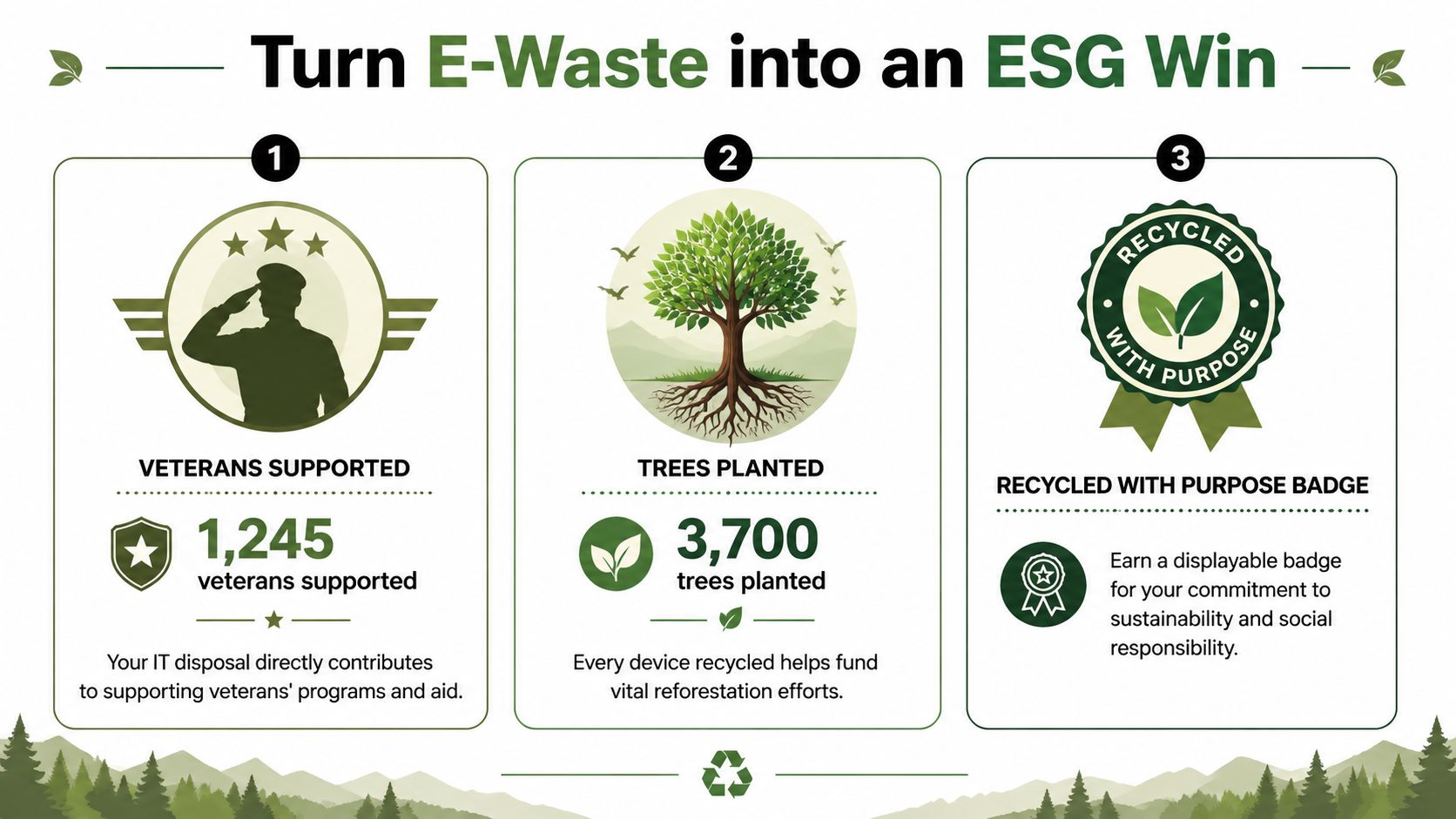
The second is narrative. Stakeholders respond to visible purpose. If all your company can say is "we recycled some old computers," the story ends there. If your disposal partner connects that activity to veteran support and reforestation, the program becomes something employees, customers, and leadership can talk about with credibility.
What a stronger ESG disposal model looks like
A mission-driven recycling program can turn a routine retirement cycle into a visible initiative:
- Corporate recycling drives give IT and workplace teams a simple event-based process for collecting retired gear.
- Impact certificates provide a cleaner handoff to CSR or sustainability teams than a basic receipt.
- Recycled with Purpose badges give communications teams a legitimate asset for websites, recruiting materials, and sustainability pages.
- Veteran support and tree planting reports tie technology disposal to concrete social and environmental action.
The "Recycle for a Cause" model changes the conversation. Instead of asking staff to clear out old devices because storage space is tight, you can connect the project to a wider purpose. Old tech can support veterans and fund reforestation while still meeting security and compliance requirements.
Why this matters internally
A good ESG disposal program doesn't just help external reporting. It also helps internal alignment.
IT cares about secure handling. Procurement cares about asset recovery. Sustainability wants diversion data. HR and communications want initiatives people can understand. A dual-mission program gives each group a reason to support the same project.
Here are the pieces that tend to work best:
Recycle for a Cause messaging
Keep it plain and specific. The strongest campaigns connect equipment retirement to visible outcomes without making the message feel abstract or sentimental.
A line such as "Your old tech can house a veteran and grow a forest" is memorable because it explains why this disposal event matters beyond storage cleanup.
Seasonal campaign windows
Veterans Day, Earth Day, and Arbor Day are natural moments for internal drives, office cleanup campaigns, and partner storytelling. They also make cross-team coordination easier because the initiative can be scheduled around an existing calendar moment.
Documentation built for CSR teams
Many providers can destroy data. Fewer providers package the resulting documentation in a format useful for ESG review. This presents a key opportunity. The company that gives your sustainability team usable reporting becomes easier to keep on the approved vendor list.
A disposal vendor removes equipment. A strategic disposal partner gives your company records, language, and proof you can reuse in ESG and CSR workflows.
What companies should ask for
If you want disposal to support ESG instead of sitting outside it, ask these questions before signing:
- Can you provide auditable data destruction documentation and environmental reporting together?
- Can you support mission-based reporting such as veteran impact or reforestation certificates?
- Do you offer a badge or recognition asset we can display in sustainability materials?
- Can your reporting be routed to both IT and CSR stakeholders without extra cleanup on our side?
For teams mapping the broader environmental side of the program, this overview of the benefits of e-waste recycling is useful background.
The key shift is mindset. Disposal doesn't have to live only in the risk column. With the right reporting and the right mission alignment, it can also live in the value column.
How to Select the Right Atlanta IT Disposal Partner
Vendor selection is where a lot of good internal planning either pays off or falls apart. The wrong partner gives you vague promises, generic paperwork, and pricing that only becomes clear after the equipment is loaded. The right one explains the workflow, defines the custody process, and gives you enough visibility to defend the project internally.
Start with the economics, but don't stop there
Cost transparency is a recurring issue in the Atlanta market. Industry averages for wiping and shredding often land around $0.30 to $0.50 per pound, and free pickup usually depends on volume. The same market snapshot notes that server buyback values have increased by 30% due to metal price surges, yet many providers still don't offer clear ROI tools, according to this discussion of Atlanta corporate IT disposal costs.
That doesn't mean the cheapest quote is the right one. It means you should insist on understanding what is included.
Ask whether pricing changes based on:
- Onsite vs. offsite processing
- Wiping vs. shredding
- Mixed loads vs. sorted equipment
- Labor for de-installation or packing
- Pickup minimums or free pickup thresholds
- Revenue share or buyback on reusable assets
Use a checklist, not a gut feeling
The most useful vendor conversations are structured. Here's a practical comparison framework.
| Criteria | What to Ask or Verify | Why It Matters |
|---|---|---|
| Data destruction method | Ask whether they offer both wiping and physical destruction, and how they decide between them | You need the method to match the asset and risk level |
| Documentation | Verify certificates, serial-level reporting, and chain-of-custody records | Auditors and legal teams need more than a pickup receipt |
| Pickup and logistics | Ask who handles packing, loading, and transport | Logistics gaps create delays and custody confusion |
| Asset value recovery | Ask whether usable servers, laptops, or network gear are evaluated for buyback | This can offset project cost |
| Environmental handling | Verify downstream recycling practices and landfill policies | You want responsible disposition, not hidden dumping |
| Client fit | Ask whether they routinely handle hospitals, schools, agencies, or data centers like yours | Sector familiarity reduces process mistakes |
| Pricing clarity | Request line-item explanations for labor, wiping, shredding, transport, and recycling | Hidden fees are common in loosely scoped projects |
| Reporting for ESG or CSR | Ask whether they can provide impact-style reporting beyond destruction certificates | This helps the project serve more than one internal stakeholder |
If you're comparing local providers, this page on IT asset disposition companies can help frame what services and capabilities should be on your shortlist.
Questions that reveal a weak vendor quickly
Ask direct questions and listen for direct answers.
- What does your certificate include?
- How do you maintain chain of custody from pickup through final processing?
- Can I separate assets for resale, recycling, and shredding before the pickup?
- What happens to a failed drive that can't be wiped?
- How are higher-value servers handled if they have resale potential?
If the answers stay vague, the reporting probably will too.
What works best
The strongest partner is rarely the one with the loudest marketing. It's the one whose scope is easy to understand. You should know what happens to each class of asset, what paperwork you'll receive, and what the financial model looks like before the truck shows up.
That level of clarity makes internal approvals much easier, especially when finance, legal, and IT all need to sign off.
Your IT Equipment Disposal Questions Answered
A few questions come up in almost every corporate disposal project. Getting these answered early saves a lot of internal back-and-forth.
Can we watch hard drive destruction?
Yes, many companies prefer a process they can witness, especially for regulated or sensitive assets. If you're arranging onsite shredding or supervised destruction, confirm that expectation in the scope before scheduling. The key is making sure witness procedures, serial logging, and final certificates all align.
Can some equipment be wiped and resold instead of shredded?
Yes. That is often the smartest path for working laptops, desktops, and certain servers. The decision depends on device condition, data sensitivity, and whether your organization permits sanitization for that asset category. If resale is possible, make sure the reporting still shows what was wiped and what was destroyed.
What should we do with failed hard drives?
Treat failed drives as destruction candidates unless your security team has a documented reason to handle them differently. A failed drive usually removes the practical option of verified wiping.
How should we prepare for pickup day?
Keep it simple:
- Stage assets by category so reusable equipment isn't mixed with destruction-only media
- Label exceptions clearly such as drives awaiting witness destruction
- Make access easy by confirming loading areas, dock timing, elevators, and building rules
- Keep your internal asset list nearby so your team can reconcile what leaves the site
Do we need one vendor for everything?
Not always, but one coordinated workflow is easier to manage than multiple fragmented handoffs. Companies usually run into trouble when pickup, data destruction, recycling, and reporting are split across too many parties.
Can disposal support our company mission too?
Yes, if the partner is set up for it. Through such partnerships, Atlanta companies can do more than check a compliance box. A mission-driven program can connect retired equipment to veteran support, reforestation, employee engagement, and CSR storytelling. For many companies, that's the difference between a forgettable back-office task and a program people rally around.

What documents should we expect at the end?
At minimum, expect records that show what was collected, how data-bearing devices were handled, and what certificate supports the final disposition. If your company cares about sustainability or CSR reporting, ask for impact-oriented reporting at the same time so IT doesn't have to chase it later.
If your team is planning IT Equipment Disposal for Companies Atlanta GA, Atlanta Green Recycling can help you organize secure pickup, data destruction, equipment recycling, and documentation in a way that supports both compliance and your broader ESG goals. If you want a disposal process that protects data, keeps reporting clean, and connects retired tech to veteran support and tree planting, it's worth starting the conversation early, before the next storage room fills up.