
Secure Server Recycling for Data Centers Atlanta GA

Metro Atlanta now sits as the world’s second-largest data center market by inventory capacity, with at least 163 data centers and more than $40 billion invested in the first seven months of 2025 alone, according to Georgia Trend’s reporting on the state’s data center dominance. That number changes how data center managers should think about retired hardware. In Atlanta, server recycling isn’t a back-room cleanup task. It’s part of operating critical infrastructure in a market moving fast.
When hardware refresh cycles tighten, the pressure hits from every side. Security teams want certainty that no residual data leaves the building. Facilities teams need clean removal with no disruption to production space. Finance wants value recovery where it makes sense. ESG leaders want proof that old servers didn’t just move from one warehouse to another.
That’s why Server Recycling for Data Centers Atlanta GA should be treated as a strategic ITAD decision, not a hauling job. The right process protects data, preserves auditability, reduces landfill exposure, and gives your organization a credible sustainability story. In Atlanta, that last part matters more than many operators realize.
A good decommissioning plan should answer four questions before the first rail kit is touched:
- What assets are leaving service
- What data still lives on them
- Which items should be reused, remarketed, or destroyed
- What evidence will you need for audit, legal, and ESG reporting
Some organizations stop at compliance. Smart ones go further. They use end-of-life hardware programs to support broader corporate goals, including documented environmental outcomes and community impact tied to veteran support and reforestation initiatives.
The Strategic Imperative for Server Recycling in Atlanta's Data Center Hub
Atlanta’s market scale changes the economics and the risk profile of decommissioning. In a region with dense clusters in Alpharetta, Lithia Springs, Suwanee/Norcross, and Downtown Atlanta, server retirement happens against a backdrop of aggressive expansion and shortened refresh windows. The practical result is simple. More hardware exits service faster, and mistakes become expensive quickly.
For data center operators, the first move is defining project scope in operational terms, not recycling terms. Start with the environment you’re changing. Is this a cage reduction, a row retirement, a full hall refresh, or a complete facility shutdown? That distinction determines staffing, pickup staging, sanitization method, access windows, and chain-of-custody controls.
Then build a working asset inventory. Not a rough spreadsheet from procurement records. A current decommissioning inventory that shows:
- Asset identity including server type, manufacturer, model, and serial
- Physical location down to room, row, cabinet, and rack unit
- Data profile such as production, backup, regulated, encrypted, or unknown
- Disposition path for reuse, resale, parts harvesting, recycling, or destruction
- Dependency flags for any unit tied to storage, networking, licensing, or migration sequencing
That’s where many projects either stay controlled or drift. If your inventory is weak, your destruction certificates won’t line up with what left the floor.
A second planning step is setting objectives in plain language. Some teams want maximum certainty and will default to shredding all media. Others want to preserve resale value on newer equipment after verified sanitization. Both can work. What fails is trying to decide disposition on the loading dock.
Practical rule: If your asset policy doesn’t define when to wipe, when to shred, and when to remarket, your technicians will end up making risk decisions in real time.
For Atlanta operators reviewing options, it helps to understand the local market context around Georgia data center growth and infrastructure concentration. The more concentrated the market becomes, the more disciplined ITAD workflows need to be.
The point isn’t just to get retired servers out of the room. It’s to leave with documented control, preserved value where appropriate, and a defensible record of responsible disposition.
Phase One Planning Your Data Center Decommissioning Project
The strongest decommissioning jobs look uneventful from the outside. That only happens when the planning is disciplined. In Atlanta’s current environment, that discipline matters because hardware turnover is rising alongside broader sustainability pressure. Inteleca’s coverage of Georgia’s data center boom notes acute e-waste challenges from rapid AI-driven hardware turnover in a state with no clear recycling policy, and it also notes that AI workloads are projected to consume up to 9.1% of U.S. electricity by 2030.
Build the inventory before you touch the racks
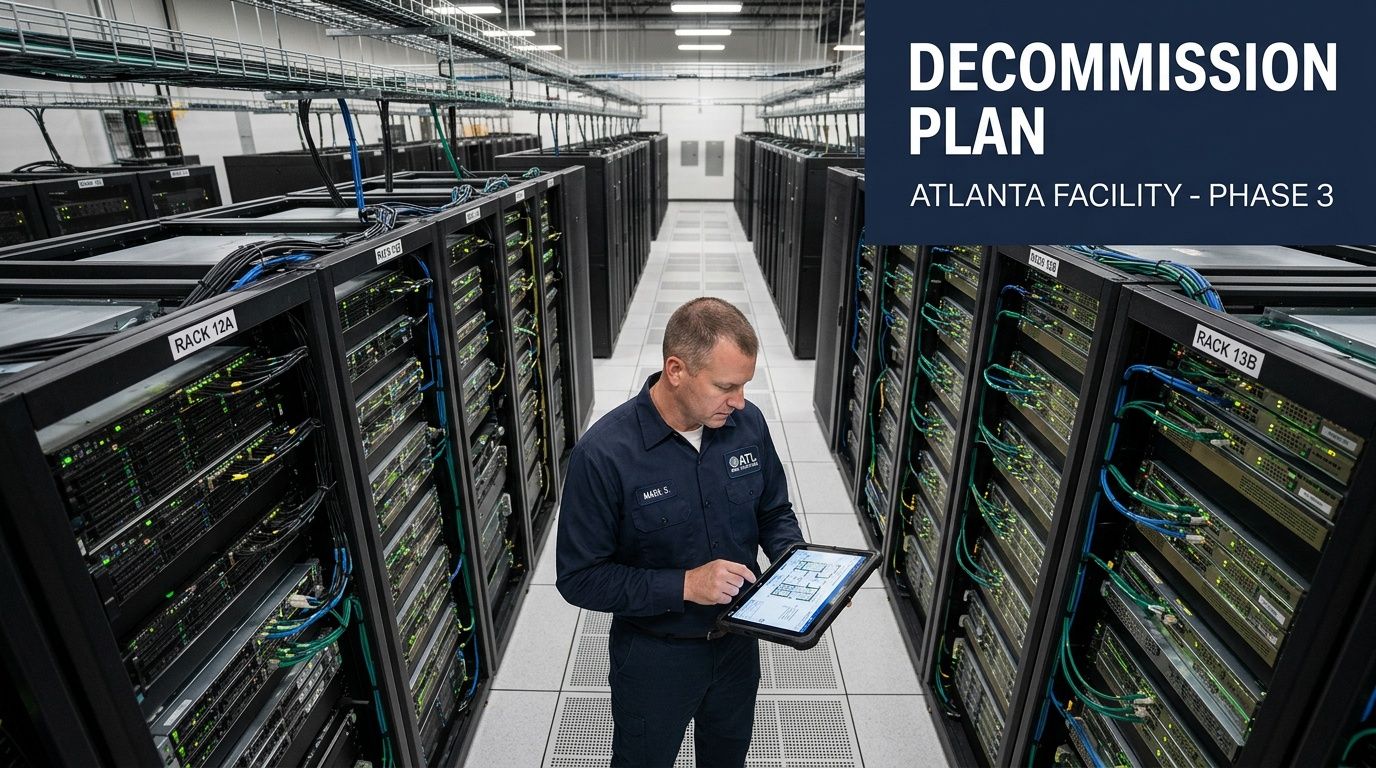
A usable inventory does more than count boxes. It tells you what can move, what can’t move yet, and what must never leave custody without documented sanitization. I recommend separating assets into operational groups instead of treating all retired servers as one pool.
A practical inventory often includes these categories:
Active but scheduled for migration
These assets stay in place until application owners sign off. Removing them early creates downtime risk, not recycling efficiency.Retired and data-bearing
This category gets the highest control. Drives, storage shelves, hyperconverged nodes, and appliances all need a defined sanitization path.Retired and non-data-bearing
Racks, PDUs, rails, cabling, blanking panels, and some supporting hardware move on a different workflow.Likely resale candidates
Newer equipment with usable CPUs, RAM, and power supplies may justify testing and controlled remarketing.Destroy-only assets
Failed media, damaged units, unsupported equipment, or anything covered by stricter internal policy goes straight to destruction.
Set priorities that match business risk
Teams often talk past one another. Security may want physical destruction for everything. Finance may push for value recovery. Facilities may care most about speed and floor access. None of those views are wrong. They’re incomplete on their own.
Use a short decision framework:
| Decision area | What to define early |
|---|---|
| Data security | Which media gets wiped, which gets shredded, who approves exceptions |
| Value recovery | Which asset classes are eligible for testing and resale |
| Timeline | Night work, maintenance windows, freight elevator access, dock scheduling |
| Documentation | Required reports, serial capture, destruction records, audit package format |
If you wait until removal day to settle the security-versus-recovery question, you usually lose both. Drives get over-destroyed, reusable hardware gets scrapped, and paperwork gets messy.
Wiping versus shredding isn’t a philosophical debate
Managers often ask whether software wiping is “enough.” The answer depends on the asset, the compliance posture, and whether the hardware is intended for reuse.
Data wiping supports reuse. It’s appropriate when the drive is functional, the sanitization process is validated, and your policy allows the device to remain in circulation after erasure. It preserves downstream value.
Physical destruction removes reuse from the equation. It makes sense for failed drives, highly sensitive environments, or organizations that want the simplest possible answer during audit.
The mistake is using one method for every asset because it feels easier. It usually isn’t. You either destroy value unnecessarily or leave yourself with a policy exception that nobody documented well.
Put the right internal people in the room
The best planning meetings aren’t large. They are cross-functional.
Bring in:
- IT operations to confirm migration status and equipment dependencies
- Information security to define sanitization requirements
- Facilities or data center operations to manage access, lifts, docks, and timing
- Finance or asset management to review recovery priorities
- Compliance or legal when regulated data is involved
If your team needs a process benchmark, this overview of the data center decommissioning process is a useful way to align internal expectations before vendor walk-throughs begin.
Achieving Bulletproof Data Security and Regulatory Compliance
A retired server is still a liability until you can prove otherwise. In practice, that means a server’s journey from rack to final disposition needs to be controlled, documented, and matched to the right destruction method. The hardware itself is only half the story. The bigger risk is usually the data nobody realized was still there.

Atlanta Computer Recycling’s guidance on server decommissioning gets the sequence right. Certified data destruction is a multi-phase process. Data has to be migrated first. Then trained technicians perform onsite de-installation. After that, destruction methods meeting DoD 5220.22-M standards are applied, and regulated organizations should work with an ITAD specialist providing R2 V3, ISO, and NAID certifications.
What a controlled chain looks like
A well-run project in metro Atlanta usually starts inside the white space, not at the truck. Technicians verify the approved asset list, check cabinet positions, and match serials before equipment is removed. Data-bearing devices are separated from non-data-bearing gear as early as possible.
From there, each checkpoint matters:
Migration confirmation
Application owners or infrastructure leads confirm the workload has moved and the asset is ready for retirement.Onsite de-installation
Technicians de-rack equipment with proper lifts and pack-out procedures so nothing gets damaged or mislabeled during removal.Serial capture and custody logging
Every drive, chassis, or appliance that falls under the destruction scope needs to be traceable.Transport under documented custody
This step should preserve the same asset identity established in the facility.Final sanitization or destruction
The chosen method must match the media type and policy requirement.Audit package generation
Certificates are important, but they aren’t enough on their own. The underlying logs need to match them.
When each destruction method fits
Not every media type should follow the same path. The right decision is situational.
| Method | Best fit | Trade-off |
|---|---|---|
| Data wiping | Functional drives intended for reuse | Requires validated process and clean documentation |
| Degaussing | Magnetic media where reuse isn’t needed | Limited to applicable media types |
| Physical shredding | Failed drives, highly sensitive media, strict destruction policies | Eliminates resale and reuse value |
A lot of confusion comes from mixing legal comfort with technical need. Some teams feel safer shredding everything. That can be reasonable. But if you’re retiring large volumes of still-functional enterprise drives and newer compute gear, blanket destruction can erase legitimate recovery options without improving your actual controls.
Residual risk usually hides in the exceptions. The forgotten boot drive, the appliance nobody tagged correctly, the storage shelf assumed to be empty. That’s why documented process matters more than bold language in a vendor proposal.
Compliance is about evidence, not promises
Healthcare organizations, financial institutions, government agencies, and education systems often need more than a generic “destroyed” statement. They need records that stand up under internal audit and third-party review. That means chain-of-custody logs, serialized reporting, and certificates tied to actual assets.
Ask direct questions:
- Who performs de-installation?
- Are technicians trained specifically on data-bearing equipment?
- How is chain of custody documented from rack to facility?
- Which certifications back the process?
- Can the provider separate wipe-for-reuse assets from shred-only media in one project?
For teams reviewing local requirements, this guide to secure data destruction services in Atlanta is a useful reference point for framing vendor questions in business terms.
A data center manager shouldn’t have to “trust the process” in the abstract. You should be able to inspect it, map it, and prove it after the fact.
Navigating Onsite Removal and Secure Logistics in Metro Atlanta
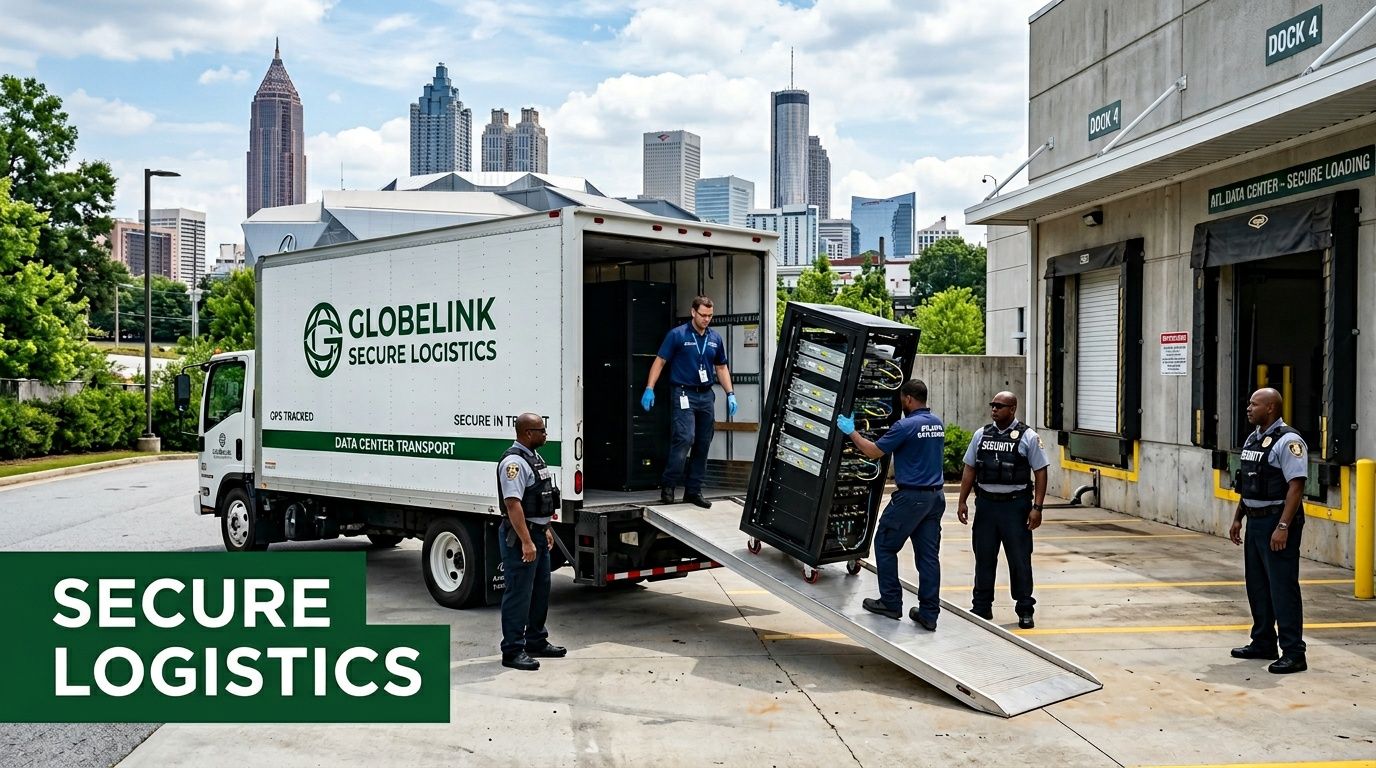
The physical move is where many otherwise solid plans start to fray. A server can be perfectly approved for retirement and still create risk if the onsite removal is rushed, the dock handoff is sloppy, or the transport chain changes hands too many times. In metro Atlanta, those issues get amplified by access restrictions, traffic patterns, and the practical realities of moving equipment from busy facilities spread across suburbs and urban cores.
Cheap freight is usually expensive later
Choosing an ITAD partner on price alone often means accepting more handoffs, thinner documentation, and less control over who touches the equipment. That’s not a savings if a serial number disappears from the record or a mixed pallet forces a compliance exception.
For data-bearing assets, I prefer direct-control logistics for three reasons:
- Personnel accountability because the same provider manages removal and transport
- Custody continuity so there’s no gap between rack removal and facility receipt
- Operational coordination with teams that understand dock protocols, access lists, and after-hours work
Third-party freight can work for some commodity shipments. It’s a poor fit for mixed loads of servers, drives, switches, rails, and accessories coming out of a secured environment.
Middle-mile thinking matters in decommissioning
A lot of managers focus on first touch and final destruction. The vulnerable stretch is often in between. The logistics world calls that the middle mile, the movement between points in the supply chain where timing, transfers, and visibility matter most. If you want a useful primer on that concept, Peak Transport offers practical insights on middle mile from Peak Transport that translate well to IT asset moves.
For data center decommissioning, middle-mile discipline means:
- Planned routing instead of ad hoc pickups
- Asset segregation so data-bearing gear never gets buried in general scrap handling
- Tight scheduling around loading dock windows and building security
- Proof of receipt that closes the loop quickly after departure
A missing chain-of-custody event usually doesn’t happen during destruction. It happens during movement.
Why ESG and certifications belong in the logistics decision
It’s easy to treat logistics as a separate procurement line item. That’s a mistake. The way assets are removed and transported affects your compliance exposure and your ESG credibility. If your sustainability report says hardware was responsibly recycled, but your logistics chain is opaque, the claim weakens.
That’s why I’d rather see a manager choose a provider with audited certifications, direct pickup capability, and documented downstream handling than save money with a loosely connected vendor stack. In practical terms, that often produces fewer internal headaches and cleaner reporting.
For facilities evaluating removal access, dock flow, and staging constraints, this resource on commercial loading dock requirements and pickup coordination is worth reviewing before scheduling the job.
In Atlanta, physical control is part of data security. Treat it that way.
How to Select the Right Atlanta ITAD Partner for Your ESG Goals
A vendor can remove retired servers. A real ITAD partner helps you decide what should be wiped, what should be harvested for parts, what should be remarketed, and what should be destroyed with airtight records. That difference matters more when your organization also wants the project to count toward ESG and CSR commitments.

One of the better ways to judge a provider is to listen to how they talk about retired hardware. If every asset is described as “junk,” you’re probably not dealing with a mature circular-economy operator. Ecycle Atlanta’s discussion of server equipment recycling and disposal makes an important distinction. Professional server recycling goes beyond simple destruction. Trained technicians disassemble systems to recover components like CPUs, RAM, and motherboards for secondary markets, and they assess reusability before defaulting to recycling.
The first questions I’d ask in a vendor meeting
A strong ITAD conversation gets specific quickly. Ask for process details, not brand statements.
Try questions like these:
- How do you decide whether a server is reused, harvested for components, or destroyed
- Can you show sample chain-of-custody documentation
- Which certifications back your destruction and recycling workflows
- How do you report serialized assets after pickup
- What happens to infrastructure gear such as racks, switches, UPS accessories, and cabling
- How do you support ESG reporting beyond a recycling certificate
The last question often separates serious partners from generic recyclers.
Watch for greenwashing in social impact claims
Many companies now attach mission language to recycling. Some of it is genuine. Some of it is marketing wallpaper. The easiest way to tell the difference is to ask what proof exists.
If a provider says your project supports veterans or reforestation, ask for:
| What to verify | What a credible answer looks like |
|---|---|
| Nonprofit relationships | Named partner organizations and a defined program model |
| Reporting format | Impact certificates, project summaries, or CSR-ready documentation |
| Timing | When impact reports are issued after processing |
| Scope | Whether impact is tied to actual completed recycling activity |
| Brand use | Rules for using badges or claims in sustainability reports |
A cause-based model can be valuable. It gives your HR, ESG, and communications teams a concrete story to tell. But it needs documentation or it won’t survive internal scrutiny.
If a partner can document the path of a hard drive but not the path of its claimed community impact, treat the ESG pitch as incomplete.
The local factor still matters
For Atlanta organizations, local presence isn’t just convenience. It affects scheduling, onsite labor quality, response time, and the feasibility of the logistics plan. A provider that regularly handles metro-area pickups will usually ask better questions about freight elevators, security escorts, dock access, and phased removal windows.
This is also where one regional option may fit. Atlanta Green Recycling provides business IT asset disposition services that include secure data destruction, server recycling, onsite de-installation, packing, and fleet-based pickup for organizations across the metro area. For teams comparing regional providers, this list of Atlanta-area IT asset disposition companies and evaluation factors can help structure the shortlist.
The right partner should reduce your risk, preserve recoverable value where policy allows, and give you credible material for sustainability reporting. If they can’t do all three, keep looking.
Recycling That Restores Your Tech Turns into Trees and Transformation
Most data center managers don’t struggle to understand secure destruction. They struggle to connect a decommissioning project to something broader than compliance. That’s where a mission-driven recycling model becomes useful. It turns an operational necessity into a documented ESG action that employees, executives, and outside stakeholders can understand.

There’s a real reporting gap here. Data Center Knowledge’s coverage of Atlanta water recycling and local resource concerns notes that while facilities can consume millions of gallons of water daily, there’s still little hard local data showing the quantifiable environmental benefit of server recycling. That gap creates an opening for impact programs that track outcomes people can understand, such as trees planted or veterans supported.
How a cause-based ITAD model works in practice
The strongest version of this model is simple. Your company retires hardware through a secure, documented process. After processing is complete, you receive not just destruction and recycling records, but also an impact report tied to a defined social and environmental program.
That can include:
- Veteran support reporting tied to an established assistance initiative
- Reforestation certificates for internal CSR files or public sustainability updates
- A digital recognition badge such as “Recycled with Purpose” for use on a website or ESG page
- Campaign-ready language for Earth Day, Arbor Day, or Veterans Day communications
The business value is practical. Sustainability teams get reporting material. HR gets a story employees can rally around. Communications teams get a credible local angle. Procurement still gets the compliance package it needs.
Questions decision-makers usually ask
Here are the high-level questions that come up most often after a leadership review.
Can this replace secure ITAD requirements?
No. The cause-based element should sit on top of secure, auditable disposition. It doesn’t replace chain of custody, destruction records, or compliance controls.
Does social impact belong in a data center decommissioning project?
Yes, if it’s documented and tied to real processing activity. It turns a required operational event into something your company can use for ESG and CSR reporting.
Will employees care?
Usually, yes. Internal teams respond better to “retired hardware supported veterans and reforestation” than to “assets were disposed per policy.”
A realistic internal rollout
A mid-sized Atlanta technology company doesn’t need a big public campaign to make this work. It can start with a controlled internal project:
- Select a qualified ITAD provider with documented impact programs
- Define what your company wants to report internally and externally
- Request post-project materials that work for audit and CSR files
- Share the outcome with employees using plain language
- Repeat the model for future refresh cycles
This works especially well when paired with seasonal campaigns. Veterans Day and Earth Day are natural moments to show that retired enterprise tech can serve a second purpose beyond simple disposal.
The best ESG stories in IT aren’t invented by marketing teams. They come from operational decisions that were documented well enough to be shared confidently.
Frequently Asked Questions About Server Recycling in Atlanta
Is server recycling the same as scrap removal
No. Server Recycling for Data Centers Atlanta GA should include asset tracking, data sanitization decisions, secure de-installation, transport under chain of custody, and final reporting. Scrap hauling only addresses physical removal.
Should every drive be physically shredded
Not always. If a drive is functional and policy allows reuse after validated sanitization, wiping may be the better path. If the media is failed, highly sensitive, or covered by stricter internal rules, physical destruction is often the cleaner choice.
What should be on my internal project checklist
Focus on the basics first:
- Current asset inventory
- Migration signoff
- Security policy for wipe versus shred
- Dock and access planning
- Required audit documentation
- Decision on reuse, resale, or destruction
Can retired servers still have value
Yes. In many projects, value recovery comes from reusable systems or harvested components rather than whole-unit resale. That’s why granular asset evaluation matters.
What documentation should I expect after the job
Ask for records that match your policy and industry requirements. That may include serialized asset reports, chain-of-custody documentation, certificates of destruction, and recycling documentation. If ESG reporting matters to your organization, request separate impact reporting as well.
Why use a local Atlanta ITAD partner
Local providers usually handle scheduling, building access, and metro-area logistics more smoothly than distant vendors coordinating through third parties. That often leads to tighter custody control and less disruption onsite.
If you’re planning a server refresh, cage cleanup, or full facility shutdown, Atlanta Green Recycling can help you scope the project, document chain of custody, coordinate secure pickup, and align end-of-life IT decisions with both compliance requirements and ESG reporting needs.