
Top Electronics Recycling Pickup for Businesses Atlanta GA


Old computers pile up in Atlanta offices. A few laptops sit in a storage closet after a hardware refresh. Retired servers stay in a back room because nobody wants to guess what’s still on the drives. Monitors collect dust near the loading dock while facilities, IT, compliance, and finance all wait for someone else to own the problem.
That delay creates two risks at once. One is operational. You lose space, slow down moves, and keep obsolete assets around longer than you should. The other is bigger. Electronic waste keeps rising while recycling systems struggle to keep up. Globally, e-waste reached 62 million tonnes in 2022 and is projected to rise to 82 million tonnes by 2030, while only 22.3% was properly collected and recycled, according to this Atlanta e-waste pickup overview.
For organizations looking for Electronics Recycling Pickup for Businesses Atlanta GA, the job isn’t just “get rid of stuff.” It’s secure retirement of IT assets, workable logistics, clean documentation, and a process that fits your CSR and ESG goals instead of sitting outside them.
Recycling That Restores Lives and Landscapes
Most business recycling vendors lead with trucks, pallets, and service areas. That matters, but it misses the larger opportunity. When a company recycles old tech, it can do more than clear a room and avoid improper disposal. It can turn a routine facilities task into a visible act of community support.
That’s the idea behind a cause-based approach to electronics recycling. A retired laptop, a stack of desktops, or an old server rack can support two outcomes at once. First, it helps keep recoverable materials in circulation and keeps hazardous components out of the wrong waste stream. Second, it can be tied to a social mission that employees, customers, and leadership remember.

Why mission matters in B2B recycling
A standard recycling transaction is easy to forget. A mission-linked one isn’t. “Recycle for a Cause” works because it gives office managers and IT teams language they can use internally. Instead of saying, “We disposed of obsolete hardware,” they can say, “We used a recycling program that supports veterans and reforestation.”
That changes how a pickup is perceived inside a company.
- For HR and internal comms: it becomes an employee engagement story.
- For sustainability teams: it supports ESG reporting with a social angle, not just a waste diversion angle.
- For leadership: it turns a back-office task into a brand-aligned action.
- For facilities and IT: it gives a practical disposal project broader support across departments.
A lot of companies want that kind of alignment, but they don’t want a complicated process. They want one pickup request to solve multiple needs.
Your old tech doesn’t have to end as a compliance chore. It can become part of a program your team is proud to talk about.
The local relevance for Atlanta businesses
In the U.S., annual e-waste generation exceeds 3.5 million tons, and only 15-20% is typically recycled, according to this Atlanta-focused recycling reference. For Atlanta businesses, that turns local pickup into something more important than convenience. It’s one of the few practical ways to move bulk equipment out of offices, schools, hospitals, and data environments without pushing the burden onto employees or landfill-bound disposal streams.
The mission side matters even more when a company wants visible local impact. A cause-based recycling campaign can be built into:
- Veterans Day drives tied to office cleanouts
- Earth Day campaigns connected to internal sustainability goals
- Arbor Day initiatives that make reforestation part of a tech refresh
- School and municipal partnerships that combine collection with community messaging
That’s why mission-driven recycling works better than generic “green” language. It gives people something concrete to rally around. “Your old tech can house a veteran and grow a forest” is more memorable than “responsible disposal services available.”
What works and what doesn’t
What works is simple. Keep the message close to the action. If your business is retiring assets, make the social value part of the pickup itself, not an afterthought buried in a PDF.
What doesn’t work is vague positioning. If a recycler says it supports sustainability but gives you nothing usable for communications, leadership, or employee engagement, the story stops at the loading dock.
A stronger model includes clear post-pickup materials, seasonal campaigns, and visible proof that recycling can support real outcomes beyond disposal. That’s also why local education matters. Businesses searching for options often start with broad terms and then narrow by trust, process, and impact. A practical starting point is this page on recycling in Atlanta, which helps frame what responsible local recycling should look like.
A better lens for evaluating providers
Before you schedule a pickup, ask one question that most buyers skip. After the truck leaves, what value is left for your business besides a cleared room?
If the answer is only “the equipment is gone,” that’s a weak program.
If the answer includes cleaner compliance, easier reporting, stronger internal storytelling, and support for veterans and reforestation, the pickup becomes part of a larger business case. That’s where Electronics Recycling Pickup for Businesses Atlanta GA stops being a disposal line item and starts becoming a useful CSR asset.
Preparing Your Atlanta Business for E-Waste Pickup
A pickup goes well when your team answers three questions before the truck arrives. What is leaving the building, which items hold data, and where can the crew access everything without disrupting operations.
That preparation matters more than perfect paperwork. In Atlanta offices, schools, clinics, and warehouses, the delays I see most often come from scattered equipment, unclear ownership, and building access that was never confirmed with facilities or property management.
Start with a usable internal inventory
Build a working list, not a forensic audit. Focus on the assets that affect handling, security, and labor. That usually means desktops, laptops, servers, monitors, switches, phones, printers, storage devices, and any specialized electronics your business has retired.
A useful inventory should answer five practical questions:
- What device categories are included
- Which items store data
- Which items still need de-installation
- Where the equipment sits today
- Whether your team can consolidate it before pickup
If equipment is spread across departments, ask each team lead to confirm what is retired and approved for release. That small step prevents a common pickup-day problem. Someone realizes a laptop in the pile still belongs to an active employee, or a rack unit was supposed to stay online until after a cutover.
Practical rule: separate data-bearing devices from general electronics before you schedule the job. It saves time and keeps chain-of-custody decisions clear.
Accepted items for business pickup
Most commercial pickups include the same core categories, but how you prepare them affects speed and cost. Loose peripherals dumped into bins take longer to verify than boxed, labeled material. Racked servers take more planning than tower PCs sitting in a storage room.
| Category | Accepted Items | Special Notes |
|---|---|---|
| Computers | Desktop PCs, laptops, workstations | Tag devices that still need data destruction |
| Servers and storage | Rack servers, tower servers, storage arrays, hard drives | Note whether equipment is loose, racked, or still connected |
| Displays | Flat panel monitors | Stage carefully to avoid breakage during handling |
| Networking | Switches, routers, firewalls, telecom gear | Group accessories with parent equipment when possible |
| Office electronics | Printers, scanners, docking stations, keyboards, mice | Smaller peripherals should be boxed or palletized |
| Enterprise IT surplus | Mixed corporate IT assets from office cleanouts | Best prepared by department or floor for faster verification |
| Specialized business electronics | Lab equipment, medical monitors, industrial control electronics | Confirm handling requirements in advance if the equipment is sensitive or oversized |
Free pickup is often tied to commercial volume, but providers set those thresholds differently. The practical move is to describe your load by item count, pallet count, and building conditions when you request service. That gives you a faster yes or no than asking for “free pickup” in the abstract.
How to stage equipment so pickup goes faster
Choose one staging area if your building allows it. Ground-floor access near a dock, freight entrance, or receiving area usually cuts labor time and reduces disruption for your staff.
A strong staging plan is simple:
- Use one collection zone: loading dock, warehouse corner, mailroom, or another approved access point.
- Group by device type: servers together, monitors together, loose drives in secured containers.
- Keep traffic paths open: avoid blocking exits, shipping lanes, or active receiving space.
- Mark exceptions clearly: identify anything that needs wiping, shredding, serial tracking, or special handling.
If your site has freight elevators, limited dock windows, or security check-in requirements, review those details before scheduling. This guide to loading dock pickup coordination is useful for planning access, timing, and staging around the building’s real constraints.
Good staging also creates a better paper trail. Your facilities team knows where the material came from, your IT team can verify what left, and your recycler can process the load without stopping every few minutes to sort mixed equipment.
What usually causes delays
Delays usually come from preventable issues, not complicated recycling rules.
- Assets are still spread out across offices, closets, labs, or multiple floors.
- No one owns the handoff on pickup day.
- Data-bearing devices are mixed in with low-risk peripherals and scrap.
- Building access is unresolved with security, facilities, or the property manager.
- Equipment is still installed and nobody planned for disconnects.
Atlanta Green Recycling helps businesses avoid these slowdowns by setting expectations early, especially for larger office cleanouts and multi-department pickups. That matters if you want the project to do more than clear space. A well-run pickup gives you cleaner internal reporting, fewer chain-of-custody gaps, and a better foundation for the veteran support and reforestation outcomes your company may want to include in ESG or CSR reporting.
Preparation does not need to be complicated. It needs to be accurate enough to keep the day controlled, secure, and efficient.
Ensuring Data Security and Onsite Project Support
For most businesses, the central question isn’t whether old electronics can be recycled. It’s whether they can be removed without exposing customer data, employee records, financial information, or internal intellectual property.
That concern is justified. A retired laptop isn’t harmless just because it no longer boots. A failed server drive can still hold regulated data. A copier hard drive can be as sensitive as a file server if the machine handled scanned records.

What secure data destruction should include
A business pickup process needs more than “we recycle electronics.” It should include a clear method for handling data-bearing assets from the moment your team releases them.
Common layers include:
- Device identification: laptops, desktops, servers, storage arrays, and loose media are flagged before removal.
- Controlled collection: equipment is moved under documented handling procedures rather than mixed into general scrap flow.
- Data sanitization: suitable devices can be wiped to DoD 5220.22-M sanitization standards when that path fits the asset.
- Physical destruction: obsolete or damaged drives and media can be shredded when wiping isn’t appropriate.
Those options matter because not every device should be treated the same way. If a drive is nonfunctional, heavily damaged, or part of a stricter internal policy, shredding is often the cleaner answer. If an organization has reuse or remarketing goals for certain assets, wiping may be the better route.
Regulated industries need process, not slogans
Healthcare, finance, education, and government teams usually ask the right first question: what happens to the data?
That’s where process matters more than marketing. HIPAA-sensitive devices should move through a chain that supports secure collection and documented destruction. The same goes for organizations that need to align asset disposition with internal legal, audit, or privacy requirements such as SOX or GDPR-driven policies.
A practical workflow usually includes:
- Scope review before pickup
- Identification of data-bearing categories
- Separation of wipe candidates and shred candidates
- Onsite handling by trained personnel
- Final documentation for records and audits
One option businesses use for this type of project is Atlanta Green Recycling, which provides secure business electronics recycling, DoD-standard wiping, physical shredding, and onsite project support for de-installation and decommissioning work.
If your recycler can’t explain the difference between wiping a working drive and shredding a failed one, keep looking.
Onsite support for real-world cleanouts
Security isn’t only about what happens to the media. It’s also about how equipment leaves the building. In office closures, hospital upgrades, lab refreshes, and data center work, old hardware is often still mounted, cabled, stacked, or locked inside secured rooms.
That’s why onsite project support matters. Good teams don’t just show up for curbside collection. They can assist with de-installation, packing, device segregation, and managed removal from office suites, server rooms, and technical spaces.
This is especially important when:
- A data center is being decommissioned
- A tenant improvement project requires fast room clearance
- A hospital or clinic is replacing regulated equipment
- A school district is collecting devices from multiple departments
- An office move requires removal on a narrow schedule
For companies that need destruction performed with stronger visibility, it also helps to review onsite shredding options near Atlanta. That kind of service can reduce uncertainty when drives, backup media, or other sensitive storage devices can’t leave the site without direct control.
The rule is simple. If your business cares about privacy, compliance, or reputational risk, treat e-waste pickup as a data security project first and a recycling project second.
Scheduling Your Pickup and Navigating Logistics
Pickup scheduling sounds simple until it encounters challenges like freight elevators, tenant access windows, dock reservations, and mixed equipment volumes. That’s where many Atlanta businesses discover the difference between a recycler that can take material and one that can manage a business pickup well.
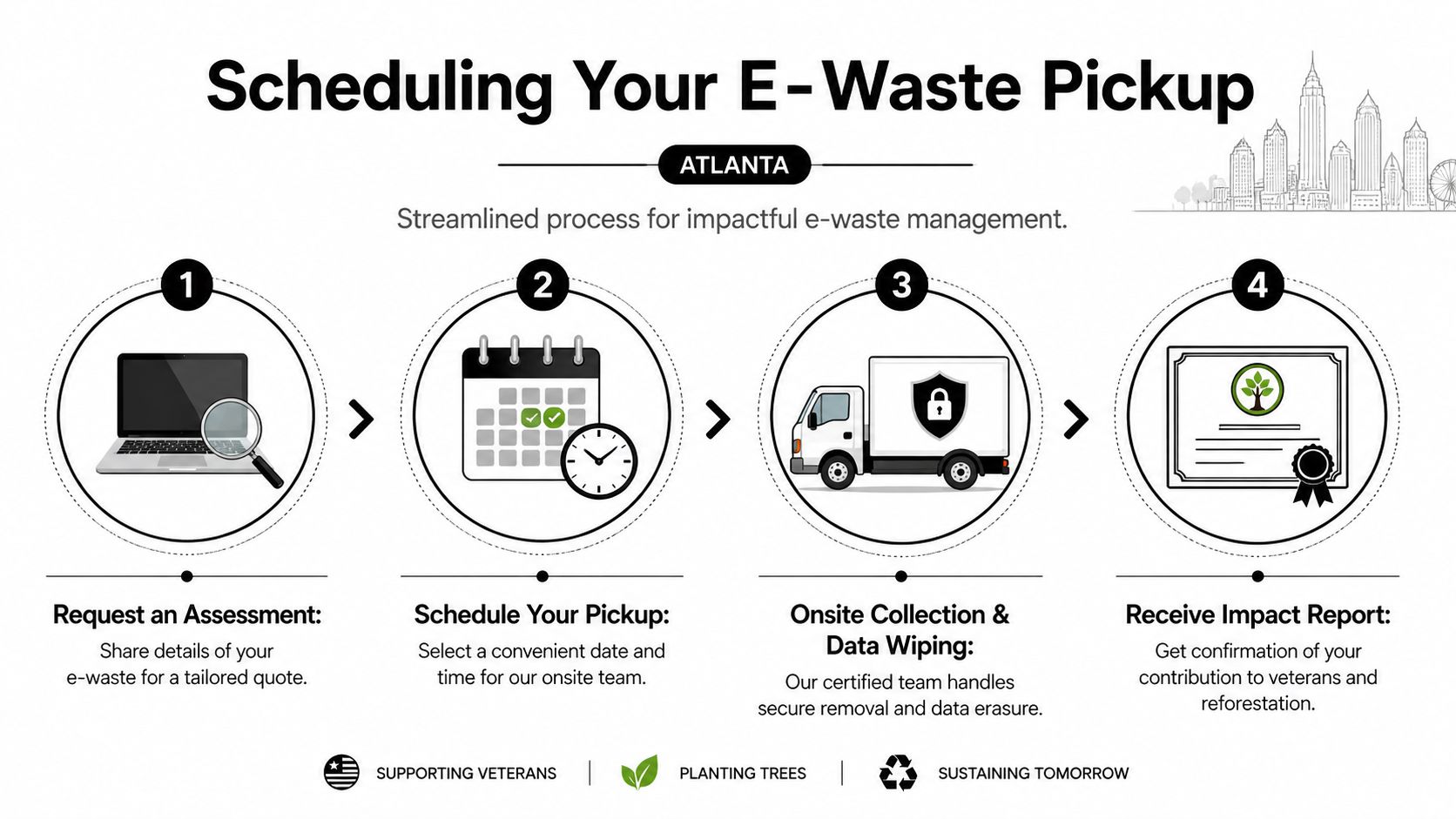
The first step is always scoping. A provider needs to know what you have, where it sits, whether any of it stores data, and how it can be accessed. That short assessment usually determines whether the job qualifies for free pickup, needs palletization, or should be grouped into a larger cleanout.
What the pickup flow usually looks like
Most business collections follow a straightforward path:
- Assessment request with a list or photos of equipment
- Logistics review covering access, dock conditions, and any handling needs
- Pickup scheduling for a date your team can support
- Collection and secure processing for devices and media
- Documentation after service for records and reporting
That looks basic on paper, but the quality of execution matters. If your office is in a high-rise, your dock may need a scheduled slot. If you’re clearing a branch office, building management may require a certificate of insurance. If you’re moving server gear, your recycler may need exact dimensions, rack status, and elevator constraints in advance.
Operations teams that want a broader view of transport planning often find this guide for logistics managers helpful because it explains how carrier coordination and site readiness affect service reliability.
Free pickup thresholds and the small-volume problem
In Atlanta, many providers reserve free pickups for larger jobs. Common thresholds include 10-20 major IT items or a full pallet, as described in this local electronics recycling overview. That works for a major office cleanout, but it leaves smaller organizations in a bind.
That gap is bigger than many people realize. The same Atlanta-focused source notes that 42% of Atlanta SMBs generate fewer than 10 devices quarterly, which explains why many smaller offices, schools, and branch locations struggle to find practical pickup options through standard volume rules.
That’s why flexible logistics matter. A rigid threshold model works for one-time large removals. It works poorly for recurring small batches, multi-site collection, or businesses that want scheduled, lower-volume pickups instead of waiting until a closet overflows.
What works better in practice
A more workable model usually includes some combination of these options:
- Bundled pickups: combine multiple departments, branches, or dates into one service event.
- Micro-collection planning: stage smaller volumes for periodic collection rather than emergency cleanouts.
- Site-specific routing: align pickups with loading dock access, business hours, and building restrictions.
- Reverse logistics support: manage retired assets as part of a broader move, refresh, or decommissioning project.
If your operation spans multiple sites or includes recurring technology turnover, it helps to think in reverse logistics terms rather than one-off junk removal. This overview of reverse logistics companies and recovery planning is a useful reference point for that approach.
Small-volume electronics don’t become easier to manage by waiting. They just become less organized.
On pickup day, the best outcomes come from simple preparation. Have one site contact available. Keep assets staged where they were promised. Separate anything that needs special data handling. Once those basics are in place, the logistics become manageable, even in busy Atlanta commercial buildings.
Leveraging Your Recycling for CSR and ESG Wins
A finance lead signs off on an electronics pickup to clear storage and close out retired assets. A month later, the same project shows up in an ESG update, an employee newsletter, and a supplier review packet. That only happens when the recycler gives your team documentation that is usable beyond a basic haul-away receipt.
Responsible electronics recycling carries real weight because the waste stream is still growing and proper recovery rates remain too low, as noted earlier in this article. For Atlanta businesses, that creates a practical opening. A required disposition project can also support your company’s environmental goals, community commitments, and public reporting if the output is organized the right way.
The records your internal teams will actually use
Business managers often ask for a receipt. Legal, IT, procurement, HR, and sustainability teams usually need a fuller record set.
The useful package after pickup often includes:
- Service confirmation and chain-of-custody records for operations, facilities, and compliance files
- Certificates of Data Destruction for IT and security teams managing data-bearing assets
- Environmental and social impact summaries for ESG and CSR reporting
- Clear reuse language and visual assets for communications teams that need approved messaging fast
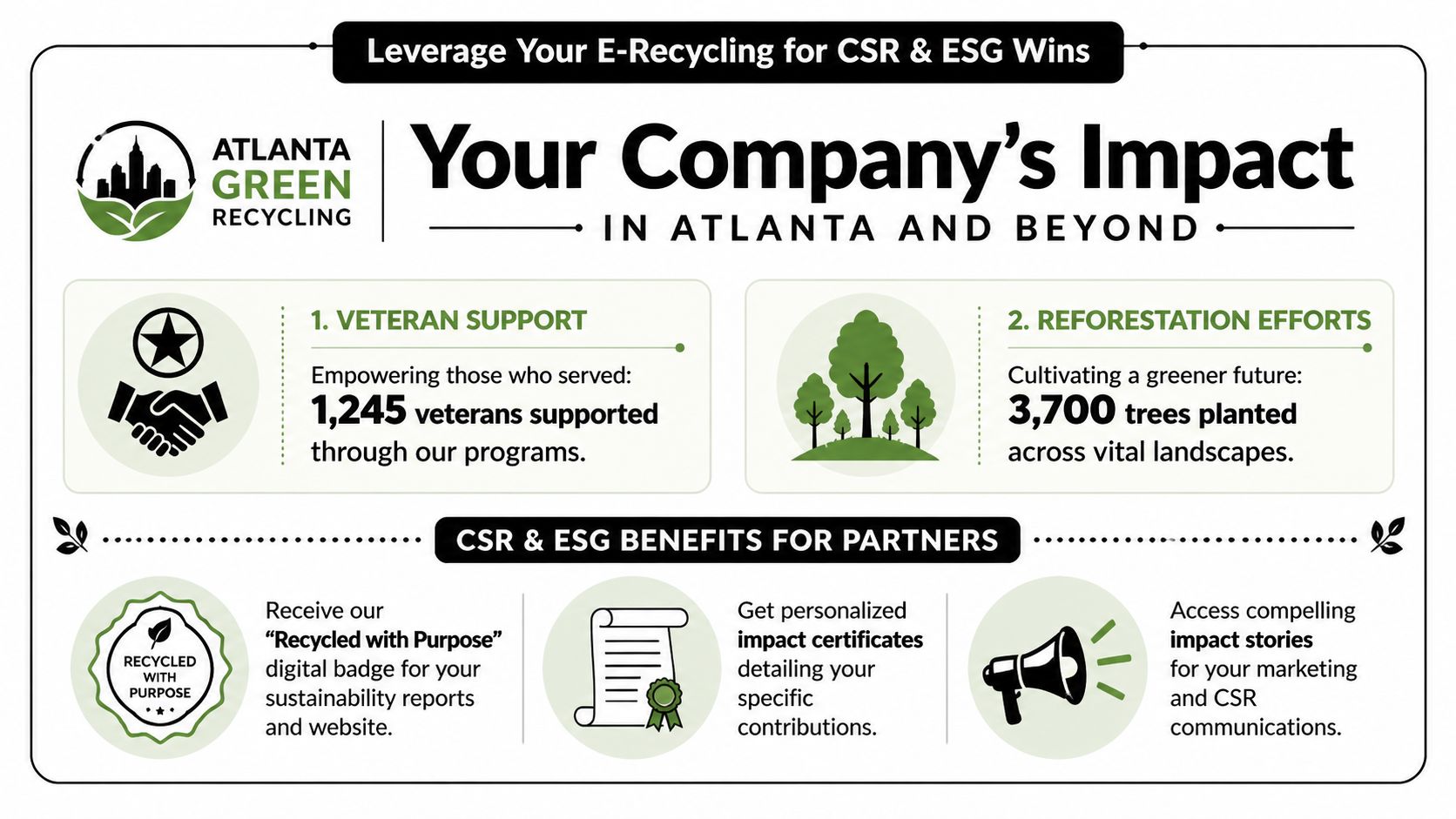
At Atlanta Green Recycling, the social side matters as much as the recycling side. Veteran support reporting, tree-planting documentation, and a Recycled with Purpose badge give companies something specific to show. That is a stronger position than a generic claim that old equipment was disposed of responsibly.
How one pickup can support several business goals
A well-documented recycling event can serve multiple functions without creating extra work for every department:
| Business function | Practical value from recycling documentation |
|---|---|
| Sustainability reporting | Records responsible end-of-life handling for retired equipment |
| CSR communications | Connects asset retirement to veteran support and reforestation |
| Employee engagement | Gives staff a visible example of company values in action |
| Procurement and vendor review | Shows documented disposition practices during audits or renewals |
| Sales and partnerships | Supports trust with customers who ask about security and environmental practices |
The dual-impact model matters here. Standard recycling paperwork usually covers environmental handling. It does not always give a business credible social-impact material. When the recycling process also funds veteran support and reforestation, one operational task can contribute to two parts of your ESG story.
Leadership teams respond well to that because it reduces program sprawl. One approved process can help with facility cleanup, data disposition records, sustainability reporting, and community impact. That is easier to repeat each quarter than running separate initiatives for each goal.
A few formats tend to get used right away:
- Digital badges for supplier pages, careers pages, or sustainability sections
- Impact certificates for annual reports and board materials
- Short summaries for LinkedIn posts, recruiting content, and internal updates
- Seasonal campaign assets tied to Veterans Day, Earth Day, or Arbor Day
Recycling budgets are easier to defend when several departments can point to a direct benefit.
If your company is building a repeatable process instead of treating each pickup as a one-off event, review these corporate e-waste solutions for Atlanta businesses. The companies that get the most from Electronics Recycling Pickup for Businesses Atlanta GA treat the pickup as the start of a documented ESG and CSR asset, not the end of a disposal task.
Common Questions About Business E-Waste Pickups in Atlanta
A common Atlanta scenario looks like this. Facilities has a stack of retired monitors, IT has a cart of laptops waiting on sign-off, and nobody wants obsolete equipment sitting in a closet for another quarter. These are the questions business managers usually ask when they want pickup handled correctly the first time.
What counts as enough equipment for a business pickup
For most Atlanta pickups, the deciding factor is the number of primary devices, not the pile of cables around them. Desktops, laptops, servers, network gear, and business-grade printers usually carry the load count. A practical rule is that a qualifying volume often fills a standard 40×48 inch pallet, even if the equipment mix is uneven.
Loose keyboards, mice, cords, and small accessories are usually accepted with a larger load. They rarely justify a dedicated trip by themselves.
What if we are below the usual pickup minimum
Bundle the job instead of waiting for storage to become a problem. We often advise companies to combine one office cleanout with a nearby branch, a scheduled IT refresh, or a quarter-end purge of stored assets.
That approach saves labor and truck time. It also gives your team one documented event instead of several small disposal decisions spread across the year.
Do medical or healthcare devices need a different process
Often, yes. The main issue is not the device category by itself. It is whether the equipment may hold protected information, licensed software, or embedded storage that staff overlooked.
Infusion pumps, imaging peripherals, nurse station PCs, label printers, and multifunction copiers can all raise different handling questions. Flag those items before pickup so chain-of-custody, data destruction, and downstream processing match your compliance requirements.
Is data wiping enough, or should drives be physically destroyed
Use the method that fits the asset’s next step. If a device is suitable for reuse and your policy allows sanitization, wiping can preserve value and keep more equipment in productive use. If a drive is failed, encrypted with no recovery path, or tied to a stricter internal standard, physical destruction is usually the cleaner choice.
The trade-off is simple. Wiping supports reuse. Shredding reduces residual risk.
Do we need to move everything to the loading dock first
No, but access details change the scope. A pickup from a ground-floor staging area is different from removing equipment from cubicles, locked storage rooms, IDF closets, or an upper-floor server room.
Send photos if the layout is complicated. That helps the recycler assign the right crew, carts, packing supplies, and truck capacity before arrival.
Can multi-site companies schedule pickups under one program
Yes, and that is usually the better way to run it. A single process gives procurement, facilities, and IT one approval path, one reporting standard, and fewer one-off exceptions between offices.
For Atlanta companies with several locations, central coordination also makes the social-impact side easier to document. One recycling program can support veteran assistance and reforestation while giving leadership a cleaner record of how retired equipment was handled across the business.
What should we do internally before requesting pickup
Keep the prep focused:
- Count the primary assets
- Separate confirmed data-bearing devices
- Note stairs, elevators, dock access, and restricted areas
- Assign one onsite contact for pickup day
- Take a few photos if the load is mixed or spread out
That short checklist prevents the usual delays.
What paperwork should we ask for after pickup
Ask for documentation that matches your risk level and reporting needs. Many businesses want a pickup record, asset summary, and data destruction confirmation where applicable. Regulated organizations may also want chain-of-custody details by device group or by location.
If your sustainability or CSR team will use the project later, request impact documentation at the same time. It is easier to capture that once than reconstruct it after the equipment is gone.
How can this support our CSR or ESG goals without sounding forced
Tie the pickup to work the company already has to do. Retired electronics still need secure handling, documented disposition, and responsible recycling. When that same process also supports veterans and reforestation, the project contributes to environmental reporting and community impact without creating a separate initiative for staff to manage.
That makes the story more credible. It started as an operational need and produced measurable social and environmental value.
If your team is planning an office cleanout, IT refresh, medical equipment retirement, or data center project, Atlanta Green Recycling is a practical place to start. You can review service options, confirm accepted business equipment, and plan a pickup process that addresses secure handling, site logistics, and post-pickup reporting in one workflow.