
Corporate Guide to Recycling in Atlanta


Is that pile of obsolete laptops and servers in the back room starting to look like a mountain? For a lot of Atlanta businesses, old tech is a huge, growing headache. But what if all that e-waste could be a strategic asset instead of just a liability? When done right, recycling in Atlanta goes way beyond a simple compliance checkbox and becomes a serious power play for your business. It's about turning e-waste into hope.
Why Smart E-Waste Recycling in Atlanta Is a Business Win
Let's get past the usual talk about saving the planet for a second. While that's incredibly important, a well-thought-out electronics recycling program delivers real, tangible benefits that hit your bottom line, boost your brand, and reinforce your company’s mission. It's about flipping a logistical nightmare—all that outdated equipment—into a powerful story about security, responsibility, and making a real impact right here in our community.
For any company in the Atlanta area, this is about more than just clearing out a storage closet. It's about heading off some major risks. Every single retired hard drive, server, and company phone is packed with sensitive data. Disposing of them the wrong way is a direct threat, leaving your organization wide open to data breaches that can result in crippling financial penalties and do permanent damage to your reputation.
Protect Your Data and Your Reputation
Working with a professional e-waste recycling partner means you get certified data destruction. This ensures every bit of information is permanently and securely wiped clean according to the toughest standards. That documented process is your proof that you did your due diligence, protecting you from compliance fines and legal headaches down the road. Honestly, it's just essential digital hygiene for your business, protecting not just your company, but your customers and employees, too.
But beyond just managing risk, a smart recycling program becomes a powerful tool for your marketing and ESG (Environmental, Social, and Governance) goals. Let's face it, today's customers and business partners are actively looking to work with companies that show a real commitment to corporate social responsibility (CSR).
By partnering with a mission-driven recycler, you can turn your e-waste into tangible support for community causes. Imagine promoting that “Your old tech can house a veteran and grow a forest.” This isn't just recycling; it's recycling that restores lives and landscapes.
Turn Compliance into a Compelling Story
This approach gives you a narrative that truly connects with your audience. You can feature this dual impact—environmental care and social good—in your marketing campaigns, annual reports, and all over social media. It sets your brand apart in a crowded market, proving that your company's values are baked into every part of your operation.
This dual-impact model offers a clear return on your investment. The positive PR you get from community engagement and cause-based marketing can be far more valuable than what you’d spend on traditional ads. And for businesses trying to hit sustainability goals, it's a straightforward, verifiable win.
You can learn more about putting this into action by exploring the ways e-waste recycling is profitable for your business. Think of this guide as your playbook for turning a necessary chore into a strategic advantage that strengthens your brand and deepens your connection with the Atlanta community.
Setting Up Your In-House E-Waste Program
Let's be honest, that pile of old electronics in the storage closet isn't going to sort itself out. But transforming that e-waste chaos into a smooth, effective process is much easier than it looks. Building a corporate electronics recycling program isn't about adding a huge new workload; it's about creating simple, repeatable steps that become second nature.
This isn't about occasional, frantic cleanups. It's about building a sustainable, ongoing practice.
The best place to start? Figure out what you're actually dealing with. A quick e-waste audit doesn't have to be some formal, complicated affair. Just get a handle on your retired electronic assets—old servers, forgotten laptops, company mobile phones, monitors, and networking gear. Knowing what you have is the first real step.
Laying the Groundwork for Success
Once you have a rough inventory, you need to create a little structure. First up, assign a program champion. This person doesn't need a new title on their business card. They just need to be the go-to person who understands the process and can point employees in the right direction. Their job is to keep the program visible and keep the momentum going.
With a champion in place, you can get physical. Designate simple, well-marked collection points. These could be large, clearly labeled bins in the IT department, a specific corner of a supply room, or a dedicated spot in your warehouse. The goal is to make it incredibly easy for people to do the right thing.
The most effective in-house programs are built on clarity, not complexity. If employees have to guess where to put an old keyboard or what to do with a retired laptop, the program will stall. Make the right choice the easiest choice.
This infographic breaks down the major wins of a well-structured recycling program, from locking down your data to boosting your brand's reputation in the community.
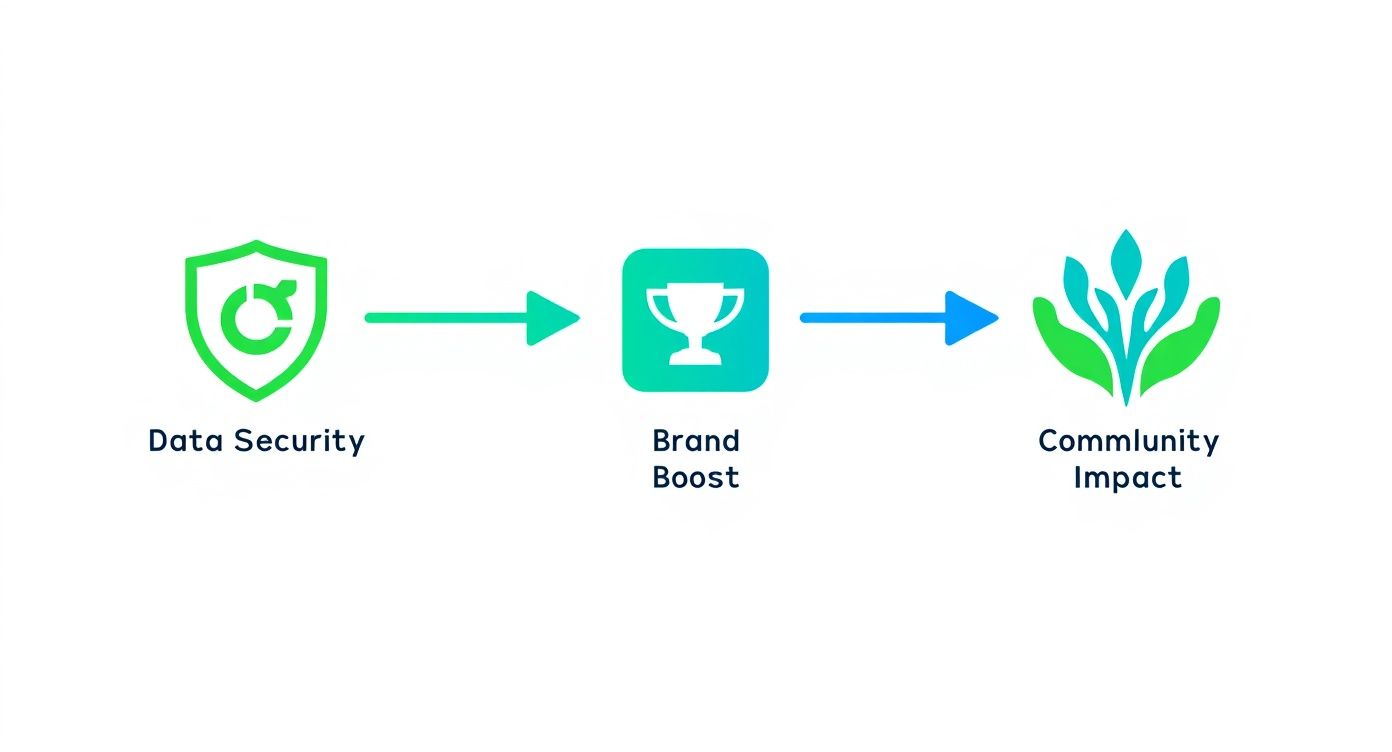
You can see how a single act of responsible recycling creates a ripple effect of positive outcomes for any Atlanta business.
Building a Team and Defining Responsibilities
To keep your program from fizzling out, it really helps to define who handles what. A successful program for recycling in Atlanta depends on clear roles so tasks don't fall through the cracks. This simple structure builds accountability and keeps everything moving efficiently, from the first old monitor being dropped off to the final pickup.
Here’s a clear breakdown of who does what to keep your corporate e-waste program running smoothly.
Key Roles for a Successful In-House Recycling Program
| Role or Team | Primary Responsibility | Example Tasks |
|---|---|---|
| Program Champion | Oversees the program's operations and acts as the main point of contact. | Educating staff on procedures, coordinating with the recycling partner, and tracking program metrics. |
| IT Department | Manages the secure decommissioning of assets and prepares them for recycling. | Wiping hard drives, cataloging devices for inventory, and moving equipment to collection points. |
| Facilities Management | Handles the physical logistics of collection areas and schedules pickups. | Ensuring collection bins are accessible and not overflowing, and coordinating with the recycling provider for pickup logistics. |
| Marketing/Comms | Promotes the program internally and shares its successes externally. | Sending out informational emails, creating signage, and highlighting impact metrics in company newsletters or ESG reports. |
Having these roles defined, even informally, makes a world of difference.
Communicating the Program to Your Team
Your final foundational piece is communication. You need to create clear, jargon-free instructions that tell your team exactly what to do with their old electronics. This could be a simple one-page PDF, a quick section in the employee handbook, or a few posters near the collection bins.
Make sure your communication covers:
- What to recycle: Be specific. List the types of e-waste you accept.
- Where to take it: Clearly identify the location of your collection points.
- Who to ask: Provide the name and contact info for your program champion.
- Why it matters: Briefly connect their actions to the big picture—data security, environmental responsibility, and community support.
By taking these practical steps, you build a solid framework for managing your e-waste responsibly. For more detailed guidance, check out our guide on establishing a successful office e-waste recycling program in Atlanta. A little bit of planning upfront can turn a chaotic problem into a major organizational win.
Finding The Right E-Waste Partner In Atlanta
Picking an e-waste recycler in Atlanta isn't just about finding someone to haul away old equipment. It’s about finding a genuine partner—one who shields your business from massive risks while helping you tell a powerful, positive story. This decision goes far beyond simple logistics and straight into the territory of data security, environmental compliance, and your company's reputation.
Let's face it, your old hardware is a goldmine of sensitive data. The right partner gets this and puts data security at the absolute top of their list. But the best partners do more; they turn a compliance task into a mission that perfectly aligns with your own company's values.
The Non-Negotiables: Certifications and Security
Before you even think about a recycler's mission, you have to verify their credentials. This is ground zero for a safe and responsible partnership. Skimp on this, and you're opening your business up to serious legal, financial, and reputational harm.
You're looking for key industry certifications that prove a vendor is held to the highest possible standards. The two you absolutely need to see are:
- R2 (Responsible Recycling): This certification is a clear sign that a facility follows a strict hierarchy of responsible management strategies for used and end-of-life electronics.
- e-Stewards: Built specifically to stop hazardous e-waste from being dumped in developing countries, this standard also guarantees secure and complete data destruction.
A partner holding these certifications has proven their commitment to both the planet and your data security. When you’re vetting potential recyclers, always ask for their certification numbers and check them yourself. This isn't just due diligence; it's essential for understanding third-party risk management when you're entrusting them with your company's digital past.
The single most important document you will get from your e-waste partner is a Certificate of Data Destruction. This isn't just a piece of paper. It's your legal proof that every bit of sensitive data was professionally and permanently wiped clean, protecting you from breaches and compliance nightmares down the road.
Beyond Compliance: Finding A Mission-Aligned Partner
Once you've confirmed a recycler meets the baseline security and environmental standards, you can start looking for what really makes them stand out: a shared mission. This is where a simple operational task becomes a strategic advantage for your brand.
Imagine being able to tell your customers and employees that your old company laptops helped plant a new forest. Or that they provided critical support for local veterans. That's the power of mission-driven recycling.
Atlanta itself has been making real progress. Since 2017, the city’s municipal recycling rate doubled to 23% by 2022. While that’s still a bit below the national average, it shows a growing local commitment to sustainability. It’s the perfect backdrop for businesses to step up and lead by example with mission-focused recycling in Atlanta.
A Practical Checklist For Vetting Atlanta Recyclers
To find the perfect fit, you have to ask the right questions. This checklist will help you identify a partner who not only protects you but also strengthens your ESG and CSR programs. Targeting keywords like “electronics recycling for veterans,” “Atlanta tech recycling,” and “corporate sustainability electronics disposal” can help you find partners focused on a dual mission.
Key Questions to Ask Potential E-Waste Partners:
- Certifications: Can you provide your R2 and/or e-Stewards certification numbers so we can verify them?
- Data Destruction: What’s your standard process for data destruction? Does it follow NIST 800-88 guidelines? And will we get a formal Certificate of Data Destruction for our records?
- Logistics: Do you offer free pickups for corporate recycling drives of 50+ devices? What’s your process for handling de-installation and packing on-site?
- Impact Reporting: Can you provide documentation we can use for our ESG reports, like Plant-A-Tree certificates or Veteran Support Impact Reports?
- Chain of Custody: How do you track our assets? Can you give us a clear chain of custody from the moment you pick them up to their final disposition?
- Mission Alignment: What is your company's bigger mission? Do you offer things like an eco-badge certification we can use to showcase our partnership?
A partner who can answer these questions with confidence and transparency is one you can build a relationship with. They'll operate as an extension of your team, dedicated to protecting your interests while helping you hit your sustainability targets. To get a better idea of what to look for, you can review the details of our certified electronic waste recycling services.
Making the right choice here means you're not just getting rid of old tech—you're safeguarding your data, staying compliant, and turning your e-waste into a story of positive change.
You’ve done the hard work—you've audited your assets and picked the right partner. Now for the really satisfying part: turning all that operational effort into a tangible ESG and marketing win.
A well-run electronics recycling program is more than just responsible disposal; it’s a powerful story about corporate responsibility. It’s time to tell that story.
From Paperwork to a Compelling ESG Story
The documentation you get from a mission-driven partner isn't just paper for a filing cabinet. Think Plant-A-Tree certificates or Veteran Support Impact Reports. These are the building blocks of a narrative that will resonate with investors, customers, and even your own team.
These impact reports are gold for your annual sustainability reports, your website's CSR page, and investor updates. Instead of a vague statement about recycling, you can now use concrete, powerful metrics with live impact counters showing stats like "1,245 veterans supported" and "3,700 trees planted."
"This year, our retired IT assets helped plant 3,700 trees" lands with much more impact than, "We recycled our computers."
This is how you show a clear return on investment that goes way beyond simply clearing out old equipment. To dig deeper into the business case, you can explore more about how sustainable electronics recycling benefits your business. The real key is to translate your actions into measurable outcomes that strengthen your brand.
Kickstart a Cause-Based Marketing Campaign
One of the most powerful ways to get the word out is through cause-based marketing campaigns. These initiatives link the simple, practical act of recycling with real, emotional outcomes that people connect with. This is how you generate positive PR and build genuine brand affinity.
A “Recycle for a Cause” campaign can be incredibly effective. Go with messaging that gets straight to the point: “Your old tech can house a veteran and grow a forest.” That kind of emotional connection is memorable and easy for people to share.
This approach works because it reframes a routine business process as a community-driven action. You’re not just managing e-waste; you’re joining a larger movement of restoration and support. That’s a story worth telling.
Seasonal drives are another fantastic way to create a buzz. Align your recycling events with holidays that fit your mission to get the most PR mileage and engagement:
- Earth Day & Arbor Day: This is the perfect time to focus on the environmental side of your program. You could offer businesses free pickups for 50+ devices and promote the collective number of trees you'll plant together.
- Veterans Day: Here, you can shift the spotlight to the social impact. Try partnering with a local VFW post or a veteran support organization to host a joint recycling event.
Build Social Proof and Forge Corporate Partnerships
To make your ESG efforts more visible, create a digital “Recycled with Purpose” badge. It's a simple graphic that you and your corporate partners can feature on their websites and in sustainability reports, offering immediate social proof of your commitment.
This is especially effective when you're building B2B relationships. You can position your program as an easy ESG win for other Atlanta companies. Offer them a turnkey solution: they recycle their devices with you and, in return, get the documentation they need for their own CSR reporting.
Publish a few case studies on LinkedIn showing how other local businesses have used your joint efforts to hit their sustainability goals. This creates a network effect, amplifying your positive impact across the city. Run social proof ads featuring impact stories: “Your company can turn e-waste into forests.”
Engage the Community and Amplify Your Impact
A truly successful sustainability program can't just live inside your office walls. The real magic happens when you take it out into the community, building goodwill and making your positive impact something everyone can see and be a part of.
Taking your electronics recycling initiative public is how you turn a smart internal policy into a powerful story about corporate citizenship. This is how you build genuine brand credibility and stake your claim as a real leader in the Atlanta community. It creates a ripple effect, showing employees, customers, and partners that your company values are about action, not just words.
Forge Powerful Community Partnerships
One of the best ways I've seen to get the community involved is by joining forces with local organizations that are already on the same page. These partnerships make it incredibly easy for residents to participate and, frankly, they generate powerful, feel-good stories.
Think about these kinds of collaborations:
- Veteran & Environmental Groups: Picture this: you co-host a community e-waste drive with a local VFW chapter or an Atlanta-based environmental NGO. Suddenly, the event has double the appeal, attracting people who want to support veterans and those who are passionate about sustainability.
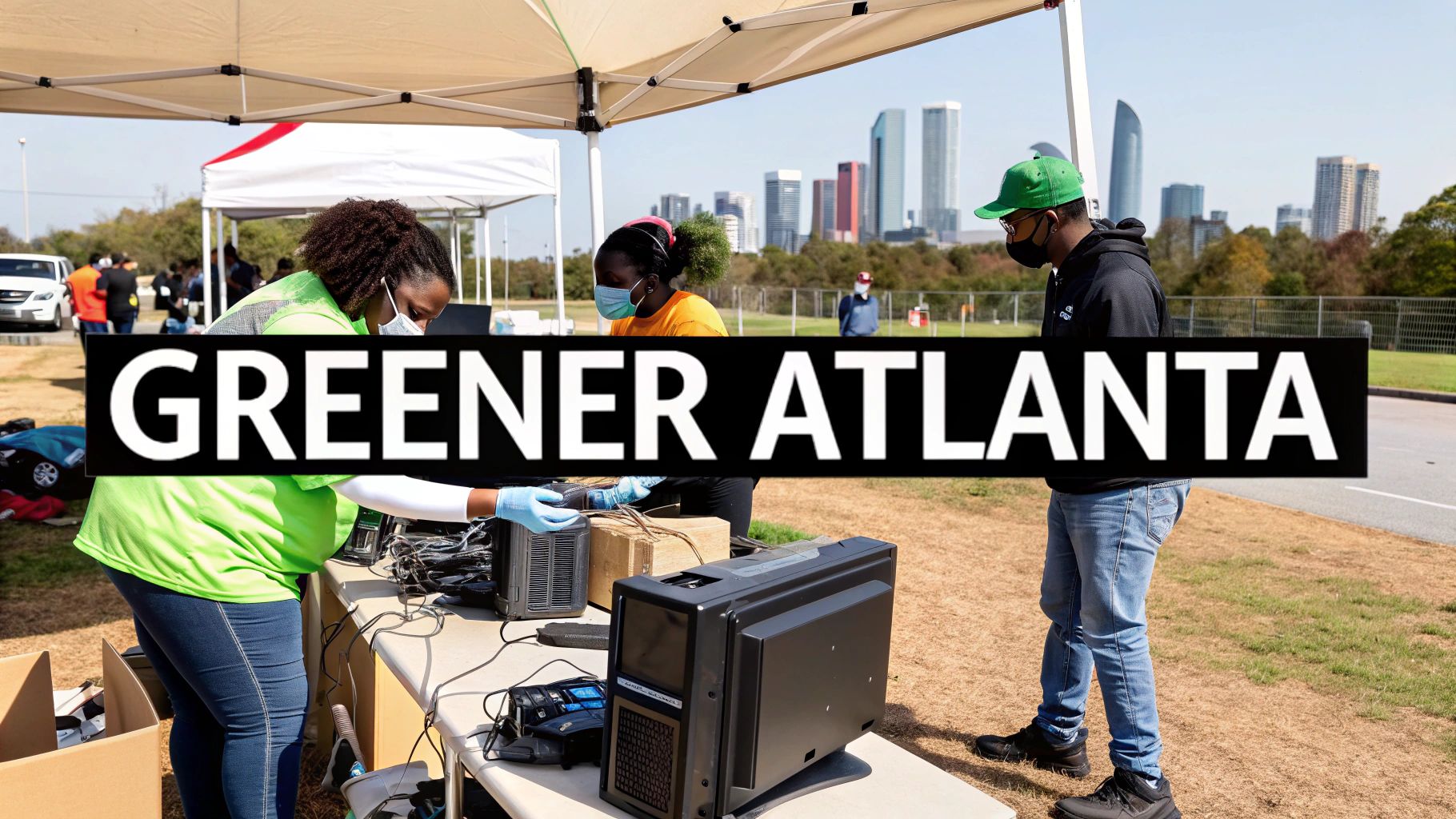
- City & School Collaborations: Why not partner with local schools or even universities like Georgia Tech or Emory for a “Greener Atlanta” initiative? These events are perfect for collecting old devices from students and faculty while educating the next generation of leaders.
This community-first model for recycling in Atlanta builds grassroots support and forges authentic connections. On a practical level, it's also a smart way to manage the logistics of a large-scale collection event by sharing the load.
Turn Your Initiative into a Positive News Story
Don't forget that your community efforts are newsworthy. Local media outlets are always on the lookout for positive stories about businesses making a real difference. Pitching your dual-impact model—supporting veterans while helping the environment—to the local press is a no-brainer.
A well-placed story in the Atlanta Journal-Constitution or a feature on a popular local sustainability blog can do more for your brand than a traditional ad ever could. It’s third-party validation that positions your company as a proactive community leader.
When you make your pitch, focus on the people. Share short video stories about the veterans you've helped or USDA reforestation footage from your donations. Frame it not just as an event, but as a meaningful contribution to the city. Atlanta has a great history of public initiatives—remember the Cartlanta program in 2013? It led to a 23% jump in residential recycling. Tapping into that civic spirit can make your story that much more compelling.
From One-Time Recyclers to Brand Advocates
Great community engagement doesn't end when the event is over. The key is to nurture the relationships you've just built. You want to turn those one-time participants into long-term advocates for your mission.
It can be simple. After someone donates at a community drive, follow up. An automated email with a personalized impact certificate can work wonders. Tell them exactly what their contribution did (e.g., “Your old laptop helped plant 3 trees and supported 1 veteran”). It’s a small gesture that makes their action feel tangible and leaves a lasting positive impression. A simple referral program that plants an extra tree in their name for referring others can also foster loyalty.
By extending your program into the community, you're doing so much more than just helping people clean up junk. You're building a network of support, elevating your brand's reputation, and creating a legacy of positive change across Atlanta.
Got Questions About Atlanta E-Waste Recycling? We’ve Got Answers.
Even with the best-laid plans, a few questions always pop up. It’s completely normal. We hear the same handful of queries from businesses all the time, so we’ve put together some straightforward answers to clear up any final confusion.
What Kinds of Business Electronics Can We Actually Recycle?
This is usually the first question people ask, and the answer is almost always, "More than you think."
Certified e-waste partners in the Atlanta area are equipped to handle a massive range of corporate tech. Of course, this covers the big stuff like laptops, desktops, servers, and monitors. But it goes way beyond that.
Think about your networking gear, office printers, company cell phones, tablets, and even all those keyboards, mice, and cables. The best move is to simply ask your recycling partner for their list of accepted items. That way, you know everything from the server room to the individual cubicles is covered.
How Do We Actually Prove Our Company Data Was Destroyed?
This is a big one, and you should demand a rock-solid answer. Any legitimate Atlanta e-waste recycler must provide certified data destruction that meets government and industry standards, specifically NIST 800-88.
After the process is complete, they are required to issue you a formal Certificate of Data Destruction.
This isn’t just a piece of paper; it’s your legal proof that every bit of sensitive company, client, and employee information was professionally and irreversibly destroyed. It’s the single most important document you’ll receive, shielding you from any future risk or compliance questions. Don't proceed without a guarantee you'll get one.
Does Our Business Have to Pay for Electronics Recycling?
Honestly, it depends on what and how much you have. For many businesses in the Atlanta metro, the answer is no. Most corporate recyclers offer free pickups if you have a decent amount of equipment—often around 50 items or more. Why? Because the value of the precious metals and components they recover is enough to cover their costs.
Where you might see a small fee is with specialty items. Old CRT monitors, for instance, are bulky and contain hazardous materials like lead that require special handling. This extra work can come with a cost. The best practice is always to get a clear, itemized quote upfront so you know exactly what to expect. No surprises.
How Does This Really Help Our Company ESG Goals?
Properly recycling your old tech isn't just a disposal task; it’s a huge win for your ESG (Environmental, Social, and Governance) goals, hitting all three pillars in a meaningful way. When you think about your recycling in Atlanta this way, its true value becomes clear.
-
(E)nvironmental: This is the most direct benefit. You’re keeping toxic materials out of local landfills and conserving the valuable, finite resources needed to build new electronics. It's a clear, measurable impact.
-
(S)ocial: When you work with a mission-driven recycler, your old tech gets a second life helping others. Your company's retired equipment can be transformed into real support for community initiatives, like programs for veterans or local environmental projects.
-
(G)overnance: Having a formal, documented e-waste policy sends a powerful message. It shows investors, customers, and regulators that your company is serious about data security, compliance, and operating as a responsible corporate citizen.
It turns a simple operational task into a strategic move that strengthens your company's reputation and purpose from every angle.
Ready to turn your company's e-waste into a powerful story of security and community impact? Atlanta Green Recycling offers certified, mission-driven electronics recycling solutions for businesses across the metro area. Let us help you protect your data, meet your ESG goals, and make a tangible difference.