
Expert Professional Computer Recycling Services Atlanta GA


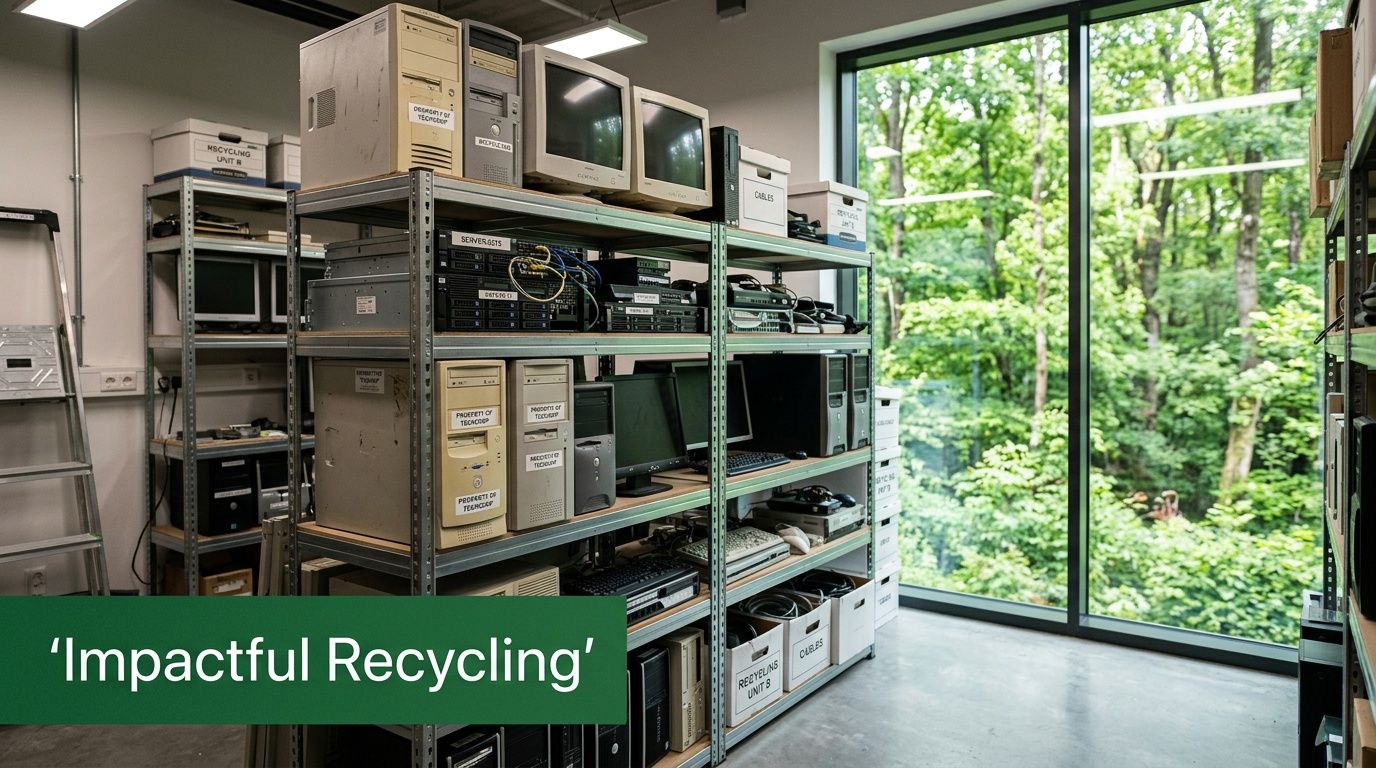
The storage room usually tells the story first. In Atlanta offices, it’s often a locked back room with retired laptops, decommissioned servers, old monitors, and a growing pile of “we’ll deal with that later” equipment that now carries security, compliance, and sustainability risk.
Professional computer recycling isn’t just about clearing space. Done correctly, it turns obsolete technology into documented compliance, recovered value, and a social impact story your company can stand behind.
Your Old Tech Can House a Veteran and Grow a Forest
A common call starts with an office manager who needs a closet emptied before a move, or an IT lead staring at retired devices after a refresh cycle. The equipment still looks useful. That’s what makes old tech deceptively risky. It sits untouched, still holding data, still taking up space, and still waiting for someone to make a disposal decision.
That decision matters more than most companies realize. The U.S. now generates over 7 million tons of e-waste annually, and only 15–20% is properly recycled, which is why certified recyclers play such an important role in commercial markets like Atlanta according to Atlanta computer recycling industry data.
Liability can become visible impact
Most companies start this process because they need secure disposal. The smarter ones also ask what else the process can do for them.
That’s where cause-based recycling changes the conversation. Instead of treating retired equipment as a pure waste stream, businesses can connect responsible recycling to a broader mission. Old tech can support veteran-focused programs, contribute to reforestation efforts, and give leadership teams a practical way to show that sustainability isn’t just a line in an annual report.
Practical rule: If your obsolete devices are still sitting in storage, they’re not neutral. They’re an unmanaged asset and an unmanaged risk.
Why this message resonates in Atlanta
Atlanta is full of fast-moving businesses, healthcare systems, schools, public agencies, and distributed offices. They replace technology constantly. What they need isn’t generic junk hauling. They need a process that respects chain of custody, data security, environmental handling, and the fact that stakeholders now expect a purpose behind operational decisions.
A strong “Recycle for a Cause” message works because it ties a routine facilities task to something human. Your old devices don’t need to disappear unnoticed. They can become part of a measurable story about community support and environmental restoration.
If your team is sorting through a backlog now, this guide on what to do with outdated computers is a practical place to start.
Why Professional Computer Recycling in Atlanta Is Non-Negotiable
A surprising number of businesses still treat e-waste like bulky trash with a few extra steps. That’s usually where mistakes begin. Professional Computer Recycling Services Atlanta GA matter because retired electronics carry three separate obligations at the same time: data protection, regulatory handling, and responsible material disposition.
A desk chair can be tossed with little consequence. A retired laptop, firewall, copier drive, or medical workstation can’t.
What goes wrong with informal disposal
The first failure is usually chain of custody. Equipment leaves one office, gets stacked in a loading area, handed to a general hauler, or dropped into an informal resale path. At that point, nobody can clearly prove who had possession, what happened to the data, or whether the equipment was processed through a compliant downstream channel.
The second failure is assuming deletion equals destruction. It doesn’t. If devices leave your control without verified sanitization or destruction, your organization keeps the risk even after the hardware is gone.
The third failure is environmental. Electronics contain materials that shouldn’t end up in landfill disposal. Companies that care about governance and sustainability need a documented end-of-life process, not a casual cleanup.
For a broader business-level view, this overview of the environmental impact of electronic waste helps frame why disposal decisions belong in corporate operations, not just facilities management.
Risk versus opportunity
There’s a sharp difference between “getting rid of equipment” and managing IT assets professionally.
| Informal disposal | Professional ITAD approach |
|---|---|
| Unclear chain of custody | Device-level tracking and documented handling |
| No defensible proof of sanitization | Verified wiping or shredding with records |
| Mixed environmental outcomes | Responsible recycling and material recovery |
| Missed resale value | Potential value recovery from reusable assets |
| Weak reporting for stakeholders | Documentation that supports audits and ESG reporting |
Professional handling also changes the economics. When remarketable assets are identified early, organizations can recover value instead of paying blindly for removal. That doesn’t happen when equipment is treated as undifferentiated scrap.
Businesses usually regret two things: waiting too long, and handing the job to a vendor that can haul equipment but can’t document what happened to it.
Atlanta companies need more than pickup
In this market, organizations often manage multiple offices, healthcare data, lab gear, school equipment, or data center hardware. They need a recycler that can handle office moves, refresh cycles, lease returns, and decommissions without breaking internal controls.
That’s why professional recycling is essential. It’s not a nice-to-have sustainability service. It’s part of governance, cyber hygiene, and operational risk management.
Our Turnkey IT Recycling and Decommissioning Services
A good decommissioning project starts long before the truck arrives. The primary task is deciding how assets will be identified, removed, sanitized, documented, and routed so the organization does not lose control halfway through the process.
That matters because retired equipment creates several competing priorities at once. IT wants chain of custody. Compliance teams want records they can defend. Finance wants to know whether any devices still hold resale value. Sustainability teams want credible diversion and reuse outcomes they can report. A properly run program brings those priorities into one operating plan instead of treating recycling as a hauling job.
What a full-service program includes
A business-focused IT recycling program usually combines several workstreams:
- Bulk computer and laptop recycling for refresh cycles, office relocations, and storage room clear-outs
- Server and networking equipment removal for racks, switches, firewalls, telecom gear, and related infrastructure
- Onsite de-installation for organizations that need equipment disconnected, staged, and packed without disrupting staff or production areas
- Data center decommissioning where sequencing, site access, labeling, and asset tracking have to stay tight from start to finish
- Secure media handling for hard drives, SSDs, backup tapes, and storage embedded in other devices
The difference is coordination. Teams need to know what is being picked up, what requires serial capture, what can be refurbished, and what has reached end of life. That planning protects auditability, resale potential, and environmental outcomes at the same time.
Equipment commonly included
The recycling stream in a commercial setting usually extends beyond desktops and monitors. It often includes:
- End-user devices such as laptops, desktops, tablets, thin clients, and docking stations
- Infrastructure hardware including servers, storage arrays, UPS units, rack equipment, and networking gear
- Office electronics such as printers, copiers, scanners, phones, and conference room systems
- Specialized business equipment including point-of-sale hardware, industrial electronics, and selected medical-related IT assets
Projects also vary by sector. A school technology refresh has different timing and documentation needs than a hospital equipment replacement or a corporate office consolidation. The disposal outlet may be similar. The controls should not be.
What works during decommissioning
The cleanest projects usually follow a few operating rules.
- Inventory before anything moves. Once equipment starts shifting between rooms, loading docks, and temporary storage areas, record quality drops fast.
- Separate reusable assets from scrap early. That preserves value and avoids destroying hardware that could support reuse, donation, or refurbishment.
- Choose sanitization based on risk and device condition. Functional media may be wiped and remarketed. Damaged or higher-risk media may need physical destruction.
- Schedule labor around business operations. After-hours work, phased removal, or room-by-room pickups often reduce disruption and cut the chance of internal mistakes.
For organizations comparing scopes of work, this overview of IT asset disposition services in Atlanta GA gives a useful starting point.
There is also a broader ESG question underneath the logistics. Equipment that is still usable can support refurbishment and community benefit instead of going straight to commodity recycling. For Atlanta companies, that turns a routine decommission into something more measurable. Less waste sent downstream. More credible reporting. More opportunity to connect IT operations with social impact, including support tied to veterans and reforestation rather than disposal alone.
What doesn’t work
Problems usually come from partial planning. An IT team approves wiping but not removal labor. Facilities schedules pickup but misses serial-number capture. Retired assets sit in a closet for months while departments wait on signoff, which increases the chance of loss, undocumented reuse, or disposal with no reporting trail.
A coordinated workflow is easier to budget, easier to audit, and easier to defend when procurement, compliance, sustainability, and security teams all need answers later.
Achieving Ironclad Data Security and Regulatory Compliance
Data destruction is the point where many recycling programs either become defensible or fall apart. If a recycler can’t explain exactly how data is sanitized, when physical destruction is required, and what documentation you’ll receive, the service may remove equipment but it won’t remove liability.
Professional recyclers use NIST 800-88 aligned wiping and DoD 5220.22-M 3-Pass methods for software sanitization, while physical shredding destroys media for maximum security. Certificates of Data Destruction then create the audit trail organizations rely on for HIPAA, GDPR, and FACTA compliance, as described in GreenTek’s computer recycling compliance overview.
Wiping versus shredding
These methods serve different purposes. Confusing them leads to either unnecessary cost or unnecessary risk.
| Method | Best fit | Main benefit | Main trade-off |
|---|---|---|---|
| Software wiping | Devices suitable for refurbishment or resale | Preserves hardware value | Requires functioning media and documented process |
| Physical shredding | Highly sensitive data environments or failed media | Eliminates recovery possibility | Destroys resale value |
Software wiping makes sense when an organization wants both security and value recovery. If the drive is functional and the sanitization process is verified, the asset can move into resale or reuse channels rather than immediate destruction.
Physical shredding makes sense when policy, sensitivity, or media condition removes any tolerance for residual risk. Healthcare, government, legal, and financial settings often choose shredding for selected assets even when wiping is technically possible.
The right question isn’t “Which method is better?” It’s “Which method matches the device, the data, and the policy requirement?”
Why healthcare and regulated sectors need stricter controls
Hospitals, clinics, insurers, banks, and public agencies don’t just need secure destruction. They need a process they can prove.
That means:
- Chain of custody records that show where devices were, who handled them, and when control changed
- Asset-level documentation tied to serial numbers or other identifiers
- Certificates of Data Destruction that support audit preparation
- Method selection by risk profile, especially for equipment containing protected or regulated information
For healthcare organizations in particular, generic vendor language around “secure recycling” isn’t enough. If the provider can’t explain how a workstation, server drive, imaging console, or retired medical IT device is handled from pickup through destruction, the process isn’t audit-ready.
Witnessed onsite shredding can be particularly important. Some organizations want destruction completed on their premises so compliance teams can observe the event, close the custody loop immediately, and retain direct proof for internal records.
What a defensible workflow looks like
A strong compliance workflow usually includes the following:
- Pre-removal review to identify devices by department, sensitivity, and disposition path
- Controlled pickup and transport so assets don’t move through undocumented hands
- Sanitization or destruction verification using recognized methods
- Post-service reporting that compliance, legal, or audit teams can file and retrieve later
If your team is evaluating methods and documentation standards, this guide to Atlanta secure data destruction services is a useful operational reference.
What companies get wrong
The most common mistake is selecting the cheapest hauling option and assuming data destruction is included. Another is shredding everything by default, which may satisfy security concerns but can erase recoverable value unnecessarily.
The better path is policy-driven. Define what must be shredded, what can be wiped, what records must be retained, and who signs off. When that’s done well, recycling becomes one of the most controlled parts of the entire asset retirement cycle.
Our Seamless Pickup Logistics and Value Recovery Model
The easiest projects to manage are the ones that don’t create extra work for the client. Pickup logistics should feel structured, not improvised. That means scheduling, inventory control, secure transport, and clear final disposition without your team having to supervise every handoff.
The underlying economics matter too. According to Atlanta ITAD value recovery guidance, documented chain of custody and resale channels for newer assets often offset or eliminate disposal costs, which is why many businesses experience zero-cost recycling for standard IT equipment while older items with difficult processing needs may still incur fees.
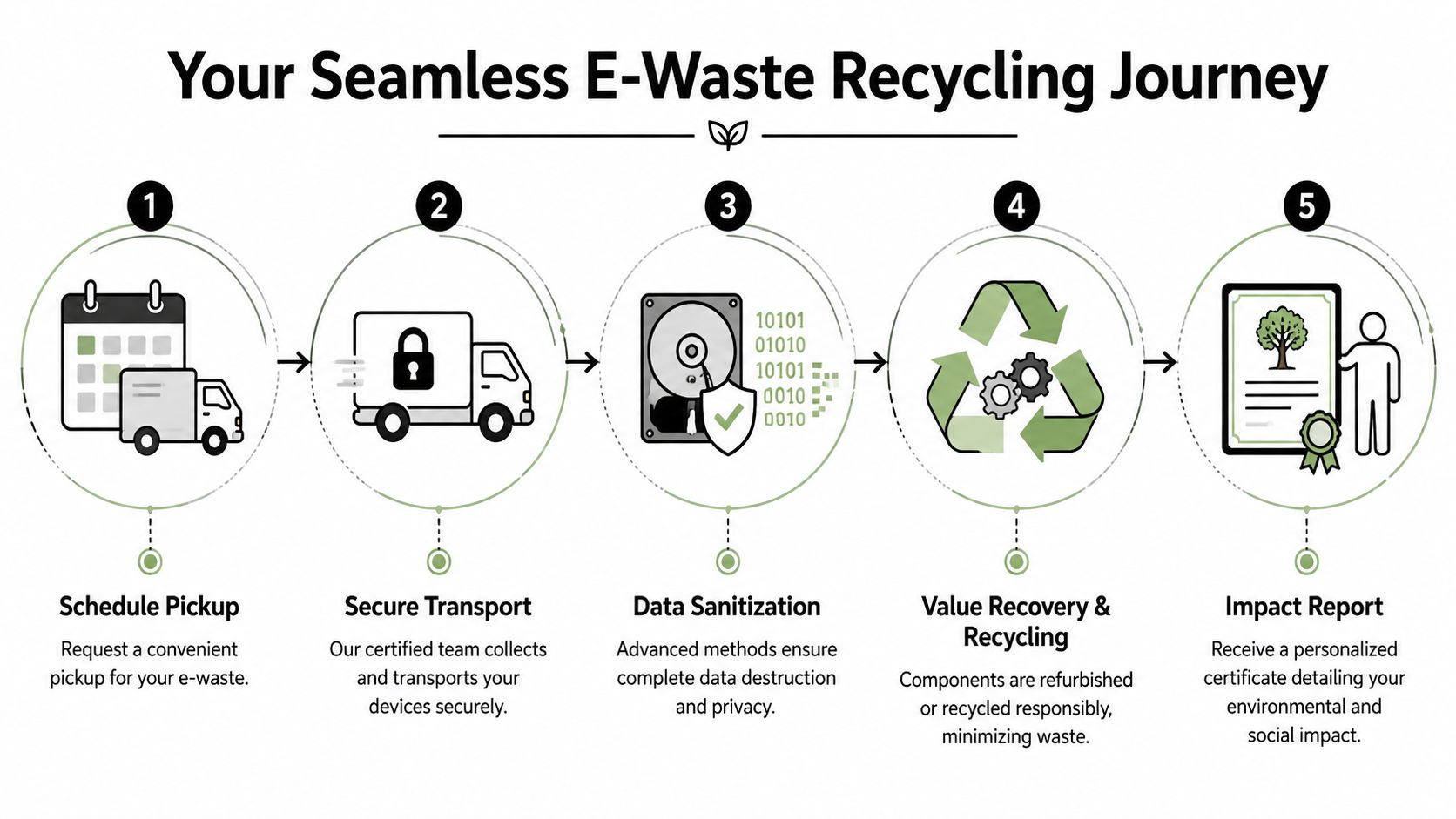
What the pickup process should look like
A reliable workflow is usually straightforward for the client, even if the backend is complex.
Schedule the collection
Pickup windows should align with office operations, loading access, and any security requirements. Multi-floor offices, hospitals, campuses, and data facilities often need more planning than a simple dock appointment.
Create the asset manifest
Devices should be identified before they leave the site. Serial capture and equipment categorization are what make later reporting useful.
Pack and move securely
The equipment needs controlled handling, especially when storage media, rack gear, or fragile equipment are involved.
Transport through a documented chain
Dedicated fleet pickup reduces the uncertainty that comes from handing sensitive assets through multiple intermediaries.
Issue final reporting
That can include destruction records, asset summaries, and impact documentation depending on the project scope.
Why some pickups are free and others aren’t
Transparency matters. Not all electronics have the same downstream value.
- Newer enterprise hardware may retain resale or parts value, especially servers, data center equipment, and current-model business devices.
- Standard office IT equipment often falls into a workable middle ground where recovered material or resale value covers the processing cost.
- Legacy items such as CRT monitors or harder-to-process equipment may require fees because their handling is more specialized and less recoverable.
That doesn’t mean pricing is arbitrary. It means the disposition path drives the cost structure.
If a vendor can’t explain why one category is free and another has a fee, you probably aren’t getting a real ITAD model. You’re getting a haul-away quote.
What clients should expect from reporting
A useful post-pickup package isn’t just a receipt. It should help internal teams close out the project.
Look for documentation that supports:
- Finance with asset retirement records
- IT with device-level disposition visibility
- Compliance with destruction proof where applicable
- Sustainability teams with recycling and impact summaries
For organizations planning a business pickup across the metro area, this page on electronics recycling pickup for businesses in Atlanta GA outlines the operational side well.
Turn Your E-Waste into a Powerful ESG and CSR Narrative
Many companies already know how to recycle equipment responsibly. What they often don’t have is a way to turn that operational activity into a story leadership, procurement, marketing, and sustainability teams can all use.
That gap matters more now. Sixty-eight percent of Fortune 500 firms require vendor ESG data, and reporting from recycling programs is becoming more useful when it connects device disposition to outcomes such as trees planted and veteran support. The same source notes an average 500kg CO2e avoided per server, which gives companies something tangible to discuss in sustainability and disclosure conversations through B2B recycling ESG reporting insights.
What companies need beyond a recycling receipt
A standard recycling receipt closes a disposal task. It doesn’t do much for ESG or CSR reporting.
A more useful model gives businesses materials they can use:
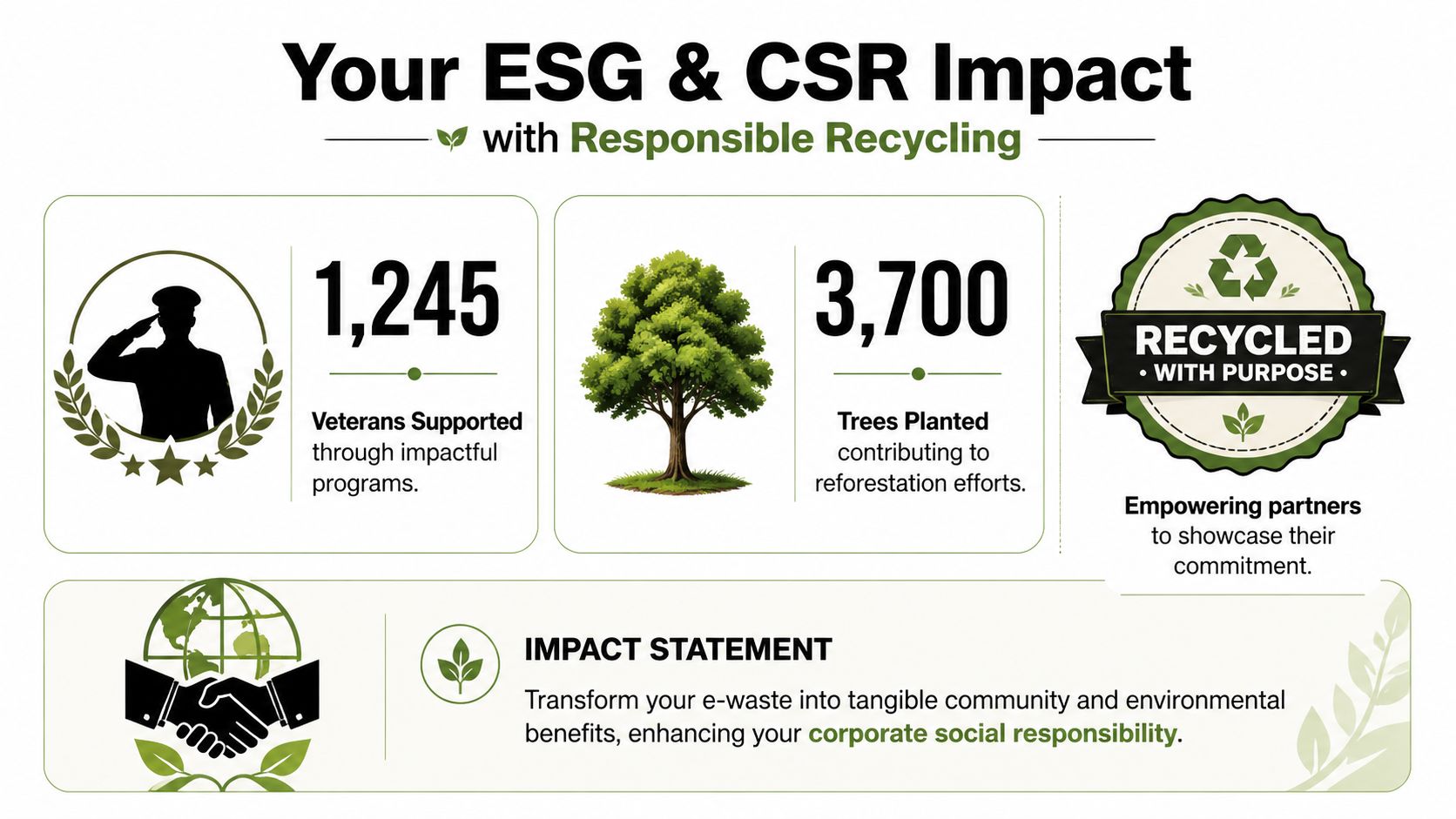
- Plant-A-Tree certificates that tie equipment recycling to reforestation action
- Veteran Support Impact Reports that connect the project to community benefit
- Digital recognition assets such as a “Recycled with Purpose” badge for websites, recruiting materials, or sustainability pages
- Program summaries that procurement and ESG teams can retain for vendor review files
These outputs matter because internal stakeholders ask different questions. Compliance wants proof. Sustainability wants metrics. HR and communications want a story that feels credible and local.
Why the dual mission is strategically useful
There’s a practical reason the veteran-aid-plus-reforestation model works so well. It bridges the “S” and the “E” in ESG without forcing companies to create a separate campaign from scratch.
For an Atlanta business, that can look like this:
| Recycling output | Internal use |
|---|---|
| Data destruction and asset disposition records | Compliance and audit support |
| Recycling summary | Sustainability reporting |
| Tree-planting certificate | CSR and employee engagement |
| Veteran impact report | Community relations and social impact communications |
| Digital badge | Website, proposal, and employer brand use |
This isn’t just about public relations. It helps companies document that a routine operations project produced environmental and social value alongside risk reduction.
What works in practice
The strongest programs make the impact visible and repeatable.
A few examples of smart execution:
- Corporate recycling drives tied to refresh cycles, office moves, or warehouse cleanouts
- Seasonal campaigns around Veterans Day, Earth Day, or Arbor Day that give teams a reason to participate
- Website impact counters showing progress in veterans supported and trees planted
- Follow-up certificates that departments can share internally after each project
These tools also help with employee engagement. Staff are more likely to participate in orderly device retirement when they understand the purpose behind it.
Recycling becomes easier to champion internally when employees can see that obsolete equipment didn’t just leave the building. It supported people and restored landscapes.
What doesn’t work
Generic “green disposal” language doesn’t carry much weight anymore. Neither do unsupported claims about sustainability impact. Companies need documentation they can file, reference, and communicate without guessing.
That’s why measurable outputs matter. A business that can point to vetted disposal records, a community-impact report, and reforestation-linked certificates has something stronger than a feel-good statement. It has a documented narrative.
For local SEO and market visibility, this also creates a useful identity around terms like electronics recycling for veterans, Atlanta tech recycling, and corporate sustainability electronics disposal. The differentiator isn’t just that the equipment was recycled. It’s that the recycling produced a trackable business and community outcome.
Atlanta Partnerships in Action Case Studies
The most convincing examples aren’t grand campaigns. They’re ordinary Atlanta projects handled with discipline and a clear purpose.
A Buckhead office consolidates floors after a lease change. A hospital replaces aging workstations. A school district updates a lab. Each project begins as a disposal problem. The better ones end as compliance closure plus visible community impact.

Healthcare institutions need a tighter model
Healthcare is the clearest example of why generic recycling language falls short. Recent 2025 Georgia health audits flagged 22% non-compliance in e-waste disposal, and healthcare institutions need specialized HIPAA-compliant services, witnessed onsite shredding, and audit-ready documentation, as noted in the Atlanta healthcare recycling market overview.
In practice, that means a hospital can’t treat retired endpoints, storage media, or embedded drives the same way a standard office might. The workflow needs compliance participation, stricter custody handling, and records that stand up later.
A realistic healthcare engagement usually includes:
- Department-by-department coordination so clinical operations aren’t disrupted
- Witnessed destruction for sensitive media
- Audit-ready certificates and internal logs
- Clear separation between reusable hardware and mandatory destruction items
Community-driven partnerships create stronger outcomes
Outside healthcare, some of the most effective projects are community collaborations.
A city department may combine a surplus equipment purge with a local service initiative. A university may pair a technology turnover cycle with a reforestation campaign. A business park tenant may host a coordinated recycling drive that also supports veteran-focused organizations in the region.
Those programs work because they give organizations something more meaningful than disposal. They create a local story that staff, leadership, and outside stakeholders can all understand.
Good recycling partnerships solve the operational problem first. The social impact only matters if the chain of custody, data handling, and reporting are already solid.
What these examples have in common
The strongest Atlanta partnerships usually share three traits:
- They start with a real business need. Office moves, refresh cycles, and decommissions are natural trigger points.
- They assign the right destruction method. Sensitive assets get stricter handling.
- They preserve the reporting value of the project. The organization leaves with proof, not just an empty room.
That combination is what turns computer recycling from a facilities task into something leadership can use.
Frequently Asked Questions
Do devices being refurbished or resold still get secure data destruction
Yes, if the process is handled correctly. Devices intended for reuse should go through verified software sanitization before they enter any resale or remarketing path. The point is to preserve hardware value without preserving data.
If a device can’t be sanitized reliably, or internal policy requires destruction, it should be physically shredded instead.
What should our team do before pickup day
Keep preparation simple and controlled.
- Identify what’s leaving service so nothing active gets mixed into the load
- Separate high-sensitivity assets if some devices require different handling
- Assign one internal contact from IT, facilities, or compliance to answer questions onsite
- Preserve access details such as dock instructions, elevator limits, and pickup contacts
You don’t need to over-package everything in most business pickups, but you do need a clear internal handoff.
Can one pickup cover multiple Atlanta-area offices
Yes, many business recycling programs can coordinate pickups across multiple metro locations. The important part is consistency. Use the same inventory expectations, custody process, and documentation standards across each site so your final reporting stays usable.
For companies with branch offices, clinics, campuses, or distributed facilities, central coordination usually works better than having each location improvise its own disposal process.
How do we decide between wiping and shredding
Use policy, data sensitivity, and asset condition to make the call.
Choose wiping when the media is functional and value recovery matters. Choose shredding when the risk tolerance is near zero, the media is damaged, or your compliance framework calls for physical destruction.
What documentation should we ask for after service
Ask for the records your internal teams will use later. That often includes:
- Asset inventories or manifests
- Certificates of Data Destruction when media was sanitized or destroyed
- Disposition summaries for finance or IT records
- Impact or recycling reports if your sustainability team tracks vendor outcomes
Are all electronics handled the same way
No. Laptops, servers, monitors, drives, networking gear, printers, and legacy devices often move through different processing paths. That’s normal. What matters is that the provider can explain the path, document the handoff, and align the method to your risk and reporting needs.
If your organization needs a cleaner, more defensible way to retire IT equipment, Atlanta Green Recycling provides business-focused support for secure electronics recycling, data destruction, decommissioning, and impact-oriented reporting across the Atlanta metro area. A well-run recycling program doesn’t just remove old tech. It helps your company protect data, satisfy compliance requirements, and turn end-of-life equipment into a credible ESG and community-impact story.