
Atlanta’s 7 Top Local Telecom Companies for 2026


Upgrading your Atlanta business connectivity usually starts with a bandwidth problem. Your team is tired of unstable video calls, slow file syncs, or a provider that takes too long to resolve outages. You start comparing local telecom companies, looking at fiber maps, fixed wireless options, and contract terms, and that part makes sense.
What often gets ignored is the other half of the project. The day the new circuit goes live, somebody still has to deal with the old firewall, switches, phones, racks, cabling, failed drives, and retired backup gear. If your business handles patient data, financial records, student information, or government systems, that isn't a housekeeping detail. It's a security and compliance task.
That matters even more now because telecom infrastructure keeps shifting away from legacy wireline. In Florida, wireless subscriptions reached 26 million, VoIP connections reached 4.3 million, and wireline access lines fell to 587,000, according to the Florida telecommunications industry report. For Atlanta businesses, the practical takeaway is simple: network transitions are happening faster, and old equipment is leaving service more often.
This guide gets to the point. It covers seven major providers Atlanta businesses commonly evaluate, then connects that decision to the disposal phase so your move isn't just well-connected, but also secure, compliant, and useful for your ESG story. If you're also refining telecom outreach or messaging, Fypion Marketing's telecom marketing overview is a useful companion read.
1. AT&T Business
AT&T Business is usually on the shortlist when an Atlanta company wants one provider that can handle primary internet, backup connectivity, voice, and a broader enterprise stack. For offices that need a familiar incumbent with both fiber and wireless options, it's a practical starting point.
The appeal is range. You can buy standard business fiber where available, move up to Dedicated Internet Access for stricter uptime and performance commitments, or layer in wireless broadband for temporary sites and failover.
Where AT&T fits best
AT&T tends to fit businesses with more moving parts than a single small office. Think multi-location companies, medical groups, legal offices, manufacturers, or organizations with a mix of branch sites and headquarters connectivity needs.
A few strengths stand out:
- Broad service mix: Business Fiber, Dedicated Internet Access, wireless backup, voice, and managed network services can sit under one umbrella.
- Good for policy-heavy environments: Static IPs, SLA-backed connectivity, and add-on security options matter when internal IT teams need cleaner control.
- Useful for office moves: If you're relocating or consolidating space, having both wired and wireless options can reduce cutover risk.
The trade-off is cost creep. Base connectivity may look reasonable, but dedicated circuits, security layers, and advanced support can push the monthly spend up fast. Availability also varies by address, even inside the same Atlanta submarket.
Practical rule: Ask AT&T for two quotes, not one. Get a business fiber quote and a DIA quote, then compare install timelines, support terms, and total monthly cost before you commit.
What to plan for on cutover day
AT&T is often chosen during bigger refresh cycles, and that's when the disposal side gets overlooked. The old edge gear usually includes routers, managed switches, voice handsets, access points, and storage devices that shouldn't end up in a closet.
If your move involves retiring infrastructure, pair the install with a formal Atlanta IT asset disposition program for businesses. That keeps the telecom transition tied to chain-of-custody, data destruction, and documented equipment removal instead of leaving cleanup to your office manager after the fact.
Use AT&T when you want depth and optionality. Skip it if you only need the cheapest simple pipe and don't care about broader service integration. Visit AT&T Business to check business service options.
2. Comcast Business
Comcast Business wins plenty of Atlanta deals for one reason. It reaches a lot of buildings quickly. If your office needs service fast and fiber isn't the easiest install, Comcast is often the most realistic near-term option.
For many offices, especially standard commercial suites, coax-based business internet is enough. It supports cloud apps, voice, video meetings, and normal office traffic without the lead times that sometimes come with custom fiber builds.
What works well with Comcast
Comcast is strongest when speed-to-install matters more than network elegance. I've seen this work well for branch offices, clinics, agencies, and companies opening a new space that need internet operational before every long-term network decision is finalized.
The practical advantages are straightforward:
- Wide metro serviceability: Many Atlanta addresses can get service without waiting on a fresh construction project.
- Flexible path upward: A business can start with broadband and later move to dedicated internet if the site grows.
- Backup options: LTE backup and managed security can fill obvious gaps for lean IT teams.
The downside is equally straightforward. Cable broadband isn't the same as dedicated fiber. Performance can vary by local network conditions, and pricing often gets clearer only after an address-specific quote.
Comcast is a strong operational choice when you need service next, not six months from now.
Where businesses get burned
The mistake is assuming all "gig" connections behave the same. If your Atlanta office pushes large backups, heavy design files, surveillance uploads, or hosted infrastructure traffic, the asymmetrical nature of many cable tiers can become a bottleneck.
That matters during migrations because the same businesses replacing internet often replace old firewalls, modems, voice systems, and local storage hardware at the same time. Those retired devices may still hold sensitive information or configuration data.
Before your provider swap is complete, schedule secure business data destruction in Atlanta. It closes the loop between network replacement and data risk reduction.
Comcast is a good fit when availability and installation speed lead the decision. It isn't the cleanest choice for businesses that need highly predictable upstream performance or heavily customized network architecture. Check current business offerings at Comcast Business.
3. Google Fiber Business
Monday at 9 a.m., the new office opens, the team logs into cloud apps, and nobody wants to troubleshoot a messy internet install or a stack of leftover network gear from the last provider. That is the appeal of Google Fiber Business in Atlanta. It is simple to price, simple to explain, and for the right office, simple to deploy.
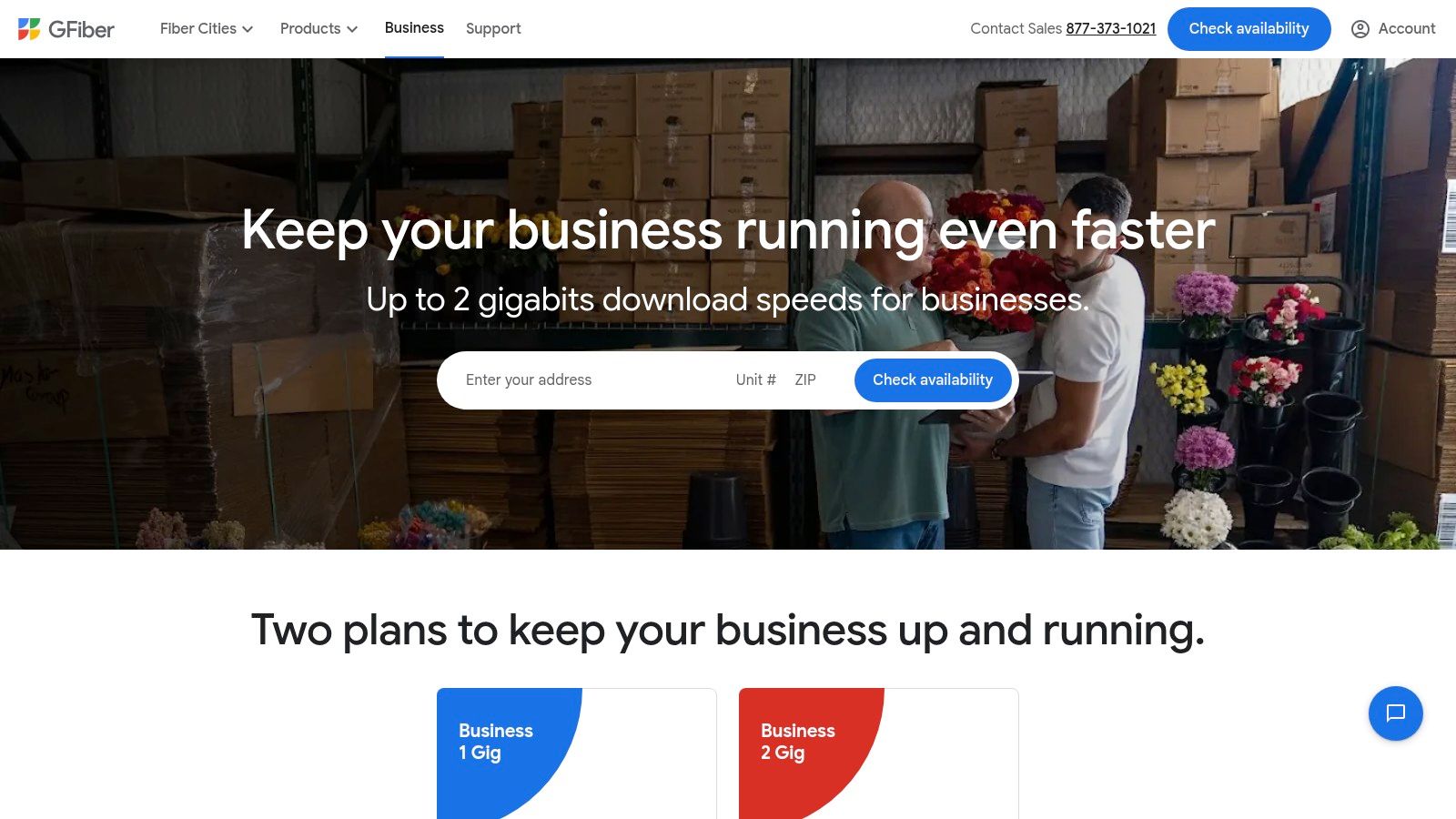
Google Fiber Business lists Business 1 Gig at $100 per month and Business 2 Gig at $250 per month on its Google Fiber Business site. It also includes Wi-Fi 6 gear and up to two mesh extenders. That package appeals to small and midsize offices that want strong connectivity without turning the rollout into a separate infrastructure project.
Best use case for GFiber
Google Fiber Business fits best in offices that rely on cloud platforms all day and regularly push large files upstream as well as down. Creative teams, software companies, professional services firms, and multi-user hybrid offices usually benefit from symmetrical speeds more than they benefit from a long menu of carrier add-ons.
A few strengths stand out:
- Straightforward pricing: Teams can evaluate the service quickly without a drawn-out quoting process.
- Symmetrical bandwidth: Upload-heavy work such as backups, video collaboration, file sync, and cloud-hosted workflows performs better on fiber than on many cable plans.
- Lower hardware friction: Included Wi-Fi gear removes one more decision during setup.
The trade-off is coverage. If your Atlanta building is outside the service footprint, there is nothing to buy. Google Fiber can also feel limiting for larger organizations that want one carrier to bundle internet, voice, wireless, managed security, and more advanced WAN services under a single enterprise contract.
Treat the switch as one project
Businesses often choose GFiber during a broader cleanup. They are replacing an aging firewall, retiring a small server, pulling out an old ISP modem, or shutting down local storage that no longer makes sense once faster fiber and cloud tools are in place.
That is why provider selection and hardware retirement should be planned together. A cleaner internet service does not finish the job if old drives, switches, access points, and rack equipment are still sitting in a closet with business data on them.
For Atlanta companies with ESG or CSR goals, this is also a good point to connect telecom upgrades to a broader business sustainability strategy for Atlanta organizations. The provider is the "in." Responsible decommissioning is the "out."
If your office is moving from legacy systems to cleaner cloud and fiber workflows, line up server recycling for Atlanta data centers and business environments before cutover week. Atlanta Green Recycling helps close that disposal gap while supporting veteran aid and tree planting, which gives the transition a practical operations benefit and a real ESG story your business can stand behind.
GFiber is easy to recommend when it is available and your requirements are clear. It is less compelling for enterprises that need deep carrier customization. For many Atlanta offices, though, it is one of the cleanest ways to upgrade service and retire old hardware without turning a provider change into two separate problems.
4. Verizon 5G Business Internet
A common Atlanta scenario looks like this. A new branch is ready, the staff starts next week, and the building owner cannot give you a clear date for fiber access. Verizon 5G Business Internet can solve that kind of problem fast.
It is a practical option for temporary offices, short-notice expansions, project sites, healthcare admin spaces, and locations where construction delays would hold up operations. It also works well as a backup connection for offices that already have a primary wired circuit.
When Verizon makes sense
Verizon is strongest where deployment speed matters more than perfect symmetry or carrier-grade customization. I usually recommend it for sites that need internet service quickly and can benefit from avoiding cabling work, permit delays, or landlord coordination.
It tends to fit well in a few situations:
- Fast activation: Good for offices that cannot wait through a long install cycle.
- Useful failover path: A separate wireless circuit can improve business continuity.
- Less building disruption: Self-install and outdoor equipment options can reduce on-site work.
The trade-off is consistency. Signal strength, wall materials, nearby interference, and local network load all affect results. If the site runs latency-sensitive apps, large uploads, or voice traffic with little tolerance for jitter, test before you commit to Verizon as the only connection.
Buy Verizon for speed of deployment and flexibility. Then verify performance at the actual address.
Treat the cutover and the cleanup as one project
Verizon often enters the conversation when a business is trying to simplify a site. That usually means old gear is about to come out: legacy modems, small firewalls, aging access points, retired switches, and sometimes local storage that no longer fits the new setup.
That hardware should not sit in a closet after cutover. It may still hold business data, and it still creates a disposal obligation. Build the retirement plan into the provider change and use a documented IT asset disposition process for business hardware before the old equipment leaves your office.
For Atlanta companies with ESG and CSR goals, the "in" and the "out" aspects should align. Verizon can help get a site online quickly. Atlanta Green Recycling helps close the project properly by handling the disposal phase in a way that supports veteran aid and tree planting. That gives your telecom transition an operational finish and a stronger sustainability story.
Verizon is a smart choice when wiring delays, temporary needs, or failover planning are driving the decision. Review current service details at Verizon 5G Business Internet.
5. T-Mobile for Business – 5G Business Internet / SuperBroadband
T-Mobile for Business is the fixed wireless option I usually put in the "simple but worth testing" category. For Atlanta businesses that want easy deployment, included equipment, and a cleaner monthly bill, it's appealing.
T-Mobile also stands out because it offers a path for higher-availability sites through SuperBroadband, which combines 5G connectivity with satellite redundancy. That's not necessary for every office, but it can be useful for locations where path diversity matters and traditional wireline diversity is hard to get.
What T-Mobile does well
This is often a strong fit for distributed businesses. Retail groups, small branch networks, remote admin offices, and temporary spaces can get online without a telecom construction project.
A few practical advantages:
- Fast self-setup: Good for offices that need quick activation.
- Simple packaging: Equipment inclusion reduces procurement friction.
- Useful secondary circuit: Works well as backup internet for locations already using fiber or cable.
The weak spot is consistency. Like any wireless service, performance depends on the local environment. Some applications and network policies also need extra testing before rollout, especially in organizations with strict security or compatibility requirements.
Why ITAD should be part of the same decision
A lot of Atlanta companies still separate telecom procurement from decommissioning. That creates clutter, missed data-handling steps, and assets that sit around unused because nobody owns the exit process.
The better approach is to treat connectivity replacement and hardware retirement as one project. If your team is replacing an old router stack, voice handsets, branch firewall, or aging modems while moving to fixed wireless, formalize the exit path through IT asset disposition services in Atlanta.
One industry gap is worth noting here. Public information on how smaller and local telecom companies build workforce pipelines is limited, even though RCR Wireless reports on rural broadband workforce pressure. That lack of transparency is a reminder to ask any provider, national or local, practical service questions about install support, escalation paths, and technician availability before you sign.
T-Mobile works best when speed, simplicity, and backup connectivity matter more than perfect predictability. Explore current options at T-Mobile for Business Internet.
6. Lumen (CenturyLink/Level 3)
A growing Atlanta company signs a better carrier contract, gets the new circuit installed, and still ends up with old routers, transport gear, and voice hardware sitting in a closet for months. That is a planning gap, not a minor cleanup task. With Lumen, the connectivity decision and the retirement plan should be scoped together from the start.
Lumen fits organizations that need more than standard business internet. Its strengths show up in enterprise WAN design, Dedicated Internet Access, Ethernet, cloud connectivity, and higher-capacity environments where latency, uptime, and inter-site performance affect revenue or operations.
Where Lumen earns its keep
Lumen is a practical fit for healthcare groups, financial firms, logistics networks, large campuses, and multi-location businesses that need disciplined network architecture. In those environments, the provider matters less as a brand name and more as a transport and backbone decision.
What usually stands out:
- Enterprise backbone depth: Useful for connecting multiple sites and supporting intercity traffic.
- Scalable capacity: Helpful for locations with shifting demand, large data transfers, or planned growth.
- Cloud connectivity options: A strong match when cloud platforms are part of daily production traffic.
The trade-off is straightforward. Lumen is often a bigger purchase, a longer sales process, and a more technical deployment than SMB broadband. Building availability matters too. If your property is not already served, timeline and construction costs can change the economics quickly.
That is why Atlanta businesses should ask harder pre-sale questions here than they would with a plug-and-play provider. Confirm building serviceability, contract terms, handoff type, SLA details, install ownership, and who handles escalation after turn-up. Those details decide whether Lumen is a strong fit or an expensive mismatch.
Treat the cutover and the cleanup as one project
Lumen often enters the conversation during a real infrastructure change, not a simple bill swap. Teams may be replacing branch routers, retiring legacy circuits, removing old firewalls, or consolidating voice and data equipment as part of the move.
That creates the "out" side of the project.
For Atlanta organizations with regulated data, aging network hardware, or storage media tied to the old environment, decommissioning needs the same attention as provider selection. The companies that handle this well assign an owner for both tracks. New carrier in. Old equipment out. Documented chain of custody. Nothing left forgotten in a rack or storage room.
Choose Lumen when your business needs an enterprise network foundation and has the internal discipline to manage a more involved rollout. Then finish the job properly. Pair the telecom transition with a documented disposal plan through Atlanta Green Recycling, which gives your company a responsible local outlet for retired equipment while also supporting veteran aid and tree planting as part of the same project. Review enterprise connectivity options at Lumen.
7. Zayo
Zayo is the most specialized name on this list. If you're a typical small office looking for plug-and-play internet, this probably isn't your first call. If you're running a data center footprint, high-capacity enterprise network, or a serious multi-site environment in Atlanta, Zayo can be exactly the right call.
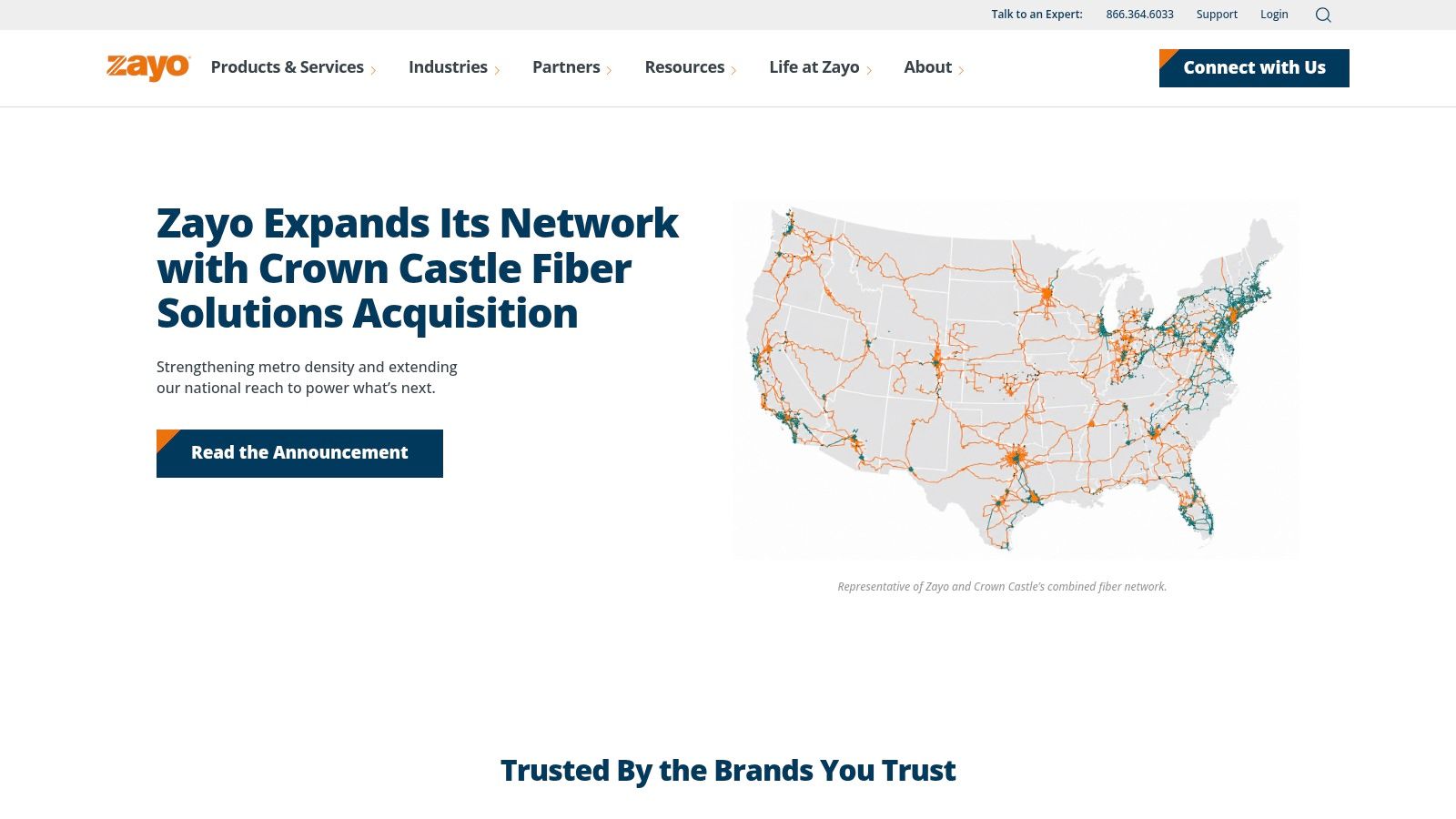
Zayo's value is customization. Dark fiber, wavelengths, carrier-grade connectivity, and dense metro fiber infrastructure make it attractive when standard business ISP offers stop being enough.
Best fit for high-capacity Atlanta environments
Zayo is strong for organizations that already know what they need. Data center operators, larger enterprises, hyperscale-adjacent users, and businesses planning long-term network control often prefer that level of flexibility.
That usually means:
- High-capacity transport options: Better suited to advanced network architecture than typical office plans.
- Metro and data center connectivity: Helpful in carrier-dense Atlanta environments.
- Growth path: Businesses can scale from simpler connectivity into much more custom arrangements.
The downside is complexity. Zayo sales cycles tend to be longer, engineering is more involved, and building laterals or special access into a property can introduce new fees and timeline questions.
Ask harder questions before signing
With Zayo, procurement teams should go beyond bandwidth and price. Ask about building access, turn-up process, support escalation, cross-connect dependencies, and what happens if your facility changes footprint later.
That level of diligence matters because public visibility into the financial models of smaller and non-mass-market telecom providers is often thin. Forvis Mazars noted that the industry accepted $950 million in broadband grants, up 50% from 2022, while rural telecom companies also faced decreased operating income despite revenue growth. Even though that commentary focuses on rural telecom, the broader lesson for Atlanta buyers is relevant: ask direct questions about provider durability, service delivery, and long-term fit.
Zayo is a strong choice when your network team needs infrastructure, not just internet. For straightforward SMB buying, it's usually more carrier than you need. Explore options at Zayo.
7-Provider Local Telecom Comparison
| Provider | 🔄 Implementation complexity | ⚡ Resource requirements & speed | ⭐ Expected outcomes & reliability | 📊 Ideal use cases | 💡 Key advantages |
|---|---|---|---|---|---|
| AT&T Business | Moderate–High: carrier provisioning, SLA setup | Fiber/Wireless options; higher-cost add-ons for static IPs and security | High reliability with SLA-backed DIA and up to 5 Gbps where available | Multi-site enterprises, regulated industries needing static IPs & SLAs | Deep Atlanta footprint, layered services (voice, SD-WAN, security) |
| Comcast Business | Low–Moderate: fast coax installs; DIA requires more setup | Wide HFC availability; LTE backup optional; DOCSIS 4.0 rollout increases upstream | High downstream speeds; upstream often asymmetrical and node-dependent | SMBs and offices needing fast installs and scalable bandwidth | Broad coverage, quick deployment, multi-gig roadmap |
| Google Fiber Business (GFiber) | Low: simple provisioning where fiber exists | Fiber-to-premises; Wi‑Fi6 router and mesh included; straightforward pricing | Very good symmetrical performance and predictable SLAs | Offices that transfer large files, cloud-first businesses, conferencing | Transparent pricing, strong upload speeds, included CPE |
| Verizon 5G Business Internet | Low: self‑setup or pro-install CPE; minimal wiring | Fixed wireless CPE; unlimited data; performance tied to 5G signal | Rapid turn-up but variable performance and lower upload vs. fiber | Pop-ups, quick-turn branches, backup/failover links | Fast deployment, clear online pricing, good failover option |
| T‑Mobile for Business (5G / SuperBroadband) | Low: fast self-setup; SuperBroadband adds integration steps | Gateway included; optional Starlink satellite for redundancy increases complexity | Reliable for secondary/backup use; throughput varies by signal | Distributed branches, backup connectivity, high-availability with satellite | Simple pricing, multi-year guarantees on select offers, satellite diversity option |
| Lumen (CenturyLink/Level 3) | High: enterprise provisioning, potential build-outs | Enterprise-grade ports, on-demand NaaS scaling, cloud on-ramps | Very high reliability, low latency DIA with SLA and on-demand scaling | Data centers, regulated enterprises, multi-site WANs, cloud-connected workloads | On-demand bandwidth, deep backbone, DDoS/cloud connectivity options |
| Zayo | Very High: custom engineering, long sales/engineering cycles | Dark fiber, wavelengths, high-capacity routes; potential build/IRU costs | Carrier-grade, very high capacity and SLA-backed performance | Hyperscalers, data-center operators, enterprises needing dark fiber | Highly customizable high-capacity solutions and dense metro connectivity |
From Decommissioning to Dual Impact with Atlanta Green Recycling
Once you've picked a provider, the project isn't over. It just shifts from procurement to execution. That's the point where many Atlanta businesses lose discipline. The circuit goes live, the team celebrates, and the old equipment gets stacked in a closet for "later."
That old gear can include storage media, firewalls, phones, switches, access points, server hardware, and telecom room leftovers that still carry operational or data risk. For hospitals, schools, government agencies, and companies with regulated information, that isn't a minor loose end. It needs chain-of-custody, secure destruction, documented removal, and a responsible downstream process.
Atlanta Green Recycling turns that disposal phase into something more useful than a cleanup ticket. It becomes a practical ESG and CSR action tied directly to a real business project. When your company upgrades providers, relocates offices, consolidates sites, or retires old voice and network hardware, you can route the outbound equipment through a program built around secure decommissioning and community impact.
That's where the dual-mission approach stands out. The "Recycle for a Cause" message gives Atlanta companies a stronger internal and external story: your retired tech doesn't just leave the building, it supports veteran aid and tree planting. "Your old tech can house a veteran and grow a forest" is the kind of message employees remember, leadership can share, and CSR teams can use.
There are practical benefits beyond the story:
- Secure handling: Retired devices can be processed through compliant workflows that support audit and internal policy needs.
- Operational relief: Pickup, logistics, de-installation support, and bulk removal keep IT teams focused on the cutover, not the scrap pile.
- CSR documentation: Plant-A-Tree certificates and Veteran Support Impact Reports give companies a cleaner record for sustainability reporting and stakeholder communication.
- Campaign potential: Office moves, telecom refreshes, and seasonal cleanup events can become cause-based recycling drives tied to Earth Day, Arbor Day, or Veterans Day.
The best telecom transition projects treat the new install and the old equipment removal as one budget, one schedule, and one accountability chain.
For Atlanta businesses, that's a better way to manage local telecom companies and the hardware they displace. The provider gets your business connected. Atlanta Green Recycling helps close the loop responsibly, securely, and with visible community value. That isn't just good disposal practice. It's a smarter business process and a stronger brand story.
If your Atlanta business is changing providers, moving offices, or retiring old network gear, talk with Atlanta Green Recycling before cutover day. We help organizations turn telecom upgrades into complete end-of-life projects with secure data destruction, compliant electronics recycling, pickup logistics, and a mission-driven impact story built around veteran support and tree planting.