
Telecom Services in Atlanta: A Complete Business Guide


Your team is probably dealing with this right now. A lease is ending, a new office is opening, a cloud migration is underway, or your phone system finally feels too old to support how people work. Everyone agrees the business needs better connectivity. Fewer people ask the second question: what happens to the routers, switches, desk phones, servers, and storage gear you’re replacing?
That gap creates risk. Telecom decisions don’t stop at circuit availability or monthly spend. They shape uptime, compliance, employee experience, vendor flexibility, and the trail of hardware your company leaves behind. For Atlanta businesses, that matters even more because local infrastructure now gives companies room to scale fast, but only if they choose services and retirement plans with equal care.
Navigating Atlanta’s Tech Boom Your Telecom Strategy
Atlanta has become a serious infrastructure market, and local companies can feel the shift. More providers are competing for enterprise contracts. More buildings can support higher-capacity connectivity. More IT leaders are redesigning networks around cloud access, branch connectivity, and hybrid work instead of a single headquarters.

Atlanta’s data center market is evolving rapidly. Installed IT power capacity is listed at 1.82 gigawatts in 2026, up from 0.92 gigawatts in 2025, a 98% year-over-year increase, and the market has 2,076 MW under construction according to Mordor Intelligence’s Atlanta data center market report. That growth changes what local businesses should expect from telecom partners. It also changes how fast your company may need to upgrade.
Growth changes the telecom conversation
A few years ago, many Atlanta firms could get by with a simple business internet line and a basic phone contract. That’s no longer enough for a company with multiple offices, cloud applications, compliance obligations, remote workers, and security reviews from customers.
A modern telecom strategy should answer four practical questions:
- How does traffic move today across offices, cloud apps, remote users, and customer systems?
- What can fail without stopping operations and what needs redundancy?
- Which devices will be retired when the new service goes live?
- Who documents disposal and data destruction when old equipment leaves your control?
Practical rule: Every telecom upgrade should have two workstreams. One for deployment, one for retirement.
That second workstream gets overlooked. A business signs a new circuit, replaces firewalls and switches, and celebrates a clean cutover. Then old hardware sits in a storage room, still holding configuration data, call logs, credentials, or customer information.
Telecom planning includes end-of-life planning
That’s why telecom strategy and IT asset disposition belong in the same conversation. If your business is expanding bandwidth, moving into colocation, or refreshing network hardware, you should also think about decommissioning. Companies handling data center operations in Georgia often discover that the riskiest equipment isn’t always the newest gear in production. It’s the retired hardware nobody formally tracked after the migration.
Atlanta gives businesses a strong platform to grow. The smarter move is to treat telecom procurement, deployment, and retirement as one connected lifecycle instead of three separate projects.
Decoding Telecom Services For Your Atlanta Business
Most confusion around telecom services in Atlanta comes from language. Providers talk in acronyms. Procurement teams compare quotes that don’t use the same terms. IT leaders know they need something better, but not always what each service does.
This quick visual helps translate the options.
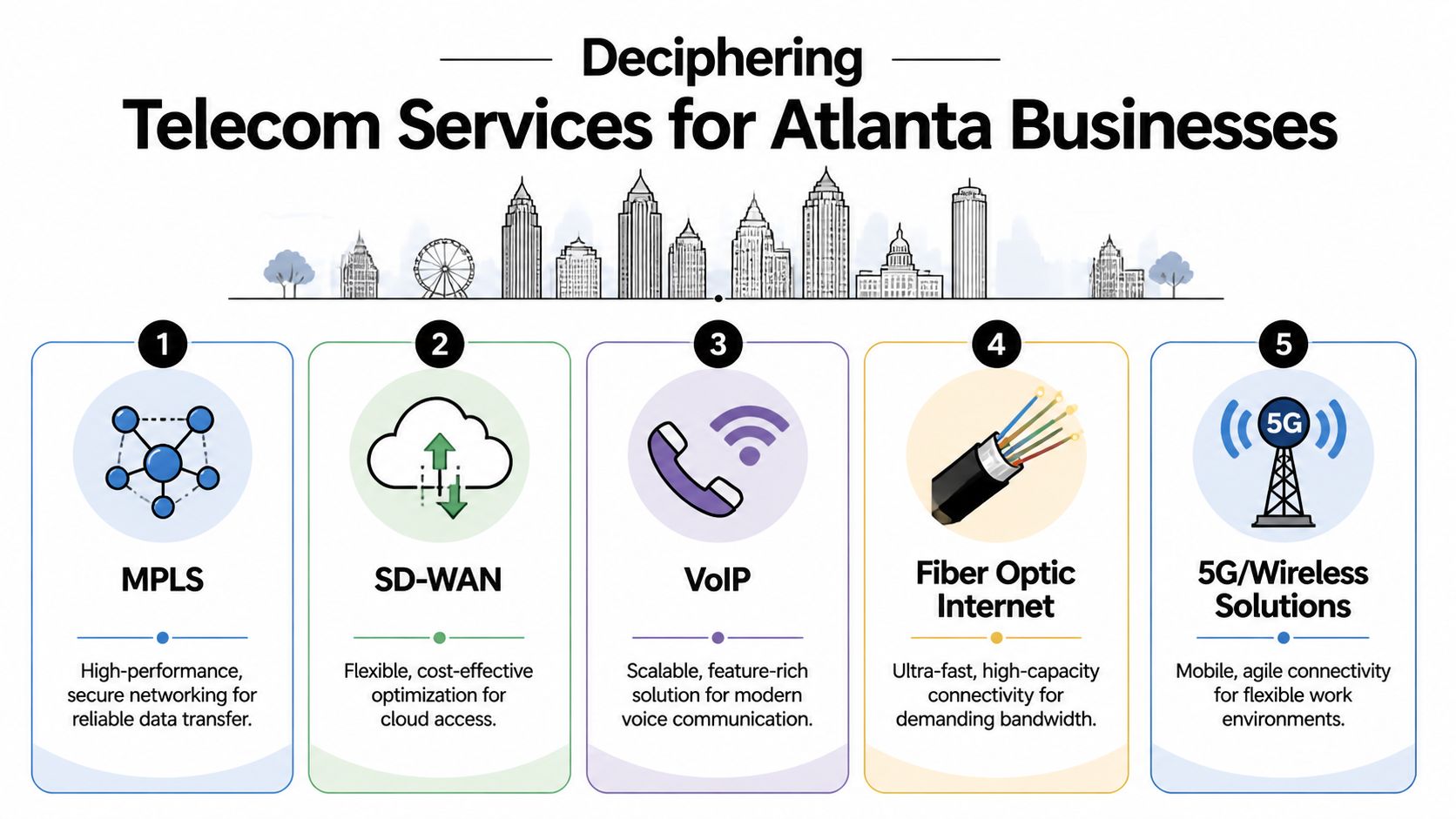
Start with the plain-English version
Fiber optic internet is your high-capacity road. It’s built for businesses that move a lot of data, rely on cloud software all day, run video meetings constantly, or need stable performance across many users.
VoIP means phone service delivered over your internet connection. It replaces many legacy phone systems and usually adds features people now expect, such as mobile apps, call routing, voicemail to email, and easier support for remote staff.
MPLS is a private, tightly managed networking approach for connecting sites. Think of it as a reserved route for important business traffic. Companies with strict performance or security expectations still use it for selected workloads.
SD-WAN acts more like a smart traffic controller. It can steer application traffic across different connections based on business rules. If one path is congested or unavailable, it can shift traffic to another option.
5G and wireless backup add flexibility. They’re useful for temporary sites, mobile teams, rapid branch activation, and backup connectivity if a wired link goes down.
A good buying process starts when your team can explain a service without using the provider’s jargon.
How to match the service to the problem
The easiest way to choose is to tie the service to an operational pain point.
If your office internet slows down whenever everyone joins calls, start with fiber.
If staff complain that the phone system feels disconnected from how they work, look at VoIP.
If you run several sites and critical applications must behave consistently, MPLS or SD-WAN may be the better discussion.
If your business can’t afford to go offline during a local outage, add wireless failover.
Here’s a simple comparison to keep the options straight.
| Atlanta Telecom Service Comparison | |||
|---|---|---|---|
| Service Type | Best For | Key Benefit | Typical Cost |
| Fiber Optic Internet | Offices with heavy cloud, voice, and video use | High-capacity connectivity | Varies by provider, building, and contract |
| VoIP | Teams replacing legacy phones | Flexible calling features | Usually depends on users, features, and support model |
| MPLS | Multi-site organizations with strict traffic control needs | Predictable private networking | Often higher than public internet-based options |
| SD-WAN | Companies using multiple links and cloud apps | Smarter traffic routing | Depends on software, circuits, and management scope |
| 5G or Wireless Backup | Branches, pop-up locations, and failover needs | Fast deployment and resilience | Depends on coverage, equipment, and usage plan |
What many Atlanta buyers miss
The service itself is only part of the decision. The question is how the service will be used in your environment. A law firm, distribution business, clinic network, and design agency may all buy fiber, but they won’t need the same failover plan, voice setup, or branch architecture.
That’s why it helps to compare practical service bundles, not isolated products. If you’re reviewing business internet and VoIP solutions, look for how the provider groups connectivity, phone service, support, and upgrade paths into one operating model.
A short decision filter
Use this when your team is stuck between options:
- Identify the traffic first. Voice, video, cloud apps, file transfers, and site-to-site access don’t behave the same.
- List the essential requirements. Some businesses need voice continuity. Others care most about branch uptime or vendor-managed security.
- Choose for the next stage of growth. Don’t buy a service that only fits your current headcount.
- Check building reality. A great design on paper fails if your location can’t support the required last-mile service.
If you want a local starting point for evaluating carriers and options, review Atlanta-focused provider considerations through telecom providers near me.
The Atlanta Advantage Why Your Telecom Choices Matter Here
Not every city gives businesses the same network foundation. Atlanta does, and that changes the quality of telecom choices available to local companies.
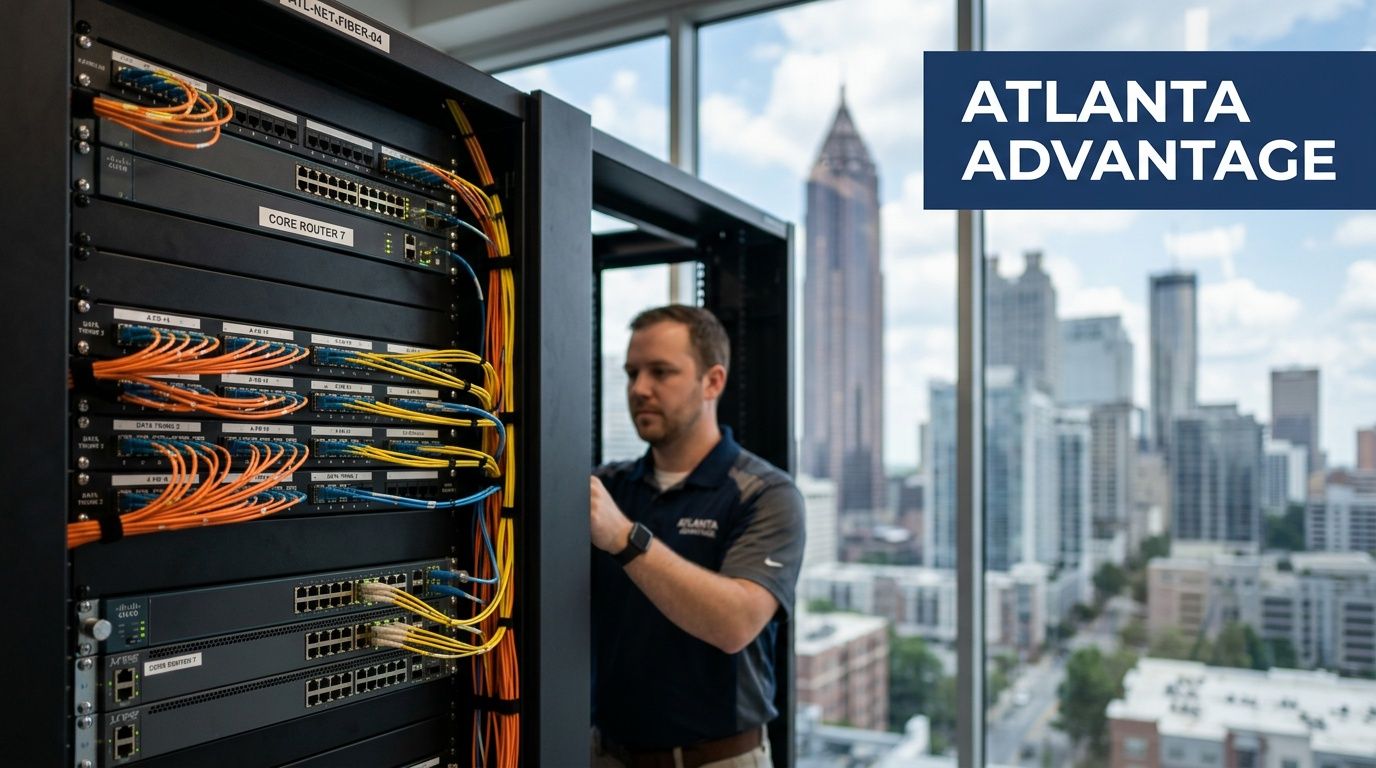
Atlanta is often called “America’s Most Wired City” and ranks in the top five U.S. markets for fiber access because two of the country’s largest fiber trunk lines converge in the metro area, creating a gateway for traffic to Europe and South America and supporting minimal network latency, according to the Atlanta connectivity report.
What that means for a local business
This isn’t just a branding line. It affects daily operations.
When a market has deep fiber presence and strong carrier density, businesses usually gain three advantages:
- More provider choice. You’re less likely to be stuck with one realistic option.
- Better architectural flexibility. Multi-site designs, cloud access, and redundant circuits become easier to plan.
- Improved resilience. Teams can build more sensible backup paths instead of forcing everything through one provider or one building entry.
A company running cloud-based ERP, unified communications, and remote support tools benefits directly from that environment. So does a healthcare group transmitting sensitive records between locations. So does a manufacturer coordinating plants, warehouses, and office teams.
Why local context matters during procurement
Procurement teams sometimes compare telecom quotes as if bandwidth is the whole product. In Atlanta, local topology matters just as much. A building near strong fiber routes may support cleaner redundancy planning than a site with fewer practical carrier paths. A downtown office may have different options than a suburban facility or a logistics site farther from core routes.
Strong telecom services in Atlanta come from the combination of carrier availability, building access, support model, and how well the design fits your operations.
That local context also helps explain why two businesses on similar contracts can have very different experiences. One may have diverse entrances, fast restoration, and room to scale. Another may have a technically adequate circuit but weak redundancy and slow coordination during outages.
The strategic takeaway
Atlanta’s infrastructure gives businesses a platform many markets would like to have. But the advantage only becomes real when companies use it deliberately. The firms that benefit most are the ones that treat connectivity as part of business design, not just a utility bill.
That usually leads to better outcomes in four areas:
| Business Need | Why Atlanta Helps |
|---|---|
| Cloud performance | Dense fiber access supports strong connectivity options |
| Multi-site operations | Carrier-rich environments make branch design more flexible |
| International data movement | Major trunk convergence supports global traffic paths |
| Business continuity | Provider diversity can support stronger redundancy planning |
The lesson is simple. Atlanta gives you options. Your job is to turn those options into a network design that supports how your business works.
A Practical Vendor Selection Checklist
Most telecom buying mistakes happen before the contract is signed. Teams focus on speed, monthly price, and a promised install date. Then they discover hidden construction issues, vague support obligations, weak escalation paths, or a service design that doesn’t fit the business.
Use a checklist instead of a sales demo to control the process.
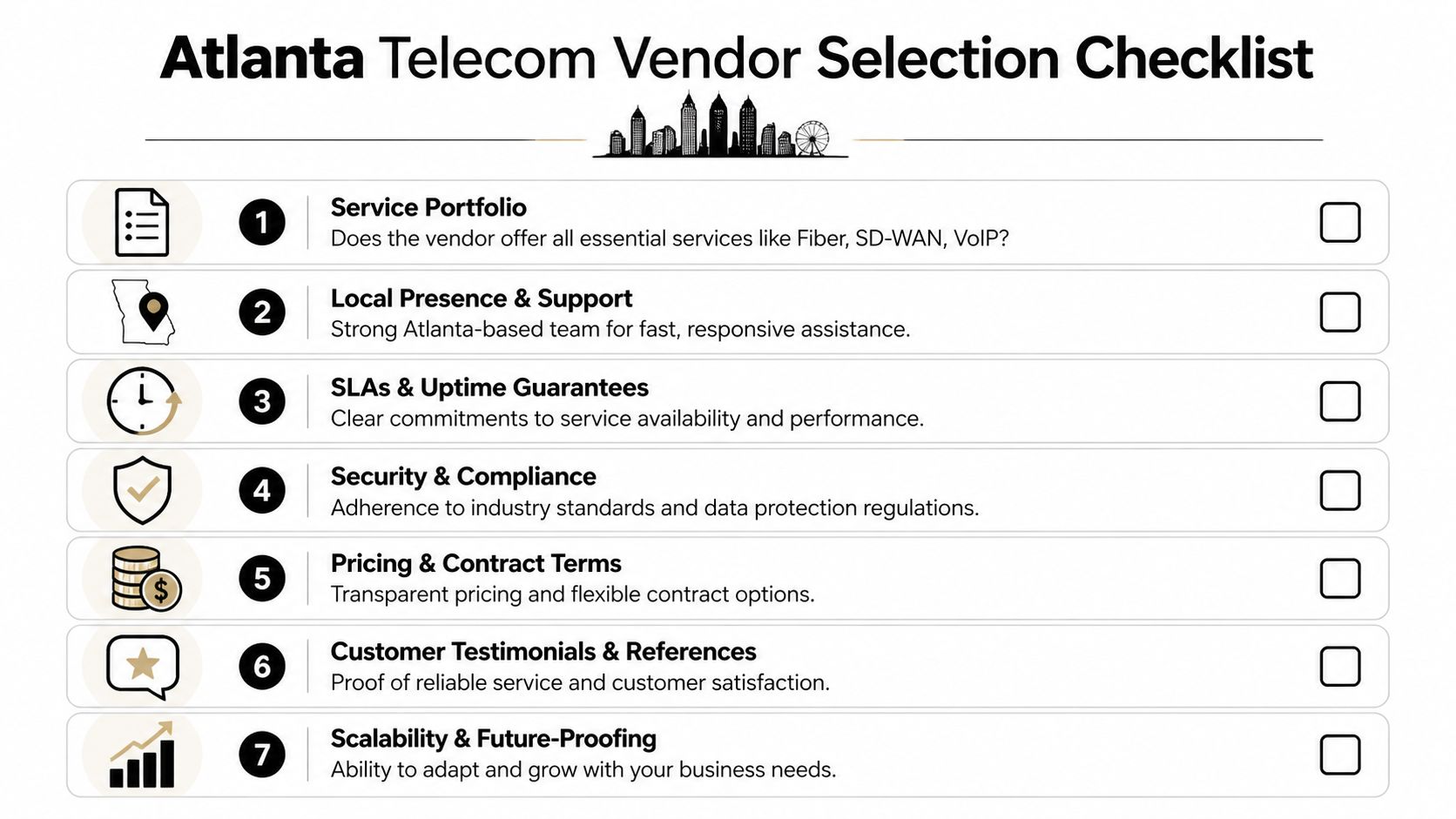
Ask better questions before you compare proposals
A strong vendor conversation should feel less like shopping and more like due diligence. These questions reveal whether the provider can support your environment after the paperwork is complete.
- What services do you manage directly? Some providers sell a broad portfolio but rely heavily on third parties.
- What does local support look like in Atlanta? Ask who handles escalation, field coordination, and installation problems.
- How do you handle redundancy? Don’t stop at “yes, we offer backup.” Ask how the backup path differs from the primary path.
- What assumptions are built into the quote? Building access, inside wiring, equipment handoff, and install sequencing all matter.
- How does the service scale? Growth may mean more users, more sites, or more application traffic.
Review the relationship, not just the line item
Vendor selection is really vendor management. That means your team should evaluate contract behavior, communication style, implementation discipline, and issue resolution, not just technical fit. For a useful procurement lens, CTO Input’s vendor management best practices offers a practical framework for thinking beyond the initial sale.
Here’s a field-tested checklist you can use in meetings and RFP reviews.
- Service fit
Does the provider offer the mix you need, such as fiber, voice, SD-WAN, or backup wireless? A narrow provider may force you into additional vendor relationships your team didn’t plan to manage.
Local operational depth
Ask whether the provider has direct experience supporting Atlanta business locations like offices, campuses, clinics, warehouses, or multi-tenant buildings. Local logistics often determine whether an install is smooth or frustrating.
Support structure
Who answers when service degrades? Find out whether support is centralized, outsourced, or paired with named account management and technical contacts.
Buyer note: If a vendor can’t clearly explain escalation during a pre-sale call, they probably won’t improve after activation.
Contract clarity
Read the terms around renewals, equipment ownership, service moves, cancellation, and upgrade changes. Long contracts aren’t always bad. Unclear contracts are.
Security posture
Ask how the provider separates customer traffic, protects management access, and handles incidents. If your team works in healthcare, education, finance, or government contracting, this part deserves legal and compliance review.
Implementation discipline
Request a deployment plan. Not a promise. A plan. It should identify milestones, dependencies, handoff points, and who owns each task.
Future fit
Today’s site may become tomorrow’s branch, warehouse node, or collaboration hub. Choose a provider that can support those changes without forcing a full redesign.
Add sustainability to procurement
Many teams now include environmental and governance criteria in vendor reviews. That’s smart. Telecom buying affects equipment turnover, packaging waste, power use, de-installation practices, and end-of-life handling for retired devices.
If procurement is part of your ESG effort, use a structured lens like sustainable procurement best practices to make sure sourcing decisions align with your broader operating standards.
The strongest telecom vendor isn’t solely the one with a competitive quote. It’s the one your business can still trust after a rushed cutover, a support ticket at an inconvenient hour, and a future upgrade that no one has fully scoped yet.
Navigating SLAs Security and Compliance
Teams often skim the SLA section of a telecom contract. That’s a mistake. When a connection fails, your business won’t be protected by the sales presentation. It will be protected, or not protected, by the service terms, the security obligations, and the evidence your provider can supply.
Atlanta businesses in regulated sectors have an important local advantage. The city’s telecom ecosystem includes specialized carriers offering dark fiber and metropolitan connectivity that support regulated industries, and that infrastructure is important for transmitting DoD-sanitized data destruction certificates and maintaining HIPAA compliance documentation for hospitals and data centers, as noted by Baxtel’s overview of Southern Telecom in Atlanta.
What to read in the SLA
An SLA should answer practical operating questions, not just legal ones.
Look closely at these areas:
- Availability terms. What level of uptime is promised, and how is downtime defined?
- Performance terms. Are latency, packet loss, or restoration targets described in measurable language?
- Exclusions. Many contracts narrow responsibility through maintenance windows, third-party dependencies, or customer-side exceptions.
- Remedies. If service fails, what credits or corrective actions apply?
- Escalation process. Who can your team contact when business operations are affected?
A weak SLA often sounds polished but says little. A useful SLA defines events, thresholds, response windows, and remedies in language your operations team can use.
Security is part of telecom design
A circuit alone doesn’t create trust. Your provider choice affects how data moves, who has access to management systems, how incidents are reported, and what documentation you can produce during audits or customer reviews.
That matters in industries where sensitive data moves across locations or where chain-of-custody documentation must be transmitted and preserved. Healthcare organizations, public institutions, and data center operators often need both connectivity and recordkeeping to stand up to internal review.
Security in telecom is not only about keeping attackers out. It’s about preserving evidence, accountability, and continuity when your business needs to prove what happened.
Compliance doesn’t end at live traffic
Companies often think about compliance only while systems are active. But the same standards that govern data in transit should shape how you document network changes, retire equipment, and preserve records tied to service delivery.
That’s especially relevant when your business replaces firewalls, storage arrays, network appliances, or telecom gear that may still contain sensitive information. Teams planning secure handoff procedures often also review Atlanta secure data destruction services so the retirement side of the project doesn’t undermine the operating side.
A practical contract test
Before signing, ask your provider to walk through a realistic incident:
- A critical circuit fails during business hours.
- Staff can’t access core applications.
- Your team needs updates for leadership and, in some industries, compliance documentation.
- The outage affects customer service, clinical workflows, or interoffice access.
If the provider can’t clearly explain detection, escalation, communication, restoration, and reporting, the contract probably has gaps. Those gaps become your problem the moment service degrades.
The Overlooked Connection Telecom Choices and IT Asset Disposition
A telecom upgrade leaves behind physical evidence. Old desk phones. Firewalls. Access points. PRI gear. Routers. Switches. Servers tied to voice or networking functions. Storage arrays from prior architectures. If your company only plans the activation side, those assets pile up in closets, back rooms, and loading docks.
That’s where telecom planning and IT asset disposition, or ITAD, connect.
New circuits create old hardware
Every time a business modernizes connectivity, it also creates a retirement event. Moving to hosted voice may eliminate a legacy PBX. Replacing MPLS with a new network design may retire branch appliances. Consolidating offices may leave racks of telecom gear with configuration data still inside.
None of that equipment is harmless just because it’s unplugged.
Devices can retain call records, credentials, configuration files, internal network maps, business contacts, and user data. The risk isn’t abstract. It comes from ordinary behavior. Someone stores the old gear “for now.” A move gets delayed. Facilities staff clear a room. Equipment changes hands without a documented chain of custody.
The security standard you apply to live infrastructure should follow the hardware all the way to end-of-life.
What a responsible ITAD process should include
For telecom and network equipment, a sound retirement process usually includes several controls working together:
- Asset identification. Know what’s being removed, from which location, and from which business function.
- Chain of custody. Document who handled the equipment and when.
- Data sanitization. Wipe or destroy media using methods appropriate to the device and risk level.
- Audit documentation. Preserve records that support internal reviews and external requirements.
- Environmental handling. Keep equipment out of informal disposal channels that create legal and reputational exposure.
These steps matter for practical reasons, not just policy reasons. A company can spend months tightening access controls on an active network, then lose trust because a retired appliance was handled casually.
Why this belongs in telecom procurement
Procurement teams often separate telecom contracts from disposition planning because different departments own them. IT buys the new service. Facilities stores the old gear. Compliance gets involved later. That structure creates blind spots.
A better approach is to ask retirement questions while evaluating the new environment:
- Which devices become obsolete after cutover?
- Which of them store or process sensitive data?
- Who signs off on removal and custody?
- What documentation will auditors or customers expect?
- Can retired telecom assets be recycled within a documented, compliance-minded workflow?
That’s also where a provider such as Atlanta IT asset disposition for businesses becomes relevant to the telecom discussion, because the infrastructure lifecycle doesn’t end when the new service turns up.
ITAD is also a corporate responsibility decision
End-of-life handling affects your company’s sustainability posture. Businesses that want stronger ESG or CSR reporting shouldn’t ignore the hardware side of network upgrades. Telecom modernization creates a visible chance to do two things at once: reduce operational risk and handle retired equipment responsibly.
That can support internal sustainability reporting, customer-facing responsibility claims, and procurement policies that ask vendors and partners for better environmental practices. It can also shape marketing in a way that feels grounded instead of performative. If your company runs a recycling drive tied to retired office and telecom equipment, the story is stronger when it includes verified handling, secure data destruction, and a social outcome.
Campaign language matters here. “Recycle for a Cause” is memorable because it connects a familiar operational task to something larger. A company can tell employees and customers that old tech doesn’t just leave the building. It supports veteran aid, tree planting, and a more circular approach to business technology. Used carefully, that becomes part of cause-based marketing, ESG reporting, staff engagement, and community partnerships with schools, municipalities, or local nonprofits.
The key is credibility. If your business wants to talk publicly about sustainability, the operational details have to be real. That starts with custody, sanitization, documentation, and responsible downstream handling.
Partnering For A Greener Atlanta Your Next Steps
A smart telecom plan does two jobs well. It gives your business stronger connectivity now, and it closes the loop on the equipment that made the old environment work. Companies that treat those as one project usually end up with cleaner audits, fewer loose assets, and a stronger story for customers, employees, and community partners.
That story matters more than many teams expect. Businesses aren’t only judged on uptime and response times. They’re also judged on how they handle waste, protect data, support communities, and document environmental decisions. Retiring old phones, switches, servers, and network appliances can contribute to those goals if the process is structured correctly.
Turn equipment turnover into a CSR asset
Cause-based marketing and ESG reporting can work together in a practical way.
A company-wide recycling initiative tied to retired IT and telecom gear can support:
- CSR documentation through pickup records, destruction documentation, and mission-linked reporting
- Employee engagement through seasonal drives around Veterans Day, Earth Day, or Arbor Day
- Public credibility with messaging that connects responsible recycling to veteran support and tree planting
- Partner recognition through digital badges or sustainability pages that show how equipment was handled
The phrase “Your old tech can house a veteran and grow a forest” works because it gives people a clear outcome, not a vague environmental promise. For organizations that want stronger community visibility, that can also support LinkedIn thought leadership, local nonprofit partnerships, school collaborations, and recycling campaigns that are easier for staff to understand and support.
Make the last step easy to document
The operational side still matters. Businesses need pickup logistics, chain-of-custody discipline, secure data handling, and records they can keep for audits or internal reporting. They also need a recycling partner that understands business environments, not just household drop-offs.
Atlanta Green Recycling offers business e-waste pickup, secure data destruction, telecom equipment recycling, and documentation workflows for organizations including hospitals, schools, government agencies, and data centers. For companies retiring larger volumes of equipment, the business can also fold the project into broader CSR messaging such as “Recycled with Purpose,” impact certificates, and recycling drives that support veterans and reforestation.
If your team is planning a telecom refresh, office move, phone migration, or network cutover, don’t leave the old hardware to chance. Build the retirement plan at the same time you build the new environment. That’s how telecom decisions become operationally strong, legally safer, and more useful to your sustainability goals.
If your business is upgrading connectivity, replacing phone systems, or decommissioning old network hardware, Atlanta Green Recycling can help close the loop with secure, compliance-minded electronics recycling and IT asset disposition services across the Atlanta metro area.