
Find Your Telecommunications Services Dallas Provider


Your office is open, your team is logged in, and work still crawls. Video calls freeze. Cloud apps lag. Phones sound fine one minute and break up the next. In Dallas, that usually isn't just a nuisance. It turns into missed sales calls, slower support, frustrated staff, and expensive workarounds.
A lot of owners start by asking one narrow question: who has the cheapest internet? That’s usually the wrong question. The better one is which provider and service mix will keep your business moving without forcing you into avoidable downtime, surprise fees, or a painful rip-and-replace a year from now.
Your Guide to Choosing Telecommunications Services in Dallas
A common Dallas scenario looks like this. A company signs a lease, adds headcount, moves more work into Microsoft 365, Zoom, cloud ERP, or hosted phones, then discovers the old connection was sized for a much smaller operation. The result is predictable. Staff blame Wi-Fi, IT blames the carrier, and management wonders why a basic utility is now hurting revenue.

Dallas gives you better options than many markets. It’s a major telecommunications hub with one of the most interconnected fiber-optic networks in the country, including infrastructure such as the Infomart carrier hotel, which gives local businesses direct access to Tier 1 network providers for low-latency connectivity, according to DataBank’s overview of Dallas data center advantages.
That matters because telecommunications services Dallas isn’t a generic buying decision. Your location, building type, carrier availability, and operating model all affect what will work well and what will become a recurring headache.
The best telecom decision usually looks boring after installation. No one talks about it because nothing breaks, tickets stay low, and the business scales without drama.
If you're comparing providers across locations, it helps to look at nearby market guidance too, especially if your company has multi-city operations. A practical starting point is this page on telecom services near me, which frames service selection around operational fit rather than advertised speed alone.
First Step Defining Your Business's Connectivity Needs
Most telecom mistakes happen before you talk to any vendor. They happen when a business says, “We need faster internet,” instead of documenting how the business uses the network.
The Dallas market doesn’t reward vague planning. The Dallas–Plano–Irving metro is the nation’s fourth largest MSA, and its population grew 13.9% between 2016 and 2023, which is one reason businesses need a more forward-looking infrastructure plan, according to the Dallas Fed’s regional data.

Audit bandwidth by workflow
Start with what your people do all day, not with the speed tier on a sales sheet.
Ask these questions:
- Cloud dependency: Are staff working in Microsoft 365, Google Workspace, Salesforce, or cloud accounting systems all day?
- Real-time traffic: How many people are in Teams or Zoom meetings at the same time?
- Large file movement: Do you move CAD files, medical images, video assets, or backups?
- Guest traffic: Are clients, visitors, or shared tenants using the same internet circuit?
- Growth pressure: Will this office add staff, new software, or a second shift soon?
If your office mostly runs email, web apps, and occasional calls, that’s one profile. If you have a call center, production team, clinic, or engineering office, that’s a different profile entirely. The wrong move is buying a low-cost shared connection because the current team can “make it work,” then finding out performance falls apart once usage normalizes.
Decide what voice really needs to do
A lot of businesses still treat phones as separate from internet planning. That creates avoidable problems. If you’re moving to VoIP, Hosted PBX, or UCaaS, your voice quality now depends on the network design, traffic prioritization, and failover plan.
Write down what matters operationally:
- Call handling: hunt groups, auto attendants, shared lines, mobile apps
- Compliance needs: call recording, retention, secure access controls
- Remote use: hybrid staff, field employees, softphones on laptops and mobile devices
- Front desk needs: paging, transfers, reception workflows, after-hours routing
Practical rule: If phones generate revenue or protect service delivery, voice belongs in the same requirements document as internet, failover, and internal LAN readiness.
Define your downtime tolerance
Many Dallas businesses make the mistake of underbuying. They assume “reliable enough” is acceptable until the first outage lands in the middle of payroll, patient scheduling, trading activity, or a client presentation.
Write a simple internal standard:
- What happens if the primary circuit fails? Can you keep working for an hour, or does work stop immediately?
- Which systems are mission-critical? Internet only, phones only, both, or site-to-site connectivity too?
- What backup is acceptable? Wireless failover, second wired circuit, or a fully diverse path?
- Who owns escalation? Internal IT, managed provider, office manager, or operations lead?
For companies that also think about broader operational resilience and site risk, this framework for business sustainability strategy is useful because telecom planning works best when it’s tied to continuity, growth, and facility decisions rather than purchased in isolation.
Comparing Telecom Technologies Fiber, SD-WAN, and More
Once your requirements are clear, the technology choices get easier. Many buyers, however, tend to get distracted by buzzwords. The right service isn’t the newest one. It’s the one that matches your traffic pattern, uptime needs, and budget discipline.
Dallas has strong demand for high-performance connectivity. The local data center market is projected to grow from 2.09 GW in 2026 to 2.55 GW by 2031, a sign of continued enterprise demand for reliable network infrastructure, according to the same earlier Dallas market source.
What works well and where it breaks
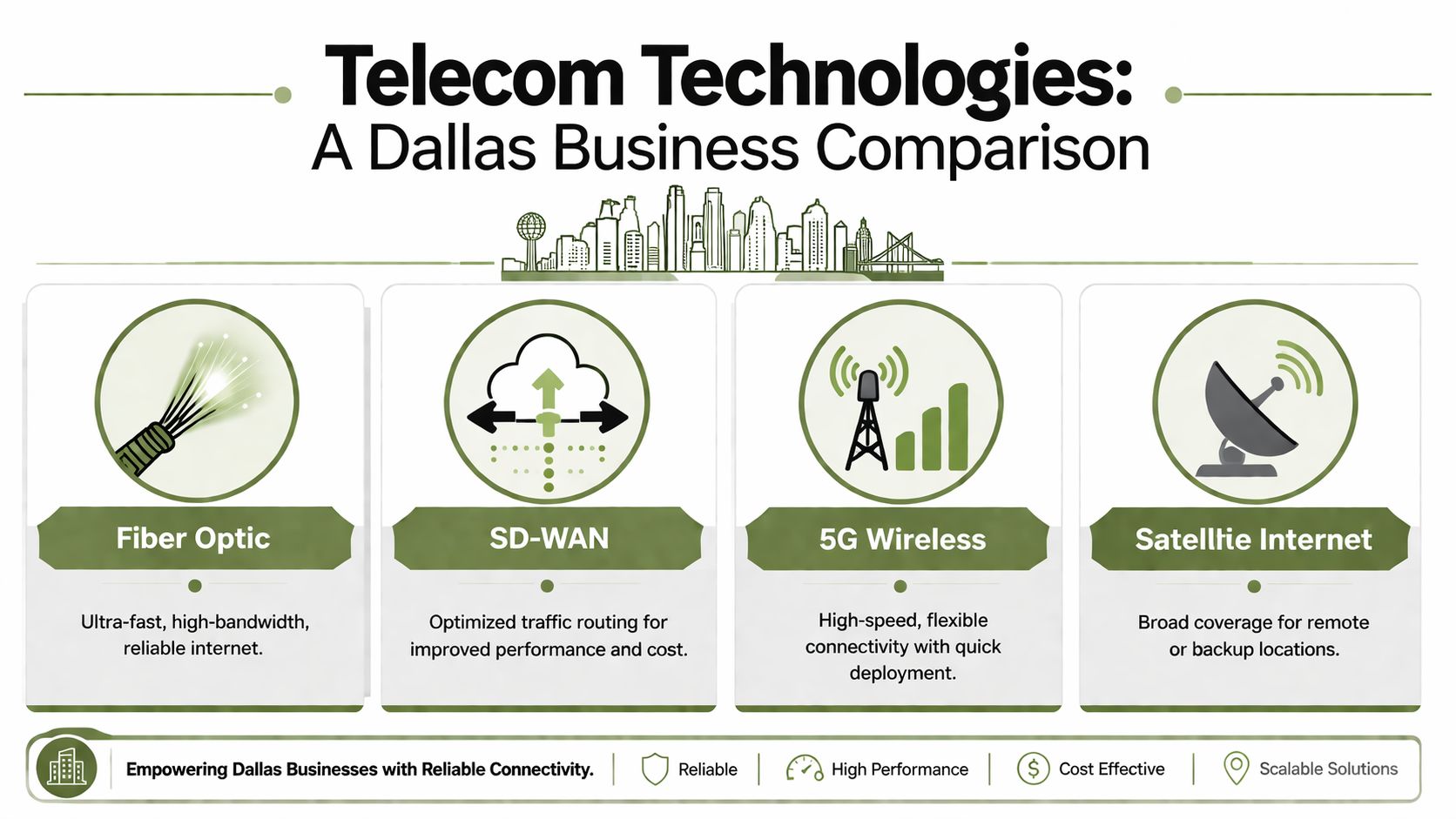
Dedicated fiber is usually the cleanest answer for offices that rely heavily on cloud apps, voice, large file transfer, or frequent uptime. It gives you stronger performance consistency and cleaner service-level commitments than many lower-cost shared broadband products. The trade-off is straightforward. It often costs more, may take longer to install, and can trigger construction or building access issues.
Shared fiber broadband or business cable can work for lighter office use, especially where cost control matters more than strict performance consistency. It’s often faster to deploy. The downside is that during congestion or local plant issues, you’ll feel the limits sooner. For basic offices, that might be acceptable. For revenue-sensitive teams, it usually isn’t.
SD-WAN isn’t a circuit by itself. It’s the traffic-control layer that sits on top of one or more connections. It shines when you have multiple sites, cloud applications, or a need to combine circuits intelligently. Good SD-WAN design can steer critical traffic over the best path and make failover less disruptive. It does add management complexity, and the value depends heavily on the provider’s engineering skill.
MPLS still has a place. It’s not the trendy option, but some finance, legal, healthcare, and multi-site enterprise environments still prefer it for predictable routing and tightly controlled site connectivity. It can be expensive and less flexible than newer approaches, which is why many businesses now compare it directly against internet-based WAN designs with strong policy control.
5G wireless is excellent for temporary offices, rapid turn-ups, and backup connectivity. It’s also useful during moves and delayed fiber installations. What doesn’t work is treating it as a universal replacement for every wired business circuit. Performance can vary by building construction, local congestion, and indoor signal conditions.
Satellite internet is usually a niche option in this context. In Dallas proper, it makes more sense as a specialty backup or for difficult locations than as the first choice for a standard office.
Business Telecom Service Comparison
| Service Type | Best For | Speed & Reliability | Security | Typical Cost |
|---|---|---|---|---|
| Dedicated Fiber | Cloud-heavy offices, call centers, healthcare, larger teams | High and consistent | Strong when paired with proper network design | Higher |
| Shared Broadband | Small offices, cost-sensitive sites | Good, but less predictable under load | Adequate for many standard uses | Lower |
| SD-WAN | Multi-site operations, app-aware routing, failover strategy | Depends on underlying circuits, but can improve user experience | Strong policy control | Moderate to higher |
| MPLS | Compliance-focused multi-site environments | Predictable private connectivity | Traditionally strong for controlled WAN design | Higher |
| 5G Wireless | Temporary service, backup links, fast deployments | Fast to deploy, variable by location | Depends on provider design and device management | Moderate |
| Satellite Internet | Hard-to-serve or backup scenarios | Broad reach, but higher latency concerns | Varies by deployment | Varies |
Match the tool to the business
A few practical matches:
- Professional office with one Dallas location: Dedicated fiber or quality business broadband, plus a backup path if downtime is costly.
- Multi-location retailer or healthcare group: SD-WAN over a mix of fiber and broadband often gives better flexibility than forcing the same circuit type everywhere.
- Law firm or finance team moving sensitive data between sites: Compare MPLS against a well-designed internet-based alternative. Don’t assume the older model is automatically better.
- New branch opening on a deadline: Use 5G as an interim service, then cut over to fiber once construction clears.
Buy the simplest architecture that reliably supports the business. Complexity adds cost twice. Once in the quote and again every time something breaks.
If your telecom planning overlaps with facility moves, server relocation, or application cutovers, these data center migration best practices are worth reviewing because circuit timing and traffic dependencies often become the hidden risk in larger transitions.
Evaluating Dallas Telecom Providers and SLAs
Two providers can sell the same service category and deliver very different experiences. That’s why the proposal document matters less than the provider’s operating discipline.
A serious buyer reads the SLA carefully. Don’t stop at uptime language. Ask how the provider defines outages, what counts as chronic instability, how credits are calculated, and whether service credits are automatic or require a claim.

Read beyond the headline promise
A provider may advertise strong availability, but your real concern is how they respond when the service degrades without going completely down.
Review these areas closely:
- Time to repair: How fast do they commit to restoring service after a confirmed issue?
- Latency and packet loss language: Especially important for VoIP, video meetings, and cloud applications.
- Escalation path: Can you reach Dallas-based support or only a general national queue?
- Maintenance windows: How are planned interruptions communicated?
- Demarcation clarity: Where does their responsibility end and yours begin?
One smart question is whether they track service quality using telecom benchmarks beyond broad uptime. Call Setup Success Rate, or CSSR, is one such metric. It measures the percentage of successfully established calls against total attempted call setups, and buyers who ask about benchmark-level performance show they understand that voice quality depends on more than a simple “up or down” status, as described in this telecom performance research on CSSR.
Test the local support claim
“Local support” gets used loosely in sales conversations. Push for specifics.
Ask:
- Who installs at my address? Internal technicians, contractors, or a mix?
- Who owns trouble tickets after install? A local account team or a centralized service desk?
- How do you escalate a DFW outage? You want names, process, and timeline.
- Have you worked in this building before? That can save days of confusion.
For businesses evaluating phone systems specifically, Premier Broadband's DFW VoIP recommendations are a useful secondary reference because they help frame the provider conversation around operational fit, not just feature lists.
Compare total cost, not teaser pricing
Cheap monthly recurring cost can hide expensive terms. I’ve seen buyers focus so hard on recurring price that they ignore install fees, router charges, support add-ons, mandatory bundles, and rigid contract language.
Look for these traps:
- Promotional rates: What happens after the initial term?
- Non-recurring charges: Construction, activation, expedited delivery, smart hands
- Bundled hardware: Is managed equipment optional or required?
- Early termination terms: What if you move offices or downsize?
- Auto-renewal language: Does the contract roll over automatically?
If the quote looks unusually cheap, the contract usually explains why.
It also helps to view telecom procurement through the same lens you use for continuity planning. This guide to disaster recovery planning is relevant because the best provider decision is the one that fits your recovery requirements before the first outage, not after it.
The Dallas Business's Procurement and Installation Playbook
Good telecom procurement is part technical review and part project management. In Dallas, building access, carrier coordination, riser availability, and landlord approvals can slow a project even when the provider is capable. That’s why the handoff from sales to delivery deserves as much scrutiny as the product itself.
The Dallas-Fort Worth area has a deep telecom labor market, with over 115,000 jobs in the sector, which means you should expect providers to field qualified local installation and support resources when the account justifies it, based on One America Works’ summary of the regional telecom workforce.
Use a disciplined buying checklist
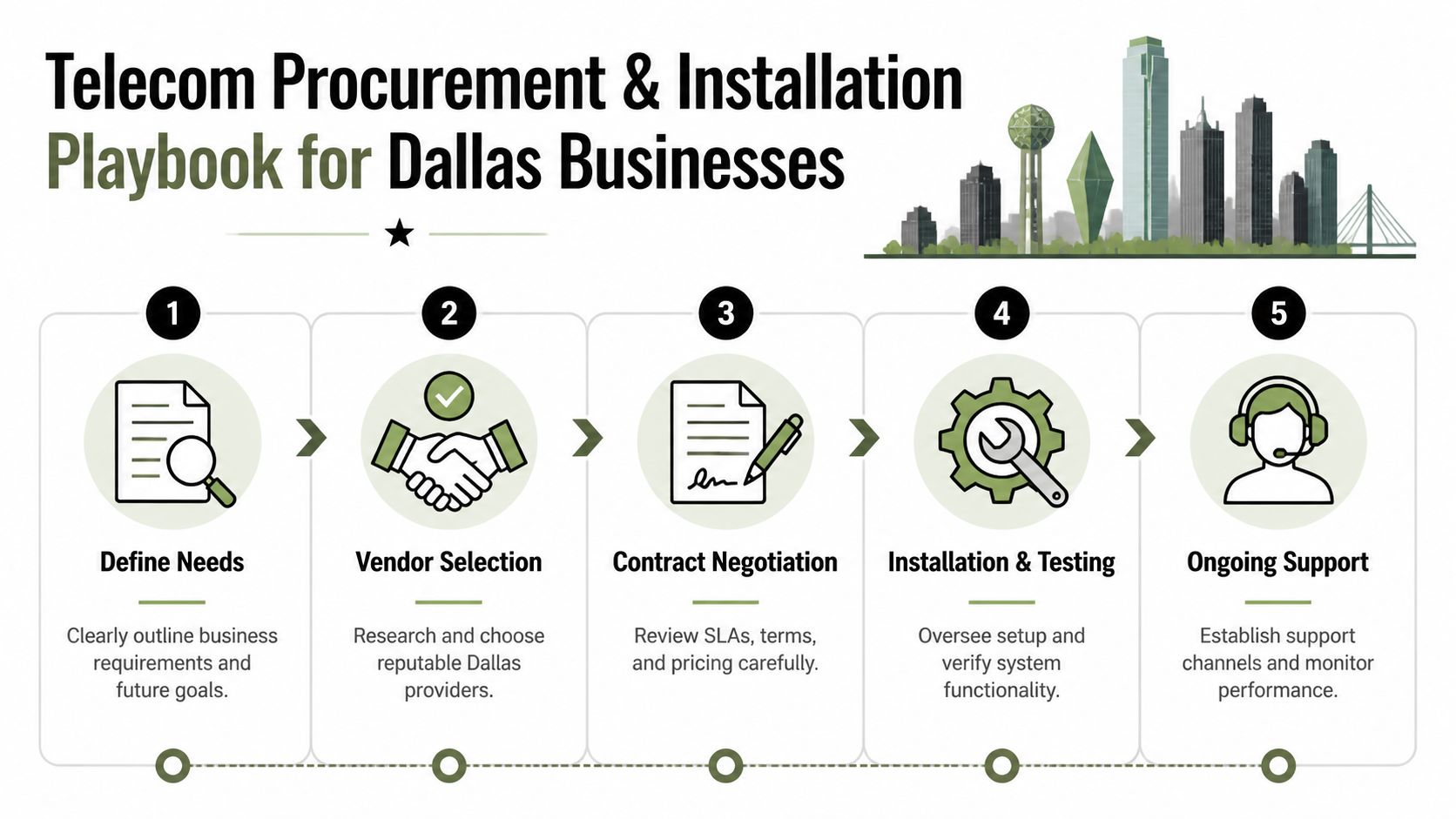
A clean procurement process usually follows this order:
Finalize the requirement document
Include user count, critical applications, voice needs, backup expectations, compliance concerns, and target install date.Confirm serviceability at the exact address
“Near the building” is not the same as “available in your suite.” Verify address-level serviceability early.Request apples-to-apples proposals
Make each provider quote the same bandwidth target, term length, managed equipment assumptions, and installation scope.Review SLA and support model together
A strong circuit paired with weak support still creates operational pain.Check building logistics before signing
Ask about riser access, conduit availability, landlord forms, certificate of insurance requirements, and after-hours access rules.Plan the cutover before the install starts
Don’t wait until the circuit is lit to decide who will test failover, voice routing, firewall readiness, and user impact.
Ask better vendor questions
Most sales teams can answer “What speeds do you offer?” That question won’t separate strong providers from weak ones.
Use questions like these instead:
- Describe your network redundancy within the DFW metroplex.
- What is your escalation process for a service outage at my exact service address?
- Who performs the installation work, and how much of it is subcontracted?
- What delays typically affect downtown or multi-tenant Dallas buildings?
- If the primary circuit is delayed, what temporary service options do you offer?
- How do you handle voice quality issues that appear only during peak usage?
- What testing happens before you declare the service ready for production?
A provider that answers with specifics usually runs cleaner projects. A provider that answers with slogans usually creates surprises.
Manage the building and cutover details
At this stage, projects often wobble. The carrier may be ready, but the building isn’t. Or your firewall vendor isn’t aligned. Or the old provider disconnects too early.
Focus on these operational details:
- Landlord coordination: Get property management involved early for access approvals and pathway questions.
- MPOE and suite path review: Verify how the circuit gets from the building entry point to your usable space.
- Internal network readiness: Firewalls, switches, QoS settings, and voice devices must be ready before turn-up.
- Parallel run period: Keep the old service active long enough to test the new environment under real load.
- Acceptance testing: Confirm cloud app performance, call quality, failover behavior, and remote access before signoff.
For businesses moving floors, changing suites, or relocating offices entirely, telecom planning should be tied directly to the move schedule. This practical guide to office relocation helps frame the sequence correctly so connectivity doesn’t become the item that delays occupancy.
Know what does not work
These habits create expensive problems:
- Signing before serviceability is verified
- Assuming install dates in a proposal are guaranteed
- Cutting off the old carrier too early
- Leaving voice migration until the last week
- Letting procurement choose on price without IT and operations input
The procurement process doesn’t need to be complicated. It needs to be controlled.
Making Your Final Decision with Confidence
The strongest telecom decisions are rarely the flashiest. They come from matching your business model to the right circuit, the right support structure, and a realistic implementation plan.
If you're choosing among telecommunications services Dallas providers, keep your filter simple. Start with how your people work. Match that to the right technology. Then pressure-test the provider’s SLA, support model, contract terms, and local execution capability. A weak answer in any one of those areas can undo a strong answer in the others.
This is also where long-term thinking pays off. Don’t buy only for today’s headcount or today’s software stack. Buy for the office you expect to run over the next few years, including remote work patterns, cloud adoption, additional locations, and the possibility of relocation within DFW.
A reliable telecom partner does more than deliver bandwidth. They reduce business friction. They protect call quality. They make growth easier. And when something breaks, they help you recover fast instead of arguing over where responsibility starts and ends.
If your Dallas telecom upgrade, office move, or data center transition also involves retiring old hardware, secure media destruction, or clearing out obsolete IT assets, Atlanta Green Recycling can help handle the end-of-life side responsibly. Their team supports organizations with secure electronics recycling, compliant data destruction, and pickup logistics, which is especially useful when telecom changes trigger equipment refreshes, decommissions, or site consolidations.