
Atlanta IT Asset Disposition for Businesses: Secure & Green

You know the scene. A locked storage room fills up with retired laptops, old monitors, decommissioned servers, and loose hard drives no one wants to sign off on. Finance wants the square footage back. IT wants chain of custody. Legal wants proof that no device leaves the building with recoverable data.
For an Atlanta business, IT asset disposition is not a janitorial task. It is an operating decision that touches security, compliance, financial recovery, and brand risk at the same time. In regulated environments such as healthcare, education, government, and finance, a weak process can leave you with missing asset records, uncertain data destruction, and electronics sent into the wrong downstream channels.
The better approach starts before pickup day. It starts with a clear policy for how assets are identified, removed from service, documented, sanitized, redeployed, resold, or recycled. That is the difference between clearing a room and running a controlled end-of-life program. Teams building that discipline usually benefit from aligning ITAD with broader IT asset management best practices so the handoff from active use to final disposition is documented from the start.
Atlanta adds another layer to the decision. Companies here deal with office moves, refresh cycles, hybrid work turnover, warehouse cleanouts, and data-bearing devices spread across multiple sites. The volume alone creates pressure. So does stakeholder scrutiny. Leadership wants clean reporting. Customers want proof that sensitive equipment was handled correctly. Employees increasingly notice whether a company treats e-waste as a responsibility or just a removal problem.
A disciplined ITAD program protects data, supports audit readiness, and keeps obsolete electronics out of bad disposal streams. It can also do more. With the right partner, retired technology becomes part of your ESG story, with measurable environmental outcomes and a social impact model that supports veterans and reforestation. That gives Atlanta businesses a practical way to turn a necessary operating expense into a program customers can respect and marketing teams can use.
Why Your Atlanta Business Needs a Strategic ITAD Plan
A familiar scene plays out in Atlanta offices every quarter. A storage room fills with retired laptops, monitors, access points, and a few old servers no one wants to claim. Then a move gets scheduled, a lease deadline appears, or leadership asks for a clean accounting of what is still on the books.
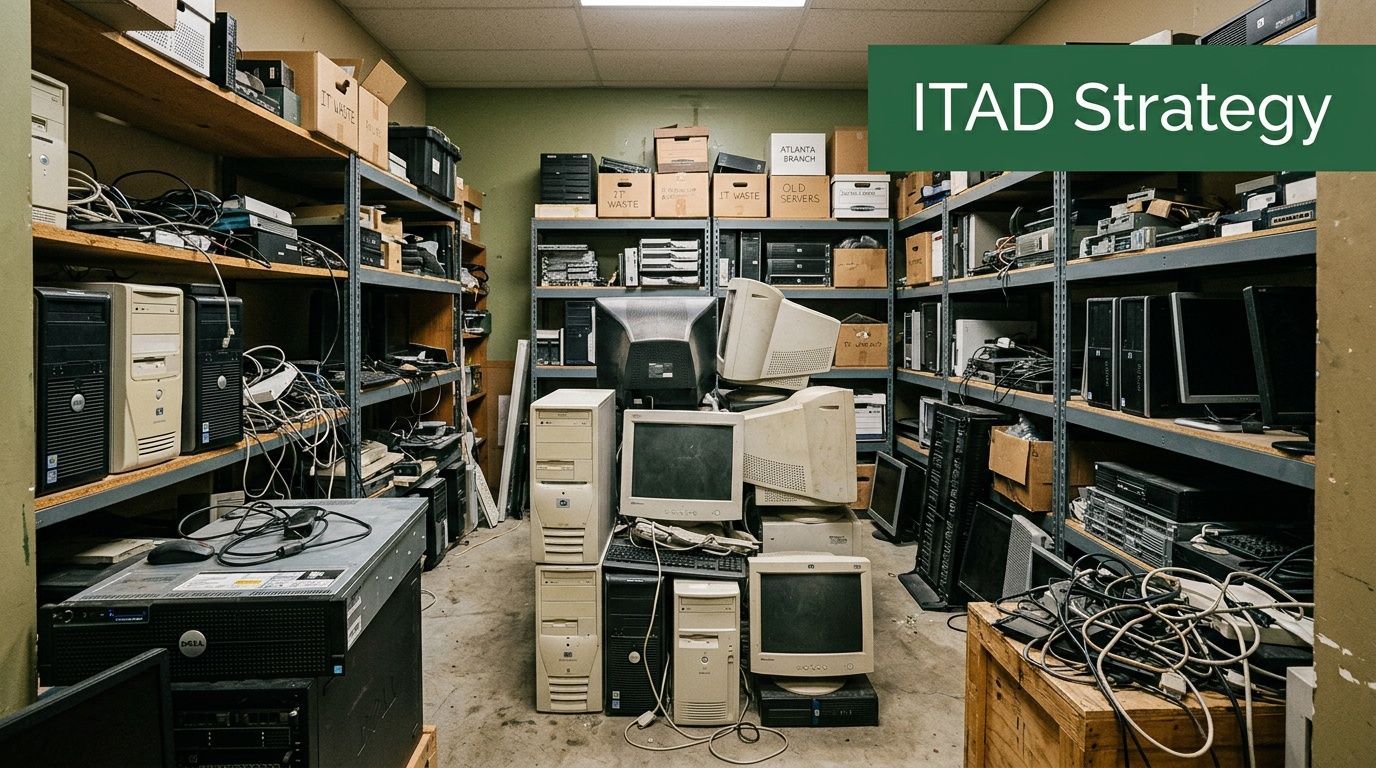
At that point, the problem is no longer just clutter. It is a mix of data risk, financial loss, and environmental exposure packed into the same pile. Some devices still contain sensitive information. Some can be refurbished or sold. Others belong in a controlled recycling stream with clear downstream documentation. A strategic ITAD plan separates those paths before the cleanup becomes urgent.
What businesses get wrong
The first mistake is treating IT asset disposition as a hauling job.
In practice, the critical decisions happen earlier. Someone decides whether a device gets held for redeployment, sent for wiping, placed for resale, physically destroyed, or left in storage for another six months. Without a defined process, staff members fill in the gaps on their own. That is how companies end up with missing serial numbers, unclear chain of custody, and no record that data was sanitized.
A second mistake is putting the entire process on facilities or office management. Those teams are important for access, staging, and logistics, but they should not be the only owners of equipment that may carry regulated data or residual value. IT, security, compliance, finance, and sustainability each have a stake in the outcome. If one group runs the project alone, blind spots show up fast.
Practical rule: If a device ever stored business data, treat it as a security-controlled asset until your team has documented proof of sanitization or destruction.
Why Atlanta companies feel this pressure
Atlanta businesses deal with constant hardware turnover. Office consolidations, hybrid work reshuffles, warehouse cleanouts, data center changes, and regular refresh cycles all push retired equipment into temporary holding areas. In a growing metro business market, those temporary piles tend to become permanent unless someone owns the process.
That pressure shows up faster in multi-site organizations. A few devices in one branch office may not look urgent. Multiply that across locations, add laptops assigned to remote employees, and the control problem gets expensive. The risk is rarely one dramatic event. It is the slow accumulation of unmanaged assets, weak records, and inconsistent handling.
A strategic plan fixes that by setting rules before pickup day. Which assets get remarketed. Which must be destroyed. Who signs off. What documentation is required. How value recovery is tracked. How sustainability results are reported. For companies that want a tighter handoff from active use to retirement, these IT asset management best practices help establish the discipline that ITAD depends on.
Why this is more than disposal
A mature ITAD program gives each stakeholder something concrete. Security gets documented handling of data-bearing assets. Compliance gets records that hold up under scrutiny. Finance gets visibility into recovery and write-off decisions. Operations gets storage space back and fewer last-minute fire drills.
There is also a business upside many companies miss. The right ITAD approach can turn a necessary operating cost into an ESG asset your leadership team can use. If your disposition partner supports veteran-focused job creation and measurable environmental outcomes such as reforestation, the program carries value beyond risk reduction. That social and environmental layer is significant because it gives Atlanta companies a credible story to share with customers, employees, and procurement teams who increasingly ask how e-waste is handled.
Handled well, ITAD stops being a cleanup project. It becomes part of how your business protects data, documents responsibility, and shows that operational decisions can support both sustainability and the veteran community.
Building Your ITAD Program Foundation An Internal Guide
Before you compare vendors, schedule pickups, or talk about sustainability, get your internal house in order. The cleanest ITAD projects usually come from companies that already know what they have, where it sits, and what rules apply to it.

A best-practice ITAD program starts with a documented assessment and inventory of obsolete electronics, then integrates compliance checks across data destruction standards, environmental laws, and vendor certifications, as outlined in this step-by-step ITAD best practices guide. That structure reduces compliance risk and lowers the odds of a preventable data exposure.
Start with an asset inventory that someone can audit
An inventory spreadsheet is fine if it’s complete. A partial list built from memory isn’t.
Track enough detail that your team can make a disposition decision without guessing:
- Asset identity: record device type, manufacturer, model, serial number, and internal asset tag if you use one.
- Current location: list building, floor, closet, data room, or user assignment so pickup crews don’t waste time hunting.
- Operational condition: mark whether the device powers on, is incomplete, is damaged, or is suitable for redeployment or resale review.
- Storage media presence: note whether the asset contains HDDs, SSDs, removable media, or embedded storage that affects destruction requirements.
If you run multiple Atlanta locations, create one master inventory and one site-level worksheet. That makes scheduling easier and reduces missed assets during office transitions.
Classify data before you classify equipment
Two identical laptops can require completely different handling. One may have held general office files. The other may have contained HR records, patient data, legal files, or financial information.
That’s why internal planning should separate data sensitivity from device condition. Start by asking:
- Did this asset ever store regulated, confidential, or customer data?
- Does it belong to a department with stricter retention or destruction requirements?
- Is software-based sanitization acceptable, or is physical destruction required?
- Does the business want reuse, remarketing, donation pathways, or final recycling only?
A retired server isn’t “old hardware.” It’s a container of obligations until your records show otherwise.
Define your primary objective before you call vendors
Some organizations say they want “responsible disposal,” but internally they mean different things. IT may want speed. Compliance may want stricter destruction. Finance may want value recovery. Sustainability may want landfill diversion and stronger CSR documentation.
Write down your priority order. In most real-world programs, it looks something like this:
- Security-first: ideal for healthcare, legal, government, and finance teams handling high-risk data.
- Value-recovery-first: common when large refreshes include reusable laptops, desktops, or servers.
- ESG-first: useful when the organization wants reporting, employee engagement, and visible sustainability outcomes.
- Hybrid: the most practical approach for midsize and enterprise companies with mixed asset classes.
For organizations building internal policy around this, these steps for starting an electronics recycling program at work help translate broad goals into a workable operating routine.
Get the right people in the room
The programs that stall usually have one missing stakeholder. The programs that move have clear roles.
Use a working group that includes:
- IT: validates assets, media types, and technical handling requirements.
- Compliance or legal: defines retention, destruction, and documentation expectations.
- Finance: approves value recovery rules, write-offs, and accounting treatment.
- Facilities or operations: coordinates staging, access, and pickup logistics.
- Sustainability or HR: uses the outcome for ESG reporting, employee communication, or community engagement.
Put your internal policy in writing
You don’t need a giant manual. You do need a short policy that answers basic operational questions. Who approves disposition? Who signs off on data destruction methods? What records must be retained? What happens to equipment with resale potential? What can never leave the premises without on-site sanitization?
That document prevents a lot of confusion later. It also helps you evaluate vendors on something more meaningful than pickup speed.
Secure Data Destruction Options for Atlanta Companies
When business leaders say they care about ITAD, they usually mean one thing first. They want to know the data is gone.
That concern is justified. Industry-standard ITAD processes align with NIST SP 800-88, moving from software-based sanitization to physical hard drive shredding, and for healthcare organizations improper data destruction is a serious HIPAA risk. The same guide notes that leading vendors provide full chain of custody tracking and can achieve over 99% reporting precision for asset records, which matters when auditors want a clean trail for every device in the batch, as described in this ITAD process and compliance guide.
The three real choices
Most Atlanta companies end up choosing among three handling paths.
| Method | Security Level | Best For | Allows Resale? |
|---|---|---|---|
| Software-based sanitization | High when properly documented under approved standards | Working devices that may be redeployed or remarketed | Yes |
| Degaussing | High for magnetic media when the media type is appropriate | Certain legacy magnetic storage environments | No, in most practical cases |
| Physical destruction | Highest finality for end-of-life media | Failed drives, highly sensitive data, or assets not intended for reuse | No |
When software wiping makes sense
Software-based sanitization is the right path when the business wants the device or drive to remain usable. This is common with late-model laptops, desktops, and some server drives that still have remarketing potential.
The key is documentation. A proper wipe isn’t “we reset the computer.” It’s a controlled, logged process tied to the asset identifier, performed under an accepted standard, and captured in the final report. If you can’t match the wipe result to the specific serial number, you don’t really have an audit-grade record.
This method works well for companies trying to balance security with value recovery. It does not work well when drives are damaged, inaccessible, encrypted in unmanaged ways, or too risky to release back into circulation.
When physical destruction is the better call
Physical destruction is what many regulated organizations choose for failed media, old drives with low residual value, or devices from highly sensitive workflows. Shredding removes the argument about whether data might still be recoverable.
That’s especially relevant in healthcare and finance, where the business consequence of uncertainty can outweigh the economic value of keeping the drive intact. For end-of-life assets, the safest answer is often the simplest one. Destroy the media, document it, and move on.
If your team is weighing process options, this Atlanta secure data destruction services guide gives a useful local view of how businesses structure that decision.
Security doesn’t come from the destruction method alone. It comes from matching the method to the asset, then proving what happened.
On-site versus off-site destruction
Atlanta companies need to think operationally, not emotionally.
On-site destruction reduces transportation exposure because data-bearing media is sanitized or destroyed before leaving your facility. That’s valuable when the asset set includes high-risk records, executive devices, healthcare systems, or legal archives. It also reassures internal stakeholders who need a visible chain of control.
Off-site destruction can work well when the vendor’s intake process, transport security, and reporting are strong. For large projects, especially across multiple locations, off-site processing may be more efficient. But efficiency isn’t the deciding factor. Trustworthy custody documentation is.
Ask these questions before choosing either model:
- Who handles the assets at pickup? Named personnel and documented handoff matter.
- How is chain of custody recorded? Serial-level records are stronger than pallet-level assumptions.
- What happens to exceptions? Damaged drives, unreadable media, and missing tags should trigger documented exception handling.
- What proof do you receive? Certificates matter, but detailed asset-level reporting matters more.
What doesn’t work
Three practices routinely cause problems:
- Bulk collection with weak labeling: if drives and devices are mixed without precise identifiers, reconciliation gets messy fast.
- IT staff doing ad hoc wiping: internal teams often mean well, but without repeatable logs and verification, the evidence usually falls short.
- Assuming cloud-first means device data doesn’t matter: browsers, local sync folders, saved exports, cached files, and endpoint tools often leave more local data than people think.
For Atlanta IT Asset Disposition for Businesses, the best data destruction method is the one your compliance team can defend, your auditors can trace, and your leadership can explain without crossing their fingers.
How to Select the Right Atlanta ITAD Partner
The wrong vendor can make a well-planned internal program fall apart. The right one makes pickup, decommissioning, data handling, reporting, and downstream processing feel controlled from the first call.
Atlanta’s market is mature enough that businesses have real choice. Providers in the area have built services around decommissioning, data destruction, recycling, and reselling, and some have achieved R2v3, ISO, HIPAA, and EPA compliance standards, according to this overview of Georgia ITAD provider capabilities. That’s good news for buyers, but it also means you need a sharper evaluation standard than “they say they recycle electronics.”
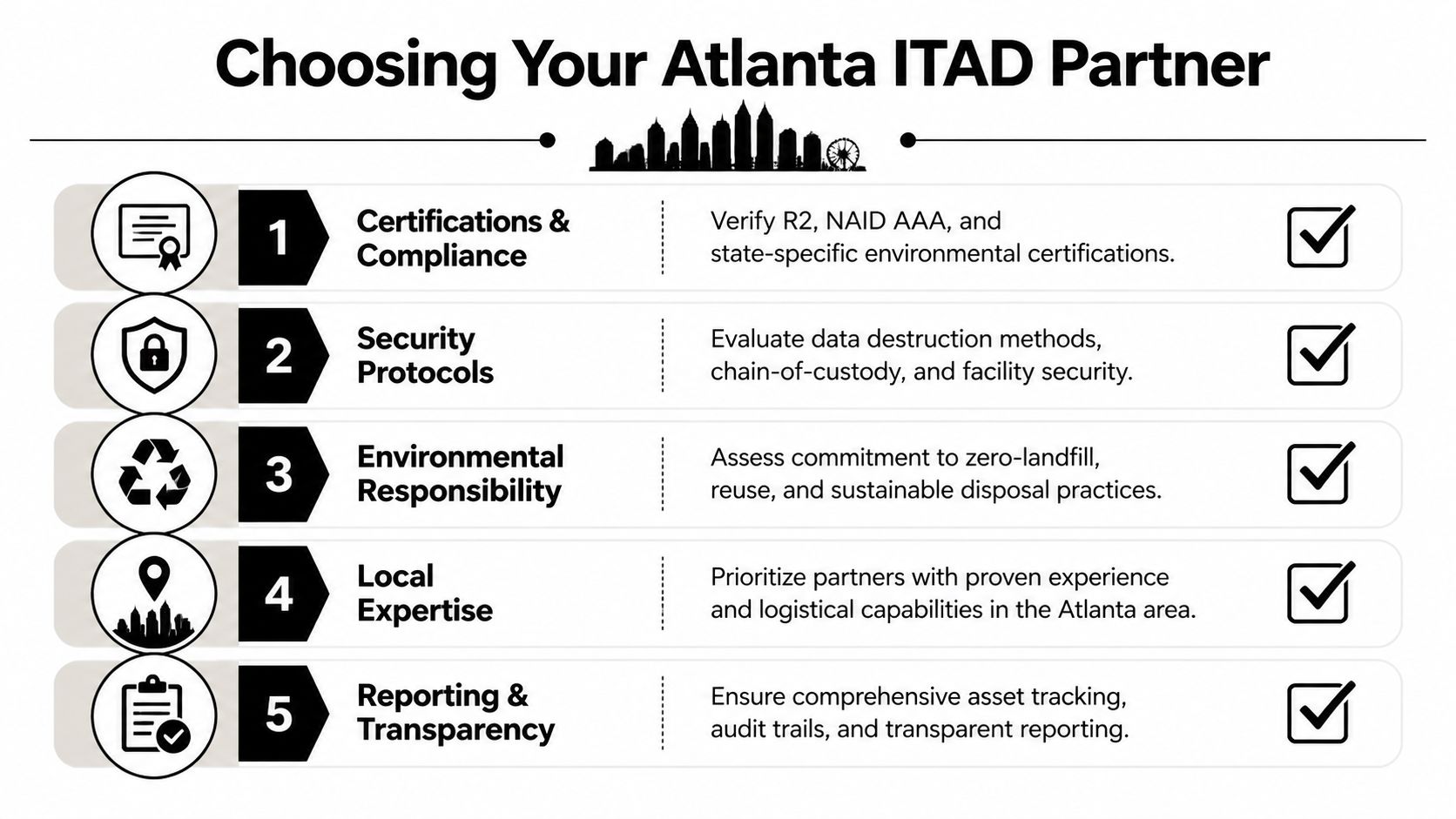
What to verify before you sign anything
A serious ITAD partner should be able to answer operational questions without sales fluff.
Look for these essential criteria:
- Documented certifications: R2v3 is a strong environmental and process signal. If the vendor handles data destruction, ask how they support secure destruction documentation and whether they align their process with recognized standards.
- Chain of custody controls: ask how assets are tracked from pickup through final disposition, and how exceptions are handled when serial numbers don’t match or devices arrive damaged.
- Detailed reporting: you want more than a generic certificate. You want itemized records that support audit requests.
- Decommissioning capability: if you’re dealing with racks, data center gear, or office shutdowns, the vendor should handle removal and packaging, not just curbside collection.
- Downstream clarity: ask where material goes after pickup. If the answer is vague, keep looking.
Questions that reveal the real quality of the partner
Most websites sound fine. The interview is where weak operators show themselves.
Ask these directly:
- How do you separate assets for remarketing versus destruction?
- What does your asset report look like?
- Can you support on-site work if our risk team requires it?
- How do you document final recycling for non-reusable material?
- Who owns the logistics process?
- What does your insurance and liability framework cover?
A capable provider should answer clearly and consistently. If every answer loops back to “we’ll figure it out,” that’s a warning.
If a vendor can’t explain their exception process, they probably don’t control it.
Why mission alignment matters too
Compliance gets you to baseline. It doesn’t differentiate your company internally or publicly.
A stronger partner helps you turn IT disposal into something useful for sustainability reporting, employee engagement, and local goodwill. That’s where a mission-driven model stands out. If your provider can tie electronics recycling to veteran support and reforestation, the same operational project can produce impact certificates, internal campaign material, and CSR-ready documentation.
That can support:
- Corporate recycling drives: useful when a business wants one event to handle cleanup and employee engagement.
- Seasonal campaigns: Veterans Day, Earth Day, and Arbor Day are natural times to connect retired technology to a visible cause.
- Digital recognition: a “Recycled with Purpose” style badge, impact summary, or partner acknowledgment can strengthen sustainability communications.
For businesses comparing local options, this directory of IT asset disposition companies is a practical starting point. One local option is Atlanta Green Recycling, which provides business-focused electronics recycling, secure data destruction, de-installation, logistics support, and documentation suited to organizations managing regulated or bulk equipment workflows.
The best partner doesn’t just remove assets. They reduce uncertainty, create usable records, and give your company a cleaner story to tell after the truck leaves.
Navigating ITAD Compliance in Georgia
Compliance in ITAD isn’t one action. It’s a chain of actions that has to hold up under review.
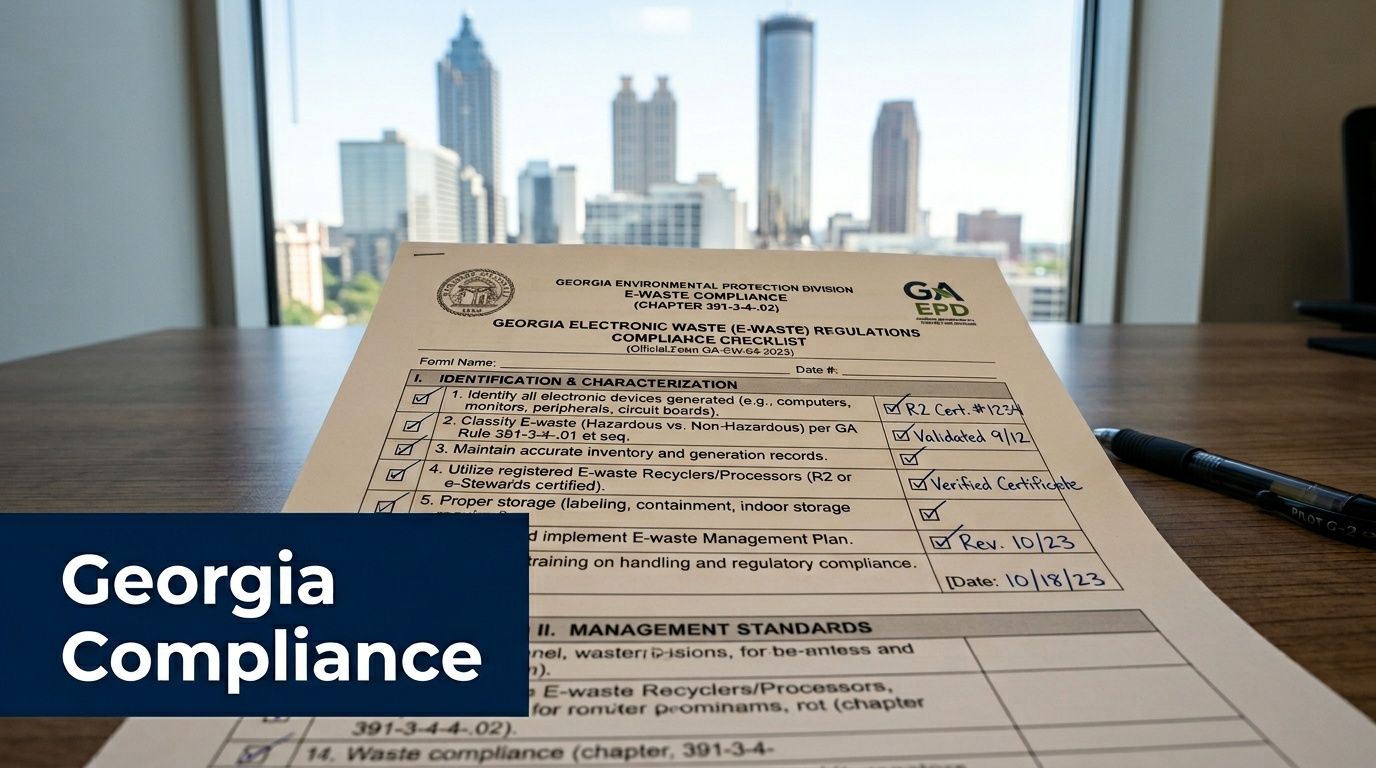
That’s why experienced teams don’t stop at “the drive was wiped.” They want to know who handled the device, when custody changed, where it went, how destruction or recycling was recorded, and what documentation will be retained if an auditor asks questions later.
What compliance really means in day-to-day operations
For healthcare organizations, retired devices can still contain HIPAA-regulated information if they haven’t been sanitized or destroyed through a controlled process. Financial institutions and companies holding consumer information face similar obligations around protecting data throughout the asset’s lifecycle.
On the environmental side, electronics can’t be treated like ordinary trash. Proper recycling workflows exist because devices may contain materials that require controlled handling. That’s why certifications, documented downstream processes, and final recycling records matter.
The records your business should insist on
A compliant process should leave behind a paper trail your team can use. At minimum, ask for:
- Asset inventory reconciliation: what was picked up, by serial or other unique identifier where applicable.
- Data destruction documentation: proof of sanitization or physical destruction tied to the assets involved.
- Recycling documentation: records showing how non-reusable material entered an appropriate recycling stream.
- Chain of custody evidence: logs that show possession and handling from pickup to final disposition.
Where Georgia businesses get exposed
The usual problem isn’t malicious conduct. It’s incomplete process control.
A company replaces equipment, stores retired devices for months, lets multiple departments move items around, and then sends a mixed batch out with limited documentation. At that point, nobody can say with confidence which devices held sensitive data, which drives were removed, or whether every listed asset was processed.
Compliance lives in the records. If the records are weak, the process is weak, even if everyone acted in good faith.
For Atlanta businesses, the practical standard is simple. Use a process that is secure, environmentally responsible, and fully documented from pickup through final outcome. That’s what keeps legal, security, and sustainability teams aligned when questions show up later.
Turning E-Waste into an ESG and Marketing Asset
Most companies still think of IT asset disposition as a line item to minimize. That’s understandable, but it misses part of the opportunity.

Many Atlanta providers talk about turning liabilities into a profitable process, but they often stop short of giving mid-market businesses a clear ROI model. That leaves decision-makers unsure whether ITAD is just a cost center or also a revenue opportunity, a gap highlighted in this overview of Atlanta IT asset disposition ROI questions.
Look at three kinds of return, not one
A useful business case for ITAD has three parts.
First, there’s risk reduction. If your program reduces the chance of data mishandling and creates cleaner documentation, that has real value even when it doesn’t show up as direct revenue.
Second, there’s asset value recovery. Some retired laptops, desktops, and servers still have remarketing potential if they’re processed correctly and kept in reusable condition.
Third, there’s ESG and brand value. This is the part many teams ignore, even though it can create internal goodwill and external visibility with very little extra effort.
Build a cause-based story around the work
If your business already has CSR or ESG goals, retired technology can support them in a visible way. A message like “Your old tech can house a veteran and grow a forest” reframes disposal as action. That matters because employees are more likely to engage with a mission than a logistics process.
A practical campaign can include:
- Corporate recycling drives: collect devices across one office or multiple sites, then summarize environmental and social impact for internal and external reporting.
- Seasonal activations: tie campaigns to Veterans Day, Earth Day, or Arbor Day so your PR and employee communications teams have a natural calendar.
- Impact documentation: issue plant-a-tree certificates, veteran support reports, or partner badges that procurement, HR, and marketing can use.
- LinkedIn thought leadership: show how operational recycling supports your company’s sustainability narrative without overstating claims.
For companies shaping that message, these benefits of e-waste recycling connect the operational side of electronics recycling with broader business and environmental goals.
What works better than generic sustainability language
Skip vague statements about “going green.” They don’t move people.
Specific, cause-linked messaging works better:
- Internal email campaigns: explain that decommissioned electronics are being handled securely and tied to veteran support and reforestation.
- Client-facing sustainability updates: mention responsible IT asset disposition as part of your broader operations practice.
- Community partnerships: co-host drives with veteran organizations, schools, municipalities, or environmental nonprofits in metro Atlanta.
The strongest ESG stories come from work your company already has to do. ITAD fits that perfectly because the operational need is real, and the impact can be documented.
When Atlanta businesses treat e-waste as both a risk-management task and a purpose-driven initiative, they get more from the same project. They clear storage, control data, improve documentation, and create a story people remember.
Frequently Asked Questions About Atlanta ITAD
How do I know whether equipment should be resold or destroyed
Start with two filters. First, determine the data risk tied to the device and whether sanitization is acceptable. Second, check condition and age. Equipment with reuse potential may fit a remarketing path if security requirements allow it. Failed drives and highly sensitive assets usually belong in a destruction workflow.
Should data destruction happen on-site
Sometimes yes. On-site destruction makes sense when your compliance team wants media destroyed before anything leaves the facility, or when the devices came from high-risk departments. Off-site can also work if the provider has strong chain of custody controls and reporting.
What departments should be involved in an ITAD project
IT, compliance or legal, finance, and facilities should all have a role. Sustainability, procurement, and HR may also matter if your company wants to document environmental outcomes or build an employee-facing campaign around the project.
What documentation should we expect after pickup
Ask for asset-level reporting where possible, data destruction records, recycling documentation, and chain of custody support. A simple pickup receipt is not enough for most business environments.
Can ITAD help with office moves and data center changes
Yes. ITAD is often part of office closures, relocations, refresh cycles, and decommissioning work. In those settings, the provider’s ability to handle packing, removal, tracking, and final reporting matters as much as the recycling itself.
Is there a way to connect ITAD with CSR goals
Yes. Many organizations use retired technology projects as part of ESG communication, employee engagement, and community partnerships. A cause-based model tied to veterans and reforestation gives the project a concrete story instead of a generic sustainability claim.
If your business needs a secure, documented, and sustainability-focused path for retired technology, Atlanta Green Recycling can help you plan an ITAD program that fits your compliance needs, logistics, and broader ESG goals across the Atlanta metro area.