
Secure Business Data Destruction Atlanta GA Services

If you manage operations or IT in Atlanta, you’ve probably seen the pile. Retired laptops from a department refresh. Old desktop towers from a move. Backup drives no one wants to touch because nobody is fully sure what’s on them. A few servers sitting in a locked room because “we’ll deal with them later.”
That pile looks like surplus equipment. In practice, it’s stored business risk.
Secure Business Data Destruction Atlanta GA isn’t just about getting rid of outdated hardware. It’s about making sure customer records, employee files, legal documents, financial data, login credentials, and internal communications don’t leave your control when the devices do. For healthcare groups, schools, law offices, manufacturers, local agencies, and data-heavy businesses across metro Atlanta, that distinction matters.
A secure destruction process also gives you something many teams forget to ask for until an audit arrives. Proof. Not a verbal promise. Not a pickup receipt. Actual documentation showing what assets were handled, how they were destroyed, and when the work was completed.
There’s another layer that deserves more attention. The right IT asset disposition partner can help you turn a disposal project into something useful for compliance, sustainability reporting, and community impact. If your company has ESG or CSR goals, retired electronics can support more than risk reduction. They can support a stronger story about how your business operates.
The Hidden Risk in Your Atlanta Office Storage Closet
An Atlanta office manager clears a storage room after a hardware refresh. The shelves hold old workstations, a few failed hard drives, retired networking gear, and several unlabeled laptops from former employees. The assumption is simple: the devices are old, so the value is gone.
The hardware value may be low. The data value often isn’t.
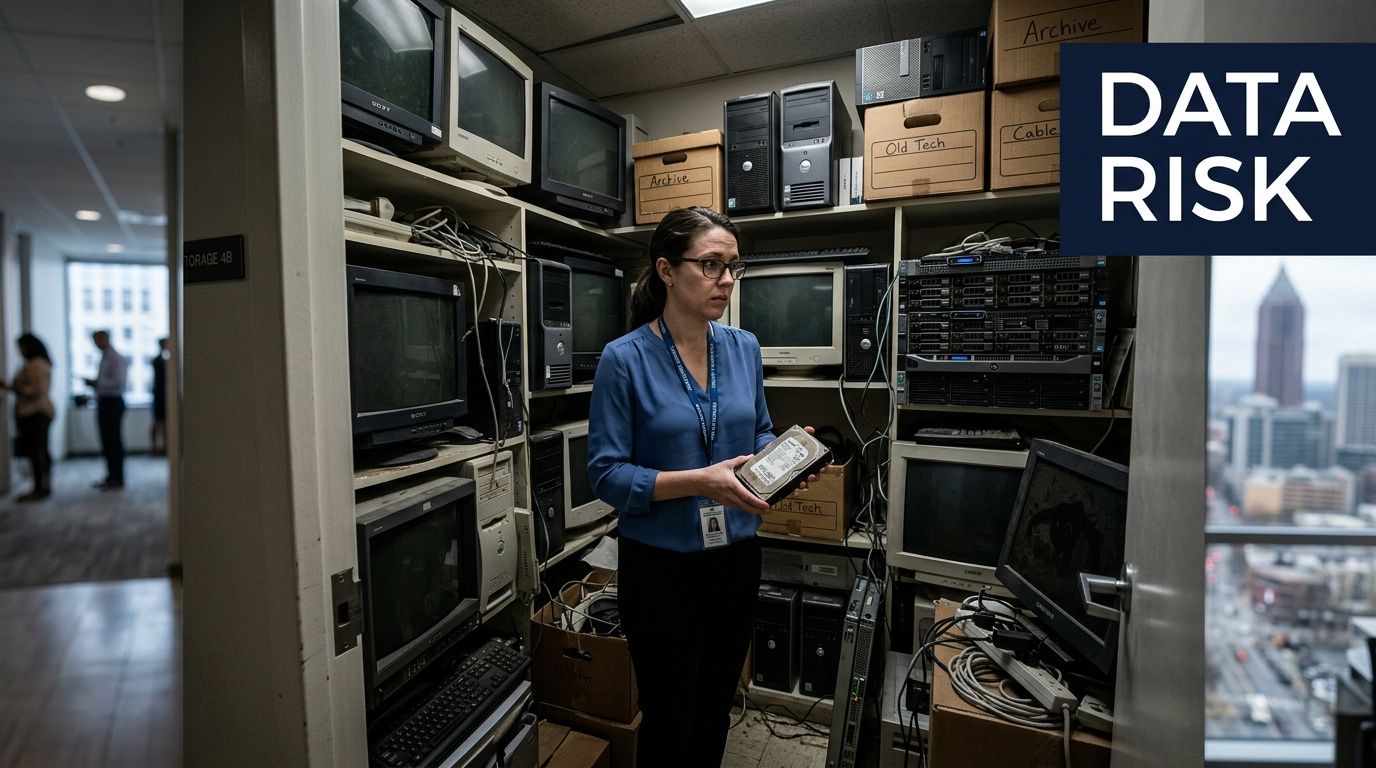
A surprising number of disposal problems start this way. Nobody intentionally mishandles data. A team is just busy. Equipment gets stacked in a back room, moved during an office relocation, or sent out with general recycling before anyone confirms what’s still stored on the drive.
That’s why disposal has to be treated as a security event, not a housekeeping task. The financial stakes are high. The average cost of a data breach for U.S. businesses exceeds $4.45 million, and the Atlanta city ransomware attack incurred $2.7 million in direct recovery costs while causing the permanent loss of years of vital data, according to Beyondo Surplus on secure data destruction.
Why old devices still create live risk
A retired device can still contain:
- Customer information that your staff no longer accesses day to day
- HR records stored locally by a former employee or department lead
- Financial spreadsheets copied for offline work
- Saved credentials in browsers, local apps, or scripts
- Backup fragments from testing, migration, or system support work
The confusion usually comes from one false assumption: if a computer won’t boot, the data must be gone. That’s not how storage media works. A damaged or obsolete machine can still hold readable data.
Practical rule: If a device ever touched sensitive business information, treat it like a data-bearing asset until destruction is documented.
What Atlanta managers usually need
Most operations managers aren’t looking for theory. They need a process that answers basic questions fast:
- What do we have
- What’s the right destruction method
- Should it happen on-site or off-site
- What paperwork do we need for audit and compliance
- Can this project also support our sustainability goals
Those questions are the difference between a rushed cleanup and a defensible disposal program.
The Three Levels of Secure Data Destruction
Not every device needs the same handling. That’s where many teams get stuck. They hear terms like wiping, degaussing, and shredding and assume they’re interchangeable. They aren’t.
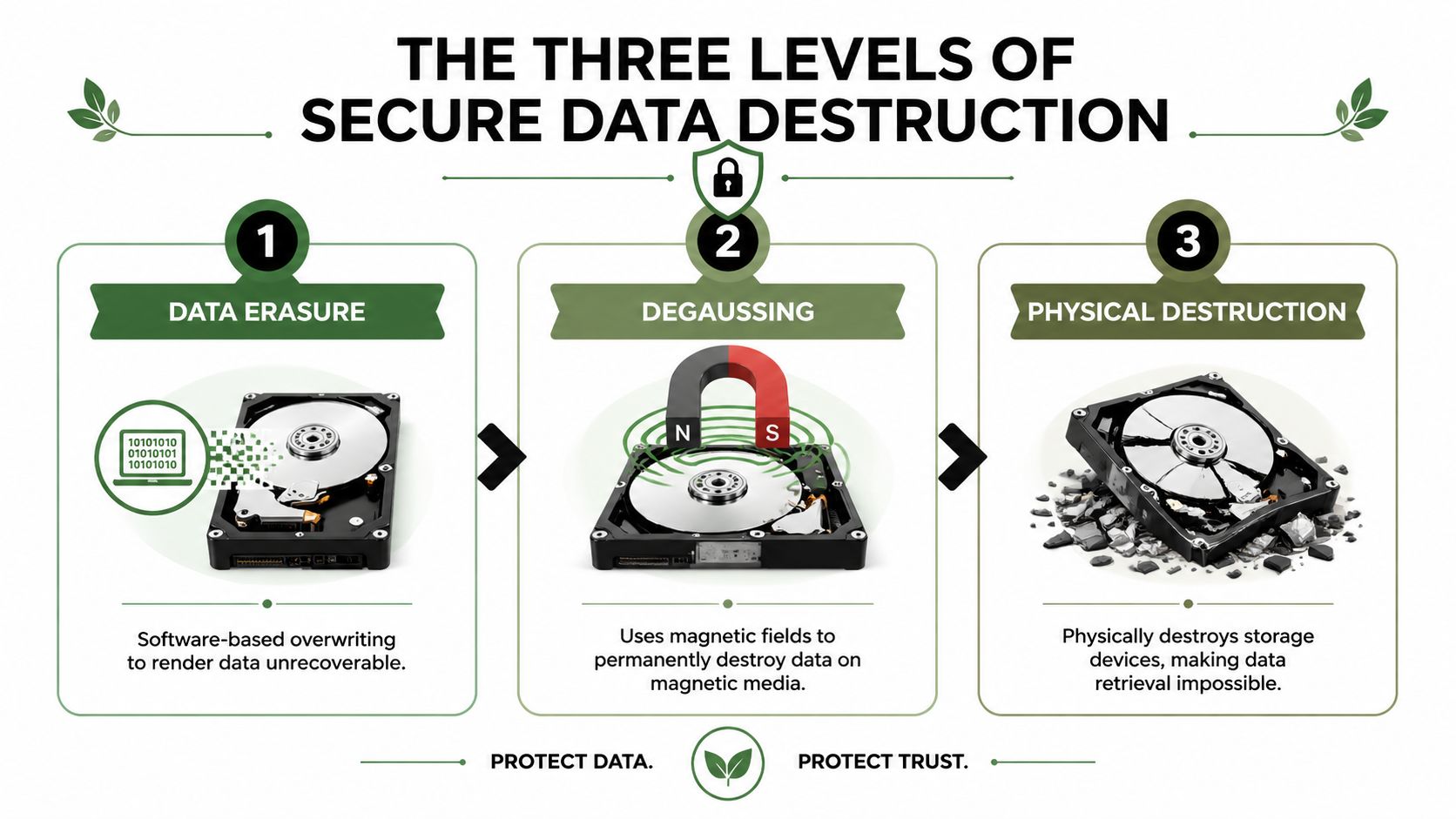
A simple way to think about secure destruction is as three levels of control, each suited to different media, different reuse plans, and different risk profiles.
Level one is data wiping and sanitization
Think of this as digitally scrubbing a drive clean. Specialized software overwrites stored information so the original data can’t be practically recovered. This approach is useful when equipment may be reused, remarketed, or redeployed internally.
For operations teams, this is often the best fit when the device still has lifecycle value. A functioning laptop, desktop, or server drive may not need to be physically destroyed if your policy allows reuse and the sanitization method meets your risk threshold.
What confuses readers most is the difference between deleting files and wiping a drive. Deleting removes easy access. Wiping is designed to remove recoverable data in a controlled, documented way.
A provider offering secure destruction of data services in Atlanta should be able to explain its wiping process in plain language and tell you when software sanitization is appropriate versus when physical destruction is the safer choice.
Level two is degaussing
Degaussing uses a powerful magnetic field to disrupt the magnetic structure of certain storage media. In plain English, it scrambles the data so the original information can’t be read.
This method is typically associated with magnetic media. It is not a universal answer for every modern device, which is why you don’t want a one-method-fits-all vendor. The usefulness of degaussing depends on the actual media type in your inventory.
Here’s where buyers often get confused. Degaussing can be highly effective for the right media, but it’s not about making the device reusable. It’s about rendering the stored data unreadable.
A good destruction plan starts with inventory, not machinery. You identify the media first, then match the method.
Level three is physical shredding
Physical shredding is the most final option. If wiping is like deep-cleaning a whiteboard, shredding is like turning the whiteboard into pieces. Once the media is physically broken down, retrieval becomes impractical.
This is often the preferred route for:
- Failed hard drives that can’t be sanitized through software
- End-of-life media with no resale or reuse value
- Highly sensitive assets where organizations want the strongest possible finality
- Mixed lots from moves, closures, or decommissions where speed and certainty matter
Shredding also gives nontechnical stakeholders peace of mind. They can understand it immediately. The drive no longer exists in usable form.
How to choose the right level
The right method depends on a few straightforward questions:
| Question | Best-fit direction |
|---|---|
| Do you want to reuse the device | Wiping may fit |
| Is the media magnetic and unsuitable for reuse | Degaussing may fit |
| Is the asset failed, obsolete, or highly sensitive | Physical shredding often fits |
| Do you need visible finality for internal policy or audit confidence | Physical shredding is usually easier to defend |
For many Atlanta businesses, the practical answer isn’t one method. It’s a mix. Some devices get sanitized for reuse. Others get shredded because the risk, condition, or policy requires it.
On-Site vs Off-Site Destruction Solving the Atlanta Logistics Puzzle
Once you know how data should be destroyed, the next decision is where it should happen. This is less about theory and more about logistics, trust, and documentation.
For Secure Business Data Destruction Atlanta GA projects, the on-site versus off-site choice often comes down to one tension. Do you want maximum physical control, or maximum processing efficiency?
What on-site destruction gives you
On-site destruction usually means a mobile shredding setup or an on-premises service team that handles the work at your location. Your staff can witness the process, and the chain of custody stays visually tight from room to truck to destruction.
That matters when a compliance officer, privacy officer, or department leader wants to see the assets destroyed before they leave the property. It also matters when the devices contain especially sensitive records.
If your organization wants a witnessed option, local teams can review on-site shredding services near Atlanta as part of their vendor shortlist.
What off-site destruction gives you
Off-site destruction usually happens at a dedicated facility built for volume, standardized processing, and consolidated workflows. That setup can be more efficient when you’re handling larger batches, mixed asset categories, or projects that involve both destruction and broader recycling work.
The tradeoff is transport. Once the equipment leaves your facility, you’re relying on chain-of-custody procedures, driver controls, secure loading, tracking, and receiving protocols to protect the assets in transit.
That doesn’t automatically make off-site a bad option. It means transport controls become part of the risk assessment.
The Atlanta factor matters
Atlanta logistics aren’t abstract. Traffic, loading dock timing, multi-location pickups, and office tower access all affect the disposal plan. According to Beyondo Surplus on secure data destruction services, on-site mobile shredding averages $15-25/device higher than off-site, while off-site can cut costs by 30%. The same source notes that recent Q1 2026 Atlanta traffic delays were up 22%, which amplified off-site transport vulnerabilities.
That doesn’t mean every company should default to on-site. It means transportation risk should be discussed openly, especially for regulated data or executive-level assets.
On-site vs off-site comparison
| Factor | On-Site Destruction (Mobile Shredding) | Off-Site Destruction (Plant-Based) |
|---|---|---|
| Chain of custody visibility | Strong visual control at your location | Depends on transport and receiving controls |
| Witnessed destruction | Easy for staff to observe | Usually not immediate on your premises |
| Cost | Higher per device | Often more cost-efficient |
| Speed for bulk processing | Can be limited by truck capacity and site conditions | Efficient for larger consolidated loads |
| Best fit | Sensitive data, high-trust requirements, executive oversight | Large batches, cost-sensitive projects, mixed recycling streams |
| Main concern | Higher price and scheduling complexity | Transport exposure |
Choose on-site when your policy values witnessed destruction more than price. Choose off-site when your process values facility efficiency and your vendor can document secure transport.
A practical decision rule
Use on-site when any of these are true:
- Your legal or compliance team wants witnessed destruction
- The data is highly sensitive
- You have leadership attention on the project
- You need immediate proof tied to a specific pickup event
Use off-site when these are true:
- You’re processing a broad batch of retired assets
- Cost control matters
- Your vendor can show disciplined chain-of-custody handling
- You’re combining destruction with recycling and asset disposition work
Many businesses land on a hybrid. They sanitize or segregate certain devices on-site, then route lower-risk equipment for secure off-site processing. That kind of nuance usually produces a stronger operational result than a blanket rule.
Meeting Compliance Demands in Atlanta
Most organizations don’t struggle because they ignore compliance. They struggle because compliance language gets abstract fast. Teams hear acronyms, certifications, and legal terms, but they’re not always told what those things mean on pickup day.
The practical issue is simple. If you ever need to prove that a retired device was handled properly, your vendor’s process has to stand up to questions from legal, security, procurement, and auditors.

Data-breach pressure keeps pushing this issue higher on the priority list. In the first three quarters of 2023, the U.S. recorded 2,116 data breach incidents, surpassing the previous annual high, according to Research and Markets on the secure data destruction market. That kind of environment makes audit-proof handling more than a nice extra.
What compliance usually means in real life
For Atlanta businesses, the compliance conversation usually comes down to four questions:
- Who handled the devices
- Where were they at each stage
- How was the data destroyed
- What documents prove the work happened
That’s why chain of custody matters so much. It records possession and movement from your site through final processing. If there’s a gap, you have a defensibility problem.
A Certificate of Destruction is the final proof point. It’s more than a receipt. It should tie the completed work to specific assets, dates, and destruction methods. Teams that want a plain-language explanation can review what a certificate of destruction includes.
Certifications are useful, but paperwork is what saves you
Buyers often focus on certifications first. Certifications matter. They signal that a vendor follows defined procedures. But documentation is what your team reaches for during an audit, incident review, or internal investigation.
Ask for records that show:
- Serialized asset tracking so devices aren’t treated as anonymous scrap
- Method detail such as wiping, degaussing, or shredding
- Completion dates that match the actual service event
- Chain-of-custody records showing custody transfers
- Final destruction confirmation tied back to your inventory
If a vendor can’t show you sample documentation before the project starts, assume the documentation will disappoint you after the project ends.
Compliance also involves your legal workflow
A data-destruction project often overlaps with contract review, records retention questions, litigation holds, and vendor-risk review. If your legal or operations team is tightening that side of the process, it can help to explore legal tools from LegesGPT for ideas on organizing legal workflows around documentation, review, and defensible recordkeeping.
That’s especially useful when multiple departments are involved and nobody wants the disposal file to live only in someone’s inbox.
The main misunderstanding to avoid
Many managers think compliance is achieved when the truck leaves the building. It isn’t.
Compliance is achieved when your organization can later prove, with confidence, what happened to each relevant asset. Without that, you may have had a secure event in practice, but not a defensible one on paper.
From E-Waste to ESG An Impact-Driven Approach
An Atlanta operations manager approves a hardware cleanout, gets the drives destroyed, files the certificate, and considers the job closed. The security task is complete, but the business decision is only half used.
Retired equipment affects more than risk. It also affects how your company handles waste, documents environmental performance, and shows up in the community. A disposal project can stay a narrow compliance event, or it can produce security evidence, sustainability records, and visible local impact from the same workflow.
That distinction matters because IT asset disposition sits downstream from choices your team already makes. You decide when offices are cleaned out, when devices leave service, which vendor receives them, and what records come back. ESG teams usually do not control those moments. Operations does.
A stronger model treats secure destruction as one part of a broader cause-driven ITAD program. The security basics still apply. You need wiping when appropriate, physical destruction when needed, documented custody, and final reporting tied to inventory. Then you add a second layer. The recycling and disposition process also supports outcomes your leadership can use in ESG and CSR reporting.
For an operations manager, the practical shift is simple. Instead of reporting, “We disposed of obsolete assets safely,” you can report a fuller result:
- Data-bearing devices were handled with documented destruction controls
- Retired electronics were directed into responsible recycling streams
- The project produced records that support sustainability reporting
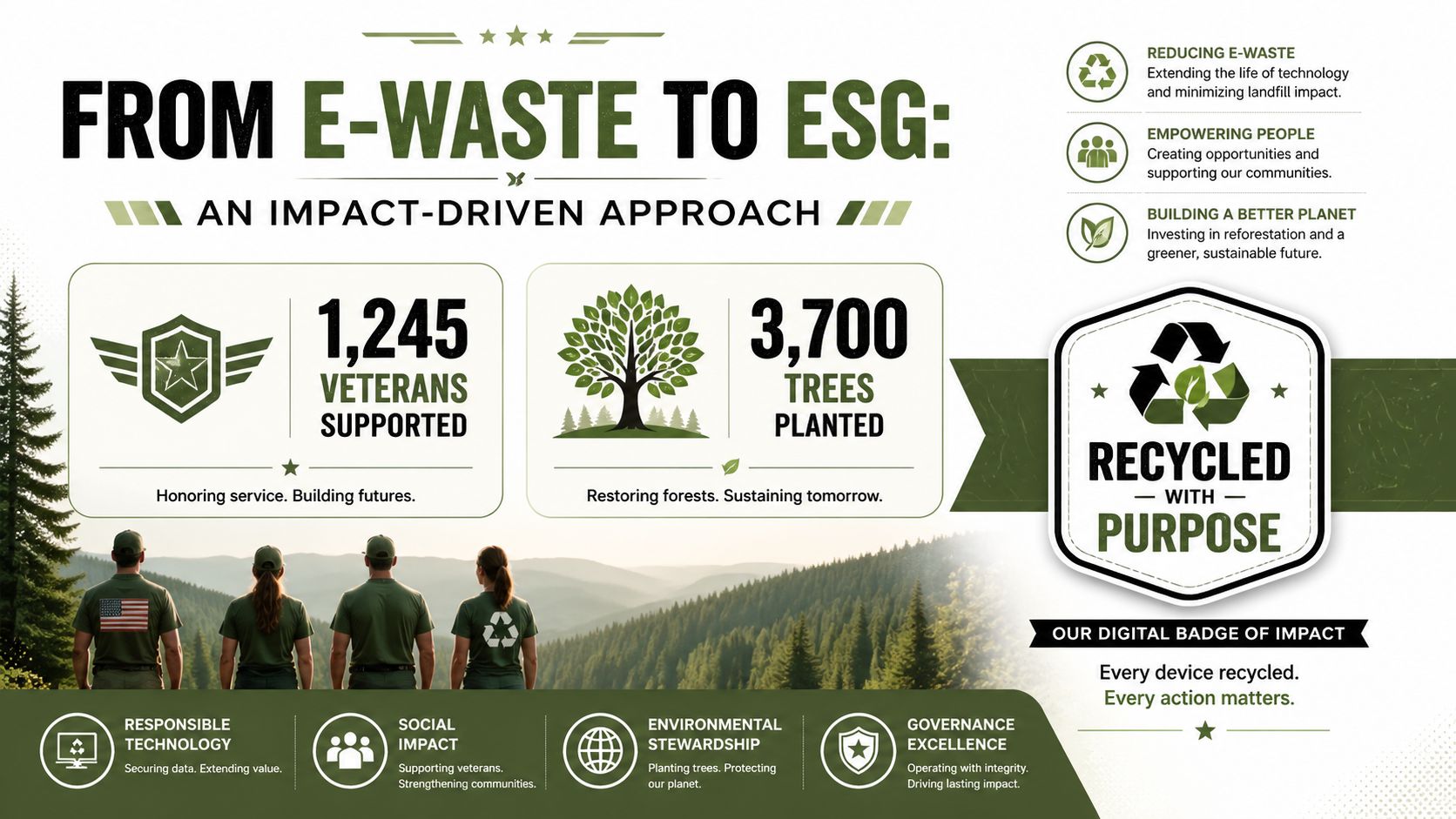
- The work contributed to community goals such as veteran support and reforestation
That changes the value of the project. Secure destruction remains the floor. ESG evidence becomes the added return.
Why this matters inside the business
Many operations leaders assume ESG belongs to another department. In reality, ESG reporting works like chain of custody. If the records are not created during the event, they are difficult to recreate later.
That is why this topic should not feel like a sudden add-on to security. The same discipline that protects data also creates trustworthy sustainability documentation. Asset counts, pickup dates, downstream processing records, and final certificates are not only audit tools. They are also the raw material for internal ESG reports, board updates, and customer questionnaires.
A mission-driven partner adds one more advantage. The story is easier to explain.
“Retired laptops were processed securely and recycled responsibly” is acceptable. “Retired laptops were processed securely, helped fund veteran support, and contributed to reforestation” is specific enough for employees, leadership, and community stakeholders to remember. People respond to concrete outcomes.
What a mission-driven program can include
The best programs make impact visible without weakening security standards. In practice, that can include:
- Impact certificates for internal ESG or CSR files
- Reforestation records tied to technology recycling activity
- Veteran-support reporting connected to the disposition program
- Employee collection events that pair office cleanouts with a clear social purpose
- Recurring service plans that turn one-time disposal into a trackable program
This improves participation. Employees are more likely to clear drawers, return aging devices, and follow disposal procedures when they understand both the risk being reduced and the benefit being created.
Why vendor selection changes here
At this stage, price per pound or price per drive tells only part of the story. A vendor may destroy media correctly and still leave you with little else. Another may deliver the same security controls plus documentation your sustainability team can use.
That is why a mission-driven partner stands apart at this stage. You are evaluating whether the provider can protect data, process electronics responsibly, and connect the event to outcomes that matter beyond the loading dock.
Atlanta Green Recycling is one example of that model. Its service mix includes secure data destruction, electronics recycling, pickup logistics, and support for organizations planning larger retirement projects such as Atlanta data center decommissioning services. The company’s broader mission also ties ITAD activity to veteran aid and tree planting, which gives Atlanta businesses a clearer way to connect disposal decisions with ESG goals.
Questions worth asking before you choose
Security questions still come first, but they should not be the only questions.
Ask vendors:
- What impact records do you provide beyond the destruction certificate
- Can you connect serialized assets or project totals to recycling outcomes
- Do you support reporting that helps with ESG, CSR, or customer vendor reviews
- How does your program contribute to community outcomes such as veteran aid or reforestation
- Can this be structured as a repeatable program instead of a one-time pickup
A well-run data destruction project removes risk. A mission-driven ITAD program removes risk and leaves your organization with something useful to report, something credible to share, and something local people can benefit from.
Atlanta Data Center Decommissioning In Action
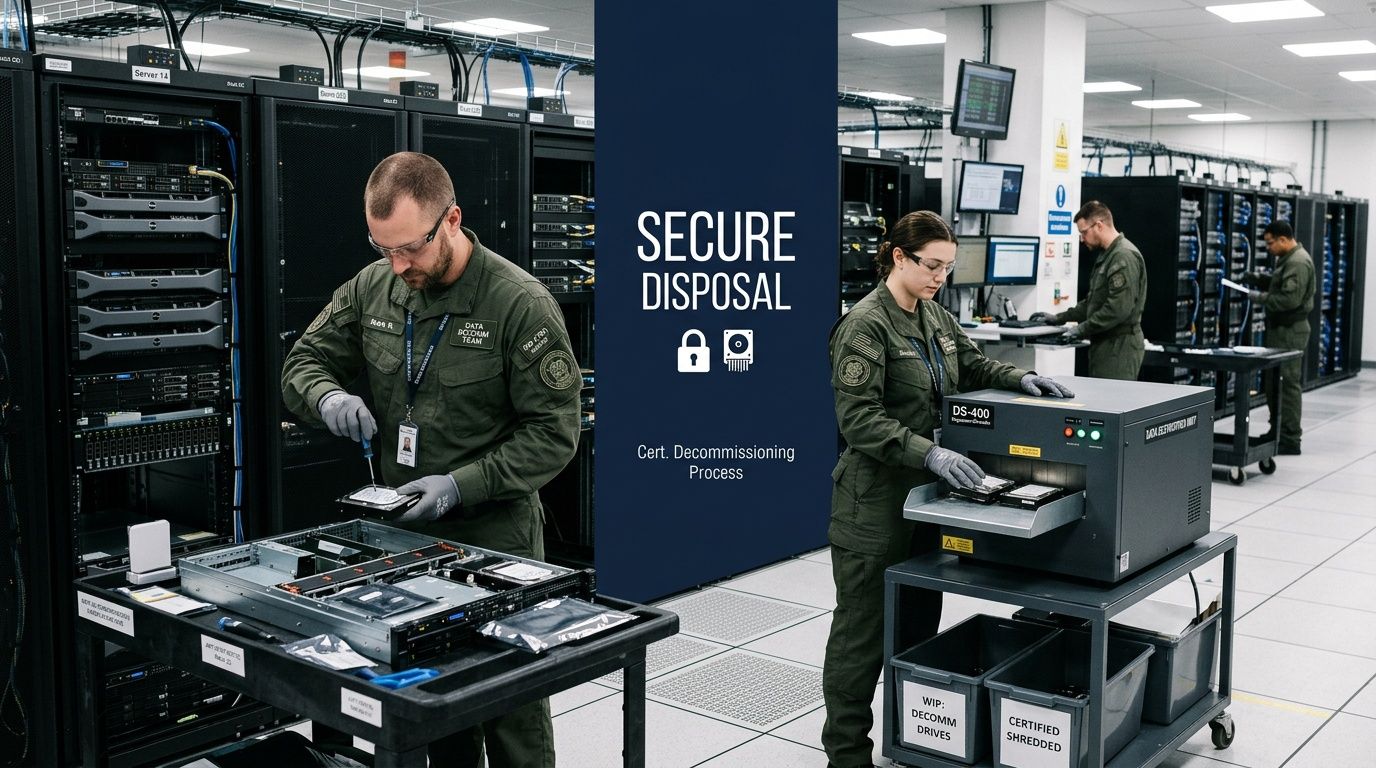
A regional company in the Atlanta metro area closes a server room after moving workloads to a new environment. The operations team now has racks to clear, loose drives to track, network hardware to remove, and a deadline tied to lease obligations. The pressure is familiar. They can’t leave equipment behind, and they can’t afford confusion about what happened to the data.
A decommissioning project requires structure.
Step one is scoping the environment
The first job isn’t destruction. It’s clarity. The team identifies what equipment is in place, which assets contain data, what must be returned, what can be retired, and which departments need signoff.
That planning stage often reveals hidden complexity. A rack may contain active-looking equipment that was abandoned after a prior migration. Loose drives may be stored in separate cabinets. Backup media may be held by another team entirely.
For organizations planning a larger shutdown or migration, Atlanta data center decommissioning services can help frame the workflow from inventory through final disposition.
Step two is inventory and serialization
Once the scope is clear, every relevant asset gets recorded. That includes visible hardware and loose media. Serialization matters because a decommission isn’t defensible if the records only say “miscellaneous drives removed.”
This step usually creates the working list that operations, compliance, and procurement will all refer back to later.
A sound inventory should answer:
- What was removed
- Where it came from
- Whether it contained data
- What disposition path was assigned
Step three is de-installation and segregation
Technicians disconnect equipment, label it, and separate it by disposition path. Reusable assets may be routed for sanitization. Failed or end-of-life storage media may be isolated for physical destruction. Non-data-bearing electronics may go to the recycling stream.
Projects often go wrong if they’re rushed. Teams mix everything together “to save time,” then spend days reconstructing records after the fact.
In a decommission, speed comes from organized segregation, not from handling everything as one pile.
Step four is matched destruction strategy
A practical project often uses a hybrid approach. Some assets are sanitized because the organization wants to preserve reuse value. Other media are shredded because policy, condition, or sensitivity calls for final destruction.
That mix is normal. It’s also one reason decommissions need more than a generic pickup crew. The provider has to understand that one room can contain multiple handling rules.
Step five is final documentation and reporting
At the end, the client should receive a package of records that closes the loop. That usually includes asset lists, chain-of-custody records, destruction confirmation, and any related recycling or impact documentation.
For an operations manager, this is the finish line. Not when the room is empty. When the file is complete.
A well-run decommission should leave you with a clean space, a clear paper trail, and no guessing about where the data-bearing equipment went.
Your Secure Data Destruction Partner Checklist
Choosing a vendor gets easier when you stop asking broad questions like “Are you secure?” and start asking for specific proof. The right partner for Secure Business Data Destruction Atlanta GA should fit your risk level, your logistics, your documentation needs, and your company’s broader values.
Use this checklist during vendor review.
Check the actual destruction options
A credible provider should offer more than one path. Some assets need sanitization for reuse. Others need physical shredding because reuse isn’t possible or policy won’t allow it.
Look for:
- Method flexibility so the vendor can match wiping, degaussing, or shredding to the asset type
- Clear explanations in plain language, not just technical jargon
- Policy alignment with your internal rules for reuse versus destruction
If a provider pushes a single method for every situation, they may be simplifying their process at your expense.
Check the logistics model
You want a vendor whose operating model fits your facility, your schedule, and your security posture.
Ask:
- Do you offer both on-site and off-site handling
- How do you secure assets during loading and transport
- Can you support office moves, storage cleanouts, or multi-site pickups
- What happens if our building has dock restrictions or access limitations
A useful starting point is comparing providers that specialize in IT asset disposition companies and services in Atlanta with the practical realities of your own environment.
Check the paperwork before the pickup
Many buyers are too trusting. Don’t wait until after the project to find out what your records will look like.
Request samples of:
- Chain-of-custody forms
- Certificates of destruction
- Serialized inventory reporting
- Pickup and completion records
If the records aren’t detailed, organized, and readable before the job, they won’t become better after the job.
Check whether the partner helps your ESG story
A disposal vendor may solve risk and still leave value on the table. If your company reports on CSR, sustainability, or community impact, ask whether the provider supports that work in a documented way.
Look for signs of a stronger fit:
- Impact certificates that can support internal reporting
- Environmental reporting tied to responsible recycling outcomes
- Community-focused initiatives such as veteran support or tree planting
- Campaign readiness for seasonal drives and employee engagement
This is where a mission-driven partner stands apart. They don’t just remove obsolete devices. They help you convert a disposal event into a documented business win.
Check how they answer basic questions
Pay attention to how the vendor responds when you ask simple operational questions. Strong partners give direct answers. Weak ones hide behind vague assurances.
Good signs include:
| Question | What a strong answer sounds like |
|---|---|
| How do you track assets | Clear explanation of inventory and serialized handling |
| What proof do we receive | Specific documents named up front |
| Can you adapt to our site | Practical details about pickups, de-installation, and chain of custody |
| Can this support our sustainability reporting | Concrete explanation of available impact documentation |
The pattern is simple. The best vendor conversations feel concrete. You leave knowing what will happen, who will do it, and what records you’ll get.
If you’re responsible for retired IT assets in Atlanta, don’t settle for a company that treats the job like junk removal. You need a partner that handles security, compliance, logistics, and community impact with equal seriousness. That’s how you reduce risk and create value at the same time.
If your organization is ready to clear obsolete devices, protect sensitive data, and turn retired tech into a stronger sustainability story, consider scheduling a pickup with Atlanta Green Recycling. A well-run ITAD program doesn’t just remove equipment. It gives your team documented destruction, cleaner operations, and a practical way to support the community while doing the secure thing right.