
Atlanta Data Center Decommissioning Services: A Guide

If you're planning your first major shutdown, consolidation, or migration out of a data room in metro Atlanta, the pressure usually lands on the same people. IT has to protect data. Facilities has to coordinate access. Compliance wants documentation. Finance wants to know what can be recovered, what must be destroyed, and what the timeline will do to the budget.
That mix is exactly why Atlanta Data Center Decommissioning Services can't be treated like a junk haul or a simple move. In this market, the job starts long before anyone touches a rack. Metro Atlanta hosts more than 150 operational data centers as of 2026, and the pace of expansion has pushed decommissioning into a much more disciplined, audit-driven practice than most first-time clients expect (Atlanta market overview and project timing).
Handled well, a decommissioning project closes risk, clears space, protects your chain of custody, and gives your organization something useful for ESG reporting. Handled poorly, it creates gaps that show up later in audits, asset reconciliation, and legal review.
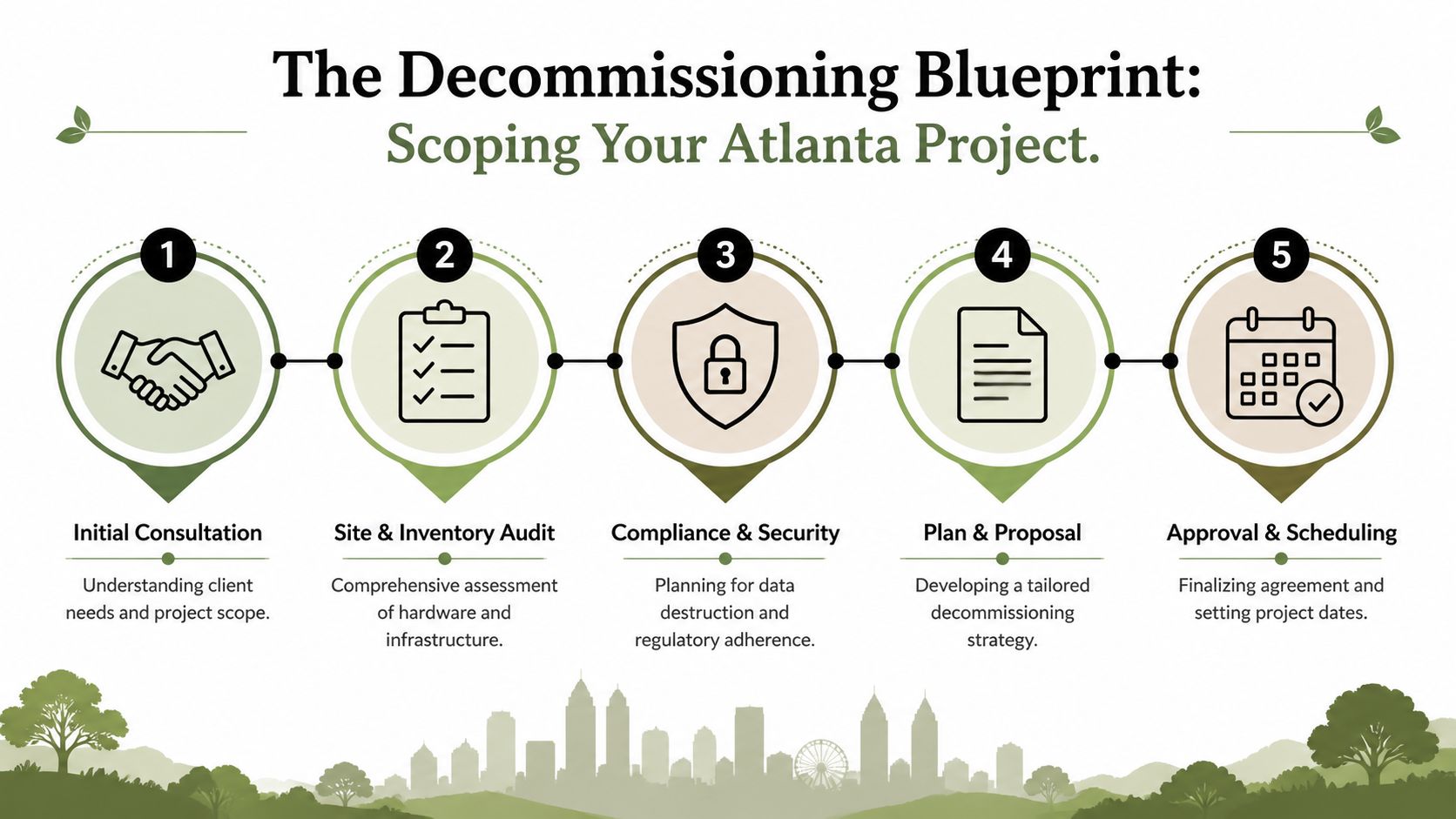
The Decommissioning Blueprint Scoping Your Atlanta Project
The project begins with the blueprint.
A shutdown window gets approved, technicians arrive, and then the avoidable problems surface. Half-labeled racks. A facilities team that only allows dock access after 6 p.m. Security rules that require an escort for every cart movement. I have seen Atlanta decommissions slow down for hours because those details were treated as housekeeping instead of scope. Good planning prevents that. Uptime Institute’s guidance on decommissioning and lifecycle management supports the same point: retired infrastructure needs a defined process, documented controls, and clear ownership across teams (data center lifecycle and decommissioning guidance).
Start with scope that can survive contact with reality
A usable scope of work answers operational questions before the first shutdown ticket is submitted.
- What is leaving the site: Servers, storage arrays, switches, firewalls, PDUs, rails, cabling, loose drives, and anything parked in cages or staging areas.
- What stays in production: Partial decommissions need protection for nearby live infrastructure, shared circuits, and active network paths.
- What requires on-site sanitization: Data-bearing media, encrypted drives, failed drives, and regulated assets need a documented destruction decision before removal day.
- Who can approve changes: Added racks, found assets, and last-minute exclusions need one decision path, not a chain of hallway conversations.
Weak scope is where budget drift starts. Teams end up debating whether patch panels, KVMs, spares, or retired appliances were part of the job. That is not a technical problem. It is a scoping failure.
Build around stakeholders, not just hardware
Hardware moves on carts. Projects move on approvals.
A workable blueprint usually includes five groups, each with a specific job:
- IT operations handles shutdown order, dependencies, and cutover timing.
- Information security sets media handling rules and destruction standards.
- Facilities controls docks, elevators, floor protection, staging areas, and building access.
- Compliance or legal confirms retention requirements and audit records.
- Finance or asset management tracks recovery, write-offs, and final reconciliation.
If one of those groups first sees the plan on decommission day, the schedule is already at risk.
For organizations tying decommissioning to a relocation or consolidation, review these data center migration best practices before locking the sequence. Migration and decommissioning often overlap. Mistakes usually happen at that handoff.
Inventory first, then schedule
A common mistake is to request a date before verifying the asset list.
Dates come after the inventory is real. The number of racks matters, but so do drive counts, cabling density, pallet build requirements, elevator limits, and whether assets need shredding on site before anything leaves the building. In practice, the same room can produce two very different schedules depending on media volume and access restrictions.
This is also where ESG planning should start, not after the trucks leave. If your company wants the project to support CSR reporting, the scope needs to separate reuse candidates from scrap, identify what can be remarketed, and document downstream handling. At Atlanta Green Recycling, that planning also lets clients connect the work to veteran employment and tree-planting impact instead of treating end-of-life IT as a quiet disposal task.
If the project includes interim holding during a phased exit, some teams also streamline operations with offsite storage solutions so equipment is not crowding active space while approvals, migrations, or final pickups are still in motion.
Walk the site before you price the work
A proper site survey should confirm the physical constraints that decide labor, packing method, and truck timing.
| Site factor | Why it matters |
|---|---|
| Loading dock access | Sets truck schedule, rolling distance, and whether lift-gate support is needed |
| Elevator size and hours | Affects cart choice, pallet breakdown, and removal sequence |
| Security procedures | Determines badges, escorts, sign-out rules, and technician count |
| Floor conditions | Helps prevent damage during cart traffic and equipment movement |
| Staging space | Prevents congestion near active cabinets and keeps chain of custody organized |
The walk-through often reveals the issues that change the whole plan. Some Atlanta buildings restrict dock use to narrow windows. Some require masonite for floor protection. Some insist on freight elevator reservations days in advance. Those are not minor notes. They define the runbook, the labor plan, and the risk profile of the job.
Your Core Execution Plan Inventory Data Destruction and Logistics
Once the blueprint is approved, execution needs discipline. It is during execution that projects either become auditable and orderly, or drift into loose handling and missing records.
A structured decommissioning workflow is usually built around four phases: planning, asset auditing, on-site data destruction, and physical removal. That matters because scope creep affects 30 to 40% of projects, incomplete audits cause 15 to 20% asset loss, skipping on-site destruction risks 25% non-compliance, and optimized operations can keep downtime under 4 hours per rack (four-phase decommissioning process).
Inventory has to become the master record
The audit isn't a paperwork exercise. It's the control point for every downstream action.
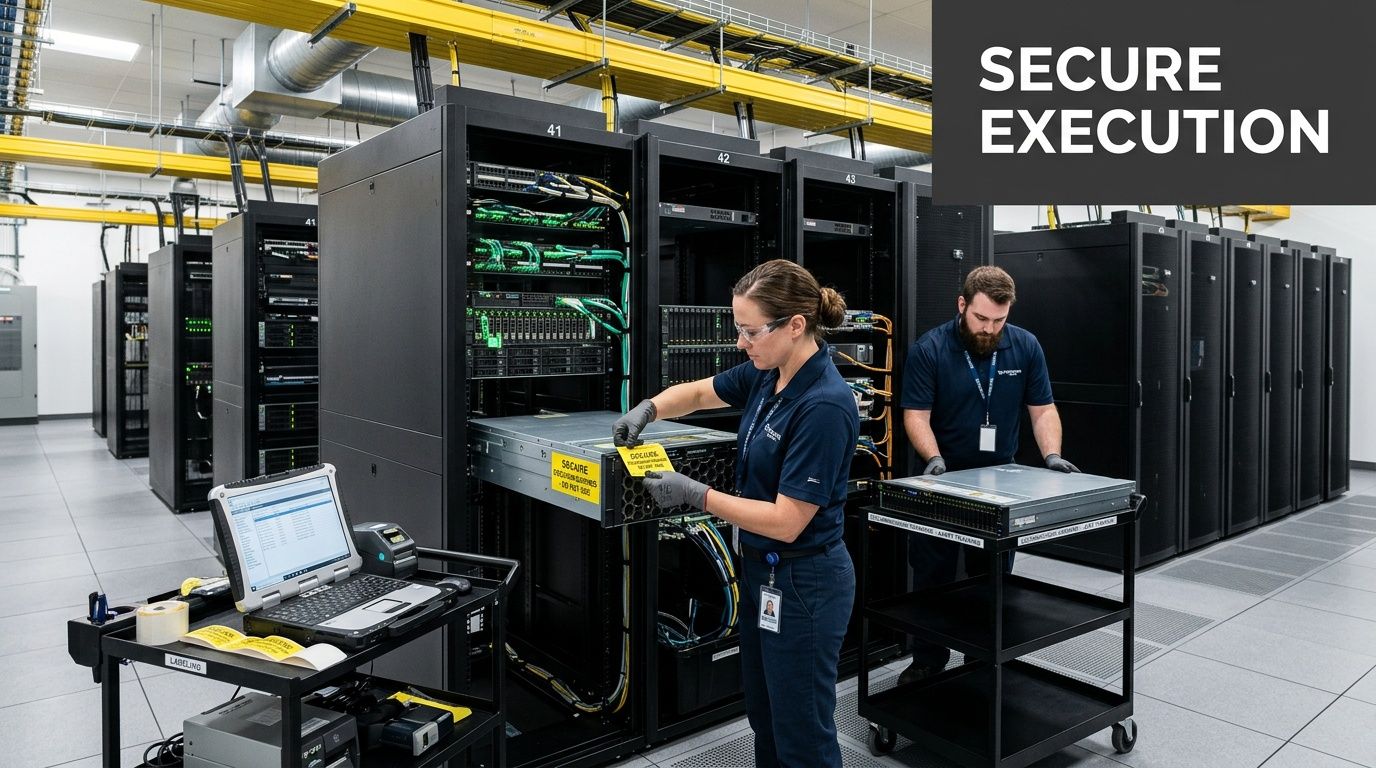
A solid inventory process should capture serial numbers, asset tags, model information, rack location, and whether the device contains data-bearing media. That list becomes the basis for removal priority, destruction decisions, financial reconciliation, and final reporting.
What works in practice:
- Scan on site whenever possible: Manual lists create errors. Barcode and serial capture tighten accountability.
- Reconcile against your own records: Don't assume your CMDB or fixed asset register is accurate.
- Flag drives early: Hard drives, SSDs, backup media, and embedded storage all need explicit handling paths.
- Separate redeployable equipment from scrap streams: That prevents accidental destruction of assets that still have use or value.
What doesn't work is auditing after gear has already been unracked. Once equipment enters mixed staging without a clean serialization process, recoverability drops and disputes start.
The inventory should tell you where every device was, what happened to it, and who handled it next.
Choose the right destruction method before move day
For regulated environments, destruction method isn't just a security decision. It's a compliance decision and a chain-of-custody decision.
Common methods used in Atlanta Data Center Decommissioning Services include NIST 800-88 wiping, degaussing, and physical shredding. The right option depends on media condition, client policy, and whether the hardware is intended for remarketing, reuse, or final destruction.
Here is the trade-off most clients care about:
| Method | Best fit | Main trade-off |
|---|---|---|
| Software wiping | Functional media that may be reused or resold | Takes process time and requires device integrity |
| Degaussing | Magnetic media slated for destruction | Media becomes unusable afterward |
| Physical shredding | Failed drives or highest-assurance destruction needs | Usually limits any recovery value |
If you're reviewing internal policies before the project, a practical reference on how to dispose of old servers in Atlanta helps align server retirement with documented destruction decisions.
Removal is logistics, not muscle
The physical pull has to be sequenced. Technicians should disconnect cabling methodically, unrack equipment with lifts when needed, pack by category, and maintain custody records from room to truck.
Trouble often arises when inexperienced crews are involved. They move too much too fast, mix serialized assets, or treat the data hall like a warehouse.
For projects where a move-out and a storage interval overlap, it can help operations teams to review how to streamline operations with offsite storage solutions. The principle carries over well to decommissioning: staged, labeled, access-controlled temporary storage can reduce confusion when your destination environment isn't ready to receive every asset at once.
Keep the chain of custody visible
A proper logistics plan should define:
- Who signs equipment out of the room
- How containers are labeled
- Which truck or fleet unit receives each load
- When destruction happens in the sequence
- What documentation is issued per asset or per batch
When those points are clear, the project moves with less friction. When they're vague, teams start relying on memory. That's not acceptable in healthcare, government, finance, or any environment where auditors may ask for proof months later.
Choosing Your Atlanta Partner A Checklist for Social Impact
Your facilities team has a shutdown window. Legal wants documented destruction. Sustainability wants numbers it can stand behind in an ESG report. Procurement has three bids that look similar on the surface.
That is where weak vendor selection causes expensive problems.
I tell Atlanta clients to score decommissioning partners on two tracks at the same time. First, can they protect chain of custody, documentation, and downstream compliance. Second, can they turn the project into something your company can report with confidence, not just file away as a disposal event. For Atlanta organizations in regulated sectors such as healthcare, finance, education, and government, that second track now matters because asset retirement often gets reviewed alongside broader sustainability and community impact goals.
The baseline checklist
A partner should clear the operational requirements before you give any weight to mission language. If the basics are loose, the social story will not survive audit review.
| Evaluation Criteria | Required Standard | Social Impact Value |
|---|---|---|
| Data destruction process | Defined wiping, degaussing, or shredding steps with certificates tied to the job | Gives your team proof that secure retirement and responsible reuse or recycling were handled together |
| Inventory discipline | Serialized tracking from audit through final disposition | Supports credible ESG reporting because every claim maps back to specific assets |
| Logistics control | Documented pickup, staging, transport, and custody procedures | Reduces the risk of undocumented handoffs that weaken both compliance and CSR claims |
| Compliance reporting | Final reports suitable for legal, security, and audit review | Lets compliance and sustainability teams work from the same records |
| Downstream accountability | Clear explanation of where assets, components, and scrap streams go | Helps your company avoid vague recycling claims |
| Impact reporting | Documented outcomes tied to the project, not generic promises | Gives leadership something they can use in ESG updates, recruiting, and community reporting |
| Project communication | One accountable contact, change control, and issue escalation process | Keeps operations stable when scope changes mid-project |
What to ask beyond price
A low bid can still be the expensive option if the provider subcontracts transport, mixes serialized assets, or issues batch paperwork that does not match your internal records.
Ask direct questions:
- Who owns the chain of custody from rack removal to final disposition?
- How are serialized assets reconciled if actual counts differ from the original audit?
- What destruction records do you issue for data-bearing devices?
- Which parts of the job are subcontracted, and which are controlled by your own team?
- Can you produce reporting that works for audit review and for ESG or CSR reporting?
- How do you document community impact tied to this specific project?
If your team wants a broader vendor screening model, how to choose the right service provider covers the same discipline procurement should apply here. The industry details differ, but accountability, clarity, and documented process still separate strong operators from risky ones.
Why social impact belongs on the scorecard
A certificate of destruction closes the compliance side. It does not help your communications team explain what the project contributed beyond risk reduction.
The better Atlanta decommissioning partners can do both. They can show where the equipment went, what was remarketed or responsibly recycled, and how the project supported measurable community outcomes. At Atlanta Green Recycling, that often means connecting qualified projects to veteran support and tree-planting programs with reporting your company can use. That matters when HR, investor relations, procurement, or your ESG committee asks for more than a disposal receipt.
There is a real trade-off here. A general recycler may offer pickup and basic recycling paperwork. A mission-driven ITAD partner with enterprise controls usually brings tighter asset accounting, stronger reporting, and a clearer community benefit, but only if those claims are documented at the job level. If a vendor talks about impact in broad terms and cannot show how project records connect to those outcomes, leave that language out of your board deck.
If you are comparing providers across the local market, reviewing Atlanta e-waste disposal companies with enterprise decommissioning capabilities helps separate household-style recyclers from firms prepared for data center work.
The right partner gives you more than equipment removal. You get a project file your auditors can trust and an impact record your leadership can stand behind.
Managing Decommissioning Timelines Costs and Risks
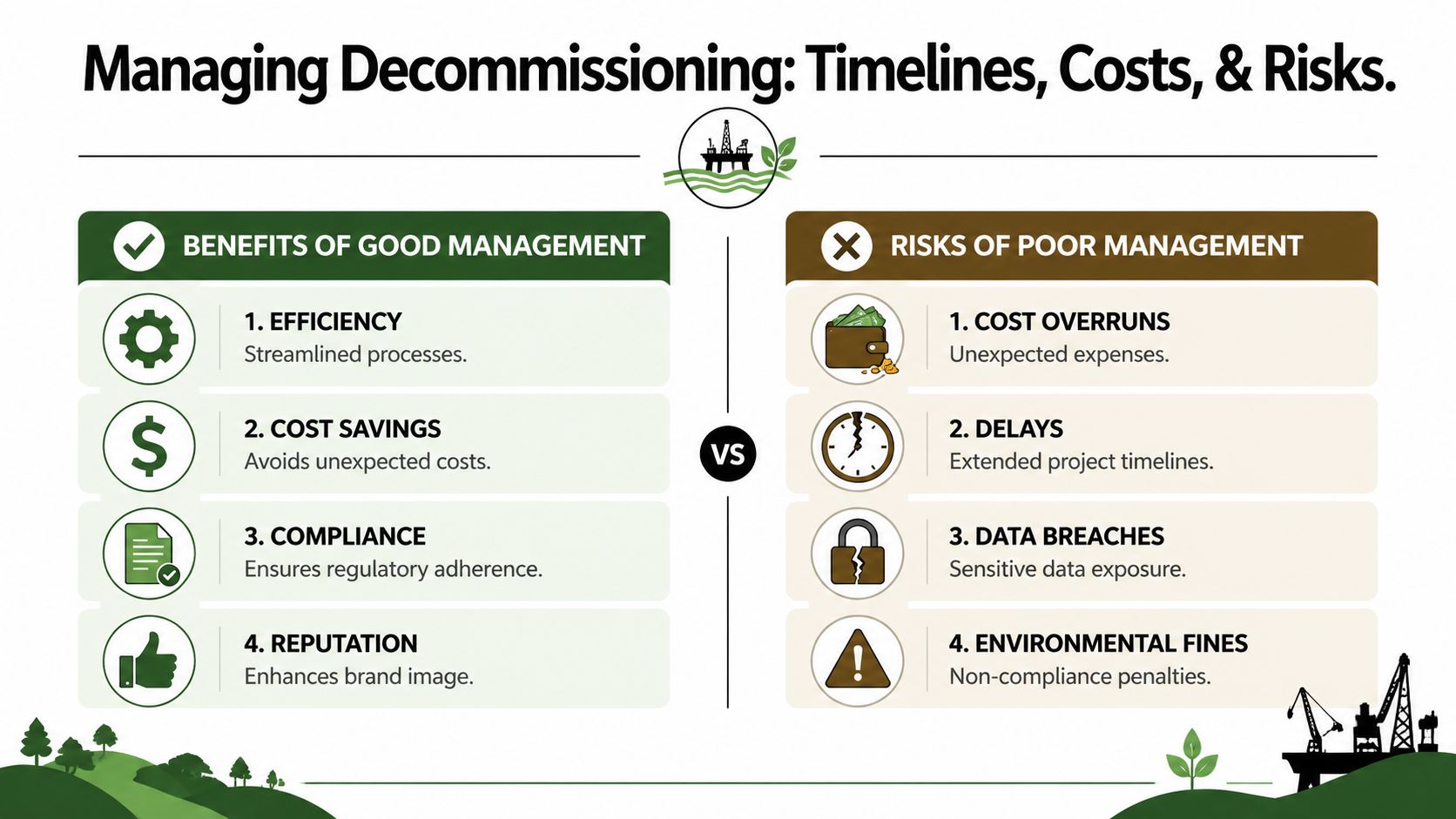
A common Atlanta scenario looks like this. The lease end date is fixed, finance wants the room cleared this quarter, security wants every drive accounted for, and facilities gives you a narrow dock window that cannot slip. That is when decommissioning stops being a disposal task and becomes a project controls exercise.
Teams that finish cleanly treat schedule, cost, and risk as one operating plan. If the removal sequence is loose, labor hours rise. If access windows are not locked, trucks sit and crews wait. If data-bearing assets mix with general hardware, chain-of-custody exposure shows up fast. I have seen all three happen on first-time projects, and none of them were caused by the hardware itself. They came from preventable planning gaps.
What drives cost on a real decommissioning job
Labor matters, but it is rarely the only cost driver. The bigger variables are usually scope clarity, building constraints, media handling requirements, and how much of the asset base still has resale value.
These are the items that move the budget most often:
- Asset volume and density: High rack counts, blade environments, storage arrays, and loose media create more handling steps and more chances for inventory mistakes.
- Data destruction choice: Physical shredding gives some clients stronger comfort and a cleaner audit story, but software erasure can reduce cost when the media type, compliance posture, and remarketing plan allow it.
- Building access limits: Freight elevator reservations, escort rules, dock congestion, union labor rules, and after-hours access can add real time to a project.
- Packaging and transport needs: Reuse, relocation, and recycling do not travel the same way. Gear headed for remarketing usually needs more controlled packing than material going to downstream recycling.
- Late scope changes: Surprise cages, forgotten spare drives, and undocumented network gear are what turn a stable quote into a change order.
Precision saves money. Rework, idle crew time, and poor sequencing are what usually burn it.
There is also a trade-off many clients miss at the start. The lowest line-item disposal price is not always the lowest total project cost. A partner that tracks serialized assets correctly, separates destruction streams, and coordinates building access well can prevent delays, damage claims, and audit cleanup that cost far more than the pickup itself.
Schedules slip for predictable reasons
Busy crews do not guarantee project progress. A room can look active all day while the critical path stalls.
The schedule usually holds when four controls are in place:
- A removal sequence by row, rack, or room that facilities and security have already approved
- A dedicated workflow for drives and other data-bearing devices
- Staging space that does not interfere with live operations or egress
- One project lead with authority to resolve conflicts on the floor
The opposite pattern is easy to spot. Assets are removed in the wrong order. Destruction staff wait on approvals. Trucks arrive before the dock clears. Inventory files stop matching what is physically in staging. Once that happens, every handoff takes longer because the team starts checking work that should have been settled before day one.
Risk control starts before the first rack comes out
The major risks in decommissioning are usually ordinary operational failures with expensive consequences. Floor damage. Missing custody signatures. Mixed loads. Unapproved asset additions. None of those are exotic, and all of them are easier to prevent than to explain later.
The Uptime Institute's guidance on decommissioning and relocation planning stresses formal preparation, clear roles, and methodical execution because changes to data center infrastructure create operational and business risk if they are handled casually (Uptime Institute decommissioning and relocation guidance).
For Atlanta projects, these are the risk areas I watch closest:
| Risk area | What causes it | What reduces it |
|---|---|---|
| Facility damage | Unprotected floors, rushed cart traffic, poor staging control | Site walk, floor protection, defined traffic paths |
| Schedule delays | Dock conflicts, elevator contention, overlapping contractors | Reserved access windows, shared master schedule, daily floor lead |
| Chain-of-custody gaps | Mixed pallets, weak labeling, undocumented handoffs | Serialized tracking, tamper-evident handling, signed transfer points |
| Scope creep | Late-added assets, unclear exclusions, poor owner signoff | Tight SOW, asset reconciliation, formal change approval |
For companies that want a wider operational framework before kickoff, these risk reduction strategies for complex decommissioning projects are a useful planning reference.
Handled well, this phase does more than protect the budget and the schedule. It gives your company a clean record of disciplined execution, which makes the ESG story credible later. At Atlanta Green Recycling, that matters because the project should stand up both in an audit file and in a leadership report that shows responsible outcomes, including community impact tied to veterans and tree-planting programs when the job qualifies.
Your ESG Legacy Final Certifications and Impact Reporting
The trucks can leave on time and the room can be empty, but the project still isn't complete until the paperwork closes cleanly. This is the phase that proves what happened.
A complete reporting package should tie together security, compliance, environmental handling, and final disposition. In a strong end-to-end methodology, final reporting includes chain-of-custody documents and destruction certificates for SOX and HIPAA audits. The same source notes that using NIST 800-88 standards reduces breach risk by 98% post-decommissioning, and R2v3 recycling can divert 95% to 99% of e-waste from landfills (security and sustainability reporting reference).

What your audit file should include
At minimum, most enterprise clients should expect documentation that answers four questions: what assets were handled, how they were handled, when custody changed, and what final disposition occurred.
That typically means:
- Serialized asset disposition report
- Certificates of data destruction for applicable media
- Chain-of-custody documentation
- Recycling or downstream disposition records
- Exception reporting for assets that differed from the original inventory
If your internal team wants to understand what a destruction document should contain, this guide to a certificate of destruction is a useful reference point.
Compliance reporting is the floor, not the ceiling
Most providers stop at the audit package. That's necessary, but it isn't the whole opportunity.
A mission-driven decommissioning program can also produce impact reporting tied to veteran support and tree planting. For companies building ESG narratives, that changes the conversation internally. Instead of presenting the project as a disposal expense, the IT team can present it as a controlled retirement program with documented environmental and social value.
What strong impact reporting looks like
The strongest ESG reporting isn't vague. It should be specific about the program, connected to the project, and easy for your communications team to reuse in annual reporting or internal updates.
Useful deliverables can include:
| Report type | Why it matters |
|---|---|
| Plant-A-Tree certificate | Gives sustainability teams a visible environmental deliverable |
| Veteran Support Impact Report | Connects IT asset disposition to a social outcome leadership can recognize |
| Project summary for CSR files | Helps ESG teams fold decommissioning into broader reporting cycles |
The best final package lets audit, legal, procurement, and sustainability teams all use the same project record for different purposes.
Cause-based decommissioning transcends a mere brand message. It creates a cleaner handoff inside the client organization. Compliance gets proof. Finance gets reconciliation. ESG gets a story with documentation behind it.
Frequently Asked Questions About Atlanta Decommissioning
How early should we start planning a decommissioning project
Start as soon as the business decision becomes likely. The inventory, access review, stakeholder approvals, and data destruction choices take longer than most first-time teams expect. Early planning also helps avoid late disputes over what is being retired versus relocated.
Should we choose on-site destruction or off-site destruction
If your environment includes regulated data, highly sensitive media, or a cautious compliance posture, on-site destruction usually gives the cleanest control narrative. It reduces transit exposure and simplifies witness procedures. Off-site processing can still work when custody controls and documentation are strong, but it needs more trust in the handoff chain.
What's the biggest operational mistake clients make
They underestimate the inventory step. If the asset list is weak, every later decision gets harder. Teams then spend project time reconciling surprises instead of executing a controlled plan.
Do we need a dedicated project lead
Yes. A decommissioning needs one person who can coordinate IT, facilities, security, and the service provider. Without that role, approvals drift and small issues sit unresolved until they affect schedule.
How do we handle equipment that still has resale or redeployment potential
Separate it early in the planning process. The audit should identify what can be reused, what can be remarkedeted, and what must go straight to destruction or recycling. Mixing those categories during removal creates preventable losses.
What documentation should hospitals and healthcare groups insist on
Healthcare teams usually need a clear chain of custody, serialized reporting, and data destruction records that support HIPAA-focused audit review. They should also confirm that the handling process for drives and other media is explicit in the scope of work, not buried in general terms.
Can decommissioning happen without disrupting nearby live systems
Yes, but it takes controlled staging, disciplined removal paths, and a crew that understands how to work in partially active environments. Partial white space decommissions are common. The key is separating retired infrastructure from anything still supporting production.
How should we prepare our building management team
Give them dates, work windows, loading requirements, truck expectations, elevator needs, and after-hours access details as early as possible. Building operations can make or break schedule adherence in Atlanta office towers and mixed-use facilities.
What if we discover extra assets on decommission day
That isn't unusual, especially in older server rooms. The right answer is to use documented change control. The provider should be able to add assets through a defined approval path so inventory, custody, and pricing stay aligned.
Is weekend or after-hours work worth it
In many facilities, yes. It can reduce interference with staff, simplify elevator and dock access, and lower disruption in busy buildings. It may also make sense for organizations that can't tolerate daytime activity near live operations.
How do schools, universities, and government agencies differ from private-sector clients
The technical work is similar, but documentation and approval chains are often more formal. Those projects usually benefit from extra clarity around custody, disposition categories, and internal signoff points.
What should a final project closeout meeting cover
Review the original scope against the completed work. Confirm all exceptions were resolved, verify that the final inventory and destruction records match expectations, and make sure the compliance and sustainability documents have gone to the right internal stakeholders.
Can a decommissioning project support our ESG and CSR reporting
Yes, if the provider offers reporting that goes beyond standard disposal paperwork. That can include environmental documentation plus social impact records tied to veteran support and tree planting. The value isn't only external. It often helps IT leadership show that a required retirement project also aligned with company values.
When should we involve finance
Early. Finance should help define what needs valuation, what can be recovered, how retired assets are reconciled, and how the project is booked internally. Bringing them in late often creates avoidable disputes over asset records and reporting format.
What should we look for in an Atlanta Data Center Decommissioning Services provider
Look for clear inventory discipline, secure media handling, chain-of-custody controls, practical logistics experience, and reporting your auditors can use. If ESG matters to your organization, also ask whether the provider can document environmental and social impact in a way your leadership team can carry into sustainability reporting.
If you're preparing for a shutdown, migration cleanup, rack retirement, or full white space exit, Atlanta Green Recycling is one resource for secure IT asset disposition, on-site de-installation, data destruction, pickup logistics, and documentation that supports both compliance review and purpose-driven reporting. For Atlanta organizations that want decommissioning to do more than clear a room, that combination can turn a difficult project into a documented operational and ESG win.