
Atlanta Certified E Waste Recycling Company: Your ESG Guide


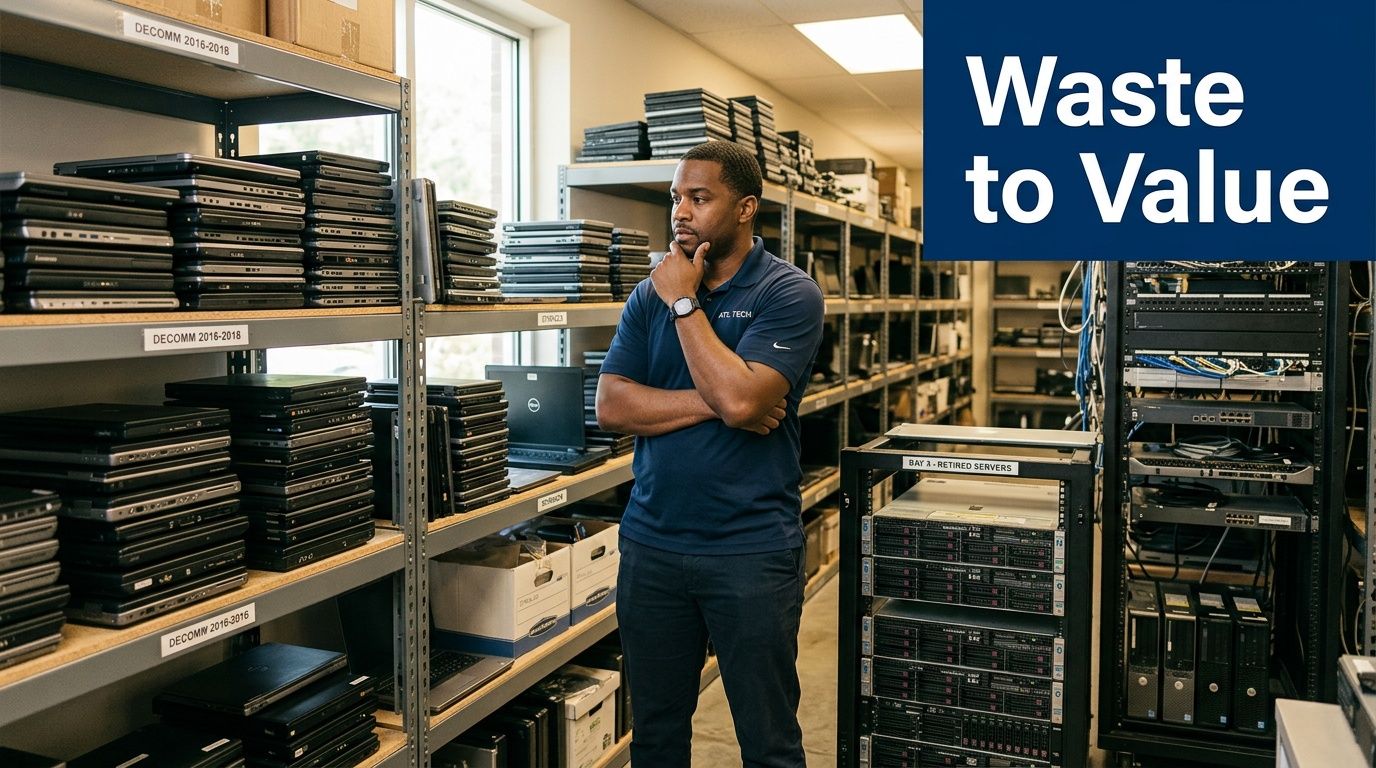
A Midtown office closes one floor after a lease change, and the IT manager ends up with a locked room full of monitors, retired laptops, old phones, and a server stack nobody wants to touch. The pile looks like disposal work. In practice, it’s a security project, a compliance decision, and a chance to create visible community impact in Atlanta.
Your E-Waste Is an Opportunity Not a Problem
Most Atlanta companies don’t struggle because they lack good intentions. They struggle because retired tech accumulates over time. One office move, one device refresh, or one merger later, and the surplus room turns into a risk register.
That risk is easy to underestimate. Hard drives keep data longer than people assume. Old networking gear still needs documented handling. Monitors, batteries, and mixed peripherals don’t belong in standard disposal streams. The longer equipment sits, the more likely someone treats it like junk instead of managed IT assets.
The shift that changes the whole conversation
A strong Atlanta Certified E Waste Recycling Company doesn’t just remove clutter. It converts a messy back-room problem into a managed outcome with records, data destruction, environmental controls, and a story your leadership team can use.
That matters because the volume challenge is real. The world generated 53.6 million metric tons of e-waste in 2019, only 17.4% was formally recycled, and the total is projected to reach 74 million tons by 2030. In the U.S., e-waste is the fastest-growing municipal waste stream, with recycling rates at only 15-20%, according to this Georgia certified e-waste overview.
For Atlanta organizations, that creates a choice. You can treat old electronics like an end-of-life burden, or you can treat them as a controlled material stream that supports data security, sustainability reporting, and local good. That’s why more teams are looking beyond one-off haul-away vendors and focusing on process quality, documentation, and long-term program design.
Practical rule: If a recycler can’t explain exactly how your assets move from pickup to final disposition, you’re not looking at a disposal partner. You’re looking at an exposure point.
Why this matters to ESG teams too
The old model was simple. Remove the junk, get a receipt, move on. That isn’t enough anymore.
Today, retired equipment can support broader goals. It can align with internal ESG commitments. It can strengthen CSR reporting. It can also support cause-based campaigns that employees and clients remember. Messaging like “your old tech can house a veteran and grow a forest” works because it connects a routine operational task to a concrete social outcome.
If your company is building a sustainability narrative, electronics recycling belongs in it. The environmental case is obvious. The brand case is stronger than many teams expect. Even the operational case is straightforward when pickup, sanitization, resale channels, and audit-ready records are handled correctly.
For a useful primer on those broader business outcomes, the benefits of e-waste recycling are worth looking at through both a compliance lens and a CSR lens.
What Certified E-Waste Recycling Really Means for Atlanta Businesses
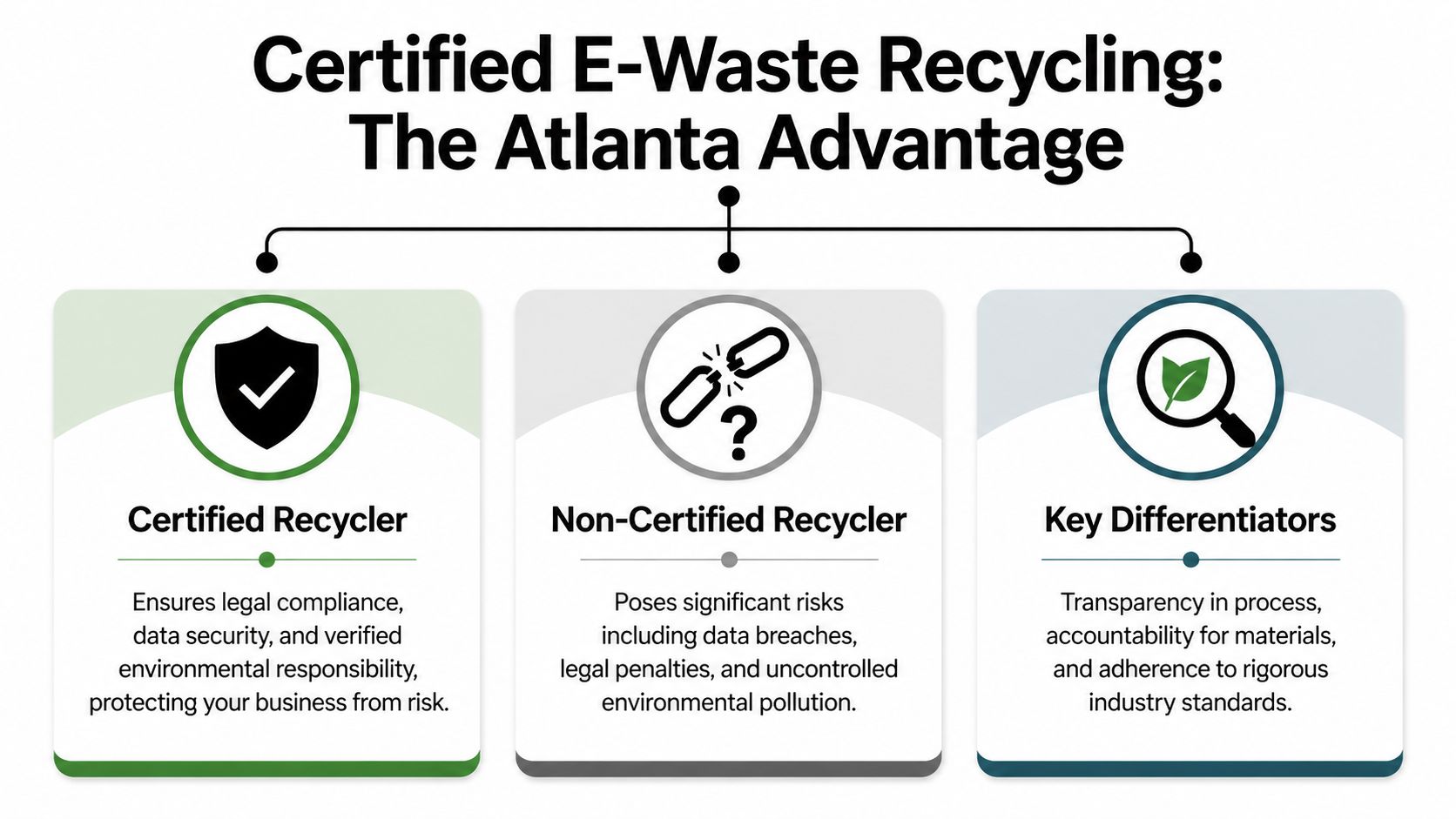
Certification gets used loosely in this market. It shouldn’t. When a vendor says they recycle electronics, that tells you almost nothing by itself. The key question is whether they operate under audited controls that protect your company after the truck leaves your site.
Choosing a certified recycler is like hiring a CPA instead of an unlicensed bookkeeper. Both may handle the same paperwork. Only one gives you a defensible standard when someone asks how the work was done.
What R2v3 actually covers
For most businesses in Atlanta, R2v3 is the certification that deserves the closest attention. It isn’t a marketing badge. It’s an operating framework.
R2v3 requires audits in over 50 operational areas, including complete chain-of-custody for all assets, dual data sanitization methods compliant with NIST 800-88, and strict environmental and worker safety controls, as outlined in this review of R2v3 e-waste recycling requirements.
That matters because it forces discipline in places where informal recyclers usually fail:
- Asset tracking: Devices are documented from pickup through processing.
- Data controls: Logical and physical sanitization methods are built into the workflow.
- Downstream accountability: Materials aren’t handed off without visibility.
- Worker and environmental safeguards: Handling practices are governed, not improvised.
If you manage regulated information, these controls aren’t nice to have. They’re the baseline for a credible program.
What goes wrong with non-certified vendors
The risk isn’t abstract. It usually shows up in one of four places.
- Missing custody records: Nobody can prove which assets were picked up, when they moved, or how they were processed.
- Weak sanitization choices: Drives that should have been destroyed get treated like standard resale inventory.
- Unclear downstream handling: Equipment leaves your site compliantly and disappears into an opaque chain.
- Poor documentation: Your team asks for proof months later and gets a generic invoice instead of audit-ready records.
Certified recycling protects you twice. First at the moment of pickup, and again later when legal, audit, procurement, or ESG teams ask for evidence.
What Atlanta buyers should verify before signing
A certified recycler should be able to answer direct questions without hedging. Ask these early:
- Is your certification current and verifiable?
- How do you maintain chain-of-custody from our dock to final processing?
- Which assets are wiped, and which are physically destroyed?
- What documentation do you issue after completion?
- How do you manage downstream vendors and material flows?
Clear answers usually indicate a mature operator. Vague answers usually indicate a sales script.
For local teams comparing options, this page on a certified electronics recycling company in Atlanta GA is a practical reference point because it frames certification around operational control, not just disposal.
Recycling That Restores Lives and Landscapes
Compliance gets a project approved. Purpose gets people engaged.
That’s the difference between a routine recycling vendor and a mission-led model that your employees, leadership team, and customers want to talk about. In Atlanta, that distinction matters because companies are under pressure to show community value, not just internal process discipline.
Why cause-based recycling works
Most sustainability messaging fails because it feels abstract. People hear “responsible disposal” and tune out. They hear “your retired tech can support veterans and fund reforestation,” and they understand the stakes immediately.
That’s why a “Recycle for a Cause” campaign is more than branding. It gives the act of recycling a human endpoint. Old equipment stops being a pile of obsolete hardware and becomes part of a social impact chain. Internally, that helps operations teams get employee participation. Externally, it gives communications and ESG teams a more meaningful story to tell.
A phrase like “Recycling That Restores Lives and Environments” works because it ties the environmental side and the social side together without forcing them apart. The same is true for lines such as “Turning E-Waste into Hope” or “Where Tech Meets Trees & Transformation.” They’re effective when they’re backed by documented activity, not just design work.
What transparency should look like
If a company wants to build trust around mission-based recycling, it should show the work plainly. That’s where impact counters and post-pickup documentation help.
Useful examples include:
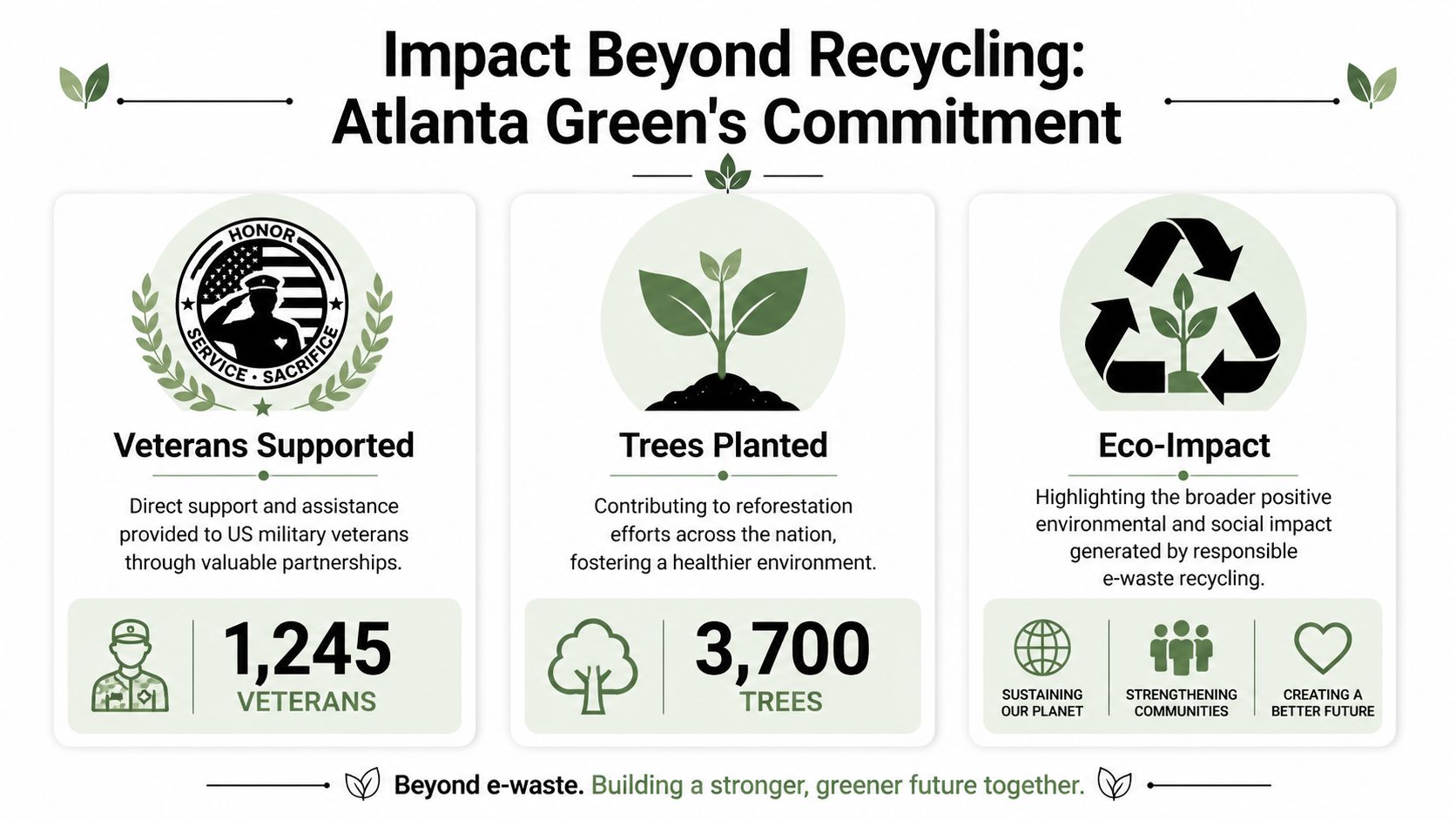
- Live impact counters: Showing veteran support and tree-planting totals on the website.
- Pickup follow-up: Sending plant-a-tree certificates and veteran support summaries after service.
- Seasonal drives: Tying campaigns to Veterans Day, Earth Day, and Arbor Day so employees have a clear reason to participate.
- CSR-ready reporting: Giving corporate clients language and documents they can use in internal updates and external reporting.
The author brief specifically calls for counters such as “1,245 veterans supported” and “3,700 trees planted.” Those numbers belong in company-owned campaign materials and visual assets, which is where they’re presented in the infographic above. In article copy, the stronger point is qualitative. Visibility matters. So does consistency. If you claim dual impact, show ongoing proof of that work.
Social impact only strengthens a recycling program when the reporting is concrete enough for procurement, legal, and communications teams to trust it.
The strongest ESG story is the one employees can repeat
A lot of ESG language is written for reports, not for humans. Electronics recycling is one of the few areas where the message can stay simple without becoming simplistic.
Employees understand office cleanouts. They understand laptop refreshes. They understand secure destruction. If those same activities also support veterans and reforestation, your sustainability program becomes easier to communicate across the company.
That’s why the dual-mission model works especially well for:
- Corporate recycling drives tied to office moves and refresh cycles
- University and school campaigns that combine collection days with community action
- Municipal or nonprofit collaborations built around neighborhood cleanup and reuse
- LinkedIn thought leadership that connects operations, compliance, and local impact
- Digital badges such as “Recycled with Purpose” that partners can place on sustainability pages
For companies that want this work to reflect local values, a page like Atlanta recycling services gives a useful starting point for turning disposal into a visible community initiative rather than a hidden back-end task.
The Blueprint for Secure Corporate Data Destruction
Most IT asset disposition mistakes don’t happen because teams ignore security. They happen because people use the wrong destruction method for the wrong device, then assume a generic receipt solves the problem.
Data destruction needs a method decision first, then a documentation decision. If either is weak, the whole process is weak.
Three methods and when they fit
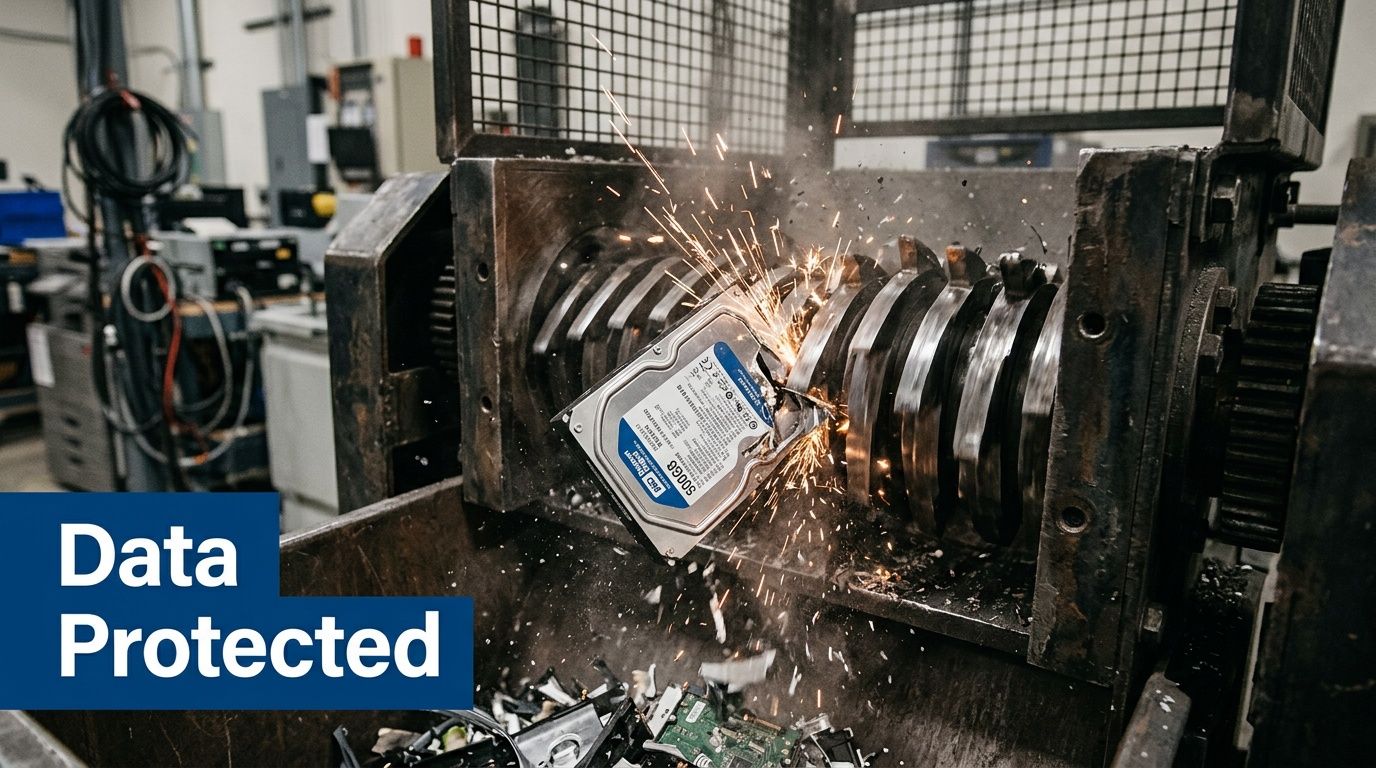
The easiest way to explain the options is this. Data wiping is like digitally shredding a file. Degaussing is like scrambling the signal into irreversible noise. Physical shredding is like turning the filing cabinet itself into confetti.
Each method serves a different operational purpose.
Software-based wiping
This is the right choice when hardware may still have reuse or remarketing value and your policy allows logical sanitization. The key is that the process must follow recognized standards and be recorded per asset.Degaussing
This method destroys magnetic data by disrupting the media. It can be appropriate for certain legacy storage media where reuse isn’t the priority and the organization wants a strong technical destruction path before final scrap processing.Physical shredding
This is the cleanest answer when risk tolerance is low, the media is damaged, or policy requires irreversible destruction. Many healthcare, government, and legal environments prefer this route for the simplest reason possible. It leaves the least room for argument later.
What regulated teams usually get right
Teams handling sensitive data tend to be more decisive, and that’s usually a good thing. If an organization stores protected health information, confidential public-sector records, or sensitive internal data, they often choose physical destruction for media and document the event carefully.
That doesn’t mean every asset must be shredded. It means the data classification should drive the treatment plan.
A practical review should cover:
- Asset type: Laptop, desktop, server, phone, removable media, or networking gear
- Data sensitivity: Standard business records versus highly sensitive or regulated content
- Reuse potential: Whether preserving asset value still aligns with policy
- Chain-of-custody needs: Whether the item can leave site before sanitization
- Audit expectations: What legal, privacy, or procurement teams may request later
If your team can’t explain why a drive was wiped instead of shredded, the process wasn’t fully governed.
Documentation is the real finish line
Organizations often focus on the destruction event and neglect the paper trail. The audit trail is what closes the loop.
You should expect records that identify what was processed, how it was sanitized, and when the work was completed. For many businesses, the most important document is the Certificate of Data Destruction because it becomes the evidence used for internal controls, outside audits, and policy verification.
For buyers sorting through service models, this guide to Atlanta secure data destruction services is useful because it frames destruction as both a physical process and a compliance recordkeeping function.
How to Choose Your Atlanta E-Waste Recycling Partner
Vendor selection usually goes wrong when teams compare only convenience. Fast pickup matters. Friendly sales support matters. Neither tells you whether the vendor can protect your company when the project becomes an audit question, a legal question, or a board-level ESG question.
A better approach is to evaluate recyclers the same way you evaluate any sensitive outsourced service. Ask what they do, how they document it, and what proof remains after the job is complete.
The questions worth asking in the first meeting
Some vendors sound polished until you ask for specifics. Others are operationally solid but don’t explain themselves well unless you know what to ask.
Use this checklist.
| Evaluation Criterion | What to Ask | Why It Matters |
|---|---|---|
| Certification status | Is your certification current, and can we verify it? | Current certification is the clearest sign that controls are being maintained, not just claimed. |
| Data destruction method | Which media do you wipe, which do you shred, and what determines the choice? | You need a decision logic tied to policy, not a one-size-fits-all answer. |
| Chain of custody | How are assets tracked from pickup through final processing? | Missing custody records create legal and audit risk fast. |
| Logistics capability | Do you handle packing, de-installation, and transport directly? | Operational control reduces handoff errors during office moves and decommissions. |
| Documentation package | What records will we receive after service? | Your compliance team needs more than a pickup receipt. |
| ESG and CSR support | Can you provide reporting that supports sustainability and community impact narratives? | If your company reports on ESG, this turns disposal into documented value. |
| Local service fit | How do you support Atlanta metro scheduling and recurring pickups? | Local responsiveness matters when projects involve multiple sites or tight move dates. |
What works and what doesn’t
What works is a recycler that can speak fluently to both IT and compliance. That means they understand serial tracking, secure pickup procedures, destruction options, and reporting requirements in the same conversation.
What doesn’t work is a vendor that separates those topics as if they belong to different departments. In practice, your facilities team, IT lead, privacy officer, procurement manager, and sustainability lead all touch the same project.
Look for these signs of maturity:
- They ask for your asset profile early. Good partners want to know what types of devices, media, and handling constraints are involved before quoting the job.
- They define exceptions. They tell you what happens with damaged drives, mixed pallets, unlabeled equipment, or equipment that arrives with unexpected media.
- They talk about reporting without being prompted. That usually means they’ve supported institutional buyers before.
- They understand brand impact. If they can support a “Recycled with Purpose” badge, veteran support summary, or reforestation certificate, they’re thinking beyond haul-away logistics.
One Atlanta-based option in this market is Atlanta Green Recycling, which provides B2B electronics recycling, secure data destruction, bulk IT equipment removal, data center decommissioning support, and pickup logistics across the metro area. If you’re comparing local vendors, this list of e-waste disposal companies can help frame the questions you should ask each one.
The brand question most buyers forget
Your recycler becomes part of your story whether you plan for that or not. If the experience is sloppy, employees remember that. If the program is well-run and tied to a visible social mission, they remember that too.
That’s why the partner choice shouldn’t be treated as a commodity purchase. It affects security, reporting quality, sustainability credibility, and internal engagement all at once.
Local Proof How Atlanta Organizations Create Impact
Atlanta buyers usually trust examples more than promises. They should. Electronics recycling sounds straightforward until you look at the operational details. The institutions that manage it well tend to combine certified processing, clean reporting, and a clear internal owner.
The strongest local example in the verified record comes from higher education.

What the Emory model shows
In a recent fiscal year, Emory University partnered with a certified Georgia recycler to process 64 tons of electronic waste, resell or recycle 99.6% of the material, generate over $31,000 in revenue, and ensure all data was destroyed to NIST standards, according to Emory’s write-up on its electronic waste recycling success story.
That example matters for a few reasons.
First, it shows that institutions often underestimate how much dormant equipment they hold. Second, it shows that a disciplined process can recover value while keeping landfill disposal extremely low. Third, it confirms what experienced ITAD teams already know. Security and sustainability don’t conflict when the recycler is operating under a credible standard.
The best local case studies don’t describe recycling as cleanup. They describe it as managed asset disposition with measurable operational outcomes.
How corporate teams can apply that lesson
A mid-market office, hospital system, school district, or public agency won’t mirror a university exactly. The lesson still carries over. Inventory first. Separate data-bearing assets from commodity peripherals. Decide what must be destroyed. Then build reporting into the scope from day one.
In practice, local organizations get the most traction when they connect the operational side to the visibility side. That can mean using recycling drives for employee engagement, or making sure local discoverability supports recurring collections and office moves. If you’re refining that local visibility strategy, these Google Maps marketing strategies are useful because nearby search intent often drives who gets contacted first for pickup and service work in Atlanta.
A representative local outcome
A common Atlanta scenario looks like this: a company consolidates offices in Alpharetta, discovers years of accumulated equipment, and needs secure removal on a short timeline. What matters most isn’t flashy messaging. It’s whether the recycler can coordinate pickup, maintain chain-of-custody, issue destruction records, and leave the company with usable documentation for internal reporting.
That kind of project tends to become visible inside the business for an unexpected reason. Employees notice when a cleanup effort also carries a community purpose. Leadership notices when the same project contributes to sustainability reporting without creating extra administrative work. That’s where the local value becomes tangible.
Take the Next Step Toward Impactful Recycling
Choosing an Atlanta Certified E Waste Recycling Company isn’t just about getting obsolete devices out of the building. It’s a practical way to protect data, support compliance, improve reporting quality, and connect routine IT operations to visible community impact.
That combination is why good recycling programs get traction across departments. IT gets controlled disposition. Compliance gets documentation. Sustainability gets a credible story. Employees get a mission they can understand without a long explanation.
If you’re ready to move, there are a few low-friction next steps:
- Schedule a pickup for surplus equipment if your office, school, healthcare site, or facility has an active backlog.
- Request an e-waste assessment if you need help separating reusable assets, destruction candidates, and mixed electronics.
- Ask for documentation details up front if your legal, privacy, or procurement teams need audit-ready records.
- Build a cause-based campaign around your next refresh cycle if you want the project to support veterans and reforestation as part of your ESG program.
- Create a recurring pickup plan if e-waste tends to pile up after each procurement cycle or office move.
The companies that handle this well don’t wait until storage rooms overflow. They put a process in place before the next hardware refresh creates the same problem again.
Frequently Asked Questions
What equipment can a business recycler usually accept
Most B2B electronics recyclers handle common IT assets such as computers, servers, monitors, networking gear, phones, and related office electronics. For anything unusual, ask for an accepted-items review before pickup so your team can separate standard devices from specialty materials.
Is there always a cost for service
Not always. Pricing depends on the mix of assets, pickup requirements, labor needs, and whether equipment has reuse value. The right way to evaluate cost is to look at the full package, including logistics, data destruction, documentation, and reporting.
How do we receive proof of data destruction
A qualified recycler should issue formal destruction documentation after processing. Your team should ask in advance what records are included, how assets are identified, and whether the final package supports internal audit or compliance review.
Can a recycler support office moves and decommissions
Yes, many business-focused providers support office cleanouts, de-installation, packing, and scheduled pickups. The important question is whether they can maintain chain-of-custody and reporting quality while the move is happening quickly.
How do impact certificates fit into the process
For mission-driven programs, companies can request post-service materials such as plant-a-tree certificates, veteran support summaries, or CSR-ready documentation. Those items are most useful when they’re built into the scope at the start, not requested after the fact.
How quickly can service be scheduled in metro Atlanta
Scheduling depends on asset volume, site access, and whether the project needs packing or de-installation support. If timing matters, send an inventory summary early and confirm whether the vendor can support your specific pickup window.
If your organization needs a practical path for secure electronics disposal, data destruction, and mission-driven recycling, contact Atlanta Green Recycling to discuss pickup options, asset assessments, and documentation needs across the Atlanta metro area.