
Enterprise Electronics Recycling Atlanta GA: Enterprise

That closet of retired laptops near the server room usually gets ignored until an office move, audit request, or hardware refresh forces the issue. Then it becomes urgent. Someone has to figure out what can be reused, what contains sensitive data, what can leave the building, and how to document the whole chain without creating a security problem.
For Atlanta companies, that pile of old equipment is more than surplus hardware. It’s a compliance exposure, a logistics project, and a brand decision. Handled well, Enterprise Electronics Recycling Atlanta GA becomes one of the simplest ways to reduce risk, clear space, support ESG reporting, and turn a routine disposal task into something your employees and stakeholders want to talk about.
Your Old Tech Can House a Veteran and Grow a Forest
An office manager in Buckhead or Alpharetta usually sees the same pattern. A few laptops get replaced. Then monitors stack up after a department refresh. Then an old switch, a printer, and several hard drives end up in a locked room because nobody wants to be the person who disposed of them the wrong way.
That hesitation is rational. Electronics disposal isn’t just hauling junk. The equipment may still hold data, some assets may still hold resale value, and the company’s disposal choices say something about how seriously it takes sustainability and community impact.

A routine disposal project can carry real meaning
The strongest recycling programs don’t stop at diversion from landfill. They connect operational discipline with a social mission people can understand immediately. “Your old tech can house a veteran and grow a forest” works because it translates an abstract disposal process into a human outcome.
That’s where cause-based positioning becomes useful. A company can treat retired IT assets as a burden to get rid of, or it can frame them as a chance to support veteran aid and tree planting while still meeting internal security and reporting requirements. That message lands with employees, customers, and procurement teams because it links a back-office process to visible community value.
A practical example is the idea of a “Recycle for a Cause” campaign tied to company refresh cycles, office consolidations, or seasonal events such as Veterans Day, Earth Day, and Arbor Day. Those campaigns give facilities, IT, HR, and marketing teams something they can align around without forcing a separate CSR initiative.
Scale matters when enterprise loads are involved
Not every recycler is built for enterprise volume. Capacity, documentation, fleet logistics, and certification matter more than a catchy sustainability claim. One Atlanta-area benchmark worth noting is that Atlanta Recycling Solutions has recycled over 210 million pounds of electronics since its establishment in 2004, showing the kind of scale corporate clients often need for large IT asset disposition projects, according to Georgia certified e-waste recycling company coverage.
Practical rule: If a provider can’t explain pickup logistics, chain of custody, and reporting before talking about “green impact,” keep looking.
For businesses that need structured pickup and program support, corporate e-waste solutions in Atlanta are usually more useful than one-off drop-off options. Enterprise teams need a repeatable process, not a one-time cleanup.
Why Smart E-Waste Management is a Business Imperative in Atlanta
A lot of companies still treat electronics recycling as a housekeeping task. It isn’t. It sits at the intersection of security, compliance, facilities management, procurement, and reputation.
The first issue is scale. In the U.S., e-waste generation exceeds 3.5 million tons annually, and Georgia still doesn’t have a state e-waste recycling mandate, which means businesses often have to rely on certified providers to manage expectations and documentation. Georgia’s HB 351 is effective January 2026 and enhances solid waste tracking, which raises the importance of having a defensible process in place, as noted in this Atlanta e-waste recycling overview.
That combination creates a common mistake. Because there isn’t a broad statewide electronics recycling mandate, some managers assume disposal is mostly optional or informal. It’s not. Your data obligations, internal policies, customer contracts, and industry rules still follow the equipment until the data is destroyed and the assets are properly documented.
What businesses get wrong
Improper e-waste management usually fails in one of three places:
- Storage without a plan means devices accumulate for months or years, increasing the chance of loss, theft, or undocumented disposal.
- Unverified downstream handling means a company knows the truck picked up the assets but can’t show what happened after.
- Focusing only on haul-away convenience means nobody checks whether the provider can support audit, security, or ESG reporting.
The environmental issue matters, but in practice the buying decision is usually driven by risk. Healthcare groups worry about patient data. Schools worry about old devices leaving campus without controls. Government offices worry about chain of custody. Data centers worry about decommissioning at volume and speed.
Why this is also a brand decision
Stakeholders increasingly expect operational choices to match public values. If a company talks about sustainability, community investment, or responsible governance, old servers and laptops are a simple place to prove it. Recycling done correctly produces documentation, supports internal policy, and creates a credible story for CSR reporting.
The companies that handle e-waste well usually don’t see it as “trash removal.” They treat it like controlled asset disposition.
That shift changes how teams buy the service. They stop asking only, “Will you pick this up for free?” and start asking, “Can you help us reduce exposure, satisfy procurement, and support our ESG narrative?” For Atlanta firms that need a framework, this Atlanta business technology recycling guide is the kind of resource that helps align operations with compliance and sustainability goals.
The End-to-End Recycling Journey for Your IT Assets
Most enterprise clients want one thing before they schedule a pickup. They want to know exactly what happens after the equipment leaves the building.
A sound IT asset recycling process should feel boring in the best sense of the word. Every handoff should be documented. Every asset category should have a disposition path. Nobody should be improvising in the hallway while boxed laptops wait near the loading dock.
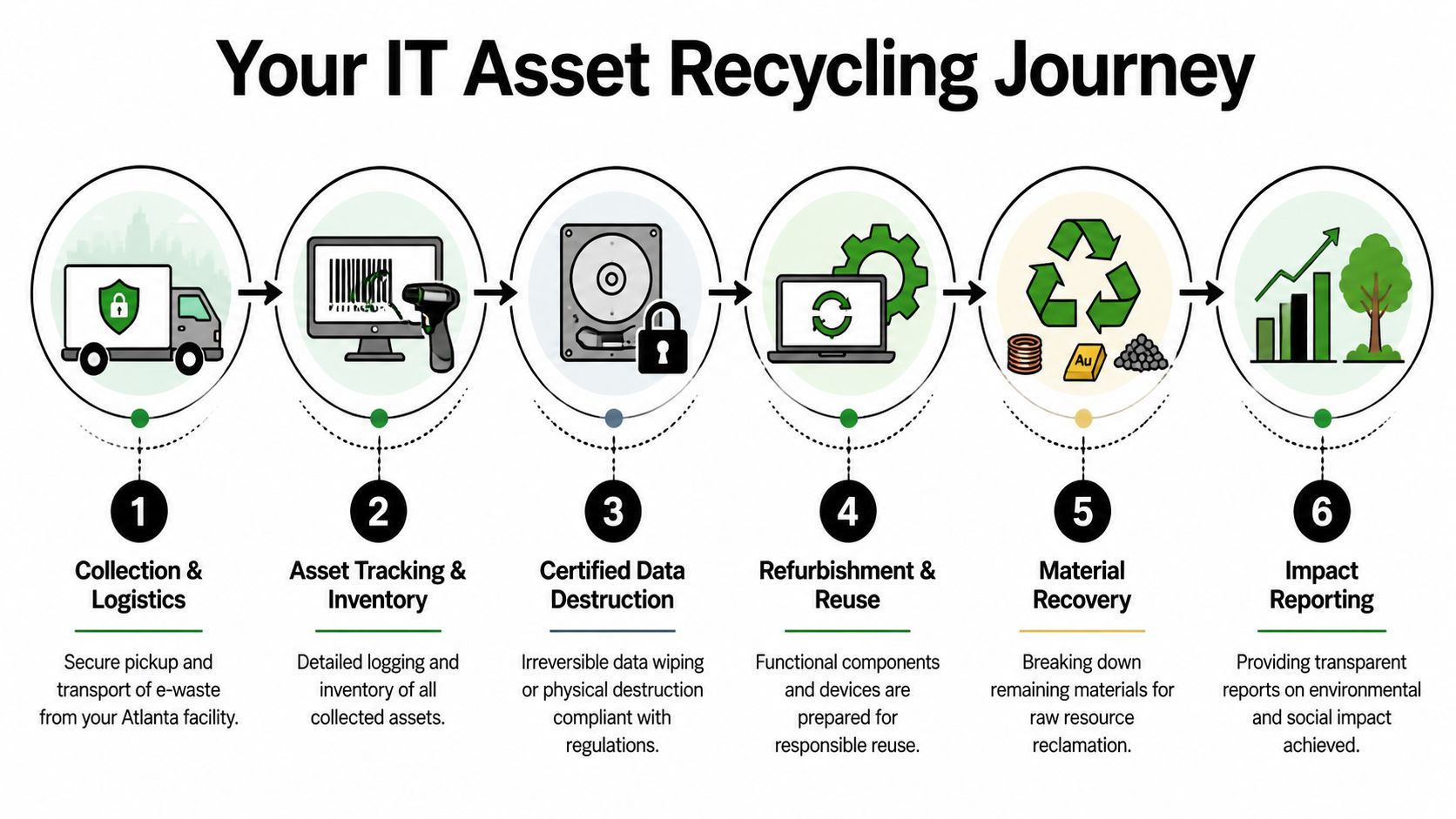
The six stages that matter
Collection and pickup
The project starts with scope. How many sites are involved, what asset types are in play, whether equipment is palletized or still in service, and whether on-site packing is needed all affect the plan.Inventory control
Once equipment is collected, assets should be logged in a way that matches internal records closely enough to support later reporting. For enterprise clients, confusion often arises if the provider’s intake process is weak.Data destruction decision
Some devices are candidates for wiping and remarketing. Others need physical destruction because they’re failed, obsolete, or governed by stricter internal rules.Reuse assessment
Reuse sits above recycling in practical value. If a device or component can be refurbished responsibly after data sanitization, that usually creates better financial and environmental outcomes than breaking it down immediately.Material recovery
Equipment that can’t be reused moves into dismantling and commodity recovery streams. The quality of downstream partners matters here, for at this stage, “responsible recycling” either holds up or falls apart.Reporting and closure
Good projects end with documentation. That can include inventory summaries, destruction records, service confirmations, and impact materials suitable for internal sustainability files.
What the handoff should look like inside your company
The strongest internal projects usually assign clear ownership before pickup day. I’ve seen simple cleanouts turn messy because IT assumed facilities was handling labels, while facilities assumed IT had already removed all storage media.
Use a short pre-pickup checklist:
- Confirm scope: Include laptops, desktops, monitors, servers, networking gear, phones, and loose drives.
- Separate high-risk media: Flag failed drives, backup units, and anything tied to regulated data.
- Clarify access: Loading dock rules, elevator reservations, after-hours access, and security sign-in procedures should be settled in advance.
- Define the paperwork: Decide who needs the inventory file, destruction confirmation, and final impact summary.
What works and what doesn’t
Here’s a simple comparison that mirrors what I see in real enterprise projects:
| Approach | What happens |
|---|---|
| Centralized pickup planning | Fewer missed assets, cleaner chain of custody, less staff disruption |
| Department-by-department ad hoc disposal | Duplicate work, missing devices, inconsistent documentation |
| Sorting by disposition path before pickup | Faster processing and clearer reporting |
| Throwing everything into gaylords without review | More remarketing opportunities lost and more audit questions later |
If your team can’t answer “where is that device now?” at each major handoff, the process isn’t controlled enough.
For organizations preparing a formal disposition cycle, Atlanta IT asset disposition for businesses is the operational model to look for. The point isn’t just removal. It’s predictable custody from pickup through final reporting.
Achieving Ironclad Data Security and Compliance
Data destruction is the point where an ordinary recycling project becomes a board-level risk decision. A pallet of retired laptops may look like surplus equipment. To an auditor, plaintiff, or threat actor, it can still be a collection of regulated records, credentials, and recoverable customer data.
That is why the first real question is not whether a vendor recycles electronics. It is whether your company can prove, asset by asset, what happened to the data-bearing devices after pickup.
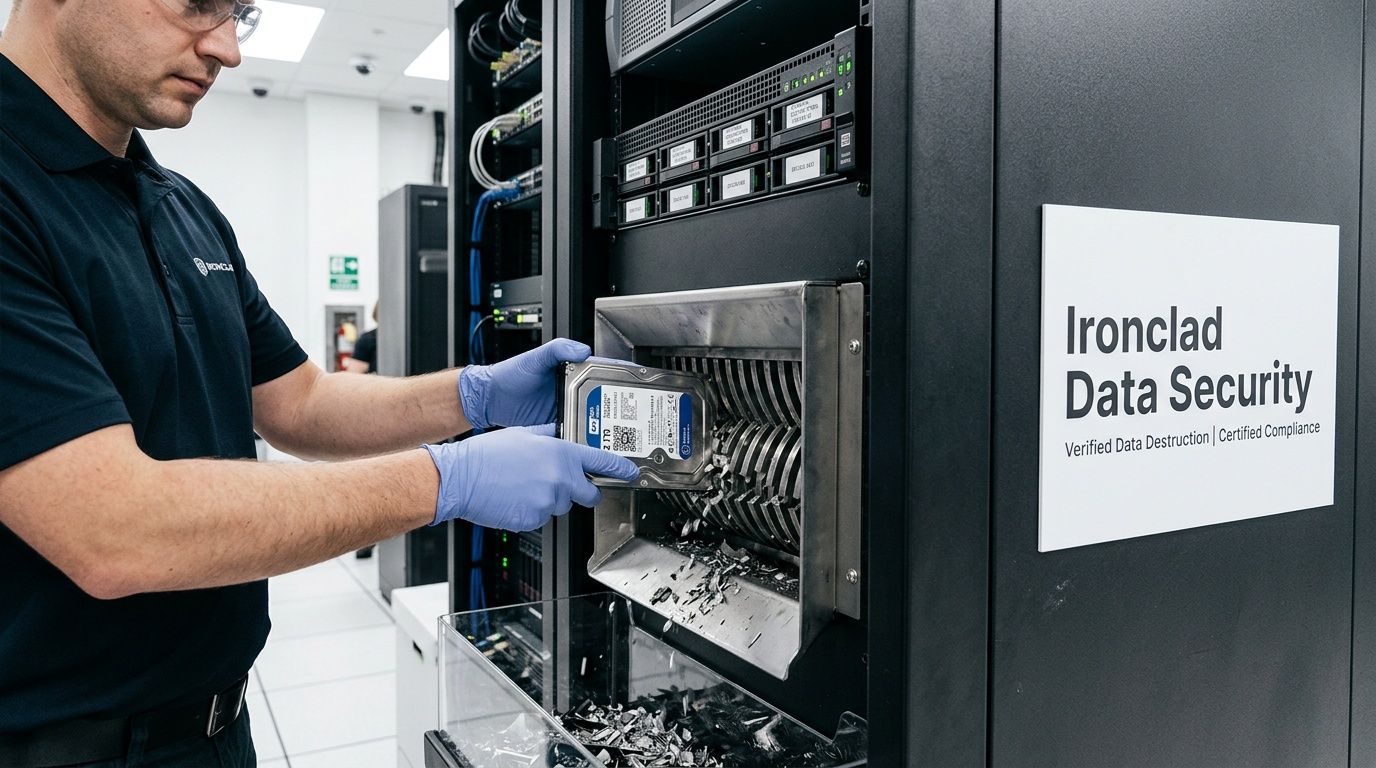
Wiping and shredding serve different business goals
A sound disposition program separates media that can be sanitized and reused from media that should be destroyed outright. That choice affects security, resale value, audit exposure, and your ESG story.
Software-based wiping fits drives that still function and are approved for reuse or remarketing. The standard referenced for local service is DoD 5220.22-M sanitization, which Atlanta Green Recycling uses for drive wiping.
Physical shredding fits failed media, drives that do not pass wipe verification, and assets governed by stricter internal rules. The same local reference states that Atlanta Green Recycling uses physical shredding to NIST 800-88 Level 4, with auditable chain of custody for HIPAA and GDPR-related requirements, according to this Atlanta electronics recycling reference.
The trade-off is straightforward. Wiping preserves asset value. Shredding removes doubt. Strong ITAD programs define in advance which categories go down each path so the decision is not improvised under deadline pressure.
What regulated sectors should require
Healthcare, financial services, legal, and public-sector teams should insist on evidence, not assurances. A vendor saying “we wipe drives” is not enough if your compliance team later has to answer who handled the device, when the media changed custody, and what happened when sanitization failed.
For regulated organizations, the baseline usually includes:
- Documented chain of custody from pickup through final processing
- Asset-level traceability for servers, laptops, loose drives, and other storage media in scope
- Certificates of Destruction or equivalent records tied to the actual method used
- A written exception process for failed, damaged, or unidentified media
- Policies aligned with federal guidance on media sanitization, such as NIST SP 800-88 Rev. 1
HIPAA does not prescribe one universal destruction method for every device. The U.S. Department of Health and Human Services focuses on proper disposal and protection of electronic protected health information, which is why documentation and controlled handling matter as much as the destruction step itself. For Atlanta companies reviewing vendors, secure business data destruction in Atlanta GA should be judged on custody controls, verification records, and exception handling, not pickup alone.
A practical decision table
| Asset condition | Typical defensible path |
|---|---|
| Working laptop slated for reuse | Certified data wipe, then remarketing or reuse |
| Failed hard drive from a clinical setting | Physical shredding with destruction record |
| Server storage from a policy-sensitive environment | Policy-driven review, though many organizations choose destruction over resale |
| Loose media with unknown history | Treat as high risk until verified and documented |
A final point gets missed too often. Good security documentation also supports brand protection. If your company reports on governance, privacy, or ESG performance, disposal records help show that responsible recycling was not just an environmental gesture. It was a controlled business process with clear accountability.
Field note: Deleting files or reformatting a drive does not meet enterprise disposition standards. It only creates false confidence.
From E-Waste to Easy ESG Wins for Your Corporation
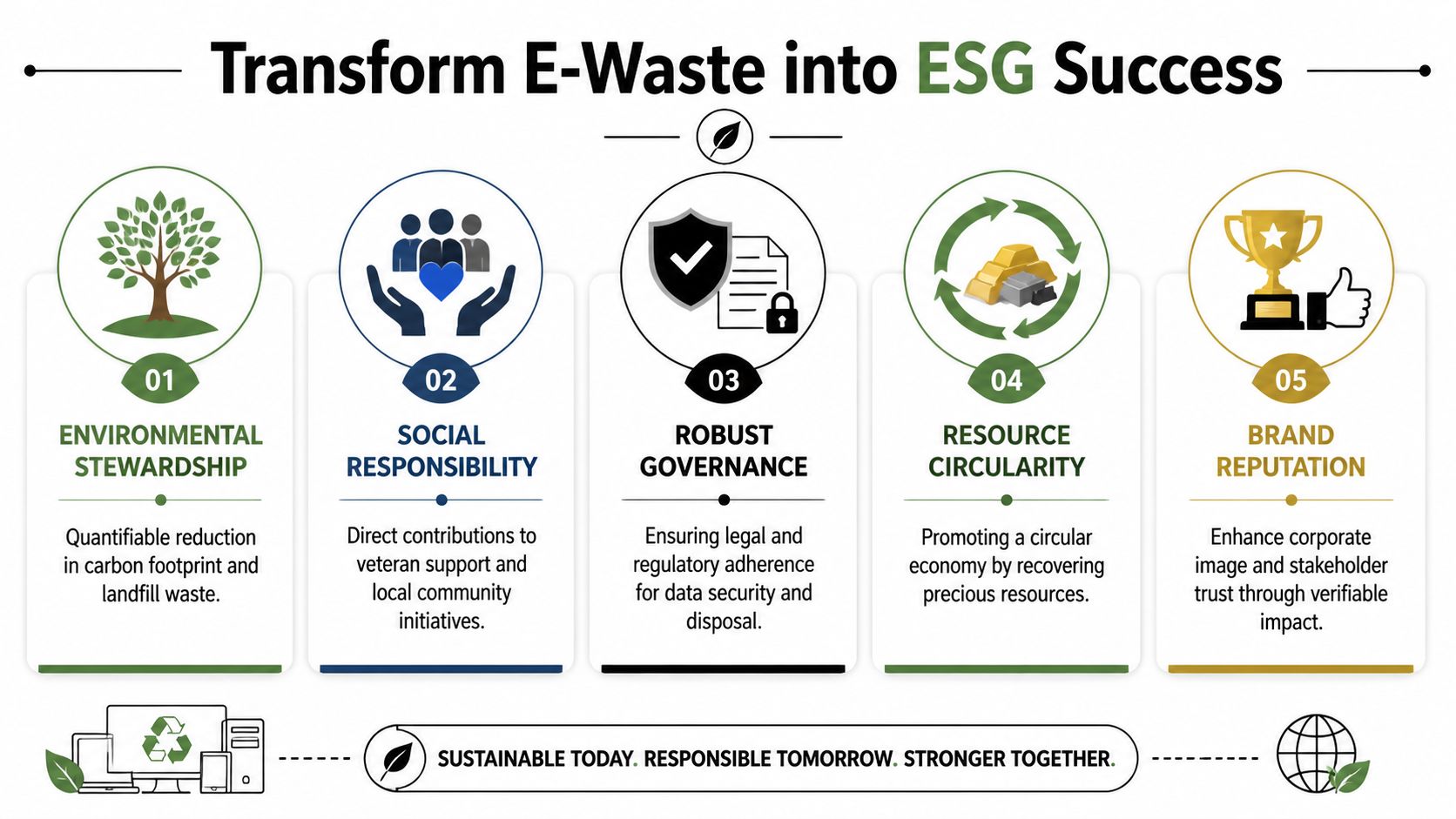
A storage room full of retired laptops rarely looks like an ESG opportunity. In practice, it often is. For Atlanta companies, old IT assets can support measurable environmental reporting, show disciplined governance, and create a community impact story people remember.
Electronics recycling works well for ESG because it ties operational decisions to visible outcomes. The environmental case is straightforward. Materials stay in circulation and hazardous components stay out of the wrong waste stream. The governance side is just as important because disposition records, custody controls, and approved processing methods show that sustainability was handled as a managed business function. The social side gives the program reach beyond the loading dock when veteran support and reforestation are part of the documented outcome.
Why this resonates with employees and stakeholders
Employees know what obsolete tech looks like. They see the monitor stacks after a refresh, the phones left in drawers, and the surplus equipment waiting for someone to decide its fate. When the company can say where that equipment went, how it was processed, and what social impact came from the project, the message feels credible.
That credibility matters for brand and culture. A vague sustainability claim gets ignored. A documented program with a Plant-A-Tree certificate, a Veteran Support Impact Report, and a digital “Recycled with Purpose” badge gives HR, procurement, sustainability, and marketing something they can all use without stretching the facts.
The strongest programs also make reporting easier. Teams do not have to invent a CSR story after the pickup. They start with records, outcomes, and approved language.
What a usable ESG recycling program looks like
A good program is built for communication as well as processing. It should fit the way the company already operates, whether that means a one-time cleanout, recurring refresh cycles, or a site consolidation with support from reverse logistics companies for business equipment recovery.
Useful formats include:
- Corporate recycling drives: Practical for office consolidations, hardware refreshes, and department cleanouts with enough volume to justify organized pickup.
- Seasonal campaigns: Veterans Day, Earth Day, and Arbor Day give internal teams a clear reason to participate and give communications teams a timely story to tell.
- Digital recognition: A “Recycled with Purpose” website badge shows participation in a factual, low-risk way.
- Internal communications assets: Short impact summaries, staff email copy, and CSR-ready language help the story travel internally without technical confusion.
Where healthcare and other regulated sectors can stand out
Regulated organizations have a stronger ESG story when they connect mission, compliance, and community benefit in one operating process. Healthcare is the clearest example.
Hospitals, clinics, and specialty practices do not gain much from generic recycling language. They gain value from a program that reflects their actual responsibilities. Industry guidance from the American Hospital Association on hospital sustainability and environmental services shows why healthcare organizations often need sector-specific disposal practices rather than a one-size-fits-all approach. That gap creates room for Atlanta healthcare groups to distinguish themselves. They can show that retired devices were handled under documented controls and that the resulting recycling effort also supported veteran aid and tree planting.
The same principle applies during relocations and consolidations, where timing, facilities coordination, and asset disposition often collide. Teams handling those projects can borrow useful sequencing ideas from Posch & Silva business relocation help, especially when IT, facilities, and sustainability goals all need to stay aligned.
Sustainability messaging works best when legal, IT, and marketing would all sign off on the same sentence.
Use the story without overstating it
Strong ESG communication stays close to the facts. State what was collected, how it was processed, what documentation was issued, and what verified social impact was tied to the program. Skip inflated cause language and broad claims the company cannot support later.
A practical rollout often looks like this:
- A pickup tied to a refresh, relocation, or cleanup cycle.
- A follow-up packet with disposition records and impact materials.
- A LinkedIn post highlighting secure recycling, veteran support, and tree planting.
- A sustainability report mention using verified language only.
- A recurring annual or semiannual drive so the program becomes part of operations.
That is why e-waste can become an easy ESG win for a corporation. The value is not in polished messaging alone. The value is in turning a routine disposal task into a documented proof point for compliance, security, community impact, and brand trust.
Planning Your IT Asset Disposition Logistics and Financials
By the time most companies ask for a quote, the disposal project already has hidden complexity. The equipment may be spread across floors or sites. Some devices may still be in service. A few may hold resale value, while others are pure recycling material.
That’s why planning matters more than people expect. Good logistics reduce labor, avoid pickup-day confusion, and preserve whatever value is still in the asset pool.
The logistics questions to settle first
Start with the basics that affect labor and chain of custody:
- Pickup format: Do assets need boxing, palletizing, or on-site packing?
- Site access: Is there loading dock access, freight elevator scheduling, or security check-in?
- Asset mix: Servers, desktops, monitors, phones, loose drives, and networking gear often need different handling.
- Business timing: Some companies want a single purge event. Others need recurring pickups tied to refresh cycles.
If your recycling project is happening during an office move, treat disposal planning as part of the relocation project, not as an afterthought. A practical reference for sequencing facilities tasks alongside move planning is Posch & Silva business relocation help, especially when IT, facilities, and vendors all need to coordinate on timing.
Where the financial upside can come from
Many managers assume electronics recycling is only a cost center. That’s often true for obsolete or broken hardware, but not always for enterprise-grade equipment with residual market value.
Verified market guidance shows that U.S. firms can recover 10-20% of asset value via certified buybacks, which is a meaningful consideration for Atlanta data centers and tech firms undergoing decommissioning, according to this Atlanta IT asset buyback discussion.
That doesn’t mean every load will generate a payout. It means companies should avoid mixing all equipment into a single “junk” category before anyone evaluates it.
A simple planning view
| Planning factor | Why it matters |
|---|---|
| Working enterprise hardware | May qualify for buyback instead of pure disposal |
| Failed or obsolete equipment | Usually moves straight to destruction or recycling |
| Loose storage media | Requires separate tracking and security handling |
| Multi-site pickups | Adds coordination but can simplify enterprise cleanouts when centralized |
One option Atlanta companies look at for coordinated pickup and equipment return flows is reverse logistics support for business electronics. What matters most is that the vendor can separate reusable assets from scrap streams without weakening your security controls.
Partner with Atlanta Green Recycling Today
If your business has old laptops in storage, retired servers in a cage, or monitors stacked after a refresh, waiting rarely improves the outcome. Assets lose value, records get harder to reconstruct, and the chance of an uncontrolled handoff goes up.
A disciplined recycling program solves several problems at once. It clears space, supports secure data handling, gives your team documentation for audit and internal reporting, and turns a routine disposal task into a visible community benefit tied to veteran support and tree planting.

The easiest way to start is simple:
- Request a consultation so the asset mix, security needs, and pickup scope are clear.
- Review a no-obligation quote that separates logistics, destruction requirements, and any possible value recovery.
- Schedule the pickup on a timeline that works for your operations, whether that’s a one-time cleanout or a recurring service cadence.
For Atlanta companies, schools, healthcare organizations, agencies, and data centers, Enterprise Electronics Recycling Atlanta GA works best when it’s treated as part of IT governance and corporate responsibility, not just disposal. Done right, old tech doesn’t just leave the building. It supports a cleaner process, a stronger paper trail, and a better story about what your organization does with what it no longer needs.
Frequently Asked Questions About Enterprise Recycling
What items are commonly accepted in enterprise recycling programs
Enterprise recycling programs usually accept desktops, laptops, servers, monitors, networking equipment, mobile devices, peripherals, and loose storage media. Acceptance rules change by provider, site conditions, and the downstream processing method, so confirm the item list before scheduling pickup.
That matters most for batteries, medical devices, specialty lab equipment, and industrial electronics. Those categories often need separate handling, packaging, or documentation.
What should we do before pickup day
Start with a clean internal inventory. Identify which assets contain sensitive data, which devices may still have resale value, and which departments own the equipment being released.
I also recommend assigning two clear roles. One person approves the final list before anything leaves the building. Another person receives certificates, settlement details, and impact reporting after the project closes. That simple step prevents a common problem in larger Atlanta organizations. Equipment gets removed, but no one can quickly produce the records later for audit, finance, or ESG reporting.
Can employees include personal electronics in a company drive
Yes, if the program is set up that way.
Keep employee-owned devices separate from company assets on intake logs, collection bins, and reporting. That protects everyone involved. Ownership stays clear, data responsibility stays clear, and your company records do not get mixed with personal drop-off activity.
How do we receive a Recycled with Purpose badge
The answer depends on how the recycler structures its reporting and brand assets. In many programs, the badge is issued after processing is complete and the impact summary is finalized.
Ask three questions before kickoff. Is the badge approved for website use? Can it be used in CSR or ESG materials? Does it come with supporting language your marketing team can use without overstating the program’s impact? That keeps the badge useful for brand credibility instead of becoming a design file with no reporting context.
How should veteran support and tree planting be reported
Report those outcomes with precise, provider-backed language only. Marketing claims should match the documentation you receive, not broad internal assumptions about what the project accomplished.
The strongest reporting package includes asset disposition records and a separate impact summary. That gives sustainability, HR, and communications teams a shared source they can use in recruiting materials, stakeholder updates, and annual reporting. For brand protection, documented impact always carries more weight than a generic statement about “giving back.”
Is free pickup always the best option
Free pickup can help on the right project, but price alone is a weak filter for enterprise recycling. A lower-cost option can create bigger downstream costs if the provider cannot support chain of custody records, data destruction documentation, or coordinated processing across multiple sites.
The better question is total business value. Atlanta companies usually benefit more from a recycler that can manage scheduling, security controls, audit-ready paperwork, and any value recovery review in one process.
How often should a business schedule electronics recycling
Set the schedule around your refresh cycle, storage limits, and risk tolerance. A fast-growing company replacing devices every quarter needs a different cadence than an office doing a major refresh every few years.
In practice, recurring pickups are often easier to control than a large annual purge. They reduce storage clutter, limit the time retired assets sit on-site, and make records easier to maintain. They also create a steadier stream of verified social and environmental impact, which helps if your company wants to tie ITAD activity to ESG goals instead of treating recycling as a once-a-year cleanup.
If your organization needs a practical path for secure, compliant, and mission-driven electronics disposition, contact Atlanta Green Recycling. A clear pickup plan, documented data destruction, and a recycling program tied to veteran support and reforestation can turn old tech into a cleaner operation and a stronger community story.