
Best Telecom Infrastructure Companies Near Me 2026


Most advice on finding telecom infrastructure companies near me stops at coverage maps, install dates, and monthly cost. That's only half the job.
A telecom project is finished when the new circuit is live and the old environment is removed, documented, sanitized, and disposed of correctly. If you skip that second part, you leave risk behind in closets, IDFs, data rooms, branch offices, and storage cages. Old firewalls may still hold configs. Retired servers may still contain logs or credentials. Decommissioned edge gear may still fall under retention, audit, or chain-of-custody requirements.
That risk gets missed because local search results usually surface installers first. Industry guidance also points out that searches for local telecom providers often overlook what happens to business continuity during moves or decommissioning, and that the cheapest contractor isn't the lowest-risk option when regulated data and chain-of-custody are involved, as discussed by Prince Telecom. For Atlanta organizations, that matters whether you're running a hospital campus, a school district, a municipal site, or a multi-office business.
The practical way to approach any telecom refresh is lifecycle-first. Start with the future-state network, but inventory the current-state assets at the same time. Document what's staying, what's moving, what's being replaced, who owns each handoff, and what has to be retired under a defensible process.
Introduction Finding a Provider Is Only Half the Project
A clean telecom rollout starts before you contact a vendor. It starts with scope. Not just bandwidth, but physical assets, compliance obligations, business continuity windows, and end-of-life handling.
Teams get into trouble when they treat procurement and decommissioning as separate jobs owned by different people who don't compare notes. The network team orders new service. Facilities schedules access. A contractor removes legacy gear. Months later, someone discovers old switches, UPS units, patch panels, or storage media still sitting onsite with no disposition record.
Start with a lifecycle inventory
Before you request quotes, build a simple working inventory that covers:
- Active network assets like routers, switches, firewalls, wireless controllers, optical gear, racks, and structured cabling endpoints.
- Supporting infrastructure such as battery backups, PDUs, console devices, patch panels, and cross-connect documentation.
- Data-bearing equipment including servers, appliances, security devices, and any removable media tied to the telecom stack.
- Site constraints like MDF/IDF space, roof access, risers, power availability, after-hours work rules, and move deadlines.
That inventory should also show what happens at cutover. Does old hardware remain in place for rollback? Is there a staged retirement window? Who signs off once devices are disconnected?
Practical rule: If an old device ever handled traffic, identity, logs, call records, or user data, don't let anyone classify it as simple scrap until IT signs off.
Define the project endpoint correctly
The wrong endpoint is “new service installed.”
The right endpoint is “new service stable, old assets removed, data destruction complete where required, recycling or remarketing documented, and final closeout accepted.”
That framing changes how you evaluate vendors. You're not only buying installation labor or connectivity. You're managing a chain of operational risk from first survey to final asset disposition.
For Atlanta-based teams, especially in healthcare, education, and government, that's the difference between a smooth migration and a cleanup project nobody budgeted for.
Defining Your Telecom Needs Beyond Bandwidth
Bandwidth still matters. It just doesn't answer enough of the core questions.
Modern telecom infrastructure isn't only about getting a bigger pipe to the building. The industry has shifted from a tower-centric model toward a broader connectivity platform shaped by AI, cloud services, and data-center-adjacent demand, as noted by the Telecommunications Industry Association. In practice, that means a local provider may be relevant not just for access circuits, but also for enterprise fiber, interconnection, and secure data-center services.
What your network must support
Start with business function, not carrier marketing. Ask what the network has to carry over the next planning cycle:
- Cloud-heavy operations with direct access needs to major platforms
- Voice and collaboration traffic that can't tolerate unstable latency
- Healthcare workflows involving imaging, EMR connectivity, or campus-to-campus access
- School and university environments with dense user populations and seasonal utilization shifts
- Government and public service sites where uptime, auditability, and controlled change windows matter
If you're reviewing local build options for last-mile and campus work, it helps to compare those requirements alongside physical plant considerations such as conduit paths, building entry, and handoff locations. A local reference point for that part of the project is fiber optic installation near me.
A better requirements checklist
Use a planning sheet with categories like these.
| Requirement area | What to document |
|---|---|
| Service profile | Symmetrical throughput needs, traffic type, critical applications |
| Resilience | Failover expectations, diverse path preferences, acceptable outage window |
| Security | Regulated data exposure, logging requirements, access control, device handling |
| Physical environment | Rack space, power, cooling, roof rights, riser access, demarc location |
| Growth path | New sites, consolidations, cloud adoption, edge compute, office moves |
| Retirement plan | Which assets will be removed, stored, repurposed, or destroyed |
The last row is the one many teams omit. It shouldn't be optional.
What works and what doesn't
What works is a use-case-driven scope. You tie connectivity decisions to actual operational patterns. You ask whether your local provider can support cloud adjacency, secure handoffs, and low-latency routing to the environments your users depend on.
What doesn't work is buying a circuit based on a headline speed tier and assuming the rest will sort itself out.
Buyers often search for telecom infrastructure companies near me as if they're choosing a local utility. In reality, they're choosing a delivery model that affects application performance, migrations, and every asset left behind after cutover.
Don't ignore future moves
Office relocations, branch consolidations, and data room reductions put extra stress on telecom planning. A provider that can provision service isn't automatically equipped to support a move sequence with staged disconnects, temporary redundancy, and clean retirement of old hardware.
That's why the best requirements document reads like an operations plan, not a shopping list.
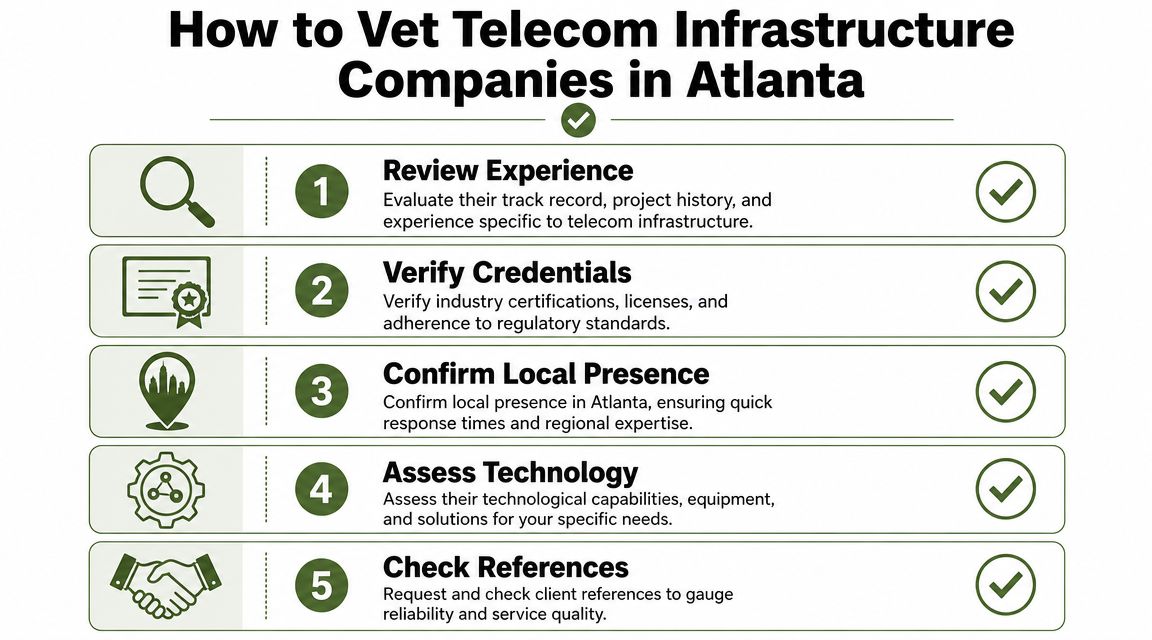
How to Vet Telecom Infrastructure Companies in Atlanta
Atlanta buyers need to vet two things at once. First, can the company deliver the network you need? Second, can it manage the realities of the local market, where access to dense infrastructure often matters more than office proximity?
The U.S. communications infrastructure market is highly concentrated. Crown Castle says it has more than 40,000 cell towers and approximately 115,000 route miles of fiber in the U.S. on its communications infrastructure overview. That matters because local telecom ecosystems are tied to these embedded physical assets. In a major market like Atlanta, vendor reach, redundancy options, and access to existing infrastructure can shape install timelines and service quality.
Large network reach versus local execution
A national infrastructure owner and a local deployment partner don't play the same role. One may control the underlying fiber path or tower access. The other may handle construction, inside plant work, testing, and handoff.
That distinction affects your shortlist. For Atlanta projects, evaluate vendors in two columns:
| Vendor type | Best use |
|---|---|
| National or regional infrastructure-backed provider | Reach, redundancy, interconnection options, larger footprint |
| Specialized local integrator or field services firm | Onsite responsiveness, building knowledge, move coordination, localized execution |
You don't want to confuse raw footprint with project ownership. Plenty of buyers do.
Questions that expose weak vendors
A polished proposal can hide a thin delivery model. Ask sharper questions.
- Who performs the work: What portion of the project is handled by your own team versus subcontractors?
- How handoff is tested: What standardized testing do you use before acceptance, and what documentation do you provide?
- How delays are managed: What buffer do you build for permits, supply issues, and access problems?
- How local support works: Who responds when a problem appears after cutover, and are they based in the Atlanta market?
- How de-installation is handled: If legacy gear must come out, what exactly do you remove, what do you leave, and how is custody documented?
Those questions line up well with telecom project management realities. Buyers also benefit from reviewing providers that already understand hybrid cloud and enterprise platform dependencies. If your telecom stack feeds cloud-heavy workloads, this directory of leading AWS, Azure, GCP partners is useful for identifying firms that think beyond the physical circuit.
Look for an operator, not just an installer
An installer gets cable in the wall. An operator-level partner understands sequencing, rollback, acceptance, and post-cutover accountability.
Signs you're dealing with the wrong kind of vendor:
- Vague ownership language around permits, testing, or turn-up
- No formal closeout package
- No clarity on subcontractors
- No process for legacy asset removal
- No willingness to tie milestones to measurable outcomes
For Atlanta organizations that need ongoing support, a practical local reference is managed telecom services near me, especially when the project doesn't end at installation and needs recurring oversight.
Ask every bidder the same operational questions in the same order. The differences show up fast when a vendor actually runs disciplined telecom projects.
Key Questions for Your RFP and Contract
A vague telecom RFP creates expensive ambiguity. Vendors fill the gaps with assumptions, and those assumptions don't match each other. Then the project changes in flight, costs move, and everyone argues about scope.
Best-practice telecom RFP guidance recommends writing scope in measurable terms, with exact deliverables, geographic areas, performance targets, and compliance requirements. It also recommends specifying service levels such as bandwidth, latency, redundancy, and uptime rather than generic “high-speed” language, as outlined in telecom RFP best practices.

Language that produces usable bids
Bad RFP language sounds like this:
- Need reliable high-speed service
- Support office move
- Replace old equipment
- Minimize downtime
That wording is too soft to compare bids.
Better language is specific:
- Minimum symmetrical throughput requirement
- Defined cutover window
- Documented test and acceptance process
- Named compliance requirements
- Explicit de-installation scope for retired equipment
The contract questions that matter most
Use the RFP to force clarity before contract review. Then preserve that clarity in the agreement.
Ask questions like these:
What exactly is included in site survey and design?
If drawings, labeling, patching plans, and demarc verification matter, list them.What are the acceptance criteria?
Don't accept “service activated” as the only milestone. Require test results and closeout documents.How are changes controlled?
Define who can approve changes, how they're priced, and what documentation triggers a change order.Who owns permits, access coordination, and utility dependencies?
This often gets blurred until a delay hits.What happens to removed hardware?
This must be written. Not discussed. Written.
A local example of broader project planning around connectivity and business operations is enterprise telecom solutions in Atlanta, where installation, support expectations, and lifecycle concerns need to be aligned upfront.
Put decommissioning in the contract body
Many teams mention old equipment in a notes field or a kickoff call. That's a mistake.
If old switches, routers, appliances, circuit hardware, or rack components are being removed, the contract should answer:
| Contract item | Why it matters |
|---|---|
| Removal scope | Prevents finger-pointing over what gets taken out |
| Ownership at pickup | Establishes chain of custody |
| Data handling obligations | Protects regulated or sensitive information |
| Documentation required | Supports audits and internal sign-off |
| Recycling or destruction path | Distinguishes disposal from compliant disposition |
What procurement teams often underestimate
They focus on buying the new service and treat retirement of old assets like facilities cleanup. It isn't.
Legacy telecom gear may contain logs, credentials, call records, management configs, certificates, and internal topology data. If your contract doesn't define who handles that material and how, you're leaving one of the highest-risk parts of the project open to improvisation.
A telecom contract should describe how the project ends. If it doesn't, you're not buying a full delivery. You're buying a partial one.
The Critical Final Step Secure IT Decommissioning
The cutover weekend ends. Users are online. The provider sends the closeout package. Then someone opens the old room and sees the leftovers.
There's the retired firewall pair on the bottom rack. A stack of access switches. A voice gateway nobody claimed. Two storage appliances that supported call recording. Boxes of patch cables and optics. Maybe a UPS unit waiting for facilities. Maybe branch hardware that got shipped back without labels. Sloppy projects manifest through these remnants.
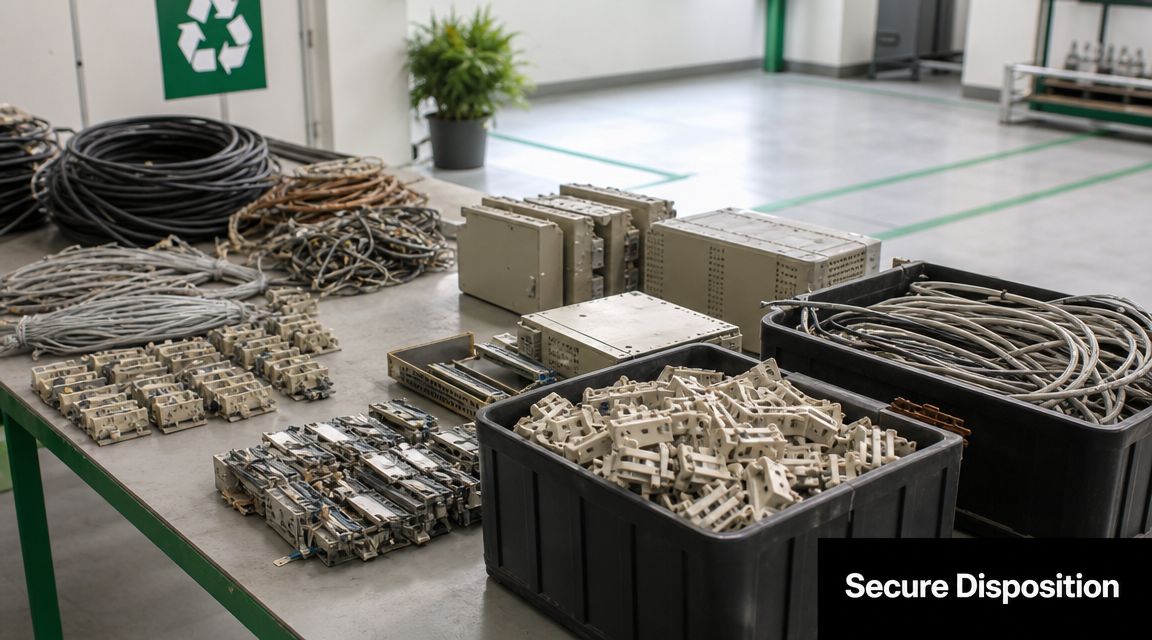
Removal is not disposition
A lot of contractors can unbolt gear, coil cable, and clear a room. That does not make them an IT asset disposition partner.
Secure decommissioning has its own workflow:
- Asset identification so nothing data-bearing disappears into mixed scrap
- Chain of custody from disconnect through transport and processing
- Data destruction method selection based on device type and policy
- Disposition decision for reuse, recycling, or destruction
- Documentation that stands up in audits and internal reviews
If a vendor can't show that workflow, they're doing removal, not compliant decommissioning.
What a defensible process looks like
A practical decommissioning runbook usually includes these steps.
| Step | Operational question |
|---|---|
| Inventory confirmation | Does the pickup list match what was actually removed? |
| Segregation | Which items contain data, batteries, or special handling requirements? |
| Custody transfer | Who signed at release and who received the load? |
| Sanitization or destruction | What method applies to each media type? |
| Final reporting | What proof will procurement, IT, security, and compliance receive? |
One local option for this kind of end-of-life work is ITAD telecom services near me. The key issue isn't brand preference. It's whether the provider separates data-bearing assets from general telecom scrap and documents every handoff.
The often-missed crossover risk
Telecom and IT blur together in the field. A network refresh may retire routers, security appliances, small servers, call systems, and edge storage in the same project. The installer might treat all of it as old equipment. Your compliance team won't.
I've seen teams budget carefully for new circuits and cabling, then leave decommissioning to the end, when nobody wants to spend more time on a “finished” project. That's exactly when assets get boxed without labels, stored without records, or removed by whoever is already onsite.
If the old environment supported authentication, voice, surveillance, logging, or regulated workflows, secure decommissioning belongs under formal project control.
Where sustainability and security can align
Decommissioning doesn't have to end as a pile of undocumented e-waste. With the right partner, it becomes part of your compliance record and part of your sustainability record.
That matters more now because organizations are consolidating sites, retiring aging hardware, and trying to reduce waste without losing auditability. A disciplined process can separate reusable assets, destroy media that shouldn't leave control, and recycle the rest through a compliant channel.
The mistake is assuming your telecom installer should own all of that by default. Most shouldn't. Their job is to build and hand off the new environment. End-of-life processing is a separate specialty and should be treated that way.
Turn E-Waste into an ESG Win with Purposeful Recycling
ESG value does not come from dropping old telecom gear into a recycling stream and hoping the sustainability team can turn it into a story later. It comes from specifying the outcome at the same time you plan the replacement.
If the project is retiring switches, phones, wireless gear, racks, UPS units, user devices, or telecom-adjacent IT equipment, ask what happens after pickup. Ask what gets reused, what gets broken down for materials recovery, what documentation comes back, and what your organization can report without stretching the truth.

Recycle for a Cause works when the outcome is documented
A cause-based recycling program can help, but only if it is tied to records your operations, compliance, and sustainability teams can all use. Otherwise, it is just disposal with nicer language.
For Atlanta organizations, that often lands better with leadership because the result is specific. Retired technology can be processed through a program that supports community outcomes and reduces landfill waste, while still giving the business a documented chain of handling. That is far more useful than a generic claim that the equipment was "recycled responsibly."
Where this fits in a real telecom project
Purposeful recycling works best when it is built into site closure, migration, and refresh planning, not added after cutover. I have seen teams get better participation from branch managers and department leads when they know the old equipment is not just leaving the building, but being tracked and put through a defined downstream process.
It is especially practical in cases like these:
- Office moves with a mix of telecom hardware, end-user devices, and miscellaneous closet equipment
- School and municipal refreshes where public accountability matters along with disposition records
- Healthcare or multi-site consolidations where secure retirement is required and sustainability reporting still matters
- Seasonal collection campaigns tied to internal CSR efforts, if the chain of custody and reporting are still handled with discipline
A useful outside example is this Singapore Apple upgrade guide, which frames replacement as a full lifecycle decision instead of a one-time purchase. The same thinking applies to telecom infrastructure. Buy the new environment with the old one already accounted for.
What to ask for from the recycling partner
If the ESG angle matters, request deliverables that stand up in an audit and still help your reporting team.
- Processing summaries that show what was received and how it was handled
- Impact documentation your CSR or ESG team can reference without rewriting technical records
- Pickup records and asset counts that match internal inventories closely enough to reconcile exceptions
- Recognition assets or program summaries only if they are backed by real operational data
For teams building that process, this Atlanta business technology recycling guide is a practical reference.
Why this improves more than the annual report
The operational upside is easy to underestimate.
Clear recycling outcomes reduce resistance from site contacts who would otherwise hold old hardware "just in case." They also give procurement, IT, facilities, and compliance a cleaner closeout package. That matters when someone asks six months later what happened to the retired firewall, phone system, or storage appliance that disappeared during the network refresh.
Handled properly, e-waste recycling becomes part of project control. It supports environmental goals, but it also prevents the usual mess of abandoned hardware, vague handoffs, and missing records. That is the standard to aim for.
Conclusion Your Partner for the Full Infrastructure Lifecycle
Searching for telecom infrastructure companies near me should lead to a better network. It should also lead to a cleaner, safer exit from the old one.
The strongest telecom projects aren't judged only by whether the circuit comes up on time. They're judged by whether the team controlled scope, documented handoffs, protected data, and retired legacy assets without creating a compliance mess afterward.
For Atlanta organizations, the practical standard is simple. Define requirements beyond speed. Vet vendors based on delivery discipline, not sales language. Write measurable RFPs. Put de-installation and custody obligations in the contract. Then treat decommissioning as a formal workstream, not a leftover task.
That full-lifecycle approach is what keeps closets from filling with abandoned gear, keeps sensitive hardware out of the wrong hands, and gives your organization a documented path from deployment to disposal.
The next time you evaluate telecom infrastructure companies near me, don't stop at who can light the new connection. Ask who owns the last mile of the project after cutover, when the old equipment still needs to be removed, tracked, sanitized, and recycled properly.
If your organization is planning a network upgrade, office move, site closure, or telecom hardware retirement in the Atlanta area, Atlanta Green Recycling can help you handle the end-of-life side with secure data destruction, de-installation support, and compliant electronics recycling workflows that fit enterprise, healthcare, education, and government environments.