
Your Guide to Enterprise Telecom Solutions Atlanta


Your Atlanta office may already be sending the signal. Video meetings stutter. File transfers crawl during peak hours. Your help desk keeps hearing the same complaints about dropped calls, flaky Wi-Fi, and old phone systems that nobody wants to touch because they still barely work.
That’s usually when companies start shopping for enterprise telecom solutions Atlanta providers. Most make the same mistake. They focus only on the shiny front end: bandwidth, phones, cloud UC, SD-WAN, failover, pricing. They ignore the full lifecycle. That’s a bad strategy. A telecom upgrade isn’t finished when the new circuit goes live. It’s finished when the retired switches, servers, PBX gear, routers, handsets, and storage media are securely removed, sanitized, documented, and handled responsibly.
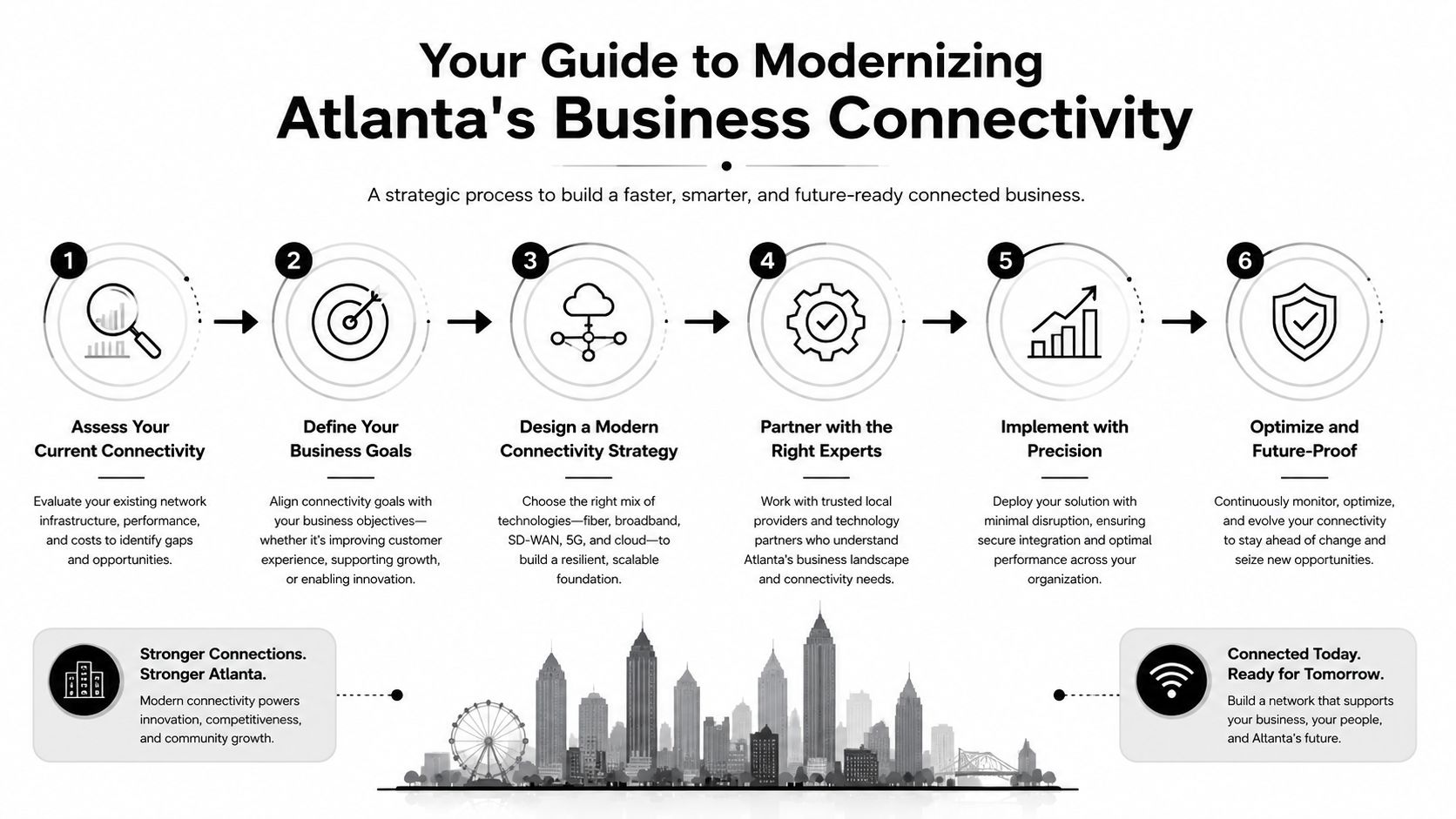
Your Guide to Modernizing Atlanta's Business Connectivity
Atlanta companies don’t have the luxury of waiting around for legacy telecom to fail completely. If your business depends on hybrid work, contact center performance, secure clinical communications, campus-wide connectivity, or data center interconnects, weak infrastructure drags down everything else.
The market is moving fast. The global enterprise telecom services market was valued at approximately USD 848.2 billion in 2022 and is projected to reach USD 1.2 trillion by 2032, according to Global Market Insights on enterprise telecom services. That growth is tied to 5G, cloud communications, and managed infrastructure. It also means more retired equipment piling up after every refresh.
Stop treating telecom as a one-vendor purchase
A strong upgrade starts with a business decision, not a carrier quote. You’re deciding how your company will communicate, move data, support remote staff, protect regulated information, and scale across metro Atlanta. If your operation includes customer support, it’s worth reviewing how enterprise contact center solutions fit into the larger architecture so voice, routing, reporting, and customer experience aren’t handled as a disconnected side project.
Telecom also doesn’t live in isolation from your facilities. Smart offices, badge access, cameras, occupancy tools, sensors, and building systems all compete for network reliability. Companies planning office modernization should think about telecom and facilities as one program, not two. This integration makes a resource on smart building technology in Atlanta particularly useful, especially if you’re refreshing structured cabling, wireless coverage, and edge hardware at the same time.
The lifecycle matters more than the launch date
Most provider proposals are built to get a signature. They aren’t built to protect you at the end of the project.
Practical rule: If your telecom plan doesn’t include decommissioning, data sanitization, chain of custody, and recycling documentation, the plan is incomplete.
That’s my opinion after watching too many companies overspend on modern connectivity, then shove old hardware into a storage room for “later.” Later becomes never. Meanwhile, security risk, compliance exposure, and clutter keep growing.
A smart telecom strategy in Atlanta has six parts: define operational needs, map future growth, score vendors objectively, negotiate contract flexibility, execute a clean cutover, and retire old hardware with the same discipline you used to install the new environment.
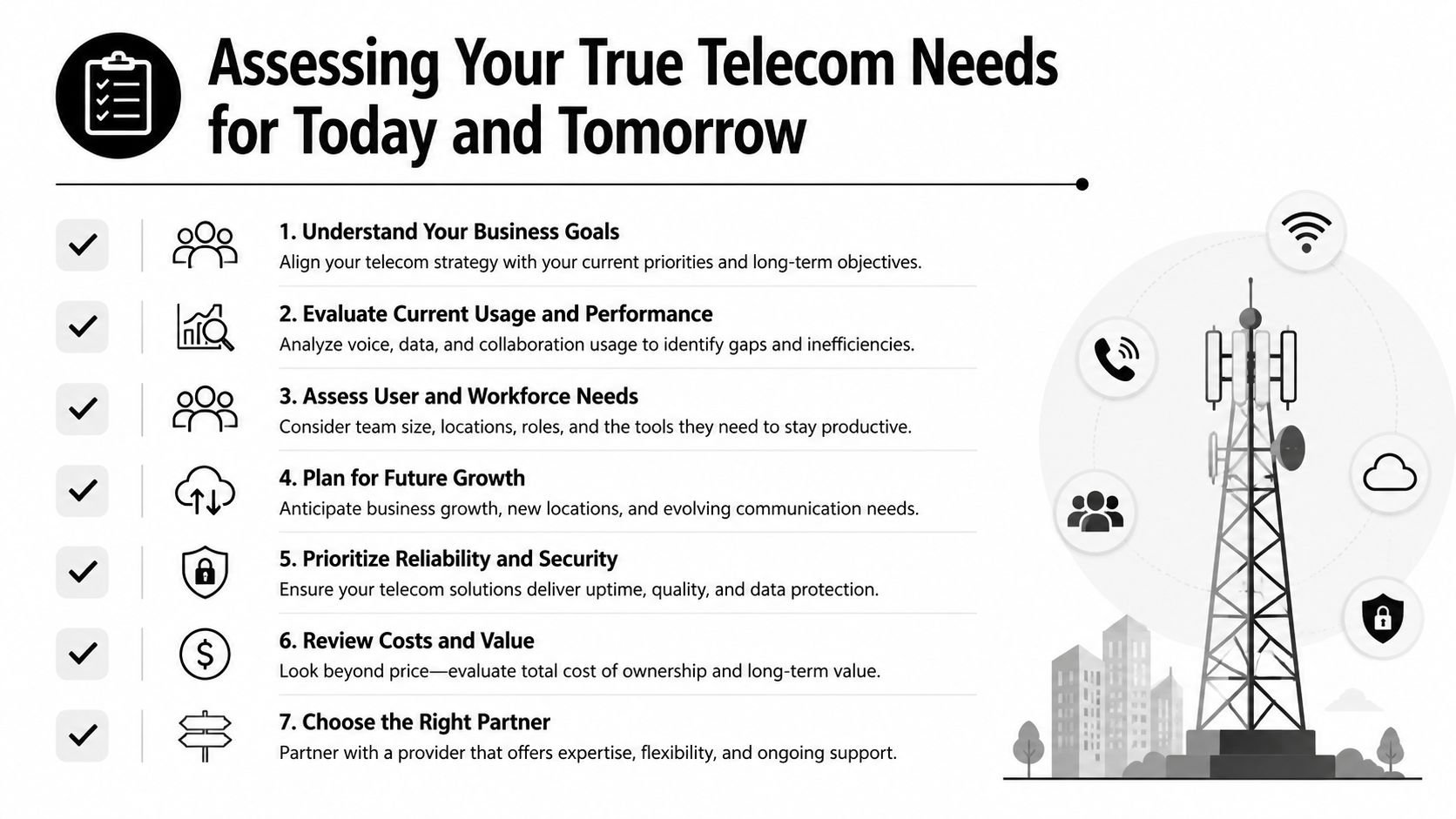
Assessing Your True Telecom Needs for Today and Tomorrow
Most telecom buying mistakes happen before the first vendor call. The issue isn’t bad pricing. It’s bad self-diagnosis. If you can’t define what your business needs, providers will define it for you, and they’ll usually define it in a way that increases monthly recurring revenue.
Start with the business model, not the circuit size. A hospital network, a logistics company near the airport, a Midtown law firm, a multi-campus school system, and a regional headquarters all have different traffic patterns, uptime requirements, compliance obligations, and support realities. That sounds obvious, but too many RFPs still boil down to “we need faster internet and better phones.”
Define the current-state problems in operational terms
Don’t write “poor performance.” Write what’s failing.
- Voice issues: Are calls dropping, jittering, or routing poorly between sites?
- Application slowdown: Which systems suffer first? File shares, EMR access, ERP, VoIP, remote desktops, video?
- Support burden: How often does your internal team troubleshoot telecom instead of advancing strategic work?
- Site complexity: Are branch offices, clinics, campuses, or warehouse facilities managed inconsistently?
- Vendor sprawl: How many providers touch your voice, internet, mobility, failover, and support environment?
If you need a practical baseline for voice modernization, F1Group's guidance on business telephony is a useful reference for comparing hosted telephony against older on-premise assumptions.
Build a future-state requirements map
The right question isn’t “What do we need today?” It’s “What will break when the business changes?”
Use these planning buckets:
Workforce model
Hybrid work changes traffic patterns. Remote users need secure, consistent access to voice and collaboration tools. Executives expect meetings to work from home, airport lounges, and branch offices without thinking about the underlying platform.
Site growth and contraction
Atlanta companies expand, consolidate, relocate, and reconfigure space constantly. Your telecom environment should let you add offices, reduce footprint, or support temporary locations without rebuilding everything from scratch.
Device growth
Your network no longer supports just laptops and desk phones. It may also support cameras, tablets, access control, printers, sensors, digital signage, and specialty devices. Every one of those endpoints competes for reliability and segmentation.
Ask vendors about automation maturity
This is where stronger buyers separate themselves from passive buyers. Autonomous Networks are no longer just a conference talking point. Bain’s analysis of autonomous networks notes that providers like China Mobile are targeting nationwide Level 4 by 2028, and AI-driven fault prediction and dynamic resource allocation can reduce downtime by 30% to 50%. You don’t need a fully autonomous environment tomorrow, but you should ask every provider what they’re doing around predictive maintenance, closed-loop automation, and fault isolation.
If a provider can’t explain its roadmap for automation in plain English, assume you’ll be paying for manual workarounds longer than you want.
Document compliance and disposal requirements early
For healthcare, education, finance, and government-adjacent organizations, telecom isn’t just a utility. It carries regulated information and sits beside regulated systems. Your requirements document should include security controls, data retention implications, decommissioning expectations, and chain-of-custody standards before procurement starts.
That matters in Atlanta because office moves, network refreshes, and multi-site upgrades generate a lot of retired equipment quickly. If your planning process ignores old handsets, edge devices, storage media, rack equipment, and failed hardware, the cleanup becomes chaotic. A local planning reference on telecom providers near Atlanta can help frame the regional provider market, but your internal requirements should always come first.
Evaluating Atlanta Telecom Providers A Vendor Scorecard
Once your requirements are clear, vendor selection becomes a filtering exercise instead of a sales contest. That’s exactly what you want. Atlanta has no shortage of providers that promise responsive support, scalable service, and “enterprise-grade” everything. Those claims mean very little until you score them against your actual operational needs.
The market context matters here. The enterprise telecom sector saw $56 billion deployed across 424 transactions between Q1 2020 and Q2 2024, according to Jahani & Associates on enterprise telecom M&A and valuations. In a consolidating market, a small Atlanta provider may be excellent today and look very different after an acquisition. Ask direct questions about ownership, funding, leadership stability, support model continuity, and long-term strategy.
What I look for first
I start with five categories. Not ten. Not twenty. Five.
Network fit
Can the provider support your locations, traffic patterns, failover requirements, and application mix without forcing awkward workarounds? If your environment includes multiple offices, clinics, warehouses, or data center relationships, ask how they handle local access diversity, escalation, and cutover coordination.
Support quality
You’re not buying a circuit. You’re buying the experience of dealing with problems. Ask who answers after hours, who owns escalations, whether support is local or centralized, and whether implementation engineers disappear after go-live.
Security and governance
Can they document access control, device management boundaries, incident handling, and decommissioning expectations? A provider that’s sloppy in documentation is usually sloppy in execution.
Commercial clarity
The cleanest proposal often wins. If pricing is confusing during the sales cycle, billing will be worse later.
Strategic resilience
Could this provider survive a market shift, merger, leadership change, or product transition without turning your account into an orphan?
Use a scorecard or expect bias
When companies skip a scorecard, someone picks the vendor they “feel best about.” That usually means the rep was polished, the slide deck looked modern, or the quote seemed cheap at first glance.
Use a weighted table and force your team to justify scores.
| Evaluation Criterion | Weight (1-5) | Vendor A Score (1-5) | Vendor A Weighted Score | Vendor B Score (1-5) | Vendor B Weighted Score |
|---|---|---|---|---|---|
| Network performance and local coverage | 5 | ||||
| SLA strength and remedy terms | 5 | ||||
| Implementation capability | 4 | ||||
| Support responsiveness | 5 | ||||
| Security and compliance posture | 5 | ||||
| Pricing transparency | 4 | ||||
| Contract flexibility | 4 | ||||
| Reporting and visibility | 3 | ||||
| Financial stability | 4 | ||||
| Decommissioning coordination | 3 |
Questions that expose weak vendors fast
Here are the questions I’d ask in the first serious meeting:
- Ownership question: Who owns the customer relationship if your company is acquired?
- Escalation question: What happens if a major outage starts after business hours?
- Provisioning question: Who coordinates with building management, cabling teams, and other providers?
- Billing question: Show me a sample invoice for a multi-site enterprise account.
- Support question: What’s your average path from ticket open to senior engineering involvement?
- Lifecycle question: How do you support hardware retirement, return logistics, and site cleanup after cutover?
Good vendors answer directly. Weak vendors answer with marketing language.
Atlanta-specific factors to score hard
Atlanta businesses should care about regional realities. Dense office corridors, suburban campus footprints, healthcare systems, education networks, industrial sites, and data center traffic all create different service expectations. Ask vendors how they support metro-wide implementations, how they coordinate across building access constraints, and how they deal with legacy handoffs from older circuits and PBX systems.
Don’t ignore references, either. Ask for references that look like you. A provider that excels with simple office voice may not be built for distributed operations with compliance pressure and heavy change management.
If you want a local comparison baseline while building your shortlist, review the broader range of local telecom companies in Atlanta. Use that kind of resource for market orientation, not as a substitute for structured scoring.
Negotiating Contracts and Planning a Seamless Integration
Most telecom contracts are designed to lock in revenue, limit provider exposure, and leave enough ambiguity for later billing disputes. That’s not a criticism. It’s just the reality of carrier and managed services contracting. If you don’t negotiate hard on structure, your company absorbs the risk by default.
Price matters, but price isn’t the center of the deal. Flexibility is. Accountability is. Exit rights are. Implementation obligations are. If you get those wrong, a “good” monthly rate won’t save you.
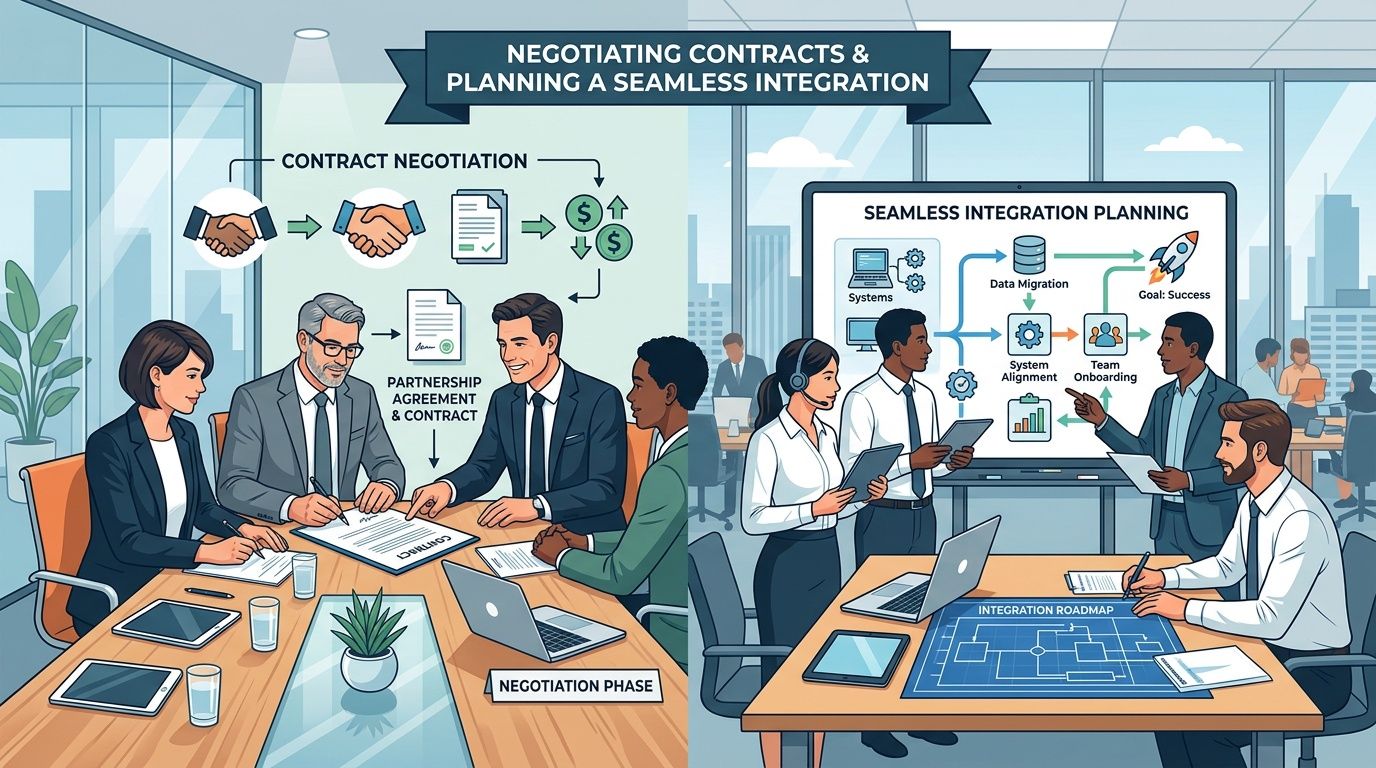
Negotiate the terms that matter after go-live
A contract should answer the questions your CFO, CIO, compliance lead, and operations team will ask six months later.
SLA remedies
Don’t settle for vague uptime language. Define what qualifies as non-performance, how incidents are measured, what reporting you’ll receive, and what remedy applies when service falls short.
Change flexibility
Your business may add locations, close space, spin up projects, or shift workload distribution. Bake in a process for scaling up and down without triggering absurd penalties.
Billing simplicity
McKinsey’s analysis of SMB-style bundling in telecom found that bundled models can simplify billing and reduce administrative overhead by up to 25%. That’s why I often tell larger organizations to ask for a more consolidated “one bill, one relationship” approach rather than accepting fragmented billing across services, as discussed in McKinsey’s article on winning the SMB tech market.
Plan the integration like a controlled migration, not a vendor install
Projects either look professional or sloppy at this point. A provider may handle the circuit turn-up and phone provisioning, but your team still owns the business impact.
Use a phased integration model:
- Inventory the current environment. Include circuits, phones, switches, firewalls, PBX dependencies, analog lines, failover paths, and site contacts.
- Map business-critical functions. Identify who cannot tolerate downtime, even briefly.
- Sequence the migration. Move low-risk locations first if your footprint allows it.
- Create cutover runbooks. Every site needs one.
- Confirm rollback paths. If something fails, who decides and how quickly do you revert?
- Tie decommissioning into the project plan. Don’t leave old gear behind waiting for “phase two.”
The cleanest cutovers happen when operations, facilities, security, and IT all work from one plan.
Don’t let migration planning end at activation
A lot of enterprise telecom solutions Atlanta projects fail in the handoff between installation and operational ownership. New services go live. Users are mostly happy. Then nobody handles documentation, asset retirement, billing cleanup, or old circuit disconnects with discipline.
That’s why migration planning should include site access, equipment staging, return logistics, and shutdown timing for replaced hardware. If your project touches data center infrastructure or major rack changes, a resource on data center migration best practices can help shape the execution side of the plan.
Managing Secure Decommissioning and IT Asset Disposition
This is the step most companies underestimate, and it’s the step that can cause the most avoidable damage.
Old telecom hardware isn’t harmless because it’s unplugged. Legacy PBX systems, switches, routers, firewalls, storage devices, call recording hardware, servers, access points, and endpoint media can still hold sensitive data, credentials, configurations, call logs, and customer information. Leaving that equipment in a back room is not cautious. It’s negligent.
According to the Bain article referencing enterprise ICT service shifts, the 2026 Verizon DBIR states that 65% of data breaches stemming from physical assets are linked to improperly decommissioned hardware. That should end the lazy habit of treating telecom retirement like office cleanup.
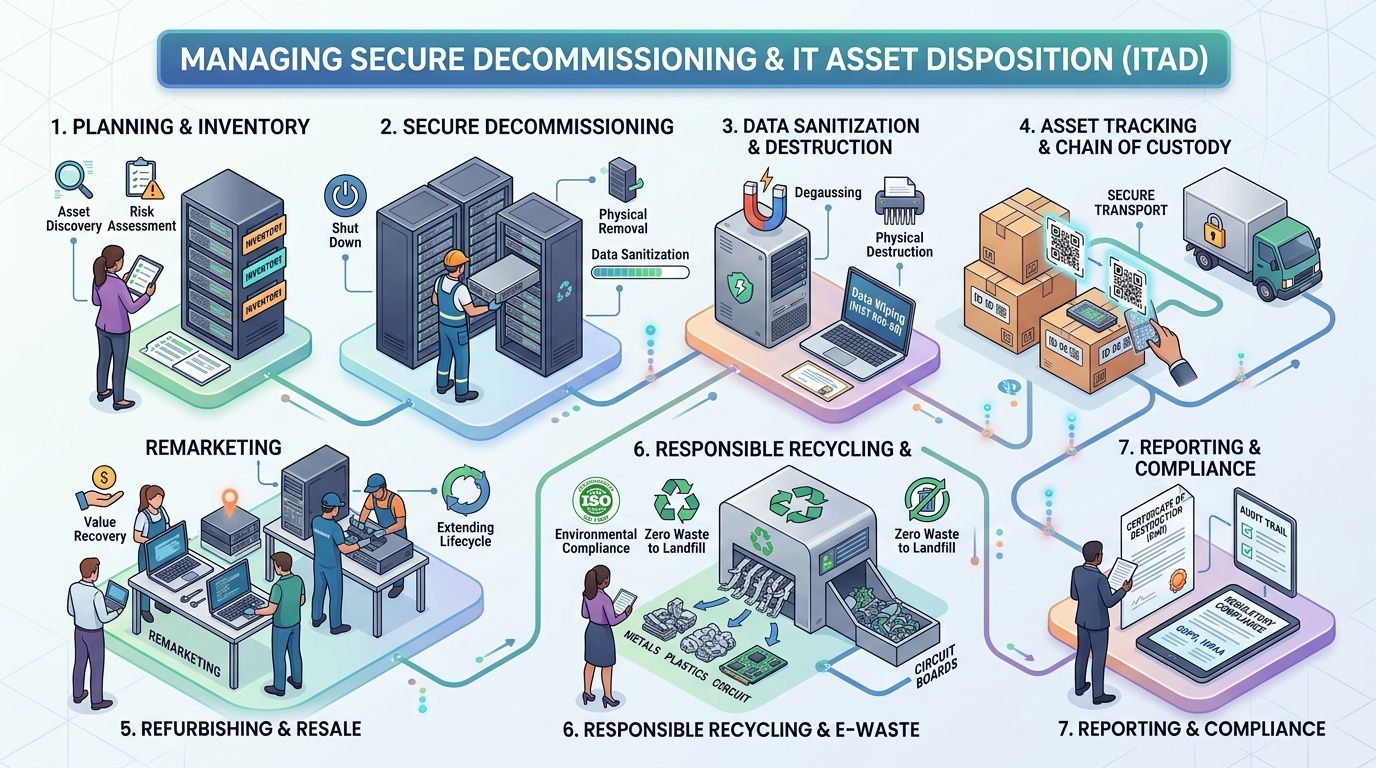
What secure decommissioning actually requires
A real IT asset disposition process is structured. It’s not “haul it away.”
Asset identification
List everything coming out of service. Include servers, switches, routers, handsets, conferencing gear, storage arrays, workstations tied to telecom systems, backup media, and loose drives.
Chain of custody
From rack removal to transport and final processing, someone should be able to show where your equipment went and who handled it.
Data sanitization
For organizations with regulated data or sensitive IP, certified wiping to DoD sanitization standards and physical shredding for obsolete or failed media should be treated as core controls, not optional add-ons.
Documentation
You need records for internal audit, compliance review, and stakeholder assurance. If your team can’t prove what happened to retired hardware, your process is weak.
Decommissioning is also an ESG and brand decision
Here’s the part many leadership teams miss. Responsible telecom retirement doesn’t just reduce risk. It supports environmental and CSR goals in a way that procurement, legal, and marketing can all understand.
The enterprise telecom market’s growth is driving more upgrade activity and more retired infrastructure. That creates a practical opening for companies that want their upgrade projects to align with sustainability and corporate responsibility. A disposal workflow that diverts e-waste from landfill and produces audit-ready records is already useful. One that also supports a cause-based model tied to veteran aid and tree planting is stronger because it turns a backend compliance task into a visible business value story.
That kind of approach works especially well for Atlanta companies with formal ESG or CSR reporting. A “Recycle for a Cause” campaign is simple and effective. Old tech doesn’t just leave the building. It contributes to veteran support and reforestation. That message is stronger than generic sustainability language because employees, customers, and partners understand it immediately.
Retired telecom gear is either a hidden liability or a visible proof point. You decide which.
What I recommend companies require
If you’re refreshing voice, connectivity, or edge infrastructure, put these requirements in writing before cutover:
- Certified sanitization: Require documented data destruction for any asset with storage or configuration memory.
- Onsite de-installation support: Don’t ask your internal team to become a moving crew.
- Serialized tracking where appropriate: Especially for enterprise and regulated environments.
- Pickup and logistics planning: Old hardware should leave on a schedule, not “sometime next quarter.”
- Impact reporting: If your company has ESG or CSR goals, ask for documentation you can use internally.
- Cause-based communication: If your organization values community impact, build it into employee communications and sustainability reporting.
That last point matters. If your company wants stronger engagement around sustainability, add practical touches: impact certificates, a “Recycled with Purpose” badge for partner communications, seasonal drives around Veterans Day or Earth Day, and LinkedIn thought leadership that frames telecom disposal as part of responsible modernization, not janitorial cleanup.
For local organizations handling office closures, data center changes, clinic upgrades, or campus refreshes, a practical starting point is reviewing Atlanta IT asset disposition for businesses so the decommissioning scope is defined before hardware starts piling up.
Building Your Resilient and Responsible Telecom Strategy
The best enterprise telecom solutions Atlanta strategy doesn’t start with a provider demo and end with a successful install. It starts with operational clarity and ends with disciplined retirement of the old environment.
That full-lifecycle view changes the quality of your decisions. You buy services that fit the business, not just the budget cycle. You choose vendors that can survive change. You negotiate for flexibility. You cut over with less chaos. And you remove old equipment in a way that protects data, supports compliance, and advances sustainability goals instead of undermining them.
What strong companies do differently
They make three decisions early.
- They define requirements before talking to providers.
- They score vendors objectively instead of buying the best pitch.
- They treat decommissioning as part of telecom strategy, not post-project debris removal.
That’s the difference between a messy upgrade and a mature one.
If your organization also cares about community impact, there’s no reason to separate telecom modernization from broader corporate values. A mission-driven disposal program tied to veteran support and reforestation gives your team a practical way to connect security, sustainability, and local responsibility without adding fluff to the project.
Frequently Asked Questions
How do I choose between a large national provider and a smaller Atlanta telecom firm
Use your scorecard. Large providers may offer broader product breadth and established processes. Smaller firms may move faster and provide better account attention. Neither is automatically better. Ask about support ownership, escalation paths, implementation depth, and long-term stability. In a consolidating market, those answers matter.
What should be in an enterprise telecom RFP
Include site list, user profile, current pain points, application dependencies, security expectations, support hours, implementation requirements, billing preferences, and decommissioning scope. If old hardware is being replaced, say so directly. Don’t leave asset retirement out of the document.
Should we bundle services or keep multiple vendors
Bundle when it creates cleaner accountability, simpler billing, and less vendor sprawl. Keep separate vendors when one provider can’t meet specialized needs or when risk diversification matters more than consolidation. The right answer depends on your operating model, not vendor sales pressure.
How early should we plan for decommissioning
At the start of the project. If you wait until after cutover, old equipment sits longer, documentation gets weaker, and chain of custody becomes harder to prove. Build retirement logistics, sanitization requirements, and pickup timing into the original implementation plan.
What telecom equipment usually needs secure disposition
Anything with storage, configuration data, logs, credentials, or business information. That often includes servers, storage media, firewalls, routers, PBX platforms, call recording systems, switches, old workstations tied to telecom systems, and failed drives pulled during upgrades.
Is wiping enough, or do we need shredding too
It depends on the device condition, regulatory expectations, and your internal risk tolerance. Functional media may be eligible for sanitization to DoD standards. Failed, damaged, or highly sensitive media often calls for physical destruction. Your compliance and security teams should align on the standard before decommissioning begins.
How can telecom disposal support ESG and CSR reporting
Ask for documentation that shows responsible processing and environmental handling. If your organization values cause-based initiatives, look for programs that connect electronics recycling to community outcomes like veteran support and tree planting. That turns a backend operational task into something your sustainability and communications teams can utilize.
If your company is planning a network refresh, phone migration, office move, clinic upgrade, or data center decommission in metro Atlanta, Atlanta Green Recycling can help handle the last mile that most telecom projects ignore. They provide business-focused electronics recycling, secure data destruction, DoD-standard sanitization, physical shredding, pickup logistics, and documentation for compliance-minded organizations. If you want a telecom upgrade that also supports ESG goals, veteran aid, and tree planting, they’re worth contacting.