
Boost Your Business with Telecom Services in Los Angeles


A lot of telecom teams in Los Angeles are dealing with the same scene right now. A back room fills up with retired switches, aging handsets, dead access points, extra cabling, decommissioned servers, and a stack of devices nobody wants to touch because each one might still hold data, asset tags, or procurement history. The equipment is out of production, but it’s still creating work.
That problem gets bigger in a market like Los Angeles. The city sits inside a deep telecom and tech environment, with broad enterprise activity, wireless infrastructure growth, and constant hardware refresh cycles. If you manage IT, facilities, procurement, or compliance, old telecom gear doesn’t disappear on its own. It turns into a decision about risk, reporting, and reputation.
Most companies still treat end-of-life electronics as a cleanup task. That’s too narrow. The better approach is to treat retired telecom equipment as part of your ESG operations. When you handle disposition well, you reduce exposure, support sustainability goals, strengthen internal reporting, and create credible stories your marketing and HR teams can use.
That shift matters even more when replacement strategy includes reuse alongside recycling. In some refresh programs, redeployment and secondary market purchasing make more sense than buying new across the board. For teams exploring lower-waste procurement options, it can be useful to buy refurbished iPhones for selected roles while routing obsolete devices into a controlled recycling stream.
A practical starting point is understanding the wider environmental impact of electronic waste. Once teams see e-waste as an operational and brand issue, not just a disposal issue, better decisions follow.

Introduction From E-Waste Burden to ESG Opportunity
A telecom refresh usually starts with a straightforward objective. Replace aging handsets, retire old network gear, clear storage space, close the ticket. Then underlying challenges surface. Security asks for data destruction records. Finance wants asset disposition documented. Sustainability needs numbers for ESG reporting. Marketing wants proof that any environmental claim can stand up to scrutiny.
For Los Angeles companies with distributed offices, frequent moves, and steady device turnover, retired telecom equipment creates a choice. It can remain a cleanup problem, or it can become a structured ESG program with business value attached to it.
That shift matters because standard disposal rarely produces anything useful beyond an empty closet. A better model turns the same stream of obsolete phones, routers, switches, and peripherals into documented environmental impact, community benefit, and a story your leadership team can use externally without stretching the facts. For teams reviewing the broader environmental impact of electronic waste, the opportunity is bigger than waste reduction alone.
The strongest programs I see do one thing differently. They define e-waste disposition as part of corporate responsibility operations, not facilities cleanup. That changes vendor selection, chain-of-custody standards, reporting expectations, and what success looks like at the end of a pickup.
A reuse-first decision also belongs in that conversation. Some devices still have service life and should go through refurbishment channels instead of immediate destruction. In selected deployment scenarios, it can make financial and environmental sense to buy refurbished iPhones while routing obsolete equipment into a controlled recycling process.
The strategic upside gets stronger when the recycling model carries dual impact. Instead of treating end-of-life telecom gear as a narrow waste stream, companies can support programs that direct value toward veteran aid and reforestation at the same time. That gives ESG teams measurable outcomes, gives CSR programs a concrete local story, and gives brand and recruiting teams something more credible than a generic sustainability claim.
In practice, the question is simple. If your company is already replacing telecom equipment, why stop at disposal when the same process can reduce waste, support veterans, fund tree planting, and produce reporting your stakeholders will use?
The Hidden Risks of Standard IT Asset Disposition
The biggest mistake I see in telecom asset disposition is assuming all recycling is equal. It isn’t. In Los Angeles, where telecom infrastructure ranges from office voice systems to fiber-connected enterprise environments, ordinary disposal creates problems that remain unnoticed until an audit, incident, or renewal cycle forces them into view.
The risk isn’t limited to hard drives in desktop towers. Retired telecom equipment often includes storage-bearing devices, management modules, system logs, call records, and configuration data. A router or appliance that looks harmless may still carry sensitive information.
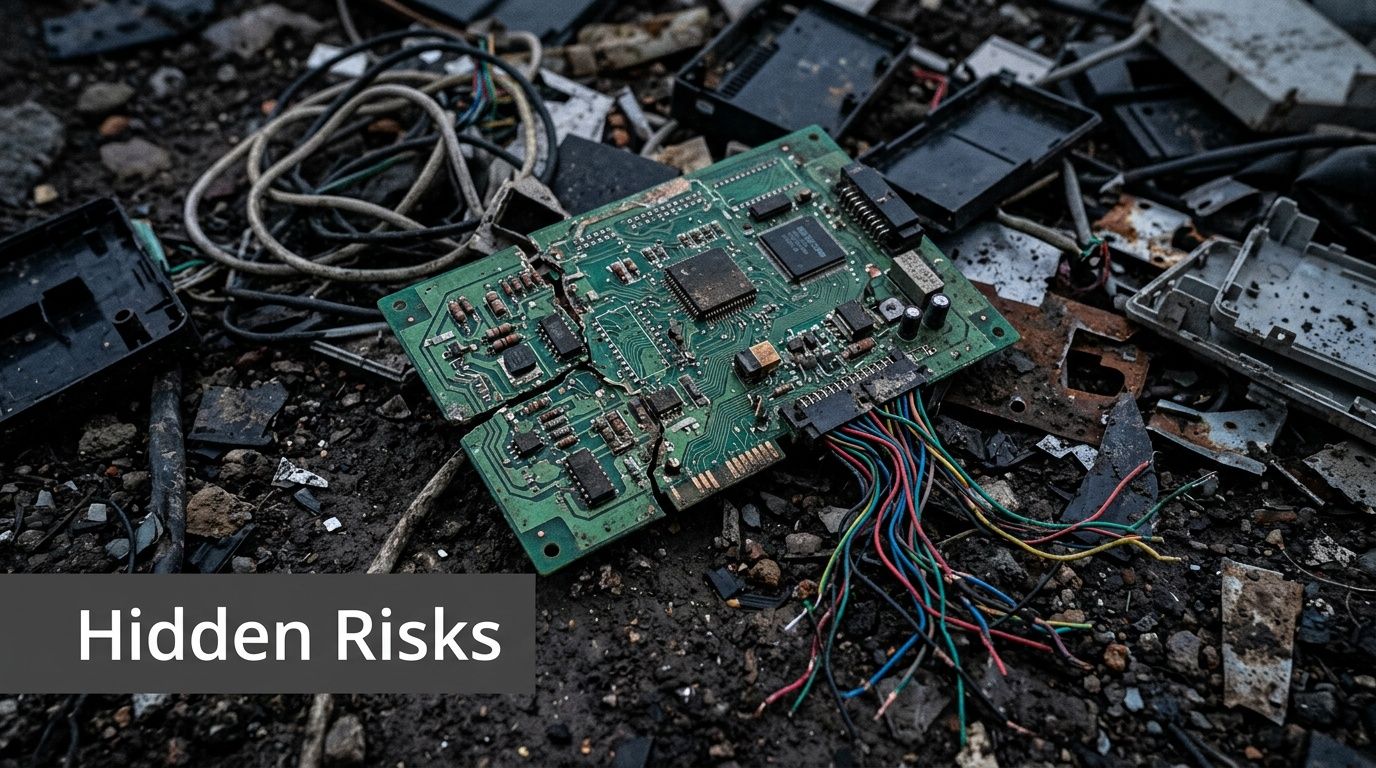
Data risk is usually operational, not theoretical
If your team has ever decommissioned voice equipment, network switches, security appliances, or branch office telecom hardware, you already know the messy part. Devices don’t always arrive with clean inventories. Labels are wrong. Ownership is fuzzy. Someone assumes a quick reset is enough.
It usually isn’t enough.
A disciplined IT asset disposition process matters because it creates separation between “device removed” and “risk closed.” Those are not the same thing. For storage media and data-bearing systems, sanitization standards and physical destruction options need to be planned in advance, not improvised during pickup.
Poor planning raises technical and compliance exposure
There’s a useful lesson from cabling work. In structured cabling, integrating BIM-modeled pathways during initial builds cuts retrofit costs by 25-35%, poor cabling leads to 20-30% packet loss, and professional services can support 99.99% uptime, according to structured cabling guidance for Los Angeles installations. The direct telecom lesson is about planning. When teams plan infrastructure early, they avoid expensive cleanup later. Asset disposition works the same way.
In practice, poor disposition planning creates three recurring failures:
- Untracked custody: Devices leave the site without clear receiving records, serial reconciliation, or destruction confirmation.
- Mixed-value loads: Reusable devices, scrap equipment, and regulated media get handled the same way, which lowers recovery value and raises exposure.
- No reporting path: Sustainability teams get a vague recycling note, while legal and compliance teams still lack the records they need.
The cheapest pickup is often the most expensive outcome once legal, security, and reporting gaps surface.
Reputation damage starts with small internal shortcuts
Most reputational problems don’t begin with a scandal. They begin with a shortcut that seemed harmless at the time. A facilities team clears space fast. A branch office closes. A vendor offers simple haul-away pricing. Months later, no one can prove what happened to the devices.
That’s bad enough for a private company. It’s even worse for healthcare groups, schools, public agencies, and enterprises with customer-sensitive data. Buyers, boards, and employees increasingly expect consistency between sustainability claims and disposal practices. If the company promotes responsible operations but can’t document how it handled retired telecom assets, the gap shows.
What standard disposal gets wrong
A basic disposal vendor often focuses on removal. A real ITAD partner focuses on control.
| Risk area | Standard disposal approach | Strong ITAD approach |
|---|---|---|
| Data handling | Assumes reset or removal is enough | Documents sanitization or destruction |
| Chain of custody | Pickup-focused | Asset-tracked and receipt-driven |
| ESG value | Minimal | Reportable and reusable across teams |
| Brand protection | Reactive | Built into the process |
Teams don’t need a more convenient way to lose track of old telecom hardware. They need a system that closes risk before the gear leaves the building.
Recycling That Restores Lives and Landscapes
There’s a better way to frame retired telecom equipment. Not as waste. As material with mission value.
That shift matters because standard recycling usually stops at compliance and diversion. Useful goals, but limited ones. A purpose-built program can do more. It can turn decommissioned telecom gear into something your sustainability team can report, your communications team can tell stories about, and your employees can support without feeling like the company is stretching for a CSR angle.
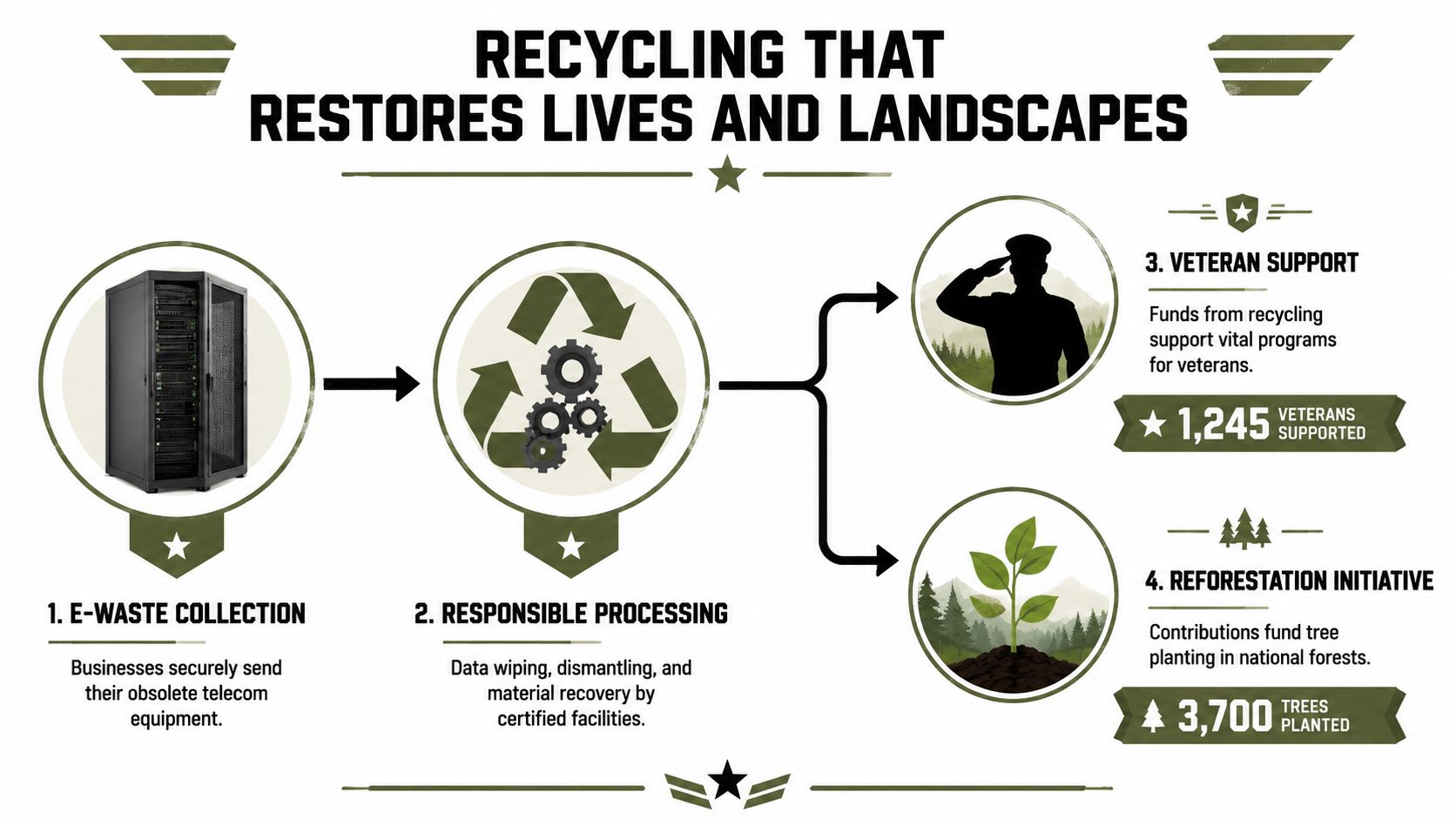
The strongest version of that model is simple to understand. Your old tech can house a veteran and grow a forest. That line works because it connects an ordinary operational task to outcomes people care about.
Why the veteran angle matters in telecom
Telecom access conversations often focus on affordability programs, but they often miss the specific connectivity and employment barriers veterans face. As noted in local service context discussing wireless assistance and veteran needs, telecom coverage frequently overlooks veteran-specific connectivity and employment needs, while veteran-inclusive supply chains are gaining attention in corporate ESG and CSR work.
That matters for recycled telecom equipment because employment access, device access, and support services are connected in practice. A company can retire old assets and do more than “dispose responsibly.” It can support a cause that aligns with workforce transition, dignity, and community repair.
The dual-impact model works because it is concrete
A purpose-driven recycling model becomes credible when it avoids vague promises and uses clear outputs. The strongest campaigns use direct language, visible tracking, and repeatable reporting.
Examples that work well in practice include:
- Cause-based campaign language: “Recycle for a Cause” is direct and easy for employees and customers to understand.
- Visible impact counters: A website can show “1,245 veterans supported” and “3,700 trees planted” as ongoing proof points.
- Seasonal campaigns: Veterans Day, Earth Day, and Arbor Day create natural moments for collection drives and PR activity.
- Certificates that travel internally: A sustainability team can share impact certificates with HR, recruiting, investor relations, and community outreach teams.
A lot of ESG messaging fails because it sounds abstract. This model avoids that. People understand veterans. People understand trees. They also understand that old telecom gear usually sits around doing nothing.
Why landscapes belong in the same story
Environmental impact can feel distant when the work starts in a server room or telecom closet. Reforestation closes that gap. It gives companies a visible environmental narrative tied to a physical action.
That helps in three ways:
- Employees connect with it quickly. Tree planting is easier to communicate than commodity recovery streams.
- Marketing teams can use it without inventing a story. The story is already there.
- Procurement and sustainability teams can align around one action. Disposal, recovery, and community impact stop living in separate silos.
A business that recycles old telecom equipment and receives environmental certificates has more than a compliance file. It has material for hiring pages, client communications, social campaigns, and internal engagement.
Field note: The best ESG initiatives are the ones operations teams can execute without adding a second full-time job.
What a purpose-led recycling partnership should include
If a company wants this to work beyond a one-off campaign, the model needs structure. A practical program usually includes:
- Secure collection of obsolete telecom equipment
- Documented data wiping, dismantling, and responsible downstream processing
- A defined social impact track for veteran support
- A defined environmental impact track for tree planting
- Partner-facing materials that can be reused in reporting and communications
For organizations in Atlanta looking at programs with local relevance, it also helps to review how electronics recycling in Atlanta fits into broader sustainability and community efforts.
What doesn’t work
Some programs lose credibility because they over-brand the cause and under-manage the process. Others do the opposite. They run a technically sound recycling program but hide the human outcome behind bland compliance language.
The middle path works best. Handle the assets rigorously. Tell the story clearly. Keep the claims concrete. If your company already produces telecom waste through office moves, branch closures, hardware refreshes, or infrastructure upgrades, there’s no reason that disposal should end as a silent back-office task.
Your Corporate Partnership and ESG Reporting Roadmap
For a corporate IT manager, the best recycling program is the one that doesn’t create extra administrative drag. If the process is unclear, pickups get delayed, devices pile up, and the project loses momentum. A usable model has to be operationally simple and report-friendly at the same time.
That’s especially important in telecom. The broader U.S. telecom services market is projected to grow at a 7.3% CAGR from 2026-2033, according to telecom market data cited through the CPUC reference set. More telecom activity means more infrastructure turnover. More turnover means more end-of-life equipment to manage well.
Start with scope, not slogans
Before any pickup is scheduled, define what’s leaving the building. Telecom projects go sideways when companies use broad labels like “old electronics” or “network junk.” Break inventory into meaningful categories such as phones, servers, racks, switches, wireless gear, storage media, cabling, and peripherals.
That simple step changes the rest of the process. It helps with labor planning, data handling, resale screening, and reporting later.
A good internal checklist should answer:
- Which items are data-bearing
- Which assets require de-installation
- Which materials have possible reuse value
- Which departments need final documentation
- Which sites are included in the event
Build the handoff around documentation
The strongest partnerships make pickup feel routine because the paperwork is already thought through. For companies with distributed offices, that matters as much as the truck schedule.
A common workflow looks like this:
- Inventory review and scheduling. The company identifies whether the load is a simple office cleanout or a more sensitive telecom decommissioning project.
- Onsite preparation. Devices are boxed, palletized, or removed from service locations in a controlled sequence.
- Secure transport and chain of custody. The handoff is documented so no one has to reconstruct events later.
- Data destruction and materials processing. Reusable, recyclable, and destruction-bound assets are separated properly.
- Delivery of reporting outputs. The company receives sustainability, impact, and disposition records that can move into CSR files.
Make the outputs usable across departments
Most programs either become strategic or stay forgettable at this stage. If the only final document is a generic recycling receipt, your company got removal, not value. Better programs create deliverables that multiple teams can use immediately.
Those often include:
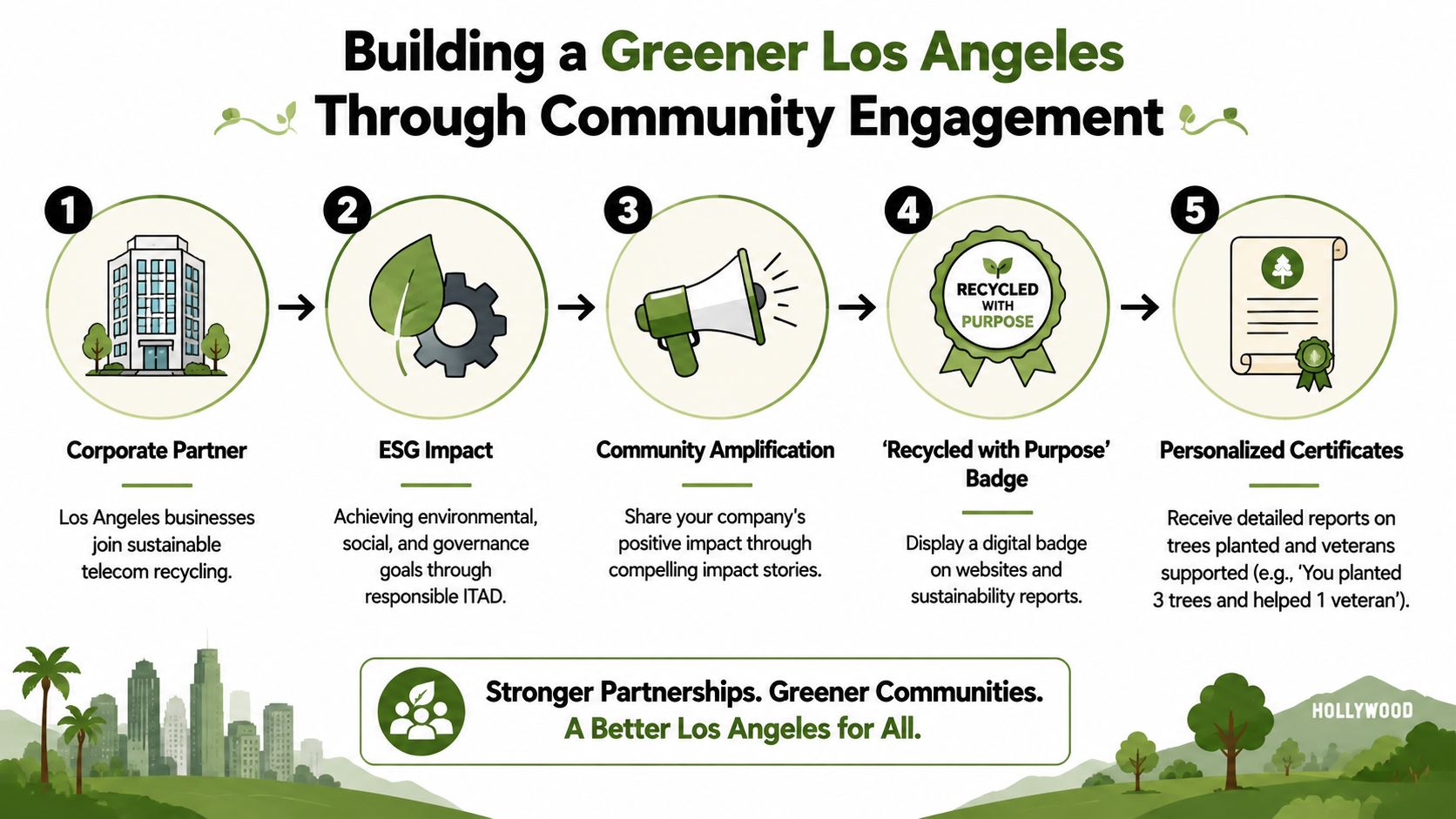
- Plant-A-Tree certificates for sustainability and community communications
- Veteran Support Impact Reports for ESG narratives and CSR documentation
- Disposition records for procurement, IT, and compliance teams
- Internal communications material for employee engagement campaigns
A lot of companies already understand this logic in adjacent functions. For example, businesses that evaluate outsourcing customer support for businesses usually compare more than labor cost. They also look at process quality, reporting, and operational lift. Telecom recycling deserves the same level of scrutiny.
Strong vendors don’t just remove work. They return useful documentation.
Tie disposition to procurement policy
One practical move many companies miss is linking end-of-life handling to purchasing standards. If procurement and IT buy equipment without a shared retirement plan, every refresh becomes a scramble.
That’s why it helps to connect telecom disposal planning with broader sustainable procurement best practices. When purchase, deployment, reuse, and retirement sit inside one policy framework, your ESG reporting gets cleaner and your operations team spends less time patching gaps later.
What a smooth partnership looks like
A smooth program feels boring in the best way. The pickup happens on time. Sensitive assets are handled correctly. Reporting arrives without chasing. Sustainability gets the story. Compliance gets the records. IT gets the space back.
That’s the standard worth aiming for. Not flashy. Just disciplined, repeatable, and easy to defend.
Measuring Your Impact An Easy Win for Atlanta Businesses
A common Atlanta scenario looks like this. IT clears out a closet of retired phones, routers, and handsets after a refresh. The pickup gets done, the invoice gets paid, and six months later nobody can say what the company gained beyond floor space.
That is a missed ESG asset.
Companies already retiring telecom hardware have a practical opportunity to turn routine disposition into evidence the business can use. In fast-moving offices, healthcare systems, multi-site operators, and growing tech teams, equipment turnover is constant. The better question is not whether assets are leaving service. It is whether the company can measure the social and environmental return tied to that activity.
Measure the work in a way leadership can use
A useful framework has three parts:
- Operational proof: what assets were removed, how they were processed, and what records exist
- Impact proof: how the program supported veterans and how many trees were planted through the recycling model
- Brand proof: what the company can publish internally or externally without stretching the story
That is what turns a basic discussion about the business benefits of e-waste recycling into something finance, sustainability, and marketing can all use.
The dual-impact model gives the numbers meaning
Plenty of vendors can provide a weight ticket or a certificate of recycling. Fewer can show outcomes that are easy to explain to employees, customers, and board members.
The dual-impact model matters because it ties each recycling cycle to two concrete results. One side supports veteran aid. The other funds reforestation. Instead of reporting that equipment was “handled responsibly,” Atlanta businesses can report what that responsible handling produced.
Examples of usable metrics include:
- assets collected and processed by device type
- number of veteran support outcomes funded through the program
- number of trees planted through recycling proceeds
- certificates, summary reports, and campaign-ready visuals tied to each pickup
- cumulative annual impact across multiple office cleanouts or refresh cycles
A visible counter works well here because it shows progress over time. “Veterans supported” and “trees planted” are clearer than generic sustainability claims, and they give recurring pickups a cumulative story instead of a one-time transaction.
Clear impact data gives IT disposal work a second life inside ESG reporting, recruiting, and client communications.
What strong reporting looks like
The best reporting assets do not need heavy editing before another department can use them. They should be specific enough for compliance review and simple enough for a communications manager to drop into a report or campaign.
A “Recycled with Purpose” badge is useful when it points to real outcomes. On its own, it signals that the company chose a verified recycling partner. Paired with impact reporting, it also shows that retired telecom equipment helped fund veteran support and tree planting. That makes the badge more than a logo. It becomes a shorthand for a documented dual-impact program.
Annual summaries, pickup-level certificates, and simple dashboard snapshots also help. They reduce the usual scramble before ESG deadlines because the evidence is already organized.
Comparing disposal models
| Feature | Standard E-Waste Disposal | Atlanta Green Recycling Model |
|---|---|---|
| Data Security | Often treated as a separate concern | Built into the recycling relationship through secure handling and destruction workflows |
| Environmental Impact | Focused mainly on removal and diversion | Connected to measurable tree planting and documented sustainability reporting |
| Community Benefit | Usually absent or incidental | Directly tied to veteran support through each recycling cycle |
| Brand Value | Hard to communicate beyond compliance | Easy to use in ESG reports, recruiting materials, website badges, and campaign content |
This difference matters in budget discussions. Executive teams rarely object to recycling because they dislike the idea. They object when it looks like a pure cost with vague returns. A program that reduces risk, documents veteran aid, tracks trees planted, and produces usable reporting stands on much firmer ground.
How it plays inside the business
Different departments will value different outputs.
A healthcare system may use the reports in board sustainability updates. A law firm may care more about secure chain-of-custody records plus a community benefit story that feels credible. A regional employer may start with the operational need to clear equipment quickly, then realize the resulting veteran and reforestation metrics are useful for recruiting and employee engagement.
The business case stays practical:
- IT gets retired equipment out of circulation with control intact.
- Compliance gets records it can defend.
- Sustainability gets report-ready veteran and tree-planting data.
- Marketing gets a local story with substance.
- HR gets a program employees can support without cynicism.
The marketing value is real if the reporting is honest
Generic sustainability content is easy to ignore. Measurable local impact is harder to dismiss.
Telecom recycling tied to veteran aid and reforestation gives Atlanta businesses specific material for LinkedIn posts, Veterans Day and Earth Day campaigns, recruiting pages, client updates, and employee cleanup drives. The key is discipline. Report only what the program produced, keep the numbers current, and connect every claim back to documented pickups.
Handled that way, impact measurement is one of the easier ESG wins available. The company is already generating the raw material through normal equipment retirement. It just needs to count the outcomes that matter.
Building a Greener Atlanta Through Community Engagement
The strongest recycling programs don’t stop at a pickup receipt. They move outward into community relationships. That’s where telecom disposal becomes a local leadership tool instead of a back-office function.
Not every neighborhood experiences telecom infrastructure in the same way. In Los Angeles, reporting on digital discrimination has highlighted service quality gaps in lower-income areas and argued that the issue goes beyond simple access, as discussed in coverage of infrastructure inequality in underserved communities. For schools, healthcare organizations, and government agencies, that’s a useful reminder. Communities may face different connectivity realities, but every community still has an e-waste problem.
Community partnerships make the program visible
A company that recycles its own telecom hardware is doing the right thing. A company that pairs that work with community collection, nonprofit collaboration, or local education becomes much more visible.
Useful partnership formats include:
- Veteran nonprofit events: Co-hosting a collection drive with a veteran support organization adds local relevance and strong employee participation.
- Environmental group collaborations: Tree-focused campaigns around Earth Day or Arbor Day give the environmental side of the program a public face.
- School and university drives: These work well for surplus devices, awareness campaigns, and community goodwill.
- Municipal partnerships: City and county events help position the company as a practical contributor, not just a sponsor.
Refurbishment can support digital equity goals
One of the most meaningful angles in this work is selective refurbishment. When appropriate devices can be recovered and redirected responsibly, recycling becomes part of a larger digital equity strategy. That’s especially relevant for institutions working in underserved areas.
The idea is straightforward. Communities that face infrastructure disadvantages can still benefit from equipment access, support programs, and responsible device circulation. A company doesn’t solve the digital divide by itself, but it can participate in a healthier local ecosystem.
Why PR works better when operations come first
Press outreach only works when the underlying program is real. The order matters.
First, build a credible telecom recycling workflow. Then attach the storytelling layer:
- Run the internal collection or decommissioning event.
- Document the environmental and community outputs.
- Package the results into visual and written assets.
- Share them through local media, LinkedIn, employee channels, and partner organizations.
That sequence produces stronger stories because there’s substance behind them. It also reduces the common CSR problem where communications races ahead of operations.
Local credibility comes from doing the work first and promoting it second.
What community leadership looks like
A business doesn’t need a huge campaign to lead. It can start with one office, one cleanup cycle, or one shared event with a school or nonprofit. The important thing is that the company shows a repeatable model others can join.
When that happens, telecom disposal stops being a hidden operational cost. It becomes a visible part of how the company contributes to a greener, more connected, and more responsible Atlanta.
Conclusion Turn Your E-Waste into a Force for Good
Telecom services in Los Angeles sit inside a fast-moving environment with constant upgrades, network changes, office moves, and hardware refresh cycles. That reality creates a familiar downstream problem. Old equipment accumulates, risk follows it, and disposal decisions get pushed down the priority list.
That’s the wrong place to leave it.
Handled well, retired telecom assets can do more than clear storage rooms. They can reduce data and compliance exposure, support cleaner procurement practices, strengthen ESG reporting, and give your company a community story that doesn’t feel manufactured. The difference comes down to whether you treat end-of-life equipment as junk to remove or as a business process to manage properly.
The most effective programs combine three things. Secure handling. Clear documentation. Visible impact.
When you add a dual-purpose model such as veteran support and reforestation, the value becomes easier for every internal stakeholder to understand. IT sees control. Compliance sees records. Sustainability sees reportable outcomes. Marketing sees a story worth sharing. Employees see a reason to participate.
If your organization has a telecom closet, storage room, branch office, or data center area filling up with obsolete devices, the opportunity is already sitting there. The next move is to turn that backlog into something useful.
For Atlanta organizations ready to turn retired IT and telecom equipment into documented ESG value, Atlanta Green Recycling offers a practical next step. Schedule a corporate pickup or start a conversation about secure data destruction, responsible recycling, and purpose-driven impact reporting that supports both operations and community goals.