
7 Top Business Telecom Services Near Me in Atlanta


Finding the Right Connection for Your Atlanta Business
Your business is growing, but the connection holding everything together isn't keeping up. Video meetings freeze, cloud backups drag, and staff start asking whether the problem is Wi-Fi when the issue is upstream capacity, circuit quality, or a poor provider fit. In Atlanta, that frustration usually gets worse once you start shopping, because every carrier claims speed, reliability, and business support, but differences show up in build timelines, upload performance, contract terms, and what happens when something breaks.
That matters more than ever because business connectivity keeps expanding in both size and importance. The U.S. telecom services market was estimated at USD 468.08 billion in 2023 and is projected to grow at a 6.6% CAGR from 2024 to 2030, with the business segment advancing at the fastest CAGR of 7.1% according to Grand View Research on the U.S. telecom services market. Atlanta businesses feel that directly. More cloud apps, more remote collaboration, more security oversight, and more multi-site operations all put pressure on the wrong connection choice.
If you're searching for business telecom services near me, you probably don't need marketing language. You need to know who is a fit for a law office in Buckhead, a warehouse in South Fulton, a medical practice in Decatur, or a company moving out of a data room and into a cleaner cloud footprint.
This guide gets practical fast. It compares the main business telecom options Atlanta companies consider, shows where each one works well, and points out the trade-offs that sales reps often downplay. It also covers a local issue many telecom roundups ignore. When you refresh circuits, phones, firewalls, routers, and old networking gear, you also need a clean plan for secure equipment retirement, data destruction, and ESG documentation.
1. AT&T Business
AT&T Business is usually one of the first providers Atlanta companies check, and for good reason. It has broad metro reach, recognizable enterprise products, and options that span standard business fiber, dedicated internet, wireless backup, and add-ons like static IPs and managed security. For a business with multiple offices or a mix of office and field operations, that range matters.
AT&T also sits in a market that keeps expanding. The ISP industry in the United States is poised to reach $179.9 billion in revenue by 2026, with an annualized growth rate of 4.7% over recent years and a 4.5% increase anticipated in 2025, according to IBISWorld's U.S. Internet Service Providers industry outlook. That doesn't tell you which provider to buy, but it does explain why carriers are pushing harder into business-grade broadband, fiber, and backup connectivity.
Where AT&T fits best
AT&T Business makes the most sense when you need one vendor that can support basic connectivity today and a more layered setup later. A lot of Atlanta firms start with business fiber, then add wireless failover, VPN support, or a dedicated circuit once they outgrow shared broadband.
A few practical strengths stand out:
- Broad product range: AT&T can cover simple internet access, dedicated internet, voice, and wireless backup under one umbrella.
- Useful for multi-location firms: If your office footprint might expand, staying with one major carrier can simplify procurement and support.
- Good continuity options: Wireless backup can be a smart middle ground when a second wired circuit isn't justified.
Practical rule: Ask for serviceability at the exact suite number, not just the building address. In Atlanta, one floor can be on-net while another still triggers delays or extra build work.
The main caution is transparency. AT&T's higher-end services often require a quote, and pricing can change sharply depending on whether your building is already lit, partially served, or off-net. That's normal in telecom, but it means you shouldn't compare AT&T's enterprise quote to a simple posted small-business fiber offer and assume it's apples to apples.
If your business is also planning a network refresh, office move, or hardware retirement, pair the connectivity decision with a documented equipment disposition plan. That's especially important for regulated environments, and it's one reason businesses often review broader telecommunications service planning for multi-site operations before signing.
Visit AT&T Business in Atlanta.
2. Comcast Business
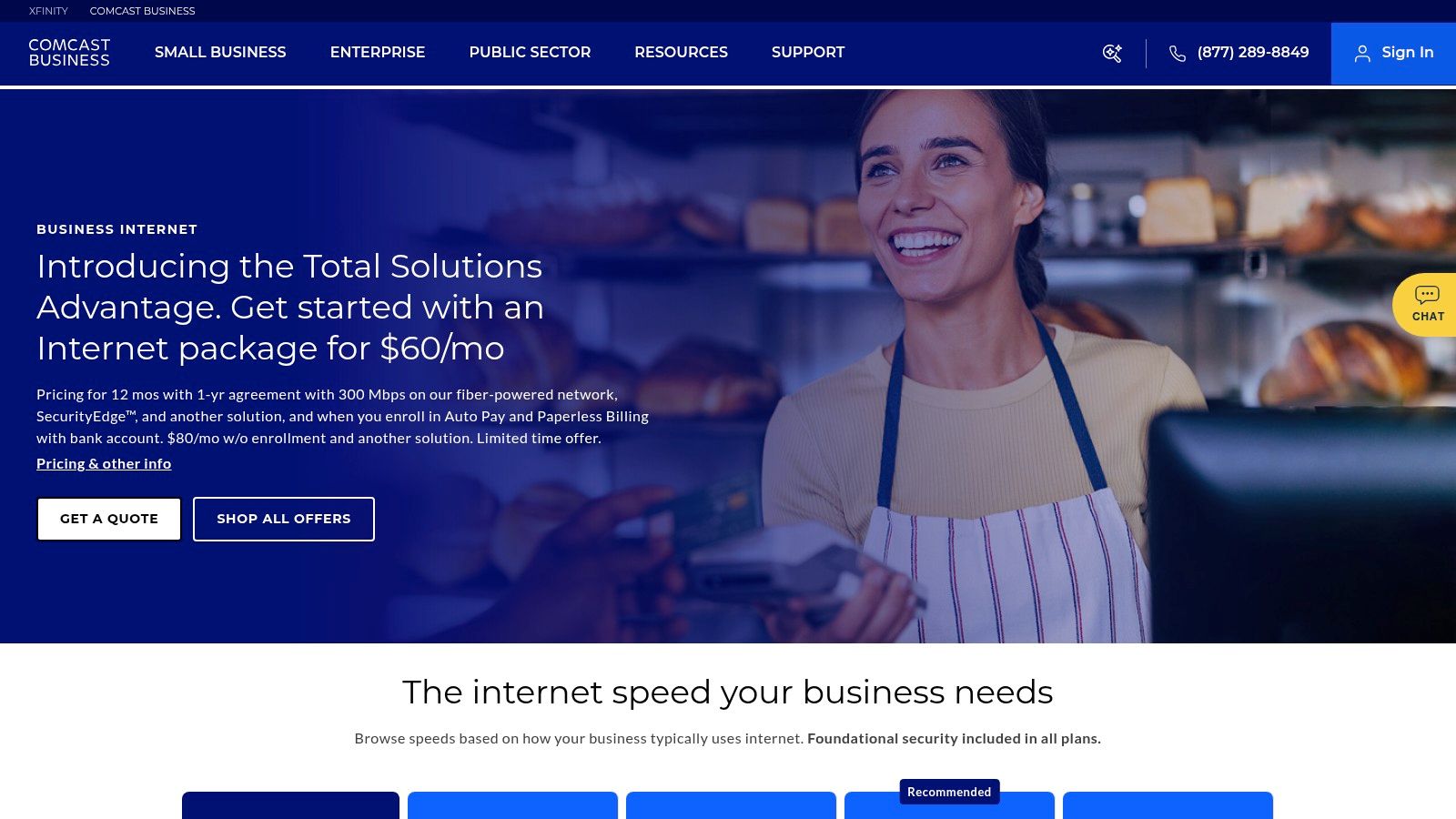
Comcast Business is often the fastest route to getting a business online in Atlanta, especially in office parks, multi-tenant buildings, and corridors where coax is already in place. If speed to install matters almost as much as monthly cost, Comcast deserves a serious look.
Its biggest practical advantage is availability. In many Atlanta buildings, Comcast can activate faster than a fiber build from a carrier that still needs construction approvals, riser access, or landlord coordination. For a company opening a branch, relocating a team, or replacing an underperforming connection, that can outweigh the purity of a fiber-first design.
What Comcast does well
Comcast Business works best for companies that want a straightforward primary connection with room to upgrade later. That could mean starting on cable broadband, then moving to fiber Ethernet or dedicated internet if traffic patterns, uptime needs, or security requirements change.
The trade-offs are familiar:
- Strong fit for standard office use: Email, cloud apps, VoIP, and normal collaboration workloads usually sit well on Comcast business broadband.
- Good path for staged growth: Businesses can often install quickly first, then revisit premium connectivity once the location is stabilized.
- Helpful in buildings with limited carrier choice: If your landlord has complicated access rules, the provider already in the building usually has the edge.
Comcast also promotes symmetrical and full-duplex improvements in select areas, which is worth asking about if uploads matter to your workflow. But don't assume those capabilities are available just because the building has Comcast service. Availability can vary by exact footprint.
One bad buying pattern is choosing a provider based only on advertised download speed. Atlanta businesses that depend on cloud backups, large design files, surveillance uploads, or hosted phone systems need to test upload performance and packet stability just as hard.
The downside is that advanced services like DIA or fiber Ethernet usually push you into a sales-led process. That's not a problem by itself, but it means the initial online offer may not reflect the configuration your business needs.
Visit Comcast Business.
3. Google Fiber GFiber Business
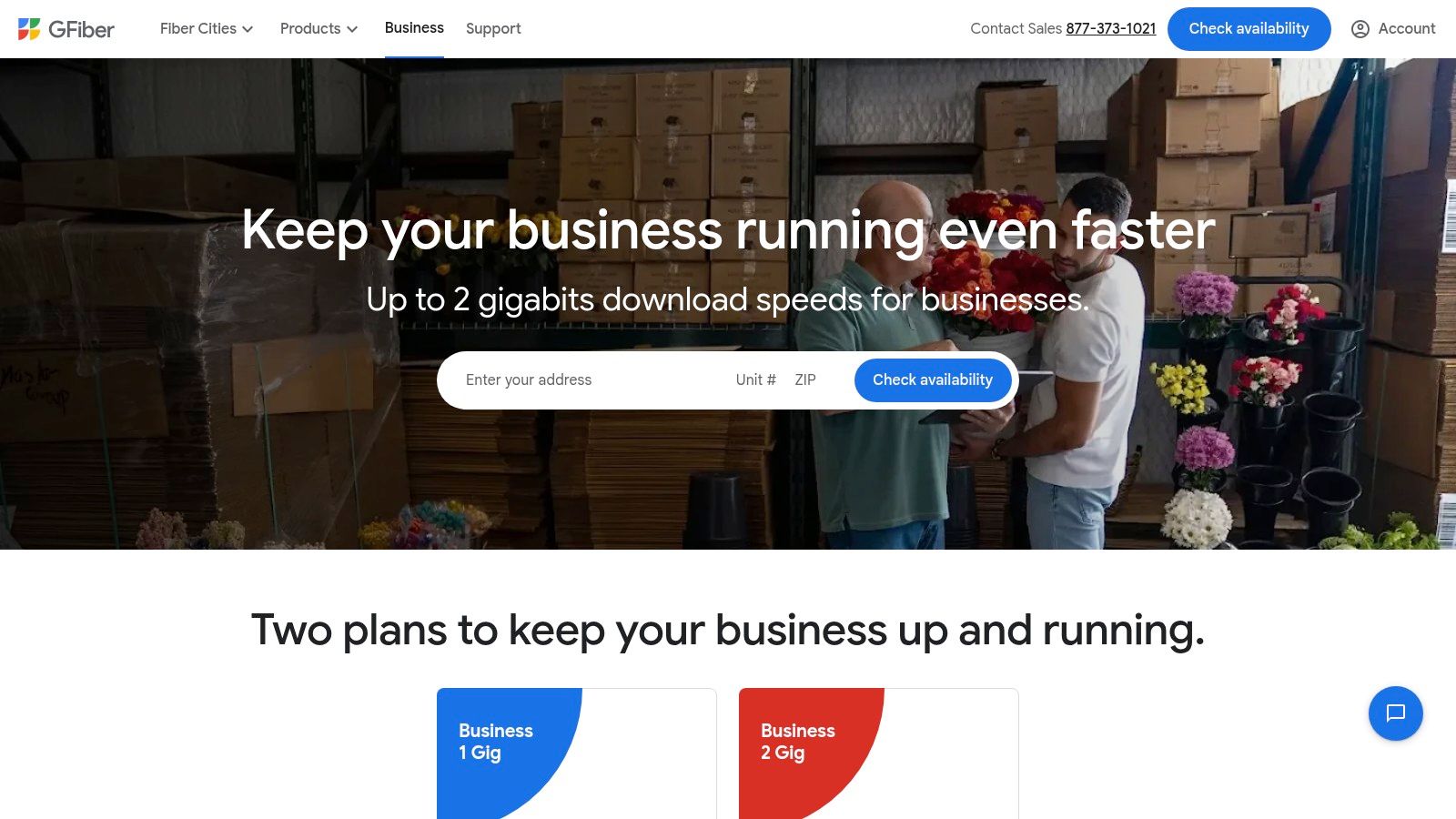
GFiber Business appeals to a specific type of buyer. If you hate opaque telecom quoting, don't want contract-heavy negotiations, and care about symmetrical fiber performance, it stands out immediately.
This is the provider I usually mention to upload-heavy teams first. Creative agencies, architecture firms, video shops, software teams pushing builds to cloud platforms, and companies with frequent large-file transfer all benefit from symmetrical service more than they benefit from another glossy promise about peak download speed.
Why businesses like GFiber
The attraction is simplicity. Posted pricing, contract-light positioning, included router hardware, and no data caps make GFiber easier to evaluate than many incumbent options. That simplicity reduces buying friction, which is a real advantage for smaller operations without a telecom specialist on staff.
There are a few reasons it earns strong consideration:
- Transparent posted pricing: You can often assess fit quickly without waiting for a rep to build a custom quote.
- Symmetrical performance: Uploads aren't treated like an afterthought.
- Low-friction buying experience: That matters for startups, branch offices, and lean operations.
The catch is coverage. GFiber is excellent where it's built, and irrelevant where it isn't. In Atlanta, that means you need to verify the exact address and not just the surrounding neighborhood.
For broader context, global telecom enterprise services are forecast to reach US$583 billion by 2030 at a CAGR of about 4%, according to Transparency Market Research on telecom enterprise services. That growth reflects why more businesses now expect telecom providers to deliver not just connectivity, but cleaner cloud support, better collaboration performance, and stronger integration with business operations.
GFiber still isn't the most feature-rich choice for regulated or heavily managed environments. If you need layered security bundles, advanced failover architecture, or one provider to handle connectivity plus broader enterprise networking, larger incumbents may fit better.
Visit GFiber Business.
4. Verizon 5G Business Internet
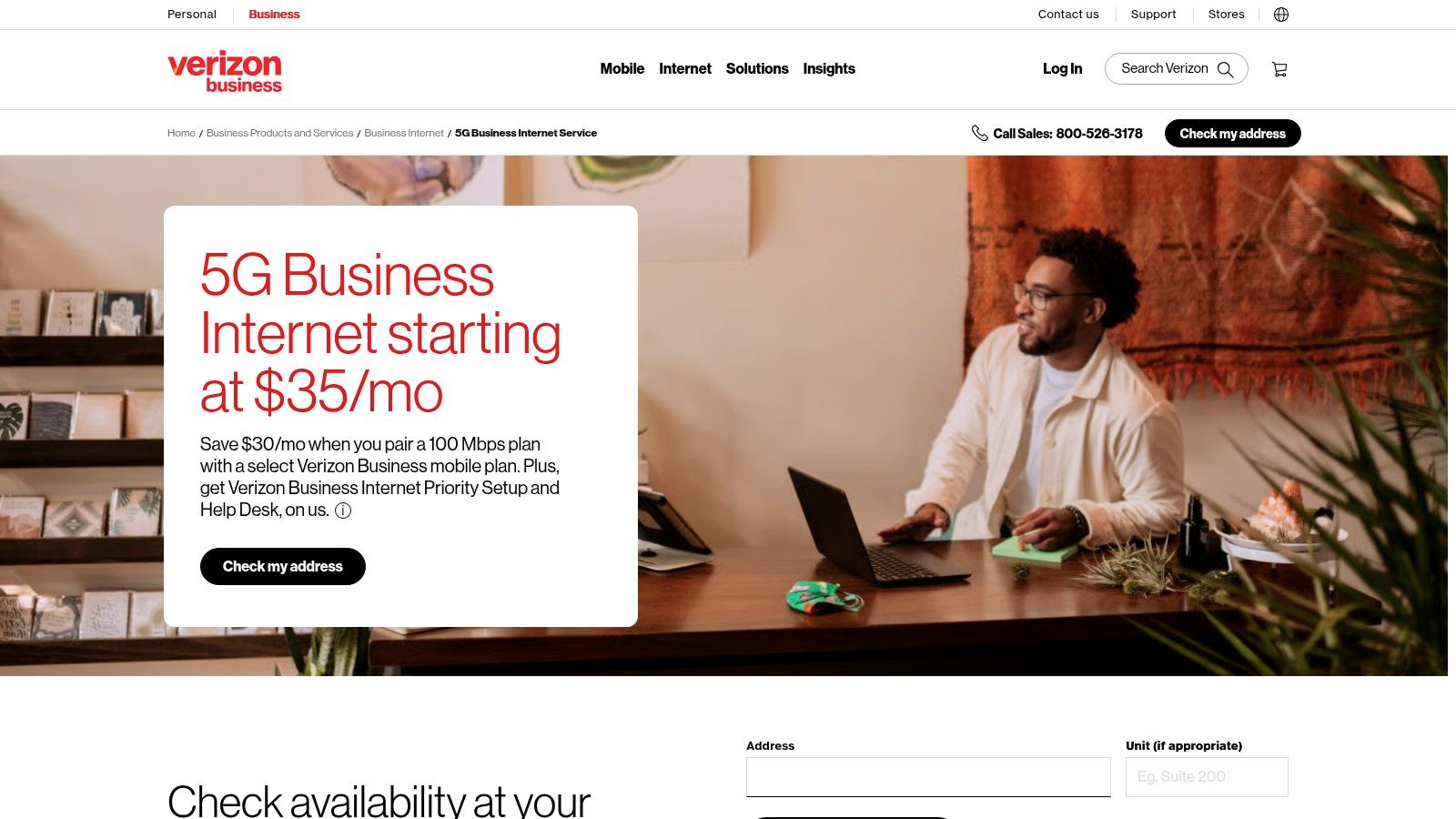
Verizon 5G Business Internet isn't a universal replacement for wired service, but that's the wrong standard anyway. Its real value is speed of deployment and flexibility. If you need connectivity at a temporary office, a construction trailer, a pop-up operation, or as a backup path for your primary circuit, Verizon becomes much more compelling.
This is one of the easiest categories to misuse. A lot of businesses hear "5G business internet" and assume it's either the future of everything or a consumer-grade workaround. In practice, it's neither. It's a practical tool for specific situations.
Best use cases for Verizon 5G
Verizon works well when trenching, landlord delays, or long fiber lead times would otherwise leave a business exposed. It also makes sense when you want a separate access path for resilience instead of relying on two circuits that share the same physical plant.
Use it when your priorities look like this:
- Fast setup matters: New sites, temporary sites, and changing sites benefit most.
- You need backup: A wireless path can keep key systems running if the wired provider fails.
- Portability has value: Businesses with mobile or shifting footprints often prefer less physical dependency.
The warning is straightforward. Fixed wireless performance depends on local signal conditions and network capacity. That means one address can perform well while another nearby doesn't. Always validate service at the exact installation point.
"For failover, wireless is often smarter than a second line from the same physical provider path."
That single rule has saved a lot of businesses from a false sense of redundancy. If your primary and backup circuits ride similar local infrastructure, one cut can still take out both.
Verizon is strongest when you treat it as part of a continuity design, not a magic answer to every network problem. Visit Verizon 5G Business Internet.
5. T-Mobile Business Internet
T-Mobile Business Internet has a similar role to Verizon's fixed wireless offering, but the buyer profile is often a bit different. It tends to attract small and midsize businesses that want simple deployment, cleaner monthly pricing, and minimal installation friction.
For Atlanta companies moving into a renovated suite or trying to get online before a wired install is complete, that simplicity can be valuable. No trenching. No construction. No long wait for a truck roll in the best-case scenarios.
Where T-Mobile makes sense
T-Mobile fits companies that don't want to overengineer the first step. If your traffic is moderate, your applications are cloud-based, and your priority is getting a site functional quickly, it can do the job.
It also works well in these scenarios:
- Temporary occupancy: Short-term project sites and swing spaces.
- Interim connectivity: Keep teams working while a permanent circuit is being delivered.
- Backup access: A secondary path for essential systems.
The trade-off is consistency. Throughput can fluctuate with signal quality and congestion, which means T-Mobile isn't the first recommendation for jitter-sensitive voice environments, latency-sensitive systems, or businesses with steady high-volume upload demands.
One practical issue buyers miss is hardware placement. With fixed wireless, the install location inside the suite affects results more than many businesses expect. If you test the gateway in a back room and get mediocre performance, that doesn't always mean the service is poor. It may mean the placement is poor.
T-Mobile can be a strong option if you buy it for what it is. Quick, usable, flexible business internet. It becomes a weak option when it's forced into a role better served by dedicated fiber or a contract-backed enterprise circuit.
Visit T-Mobile Business Internet.
6. Lumen Technologies
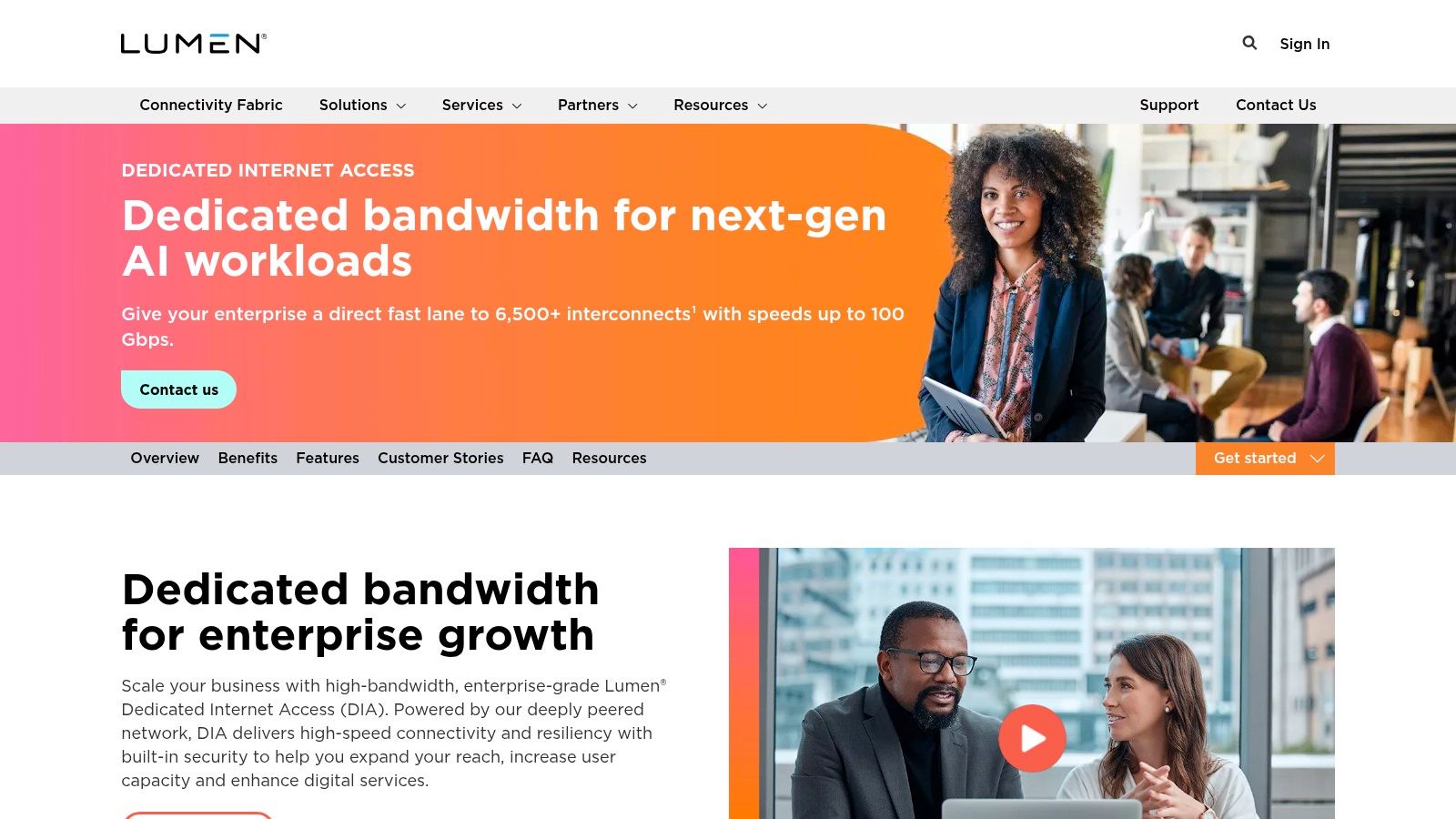
A common Atlanta scenario looks like this. The office has outgrown standard business broadband, voice quality is inconsistent across locations, and leadership wants contract-backed accountability before the next outage turns into a client problem. That is usually when Lumen becomes a serious option.
Lumen fits buyers who care less about a quick self-serve signup and more about circuit design, SLA terms, routing, and operational control. In practice, that usually means firms with multiple sites, regulated workflows, or customer-facing systems that cannot tolerate vague support commitments.
Where Lumen stands out
Lumen is often shortlisted for businesses that need more than raw bandwidth. The appeal is the ability to combine dedicated connectivity with managed network services, security options, and WAN design under one provider. For some companies, that reduces finger-pointing during incidents and gives the IT team one escalation path instead of three.
It is usually a strong fit for:
- Regulated environments: Healthcare, legal, finance, and government-adjacent organizations often need clearer service accountability and documentation.
- Multi-site operations: Central policy control and SD-WAN options matter more once traffic is moving between offices, cloud apps, and remote users.
- High-impact sites: Headquarters, contact centers, and production locations benefit from a carrier built for dedicated access rather than best-effort broadband.
The main trade-off is procurement friction. Expect engineering review, custom quotes, and more contract detail than you would see with cable or fixed wireless. That added process can be worthwhile, but only if the business needs the higher service tier.
Atlanta buyers should pay close attention to building status. If Lumen is already on net in your property, the project can move on a normal enterprise timeline. If the address is off net, installation cost, construction scope, and delivery dates can change quickly. This is one of the local checks that belongs on any serious buyer's checklist, right next to fiber availability and SLA validation.
Field note: If a quote says "subject to final engineering," treat that as a pricing and timeline warning. I advise clients to ask for build assumptions in writing before comparing carriers.
Visit Lumen Technologies.
7. Windstream Enterprise
Windstream Enterprise tends to be a strong fit when a business wants fewer moving parts. Instead of buying internet from one vendor, voice from another, and security overlays from a third, Windstream can package connectivity, UCaaS, SD-WAN, and SASE in one design.
That consolidation matters most for distributed companies. If you have several offices, remote users, shared calling needs, and application prioritization requirements, one coordinated stack is often easier to manage than a patchwork of separate services.
Practical strengths and limitations
Windstream's OfficeSuite UC, internet access options, and WAN services make it attractive for organizations that need voice and data to behave like one system instead of two unrelated purchases. QoS, failover planning, and centralized policy management become easier when the provider supports the broader design.
This provider is often a good match for:
- Multi-site operations: Centralized management is easier when locations follow one policy framework.
- VoIP-heavy businesses: Connectivity and cloud voice alignment matters.
- Growing companies: You can expand capabilities without rebuilding the provider mix from scratch.
The drawback is that you won't get a simple self-serve buying process. Expect discovery calls, custom scoping, and bundle-dependent pricing. That's normal for this type of provider, but it can be frustrating if you just want a quick internet quote.
Windstream is less about commodity connectivity and more about operational alignment. If your business has enough complexity to benefit from that, it deserves a place on the shortlist.
Visit Windstream Enterprise.
8. At-a-Glance Comparing Atlanta's Business ISPs
If you're evaluating business telecom services near me in Atlanta, the shortlist usually gets clearer once you stop comparing ads and start comparing buying models. Some providers are best for fast installs. Some are best for symmetrical fiber. Some are best for SLA-backed enterprise circuits. And some are best as backup, not primary, even if the sales pitch suggests otherwise.
The fastest way to sort the field is to ask one question first. Are you buying commodity internet, business continuity, or a managed network foundation? Those are different purchases.
Quick way to narrow your options
A useful pattern looks like this:
- Need quick activation in a common office building: Comcast Business is often practical.
- Need transparent symmetrical fiber where available: GFiber Business is attractive.
- Need broad enterprise options and wireless integration: AT&T is hard to ignore.
- Need rapid wireless deployment or failover: Verizon or T-Mobile may fit.
- Need contractual uptime and deeper networking stack: Lumen or Windstream usually make more sense.
A local business should also think beyond the circuit itself. Atlanta offices regularly refresh firewalls, desk phones, switches, wireless gear, and edge hardware when changing telecom providers. If you don't plan for secure removal and documentation at the same time, the project gets messy fast. Businesses that want a local operational view can review Atlanta telecom service considerations for business moves and refreshes.
The comparison table marker below is where a side-by-side tool view belongs. That's the best place to check service type, ideal use case, and likely trade-offs before you contact sales.
9. The Ultimate Buyer's Checklist and Local Procurement Tips
Most telecom buying mistakes happen before the contract is signed. The business assumes availability based on nearby buildings, accepts an install timeline without asking what could delay it, or compares a shared broadband quote to dedicated internet pricing as if they were equivalent services.
Atlanta businesses do better when procurement is structured. That means gathering requirements first, validating serviceability second, and negotiating terms only after the provider has confirmed what it can deliver at your address.
Buyer checklist
- Define the workload first: List the systems that matter most. VoIP, VPN, cloud backups, remote desktops, cameras, and large file sync all stress a connection differently.
- Validate exact address availability: Use suite-level checks. Building-level assumptions cause expensive surprises.
- Ask about construction risk: Clarify whether the quote assumes an existing service path or future build work.
- Check failover design: A backup that shares the same local dependency isn't much of a backup.
- Review support language: Escalation process matters just as much as the advertised SLA.
- Plan hardware retirement: Replaced routers, phones, access points, and security appliances still need secure handling.
Atlanta buyers also benefit from procurement discipline across vendors. If you're coordinating carrier quotes, voice platforms, SD-WAN, and hardware turnover at the same time, outside help can keep the process cleaner. That's one reason some firms use Cloud Tech Gurus technology procurement support while also reviewing local telecommunications company options near Atlanta businesses.
One more local point matters. Telecom changes often trigger e-waste. Old network equipment can contain stored credentials, configs, logs, and organizational data. Treating decommissioned gear like ordinary junk is a security and compliance mistake.
10. Frequently Asked Questions FAQ
Businesses usually ask the same few questions when searching for business telecom services near me, and the right answer depends on how the business operates, not on which provider has the loudest ad.
Is fiber always the best choice?
Not always. Fiber is usually the strongest fit for upload-heavy, latency-sensitive, or growth-oriented businesses, but a well-served cable connection can be enough for a standard office. The mistake is buying too little resilience, not necessarily buying the "wrong" access medium.
Should I get dedicated internet or standard business broadband?
Dedicated internet makes more sense when uptime accountability, consistent performance, and support commitments are business-critical. Standard business broadband is often fine for ordinary office workloads if you pair it with realistic expectations and a continuity plan.
Is 5G business internet good enough for my office?
Sometimes. It's often a smart option for temporary sites, quick turn-ups, and failover. It's a weaker choice when your business depends on highly stable performance for voice, remote desktops, heavy uploads, or regulated operations.
What should I do with old telecom and network equipment?
Retire it deliberately. Firewalls, switches, routers, and phones can still hold sensitive information or operational data. Businesses planning upgrades should account for secure pickup, data sanitization, and documentation as part of the project, especially if they work in healthcare, education, government, or enterprise IT. A local reference point for that planning is telecom solutions near Atlanta businesses.
How important is contract language?
Very. Installation terms, renewal clauses, support windows, price protections, and early termination conditions can matter more than the advertised monthly rate. Read the service order, not just the marketing summary.
Top 10 Local Business Telecom Services, Comparison
| Provider | Implementation Complexity 🔄 | Resource Requirements ⚡ | Expected Outcomes ⭐ | Ideal Use Cases 📊 | Key Advantages 💡 |
|---|---|---|---|---|---|
| AT&T Business | Moderate–High, fiber build or quote‑driven DIA provisioning | High, fiber/DIA install, optional 5G backup hardware | Reliable metro coverage with enterprise add‑ons and continuity options | Enterprises needing metro reach, static IPs, managed security, failover | Wide metro footprint; bundling discounts; 5G failover option |
| Comcast Business | Low–Moderate, coax fast installs; fiber/DIA may need sales engagement | Medium, coax/fiber options, potential upgrades | Broad availability and predictable OPEX on eligible bundles | Multi‑tenant offices, industrial corridors, customers needing rapid installs | Wide reach; rapid coax installs; select full‑duplex symmetrical upgrades |
| Google Fiber (GFiber) Business | Low, posted plans and contract‑light provisioning where built | Low–Medium, fiber availability limited to GFiber areas | High symmetrical performance with transparent pricing and simple terms | Upload‑heavy workflows; customers who prioritize pricing transparency | Posted pricing; no contract; Wi‑Fi 6/6E router included |
| Verizon 5G Business Internet | Low, fast self‑install or quick deployment | Low, gateway; performance tied to local 5G signal | Rapid, portable connectivity suitable as primary or failover | Temporary sites, portable locations, secondary resiliency links | Fast deployment; portable; address‑based coverage checks |
| T‑Mobile Business Internet | Low, quick setup with included gateway | Low, gateway only; best pricing often bundled | Fast, simple connectivity with variable throughput | New/renovated facilities, automatic failover, simple monthly plans | Included 5G gateway; dedicated business support; bundling incentives |
| Lumen Technologies (Level 3/CenturyLink) | High, enterprise sales, SLA setup and validation | High, DIA with backbone integration and security stacks | SLA‑backed high availability and centralized management | Regulated industries and enterprises needing auditable SLAs | 99.99% SLA options; integrated SASE/SD‑WAN/DDoS; backbone pedigree |
| Windstream Enterprise | Moderate–High, bundle discovery and contract setup | Medium–High, DIA/SD‑WAN/UCaaS deployment | Consolidated connectivity, security, and cloud voice with QoS | Distributed operations, multi‑site fleets requiring unified policies | One‑stop for connectivity, security, and UC; regional support |
| At‑a‑Glance: Comparing Atlanta's Business ISPs | N/A, informational infographic | Minimal, review for quick comparison | Quick side‑by‑side view to narrow options | Early‑stage vendor shortlisting and stakeholder briefings | Concise summary of provider differences for rapid decisions |
| The Ultimate Buyer's Checklist & Local Procurement Tips | N/A, process guide | Low, apply checklist during procurement | Fewer procurement errors and better contract terms | Pre‑contract audits and local procurement strategy | Practical steps and local tips to avoid common pitfalls |
| Frequently Asked Questions (FAQ) | N/A, reference resource | Minimal, consult for clarifications | Answers to common technical and contract questions | Initial research and stakeholder education | Clarifies terminology, circuit types, and contract considerations |
Making the Right Connection for Your Business
Choosing the right telecom provider in Atlanta isn't really about finding the single "best" company. It's about matching the provider to the job. A fast-growing office with heavy cloud collaboration needs something different from a warehouse branch that just needs dependable connectivity and backup. A healthcare group, school system, or government-facing contractor has a different risk profile again.
That's why a structured buying process works better than chasing the flashiest offer. Start with the basics. What applications drive your business every day? How painful is downtime? Do you need symmetrical performance, an SLA-backed dedicated circuit, or a reliable broadband connection with a smart failover option? Once those answers are clear, the field narrows quickly.
AT&T Business is a strong all-around choice when you want broad capability, strong metro presence, and room to scale into more advanced services. Comcast Business is practical when installation speed and general availability matter. GFiber Business stands out for transparent pricing and symmetrical fiber where service exists. Verizon and T-Mobile are useful when flexibility, fast deployment, or wireless backup matter more than traditional wired design. Lumen and Windstream move up the list when the business needs stronger service commitments, centralized management, or a tighter blend of connectivity, voice, and security.
The key is to compare like with like. Don't compare a basic broadband offer to a dedicated internet circuit and assume one is overpriced. Don't buy fixed wireless expecting it to behave exactly like premium fiber. And don't assume your building has the same options as the one across the street. In Atlanta, exact location details still shape serviceability, cost, and lead time.
There's also a local operational issue many telecom buying guides leave out. New telecom service often means old telecom hardware. Routers, switches, firewalls, handsets, access points, and edge devices don't disappear just because the new circuit goes live. They have to be removed, documented, and handled correctly. In regulated industries, that includes secure data destruction and controlled disposition. In sustainability-focused organizations, it also includes ESG reporting and responsible diversion from landfill.
That's where a broader business process matters. If you're replacing telecom infrastructure, moving offices, or decommissioning older equipment, it makes sense to tie connectivity planning to secure e-waste handling. Atlanta Green Recycling is well positioned for that conversation because it serves the same business audience making these telecom decisions. Hospitals, schools, enterprises, government agencies, and data centers all benefit from telecom upgrades paired with compliant equipment retirement.
This is also where brand values can become practical business value. Companies increasingly want vendors that support CSR and ESG goals without creating extra reporting work. A telecom refresh paired with responsible recycling, documentation, and cause-based impact is easier to justify internally than a disconnected series of operational tasks. For Atlanta businesses that care about both compliance and community impact, messaging like "Turning E-Waste into Hope" or "Recycling That Restores Lives and Environments" isn't just branding. It's a cleaner way to connect procurement, sustainability, and local identity.
For communication strategy around the customer side of growth, it's also worth thinking about how connectivity supports modern voice communication for growth. The right circuit isn't an isolated IT decision. It affects how your team sells, supports, collaborates, and scales.
The right move now is simple. Shortlist the providers that match your technical needs, verify suite-level availability, inspect the contract details, and plan the hardware transition at the same time. That's how Atlanta businesses avoid expensive telecom mistakes and end up with a connection that supports growth instead of slowing it down.
If your Atlanta business is upgrading internet, replacing phones, retiring network gear, or planning a full site refresh, Atlanta Green Recycling can help you handle the equipment side responsibly. They provide business e-waste pickup, secure data destruction, de-installation support, and compliance-minded documentation for offices, hospitals, schools, government agencies, and data centers across metro Atlanta. Their mission-driven model also gives companies a stronger ESG and CSR story through recycling programs tied to veteran support and tree-planting impact.