
Telecom Solutions Near Me: Secure IT Disposal

You searched telecom solutions near me because something concrete is sitting in front of you. It might be a locked storage room with retired desktops, a row of decommissioned switches after a network refresh, or a stack of laptops from a hybrid workforce that nobody wants to touch because every device may hold sensitive data.
For Atlanta IT managers, office managers, and compliance teams, that search usually starts as a connectivity or infrastructure question and ends as an asset retirement problem. The hard part isn't buying the next phone system, circuit, or cloud platform. The hard part is closing out the old environment without creating security exposure, audit headaches, or a landfill problem.
That’s why the vendor conversation has changed. Telecom is no longer just about service activation and uptime. It now sits inside a broader managed services model that includes secure decommissioning, data destruction, logistics, documentation, and, increasingly, ESG reporting. If you're responsible for hospitals, schools, government offices, industrial sites, or multi-location businesses in metro Atlanta, the best local partner is the one that treats end-of-life hardware as part of the same operational system as your upgrade.
Beyond the Search for Telecom Solutions Near Me
Most local searches begin with urgency. A move is scheduled. A lease is ending. A phone system has been replaced. A clinic is refreshing workstations. A data closet still contains routers, handsets, access points, UPS units, and hard drives from two different generations of infrastructure.
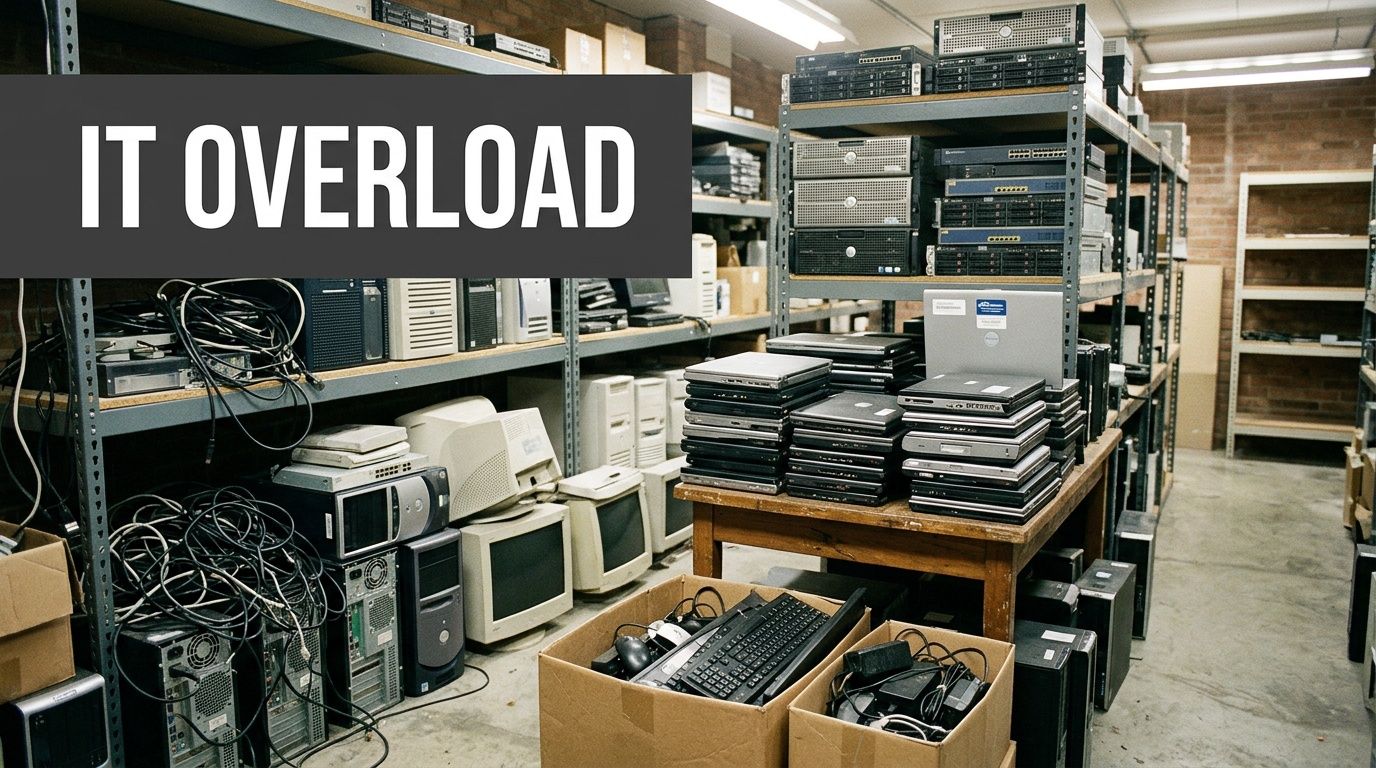
The mistake I see most often is treating telecom modernization and equipment retirement as separate projects. One vendor installs the new service. Another vendor may or may not pick up the old hardware. Then internal staff gets stuck bridging the gap, documenting serials, managing chain of custody, and answering compliance questions after the fact.
The local search usually hides a bigger risk
There’s a real market gap here. Telecom providers often handle connectivity upgrades but not the secure disposal of legacy hardware, especially in regulated settings where HIPAA-sensitive phone systems and data infrastructure must be destroyed responsibly. A unified telecom modernization and secure asset recycling approach fills that gap, as noted in CenturyLink’s fiber service context.
That gap matters because old telecom gear rarely exists in isolation. A “phone project” can involve:
- VoIP migration leftovers like PBX hardware, handsets, gateways, and voicemail appliances
- Network refresh waste such as switches, firewalls, wireless controllers, and rack accessories
- User endpoint turnover including laptops, docking stations, tablets, and monitors
- Server room retirements where storage arrays, backup units, and failed drives must be handled under strict controls
A useful local partner should understand that these assets are tied together operationally, not just physically. That’s the difference between a cleanup vendor and a real disposition partner.
Practical rule: If a provider can upgrade your telecom environment but can't explain what happens to every retired device afterward, the project isn't complete.
In Atlanta, that’s why many teams now evaluate telecom services in Atlanta through a wider lens. They’re not just asking who can connect the office. They’re asking who can help retire the old environment securely, document every step, and support broader sustainability goals at the same time.
Defining Your IT Asset Disposition Blueprint
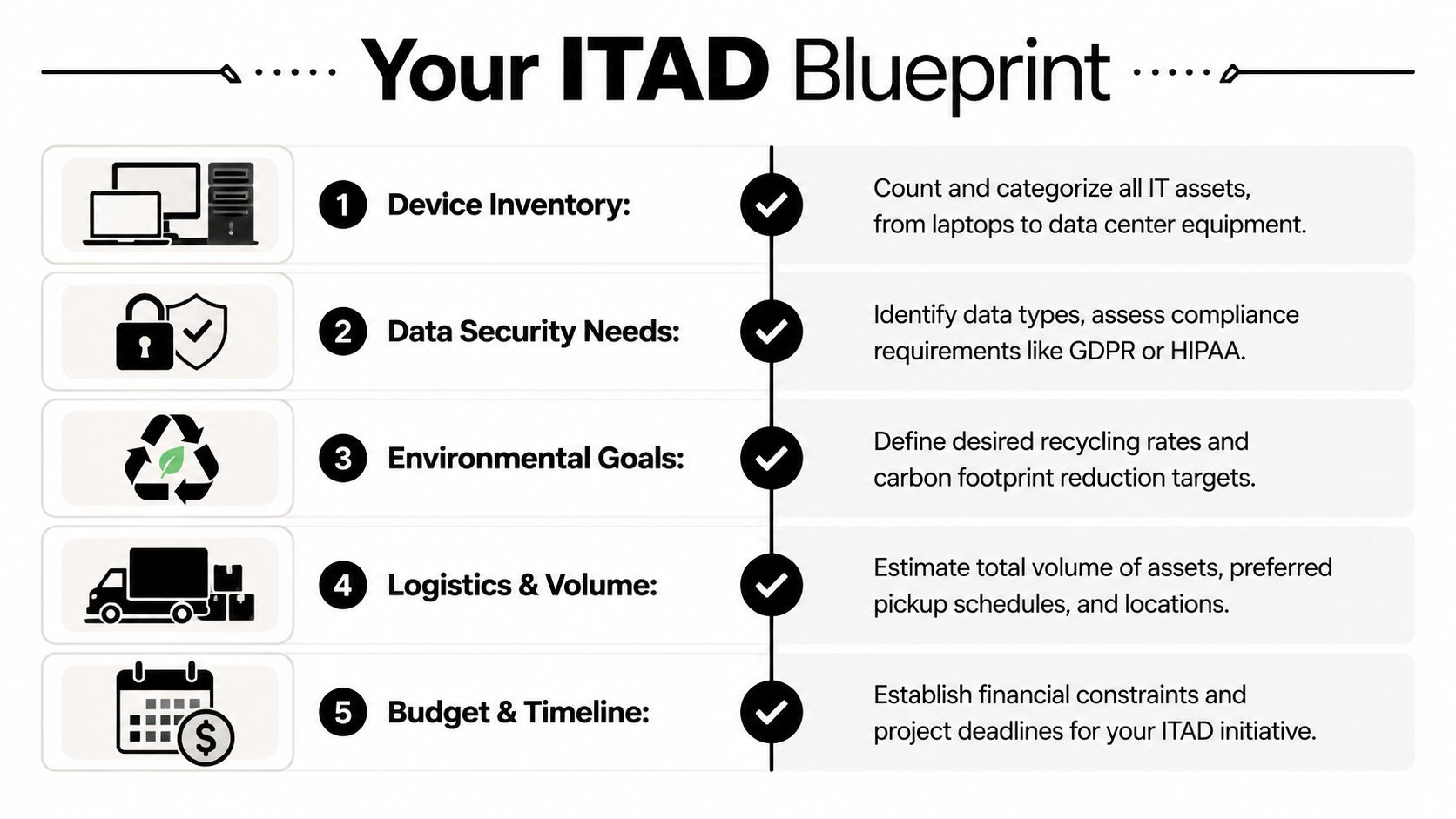
A strong vendor process starts with an internal blueprint. Without one, every quote looks reasonable and every proposal sounds compliant. Then the pickup date arrives and nobody agrees on what’s included, which assets contain regulated data, or whether the project is a one-time event or the start of an ongoing program.
The reason this matters is broader than recycling. The telecom sector has moved from basic connectivity into extensive managed IT solutions, in a global market segment exceeding $100 billion, which is one reason businesses now look at their tech stack, including end-of-life asset management, as one connected platform for reducing complexity and supporting compliance, according to Telecom Giant’s overview of managed telecom services.
Start with the asset map
Don’t begin with “we have some old equipment.” Build an actual list.
For many organizations, that means separating assets into groups:
- End-user devices. Laptops, desktops, tablets, monitors, thin clients, printers, docking stations.
- Infrastructure hardware. Switches, routers, firewalls, wireless gear, UPS systems, patch panels, telecom racks.
- Storage and compute. Servers, SAN or NAS units, backup appliances, external drives.
- Specialized equipment. Medical devices, AV hardware, industrial control units, kiosks, or lab technology.
If your inventory discipline needs tightening before an ITAD project, this inventory system planning guide from Endless Storage is a practical reference for structuring asset records before pickup day.
Classify the data, not just the device
A laptop used by HR and a conference room PC may look similar on a pallet. They don't carry the same risk.
Build your blueprint around the sensitivity of the data each asset may contain:
- General business data requires documented handling and proper disposition.
- PII-heavy systems need tighter controls and clearer destruction records.
- PHI-related devices call for HIPAA-aware handling, secure transport, and stronger proof of destruction.
- Defense or highly sensitive environments may require sanitization aligned with DoD expectations.
The device category tells you how to move it. The data category tells you how to destroy it.
Define scope before requesting quotes
The operational model matters as much as the hardware list. A partner may be excellent at quarterly office pickups and completely unsuited for a multi-floor de-installation or a phased data center retirement.
Use questions like these to shape the scope:
- Is this a one-time cleanout or a recurring program?
- Will devices be staged centrally, or collected from multiple rooms or sites?
- Do remote employees need return coordination?
- Does the project include de-racking, disconnection, or packaging?
- Do you need reporting by serial number, department, or location?
Many teams turn that blueprint into a practical request package before contacting vendors. If you need a starting point for what that internal prep should look like, an Atlanta business IT asset disposal guide can help frame the categories and questions that matter before you invite bids.
Vetting a Vendor’s Security and Compliance Capabilities
A polished sales pitch often unravels when specifics are required. Many vendors say they provide “secure recycling.” Fewer can explain, in operational terms, how a drive is handled from your loading dock to final destruction, what documentation you receive, and who is accountable if an auditor asks questions six months later.

In practice, the best ITAD vendors operate more like secure logistics companies than recycling haulers. Advanced firms now integrate telecom infrastructure into their logistics, including real-time GPS fleet tracking and IoT sensors for secure transport. Making those systems work alongside legacy inventory tools requires serious technical expertise and over 40 hours of testing per deployment to satisfy standards such as HIPAA and DoD 5220.22-M, according to DAS42’s telecom risk analytics discussion.
Ask how destruction decisions are made
A serious partner should be able to tell you when they recommend:
- Data wiping for reusable devices where sanitization is appropriate
- Physical shredding for failed media, obsolete drives, or high-risk assets
- Mixed workflows where some equipment is remarketed after sanitization and some is destroyed outright
This isn't just about preference. It’s about matching the method to the asset condition, the regulatory environment, and your internal risk tolerance.
For example, a functioning fleet laptop in a commercial office may be a candidate for wiping and reuse if policy allows. A failed hard drive from a healthcare imaging system is a different story. That media may need immediate physical destruction with an auditable record.
Review chain of custody like an auditor would
A vendor’s chain of custody should answer four basic questions:
- What asset was collected
- Who handled it
- Where it went
- How it was finally processed
If any of those steps are vague, you’ve found the weak spot.
Look for documentation elements such as:
- Serialized tracking records
- Pickup manifests signed at transfer
- Transport logs tied to the collection event
- Certificates of destruction tied to identifiable assets or batches
- Exception handling notes for damaged, missing, or nonstandard devices
If the report only tells you that “electronics were recycled,” it won’t help during an audit.
Test the HIPAA and DoD conversation
In healthcare, education, government, and legal environments, compliance language gets thrown around casually. Don’t accept generic answers.
Ask direct questions:
- How are PHI-bearing devices secured in transit?
- When is wiping acceptable, and when is shredding required?
- How are employees trained on handling sensitive media?
- What happens when an asset arrives damaged or unreadable?
- How quickly can the vendor issue final destruction paperwork?
A competent provider should discuss secure handling as a workflow, not a slogan.
Certifications matter, but process matters more
Third-party certifications can be useful because they show outside review of environmental and data handling practices. But certifications alone aren’t enough. A more definitive measure is whether the vendor can map your devices from pickup through final disposition and support that record with formal paperwork.
That’s why the deliverable matters. A real certificate of destruction should function as compliance documentation, not as a generic receipt. If the certificate can’t stand up in front of your legal, compliance, or procurement team, it doesn't solve the problem you hired the vendor to solve.
What to Expect from Onsite Service and Logistics
The day of service tells you almost everything about a vendor. If the team arrives looking like a junk removal crew, improvises staging, and asks your staff basic questions that should have been resolved in planning, the project is already off course.
A professional onsite process feels controlled. The team signs in, confirms the scope, walks the route with your facilities or IT contact, and starts from a documented asset plan rather than a loose verbal description. For office environments, that may mean collecting devices room by room. In data rooms, it may mean systematic de-installation, labeling, and palletization.
What good execution looks like
In a well-run engagement, the sequence is usually straightforward:
- Site confirmation with loading dock, elevator, security, and access details reviewed on arrival
- Asset verification against the prepared inventory or collection scope
- De-installation and packing done carefully, especially for rack gear and mixed telecom equipment
- Staging and wrap so assets leave the site secured, not stacked loosely in carts or bins
The strongest vendors also control their own transportation rather than handing your equipment to an unknown freight layer. That matters for timing, accountability, and chain of custody.
Good logistics reduce disruption for your staff. Great logistics also reduce ambiguity.
Why project governance changes the outcome
Large e-waste programs often fail for the same reason other transformation projects fail. Too many people own part of the work, and nobody owns the whole workflow. In telecom-style project management, over 70% of digital transformation initiatives fail to meet objectives, while a dedicated control tower model improves project delivery timelines by 30% to 40% and helps organizations reach 85%+ on-time completion, based on TM Forum’s analysis of transformation pitfalls.
That lesson translates directly to onsite pickup and decommissioning. The best vendors assign one coordinating team to handle scheduling, scope changes, reporting, and exceptions.
For higher-risk projects, I’d expect:
- One point of contact for your IT and facilities teams
- Escalation paths when access, counts, or device conditions change
- Clear milestones for pickup, processing, and document delivery
For organizations that need media destroyed before it leaves the premises, onsite shredding near me should mean exactly that. The service should be planned, witnessed if needed, and documented without slowing down the rest of the removal.
Choosing a Partner That Amplifies Your ESG Goals
Technical capability is the floor. It’s not the full decision.
Once two vendors can both handle secure pickup, data destruction, and reporting, the smarter question becomes: which partner helps your organization turn a required disposal event into something useful for your CSR and ESG narrative?
Many procurement teams continue to undershoot the opportunity. They buy on price and baseline compliance, then miss the fact that a recycling program can support annual reporting, employee engagement, public relations, and local community impact at the same time.
Why social impact belongs in vendor selection
If your company publishes sustainability updates, supports community initiatives, or asks department heads to contribute to ESG outcomes, end-of-life IT is one of the cleanest places to show measurable action.
A mission-driven recycling partner can support efforts like:
- Corporate recycling drives tied to office refreshes, relocations, or remote-work cleanup cycles
- Employee engagement campaigns that connect device retirement with visible community outcomes
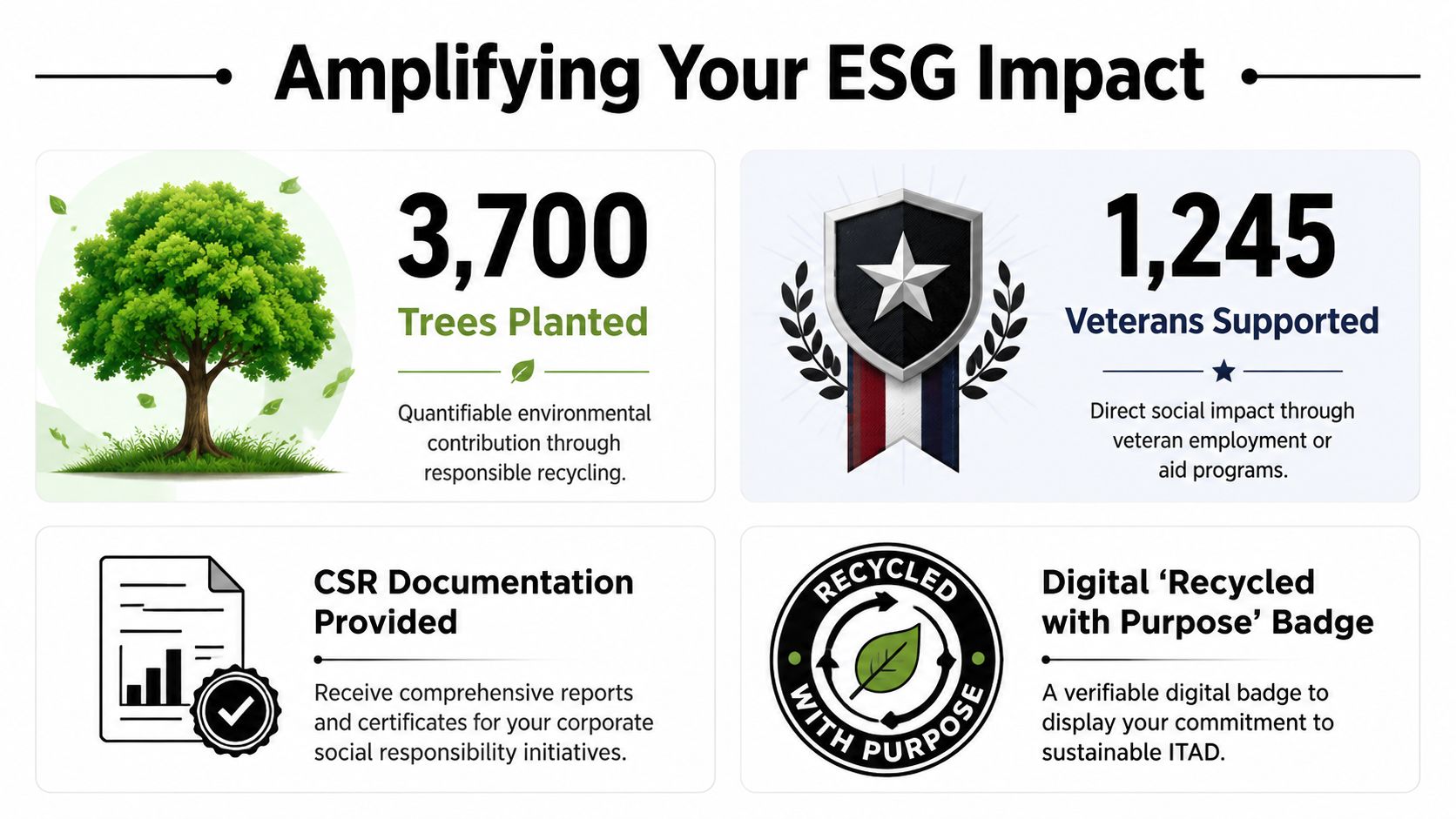
- Documentation for CSR reporting such as environmental certificates and impact summaries
- Cause-based seasonal initiatives around Veterans Day, Earth Day, or Arbor Day
The most persuasive framing is simple. Your old tech doesn’t have to end as waste. It can become part of a broader story of responsible disposal, veteran support, and reforestation.
What to ask for beyond the standard paperwork
If ESG matters to your leadership team, ask vendors whether they can provide materials your communications or sustainability team can effectively use.
Look for options such as:
- Plant-a-tree certificates for campaigns or departmental participation
- Veteran support impact reports that translate disposal activity into community value
- A digital badge such as “Recycled with Purpose” for websites or sustainability reports
- Campaign support assets for internal announcements, LinkedIn posts, or local events
The numbers shown in the infographic above, 1,245 veterans supported and 3,700 trees planted, come from the publisher brief for this campaign and should be treated as brand-specific impact figures within that program context, not as a general industry benchmark.
Buyers often think ESG is a soft differentiator. In practice, it’s a procurement advantage when the vendor can turn a mandatory compliance project into stakeholder-ready proof of action.
The easiest ESG wins are usually operational
You don’t need a huge initiative to make this work. A routine office cleanout, laptop refresh, or telecom decommissioning project can become a documented ESG contribution if the partner is built for that model.
That’s especially useful for:
- Healthcare systems that need to show secure handling and responsible disposal
- School systems and universities balancing budget pressure with sustainability goals
- Government agencies that need accountability, documentation, and community credibility
- Atlanta companies with active CSR programs looking for local, visible impact
A vendor that can support both secure disposition and reportable social outcomes does more than remove equipment. It helps your organization tell a stronger story. If that’s part of your evaluation criteria, corporate e-waste solutions should be assessed not only for compliance performance but also for how well they plug into your ESG reporting and community commitments.
Your Final Vendor Vetting Checklist for Atlanta Partners
At the final stage, keep the comparison simple. You’re looking for a partner that can secure the data, control the logistics, document the outcome, and support your broader business goals.
Reliable telecom infrastructure is part of that picture. Modern e-waste partners depend on strong connectivity for real-time tracking and secure reporting. In places like Toms River, New Jersey, 98% of the market has access to high-speed internet, which gives a useful benchmark for the level of connectivity enterprises should expect vendors to utilize for chain-of-custody reporting and compliance documentation, according to high-speed internet coverage data for Toms River.
Atlanta ITAD Vendor Checklist
| Criteria | What to Ask/Verify |
|---|---|
| Security method | Do they offer both data wiping and physical destruction, and can they explain when each is appropriate? |
| Chain of custody | Will you receive serialized tracking, transfer records, and final disposition documentation? |
| Compliance fit | Have they worked with HIPAA-sensitive, education, government, or other regulated environments? |
| Onsite capability | Can they de-install, pack, palletize, and remove equipment without relying on your staff to do the prep? |
| Transport control | Do they use a controlled fleet and secure handling procedures for devices in transit? |
| Reporting quality | Are certificates and asset reports detailed enough for procurement, audit, and legal review? |
| Project management | Is there one accountable coordinator for schedules, changes, and issue escalation? |
| ESG support | Can they provide impact documentation, certificates, or community-facing proof that helps your CSR team? |
The best local option won't just say yes. They’ll show you the process, the paperwork, and the handoff points before pickup day.
Frequently Asked Questions About IT Asset Disposal in Atlanta
How is pricing usually structured?
Most vendors price based on a mix of asset type, volume, labor required, onsite services, transportation complexity, and whether you need wiping, shredding, or both. A basic pallet pickup is different from a multi-site decommissioning with de-racking and documented destruction.
Can one vendor handle both telecom gear and general IT equipment?
They should. In real environments, old phone hardware, switches, servers, workstations, monitors, and storage media are often retired together. Splitting those streams between vendors usually creates more administrative work and more compliance risk.
Do I need onsite destruction?
Not always. It depends on your policy, device condition, and data sensitivity. Some organizations require witnessed destruction for certain media. Others are comfortable with secure transport and documented downstream processing.
What should I prepare before requesting service?
Have an inventory, site access details, data sensitivity notes, preferred timing, and any regulatory requirements ready. If your project includes multiple floors or locations, note that early.
How do I start with a local Atlanta provider?
Start with a scope review. A good partner will help you confirm asset types, handling requirements, pickup logistics, and documentation expectations before setting the collection date.
If you need a local partner that handles secure pickup, compliant data destruction, de-installation, and purpose-driven recycling for Atlanta organizations, Atlanta Green Recycling is built for that job. Their team supports businesses, hospitals, schools, government agencies, and data center projects with turnkey IT asset disposition services, while also tying recycling activity to veteran support and tree-planting impact that can strengthen your ESG story.