
ITAD Telecom Services Near Me: Atlanta Buyer’s Guide 2026


If you're searching ITAD telecom services near me in Atlanta, you're probably not browsing casually. You're dealing with retired switches, VoIP phones, rack gear, routers, access points, maybe a server room cleanup tied to an office move, carrier upgrade, or data center refresh. The equipment is taking up space, but the bigger issue is risk. Once telecom hardware leaves active service, every drive, config file, and asset tag becomes a compliance and documentation problem.
That pressure is coming from several directions at once. E-waste generation is a major environmental challenge, and the telecom industry contributes heavily because equipment turns over fast according to ERI Direct's overview of telecom ITAD services. For Atlanta businesses, that means disposal decisions affect security, audit readiness, and sustainability reporting all at once.
The smartest buyers no longer treat disposal as a back-room task. They treat it as a controlled business process, and in the best cases, as an ESG and CSR opportunity. A well-run ITAD project can protect patient data, close out an internal audit trail, recover value from reusable gear, and create a credible story around community impact. That last part matters more than many IT teams expect. When an organization can connect retired tech to veteran support and reforestation, disposal stops looking like waste handling and starts looking like purposeful stewardship.
Your Guide to Mission-Driven Telecom Recycling in Atlanta
An Atlanta IT manager usually sees the same pattern. A telecom refresh finishes. The new equipment is live. The old gear stays stacked in a closet, cage, or corner of the server room because nobody wants to move it until the security, pickup, and paperwork are figured out.
That hesitation is understandable. Once retired assets leave your control, you need confidence in chain of custody, data sanitization, and downstream handling. If you're in healthcare, education, finance, or government, the margin for error is narrow. If your leadership team also expects progress on sustainability, the pressure gets even tighter.

Why local buyers need more than a truck and a quote
A generic hauler can remove equipment. That doesn't mean they can manage telecom disposition correctly. Telecom environments often include mixed asset classes, network devices with stored configs, deinstalled rack equipment, drives removed from servers, and equipment that still has resale value if it's processed properly.
A stronger approach starts with a provider that understands business IT disposition as both an operations issue and a reporting issue. Buyers looking for a broader framework can review Atlanta IT asset disposition for businesses to compare what a full-service process should include.
The mission-driven difference
Standard ITAD asks, “How do we dispose of this safely?”
Mission-driven ITAD asks a better question. “How do we dispose of this safely, document it properly, recover what we can, and turn the project into a meaningful outcome for the business and the community?”
That's where the dual-impact model stands out. Retired telecom hardware can support veteran aid and reforestation while still meeting strict operational requirements. For a local business, that changes the buyer's journey. Your disposal project can feed internal audit files, procurement review, and sustainability reporting, while also giving marketing, HR, and leadership a story they can stand behind.
Practical rule: If an ITAD provider only talks about pickup speed and scrap value, you're hearing half the conversation.
In Atlanta, the best fit usually isn't the cheapest option or the broadest national directory listing. It's the partner that can combine security discipline, local logistics, and impact reporting without making your team chase documents afterward.
Defining Your Telecom Disposal Scope and Goals
Before you call anyone, build your internal picture of the project. Most ITAD problems start long before pickup day. The team knows equipment has to go, but nobody has a clean asset list, nobody has separated reuse from scrap, and nobody has decided what success looks like.
That's why the first move is an internal audit. Not a perfect one. A usable one.
Build the inventory before you request pricing
Start with a spreadsheet or asset management export and work row by row. Include device type, manufacturer, model, serial number, asset tag, physical condition, and whether the item contains storage media. For telecom projects, don't forget accessories and supporting components such as handsets, line cards, rails, transceivers, and power supplies. They affect both logistics and resale potential.
If your organization expects value recovery, note which items still appear deployable or commercially relevant. If your priority is pure risk removal, flag anything that should go directly to destruction. If your environment includes multiple locations, separate the inventory by site so pickup planning stays realistic.
A provider can help refine this later, but your team should enter the conversation with a working list. Buyers exploring the resale side of old telecom hardware can compare options through sell telecom equipment near me.
Set your goals in the right order
The mistake I see most often is treating every asset the same. A retired VoIP phone, an SSD pulled from a virtualized host, and a decommissioned switch shouldn't all follow the same path.
Use a simple decision structure:
Security first
Identify devices with stored data, credentials, call logs, configs, or management access history. Those assets need the strictest handling path.Compliance second
Decide what documentation your auditors, privacy officers, procurement team, or facilities group will need after the project closes.Recovery third
Separate equipment that may be suitable for remarketing from equipment that is obsolete, damaged, or better routed to recycling.Impact fourth
Decide whether leadership wants ESG or CSR documentation that can support annual reporting, employee engagement, or public-facing sustainability messaging.
A simple scoping worksheet
| Scope item | What to define internally |
|---|---|
| Asset types | Routers, switches, servers, phones, storage media, racks, cables |
| Data risk | Which assets contain drives, configs, user information, or regulated data |
| Service model | Onsite sanitization, offsite processing, de-installation, packing, pickup |
| Financial goal | Revenue recovery, cost containment, or pure secure disposition |
| Reporting need | Certificates, serialized logs, chain of custody, impact summaries |
A clean scope saves time twice. It improves the quote, and it prevents arguments after the truck leaves.
If your organization already knows it wants both compliance and a stronger sustainability narrative, write that into the project brief from the start. Otherwise, vendors will optimize for removal speed alone, and you'll end up trying to bolt reporting onto the process after it's over.
The Non-Negotiables of Data Destruction and Compliance
For telecom disposition, security discipline matters more than marketing language. A polished website doesn't protect you. A repeatable process does.
The baseline standards buyers should understand are NIST 800-88 for media sanitization and R2v3 for responsible electronics processing and downstream accountability. You'll also hear buyers ask about e-Stewards and NAID AAA. Those designations matter in different contexts, but the practical question is simple. Can the provider explain exactly how assets are sanitized, transported, documented, and processed after pickup?

Onsite versus offsite is a business risk decision
For many telecom projects, onsite sanitization is the safer choice. According to this telecom ITAD implementation analysis, onsite data sanitization using NIST 800-88 standards is critical, providers reported 100% data irretrievability after DoD 5220.22-M 3-pass wiping, and the onsite approach was shown to cut data breach risks by 40%.
That matters for Atlanta hospitals, multi-site businesses, and any company with sensitive configuration data or regulated records tied to telecom systems. If media can be wiped or destroyed before it leaves your building, you reduce the number of custody handoffs and the number of unanswered questions later.
What good process control looks like
A credible provider should be able to describe the workflow in plain language. Not buzzwords. Workflow.
- At intake the team verifies asset counts against your inventory or builds a reconciled list on site.
- During sanitization they identify what can be wiped, what requires cryptographic erase, and what should be physically destroyed.
- For nonfunctional media they should specify the destruction method, not just say “disposed of securely.”
- After processing they issue documentation that ties the result back to serialized assets where applicable.
If you stage retired equipment internally before pickup, physical security matters too. Many organizations use locked enclosures or controlled access areas to prevent tampering while equipment is awaiting disposition. For facilities planning that step, Material Handling USA equipment storage cages are a useful reference for secure containment in server rooms and data center support spaces.
Questions that expose weak compliance
Ask these directly:
- Which sanitization standard do you follow for drives and other media?
- What happens to SSDs that can't be reliably wiped?
- Can you perform onsite services before transportation begins?
- How do you document chain of custody from room removal through final processing?
- What does your certificate include?
“Secure recycling” isn't a method. It's a slogan. Ask for the method.
If a provider gets vague around wiping, shredding, or downstream processing, stop there. Buyers who want a clearer benchmark for secure workflows should review Atlanta secure data destruction services guide and compare each vendor's answers against that level of specificity.
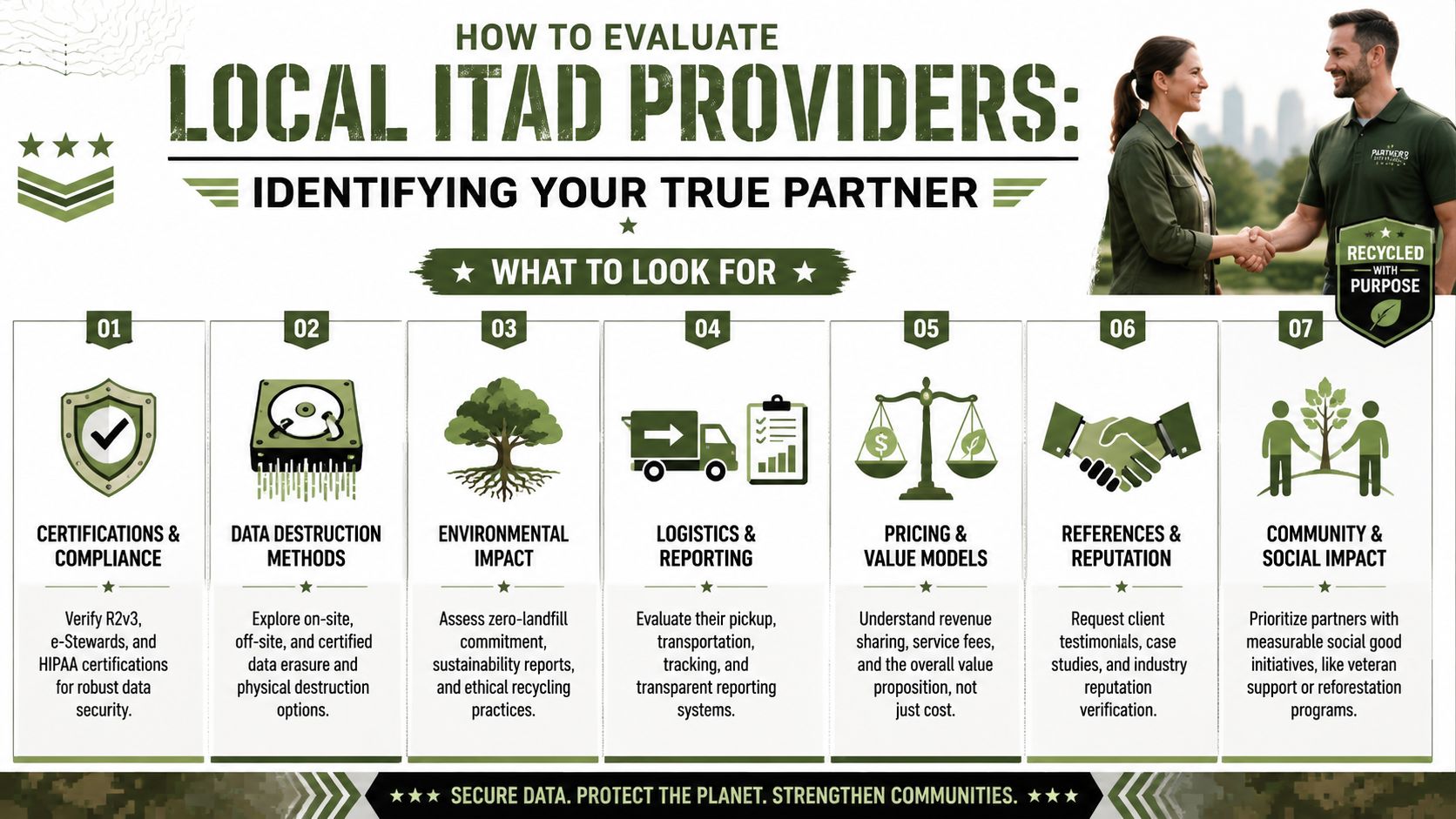
How to Evaluate Local ITAD Providers and Identify a True Partner
Once your scope is clear and your compliance bar is set, the Atlanta market gets easier to read. Most vendors can talk about pickup. Fewer can talk about accountability. Even fewer can connect responsible disposition with a usable ESG story.
That gap matters because a 2026 Deloitte survey indicates that 74% of Atlanta enterprises actively seek impact-certified disposal partners, as noted in Securis' discussion of ITAD providers and ESG trends. Buyers are looking for more than removal. They want disposal partners that can help them prove environmental responsibility and social value.
What to ask in the first vendor call
Use the first conversation to test transparency, not just availability.
Show me your process
Ask how assets move from pickup request to final certificate. Strong providers answer in sequence and can describe exceptions.Explain your downstream accountability
If material can't be remarketed, where does it go next? A serious vendor should have a clear answer.Walk me through your reporting package
Ask whether you'll receive serialized destruction records, transfer documentation, and sustainability-friendly summaries.Tell me how you handle social impact reporting If the provider claims community benefit, ask what the report looks like. Can your CSR or ESG team use it?
How local is your operation really
Local fleet, local scheduling, and local project management often matter more than broad geographic claims.
Teams that want to improve how they're found and evaluated in local search can also learn from service businesses that specialize in nearby-intent visibility. Transactional LLC is a useful example of how local SEO positioning affects trust, call quality, and conversion for “near me” searches.
Standard vendor versus strategic partner
| Evaluation area | Standard logistics vendor | Mission-driven ITAD partner |
|---|---|---|
| Main promise | Fast removal | Controlled removal plus documented impact |
| Reporting | Basic disposal paperwork | Compliance documentation plus ESG-friendly deliverables |
| Value story | Cost and convenience | Security, sustainability, and community outcomes |
| Employee engagement | Rarely included | Often supports internal campaigns and purpose messaging |
| Brand lift | Limited | Can support CSR, recruiting, and stakeholder communications |
Red flags you shouldn't ignore
Some warning signs are obvious. Others show up only when you ask the second or third question.
A vague answer about data destruction is a red flag. So is a provider that avoids discussing downstream handling. Another common issue is the “all assets are just scrap” mindset. That usually means the vendor hasn't thought carefully about segregation, value recovery, or what your finance team may want to document.
Buyer note: The best partner doesn't just remove problems. They help your company show its work.
If you're comparing local options for ITAD telecom services near me, a practical benchmark is whether the provider can support telecom-specific removals, compliance-minded documentation, and impact reporting in the same engagement. Buyers who want a local reference point can review telecom solutions near me and compare vendor claims against that standard.
Understanding ITAD Pricing and Calculating Your Total Value
Pricing gets distorted when buyers focus on only one line item. A pickup fee by itself doesn't tell you much. You need to know whether the project includes de-installation, media handling, serialization, logistics, remarketing, and final reporting. You also need to know whether the vendor's financial model aligns with your asset mix.

The pricing models that matter
In telecom ITAD, reusable gear often works best under a revenue share structure. According to Smart Waste USA's pricing guide, revenue share models typically return 60-70% to the client and can outperform buyouts by 15-20%. The same source notes that bulk discounts often apply at 500+ units, while hidden post-split deductions for logistics can erode returns by 20-30%.
That last point matters more than buyers expect. A vendor can advertise an attractive share percentage, then reduce your net recovery through fees that show up later. Ask whether costs are deducted before or after the split, and ask for that answer in writing.
Calculate total value, not lowest invoice
A disciplined buyer looks at four buckets:
- Recovery value from remarketable phones, switches, routers, and related gear
- Risk avoidance from proper data sanitization and documented custody
- Operational value from a smoother decommissioning process
- Brand value from ESG and CSR reporting tied to the project
That final bucket gets dismissed too quickly. A disposal project that produces a credible impact report, a “Recycled with Purpose” style badge, or internal-facing sustainability documentation can support leadership communications, recruiting, and annual reporting. Those aren't soft extras if your company is already under pressure to show measurable responsibility.
The pricing questions worth asking
Ask every bidder the same set:
- Which assets do you expect to remarket versus recycle?
- Are logistics charges deducted before or after revenue sharing?
- Do you charge separately for onsite de-installation or media destruction?
- What final documentation is included in the base price?
- Can you support both compliance records and impact reporting?
If you suspect retired equipment still has value, review the broader options around old electronics for cash before accepting a flat buyout. The cheapest quote often wins the meeting and loses the project.
Scheduling Your Pickup and Mastering the Documentation Trail
Execution day should feel controlled, not improvised. By the time the truck arrives, your organization should know what's being removed, who approved it, which assets need special handling, and what documents you expect at closeout.
For telecom projects, pickup is often only one part of the visit. The team may also deinstall equipment, remove gear from racks, pack loose devices, collect media separately, and reconcile the final manifest against your internal list. If your staff has to make decisions on the fly because the scope wasn't locked down, the paperwork usually suffers.
Prepare the site before the crew arrives
A few simple steps make the project smoother:
Consolidate assets by category
Keep phones, network gear, servers, loose drives, and accessories separated if possible.Label exceptions clearly
Mark assets that require destruction, assets held for remarketing review, and anything excluded from pickup.Assign one internal owner
One person should approve changes, answer access questions, and sign transfer documents.Secure the staging area
Limit access before pickup so the final count doesn't drift.
The paperwork you should expect
For regulated industries, documentation is the product as much as the pickup itself. Leading providers emphasize an auditable chain of custody and 100% diversion of electronic waste from landfills, and for Atlanta organizations using R2v3 certified services, that level of documentation supports internal audit, ESG reporting, and regulatory requirements according to this ITAD services profile.
A complete file usually includes:
- Asset transfer records showing what changed hands
- Chain of custody documentation tied to movement and processing
- Certificates of destruction for sanitized or destroyed media
- Final disposition reporting showing what was reused, recycled, or destroyed
- Impact documentation if your provider supports veteran aid and reforestation outcomes
Good ITAD documentation should answer questions months later, not create new ones.
The last item is where a mission-driven provider changes the closeout package. Instead of receiving only operational paperwork, your team can also receive impact certificates and summaries that help sustainability, HR, and leadership teams communicate what the project accomplished beyond compliance.
For local buyers searching ITAD telecom services near me, that combination is a distinct differentiator. You're not just checking a disposal box. You're closing a security loop, supporting audit readiness, and turning retired telecom hardware into a documented act of environmental and community stewardship.
If your Atlanta business needs a secure, compliance-minded telecom disposition partner that also supports veteran aid and reforestation, Atlanta Green Recycling can help you turn end-of-life equipment into a documented ESG and community impact win. Reach out to schedule a pickup, discuss de-installation needs, and build a disposition plan that protects your data, clears your space, and gives your team a stronger story to tell.