
Top Telecom Equipment Buyers Los Angeles: 2026 Guide


Your Los Angeles office just finished a telecom refresh. The new VoIP platform is live, users have moved over, and now the leftovers are piling up. Old PBX shelves, handsets, cards, switches, voicemail modules, and cabling are taking up space that operations wants back this week.
That pile is either recoverable value or an avoidable liability. If you release it to the wrong buyer, you risk weak documentation, poor chain of custody, and a messy audit trail. If you choose well, you recover some value, clear space fast, and close the loop in a way that supports compliance, sustainability, and brand reputation.
That's why the search for telecom equipment buyers Los Angeles shouldn't stop at “who pays cash.” The better question is who can remove equipment securely, document what happened, and support your broader ITAD and ESG goals. Existing buyer pages in this market often list gear categories but stay thin on serialized inventory, data destruction, and post-pickup reporting, which is exactly where risk sits for hospitals, schools, and government offices, as noted in GreenTek's Los Angeles IT equipment disposition discussion.
Los Angeles is also the kind of market where replacement cycles keep moving. The U.S. holds over 35% of North American telecom equipment market share, with demand tied to 5G expansion, IoT integration, and rising data traffic, according to Future Market Insights' telecom equipment market outlook. That means more retired gear, more refresh-driven turnover, and more reason to choose a buyer that acts like an ITAD partner, not a scrap picker.
If you need a quick primer on modern business calling systems before sorting what stays and what goes, review these telephony concepts for businesses. Then use the list below to make a hard-nosed decision.
1. Startechtel (Pomona, CA)

Startechtel is one of the clearest fits if your surplus is mostly legacy business telephony. If you've got Avaya sets, Nortel modules, ShoreTel or Mitel phones, Polycom conference units, or Cisco voice gear sitting in cabinets, this is the kind of specialist that understands old model families instead of treating everything as low-grade scrap.
Its advantage is simple. Startechtel operates close to the old-school phone-system market and publishes a visible catalog of refurbished telecom gear on its main Startechtel website. That matters because a refurbish-and-resell business usually has a better feel for what still moves in secondary channels and what is dead stock.
Best fit for legacy phone system cleanouts
This buyer makes the most sense when your environment looks like this:
- Legacy PBX estates: Nortel, Avaya, or older digital and hybrid office phone systems that still have parts demand.
- Parts-heavy surplus: Handsets, cards, modules, voicemail components, and shelf hardware rather than broad mixed IT lots.
- Replacement plus disposition: Teams that may need to buy replacement telecom equipment while offloading retired gear.
That last point is useful during branch consolidations or campus moves. You can often resolve both outbound equipment and replacement sourcing in the same conversation, which reduces coordination headaches.
Practical rule: If your retired inventory is mostly telephony and mostly older, choose a buyer with refurbishing depth before you call a general electronics recycler.
Where Startechtel falls short
This isn't the buyer I'd call first for mixed data center hardware, storage, laptops, or broad enterprise IT. Startechtel is strongest when the lot is clearly telecom-centric. If your project includes firewalls, server racks, UPS units, and networking alongside phones, you'll probably need a broader ITAD partner or a split-disposition strategy.
Quotes also depend on a clean itemized list. That's normal, but it means you should do some prep work before expecting a firm offer. Pull model numbers, note quantities, and separate tested working units from unverified returns.
If you're comparing local telecom specialists to a more compliance-centered disposition path, this sell telecom equipment near me service page shows the kind of process language many regulated organizations need.
For telecom equipment buyers Los Angeles searches tied to old PBX closets, Startechtel belongs near the top of the shortlist. It knows the hardware category, and that usually leads to a more realistic answer on what still has remarketing value.
2. Telesonic Unified Communications (Arcadia, CA)
Your cutover weekend is set. The old phone system still has to come out, the new environment has to go live on time, and one missed handoff can create downtime, stranded assets, and a messy chain of custody. That is the kind of project where Telesonic Unified Communications makes sense.
Its Telesonic asset recovery page presents the company as an integrator that also handles recovery. That changes how you should evaluate it. This is less about squeezing the last dollar out of retired handsets and boards, and more about reducing project risk, keeping the site organized, and making sure removal work does not interfere with deployment.
That matters for ESG and CSR too. A buyer tied to the de-install process can improve accountability because the same provider touches removal, logistics, and transition planning. If your organization reports on responsible asset disposition, that operational control is often more valuable than a slightly higher buyback number from a broker that only wants boxed gear at the dock.
Where Telesonic fits best
Telesonic is a strong option for projects such as office closures, UC migrations, multi-site phone refreshes, and facility renovations where equipment is still installed and live until the change window opens.
Here is where the model has real business value:
- Onsite assessment: Useful when installed condition, access constraints, and labor requirements affect what the equipment is worth and how it should be removed.
- De-install services: Important for telecom closets, mounted hardware, legacy cabinets, and cabling that cannot be pulled carelessly.
- Installation-side coordination: Strong fit when the same project includes replacement systems, staged deployment, or a planned cutover.
This operating model is especially relevant for schools, medical offices, municipal sites, and mid-market companies that cannot afford confusion during a telecom transition.
My recommendation
Use Telesonic when schedule control and site execution matter as much as resale. If your retired assets are part of a live communications environment, a buyer with field service capability is usually the safer choice.
If your priority is pure remarketing yield across a broad mix of IT assets, this would not be my first call. Telesonic looks better in scoped telecom projects than in wide, mixed-hardware liquidation events. The company's value is coordination, removal discipline, and deployment alignment.
For teams comparing local options, these telecom services in Los Angeles show the kind of regional support model that matters when disposition, service continuity, and responsible downstream handling all have to work together.
3. GreenTek Solutions (Los Angeles coverage)
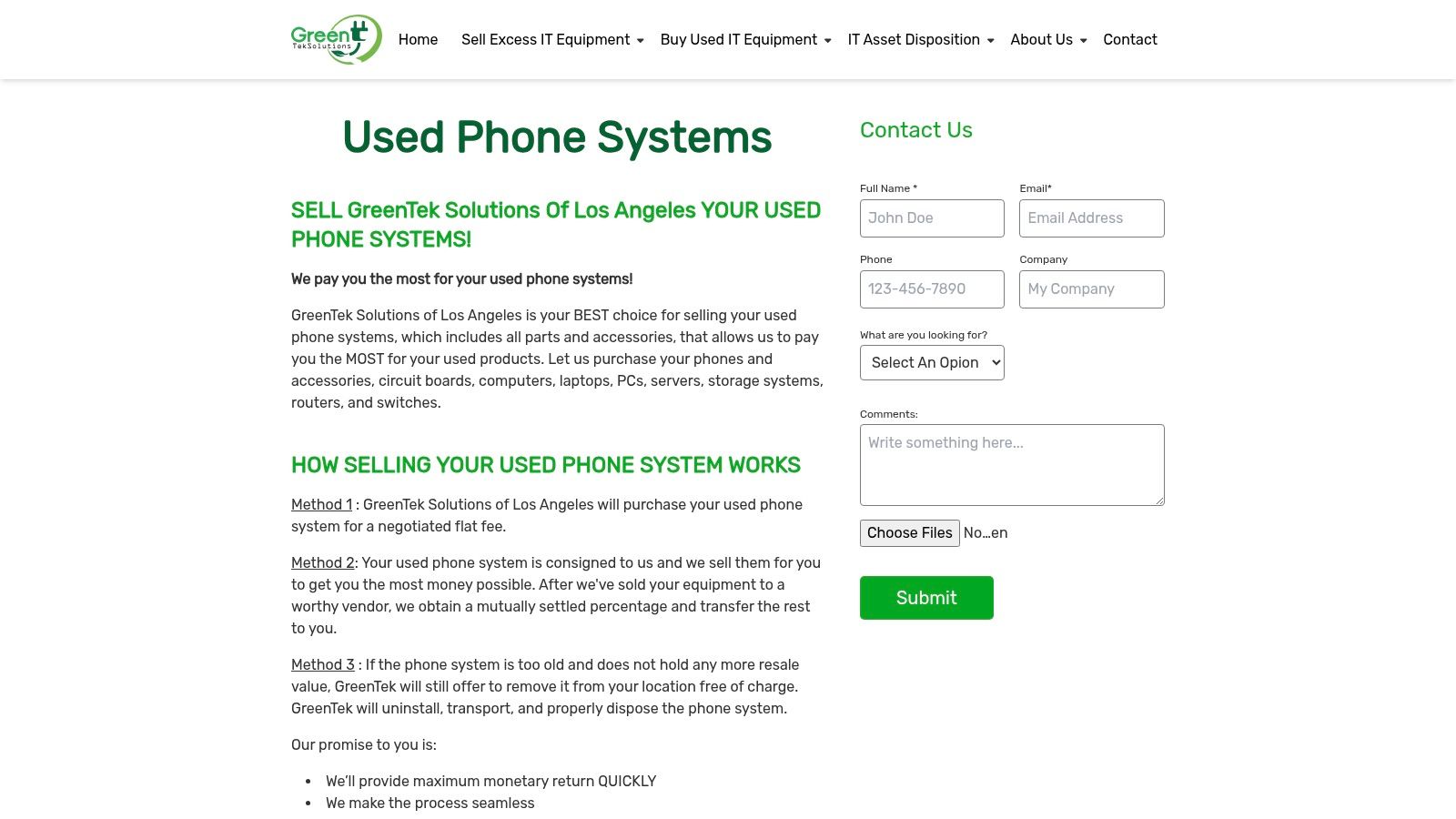
A common Los Angeles telecom refresh ends the same way. The CFO wants resale value, facilities wants the room cleared fast, IT wants serialized tracking, and the sustainability team wants proof that unusable gear did not end up in the wrong downstream channel. GreenTek gets attention because its used phone systems buying page reflects that reality better than buyers that only quote a flat buyback.
Its real advantage is decision flexibility. If your lot includes handsets, PBX components, switches, routers, and low-value accessories, forcing everything into one bid usually leaves money on the table or pushes good assets into scrap.
Why the multi-path model matters
GreenTek appears built for category-based disposition. That is the right approach for organizations treating asset recovery as both a financial and ESG decision.
- Purchase: Best for clean, in-demand telecom gear with clear resale potential.
- Consignment: A better fit for equipment that may produce a stronger return through slower remarketing.
- Eco-disposal: The correct path for obsolete, damaged, or low-value items where responsible processing matters more than resale.
That structure does more than improve recovery. It supports better governance. A buyer that separates reuse from recycling helps you document circularity, reduce avoidable waste, and show that your disposition program is tied to CSR outcomes rather than a simple liquidation event. If your team is comparing vendors on reuse, resale, and recycling standards, this guide to telecom equipment disposal near you is a useful reference point.
Best fit
GreenTek is a strong option for mixed IT and telecom inventories, especially when your goal is to maximize reuse before recycling. That matters for enterprises trying to reduce Scope 3 pressure, improve diversion reporting, or defend vendor choices in front of procurement and compliance stakeholders.
My advice is simple. Ask hard questions before you sign anything. Get clarity on serialized inventory capture, chain of custody, downstream vendors, reporting, and how they distinguish resale from recycling in final documentation.
If you want one buyer to sort assets by business value and environmental outcome, GreenTek is one of the more practical choices in this Los Angeles lineup.
4. TechWaste Recycling (serving Los Angeles/OC/San Diego)
Your facilities team needs old VoIP phones gone. Your security team wants documented handling. Your ESG lead wants proof that reusable equipment was not dumped into a recycling stream too early. That is the kind of project where TechWaste deserves a serious look.
Its VoIP phone system buying page presents the service the right way for business clients. It names accepted brands, offers pickup, and ties the transaction to data destruction and certified recycling. That matters because telecom disposition is rarely just a resale decision. It is a governance decision with audit, CSR, and reputational consequences.
Strong fit for risk-controlled disposition
TechWaste stands out when your asset mix includes more than desk phones. If the project touches storage, UC infrastructure, call recording systems, or mixed e-waste from a larger office cleanout, a buyer with ITAD process discipline is usually the better choice.
Here is the standard I recommend using to evaluate them:
- Chain of custody: Get a clear account of who handles assets from pickup through final downstream processing.
- Documentation: Ask for serialized reporting, certificates where applicable, and a final disposition summary your procurement or compliance team can file.
- Reuse versus recycling logic: A credible partner should explain what gets remarketed, what gets harvested for parts, and what goes to recycling.
- Service area execution: Los Angeles, Orange County, and San Diego jobs need scheduling discipline, not vague promises.
That framework shifts the conversation from "Who pays the most?" to "Who helps us recover value without creating environmental or compliance risk?" That is the right question.
Buyer test: Ask how they separate reusable telecom gear from scrap and how that decision appears in the final reporting.
Best for organizations that treat disposition as policy, not cleanup
TechWaste will not be my first pick for chasing the absolute highest offer on a small lot of in-demand handsets. It is a stronger option for enterprises, healthcare groups, schools, and public agencies that need secure removal and documented downstream handling.
That distinction has business value. A poorly managed pickup can undermine internal asset controls. A poorly documented recycling outcome can weaken ESG reporting. A buyer that can support both operational cleanup and responsible disposition is worth more than a slightly higher bid.
For teams building a policy-driven program, this telecom equipment disposal service guide shows the level of process language and accountability you should expect from any serious provider.
5. AndoverCG / NetworkTigers (Los Angeles Network & Data Center Liquidators)
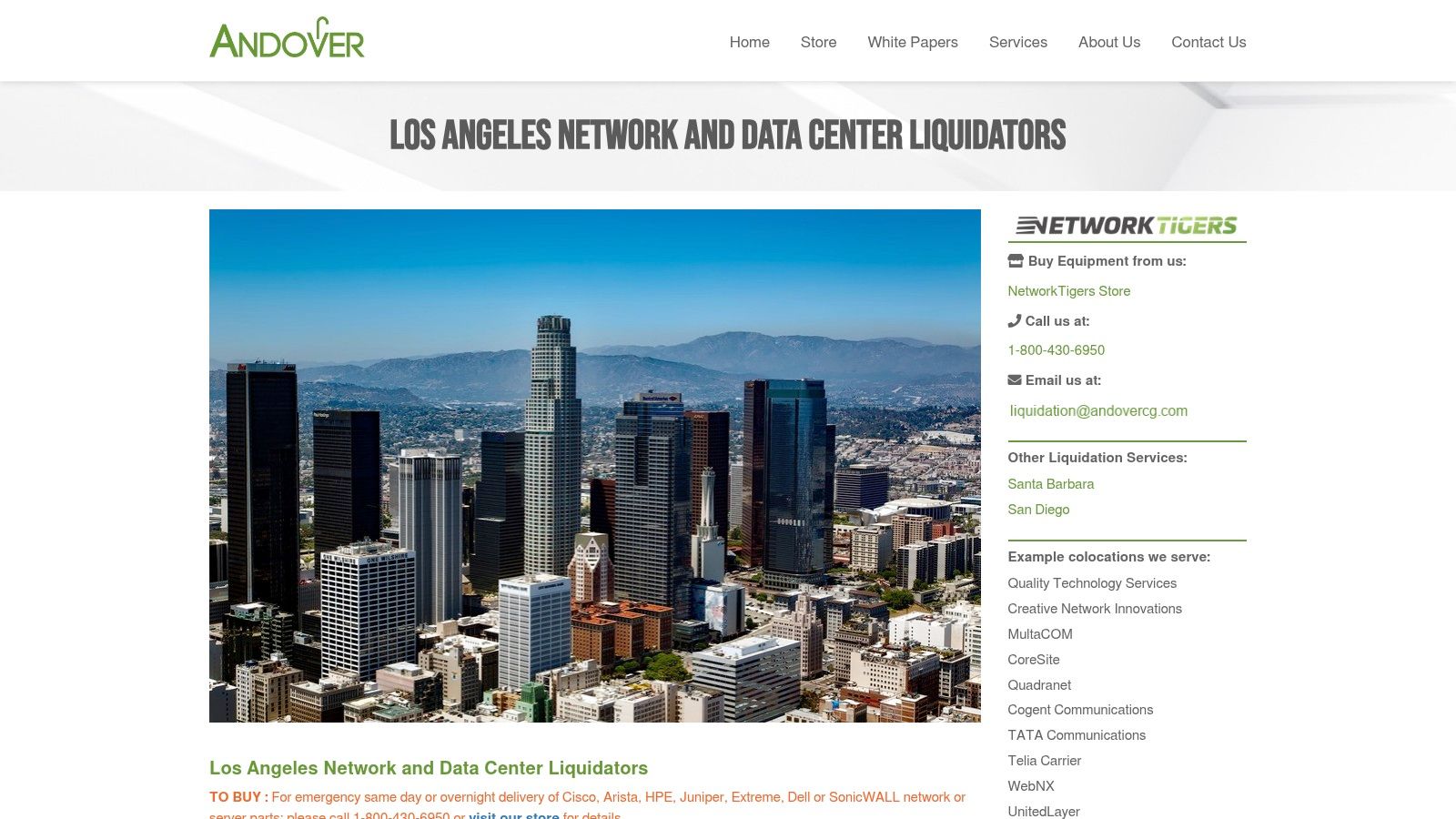
When a Los Angeles office closes and phones are removed from desks, significant value remains within the equipment racks. This is why AndoverCG and NetworkTigers merit consideration. They rank among the primary options for sellers offering routers, switches, servers, appliances, and various data-center hardware associated with a telecom update or site liquidation.
The relevant page is AndoverCG's Los Angeles network and data center liquidators program. The offer is built around corporate decommissions, colocation exits, and facility closures where inventory control, data handling, and resale all need to happen under one process.
Best for network-heavy estates with governance pressure
This buyer makes the most sense when your retired telecom gear is only one slice of a larger infrastructure project. Cisco, Arista, Juniper, HPE, optics, rack gear, and security appliances fit their model better than a pile of desk phones alone.
That matters because many companies use the phrase "telecom equipment" too loosely. Voice hardware and enterprise network infrastructure carry different resale paths, different handling risks, and different reporting needs. A buyer that understands those differences will usually protect more value and create fewer downstream problems.
The stronger business case here is control. On a network-heavy decommission, you need a partner that can catalog assets, coordinate removal, and support disposition decisions that stand up to audit. That is not just an operations issue. It affects financial recovery, data risk, and ESG credibility.
AndoverCG is also a better strategic fit for companies that take CSR seriously. Reuse should be the first question for enterprise-grade equipment that still has secondary market demand. Recycling has a place, but sending reusable infrastructure straight to scrap is a poor outcome for both recovery and environmental performance.
If your project includes real network infrastructure, start with a liquidator built for enterprise gear and ask direct questions about remarketing, data-bearing assets, chain of custody, and final reporting. For teams comparing providers against a wider responsible-disposition standard, these ITAD telecom services for secure telecom and network asset handling show the level of process support worth demanding.
6. EXS Tech Solutions (Cerritos, CA)
A common Los Angeles scenario looks like this. One site closure leaves you with handsets, switches, routers, servers, and stray accessories in mixed condition, and no one on your team wants to manage three different buyers just to clear the room. EXS Tech Solutions can work well in that situation because its EXS Tech Solutions website presents a broader buyback and recycling model than a telephony-only outlet.
Operational control is the core advantage. Cerritos proximity can shorten pickup timelines, simplify site coordination, and make it easier to get answers before equipment disappears into a long chain of subcontractors. That matters if finance wants recovery clarity, IT wants documented handling, and sustainability leadership wants proof that reusable assets were not pushed straight into scrap.
Where EXS makes sense
EXS is a practical choice for companies retiring equipment across several categories at once. Cisco, Juniper, Ciena, Nortel, Avaya, Dell, and Supermicro point to a mixed infrastructure project, not a narrow phone refresh. A buyer with wider intake capacity can reduce handoff errors and save internal labor.
It fits best in a few cases:
- Mixed telecom and network inventory: Better for teams that want one buyer to assess several product lines together.
- Consignment candidates: Useful if part of the lot deserves a slower sales path to improve recovery.
- Local pickup and coordination: A strong option when speed, visibility, and direct communication matter more than brand size.
There is also an ESG and CSR angle here that buyers often miss. A good disposition partner should separate reuse, resale, parts harvesting, and recycling with clear logic, then document those decisions. If a provider cannot explain that chain clearly, your company takes on avoidable compliance risk and loses credibility on sustainability claims. Teams building a stricter standard for downstream handling should compare EXS against responsible electronics recycling and remarketing practices for business surplus, especially if the load includes both resale-value hardware and end-of-life material.
A regional option that can outperform larger buyers
EXS does not need a national profile to be useful. Regional buyers often win on responsiveness, local scheduling, and willingness to evaluate mixed lots that larger firms cherry-pick.
My recommendation is simple. Shortlist EXS when you want one local counterparty for a mixed telecom and network disposition, then pressure-test the process. Ask who triages resale versus recycling, how chain of custody is documented, when payment is issued, and what reporting you receive at closeout. Clear answers matter more than a polished pitch.
For Los Angeles businesses, EXS is a sensible option when the goal is not just clearing equipment, but doing it in a way that protects recovery, reduces disposal risk, and supports a defensible CSR story.
7. Electronics Recycler USA (Los Angeles, CA)

A Los Angeles office closes in two weeks. The telecom room is full of old handsets, patch cables, damaged rack gear, UPS units, and scrap metal that no resale-focused buyer wants. That is the job Electronics Recycler USA is built for.
Its Electronics Recycler USA site points to a business model centered on bulk commercial and public-sector surplus, not just cherry-picked telecom hardware with clean resale value. That matters. If your project includes cable, accessories, batteries, and low-value leftovers, you need a buyer that can clear the full load without turning the easy items into the only items.
Best fit for bulk removals with ESG exposure
This is not just a cleanup decision. It is an ESG and CSR decision.
A mixed telecom decommission creates environmental obligations, documentation risk, and reputational risk. If a provider takes the valuable gear and leaves the hard-to-process material behind, your team still owns the disposal problem. A better partner handles the unattractive portion of the lot with the same discipline as the resale items and can explain what is reused, what is harvested for parts, and what is recycled.
Electronics Recycler USA stands out when the business goal is site clearance, vendor consolidation, and defensible downstream handling.
Its practical advantages are clear:
- Broad material acceptance: Useful for telecom closets, office closures, and warehouse reductions that include more than resale-ready equipment.
- Bulk B2B orientation: Better aligned with institutions and larger cleanouts than small one-off sellers.
- Operational speed: Helpful when lease deadlines, remodels, or facility turnover matter more than squeezing extra value from a few individual units.
- Simpler logistics: One pickup and one counterparty can reduce internal labor and lower the chance that material gets stranded onsite.
The business case is straightforward. Storage costs, project delays, and fragmented vendor management can erase the extra recovery a specialist promises on a narrow slice of equipment. For many Los Angeles teams, the smarter decision is the buyer that clears the site fast, documents the disposition path, and reduces compliance exposure.
I would not rank Electronics Recycler USA as the first call for high-value, well-sorted telecom resale. I would rank it high for messy, mixed, deadline-driven removals where execution matters more than top-dollar pricing on a few shelves of gear.
If sustainability reporting is part of the approval process, ask harder questions. Who tracks downstream vendors? How are batteries, cabling, and metal-bearing components processed? What closeout records do you receive? Companies setting a stricter bar should compare that process against business electronics recycling and remarketing standards for compliance-focused surplus programs.
For Los Angeles businesses, Electronics Recycler USA makes sense when the objective is to close the loop on a difficult telecom cleanout, not just sell the best items and hope the rest gets handled properly.
Top 7 Los Angeles Telecom Equipment Buyers Comparison
| Provider | Implementation / Complexity 🔄 | Resources / Logistics ⚡ | Outcomes / Impact 📊 | Ideal Use Cases 💡 | Key Advantages ⭐ |
|---|---|---|---|---|---|
| Startechtel (Pomona, CA) | Low–moderate: local refurb/refurbish workflow; requires itemized inventory for quotes | Local storefront, refurb facility, phone support; telephony-focused resources | Strong resale/value signals for Nortel/Avaya legacy systems | Sellers with legacy PBX seeking buyback and replacement procurement | Deep legacy telephony expertise; combines buyback with equipment sourcing |
| Telesonic Unified Communications (Arcadia, CA) | Higher: onsite evaluations and bundled de‑install/installation services | Onsite crews, licensed low‑voltage contractors, LA metro coverage | End‑to‑end removal and redeploy outcomes for larger lots | Enterprise/site rollouts and decommissions in the LA metro | Onsite quoting and full deployment coordination |
| GreenTek Solutions (Los Angeles coverage) | Flexible: multiple disposition paths (purchase, consignment, free removal) | Nationwide ITAD network, removal/shipping logistics; processing hubs in TX | Potentially higher recovery via consignment; variable timelines | Mixed IT/telecom lots where sellers want disposition choices | Flexible disposition options and quick valuation guidance |
| TechWaste Recycling (LA/OC/SD) | Straightforward: business pickup, model checklist for quick eligibility | Pickup, data destruction, certified recycling; zero‑landfill policy | Compliance‑friendly disposal with resale for eligible VoIP phones | Regulated organizations needing certified data destruction and recycling | Clear model appetite and compliance‑oriented ITAD services |
| AndoverCG / NetworkTigers (LA liquidators) | High: complex data‑center and colo decommissions, remarketing workflows | Remarketing channels, data erasure, cataloging; colo facility coordination | Maximized resale value for enterprise network gear | Data center/colocation and large corporate/government liquidations | Strong channel reach to optimize network gear resale |
| EXS Tech Solutions (Cerritos, CA) | Moderate: local warehouse enables simpler logistics and audits | Local warehouse/drop‑off, consignment and recycling options | Faster scheduling and payment turnaround for regional sellers | LA/OC businesses needing quick pickup or drop‑off and flexible sale terms | Proximity for faster coordination and multiple disposition paths |
| Electronics Recycler USA (Los Angeles, CA) | Moderate–high: bulk procurement and freight coordination for large loads | Bulk purchasing, cabling/metal recovery, rapid quotes, freight arrangements | Good recovery on mixed surplus; commodity pricing for cabling/metals | Large B2B/government surplus and mixed telecom/electrical lots | Buys mixed lots including cabling; fast quotes and freight support |
From Transaction to Transformation: Making the Right Choice in LA
A storage room full of retired phones, switches, and PBX gear looks like a cleanup job. In practice, it is a vendor risk decision with ESG, audit, and brand implications attached. Choose the wrong telecom equipment buyer in Los Angeles and you get vague chain-of-custody records, weak reporting, uncertain downstream handling, and a story your compliance team cannot defend. Choose the right one and the same project clears space, protects data, recovers value, and supports your CSR commitments.
Start with fit. Startechtel is the right call for legacy PBX systems, handsets, and older telephony inventory that needs a specialist buyer. Telesonic makes sense when asset removal is tied to a replacement rollout and onsite coordination matters. GreenTek and EXS work well for mixed lots where reuse, consignment, and recycling may all play a role. TechWaste is a strong option for organizations that need secure pickup, documented data destruction, and compliance-ready disposition. AndoverCG earns attention when the value sits in network and data center equipment. Electronics Recycler USA is practical for bulk, mixed, logistics-heavy loads.
That is the operational screen. The stronger screen is strategic.
Telecom turnover will keep coming, as noted earlier. Hardware refreshes, UC migrations, office consolidations, and carrier changes create a steady stream of retired equipment. Treating disposition as a one-time sale misses the bigger business question: what does this vendor help your company prove after the pickup is done?
Use a stricter scorecard. Ask for serialized asset reporting, documented data destruction, downstream transparency, and landfill diversion practices. Then ask the questions many buyers hope you skip. Can they support sustainability reporting? Can they give procurement, legal, and facilities teams records that hold up in an audit? Can they help your company show that retired technology was handled in a way that aligns with internal controls and public CSR commitments?
Price still matters. It just should not dominate the decision.
A buyer offering the highest number with weak documentation can create downstream cost, reputational risk, and internal friction that erase any short-term gain. A lower offer from a disciplined ITAD partner often produces better total value because the project finishes cleanly, the records are usable, and your team does not spend months answering follow-up questions from auditors, security, or finance.
Atlanta Green Recycling stands out on that broader standard. A key differentiator is that a mission-led disposition partner can turn an ordinary telecom refresh into a documented ESG outcome your company can definitively communicate. If retired equipment supports veteran programs and tree planting, the project stops at more than asset removal. It becomes measurable corporate responsibility tied to a routine operational process.
That matters internally too. Impact certificates, recycling campaigns, veteran support reporting, and tree-planting recognition give office managers, procurement leaders, and sustainability teams proof they can share with employees and leadership. A “Recycled with Purpose” message carries more weight than “old phones were removed,” because it connects secure disposition to community benefit and environmental stewardship.
The best telecom equipment buyer in Los Angeles is rarely the one with the loudest buyback pitch. It is the partner that reduces risk, documents every step, handles logistics without confusion, and gives your company a truthful, defensible outcome for both compliance and CSR.
If your organization needs a partner that treats retired telecom and IT assets as both a compliance obligation and an ESG opportunity, Atlanta Green Recycling is built for that role. The team supports secure data destruction, de-installation, logistics, and documentation for businesses, hospitals, schools, government agencies, and data centers. They also give companies a stronger story to tell through cause-based recycling tied to veteran support and tree planting. That means your next equipment refresh can do more than clear storage space. It can help your company protect data, simplify audits, and show measurable purpose behind every pickup.