
IT Equipment Recycling Telecom Houston


Your network refresh is approved, the replacement gear is on the truck, and the move date is fixed. Now the pressure shifts to the retired equipment sitting in racks, closets, and storage rooms across Houston. Facilities wants it cleared. Compliance wants documented custody. Finance wants to know what still has resale value. Sustainability wants more than a disposal receipt.
That is why IT equipment recycling telecom Houston should be handled as an asset retirement program, not a hauling job.
The right recycling partner does more than remove old switches, phones, servers, laptops, and rack gear. That partner should control data risk, document every handoff, separate remarketable assets from scrap, and produce reporting your legal, finance, and ESG teams can use. In practice, that means choosing a provider with certified downstream processes, disciplined intake procedures, and a service model built for corporate decommissions rather than public drop-offs.
For Houston companies, there is another decision layer that deserves more attention. A routine retirement project can also support your ESG and CSR goals if the recycler's mission creates measurable community benefit. Companies that work with a provider tied to veteran aid and tree planting are not just checking a sustainability box. They are turning an unavoidable IT lifecycle event into a documented social impact story that employees, customers, and leadership can stand behind.
That added mission only matters if the operational basics are solid. Start with a partner that can handle business telecom decommissioning in Houston with clear asset tracking and documented disposition paths. Then look at the broader service fit, including telecom services in Houston if your project includes infrastructure changes alongside equipment retirement.
The goal is straightforward. Retire equipment without creating a data incident, an audit problem, or a missed recovery opportunity, and if possible, turn the project into something that reflects well on the company after the pallets leave the dock.
The Challenge of Retiring Telecom and IT Gear in Houston
A Houston decommissioning project usually starts with an email that sounds simple: clear out the old gear before the lease ends, the refresh rollout begins, or the new site goes live. Then the actual inventory shows up. Phones are still on desks, switches are live in remote closets, retired laptops are sitting in cabinets, and someone finds loose drives in a drawer after the pickup window is already booked.
That mix creates the problem. A corporate telecom and IT retirement is not one disposal task. It is a control problem involving data security, asset value, site logistics, internal signoff, and documented disposition.

What makes Houston projects harder than they look
Houston companies often retire gear across multiple environments at once. Headquarters, branch offices, warehouses, clinics, retail sites, and colocation footprints all feed into the same project. The equipment itself is also mixed. A stack of VoIP handsets does not carry the same risk as a firewall, a server, or a laptop with local storage, but they often end up on the same cart unless someone separates them early.
That is where projects start to break down. Teams treat everything as scrap, or they hold everything for review and miss the schedule. Neither approach works well.
The better approach is to recognize the different disposition paths from the start. Some assets need serialized tracking and data destruction records. Some should be tested for resale or redeployment. Some belong in commodity recycling. Some should stay in your control until legal, compliance, or the business owner signs off.
Houston adds one more pressure point: timing. Office exits, M&A integration, infrastructure upgrades, and telecom cutovers rarely happen on a relaxed schedule. If your project also includes cabling changes, carrier equipment removal, or voice system replacement, it helps to coordinate with a provider that understands business telecom recycling and decommissioning in Houston rather than treating the pickup like a public drop-off job.
The real risk is misclassification
In practice, the biggest mistakes happen before a truck arrives. An access point gets boxed with scrap metal and no one records the serial. A retired phone system appliance is assumed to be harmless even though it stores configuration data. A storage array that still has value gets destroyed because nobody reviewed the remarketing option. Months later, finance asks about recovery, security asks for erasure records, and facilities only has a basic haul-away receipt.
I see the same trade-off in almost every corporate cleanout. Fast removal feels efficient, but uncontrolled removal creates follow-up work for IT, legal, finance, and procurement. Good providers reduce that friction by separating categories, documenting handoffs, and matching the disposition method to the asset.
Why this is also a leadership decision
Houston companies are under more pressure to show that environmental claims connect to real operating choices. IT recycling is one of those choices. A retirement event can either disappear into a generic recycling invoice or become a documented ESG and CSR action tied to responsible material handling, reuse, and measurable community benefit.
That social piece matters if the provider's operations are sound. A mission-driven recycler that supports veteran aid and tree planting gives your company something more credible to report than “equipment removed from site.” It lets procurement, IT, and sustainability teams point to a project that reduced waste, protected data, and produced a community outcome employees can understand.
That does not replace process discipline. It adds value after the basics are handled correctly.
Your Pre-Pickup Playbook Planning for Decommissioning
The cleanest pickup projects usually come from the most disciplined internal prep. Before any recycler arrives, your team needs its own version of the truth. If you skip that part, the vendor ends up defining the project for you.
Build a decommissioning manifest first
Start with a working manifest, not a rough count. A useful manifest includes asset type, model, serial number if available, physical location, business owner, and whether the item is data-bearing. It should also flag equipment that is still mounted, hard to access, damaged, or reserved for possible redeployment.
The reason is simple. Pickup crews can only document what your organization identifies well enough to release.
Use categories that match how your environment is built:
- Endpoint hardware: Laptops, desktops, thin clients, monitors, docks, and accessories.
- Network infrastructure: Routers, switches, firewalls, wireless controllers, access points, and telecom appliances.
- Data center gear: Servers, storage units, rack equipment, UPS units, PDUs, and console devices.
- Shared office equipment: Printers, scanners, conference room electronics, and mixed peripherals.
A vague note like “old IT room contents” creates confusion immediately. A manifest that separates data-bearing devices from non-data-bearing peripherals gives your compliance team something they can verify.
Identify sensitive assets before they become “scrap”
Many teams are careful with laptops and servers but casual with telecom gear. That's a mistake. Firewalls, switches, routers, VoIP systems, and certain appliances can contain stored configurations, credentials, logs, or removable media. Treat them as sensitive until your internal owner or the recycler's documented process proves otherwise.
Don't let your first inventory happen at the loading dock. By then, you're already reacting instead of controlling the process.
Create a simple internal handling rule set:
- Mark all known data-bearing devices for sanitization or destruction review.
- Separate assets with potential reuse value from obvious recycle-only equipment.
- Hold exceptions in a review lane if the ownership, condition, or data status is unclear.
That middle step matters. Teams often destroy too much gear because nobody had time to evaluate it.
Scope the job the way operations will experience it
A recycler needs more than counts. They need removal conditions. Is gear still live in racks? Is the closet badge-restricted? Is access only after hours? Does the site have a dock, freight elevator, or neither? Is the retirement happening during an office move, a data center shutdown, or a phased refresh?
Those details affect labor, chain of custody, and pickup timing more than most buyers expect.
A practical pre-pickup checklist looks like this:
- Access conditions: Note dock access, elevators, stairs, security escort requirements, and time windows.
- Packaging status: Record whether assets are boxed, palletized, loose, or still mounted.
- Approval path: Confirm who can sign releases at each site.
- Internal stakeholders: Include IT, facilities, compliance, procurement, and any department that still claims ownership.
If you're planning a larger retirement event, it helps to align your internal list with a broader data center decommissioning process so the recycler isn't walking into a partially defined project.
Set goals before the vendor asks
Not every organization has the same objective. Some prioritize hard-drive destruction above all else. Some want maximum reuse. Some need rapid removal because the lease ends this month. Others need documentation strong enough for internal audit files.
Write down your priorities in plain language before requesting service. For example:
- secure pickup with serialized tracking
- onsite or documented downstream data sanitization
- remarketing review for eligible network and server hardware
- site-level reporting rather than one combined summary
- environmental and CSR documentation for sustainability reporting
That list will do two things. It will sharpen vendor conversations, and it will expose internal disagreements before equipment starts moving.
Ensuring Bulletproof Data Security and Chain of Custody
Data destruction is where good intentions fail most often. Plenty of providers can remove gear. Far fewer can prove what happened to each sensitive device after pickup. For a Houston IT manager, that proof matters more than the truck schedule.
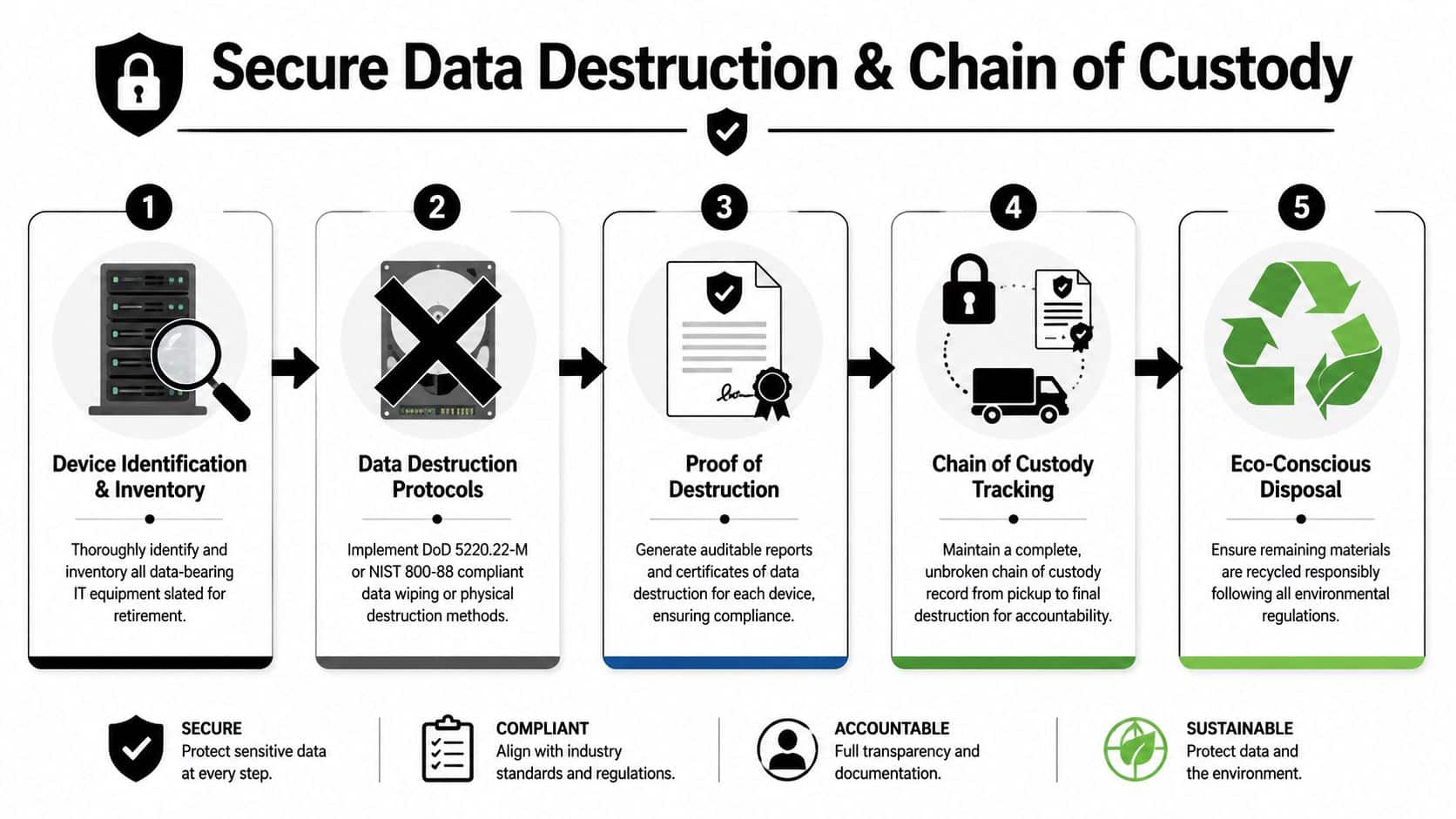
A compliant workflow used by secure Houston recyclers follows a strict sequence of secure on-site pickup, device-by-device inventory logging, data sanitization aligned with NIST 800-88 or DoD standards, and then testing for reuse potential, according to this secure recycling process overview. The same source notes that skipping serialized tracking is a major pitfall. That lines up with what experienced ITAD teams see in the field. If the asset trail is weak, the destruction paperwork becomes hard to trust.
Know what standard you're actually asking for
Buyers often ask whether a recycler is “DoD compliant” or “NIST compliant” without defining the result they need. In practice, the important question is whether the vendor can document the sanitization method used for the specific asset type and tie that method back to a serial-numbered inventory.
For business purposes, the distinction usually comes down to this:
- Data wiping: Appropriate when media can be sanitized and the device may be reused or remarketed.
- Physical destruction: Appropriate when policy requires destruction, media is damaged, or reuse isn't worth the risk.
- Device validation: Necessary for telecom and network equipment that may store configurations or credentials even when no traditional hard drive is obvious.
A factory reset isn't enough documentation for a regulated environment. It may be part of the technical process, but it does not replace auditable sanitization records.
Chain of custody is the real control
The phrase sounds legalistic, but chain of custody is operational. It answers four basic questions. What left the site? Who released it? Who received it? What happened next?
If a vendor can't answer those questions clearly, the project isn't under control.
Look for these elements in sequence:
| Control point | What you should expect |
|---|---|
| Site release | A pickup manifest tied to your inventory |
| Transport | Documented handoff and secure movement |
| Intake | Reconciliation between received assets and released assets |
| Processing | Device-level determination for wipe, reuse, repair, or destruction |
| Final documentation | Auditable records and destruction paperwork |
A certificate without a reconciled asset trail is just a nicer-looking gap.
That's why serialized tracking matters so much in IT equipment recycling telecom Houston projects. Houston organizations in healthcare, finance, education, and government don't need generic assurances. They need records that stand up when someone asks for them months later.
Ask for documentation before pickup day
One of the easiest ways to test a recycler is to request sample paperwork during vendor review. Ask for a sample asset manifest, a sample chain-of-custody report, and a sample certificate of destruction. You're not asking for marketing material. You're checking whether the provider's reporting format is detailed enough for your requirements.
What should a strong document package show?
- Serialized identification: Devices should be listed specifically when practical, not grouped into vague categories.
- Processing clarity: The report should distinguish wiped, destroyed, recycled, and reuse-eligible assets.
- Date and location details: You need to know when the handoff and processing occurred.
- Exception handling: Missing serials, damaged units, or inventory mismatches should be documented, not buried.
Match the method to the risk
Some IT managers assume every retired device should be shredded immediately. Others lean too hard toward reuse and underestimate security concerns. The right answer depends on the asset.
For example, a newer switch or firewall may be a candidate for controlled sanitization and value recovery if the process is documented properly. A failed drive from a regulated environment usually belongs in a destruction workflow. A mixed lot often requires both paths in the same project.
That's why the best recyclers don't force a single outcome. They follow a controlled sequence, preserve auditability, and decide disposition after identification and sanitization logic, not before.
Choosing a Certified Recycling Partner in Houston
Once your internal manifest is clean and your data requirements are defined, vendor selection becomes much easier. Not easy. Easier. The difference matters because a lot of Houston providers can say the right words. Fewer can back those words with current certifications, sample reporting, and a clear downstream process.
Houston operates inside a mature state and regional framework. The Texas Computer TakeBack Law was passed unanimously in 2007 and took effect on September 1, 2008, requiring computer manufacturers to offer free and convenient recycling, according to the City of Houston electronics recycling guidance. That same guidance also points to the regional role of the Houston-Galveston Area Council. For business buyers, the takeaway is simple. The local market isn't a loose, informal disposal channel. It sits inside an established recovery system.

What to verify before you approve a pickup
I'd start with documentation, not sales language. Ask every prospective vendor for current certifications, proof of insurance, sample manifests, sample destruction paperwork, and a written explanation of how they manage secure transport.
A practical screening list looks like this:
- Current certifications: Ask for actual certificate copies and confirm they're current.
- Secure logistics: Verify who handles pickup, transport, and intake, and how handoffs are documented.
- Downstream transparency: Require a plain explanation of where non-reusable equipment goes after first processing.
- Reporting capability: Make sure site-level and asset-level reports are available if your audit process needs them.
Some organizations also want a provider that can contribute to corporate messaging, not just disposal. That's where ideas like an internal eco-badge or a “recycled with purpose” designation can support ESG communications, but those features only matter if the underlying controls are solid.
Questions that expose weak operations
Most bad vendor fits show up quickly if you ask operational questions instead of broad ones. Skip “Are you secure?” and ask how the work gets done.
Use questions like these:
- How do you log devices at pickup?
- Are serial numbers captured onsite, offsite, or both?
- Which assets are eligible for wiping versus physical destruction?
- How do you handle routers, switches, servers, and firewalls that may store configuration data?
- What documentation do you provide after processing?
- How do you handle discrepancies between our list and your intake count?
What works: Vendors who answer with process steps, paperwork examples, and exception procedures.
What doesn't: Vendors who answer with reassurance and no artifacts.
Certifications matter, but fit matters too
A qualified provider still has to fit your environment. A school district retiring classroom devices has different logistics than a hospital clearing a secure equipment room. A multi-site office move is different from a data center shutdown. A telecom cleanup involving branch closets and handsets is different from a warehouse full of boxed endpoints.
That's why I pay attention to whether the vendor asks good questions back. If they want to know about dock access, building restrictions, serial availability, rack removal needs, or business-unit segregation, that's usually a sign they're planning the project seriously.
One option some organizations evaluate alongside local Houston firms is a certified electronics recycling company that handles business IT asset disposition, secure destruction, pickup logistics, and compliance-minded reporting for enterprises, schools, hospitals, and agencies. The point isn't geography alone. It's whether the provider can match your controls, reporting needs, and ESG expectations.
Red flags worth treating seriously
If I hear any of the following, I slow the review down:
- Vague destruction claims: “We wipe everything” without naming the method or documentation.
- No sample paperwork: If they can't show reports before pickup, expect problems after pickup.
- Opaque downstream handling: If they won't explain what happens after collection, assume you won't like the answer.
- Blanket scrap assumptions: Good gear shouldn't be destroyed just because evaluation takes effort.
Vendor selection in Houston shouldn't come down to who can arrive first. It should come down to who can prove control.
The Value Decision Remarketing Versus Destruction
Not every retired asset belongs in the shred stream. That's especially true for enterprise telecom and network equipment. Houston processors that handle this category note that functionality and component value can create residual financial returns, and that the better practice is to assess reuse potential before assuming an item is scrap, as described in this network equipment recycling overview.
The hard part is making that decision systematically instead of emotionally. Teams often default to destruction because it feels safer, or to remarketing because someone remembers what the device cost years ago. Neither instinct is enough.
Decision Matrix Remarketing vs. Destruction
| Consideration | Favors Remarketing | Favors Destruction |
|---|---|---|
| Asset condition | Functional, complete, and testable | Damaged, incomplete, or nonfunctional |
| Market relevance | Current or still-supported hardware | Obsolete or low-demand equipment |
| Data sensitivity | Sanitization can be documented and validated | Policy or risk profile requires physical destruction |
| Device type | Servers, routers, switches, firewalls, and some endpoints with reuse potential | Failed media, heavily regulated storage, or gear with unclear sanitization path |
| Business objective | Recover value and extend useful life | Eliminate risk quickly and document destruction |
How to think about telecom gear specifically
Telecom equipment sits in the gray area more often than buyers expect. A switch, router, or firewall may not look like a data-bearing endpoint to a nontechnical stakeholder, yet it can hold sensitive configuration details. At the same time, it may still have enough market demand to justify testing and graded resale.
That's why the right sequence is assessment first, then disposition. Not the other way around.
If an item is functional and the sanitization path is documented, remarketing may make sense. If the asset is broken, outdated, or tied to a policy that requires destruction, stop trying to squeeze value out of it. Destroy it, document it, and move on.
What buyers get wrong most often
The biggest mistake is using one rule for the whole lot. A mixed retirement batch usually needs mixed outcomes. Servers may split between reuse and recycling. Network gear may need configuration-aware sanitization. Drives may go straight to destruction. Monitors and peripherals follow a separate material recovery path.
A zero-landfill approach fits this logic well because it doesn't mean “save everything.” It means prioritize reuse where appropriate, then recycle the rest responsibly.
Transforming Recycling into a Powerful ESG Statement
Most companies still report retired electronics as an operations line item. That leaves value on the table. A well-run disposition program can support sustainability reporting, procurement narratives, employee engagement, and community-facing CSR.
The key is choosing a recycler whose process creates usable evidence. That means certificates, disposition summaries, and language your ESG team can readily include in reports. It also means the project should do more than remove waste. It should connect your company's technology lifecycle to a visible social benefit.
Why mission alignment changes the conversation
For many organizations, a mission-driven recycler offers a stronger story than generic e-waste pickup. If your retired equipment supports veteran aid and tree planting, your disposal event no longer ends with “equipment removed.” It becomes part of a broader corporate responsibility narrative.
That's where cause-based messaging can work without feeling forced. A campaign line such as “your old tech can house a veteran and grow a forest” gives employees and stakeholders a concrete way to understand the outcome. It also gives communications teams something more human than recycling jargon.
Make the documentation usable internally
A strong partner should provide records that support both compliance and outreach. Depending on the program, that may include a disposition summary, a plant-a-tree certificate, a veteran support impact report, or a digital badge your company can place on its site or sustainability page.
Those assets help in several places:
- CSR reporting: Sustainability teams can reference responsible retirement and community impact together.
- Recruiting and internal culture: Employees respond well to programs with visible local meaning.
- Seasonal campaigns: Veterans Day, Earth Day, and Arbor Day are natural moments for internal drives and public updates.
A lot of companies are already spending time on ESG reporting. Responsible electronics recycling can be one of the easier wins when the documentation is organized. If you're evaluating how the operational side supports that outcome, it helps to review the broader benefits of e-waste recycling through both a compliance and community lens.
What makes the message credible
The social story only works if the process is disciplined. Buyers are right to be skeptical of feel-good claims attached to weak controls. The mission has to sit on top of secure handling, not replace it.
When that foundation is there, though, recycling becomes more than a disposal obligation. It becomes a visible example of how your company handles technology responsibly from deployment through retirement.
Houston Telecom Recycling Frequently Asked Questions
Enterprise buyers in Houston usually ask the same small group of hard questions. They're the right questions, and a recycler should answer them plainly.
One reason this matters is that local market content often stops at accepted items and free pickup. That leaves a real trust gap. The Houston-Galveston Area Council notes a broader concern in its used electronics guidance: only 22.3% of global e-waste was formally recycled in 2022, which is one reason enterprise buyers increasingly want serialized audit trails, data sanitization details, and proof of responsible downstream handling.
What happens to telecom gear after pickup
A good answer should include intake, tracking, sanitization, testing, and final disposition. If the vendor can only say “we recycle it,” that's not enough. You want to know whether routers, switches, servers, phones, and related devices are logged individually, whether data-bearing components are sanitized or destroyed, and whether the material goes into documented downstream channels.
Who is liable if data is found later
This depends on your contract, internal policy, and whether the recycler followed documented procedures. From a practical standpoint, the best protection is a complete asset trail. If the device was identified, released properly, tracked through handoffs, sanitized under a documented standard, and covered by destruction paperwork where required, your position is much stronger than if the project relied on trust and bulk counts.
Ask vendors to explain liability in terms of process control, not just contract language.
Should wiping happen onsite or offsite
Either can be appropriate if the process is controlled and documented. The more important question is whether the vendor can show how media is secured before sanitization, who logs it, what standard is used, and how proof is delivered. Some organizations prefer onsite activity for visibility. Others are comfortable with secure transport and offsite processing. The right choice depends on policy and risk tolerance.
What documentation should we require
At minimum, require a pickup manifest, chain-of-custody records, and final destruction or disposition reporting. If your environment is regulated, ask for sample documents before you approve the project. A mature vendor shouldn't struggle to provide them.
Is free pickup enough reason to choose a vendor
No. Free pickup may be useful, but it's not the core decision factor. Data protection, certified processing, downstream transparency, and usable reporting matter more than whether the truck fee appears as a separate line item.
If your team is planning a Houston office move, telecom refresh, server retirement, or broader IT asset disposition project, Atlanta Green Recycling is one option to review for business electronics pickup, secure data destruction, compliance-minded reporting, and mission-driven recycling programs tied to veteran support and tree planting. The right next step is to compare documentation, chain-of-custody practices, and reporting quality before any equipment leaves your site.