
Secure Telecom Equipment Disposal Near Me


If you've searched for telecom equipment disposal near me, you're probably not looking for a generic drop-off box. You're looking at a pile of retired routers, switches, handsets, servers, access points, modems, cables, and backup gear that's been sitting in a closet, storage room, or data center cage too long.
For most Atlanta organizations, that pile creates three immediate problems. First, old telecom gear often still holds business data. Second, disposal rules are stricter than many teams realize. Third, nobody on your staff wants to coordinate packing, pickup, chain of custody, and final documentation on top of everything else already on the calendar.
Handled well, telecom disposal does more than remove clutter. It protects your organization, supports your sustainability goals, and can create visible community impact. That's the significant opportunity behind responsible end-of-life management.
Your Guide to Telecom Equipment Disposal in Atlanta
Atlanta IT managers usually encounter telecom disposal the same way. A network refresh finishes, an office move starts, or a phone system upgrade leaves shelves full of retired equipment that nobody wants to touch twice. The question isn't whether the gear still has value. The first question is whether it still has risk.
That concern is justified. The world generated 62 million metric tons of e-waste in 2022, and only 22.3% was formally recycled. Telecom equipment is a meaningful part of that stream, and reports indicate that up to 70% of improperly disposed e-waste can lead to data breaches according to telecom e-waste disposal data summarized by Reworx Recycling.
When companies search for telecom equipment disposal near me, they usually need more than recycling. They need a process that covers:
- Secure handling: Network devices can retain configuration files, credentials, call records, and internal business information.
- Operational relief: Someone has to sort, palletize, remove, and document everything.
- Compliance support: Hospitals, schools, government offices, and enterprise IT teams need audit-ready records.
- A meaningful outcome: Disposal shouldn't end with a vague promise that the equipment was “taken care of.”
That's why this work has shifted from waste removal to business process. A practical telecom disposition program should include secure collection, documented downstream handling, and reporting your team can use. For local organizations that want a service overview, telecom recycling solutions in Atlanta is a useful starting point.
There's another layer that matters to many companies now. Disposal can serve a public-facing purpose when it's tied to ESG and CSR reporting. Teams that are refining their local visibility often pair operational initiatives like e-waste recycling with broader online local business marketing so their sustainability actions don't stay buried in an internal spreadsheet.
Old gear shouldn't become a lingering security project. It should move through a documented chain, leave your site on schedule, and produce records your team can stand behind.
Beyond the Bin The Real Stakes of Telecom Disposal

A retired switch or firewall doesn't look dangerous. It looks inert. That's exactly why organizations underestimate it.
Telecom disposal has real business consequences because these assets sit at the intersection of security, environmental duty, and brand accountability. Once equipment leaves your building, your exposure doesn't disappear just because the hardware is out of sight.
Data security lives inside network hardware
A lot of teams still think of data destruction as a laptop issue. In practice, telecom gear can be just as sensitive. Firewalls, PBX systems, routers, servers, and network appliances often store user credentials, IP mappings, VPN settings, call logs, and internal architecture details.
Deleting configs or performing a quick reset isn't enough for regulated environments. What matters is whether the equipment was sanitized through a documented process and whether the recycler can prove it. If they can't, your old hardware is just a digital filing cabinet leaving the premises without a lock.
Practical rule: If a device touched your network, treat it as if it contains business records until verified destruction says otherwise.
Environmental compliance isn't optional
Telecom equipment also contains components that can't be treated like ordinary trash. Boards, batteries, displays, and internal materials may require controlled downstream processing. That's why disposal rules evolved well beyond “throw it in the bin and move on.”
The WEEE Directive of 2002 established telecom gear as priority waste in Europe, helping drive higher formal recycling. In the US, state laws such as those described for Georgia push businesses away from landfill disposal and toward certified providers, as noted in this overview of telecom recycling rules and disposal standards.
What works in practice is straightforward:
- Separate retired telecom assets early: Don't mix them into office cleanout debris.
- Use a documented chain of custody: Every handoff should be traceable.
- Confirm downstream handling: Ask where material recovery happens and how landfill diversion is managed.
- Match the process to the asset type: Network electronics, storage media, batteries, and cabling don't all follow the same path.
What doesn't work is informal hauling, mixed junk removal, or relying on a verbal assurance that “everything gets recycled.”
Corporate responsibility shows up in the details
Many organizations miss an easy win. Responsible disposal is operational, but it also becomes visible evidence of how a company handles risk and environmental stewardship. Procurement teams, compliance officers, sustainability managers, and executive leadership all care about different parts of the same record.
A telecom disposal project can support annual reporting, internal policy goals, vendor governance, and employee trust, but only if the process is auditable. A vague invoice from a hauler rarely helps. Certificates, inventory records, and clear destruction documentation do.
Here's the trade-off. The fastest disposal option is rarely the safest. The cheapest option is rarely the easiest to defend later. The vendor that asks the right questions up front usually causes fewer problems after pickup day.
Turn E-Waste into Hope Our Dual-Impact Model
A telecom cleanout usually starts with a practical goal. Free the room, retire obsolete gear, close the project. For companies with serious ESG targets, that same event can do more if the disposal partner is set up for it. Our model at Atlanta Green Recycling connects responsible equipment retirement to two visible outcomes: support for veterans and reforestation.
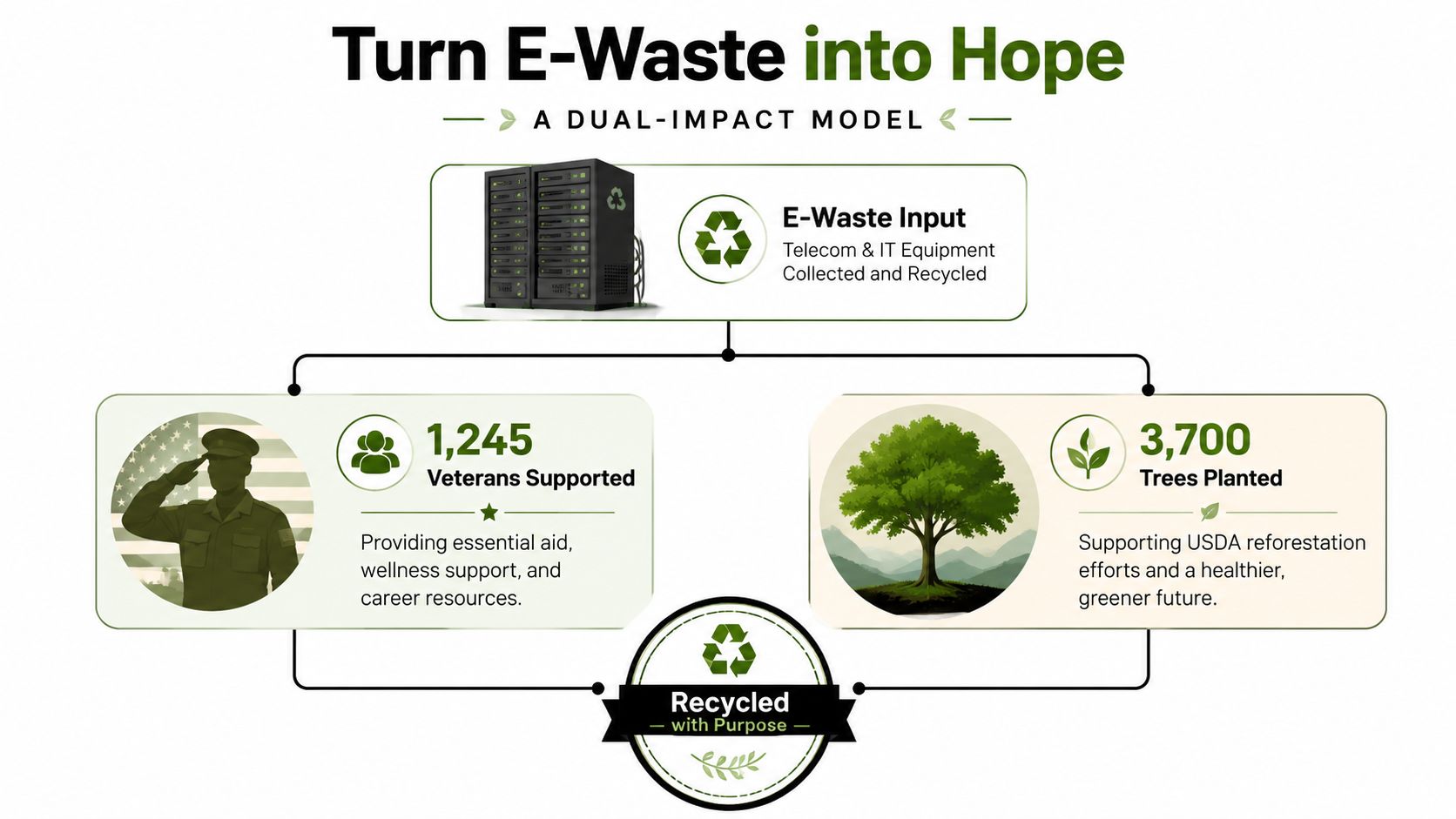
That matters because disposal is often treated as a closed-loop compliance task. Pick up the equipment, issue the paperwork, move on. Compliance still matters, and we never minimize that. But many corporate clients also want the project to reflect what the company says it values. The dual-impact model gives them a way to connect secure, documented disposal with community benefit people can recognize.
Why dual impact matters
Corporate ESG goals can sound abstract when they stay at the policy level. Employees hear about sustainability commitments. Leadership discusses social impact. Then a telecom room gets cleared out and the event disappears into an invoice file.
A better model ties the work to outcomes that are easy to explain and easy to report:
- Veteran support
- Reforestation
That is the point behind our motto: Your old tech can house a veteran and grow a forest.
For a corporate client, that message does real work. It gives HR a story employees will remember. It gives sustainability teams a concrete project instead of a broad intention. It gives leadership a cleaner way to show that asset disposition is part of ESG execution, not separate from it.
What measurable impact looks like
This only works if the impact is documented. Atlanta Green Recycling reports that its Recycle for a Cause program has supported over 1,245 veterans with essential services and planted more than 3,700 trees through reforestation partnerships.
Those numbers change the discussion inside an organization. A disposal project is no longer just a cost tied to decommissioning. It becomes a documented activity with social and environmental results that can support CSR summaries, internal communications, and stakeholder updates.
In practice, companies usually get value in three places:
- Employee participation improves because the project feels connected to a real mission.
- ESG and CSR reporting gets clearer because the outputs are specific and easier to reference.
- External communication gets stronger because the company can point to more than a generic recycling claim.
How companies put the model to work
The strongest results come when the disposal event is planned as both an operational task and a mission-based initiative. A scheduled pickup can support an office cleanout, an IT refresh, or a site consolidation. It can also give your internal teams something concrete to rally around.
Common uses include:
- Company recycling drives tied to retired telecom and IT assets
- Seasonal campaigns around Earth Day, Arbor Day, or Veterans Day
- Impact reporting tools that show veterans supported and trees planted
- Recognition materials such as certificates, summary reports, and shareable internal content
Many organizations that want to connect asset retirement with community impact start by reviewing the Atlanta business recycling program for corporate teams.
I advise clients to treat this as more than a feel-good add-on. It works best when the mission is attached to a disciplined disposal workflow, not used as a substitute for one. The social value is stronger when the operational side is already under control.
Why the message sticks
Technical disposal language rarely travels far inside a company. People outside IT may not care about equipment categories, resale hierarchy, or commodity recovery. They do understand what it means to help house a veteran and fund tree planting through responsible recycling.
That clarity has practical value. It helps internal launch emails get read. It gives communications teams language they can use without rewriting everything into ESG jargon. It also keeps the mission tied to something concrete instead of drifting into vague sustainability claims.
A network closet cleanout is easy to ignore. A disposal program that supports veterans, plants trees, and still meets the documentation standards your compliance team expects is easier to defend, easier to share, and easier to repeat.
Our Turnkey Process for Atlanta Businesses
A telecom disposal project usually breaks down when too many handoffs pile up. One vendor handles pickup, another does wiping, another processes scrap, and someone on your team is left trying to reconcile inventory against certificates weeks later. That's where delays, confusion, and audit headaches start.
The better approach is a single operational flow. Gartner projects a 25% rise in Atlanta-area data center retirements by 2026, and 70% of firms report logistics as their top barrier to proper e-waste disposal, according to Atlanta-area e-waste logistics data summarized by ShredTronics. That's why turnkey service matters so much in real telecom decommissions.
Step 1 Schedule and assess
The first step is simple. Build an asset list and define the pickup scope. Some organizations have a few pallets of retired telecom gear. Others are coordinating a full office move or data center reduction with racks, loose devices, and storage media all mixed together.
At this stage, useful questions include:
- What equipment is leaving the site
- Which assets may contain sensitive data
- Whether de-installation is needed
- How quickly the space needs to be cleared
- Who needs final documentation
For larger projects, free pickup thresholds can make planning easier, especially when multiple departments contribute equipment into one scheduled removal.
Step 2 Handle on-site logistics correctly
Good planning saves your internal team the most time, particularly with on-site logistics. On-site logistics often include labeling, palletizing, disconnecting gear, staging equipment for removal, and loading it into secure transport.
Companies routinely underestimate this part. A closet with “just old network gear” can take far longer than expected once you account for rack-mounted devices, tangles of patch cabling, UPS units, and mixed retired hardware from multiple refresh cycles.
The provider's own fleet matters because chain of custody starts at the dock door. If your team is evaluating process details, how business electronics recycling works in Atlanta gives a practical view of what a managed workflow should look like.
Step 3 Sanitize or shred data-bearing assets
For network gear, this is the line between disposal and risk transfer. Some assets can be wiped to recognized standards. Others should be physically destroyed because the device condition, media type, or security profile makes reuse inappropriate.
What works:
- Documented data wiping for suitable assets
- Physical shredding for obsolete or nonfunctional media
- Certificates of destruction tied to inventory records
- Clear segregation of data-bearing equipment from non-data-bearing scrap
What doesn't work:
- Factory reset as a disposal policy
- Unverified wiping
- Loose bulk handling before sanitization
- Missing serial-level records where required by policy
Step 4 Process equipment through responsible downstream channels
Not every asset follows the same path. Some devices may be reused or remarketed if they're eligible. Others move into parts harvesting or materials recovery. Nonrecoverable items should go through compliant recycling channels rather than landfill disposal.
Here's a basic equipment view teams often use during planning:
| Category | Examples |
|---|---|
| Network infrastructure | Routers, switches, firewalls, hubs, wireless access points |
| Telecom systems | VoIP phones, PBX equipment, modems, gateways |
| Data center gear | Servers, racks, blade systems, storage arrays |
| User and office tech | Laptops, desktops, monitors, printers |
| Cabling and power | Patch cables, structured cabling, power supplies, UPS units |
| Media and components | Hard drives, SSDs, backup media, boards |
A local option in this category is Atlanta Green Recycling, which handles business electronics pickup, secure data destruction workflows, de-installation support, and corporate reporting for organizations across the metro area.
The easiest disposal projects are the ones your staff barely has to manage after the initial inventory is approved.
Step 5 Close the loop with documentation
The final deliverable matters as much as the truck leaving your site. Documentation is what turns disposal into something your compliance, procurement, legal, or sustainability teams can defend.
A complete closeout package may include inventory records, pickup confirmation, certificates of destruction, and reporting your organization can use for internal policy files. If the project supports ESG or CSR initiatives, impact documentation becomes part of that record too.
That's the difference between “the stuff is gone” and “the project is complete.”
Make Your ESG Goals an Easy Win

Most ESG plans get stuck because they rely on large, slow initiatives that need budget, committee review, and a year of internal coordination. Telecom disposal is different. Your company already has the hardware. It already needs to leave the building. The opportunity is to make that routine task count for more.
For many organizations, this is one of the cleanest operational wins available. It combines security, sustainability, documentation, and community impact in a process that doesn't require changing your business model.
Why security belongs in the ESG conversation
Some teams separate security from sustainability. That's a mistake. End-of-life handling is governance as much as it is environmental practice. If retired network devices leave your control without proper sanitization, the issue isn't only ecological. It's also procedural and reputational.
Recent EPA-linked reporting states that 65% of e-waste data breaches stem from inadequately sanitized network devices. For regulated sectors such as healthcare and government, choosing a recycler that explicitly offers DoD 5220.22-M and NIST 800-88 compliant destruction is a core requirement, as summarized in this telecom recycling compliance overview from AVA Recycling.
That matters to ESG owners because governance claims need operational backing. If your sustainability report highlights responsible electronics disposal, your process also needs defensible data destruction.
What a company can actually use after the pickup
The best ESG-supporting disposal programs produce assets your communications, sustainability, and leadership teams can use without rewriting everything from scratch.
These are the outputs that tend to matter most:
- Impact reports: Useful for CSR summaries, internal updates, and year-end sustainability materials
- Certificates and chain-of-custody records: Useful for compliance, legal, procurement, and audit files
- Campaign-ready messaging: Helpful for employee communications around office cleanouts or refresh cycles
- Digital recognition tools: A “Recycled with Purpose” badge can fit naturally on a website, procurement page, or sustainability section
One practical framework for this lives inside a broader business sustainability strategy for electronics recycling, especially for organizations trying to align operations and reporting.
“We wanted one vendor process that our IT team, compliance group, and sustainability lead could all support. Once disposal produced both destruction records and impact reporting, the project became much easier to justify internally.”
Corporate recycling drives work because they're simple
Employee-facing sustainability programs often fail when they ask people to do too much. Corporate recycling drives work when the company handles the logistics and gives staff a clear reason to participate.
A strong program usually includes a scheduled pickup, internal communications, accepted-item guidelines, and post-event reporting that tells people what their participation accomplished. Around Veterans Day, Earth Day, or Arbor Day, that story gets even stronger because the campaign already has a natural context.
This is also where mission matters. A disposal event that clears storage space is useful. A disposal event that supports veterans and reforestation is memorable. Employees talk about it differently. Leadership presents it differently. Marketing can share it without sounding forced.
The easy-win test
If you're deciding whether a disposal initiative deserves executive attention, use a simple filter:
| Question | If yes |
|---|---|
| Does the equipment already need to be retired? | The project is operationally necessary |
| Does it reduce security and compliance exposure? | It supports governance goals |
| Does it divert electronics from landfill channels? | It supports environmental goals |
| Does it create a clear community outcome? | It supports social impact goals |
| Does it produce usable documentation? | It supports reporting and audit needs |
If you can answer yes down that list, you're not adding work for the sake of ESG. You're turning existing work into an asset.
Your Checklist for Choosing a Disposal Partner
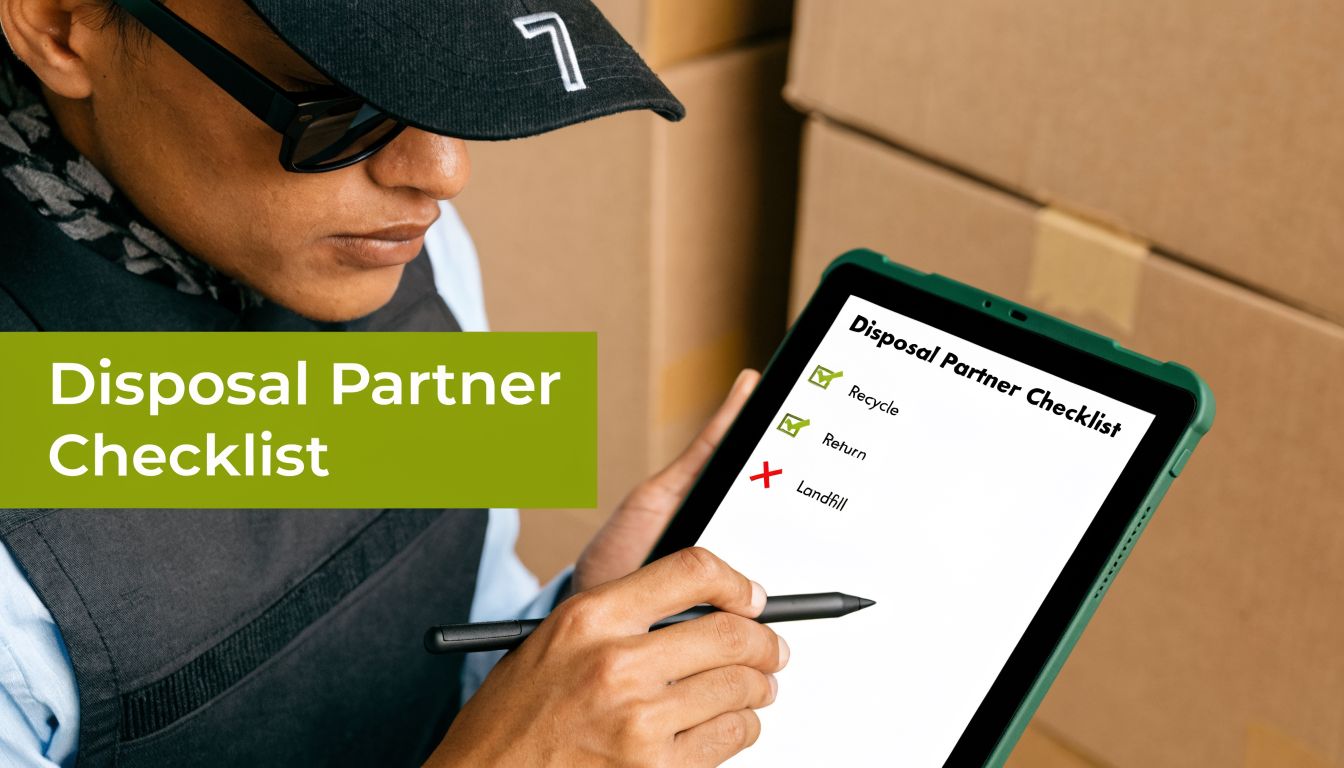
If you've compared vendors for telecom equipment disposal near me, you've probably seen broad promises that sound interchangeable. Secure. Sustainable. Compliant. Fast. Those words don't help much unless you know what to ask next.
A good vendor conversation should feel specific. If it stays vague, that's usually the warning sign.
Ask about certifications and standards
Start with the basics. Ask which certifications or documented standards shape the recycler's process. If they talk generally about “responsible recycling” but can't name recognized frameworks or documented destruction methods, keep digging.
Useful questions include:
- Which industry certifications do you maintain
- Which data destruction standards do you follow
- Can you issue certificates tied to the material removed
- How do you document chain of custody
You don't need a sales pitch. You need direct answers.
Test their logistics, not just their claims
A disposal partner can look strong on paper and still fail on pickup day. That happens when they outsource transport loosely, show up unprepared for de-installation, or can't handle mixed loads from offices, telecom closets, and server rooms in one visit.
Ask how they manage:
- On-site packing and staging
- Bulk pickups from active business sites
- Office moves and decommissions
- Tight building access or dock scheduling
- Inventory reconciliation after removal
If the vendor can't describe the physical pickup process clearly, they probably haven't done enough of this work in environments like yours.
Verify downstream transparency
Many buyers stop after the pickup question. That's too early. You also need to know what happens after the truck leaves.
Look for clear answers on:
- Material recovery: How do they separate reusable assets, scrap, media, and hazardous components?
- Landfill policy: Can they explain their diversion approach in plain terms?
- Documentation: What records will you receive, and when?
- Subcontracting: Which parts of the process do they control directly, and which are handled by downstream partners?
You're not being difficult by asking. You're doing the job your organization expects you to do.
Check whether they understand regulated environments
Hospitals, government agencies, schools, and enterprise IT teams don't all dispose of equipment the same way. A vendor that works well for a small office cleanout may not be suitable for a healthcare network or public-sector site.
Ask whether they've handled environments with:
| Environment | What to ask |
|---|---|
| Healthcare | How do you support HIPAA-oriented destruction documentation? |
| Government | How do you handle stricter custody and sanitization expectations? |
| Education | Can you coordinate bulk pickups across departments or campuses? |
| Data centers | Do you support staged decommissioning and rack-level removals? |
| Multi-site businesses | Can you standardize reporting across locations? |
Don't ignore the mission question
Most checklists stop at compliance. That's incomplete. If two providers can both handle secure removal, ask what additional value their process creates.
Does the disposal effort contribute to a larger social or environmental mission? Can they provide impact reporting that helps your organization communicate the outcome internally? Will the project produce something more meaningful than a recycling receipt?
That question matters because procurement decisions don't live in a vacuum anymore. Leadership teams want vendors who reduce risk and create visible value. When a disposal program also supports veterans, tree planting, and employee engagement, it becomes easier to defend, easier to repeat, and easier to share.
Partner with Atlanta Green Recycling Today
Telecom disposal doesn't have to stay stuck in the category of postponed facility work. When it's handled correctly, it removes security risk, supports compliance, clears space, and gives your organization a documented sustainability story that people can understand.
That's what companies are really looking for when they search telecom equipment disposal near me. They want a process that's secure, practical, and easy to manage. They also want confidence that old routers, phones, servers, and network hardware won't come back later as a documentation gap or avoidable exposure.
For Atlanta organizations, the strongest projects usually have four traits:
- The pickup is coordinated around business operations
- Data-bearing assets are handled through defensible destruction workflows
- Final documentation is clear enough for audits and reporting
- The outcome supports more than simple removal
A mission-driven model adds one more benefit. Your retired technology can do real work after it leaves your site. It can support veteran-focused programs. It can contribute to reforestation. It can give your team a cleaner answer when someone asks what happened to the equipment.
If you're planning an office cleanout, network refresh, telecom upgrade, data center reduction, or bulk IT removal, don't let the equipment sit until it becomes a bigger operational problem. Build a documented process now. Get the inventory moving. Close the loop with records your compliance team can use and impact your employees can feel.
Whether you need a pickup for a large batch of devices, a custom quote for a more complex decommission, or a better framework for ongoing end-of-life handling, the right next step is to start the conversation and define the scope.
Turn your e-waste into hope.
Need a secure, documented path for retired telecom and IT assets? Atlanta Green Recycling helps Atlanta-area organizations coordinate pickups, data destruction, responsible electronics recycling, and mission-driven impact reporting so old technology can support both compliance and community good.