
Who Buys Telecom Equipment in Houston? a Seller’s Guide


A network refresh usually ends the same way. The new switches are live, the phones have been cut over, the firewall stack is replaced, and someone is staring at a storage room full of old PBX hardware, routers, access points, handsets, patch panels, and loose circuit boards.
At that point, many organizations ask a simple question that hides a more important one. Who buys telecom equipment in Houston, and how do you sell it without dumping good hardware for scrap value, missing a data risk, or creating an audit problem later?
The practical answer isn't a list of names. It's a sorting problem. Some gear belongs with a remarketer. Some belongs with a broader IT buyback firm. Some belongs with a recycler. And some is only worth moving by commodity weight. If you want a useful baseline on secure end of life handling before you sell anything, review what IT asset disposition means in practice.
Your Houston Telecom Equipment Selling Guide
A Houston office move, carrier migration, or UC rollout often creates mixed piles of equipment. You might have working Cisco switches next to dead handsets, shelf pulls from a data closet, deinstalled voicemail modules, and a few racks of gear nobody wants to power back on. Treating all of that as one lot is where sellers lose money.
The better approach is to separate the inventory by functional resale value, parts value, and scrap value. That sounds obvious, but many organizations skip that step because they want the room cleared fast. Buyers know this. The first offer you get may be convenient, but convenience and best recovery don't always line up.
Houston gives sellers options. The city has a real secondary market for telecom and networking hardware, and that matters because mixed inventories can move through different channels depending on condition and asset type. In practice, the question isn't only who buys telecom equipment in Houston. It's which buyer type fits the specific equipment you have.
Practical rule: If a device is complete, identifiable, and power-testable, assume it may have more value than a by-the-pound offer suggests.
The other half of the job is risk control. Old telecom gear can still hold configuration data, call records, credentials, or storage media. Even if the resale value is modest, the compliance risk can be significant. Sellers who document chain of custody, sanitize data properly, and reconcile every serial number usually come out ahead, both financially and operationally.
Understanding the Houston Market for Used Telecom Gear
Houston is one of the stronger U.S. markets for telecom resale and liquidation because the buyer base isn't limited to one channel. It includes specialized reuse buyers, general IT buyers, and broad recycling outlets. That breadth matters when you're trying to move a mixed lot efficiently.
Houston telecom services and buyer channels make more sense when you look at the local ecosystem this way: resale sits at the top, component recovery sits in the middle, and scrap sits at the bottom.

Why Houston behaves like a mature secondary market
One useful signal is the local recycling density. ScrapMonster lists 214 scrap yards in Houston that accept telecom equipment, and its Houston market snapshot shows a telecom equipment price of $0.18/lb as of March 12, 2026, unchanged from March 5, 2026 according to this Houston market reference and buyer overview. On its own, that doesn't tell you what your router or PBX card is worth on the resale market. It does tell you Houston has an active floor for non-resale material.
That floor is useful because it frames the local decision correctly. If a buyer looks at testable switches, current access points, intact phone systems, or recoverable boards and still prices the whole lot like bulk metal, you're probably talking to the wrong channel.
What that means for sellers
Houston-specific listings also show firms buying used networking and telephone gear, not only scrap. The same market reference notes Houston firms such as GreenTek Solutions, which buys routers, switches, and access points, along with Clarus and EverTrade Electronics. That's a strong indicator that sellers can route equipment based on function and condition instead of assuming every retired telecom asset belongs in a recycler trailer.
A practical way to think about the Houston market is this:
| Asset condition | Best first outlet | Why |
|---|---|---|
| Complete and testable | Remarketer or IT buyback firm | Buyer can recover resale value |
| Incomplete but identifiable | Parts buyer or recycler | Component value may still exist |
| Damaged, obsolete, stripped | Scrap or commodity recycler | Value is based on weight and material recovery |
The Houston advantage is choice. Sellers can compare reuse, refurbishment, and recycling channels instead of defaulting to disposal.
That choice only helps if you sort the inventory before you quote it.
The Main Types of Telecom Equipment Buyers in Houston
Most sellers lump all buyers together. That's the first mistake. In Houston, the important distinction isn't local versus national. It's what the buyer gets paid to do with the equipment after they take possession.
Onsite telecom services in Houston usually intersect with three buyer categories. Each one values the same pile of gear differently.

Telecom remarketers and specialist buyers
These are usually the best fit for PBXs, VoIP phones, routers, switches, access points, servers, and circuit boards that are complete enough to identify and evaluate. They care about model numbers, installed modules, licensing context, cosmetic condition, and whether the unit can be tested.
A specialist buyer behaves like a classic equipment restorer. They're not buying metal first. They're buying functional inventory, service parts, or systems they can place back into the secondary market.
One example is RQ Communications, which explicitly buys used telephone equipment and networking equipment including telephone systems, voicemails, servers, telephone sets, circuit boards, cables, and complete system configurations as shown on its telecom equipment buying page.
General IT and networking buyback firms
These buyers overlap with the telecom specialists, but they're usually stronger with mainstream enterprise networking gear than niche telecom platforms. They often want recognizable networking products that fit broader IT refresh cycles.
GreenTek Solutions is an example of this profile. The verified market data notes that it buys networking switches, routers, and access points from major enterprise brands. If your inventory looks more like a network closet than a legacy phone room, this buyer type can be a better first stop than a telecom-only shop.
Scrap yards and electronics recyclers
This is the downstream channel for damaged, stripped, obsolete, or low-demand gear. They may still take a broad range of telecom hardware, but they're not assigning much value to whether the asset boots, passes diagnostics, or has resale demand.
That matters operationally. A scrap outlet is useful when you need compliant removal for equipment that has aged out of the reuse market. It's a poor first choice for a lot that still includes rack-ready gear, complete handsets, cards, or common enterprise switches.
A simple sorting lens
Use this before requesting quotes:
- Send to a remarketer if the gear is complete, labeled, and likely testable.
- Send to a general IT buyer if the lot is heavy on switches, routers, APs, and standard enterprise infrastructure.
- Send to a recycler or scrap outlet if the equipment is damaged, stripped, mixed with low-grade material, or no longer economical to test.
If you can't tell whether an item has resale value, don't ask for a scrap quote first. Ask a reuse buyer to reject it first.
That's the fastest way to avoid pricing functional gear as commodity waste.
How to Prepare Your Telecom Assets for a Successful Sale
The cleanest sales process starts before the first email goes out. Buyers price uncertainty conservatively. If your inventory is vague, your quote will be vague too, and usually lower than it needs to be.
Telecom recycling preparation and pickup planning gets easier when you treat the sale like a small decommissioning project instead of a cleanout.
Build an inventory that buyers can actually use
Start with the information that affects value:
- Make and model. “Cisco switch” is not enough. Buyers need the exact model.
- Quantity. Count every unit, even low-value handsets and spare cards.
- Condition. Note whether the item is working, untested, damaged, incomplete, or pulled from a live environment.
- Included components. Power supplies, faceplates, expansion cards, optics, rack ears, and handsets can affect whether the unit is resalable.
- Location and access details. Ground floor pickup is different from a staged removal from an active server room.
Photos help more than most sellers expect. A rack photo, a shelf photo, and close-ups of labels can shorten the quoting cycle and reduce repricing later.
Separate functional gear from dead gear
Don't force buyers to sort a mixed pallet mentally. Break the inventory into groups such as:
- Known working
- Pulled from service, untested
- Damaged or incomplete
- For recycling only
That one step changes the tone of the transaction. A buyer looking at a disciplined list sees lower handling risk. A buyer looking at “misc telecom stuff” assumes hidden labor and low recovery.
Treat data sanitization as non-negotiable
Many telecom sellers get sloppy because they think only laptops and servers hold data. Old telecom systems can retain user information, call logs, voicemail data, credentials, and configuration backups. Firewalls, unified communications platforms, and some switching and routing gear can hold more than people remember.
A proper process usually includes one of two paths:
- Software-based wiping for reusable storage media
- Physical destruction for obsolete, failed, or nonfunctional media
DoD 5220.22-M is still a familiar reference point in the market for hard drive sanitization, and physical shredding remains the fallback when reuse isn't practical. The right method depends on the media and the downstream disposition plan.
Remove “we already deleted everything” from your vocabulary. Deletion isn't sanitization.
Before pickup, identify any hard drives, SSDs, removable media, flash modules, or embedded storage that need handling instructions. If your buyer can't explain their chain of custody and destruction workflow clearly, keep looking.
Evaluating Offers and Maximizing Your Financial Return
The highest bid isn't always the best deal. In telecom liquidation, a quote can look attractive until you discover it excludes labor, packing, freight coordination, serial reconciliation, or data destruction.
That trade-off matters because the market has shifted away from simple disposal and toward structured liquidation, recovery, and secure handling. Sellers who focus only on top-line payout often miss the hidden cost of everything wrapped around that payout.

What a weak offer usually looks like
A weak offer often has one or more of these characteristics:
- Mixed valuation. Good assets and junk assets are blended into one low lot price.
- No service detail. The buyer doesn't spell out pickup scope, packaging, de-installation, or reporting.
- No data language. There's no clear statement about wiping, shredding, or certificates.
- Repricing risk. Terms leave wide room for “condition adjustments” after pickup.
Houston sellers asking who buys telecom equipment in Houston are often really asking whether any resale value remains after a refresh. That's the right question. A market guide discussing this issue notes that ScrapMonster's Houston listing showed a telecom equipment scrap price of only $0.18/lb in March 2026, and that this is far below functional resale value, which is why sellers should test the reuse market before defaulting to scrap according to this discussion of telecom buyer economics and the shift toward recovery services.
Compare total value, not just cash value
A lower cash offer may still be the better business decision if it includes the services you would otherwise have to buy separately.
Use this review grid:
| Offer element | Why it matters |
|---|---|
| Asset pricing method | Tells you whether buyer sees resale, parts, or scrap value |
| De-installation scope | Affects internal labor burden and project speed |
| Packing and logistics | Reduces handling errors and surprise costs |
| Data destruction process | Protects against security and compliance failures |
| Reporting and settlement detail | Prevents disputes and supports audit review |
The best buyers also understand event-driven sales. A move, merger, data center shutdown, or platform migration creates timing pressure. Good buyers plan around that. Weak buyers just ask when the pallets will be at the dock.
A bid is only “higher” if the buyer is assuming less work, less risk, or less accountability than the next bidder.
If you want maximum recovery, ask every buyer the same questions and compare complete scopes side by side.
Essential Documentation for a Compliant Transaction
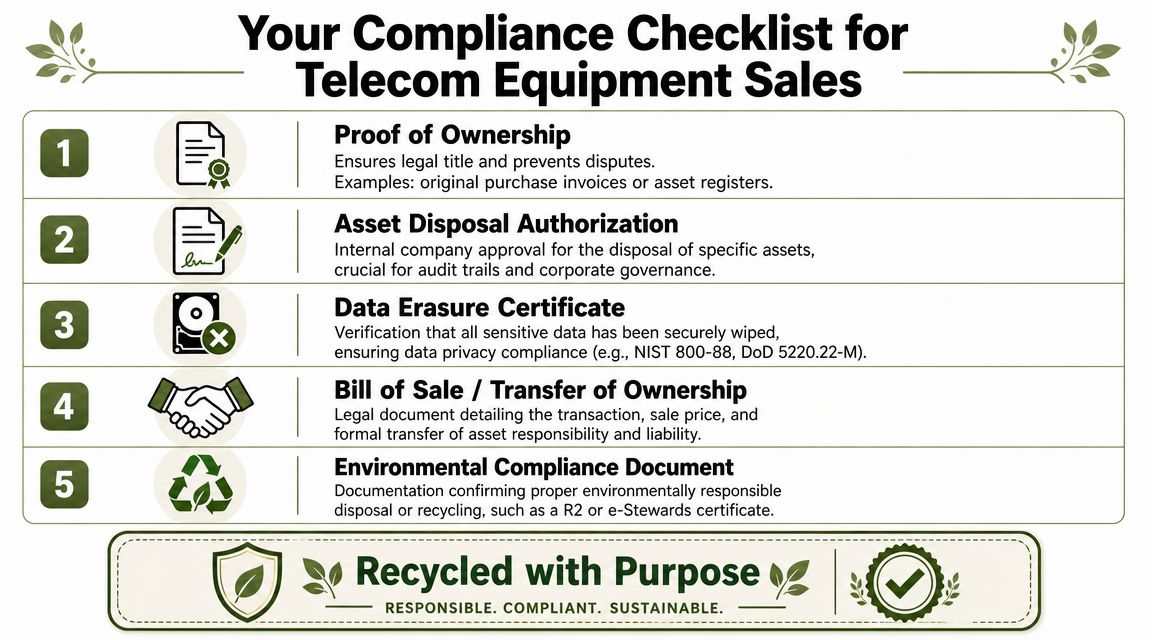
A compliant telecom equipment sale needs a paper trail from internal approval through final disposition. If the transaction ever gets reviewed by legal, finance, internal audit, or a regulator, “the buyer handled it” won't be enough.
The safest deals create a clean chain of custody that matches the inventory you approved for release.
The documents worth insisting on
Keep the file simple but complete:
- Proof of ownership or asset control. This can be an asset register, procurement record, or internal property record that shows you had authority to dispose of the equipment.
- Internal disposal authorization. Someone inside the business should approve the release. That protects IT staff and facilities teams from questions later.
- Bill of sale or transfer record. This should describe what changed hands and when responsibility transferred.
- Certificate of data destruction. If the lot included storage media or devices that could retain data, this is one of the most important documents in the file.
- Certificate of recycling or reuse. This supports environmental and policy compliance and helps close the loop for internal reporting.
- Final settlement report. It should reconcile the original inventory with tested quantities, accepted units, rejected items, and final payment.
What to check before you archive the file
Don't just collect PDFs and move on. Review them.
Look for consistency in serial numbers, pickup dates, quantities, and disposition categories. If the inventory you released doesn't match the settlement you received, resolve that before you close the ticket internally.
A strong settlement package should answer three basic questions:
- What left your control
- How data was handled
- What happened to each asset category
For regulated organizations, that level of detail isn't administrative overhead. It's liability control.
Your Next Steps Finding Buyers in Houston
At this point, the path is straightforward. Sort the inventory, decide which channel fits each asset group, and request quotes with enough detail that buyers can respond seriously.
If you're actively searching who buys telecom equipment in Houston, use search terms that match buyer intent rather than broad recycling terms. Better queries include:
- sell used network equipment Houston
- Houston telephone system buyers
- ITAD services Houston
- buy used PBX equipment Houston
- Houston telecom equipment liquidation
If the lot includes de-installation or staged removal, include that in the first outreach. Buyers price labor uncertainty quickly, and usually in their favor.
For organizations that need local support options, a useful starting point is reviewing telecom infrastructure companies near you and then separating them into resale, recycling, and service-heavy providers.
A simple outreach email template
Use something like this:
Subject: Houston telecom equipment available for quote
We have retired telecom and networking equipment available in Houston. The inventory includes model list, quantities, and condition notes.
Please provide:
- Purchase offer by asset category
- Pickup or de-installation scope
- Data destruction process and documentation provided
- Settlement timing and reporting format
Location:
Access conditions:
Preferred pickup window:
Inventory file and photos attached.
The final filter
Contact at least two or three buyer types, not just two or three companies that all do the same thing. A specialist remarketer, a broader IT buyback firm, and a recycler will see the same lot differently. That comparison is where most of the true value is found.
The sellers who do best in Houston usually aren't the ones who negotiate hardest. They're the ones who classify their assets correctly before the first quote lands.
If your organization needs a compliance-minded partner for business electronics recycling, secure data destruction, bulk IT pickups, or telecom equipment disposition, Atlanta Green Recycling is worth a look. They support companies with practical end-of-life workflows, including hard drive wiping to DoD sanitization standards, physical shredding for obsolete media, de-installation, logistics, and documentation that helps close the loop for audit and compliance teams. Their broader mission adds a cause-based angle as well, tying responsible recycling to veteran support and tree planting through a “Recycle for a Cause” model that fits well with ESG and CSR reporting.