
Best Telecom Company in Los Angeles: 2026 Buyer’s Guide


Your lease ends in Culver City. The new space in Burbank opens next month. Suddenly, the internet contract affects the move as much as the floor plan.
For Los Angeles businesses, connectivity choices show up in daily operations fast. Video calls break up with clients in Century City. Overnight backups stall in the Valley. Staff starts routing around a weak connection the moment the office gets busy.
The right provider depends less on brand recognition and more on how the business uses the connection. A law firm syncing large case files has different requirements than a retailer opening multiple locations on tight timelines. A production team moving media between offices has a different problem again. That is why a useful buyer process starts with use case first, then access type. Fiber, cable, and 5G each solve different problems in LA.
Local provider availability also changes block by block, building by building, and that matters more here than in many cities. A practical Los Angeles telecom services guide for business connectivity planning can help frame the options, but the ultimate decision usually comes down to address-level serviceability, installation timelines, contract terms, failover needs, and how much downtime your team can tolerate.
This guide focuses on the providers that business buyers in LA should compare in 2026. Furthermore, it explains where each one fits. Fiber usually makes sense for high-usage offices and multi-site operations that need stability. Cable often works for smaller teams that want lower upfront cost and faster installs. 5G can be a smart primary option for light-office setups or a backup connection when wireline lead times are too long.
That use-case view matters because “best telecom company in Los Angeles” has no single answer. The best option for a design studio in Santa Monica is not automatically the best option for a warehouse in Vernon or a medical office in Pasadena. The sections below compare the main providers through that lens, then close with a practical checklist to help you choose with fewer surprises after install.
1. AT&T Business
AT&T Business works well for companies that want one vendor for multiple access types. If you need shared fiber at one site, dedicated internet at another, and wireless lines for field staff, AT&T is usually easier to operationalize than stitching together three separate providers.
That matters more in Los Angeles than many buyers expect. Independent business connectivity listings identify AT&T as a leading provider of Ethernet Private Line services in the city, emphasizing broad coverage, solid infrastructure, and high reliability for secure data transfer in enterprise environments, as noted by Lightyear's Los Angeles Ethernet Private Line overview. For teams moving large internal datasets between offices, or connecting locations back to a central environment, that backbone quality matters as much as internet speed.
Where AT&T fits best
AT&T is strongest when your requirements go beyond “get me internet.” It's a solid fit for firms that need Business Fiber for everyday office use, AT&T Dedicated Internet for guaranteed bandwidth and SLA-backed performance, and mobility under the same account team.
I'd put AT&T high on the list for these situations:
- Multi-site operations: Businesses with offices, clinics, warehouses, or retail sites often benefit from one carrier that can support mixed access types.
- Wireline plus wireless planning: If your mobility plan and office internet need to work together, AT&T keeps procurement simpler.
- Uptime-sensitive workloads: Dedicated Internet makes more sense when voice, VPN, or cloud application performance can't swing with neighborhood congestion.
For broader local evaluation, it helps to compare providers alongside telecom services in Los Angeles that support different business footprints.
Where AT&T gets expensive
AT&T's product lineup is relatively straightforward, but the pricing gap between shared fiber and DIA is real. Shared fiber can be cost-effective for standard office use. Dedicated Internet is a different conversation and usually a budget line item you justify with uptime, SLA terms, and support escalation.
Practical rule: Don't buy DIA just because the phrase sounds more “enterprise.” Buy it when packet loss, jitter, or guaranteed throughput actually affect revenue or staff productivity.
AT&T also works best where you can qualify the serviceable address correctly on day one. In LA, suite-level eligibility can change the quote, available speeds, install timeline, and whether you're looking at fiber, dedicated access, or a workaround. If your business is moving into a multi-tenant building, confirm building access and demarc conditions before you sign anything.
2. Spectrum Business

Spectrum Business is often the practical answer when speed to install matters more than perfect symmetry. For a lot of LA offices, retail units, and service businesses, cable internet wins because it's already there, the install is faster, and the contract structure is easier to live with.
That's Spectrum's real value. It's usually not the provider you pick for the most elegant network design. It's the provider you pick when a new branch has to open soon, phones need to go live, and you can't wait on a fiber construction timeline that may or may not hold.
Best use cases for Spectrum in LA
Spectrum Business makes sense for common LA scenarios such as new office launches, temporary expansions, and straightforward SMB networks. If your workload is mostly cloud apps, VoIP, browsing, and moderate file transfer, Spectrum can be a clean fit without overbuying.
The main advantages are operational:
- Quick turn-up: Cable service is often faster to deploy than new-build fiber.
- Simple scaling: Moving from a lower business tier to a higher one is usually easier than renegotiating a custom enterprise circuit.
- Contract flexibility: Month-to-month structures are useful for short leases, temporary sites, or uncertain headcount.
For businesses comparing buildout options and local plant realities, it's worth reviewing nearby telecom infrastructure companies before assuming fiber is the better immediate answer.
What Spectrum doesn't do as well
The limitation is familiar. Upload performance on cable generally won't match fiber, and that matters if your office pushes large cloud backups, heavy media uploads, or persistent video collaboration across teams. If your users complain that downloads feel fine but outbound tasks drag, that's often the point where cable starts to show its limits.
Another issue is long-term predictability. Spectrum can be a good operational decision for a fast-moving business, but buyers should read renewal terms carefully and ask what the bill looks like after any introductory period ends.
Spectrum is often the right first connection for a location, but not always the right long-term connection once the site becomes core to your business.
If you're opening a storefront, service office, or branch with a short deadline, Spectrum belongs on the shortlist. If you run creative production, large nightly sync jobs, or heavy hosted infrastructure, test fiber options first.
Visit Spectrum Business in Los Angeles for address-specific availability.
3. Verizon Business (5G Business Internet)
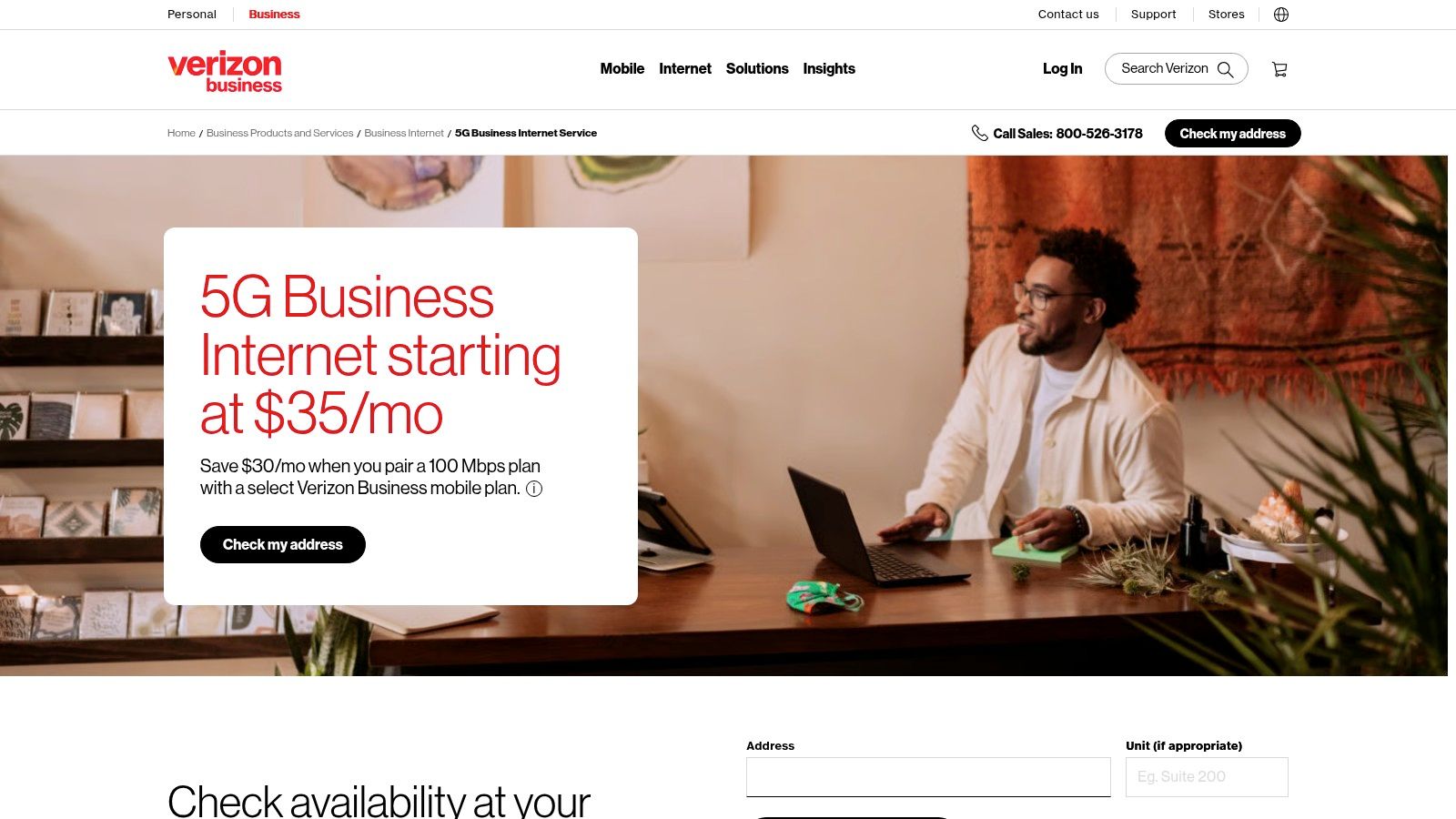
Verizon Business is the strongest 5G-first option for many LA buyers who care about fast deployment and mobile-network credibility. If your building delays wired installs, your team works from temporary locations, or you need a backup circuit that doesn't depend on the same local plant as your primary connection, Verizon's fixed wireless offer is easy to take seriously.
The larger market context supports that reputation. In Caliber's 2024 global telecom reputation study, Verizon posted a U.S.-leading Telecoms Leadership Score of 65, with AT&T at 65 and T-Mobile at 64, showing how tight the top tier is for major carriers rather than suggesting one runaway winner, according to Caliber's telecom reputation ranking. In Los Angeles, Verizon is also commonly framed as the strongest all-around mobile network choice for consistent coverage across dense urban areas and surrounding suburbs.
When Verizon 5G is the smart move
Verizon 5G Business Internet shines where trenching, landlord approvals, and construction coordination would slow a wired order to a crawl. It's especially useful for temporary offices, pop-up retail, field operations, and failover connectivity.
Use cases where Verizon is strong:
- Backup internet: A wireless failover path helps avoid a single point of failure tied to one wired provider.
- Rapid activation: Teams can get a site online without waiting for a full cable or fiber project.
- Mobility-led environments: Businesses already using Verizon for phones, tablets, and fleet connectivity may prefer one ecosystem.
If your stack also includes calling, mobile devices, and WAN policy, comparing unified communications providers in Los Angeles can help you decide whether wireless internet should sit inside a broader communications plan.
Where wired service still wins
Fixed wireless is not magic. Performance depends on local signal conditions, building materials, line of sight issues, and cell-sector load. In a clean deployment, Verizon can work very well. In a difficult building, it can become the circuit everyone blames first.
Field advice: Use Verizon 5G as a primary link when you've tested it at the exact suite, at business hours, with your actual apps. Use it as a backup when you haven't.
For latency-sensitive workloads such as hosted voice platforms, constant VPN use, and large bidirectional file movement, fiber still delivers a steadier experience. Verizon's 5G offer is best viewed as a speed-to-value and resilience tool, not an automatic replacement for every wired circuit.
You can review current options on Verizon Business 5G internet.
4. T-Mobile for Business
A common Los Angeles scenario looks like this: the lease is signed, staff start next week, and the building manager still cannot confirm when a wired install can happen. T-Mobile for Business fits that kind of rollout better than most wired options. For small offices, temporary spaces, and branch locations, speed of activation can matter more than getting the most predictable circuit available.
That use case is a key reason to consider T-Mobile. It is less about chasing top-end performance and more about avoiding delays tied to landlord approvals, riser access, aging internal cabling, or a long construction queue. In LA, those problems are routine.
Where T-Mobile makes business sense
T-Mobile works best when the priority is getting a location online quickly and keeping the monthly spend under control. That makes it a practical fit for a different set of buyers than fiber.
It is usually worth shortlisting for:
- Pop-ups, retail, and short-term leases: Fast setup matters when the space may change before a wired contract pays off.
- Small branch offices: A branch that mainly uses cloud apps, web tools, and light calling often does not need enterprise-grade wireline design.
- Temporary or transitional sites: Teams waiting on fiber construction can use T-Mobile as an interim circuit instead of delaying opening day.
- Secondary connectivity: As a backup path, it adds resilience without the cost and lead time of a second wired provider.
There is also an operational argument for it. Companies already standardizing on T-Mobile mobility may prefer one carrier relationship for phones, tablets, and business internet. That does not guarantee better network performance, but it can simplify billing, support, and device management.
Where the trade-offs show up
T-Mobile is still fixed wireless. Performance changes by block, by building, and sometimes by hour. In one LA suite, it can run well enough for cloud apps and voice. In another, coated windows, dense construction, or local tower load can turn it into a circuit users complain about every afternoon.
Technical teams should check a few things before treating it as a primary connection. Inbound networking requirements, VPN behavior, and application sensitivity all deserve testing at the exact site. Businesses with strict firewall policies or specialized equipment should review their setup against a Los Angeles telecom equipment buyer's guide before rollout.
T-Mobile is not the automatic answer for every office. It is the better fit when the business case centers on quick deployment, low friction, and acceptable performance for everyday workloads. If your LA location depends on stable upstream capacity, heavy file movement, or tightly controlled network behavior, fiber usually remains the safer choice.
See current service details at T-Mobile for Business Internet.
5. Frontier Business
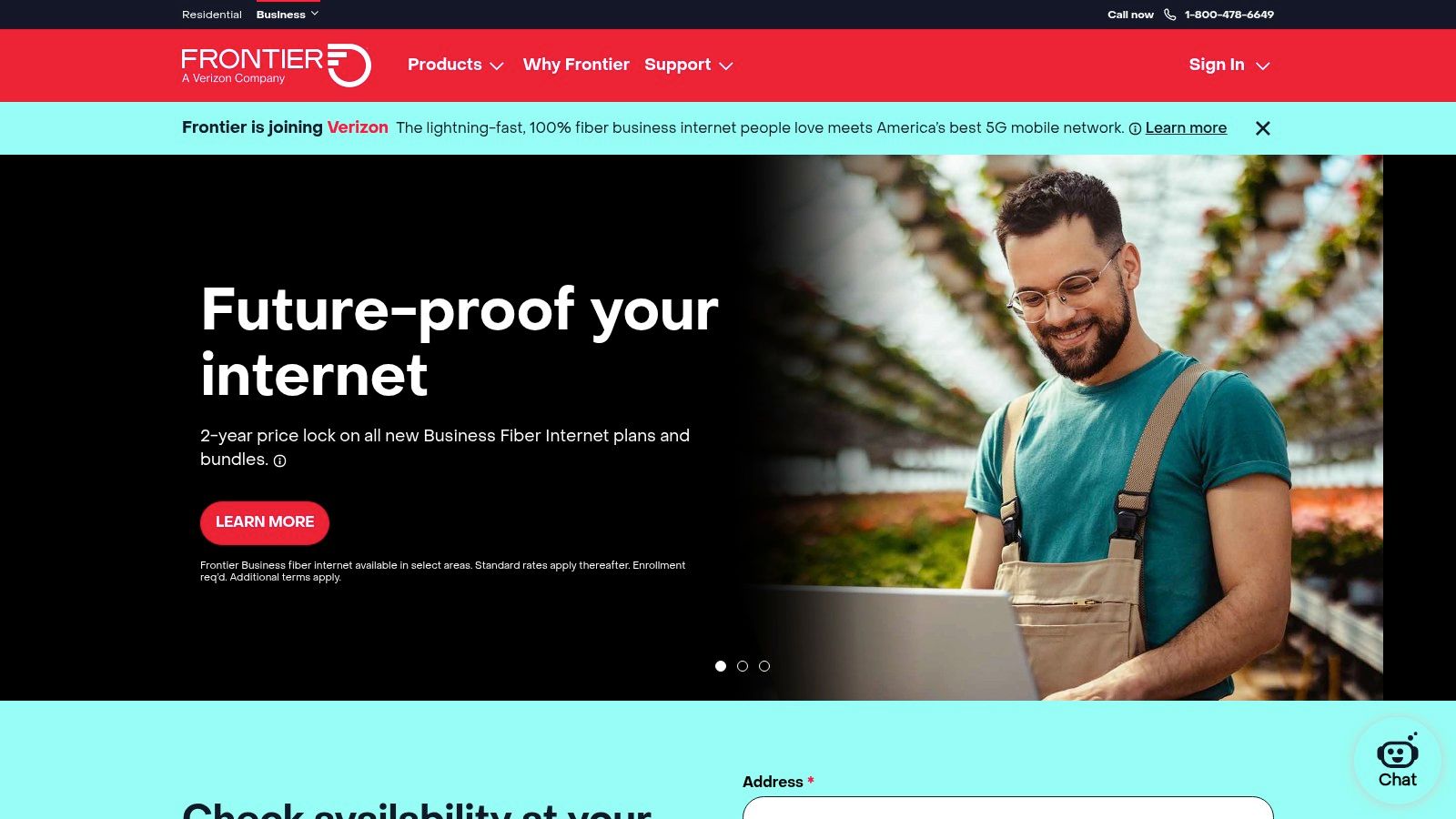
Frontier Business is the provider I'd check early if upload speed matters nearly as much as download speed. In real business use, that means cloud backups, large design files, hosted collaboration, remote desktop sessions, and VoIP environments that get unstable when the upstream side of the connection is constrained.
That's where symmetrical fiber changes the experience. Compared with cable, Frontier can be a better operational fit for businesses that push data out constantly rather than just pulling data in.
Why Frontier stands out
Frontier's business appeal is straightforward. When fiber is available at the address, it often delivers strong value for small and midsize offices that want symmetric performance without stepping into dedicated enterprise pricing.
Frontier is worth serious consideration for:
- Creative and media teams: Faster upstream capacity helps when staff send large assets to clients or cloud platforms.
- Voice-heavy offices: Symmetry tends to support more stable behavior under concurrent usage.
- Backup and sync workloads: Nightly replication and cloud storage jobs are less painful on fiber than on cable.
Address validation matters here more than brand reputation. Two businesses on the same boulevard can have very different Frontier outcomes depending on exact suite location and building readiness. If you're also replacing aging network gear during a move or upgrade, coordinate the connectivity plan with qualified telecom equipment buyers in Los Angeles and disposal partners so the project doesn't drag.
The catch with Frontier
Availability is the whole story. Frontier can be excellent where fiber is live and much less relevant where it isn't. Buyers sometimes waste time debating package differences before confirming whether the address is fiber-qualified.
Don't evaluate Frontier as a citywide answer. Evaluate it as an address-by-address fiber opportunity.
That's also why Frontier works best for businesses willing to do a bit of homework before signing. If the address qualifies and the building path is clean, it can be one of the better fiber values in LA for SMB use. If not, you'll need a fallback plan quickly.
Review current options at Frontier Business.
6. Cox Business
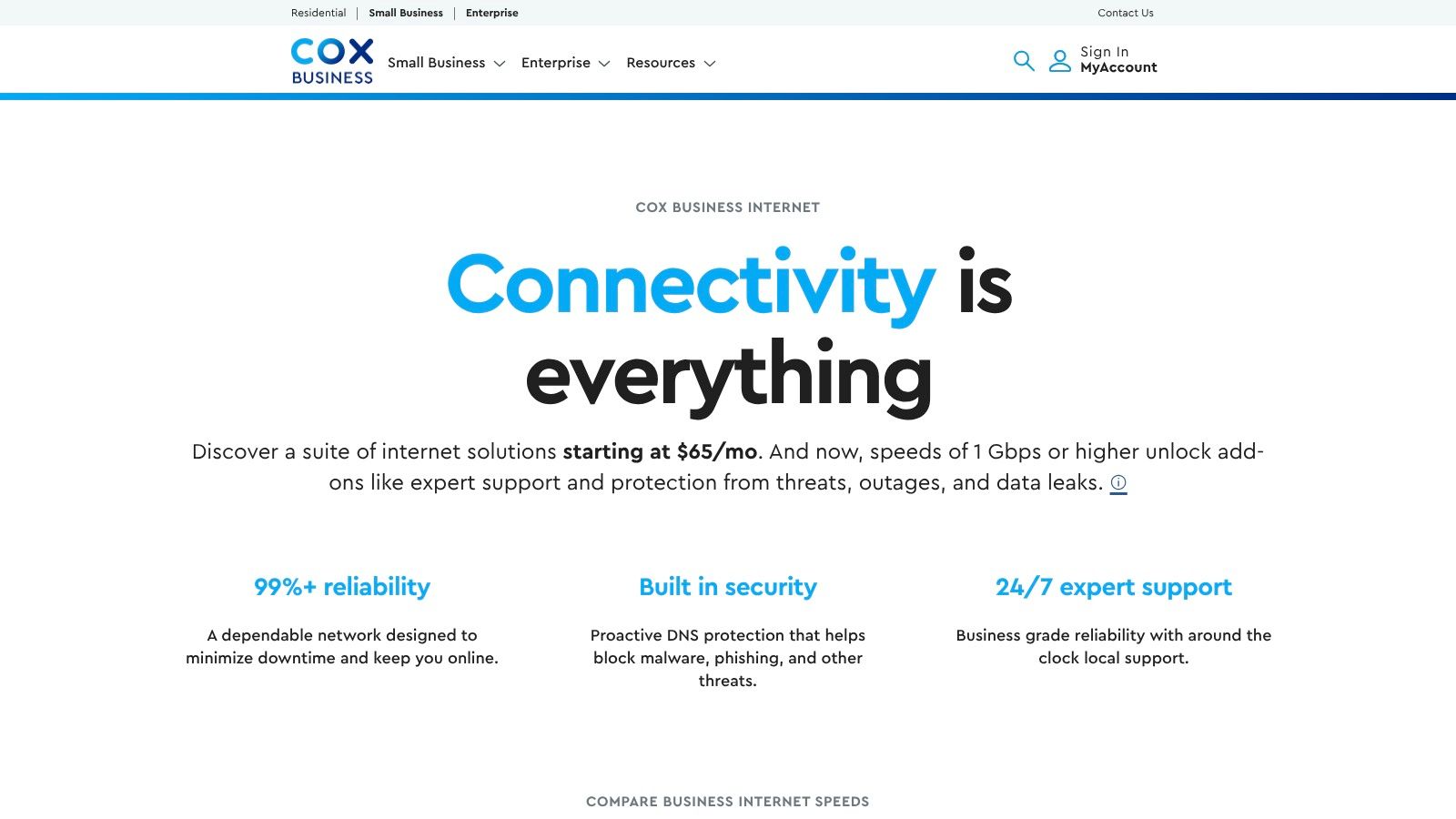
Cox Business is a niche LA-area recommendation rather than a citywide one. If your sites sit in portions of Los Angeles County that fall into Cox's service footprint, it can be a useful alternative, especially when AT&T or Frontier fiber isn't available and you still want business-oriented features like static IPs, managed Wi-Fi, and support options built for commercial users.
This is the kind of provider that matters because telecom buying is local down to the block. A company with a site in a legacy Cox area might get a very workable business service package, while another company a few miles away will have no Cox option at all.
Why some buyers should still check Cox
Cox is most relevant when your site is outside the strongest fiber footprints but still needs more than bare-bones broadband. Its business internet lineup, voice bundling, and backup options can suit branch offices, professional services firms, and local operational sites.
Situations where Cox can work well:
- Addresses in legacy Cox plant areas: Availability is the gatekeeper, but the product can be solid where it exists.
- SMB networks needing static IPs: This matters for certain remote access, camera, or line-of-business setups.
- Managed service preference: Some teams want Wi-Fi, voice, and internet from one business provider instead of assembling components themselves.
For organizations that operate in multiple metros and want consistency between markets, comparing providers against broader telecommunications service models used in other cities can help separate local constraints from purchasing habits.
What limits Cox in Los Angeles
The limitation is simple. It's not a citywide answer for businesses searching “best telecom company in Los Angeles.” You check Cox because your exact address may support it, not because it dominates the entire metro.
That's why Cox usually lands as a secondary option in procurement. It can be a good option. It's just geographically constrained, and that makes it less relevant for companies with broad LA coverage requirements or frequent location changes.
See current business plans at Cox Business Internet.
7. Tierzero
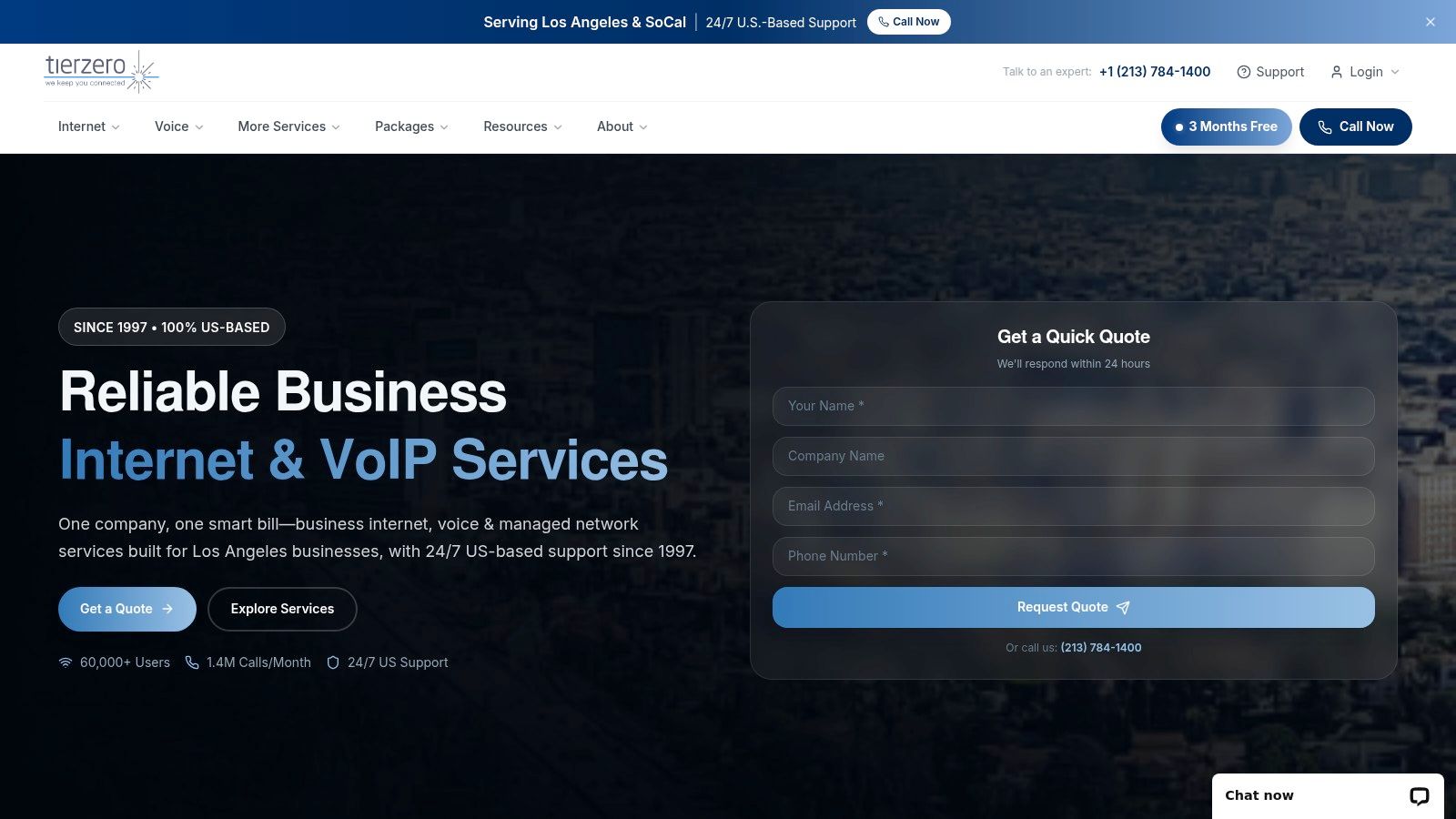
A common Los Angeles telecom problem looks like this. Your office is in a downtown high-rise or a dense commercial corridor, service is technically available from several carriers, but getting clear answers on install timelines, building access, voice setup, and fault escalation takes too long. That is where a smaller regional provider can make more sense than a bigger brand.
Tierzero earns attention because it is often evaluated differently from the national names on this list. The appeal is less about broad consumer recognition and more about execution for businesses that want internet, voice, and network support handled by a provider with local operating familiarity. For companies that care about response quality after the contract is signed, that trade-off is real.
Where Tierzero earns its place
Tierzero fits best when the buying decision is tied to a specific operating need, not just a speed tier.
I'd put Tierzero on the shortlist for:
- SMBs that want direct support contacts: A named account team usually reduces time spent re-explaining tickets and accelerates escalation.
- Businesses buying voice and connectivity together: Internet and VoIP from one provider can make troubleshooting faster when call quality issues overlap with network issues.
- Downtown LA offices and multi-tenant buildings: Local provider experience with building logistics, carrier rooms, and last-mile coordination can matter as much as raw bandwidth.
- Teams that value service accountability over national standardization: This is often the right fit for single-market firms, professional services offices, healthcare practices, and companies with a concentrated LA footprint.
That last point matters in Los Angeles. Fiber, cable, and fixed wireless each solve different problems, but provider fit also depends on how your team operates. If your business needs white-glove support, hosted voice, and a provider that can work through site-specific issues quickly, Tierzero can be a better match than a lower-touch option.
Where Tierzero is less compelling
Tierzero is harder to justify if your procurement model depends on nationwide consistency across many locations. Enterprises that want one master agreement, standardized installs across states, and a large national backbone will usually find the larger carriers easier to buy from and easier to align with internal sourcing rules.
It can also be a weaker fit if your primary goal is lowest-cost basic internet with minimal service layering. In that case, a mainstream cable or fixed wireless option may be simpler.
A practical buyer's check is straightforward. Ask whether your business is solving for price, speed to install, support quality, voice integration, or multi-site standardization. Tierzero tends to score best on the support and bundled-service side of that checklist, especially for LA-centered businesses that want a provider relationship, not just a circuit.
Visit Tierzero for current business service options.
Top 7 Los Angeles Telecom Providers Comparison
| Provider | 🔄 Implementation Complexity | ⚡ Resource Requirements | ⭐ Expected Outcomes | 📊 Ideal Use Cases | 💡 Key Advantages |
|---|---|---|---|---|---|
| AT&T Business | Moderate, fiber/DIA installs, multi-site coordination | Medium–High: fiber/DIA equipment; possible wireless bundling for promos | High reliability and bandwidth guarantees on DIA (SLA) | Multi-site enterprises needing unified access and mobility | Wide LA footprint; single-vendor for fiber, DIA and wireless |
| Spectrum Business | Low, fast turn-up, simple provisioning | Low: cable modem or available fiber at some addresses | Good throughput for downloads; asymmetric upload limits | Offices/retail needing rapid installs and month-to-month flexibility | Fast deployment and broad LA footprint vs niche fiber providers |
| Verizon Business (5G Business Internet) | Low, no-trench 5G install, quick provisioning | Low–Medium: 5G receiver; optional SD‑WAN/security appliances | Reliable fixed-wireless where 5G is strong; good failover | Temporary sites, rapid-deploy locations, backup circuits | Rapid deployment and enterprise-grade support/options |
| T‑Mobile for Business | Very Low, self-install gateway and fast provisioning | Low: self-install gateway; pairs with mobility plans | Cost-effective speeds; variable throughput by cell load | Small offices, pop-ups, retail, or backup where builds are slow | Competitive pricing and simple self-install promos |
| Frontier Business | Moderate, fiber build and address-specific provisioning | Medium: fiber handoff, sometimes included router (eero Pro 6) | Symmetrical speeds suitable for upload-heavy workloads | Offices needing cloud backups, VoIP and collaboration | Strong value for symmetrical upload speeds in served areas |
| Cox Business | Moderate, professional install; coverage limited to legacy plant | Medium: business modem, static IPs, managed Wi‑Fi options | Solid business features (static IPs, SLAs) where available | Locations within Cox legacy areas needing bundled services | Robust feature set and managed services in covered neighborhoods |
| Tierzero | Moderate, local provisioning and managed network services | Medium: managed hardware, local datacenter interconnects | High-touch support, low-latency interconnects for downtown LA | SMBs seeking personable local support and managed services | Local expertise, 24/7 US-based support and transparent packages |
Making the Right Connection for Your LA Business
A law firm in Century City, a retail chain opening a pop-up in Silver Lake, and a production team near Burbank should not buy telecom the same way. In Los Angeles, the right provider usually comes down to two things: what the site needs the network to do every day, and how much downtime the business can absorb when something fails.
That is why the best telecom company in Los Angeles is rarely a single winner across every category.
AT&T fits businesses that want one provider for fiber, dedicated internet, mobility, and larger multi-site networking. That matters for companies with several offices, regulated environments, or IT teams that would rather consolidate vendors than manage separate contracts for transport and wireless. The trade-off is that enterprise-grade options often come with more quoting complexity and a longer sales process.
Spectrum Business makes sense when speed to install matters more than getting the cleanest possible circuit design. For many LA offices where cable is already in the building, it is one of the fastest ways to get a location online. The trade-off is familiar. Cable can be a practical fit for general office use, phones, POS, and guest Wi-Fi, but fiber is often a better match for teams that push large files upstream all day.
Verizon and T-Mobile are strongest when the use case is clear. Fixed wireless can work well for temporary offices, retail locations, field operations, or backup connectivity that stays independent from the wired line serving the building. It can also work as the primary connection in some parts of Los Angeles. Still, buyers should test it under real conditions. Signal quality, building materials, and neighborhood congestion all affect performance in ways a coverage map will not fully capture.
Frontier is often the better value play when fiber is available and upload performance matters as much as download speed. Design firms, media teams, architecture offices, and businesses that live in cloud storage tend to notice that difference quickly.
Cox is more situational in Los Angeles because it depends heavily on footprint. Tierzero serves a different buyer altogether. It is a strong candidate for businesses that want local support, managed services, and a provider that understands downtown LA connectivity requirements without routing every issue through a national support chain.
A practical selection process is more useful than another generic ranking. Start here:
- Verify serviceability at the suite level. Building-level availability often hides construction delays, riser constraints, or demarc extension costs.
- Match the connection type to the workload. Fiber usually fits upload-heavy operations, cable often fits standard office use, and 5G fits rapid deployment or backup.
- Ask what can delay install. Landlord approval, conduit access, and inside wiring work can turn a fast quote into a slow project.
- Review support paths before signing. Know who answers after hours, who owns escalation, and whether onsite dispatch is included or outsourced.
- Decide on redundancy based on risk, not habit. A medical office, call center, or revenue-critical retail site usually needs a second path that does not rely on the same physical infrastructure.
The best choice is the provider that fits the business case at that address. For Los Angeles companies, that usually means evaluating fiber, cable, and 5G as different tools, not interchangeable products, then buying the one that best matches workload, install reality, and tolerance for downtime.
If your company is upgrading telecom, replacing network hardware, closing offices, or decommissioning IT equipment during a move, Atlanta Green Recycling can help you handle the retired gear responsibly. The company supports secure IT asset disposition, data destruction, pickups, and e-waste recycling for organizations that want a compliance-minded process with a mission-driven edge. Their brand stands out through cause-based recycling tied to veteran aid and tree planting, making old equipment disposal easier to align with ESG and CSR goals. For businesses that want recycling that restores lives and the environment, Atlanta Green Recycling offers a practical way to turn infrastructure change into measurable environmental and social impact.