
Unified Communications Providers Los Angeles: Top Picks 2026


Los Angeles businesses usually reach this search when they've already outgrown the patchwork. One app handles calls, another runs meetings, a third carries team chat, and nobody can tell whether dropped calls are a carrier issue, a Wi-Fi issue, or a user issue. The result isn't just annoyance. It's slower handoffs, inconsistent customer experience, and extra admin work for IT.
That's why unified communications providers in Los Angeles matter more than they used to. Unified communications is now a major enterprise category, with the global market estimated at USD 136.11 billion in 2023 and projected to reach USD 417.86 billion by 2030, a projected 17.4% CAGR from 2024 to 2030 according to Grand View Research's unified communications market analysis. For LA companies with distributed teams, client-facing staff, field employees, and multiple sites across the county, the question isn't whether to consolidate. It's which provider fits your workflow, support expectations, and compliance demands.
Cloud delivery has also become the default model. Mordor Intelligence estimates cloud deployments held 71.23% of the UC&C market share in 2025, with that segment projected to grow at a 26.99% CAGR through 2031 in its UC&C market report. In practice, that means most buyers in Los Angeles should evaluate identity controls, migration planning, mobile usability, and network readiness before they get distracted by handset catalogs and feature grids.
Below are the providers I'd put on a serious shortlist for LA. Some stand out because they're headquartered in the region. Others earn a place because they pair UC with connectivity, contact center, or stronger deployment options for larger environments.
1. Broadvoice
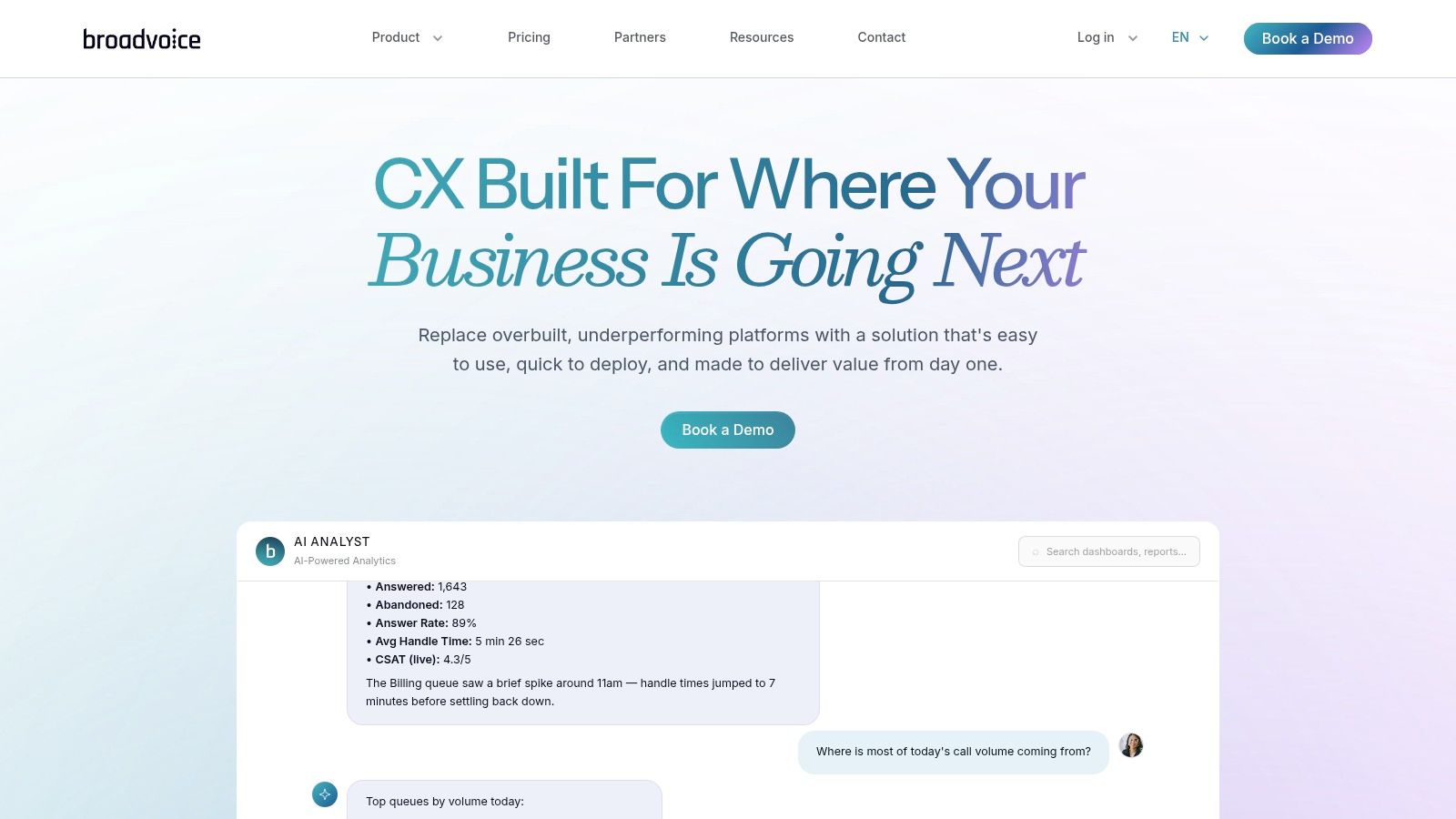
Broadvoice makes sense for LA companies that want a California-based vendor and don't want to decode a pricing mystery just to build an early budget. Its core UC platform, b-hive, covers the standard daily stack: desktop and mobile apps, messaging, softphone use, fax support, and business calling. It also gives buyers a path into contact center through GoContact, which matters if your front office and support team need to live in the same vendor ecosystem.
That local angle matters more than many buyers think. If your leadership team values regional familiarity, easier reference checks, and a provider that understands SoCal business environments, Broadvoice has an advantage over national platforms that feel remote from day one.
Where Broadvoice fits best
Broadvoice is strongest for organizations that want UCaaS now and may need contact center later. I like it for mid-market firms, professional services teams, healthcare groups, and customer-facing businesses that don't want to swap platforms again in a year.
A few practical strengths stand out:
- Transparent budgeting: Broadvoice is easier to model early because public seat pricing is available for the UC side.
- Channel mix: Native SMS/MMS and global extension dialing are useful if your teams bounce between internal chat, texting, and voice.
- Expansion path: GoContact creates a cleaner route for businesses that expect service or sales operations to grow.
For businesses comparing communications and carrier options side by side, this local guide to telecom services in Los Angeles is also useful context.
Practical rule: If you know you'll need call queues, omnichannel routing, or agent tooling within the next contract cycle, evaluate the UC product and the contact center product together. Don't buy the phone system first and assume the contact center will “just fit” later.
Trade-offs to watch
Broadvoice isn't the cheapest option in every scenario once you start layering in higher tiers, international needs, or contact center seats. GoContact is priced separately per agent, so the all-in monthly number can move higher than the initial UC seat estimate suggests.
I'd also verify exactly which features live in which tier before you sign. Broadvoice's value is strongest when you use the bundled platform intentionally. It's less compelling if you only need a basic phone replacement and won't use messaging, softphone, SMS, or future contact-center functions.
Visit Broadvoice.
2. AireSpring
AireSpring is one of the better answers when the underlying problem isn't just telephony. It's telephony plus network quality, branch connectivity, and vendor finger-pointing. Its UC offer centers on AirePBX with the MaX UC softphone, but the bigger story is that AireSpring also sells managed connectivity, including MPLS and SD-WAN, along with voice, SIP, and security services.
That's useful in Los Angeles because many businesses here operate across multiple sites, mixed building conditions, and hybrid work patterns that expose weak links fast. If your provider only owns the phone app, support gets messy the minute call quality degrades.
Why network plus UC can be the smarter buy
AireSpring works best for companies that want one accountable partner for both communications and the underlying transport. Multi-site healthcare groups, legal offices, logistics firms, and distributed office networks are the obvious fit.
The appeal is straightforward:
- Single-vendor accountability: When the same provider handles UC and connectivity, there's less room for support teams to blame someone else.
- Managed QoS path: Pairing UCaaS with managed network services can make call quality more predictable across sites.
- Operator experience: AireSpring has long-standing carrier DNA, which often shows up in deployment discipline and escalation handling.
If you're still mapping local options before narrowing to carriers and platforms, this resource on unified communications providers near me can help frame the field.
What I'd verify before procurement
AireSpring is usually a quote-led sale. That isn't automatically a downside, but it does mean procurement teams need tighter scope control. Ask for a line-item quote that separates seat licenses, connectivity, implementation, hardware, taxes, and any managed-service components.
Also check current handset and device policy documentation. Some public materials reference older guides, and that's a sign to confirm what's current before you standardize.
With providers like AireSpring, the contract review matters as much as the demo. The platform may be solid, but the real buying decision is whether the provider can own network performance end to end in your exact environment.
Visit AireSpring.
3. TPx (UCx with Webex)

TPx is a solid shortlist candidate for organizations that want a managed approach instead of a pure self-service SaaS model. Its UCx platform is built on Cisco Webex, so the user experience combines calling, messaging, and meetings in a single app, while TPx layers in managed security and connectivity services around it.
That package tends to resonate with lean internal IT teams. If your team doesn't want to become a phone-system specialist, a managed UC stack can be a better fit than buying a platform that expects you to assemble every piece yourself.
Who gets the most value from TPx
TPx is a good match for companies that already like Cisco's collaboration model or need stronger oversight across communications, connectivity, and security. Businesses replacing older on-prem systems often appreciate that TPx can package the operational side, not just licenses.
Its strengths are less about flashy novelty and more about operational coverage:
- Webex-based collaboration: Calling, meetings, and messaging live in one familiar environment.
- Contact center path: UCx Contact Center adds voice plus digital channels like chat, SMS, and WhatsApp, with CRM integration options.
- Managed layers around UC: Security and network services can sit under the same vendor umbrella.
For teams also comparing broader local business telecom stacks, this guide to telecom solutions for businesses near me helps put TPx in context.
The real trade-off
The trade-off is adoption friction. If your users already live in Teams or another collaboration tool all day, a move into a Webex-centered workflow can require deliberate change management. That doesn't mean it's a bad fit. It means the rollout plan should include user enablement, app standardization, and admin ownership.
Public pricing is also limited, so expect a sales process before you can compare true per-seat economics. That's common in managed service models, but it makes apples-to-apples comparisons harder if you don't force a detailed quote structure.
Visit TPx.
4. RingCentral
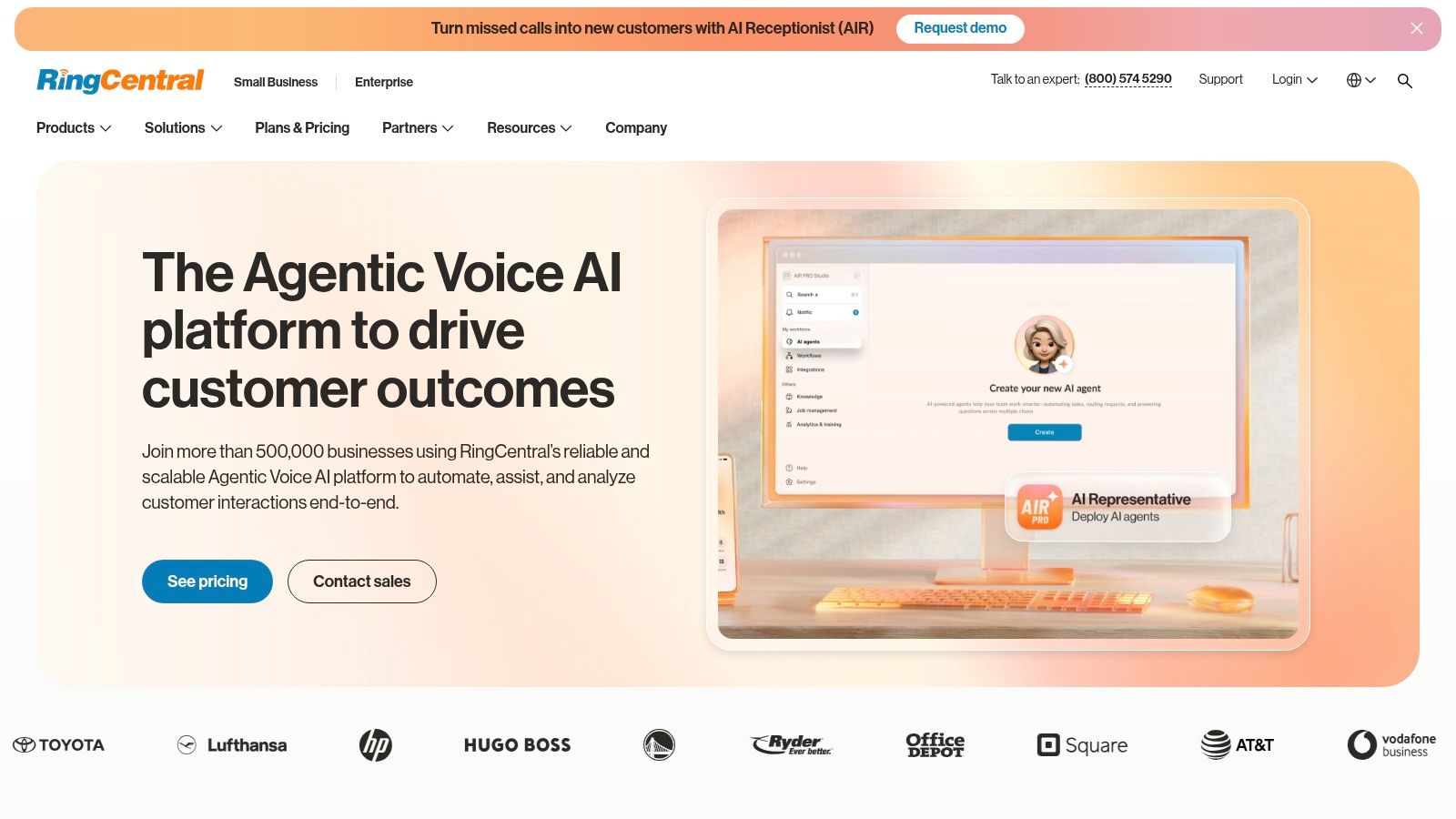
RingCentral is one of the safest picks for companies that want a mature UCaaS platform with broad ecosystem support. RingEX bundles cloud PBX, messaging, video, and SMS, and the admin layer is generally sufficiently capable for growing organizations that need policy control without moving into a separate enterprise telephony stack.
For Los Angeles buyers, one detail matters more than it gets credit for. RingCentral operates regional and geo-redundant data centers, including Los Angeles. For businesses that care about resiliency and regional performance, that's a practical advantage, not a marketing footnote.
Why RingCentral stays on so many shortlists
RingCentral works well for larger SMBs, mid-market companies, and enterprises that need a platform with broad integrations and mature PSTN options. It's also a reasonable fit when you expect the system to connect with CRM, support, identity, or workflow tools over time.
A few reasons it remains popular:
- Strong platform maturity: RingCentral has been through enough enterprise deployments that most common admin and routing needs are already accounted for.
- Integration depth: The app ecosystem is one of its biggest strengths.
- Regional resiliency: Los Angeles-area infrastructure supports buyers that want local performance considerations in the conversation.
If your project starts with replacing a legacy voice environment, this list of VoIP service providers near me is a useful companion.
Where buyers get surprised
RingCentral can get expensive once you move beyond the entry tier. That's the most common issue I see. Buyers compare base plans, then discover that the features they need live higher in the stack.
Some advanced functions also become available only at higher tiers, including certain recording options. So don't evaluate RingCentral by homepage pricing alone. Evaluate it by the actual configuration your supervisors, front desk staff, mobile users, and admins will need.
Visit RingCentral.
5. Spectrum Enterprise with RingCentral

Spectrum Enterprise is the option to consider when your organization wants RingCentral, but doesn't want to buy connectivity and UC separately. Spectrum packages RingCentral licenses with enterprise deployment services and can pair the platform with its own fiber and managed networking footprint.
In Southern California, that model is often attractive to multi-site organizations, public-sector teams, and larger enterprises that prefer master service agreements, centralized support, and one billing relationship.
Best fit for complex estates
This isn't usually the best path for a very small office that just wants inexpensive seats. It's stronger for organizations that think in terms of circuits, branch standardization, implementation governance, and support accountability.
The advantages are mostly operational:
- One-vendor structure: Connectivity and UC can be managed together under one contract path.
- Enterprise deployment support: Larger rollouts often benefit from a provider that's used to staged implementations.
- Helpful for distributed sites: Businesses with multiple offices across LA County often prefer one support chain.
For organizations still sorting out connectivity before they choose the voice layer, this guide to business internet providers near me is worth reviewing.
Read the commercial terms carefully
This offer follows RingCentral feature tiers, so the same caution applies. If your users need the higher-tier functions, your pricing will reflect that. Spectrum also tends to be quote- and contract-based, which means procurement should ask for explicit mapping between user types and license levels.
A practical concern here is migration ownership. Clarify who handles number porting, cutover sequencing, device staging, and post-launch support. The platform may be familiar, but the implementation quality will determine whether your team sees the move as a cleanup project or a disruption.
Visit Spectrum Enterprise.
6. Dialpad

Dialpad is the provider I'd put in front of teams that want AI to be built into the daily communication flow, not bolted on later. Its platform emphasizes live transcription, post-call summaries, sentiment signals, and call highlights across calling, meetings, and messaging.
That's especially appealing for sales teams, support organizations, and managers who want searchable conversations without buying a separate conversation-intelligence tool first. The interface is also cleaner than many legacy-first UC platforms, which helps with adoption.
Where Dialpad stands out
The biggest appeal is native intelligence inside the call experience. You're not forcing users into separate note-taking workflows or asking supervisors to chase recordings manually.
Dialpad is worth a close look if these needs sound familiar:
- AI in the core workflow: Live transcription and summaries reduce manual recap work.
- Modern user experience: The desktop and mobile experience is generally intuitive.
- Growth path beyond basic UC: Support, Sell, and Contact Center products create room to expand by function.
“What does migration really cost?” is the better buying question. Basic UC pages rarely answer porting, training, endpoint changes, Microsoft 365 or Google Workspace integration, and cutover risk clearly. That decision-stage gap is well summarized in Brightlio's discussion of business phone migration concerns in Los Angeles.
The caution on Dialpad
The risk with Dialpad isn't usually capability. It's scope drift. Teams get attracted by the AI value, then realize advanced analytics, contact center functions, or sales-oriented tooling may sit in separate products or SKUs.
That's fine if you budget for it upfront. It's frustrating if leadership thinks they're buying one unified package and finance later discovers multiple add-ons. I'd also walk through the pricing interface carefully and make the vendor translate every package decision into a clean written quote.
Visit Dialpad.
7. Zoom Phone
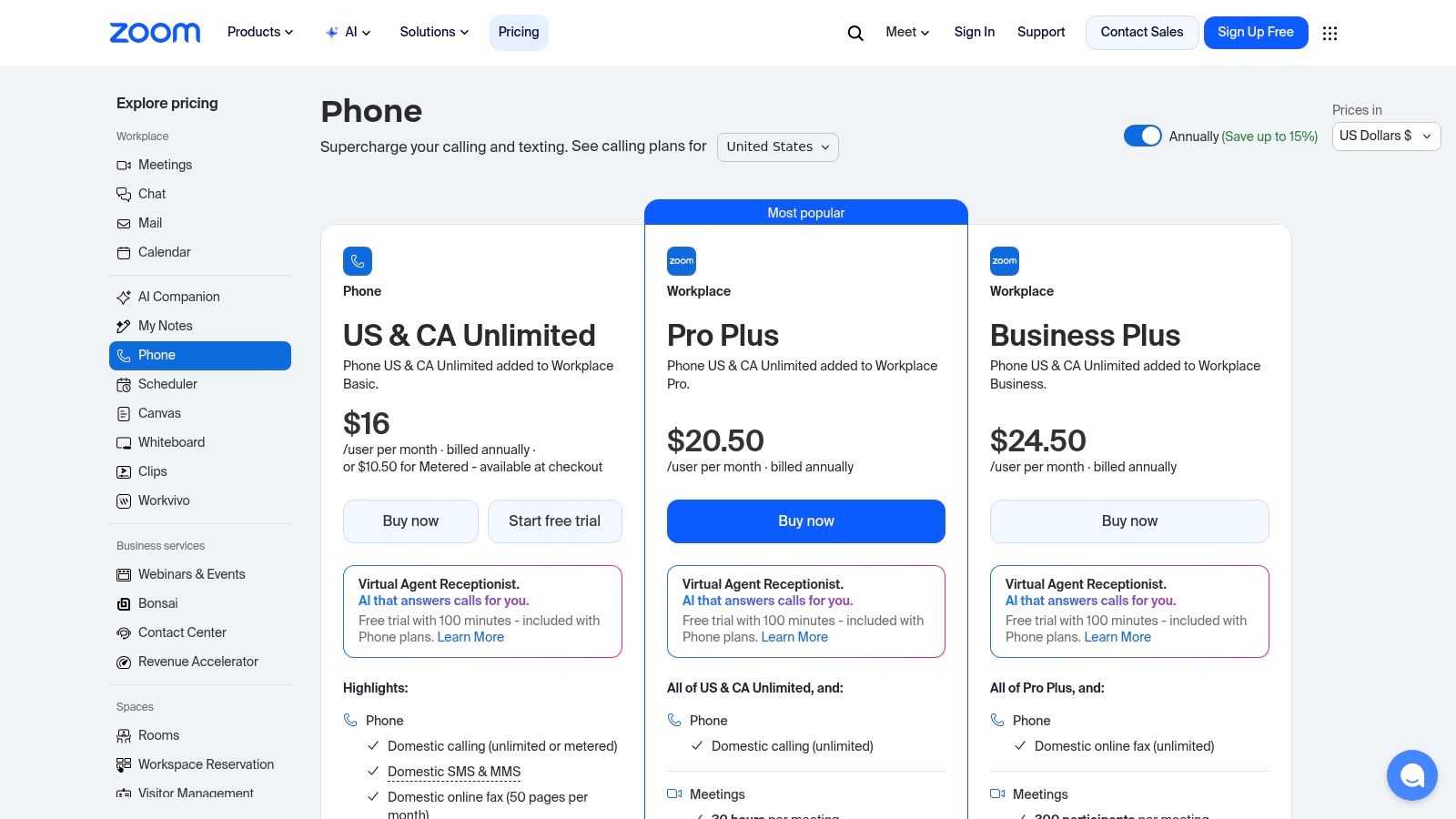
Zoom Phone is easiest to justify when your company already lives in Zoom Meetings. In that situation, the value proposition is simple. Keep the familiar interface, add cloud PBX, and bring calling, SMS/MMS, queues, IVR, and voicemail into a platform your users already know.
That reduction in change fatigue is real. For many organizations, training friction matters almost as much as features.
Best for companies already standardized on Zoom
Zoom Phone fits cleanly for firms that don't want a major collaboration reset. If your employees already spend most of the day in Zoom, adding telephony inside that environment can be a smoother transition than moving everyone to an unfamiliar app.
Core strengths include:
- Familiar interface: Existing Zoom users tend to adapt faster.
- Straightforward telephony essentials: Call queues, IVR, visual voicemail, and bring-your-own-device support cover common business needs.
- Bundle potential: Zoom Phone can sit alongside Zoom Workplace for a more unified app experience.
A broader guide to collaboration platforms is useful if your team is still deciding whether Zoom should remain the center of your collaboration stack.
Where buyers should slow down
Don't assume Zoom Phone is automatically the cheapest or simplest long term. Bundle rules, minimums, international options, and add-ons can change the total cost picture. You'll want to model your actual environment, not just the starting seat price.
Security and regulated use cases also deserve close review. One of the biggest weak spots in local search content around unified communications providers in Los Angeles is compliance depth. Basic feature pages rarely explain how vendors address HIPAA, public-sector procurement, retention policy, call recording governance, or audit logging. That gap is highlighted in TechTarget's coverage of unified communication product evaluation, and it's especially relevant for hospitals, schools, and government teams in Southern California.
LA Unified Communications: Top 7 Comparison
| Provider | Implementation complexity 🔄 | Resource requirements ⚡ | Expected outcomes ⭐ | Ideal use cases 💡 | Key advantages 📊 |
|---|---|---|---|---|---|
| Broadvoice | Moderate, UCaaS + optional CC add‑ons; separate CC pricing adds steps | Moderate, per‑seat UC, optional AI modules; standard admin effort | Unified UC + contact center from one vendor with transparent seat tiers | SMBs in CA wanting single‑vendor UC+CC and clear per‑seat pricing | Native SMS/MMS, LA HQ, optional AI, public seat pricing |
| AireSpring | Medium‑high, UC paired with managed MPLS/SD‑WAN integration | Higher, network deployment and ongoing managed connectivity | End‑to‑end QoS and reduced finger‑pointing on call quality | Multi‑site orgs needing managed network + UC and SLA accountability | Bundled managed connectivity + UC, decades of operator experience |
| TPx (UCx with Webex) | Moderate, Managed Webex stack plus security/connectivity services | Lower internal IT required; managed service model and enablement | Simplified operations with enterprise security posture and Webex UX | IT‑light teams wanting managed UC, security and optional CC | Managed UC/security bundle, Webex UX, regional experience |
| RingCentral | Low‑medium, Mature platform; features scale by tier (plan choice matters) | Scalable, from SMB to enterprise; may need higher tiers for advanced features | Reliable, enterprise‑grade UC with regional resiliency (LA DCs) | Organizations needing broad integrations and high availability in LA | Large app ecosystem, geo‑redundant data centers, 24×7 operations |
| Spectrum Enterprise (with RingCentral) | Medium, Contracted bundle of connectivity + RingCentral deployment | High, enterprise procurement, fiber deployment, single‑vendor project | Single‑vendor support and QoS with enterprise contract terms | Multi‑site enterprises/public sector in SoCal preferring one vendor | One‑bill model, Spectrum fiber footprint, deployment & support services |
| Dialpad | Low‑medium, Modern UI with embedded AI; some analytics sold separately | Low, easy deployment; add‑ons required for advanced CC/analytics | Improved agent productivity via built‑in real‑time AI features | Mid‑market teams prioritizing native AI and a clean UX | Strong native AI (transcript, highlights), intuitive interface |
| Zoom Phone | Low, Integrated into existing Zoom ecosystem; bundle details vary | Low, simple for Zoom‑standardized orgs; review license rules | Consolidated meetings + telephony in one app with competitive entry pricing | Organizations already standardized on Zoom seeking consolidation | Familiar Zoom UX, competitive pricing, bundles with Zoom Workplace |
Buyer's Checklist for Selecting Your LA Unified Communications Partner
A Los Angeles company can sign with a strong UC provider and still end up with a messy rollout. I see it when a Westside office has solid fiber, a warehouse in the Inland Empire is running on a weaker circuit, and hybrid staff are taking calls from home networks the IT team never tested. The platform is rarely the main problem. The buying mistake is usually a mismatch between the provider's delivery model and the way the business operates across Southern California.
Start with operating fit before brand preference. The UCaaS market is projected at USD 66.42 billion in 2025 and forecast to reach USD 276.9 billion by 2034, with North America holding 42.30% of the global market in 2025 according to Fortune Business Insights' UCaaS market report. Los Angeles buyers have plenty of credible options. A better buying question is which provider can support your sites, traffic patterns, compliance needs, and support expectations in this region.
The checklist I'd use before signing
- Define the service model you need: Decide whether you want a mostly self-service UC platform, a provider-led deployment, or a partner that can stay involved after go-live. In LA, that choice matters more for multi-site firms, healthcare groups, legal offices, and companies with small IT teams.
- Separate users by role before pricing starts: Front desk staff, mobile sellers, back-office users, supervisors, and contact-center agents should not be priced or configured the same way. Failure to do so often leads to overspending.
- Check local and regional performance: Ask where traffic is handled, what redundancy exists for Southern California, and whether the provider has regional data center presence or strong peering that benefits LA-area users. Providers with local headquarters or long operating history in SoCal often handle implementation and support with fewer surprises.
- Review network readiness site by site: Test headquarters, branch offices, warehouses, and home-based staff separately. One good office circuit does not mean your full deployment is ready.
- Handle compliance before procurement drags on: If you operate in healthcare, education, legal, finance, or public-sector work, ask for retention controls, admin permissions, recording policy options, logging, and data handling documents early.
- Ask for the full commercial picture: Get seat pricing, implementation fees, taxes and surcharges, porting scope, handset assumptions, support tiers, contract length, and add-ons in writing.
- Request Southern California references: Sales demos are polished. Reference calls from companies with similar locations and support expectations are more useful.
Disciplined scoping usually separates a smooth deployment from an expensive one. Group users by what they need to do, then match licenses, devices, call flows, and support levels to each group. That keeps the rollout lighter for users and cleaner for admins.
Treating everyone like the same user creates predictable problems. License costs climb. Training gets harder. Admin teams inherit features nobody needed in the first place.
Migration timing also deserves more attention than it gets. Fortune Business Insights cites a Masergy survey finding that about 97% of organizations said remote work increased interest in UC&C, while the broader UC&C market is projected to reach USD 181.84 billion by 2034 at a 10.7% CAGR in its unified communications and collaboration market overview. Companies are buying communications systems as operating infrastructure now, not just as phone service.
Buy the platform your admins can run, your users will adopt, and your compliance team can defend.
For LA businesses with offices spread across the basin, from Santa Monica to Downtown to Orange County satellite locations, a pilot is worth the time. Test softphones on office Wi-Fi, home broadband, and mobile data. Test queue behavior, voicemail delivery, SMS permissions, receptionist workflows, and supervisor reporting. A provider that knows this market will support that process and help define success criteria before the contract is locked.
One point buyers miss is cleanup after the cutover. Communications upgrades often leave behind desk phones, conference-room hardware, aging switches, retired PCs, failed drives, and other equipment that still needs secure disposition. The better-run projects plan both sides of the transition: deployment of the new stack and retirement of the old one.
Office acoustics matter too, especially if your team is shifting from desk phones to headsets and softphones. This guide to reducing workplace noise can help facilities and operations teams address call clarity issues that software alone will not fix.
When your communications upgrade leaves you with retired phones, obsolete IT gear, old conference-room equipment, or storage media that still carries business data, Atlanta Green Recycling helps you close the loop responsibly. The company supports businesses with secure electronics recycling, data destruction, hard drive sanitization, de-installation, logistics, and compliance-minded pickup programs. For organizations that care about ESG and community impact, Atlanta Green Recycling also brings a mission-driven angle to end-of-life IT management through veteran support and tree-planting initiatives, giving companies a practical way to align technology cleanup with sustainability and cause-based reporting.