
Find a Telecom Service Quote Near Me: A Pro Guide


You're probably in the middle of the same scramble I've seen dozens of times. A lease is ending, a branch office is opening, internet outages have become a weekly complaint, or finance wants a fresh round of pricing before renewal. Someone types telecom service quote near me into search, a stack of provider pages appears, and within a day your inbox fills with proposals that look similar until you read the fine print.
That's where control is often lost. One quote bundles installation into the monthly rate. Another shows a low recurring charge but leaves equipment, support, and construction vague. A third promises speed but says almost nothing about service response, escalation, or who owns the handoff when something breaks. The cheapest document on paper often becomes the most expensive service in operation.
The Search for a Reliable Telecom Provider
A local telecom search feels simple until the first quote lands. The provider says “business fiber,” another says “dedicated internet,” a third pushes a bundle with voice, Wi-Fi, and managed router support. All three claim they're the best fit. None of them are answering the same business question.
Part of the confusion starts with the market itself. The U.S. telecom market serves roughly 335 million people and is valued at over $118 billion, which means a local quote request sits inside a very large, mature service category where pricing and service quality can shift from one street to the next, as noted in telecommunications industry statistics. That's why a “near me” search doesn't just return local options. It returns different network footprints, different access methods, and different operating models.
When a junior IT manager asks me where to begin, I usually tell them to stop treating the search like a shopping cart exercise. Start by understanding the buyer's intent behind the request. Bare Digital has a useful explanation of the why behind every search, and it applies directly here. Some people searching for a telecom quote need emergency replacement service. Others need a multi-site contract, a compliance-ready rollout, or an advantage before renewal.
A telecom quote only makes sense when you know what problem the business is actually trying to solve.
That's why I don't start with provider logos. I start with the operational pain. Are dropped calls hurting sales? Is a clinic worried about continuity? Is a warehouse adding scanners and cameras? Is a law office tired of finger-pointing between carriers and IT vendors? Those are very different procurement paths.
If you're trying to sort local options without getting buried in generic sales copy, a focused list like telecom providers near your area can help narrow the field before you begin formal quote collection. The key is to treat that list as a starting point, not a decision.
Preparing Your Telecom Quote Request
Most bad telecom purchases begin before the provider replies. They start when the buyer sends a vague request.
“Need internet and phones for our office” is not a quote request. It's an invitation for every sales rep to build a different proposal, which guarantees an apples-to-oranges comparison. If you want useful pricing, you need a controlled request package.
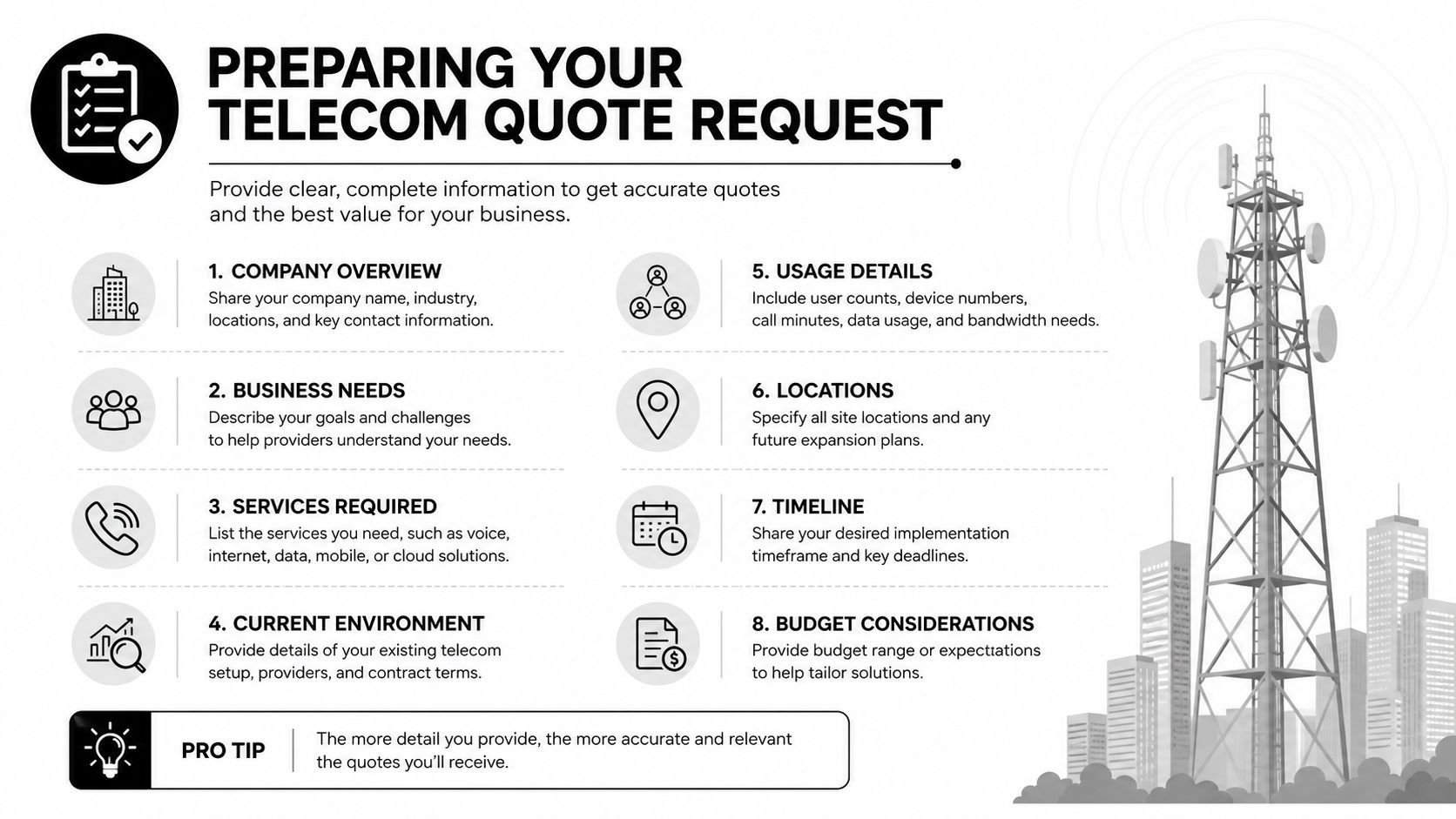
Build the request around the site, not the product label
Start with the physical service location. Exact address matters in telecom because availability changes by building, suite, riser access, and existing carrier presence. I've seen two businesses in the same complex receive very different options because one suite had prior fiber buildout and the other needed new construction review.
Then document what the location needs:
- Current services in place: list every circuit, voice service, managed firewall, and rented device you already pay for.
- User profile: note who works onsite, who works remotely, and where bandwidth spikes come from.
- Application demands: identify cloud systems, voice platforms, video usage, VPN reliance, guest Wi-Fi, and any always-on devices.
- Cutover tolerance: define whether the business can accept after-hours migration only, short downtime, or parallel service during transition.
- Support expectations: spell out escalation requirements and who owns vendor communication after go-live.
If you're comparing broader communications packages, this practical guide on how to compare business communication bundles is a good reminder that internet, voice, support, and hardware should be reviewed as one commercial bundle, not as isolated line items.
Identify the requirements providers usually try to infer
Providers will fill in blanks if you leave them blank. Don't let them.
Use a short internal checklist before outreach:
Bandwidth requirement today
Don't ask for “fast internet.” Ask for a service that supports the actual workload.Growth requirement over the contract term
If the office is adding staff, cameras, access control, or new cloud systems, include that in the request.Service level expectations
Define acceptable response times, outage handling, and whether uptime commitments need to be written into the agreement.Compliance and documentation
Healthcare, legal, financial, and public-sector teams often need stronger controls around access, retention, and vendor documentation.Equipment ownership preference
Decide whether you want provider-managed equipment, customer-owned hardware, or a hybrid.
For businesses that want a more guided option, a page covering managed telecom services near your location can be useful because it frames telecom as an operational service, not just a circuit purchase.
Check whether the site is unserved or underserved
This step gets missed all the time, and it can change the entire buying conversation. Broadband policy distinguishes between unserved locations, which lack 25/3 Mbps, and underserved locations, which lack 100/20 Mbps, according to Pew's summary of unserved and underserved definitions. That classification can affect whether a location qualifies for buildouts or subsidy-related opportunities that won't show up in a standard sales quote.
Practical rule: before you compare monthly price, confirm whether the address is being quoted as “best available service” or simply “currently marketable service.”
A location that looks expensive on paper may be waiting on infrastructure conditions that justify a different path. If you don't ask, the provider won't usually volunteer that distinction.
Finding and Vetting Local Telecom Providers
Once the request is clean, the provider search becomes much easier. You're no longer asking “Who sells internet near me?” You're asking “Who can deliver this exact service profile at this exact location, with support quality that matches the business risk?”

Don't rely on search rankings alone
Search results are useful for discovery, but they don't tell you how a carrier behaves after the contract is signed. I prefer a short list built from multiple sources: local business recommendations, landlord or building engineer knowledge, regional MSP experience, and direct provider conversations with a technical sales engineer present.
Here's what I look for early:
- Network fit: can they serve the address with the access method you want, or are they reselling someone else's last mile?
- Operational maturity: do they have a real implementation process, or are they improvising after signature?
- Local coordination ability: can they work with property management, riser access, and site contacts without constant babysitting?
A smooth sales call with a polished rep doesn't prove any of those things.
Vet the support organization, not just the circuit
The U.S. Bureau of Labor Statistics reports that the telecom industry employs over 46,000 customer service representatives, which is a useful reminder that service quality depends on people as much as infrastructure. The same BLS industry page also shows customer service wages in the sector, reinforcing that support, account handling, and service coordination are real operating functions, not afterthoughts. See the telecom industry staffing data from BLS.
What matters during vetting is how that support model reaches your account. Ask direct questions:
- Who handles onboarding after the sale?
- Is there a dedicated project coordinator?
- How are tickets escalated?
- What happens if billing and technical support disagree?
- Can they provide references from a business your size with a similar footprint?
Ask for one reference that recently installed service, one that has renewed, and one that has lived through a service issue. Those three conversations tell you more than a polished proposal ever will.
Use a practical due diligence screen
I like to separate provider review into three buckets.
Technical confidence
Can they explain handoff type, equipment responsibility, demarc location, and service restoration process clearly? If the answers stay vague, the implementation will too.
Commercial clarity
Does the provider issue a quote that maps cleanly to your request, or are they changing assumptions? Watch for silent substitutions such as lower upload speeds, bundled hardware you didn't ask for, or support tiers buried in the terms.
Security and governance
For regulated environments, ask how they handle access, documentation, and incident response. If they claim they work in healthcare, finance, or government, they should be able to explain the operational controls behind that claim without hand-waving.
The best local provider isn't always the one with the biggest footprint. It's the one that can prove it knows how to deliver and support the service you need.
Decoding the Quote Line by Line
Most procurement mistakes become evident. Two quotes can describe the same service and still carry very different long-term cost, risk, and support burden.
The first thing I teach new buyers is to split the quote into monthly recurring charges, non-recurring charges, and everything that sits in the gray area between them. If you don't force that separation, hidden cost moves around until the document looks cheap enough to sign.

What to isolate before comparing providers
Most telecom quotes include some version of these components:
- Monthly recurring charge: the core service fee for internet, voice, managed router, or support package.
- Non-recurring charge: installation, activation, site survey, cabling, construction review, or porting work.
- Equipment treatment: rented, managed, included for term, or customer-owned.
- Service terms: contract length, auto-renew language, upgrade path, and early termination exposure.
- Taxes and surcharges: often estimated loosely at quote stage and clarified later.
The danger is rarely one giant hidden fee. It's the accumulation of soft language. “As applicable.” “Subject to site conditions.” “Additional access charges may apply.” “Managed equipment required.” Those phrases aren't automatically bad, but they mean you haven't reached a final cost picture.
If you're evaluating access options, a focused directory of business internet providers near your location can help cross-check whether the quote you received reflects the actual local market.
Sample Quote Comparison
| Line Item | Provider A (Appears Cheaper) | Provider B (Appears More Expensive) |
|---|---|---|
| Monthly internet service | Lower advertised monthly rate | Higher advertised monthly rate |
| Installation | Listed separately with conditional language | Clearly defined and capped |
| Router/firewall | Added as rented equipment in fine print | Included as managed equipment |
| SLA terms | General support wording | Specific response and outage-credit language |
| Taxes and fees | Broad estimate with limited detail | Better itemization and assumptions |
| Contract exit | Stronger termination exposure | More workable change and exit terms |
| Implementation ownership | Sales-led, details deferred | Named project coordination process |
Provider A often wins the first meeting. Provider B often wins the second meeting, once operations, finance, and legal all read the quote.
Why the quote matters more than the brochure
Industry analysis reports that up to 85% of telecom invoices contain errors, and 12% to 20% of total telecom spend is often recoverable through systematic audits, according to this telecom cost management analysis. That matters at the quote stage because billing problems usually begin with unclear inventory, loose approvals, and weak contract-rate validation.
Here are the line items I challenge first:
Unnamed administrative fees
If the quote references administration, coordination, or network support charges without defining them, ask for plain language and billing treatment.
Equipment assumptions
Some providers price the circuit attractively, then recover margin through mandatory hardware rental and support packaging.
Change fees
Moves, adds, and service changes often become expensive when the original commercial framework is vague.
Approval thresholds
For multi-site buyers, require a process that flags charges exceeding the contracted rate. The source above notes a practical benchmark of flagging any charge above the contracted rate by more than 5%.
If a provider can't explain every recurring line item before signature, expect invoice disputes after activation.
A good telecom buyer doesn't just read the monthly number. They read the operating model that monthly number is funding.
Negotiation Tactics for Telecom Services
Telecom negotiation is rarely about pounding the table for a lower rate. The better move is to target the parts of the quote where the provider has room to give without undermining delivery.
A useful framing comes from service pricing discipline. Providers commonly build quotes by combining direct labor, indirect overhead, and profit, then adding a 10% to 20% contingency buffer for scope creep or unplanned work, as discussed in this pricing workflow for service quotes. Once you understand that structure, you stop negotiating blindly.
Ask for concessions where they can actually move
I usually push on these areas first:
- Installation and activation charges: these are often more flexible than the recurring service rate.
- Managed equipment terms: ask whether hardware rental can be reduced, included, or replaced with customer-owned gear if that fits your environment.
- SLA language: stronger outage credits or response commitments can be more valuable than a small monthly discount.
- Rate protection: if the provider wants term commitment, ask for pricing stability over that term.
- Implementation detail: get site survey, project coordination, and cutover ownership written down.
The key is specificity. “Can you do better?” gets weak results. “Can you waive the activation charge, include managed router support, and confirm service credit terms in the order form?” gets a real answer.
Use competition carefully
Competing quotes help, but only if the services are matched. Don't tell a provider they lost on price when the other proposal included a different access method, weaker support, or hidden equipment treatment. Good sales engineers know when comparisons are sloppy.
The strongest leverage in telecom isn't anger. It's a clean competing quote that describes the same service with better commercial terms.
If your team needs broader strategic help before signing, a resource on telecom consulting services for complex business environments can be useful for framing what should be negotiated beyond the headline rate.
Protect the relationship while tightening the deal
A provider that feels squeezed into a bad deal may recover margin later through change orders, rigid implementation behavior, or poor flexibility. Negotiate firmly, but leave room for a workable partnership.
I'd rather sign with a provider that gives clear, durable concessions and executes cleanly than force a symbolic discount and inherit months of friction.
Finalizing the Deal and Scheduling Installation
The quote isn't the finish line. The contract and the install process are where vague assumptions become expensive mistakes.
Before signature, make sure every negotiated item appears in the service order, the contract, or the attached exhibits. If the sales rep says, “We'll handle that during implementation,” treat that as unresolved until the language is documented.
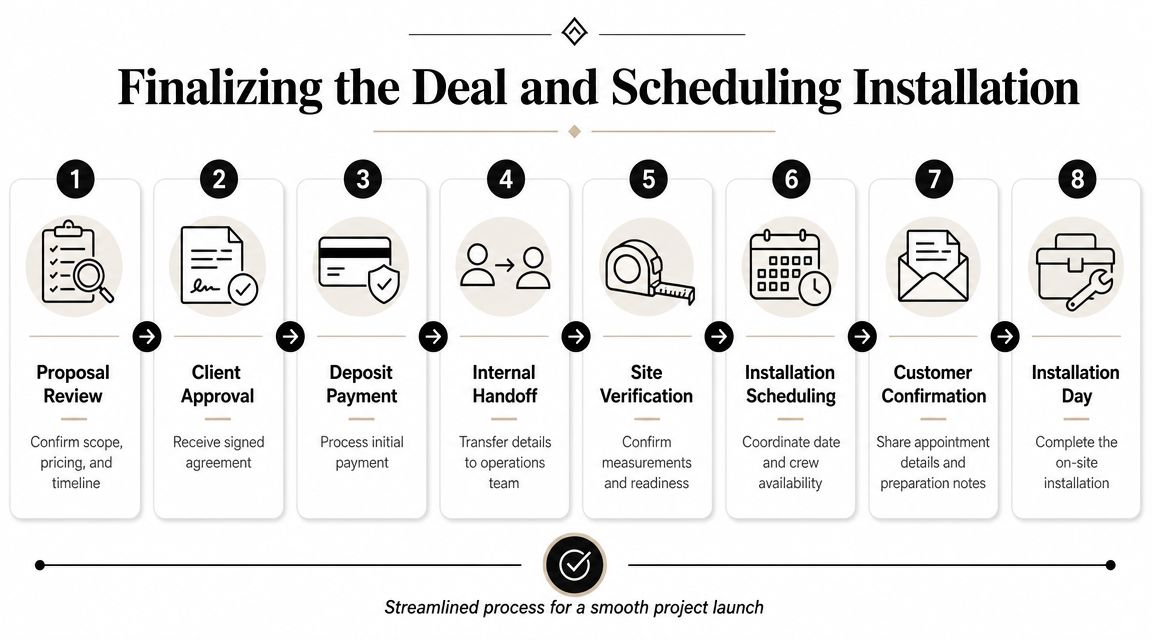
What to lock down before the truck rolls
Use a final pre-install checklist:
- Building coordination: confirm access rules, riser permissions, suite entry, and any property management requirements.
- Demarc and handoff location: verify where service will terminate inside the site and who is responsible beyond that point.
- Site readiness: confirm power, rack space, patching path, and any internal cabling dependencies.
- Cutover plan: decide whether you need parallel service, after-hours activation, or rollback options.
- Named contacts: identify one business lead, one technical lead, and one provider project owner.
A lot of failed installs come from basic operational misses. The technician arrives, but the telecom room is locked. The provider terminates service where the business didn't expect. Porting is approved, but the internal phone system isn't ready. None of these are technical mysteries. They're coordination failures.
Treat installation day like a controlled change
The cleanest cutovers are run like change management, not like a casual vendor appointment.
Confirm who tests the service, who signs off, and what counts as acceptance. If voice is involved, test inbound, outbound, forwarding, hunt groups, and any critical call flows before you release the old provider. If internet is involved, validate the handoff and make sure internal teams are ready to move traffic.
If fiber or physical access work is part of the project, a practical resource on fiber optic installation near your business can help internal stakeholders understand why site prep and pathway access affect timelines so much.
Good installations feel quiet. The planning did the hard work before anyone showed up onsite.
Conclusion: Securing More Than Just a Service
A smart search for a telecom service quote near me isn't about finding the lowest monthly number. It's about defining the need clearly, vetting the provider's operating discipline, reading the quote with a skeptical eye, and negotiating the terms that shape real-world service.
The best telecom purchase supports uptime, support quality, growth, and internal accountability. When you treat the quote as a total operating commitment instead of a sales document, bad surprises drop fast and decision quality goes up.
If your telecom upgrade, office move, or carrier change also leaves you with retired phones, network gear, servers, or other IT assets, Atlanta Green Recycling can help handle the end-of-life side responsibly. Their business-focused electronics recycling and IT asset disposition services are especially relevant for organizations that want secure data destruction, pickup logistics, and documentation, while also aligning disposal efforts with a broader social mission around veteran support and tree planting.