
Boost ROI With Telecom Consulting Services Dallas


A Dallas business leader usually runs into telecom consulting at the worst possible moment. The lease is ending. A new office is coming online. The phone system is aging out. Someone on the finance team asks why there are still charges for circuits nobody remembers approving. Then security asks a harder question: what happens to the old firewalls, phones, PRI gear, servers, and storage once they're unplugged?
That's when telecom gets exposed for what it really is. It isn't just internet service, voice lines, and carrier invoices. It's a web of contracts, infrastructure decisions, compliance obligations, and end-of-life asset risk. If one part is sloppy, the rest gets expensive fast.
For Dallas companies, the stakes are even higher because the local market is dense, carrier-heavy, and infrastructure-rich. The global telecom consulting market reached USD 7,291.0 million in 2024 and is projected to expand to USD 14,519.6 million by 2030, with North America, including Dallas, leading due to major fiber networks, 5G deployment, and the presence of telecom headquarters, according to P&S Market Research's telecom consulting market analysis.
If you're trying to make better decisions around network upgrades, billing audits, office moves, vendor negotiations, or secure decommissioning, Dallas telecommunications support options make more sense when you understand what telecom consultants do and where they save money, time, and risk.
Introduction Navigating the Dallas Telecom Maze
A common Dallas scenario goes like this. A company is moving from one office to another, consolidating floors, or refreshing infrastructure after years of patchwork upgrades. The IT manager knows the business needs reliable connectivity, stable voice service, and cleaner contracts. The CFO wants lower monthly spend. Legal wants fewer surprises in vendor terms. Security wants documented handling of retired hardware.
Nobody is wrong. They're just looking at the same telecom problem from different angles.
Telecom consulting services Dallas firms provide are meant to untangle that mess. Think of the consultant as part translator, part project manager, and part procurement specialist. They help a business understand what it has, what it needs, and where it's bleeding money or creating exposure.
Where companies usually get stuck
Most confusion shows up in three places:
- Billing complexity. Carrier invoices often include legacy services, overlapping features, taxes, and contract terms that are hard to validate line by line.
- Network performance. Users complain about call quality, lag, dropped sessions, and inconsistent connectivity, but internal teams may not have time to trace root causes.
- Compliance risk. During upgrades and disconnects, retired telecom gear can still hold business data, call logs, credentials, and regulated information.
Telecom problems rarely start as “telecom problems.” They show up as slow projects, unexplained invoices, bad user experience, or audit anxiety.
Why Dallas makes this harder and easier
Dallas is a strong telecom market. That helps because businesses have carrier options, fiber access, data center proximity, and local technical talent. It also makes decision-making harder because more options mean more contracts, more architecture choices, and more room to overbuy.
A seasoned consultant brings order to those choices. They don't just recommend circuits or voice platforms. They map telecom decisions to growth plans, office operations, and compliance requirements.
What Exactly Are Telecom Consulting Services
At a practical level, telecom consulting services Dallas companies buy are outside expertise for anything involving carrier services, voice, connectivity, network planning, telecom expense management, and telecom-related compliance. If your internal team is busy keeping systems running, the consultant handles the deep analysis and negotiation work that often gets postponed.
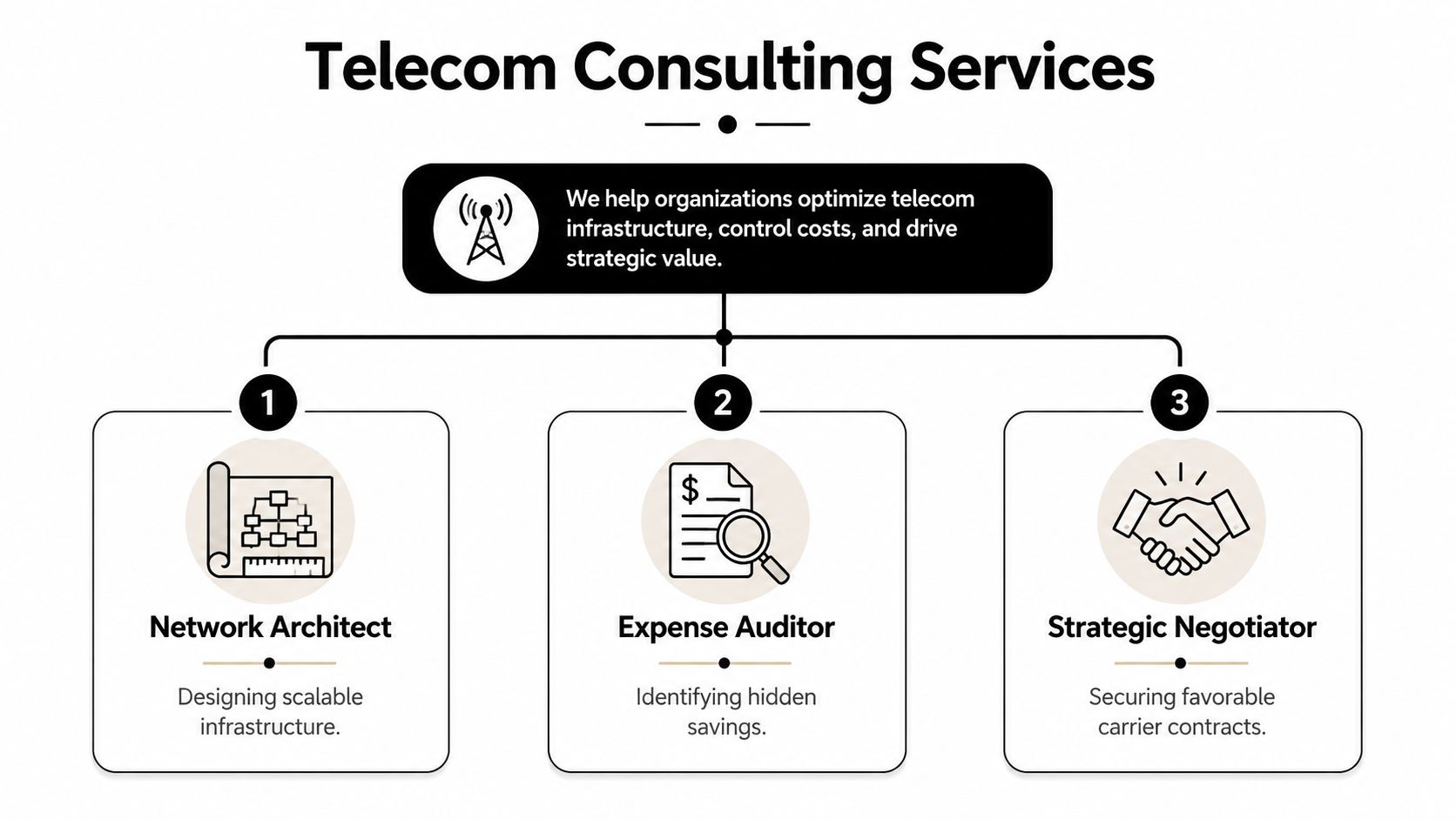
Here's the simplest way to think about it. A good telecom consultant plays three roles at once: network architect, expense auditor, and strategic negotiator.
The network architect role
This is the design side. The consultant looks at how your sites, users, cloud apps, phones, and carriers connect. They ask whether the network supports how your business works now, not how it worked five years ago.
In Dallas environments with dense offices, data-heavy workflows, and real-time communications, that matters. For network optimization, consultants address issues like 40% packet loss in high-density environments by upgrading to 10G Ethernet with low-latency under 1ms transceivers and reducing jitter from 20ms to under 0.5ms, according to WheelHouse's Dallas telecom consulting overview.
If that sounds abstract, use this analogy. Your network is a highway system. Packet loss is trucks spilling cargo off the road. Jitter is traffic arriving out of rhythm. The consultant studies where lanes are too narrow, where intersections are misconfigured, and where old routes should be replaced.
The expense auditor role
Many businesses see immediate value in this approach. Consultants review invoices, inventories, contracts, and service records to find waste. They reconcile what you ordered, what was installed, what's under contract, and what you're still paying for.
Typical audit questions include:
- Are disconnected sites still billing
- Are there duplicate voice or data services
- Did the carrier apply the contracted rates
- Are old PRI, SIP, or internet services still sitting on invoices
- Is anyone paying for features users don't use
This overlaps with telecom expense management, but consulting usually goes deeper into root cause. It's less “pay the bills” and more “fix the billing structure.”
The strategic negotiator role
Carrier contracts are rarely written for your convenience. They're written to lock in terms, define service boundaries, and preserve the provider's economics. A consultant knows which terms need scrutiny, such as renewal windows, installation commitments, service credits, and disconnect language.
That's especially useful when your environment includes cloud voice, contact center tools, and custom integration work. Teams planning broader modernization often pair telecom planning with custom cloud-based solutions so connectivity decisions support application and infrastructure goals instead of conflicting with them.
The service categories business leaders should know
Some telecom work is highly technical. Some is operational. Some is contractual. Most projects combine all three.
Network design and optimization
This covers WAN planning, internet redundancy, LAN readiness, Wi-Fi support, branch connectivity, and performance troubleshooting.Carrier sourcing and contract negotiation
The consultant compares providers, normalizes proposals, and helps you avoid false apples-to-oranges comparisons.VoIP and unified communications strategy
This includes phone migrations, SIP decisions, call flow planning, and coordination with collaboration platforms.Managed telecom oversight and expense control
Some firms stay involved after the project to monitor inventory, billing changes, renewals, and MACD activity.Regulatory and compliance advisory
This part is easy to underestimate. Telecom touches records, devices, logs, and infrastructure that may fall under internal audit rules or industry-specific requirements.
For businesses evaluating telecom solutions for nearby operations, the core test is simple: does the consultant just sell connectivity, or do they help your company make better operating decisions around telecom?
Understanding the Dallas Telecom Landscape
Dallas isn't just another metro market with a few carriers and office parks. It's one of the places where telecom, cloud, data center activity, enterprise networking, and regional growth all collide. That changes how businesses should evaluate telecom consulting services Dallas providers offer.

Why local context matters
A consultant who knows Dallas understands that the market isn't defined only by price. It's shaped by building access, fiber availability, carrier footprint, permitting issues, data center adjacency, and the operating habits of large Texas-based telecom players.
That matters when comparing providers like AT&T, Verizon, Spectrum, and other regional options. On paper, two quotes may look similar. In practice, one may fit your building better, install faster, or align more cleanly with your long-term architecture.
Dallas is dealing with the next wave already
The local conversation has moved beyond basic cost cutting. Dallas businesses are increasingly thinking about AI-driven operations, edge workloads, and what comes after current 5G projects. Emerging trends in Dallas telecom include preparing for 6G transitions and using AI for predictive network maintenance. Texas telecom capex surged 22% in Q1 2026 for AI infrastructure, and Gartner predicts 75% of enterprises will need consultants for 6G transitions by 2027, based on Prettyman's telecom consulting discussion.
That future-focus creates a practical question for business leaders. Are you buying telecom for today's floor plan, or for the next refresh cycle, cloud migration, and expansion move?
A cheap circuit that boxes you into the wrong architecture isn't a savings. It's a delayed project problem.
The local advantage of hiring local
Dallas-specific consultants tend to be stronger at details that remote advisors can miss:
- Carrier nuance. They know which providers tend to fit multi-site office networks, data-heavy environments, or voice-heavy deployments.
- Building realities. They've seen the handoff problems, riser constraints, and serviceability quirks that can stall installs.
- Project coordination. They can work more effectively with local facilities teams, cabling vendors, and movers.
- Regional planning. They understand how Dallas growth patterns affect branch expansion, relocation strategy, and data center connectivity.
If you're reviewing business telecom support in your area, local expertise shouldn't be treated as a bonus. In Dallas, it's often the difference between a smooth implementation and a long list of carrier tickets.
The Business Benefits and ROI of Strategic Consulting
The most direct reason to hire a telecom consultant is simple. They stop you from paying for telecom the way most companies drift into it, one contract, one site, and one invoice exception at a time.
The financial case
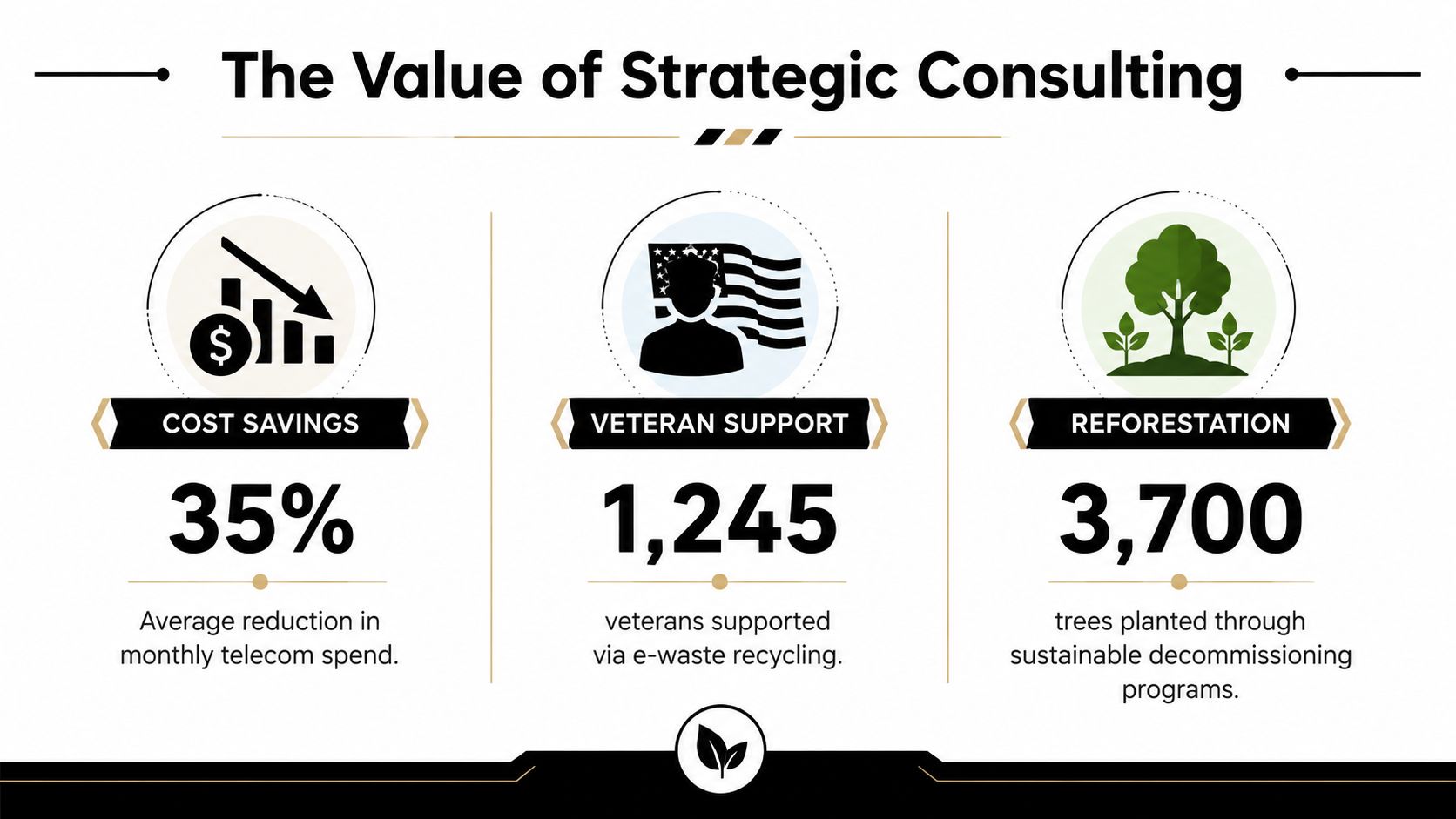
Specialized forensic billing audits in Dallas often reveal that businesses can achieve an average 20% reduction in telecom expenses, primarily by optimizing multi-vendor contracts inflated by 15% to 30% through unoptimized tariffs and hidden fees, according to Insights Telecom's audit findings.
That's the headline number. The underlying business value is what causes it. Companies accumulate old services during office moves, mergers, phone migrations, and piecemeal upgrades. No one intends to overpay. It happens because inventory, billing, and operations stop matching.
A telecom consultant's first job is to identify where your company is paying for history instead of current need.
The operational payoff
Savings matter, but performance matters just as much. If your team loses time to poor call quality, unreliable conferencing, and recurring carrier disputes, the monthly invoice isn't the only cost.
A strong consulting engagement can improve operations in ways finance teams feel later:
- Cleaner vendor management so internal IT spends less time chasing provider support
- Better-fit contracts that reduce friction during adds, moves, changes, and disconnects
- Smarter capacity planning that aligns service levels with actual use
- Lower project drag because migrations are planned instead of improvised
The hidden ROI many leaders miss
The overlooked return is risk reduction during refreshes and shutdowns. Every telecom cleanup creates a hardware question. Routers, firewalls, switches, voice gateways, PBX components, and rack equipment eventually leave service. If they're retired casually, the company may save on consulting and lose much more in audit exposure, data handling mistakes, and disposal confusion.
That's why telecom planning works best when it's paired with disciplined asset retirement. Teams that align contract cleanup with IT asset management best practices usually make cleaner decisions because they know which services are ending, which devices are affected, and which records must be retained.
How to Choose the Right Telecom Consultant in Dallas
Choosing a consultant isn't like buying bandwidth. You're not just comparing a monthly rate. You're choosing who gets to inspect your contracts, shape your network decisions, and handle details your executives may never see until something goes wrong.

Questions worth asking in the first meeting
Start with experience, but make it specific. “Do you work in our industry?” is too broad. Ask whether they've handled environments like yours, such as healthcare sites with regulated data, multi-location professional offices, or warehouse networks with voice and mobility demands.
Then ask about security and data handling. A 2025 report noted 68% of Dallas-area enterprises faced telecom-related security breaches, and firms evaluating consultants should ask about secure data handling and compliance experience, including HIPAA and DoD 5220.22-M, based on Bearstone's Dallas telecom consulting page.
Use questions like these:
- How do you validate telecom inventory before recommending cuts or changes
- What is your process for retired telecom hardware that may still contain sensitive data
- How do you document disconnects, credits, and contract obligations
- Who manages carrier escalation during a migration
- What compliance frameworks do you regularly work with
If a consultant talks only about savings and never about documentation, hardware handling, or data sanitization, keep looking.
What strong answers sound like
Good consultants explain their process in plain English. They should be able to describe how they gather invoices, map service inventory, review contract terms, verify installed assets, and coordinate carrier changes. They should also say where their responsibility ends and where your internal team or recycler takes over.
This matters even more when a telecom project overlaps with cloud collaboration or file platform changes. Businesses planning voice modernization alongside broader workplace changes can learn a lot from guidance on avoiding Microsoft 365 migration disasters, because the same project mistakes show up repeatedly: weak discovery, poor ownership, and not enough attention to user impact.
Comparing Telecom Consulting Pricing Models
| Pricing Model | How It Works | Best For |
|---|---|---|
| Retainer | The consultant provides ongoing support across billing, vendor management, and project coordination for a recurring fee | Companies with multiple locations or frequent telecom changes |
| Project-based | Pricing is tied to a defined initiative such as an office move, audit, phone migration, or carrier RFP | One-time transitions with clear scope |
| Contingency or savings-based | Fees are linked to identified cost reductions or negotiated savings | Organizations focused primarily on billing cleanup |
| Hybrid | A mix of fixed project fees and ongoing advisory support | Businesses that want both short-term execution and long-term oversight |
Red flags that deserve attention
Some warning signs are easy to miss because they sound confident in the room.
- Provider bias. If every recommendation points to one carrier, ask whether the consultant is independent.
- Vague scope. If they can't define deliverables, expect disputes later.
- Weak security language. If they gloss over wiping, chain of custody, or disposal controls, don't assume those pieces are covered.
- No Dallas execution depth. Strategy is useful. Local implementation experience is what keeps installs and disconnects from drifting.
A strong consultant doesn't just know telecom. They know how telecom projects fail, and they've built habits to prevent that.
Beyond Contracts A Holistic Approach to IT Decommissioning
Most telecom guides stop at rates, contracts, and network performance. That's only half the job. The other half starts when old telecom infrastructure leaves service.
When a Dallas business upgrades circuits, moves offices, retires voice platforms, or shuts down part of a data room, physical equipment gets stranded. That can include switches, routers, firewalls, phones, servers, storage, UPS-connected devices, and telecom-adjacent hardware. If nobody owns the exit plan, those assets sit in closets, pile up in staging areas, or leave the building without proper data handling records.
Where telecom and ESG meet
It is precisely a more mature strategy that stands out. Instead of treating decommissioning as an afterthought, companies can connect telecom cleanup with broader ESG and CSR goals.
The practical model looks like this:
- Carrier and contract cleanup removes inactive services and defines what equipment is no longer needed.
- Secure deinstallation and sanitization protects regulated data and internal records.
- Responsible recycling and reporting supports sustainability documentation and internal governance.
- Cause-based messaging turns a back-office task into a visible values story.
For some organizations, that creates a stronger internal business case. Finance likes the waste reduction. Security likes the documented handling. Operations likes the cleared space. Leadership likes that the project can support sustainability reporting and community impact at the same time.
A more useful way to frame disposal
Many companies still think about retired equipment as junk removal. That framing is too small. It ignores chain of custody, documentation, internal audit expectations, and brand value.
A better framing is this: decommissioning is the final phase of telecom governance.
That's why teams handling larger retirements should review a formal data center decommissioning process before the first rack is powered down. The strongest projects treat disconnects, asset manifests, sanitization, logistics, and final reporting as one workflow, not five unrelated tasks.
The end of a telecom contract should trigger an asset review, not just a cancellation request.
Why the social angle matters
There's also a messaging opportunity here, especially for companies with ESG or CSR commitments. A mission-driven recycling model can support seasonal drives, internal employee engagement, and partner communications. “Recycle for a Cause” is effective because it makes infrastructure cleanup feel tangible. Old tech doesn't just leave the building. It supports veteran aid, tree planting, and a more visible sustainability story.
That won't replace financial ROI. It complements it. For many leadership teams, that makes approval easier because the project serves more than one business objective.
Frequently Asked Questions
| Question | Answer |
|---|---|
| What does a telecom consultant actually do for a Dallas business? | They review your carrier contracts, telecom inventory, invoices, network design, and migration plans. Then they help you reduce waste, improve fit, negotiate better terms, and lower operational risk. |
| Is telecom consulting only for large enterprises? | No. Mid-sized firms often benefit because they have enough complexity to create waste, but not always enough internal bandwidth to audit it deeply. |
| When should a company hire a telecom consultant? | Before an office move, carrier renewal, phone migration, network refresh, merger, or decommissioning project. Those are the moments when bad assumptions become expensive. |
| Can a telecom consultant help with VoIP and cloud calling? | Yes, if that's part of their scope. Many help compare platforms, plan migrations, coordinate carriers, and reduce disruption during cutover. |
| What's the biggest mistake companies make? | They focus only on monthly rates. The bigger issues are usually inventory accuracy, contract terms, implementation timing, and what happens to retired equipment. |
| How do I know if our bills need auditing? | If your company has multiple providers, old locations, recurring credits, unexplained features, or services that nobody can clearly map to users or sites, an audit is usually worth considering. |
| Should security questions be part of vendor selection? | Yes. Ask how they handle retired hardware, whether they understand regulated data environments, and how they document sanitization and chain of custody. |
| How long does a consulting engagement take? | It depends on scope. A billing review may move quickly. A multi-site migration or decommissioning effort usually takes longer because it involves vendors, facilities, users, and retired assets. |
If your organization is planning a telecom upgrade, office move, or infrastructure retirement, Atlanta Green Recycling can support the part most teams overlook: secure, compliant end-of-life handling for retired IT and telecom-adjacent equipment. Their services help businesses simplify pickups, document data destruction, and align decommissioning with broader sustainability goals, including a mission-driven model centered on veteran support and tree planting.