
Managed Telecom Services Near Me: Atlanta IT Manager’s Guide

You search managed telecom services near me because something has already gone sideways. A circuit is unstable. Voice quality is slipping at a branch office. Your team is chasing a carrier ticket that should've been escalated hours ago. At the same time, you've got a storage room with retired firewalls, old access points, dead laptops, and decommissioned servers waiting for secure disposition.
That combination is normal in a multi-site Atlanta operation. Live infrastructure and end-of-life infrastructure are part of the same job. If you manage hospitals, schools, government offices, warehouses, or corporate campuses, uptime matters on the front end and documented disposal matters on the back end. The mistake is treating those as unrelated purchases.
The better approach is to select a telecom partner with the discipline to support the full technology lifecycle. That starts with knowing what you need before you ever call a provider.
Beyond the Search Bar Defining Your Telecom Needs in Atlanta
The worst time to define your telecom requirements is during a sales demo.
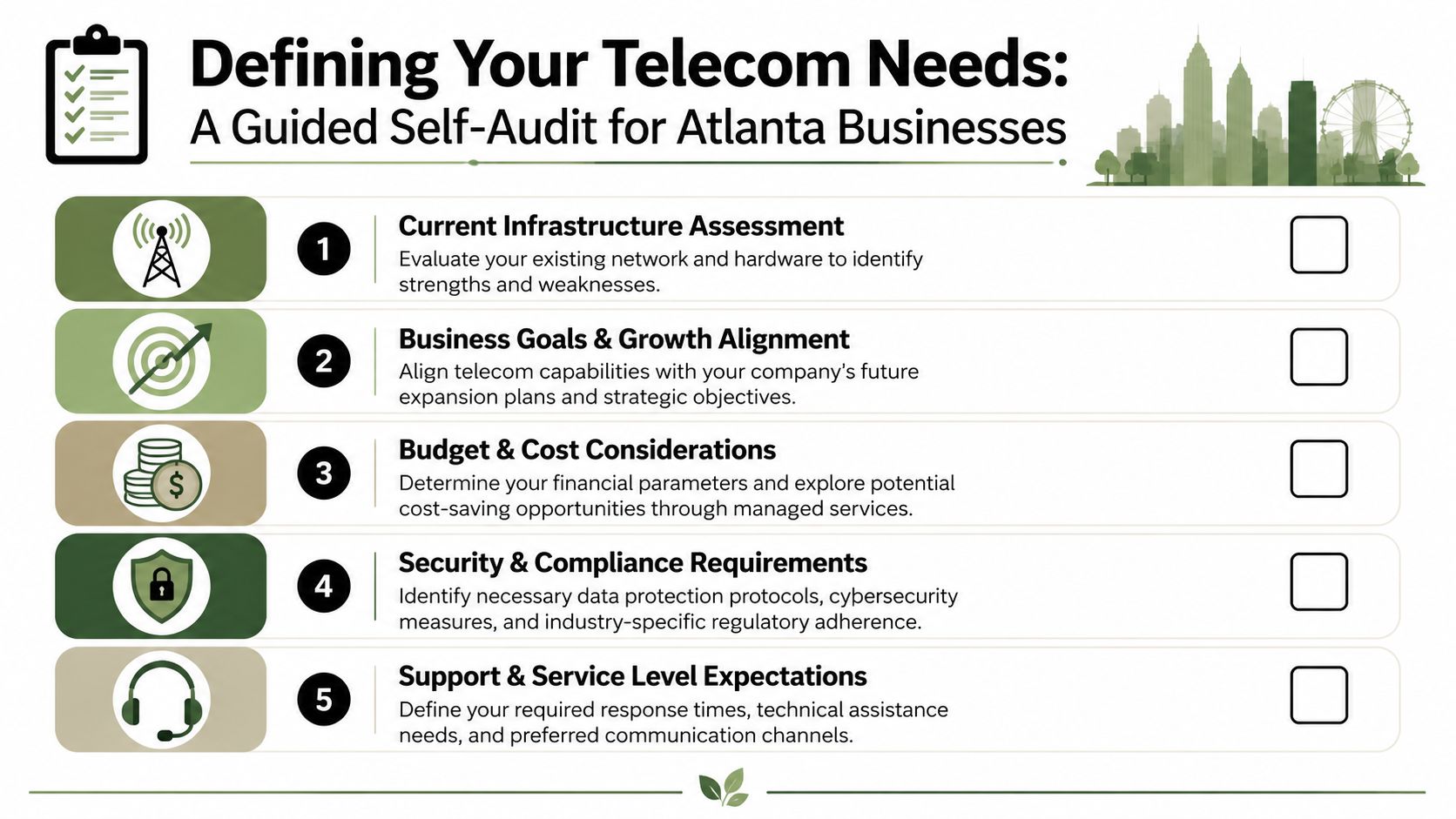
I've seen IT teams start a provider search because leadership wants “better support” or “more reliable internet.” Those aren't requirements. They're symptoms. Authentic work happens when you pin down which sites are fragile, which workflows are compliance-sensitive, and which assets are approaching replacement.
Start with your actual failure points
An Atlanta company with offices in Midtown, a warehouse in South Fulton, and remote staff across the metro doesn't have one telecom environment. It has several. The Buckhead office might struggle with conference room Wi-Fi density. The warehouse might depend on stable handheld connectivity. The remote users may care more about UCaaS performance and secure mobile access than office bandwidth.
I will begin at this point:
- Site inventory: every circuit, carrier, firewall, switch stack, wireless controller, SIP trunk, and backup connection
- Application dependency map: VoIP, Teams or Zoom, ERP, cloud apps, file transfers, badge systems, security cameras, and anything tied to patient, student, or government data
- Operational pain log: recurring outages, slow failovers, dead spots, billing confusion, support bottlenecks, and equipment that nobody wants to own
- Asset lifecycle review: what's active, what's aging out, and what should already be off your books
A lot of teams skip that last point. They shouldn't. Old telecom hardware becomes a disposal problem fast, especially when configurations, credentials, logs, or stored data could still exist on the device.
The market is moving in this direction anyway. The telecom managed services market forecast from Mordor Intelligence projects growth from USD 31.93 billion in 2026 to USD 53.83 billion by 2031, with a 11.02% CAGR, driven in part by large enterprises buying scalable security and network support.
Turn business complaints into technical requirements
“Wi-Fi is bad” usually means one of four things. Coverage gaps, saturation, poor roaming, or bad design around high-density areas.
“Phones cut out” could be packet loss, jitter, a misaligned QoS policy, ISP instability, or weak vendor coordination between voice and network teams.
“Support is slow” often means the current provider's escalation path is vague, their NOC lacks authority, or your internal ownership model is split between IT, facilities, and finance.
That's why I recommend a short written intake before contacting any provider. Keep it blunt:
- Which sites lose money or create compliance exposure when connectivity drops?
- Which applications require low latency or stable voice quality?
- Which systems must stay online during circuit failover?
- Which devices are nearing refresh and need secure retirement?
- Which support windows matter. Business hours, after-hours, or true around-the-clock coverage?
Practical rule: If your team can't describe the business impact of an outage by site, a provider can't design the right support model.
Include security and disposal in the same review
Telecom decisions bleed into cyber risk. Remote access, mobile management, branch connectivity, and cloud voice all introduce exposure if they're poorly governed. If your team needs a useful framework for identifying operational and cyber blind spots before provider selection, GoSafe's cyber risk assessment guide is a solid planning resource.
Your self-audit should also cover what happens when equipment leaves service. Retired phones, routers, wireless gear, and edge devices aren't harmless just because they're unplugged. A provider that understands the handoff between active service and decommissioning will ask better questions about configuration backups, credential removal, circuit disconnect timing, and chain of custody.
For Atlanta teams that need local context around network design and support options, it helps to compare your internal findings against telecom services in Atlanta before narrowing the field.
What a good requirement list actually looks like
A usable shortlist document is rarely pretty. It should include priorities, not marketing language.
For example:
- Critical locations: headquarters, clinic sites, call-heavy offices, distribution facilities
- Needed services: SD-WAN, managed Wi-Fi, carrier management, UCaaS oversight, firewall monitoring, mobile fleet support
- Compliance needs: HIPAA, public-sector documentation, internal audit trails, secure decommissioning records
- Preferred support model: direct engineer access, named account team, local dispatch options, ticket visibility
- Lifecycle expectations: install, monitor, optimize, replace, remove, document, dispose
That kind of document changes every provider conversation. It stops the generic pitch and forces a practical discussion about fit.
Finding and Vetting Local Managed Telecom Providers
A local provider search should begin offline. Search results are useful, but they don't tell you who performs under pressure when a branch office loses service before a compliance audit or a site move.
North America already accounts for over 35% of the global managed telecom services market, with the region valued at USD 14.0 billion in 2023, according to Grand View Research's market analysis. That scale is one reason Atlanta buyers have plenty of choices. The hard part isn't finding providers. It's filtering out firms that can sell but can't execute.
Build your shortlist from people who carry operational risk
My first calls usually go to peers, facilities leaders, compliance officers, and project managers who've lived through circuit migrations or office consolidations. Ask who handled a messy cutover well. Ask who owned mistakes. Ask who disappeared after signature.
Good local sourcing channels include:
- Peer referrals: IT directors, infrastructure managers, healthcare ops leaders, and school district technology staff
- Carrier-adjacent contacts: structured cabling firms, data center operators, and MSPs that have seen providers in action
- Industry groups: regional technology councils, healthcare IT communities, and public-sector procurement networks
- Move and decommission stakeholders: teams involved in office closures, floor restacks, or hardware retirement
A provider can look polished online and still be weak at field coordination, dispatch, or change management. Local references expose that quickly.
Separate local presence from local capability
“Local” can mean a sales rep with a Georgia number. It doesn't necessarily mean local engineers, local project management, or local response capacity.
Ask direct questions:
- Who owns implementation?
- Where is the NOC?
- Who handles after-hours incidents?
- Can they coordinate with your cabling vendor, security integrator, and disposal partner?
- Do they understand Atlanta site realities like multi-building campuses, medical offices, distribution sites, and municipal procurement friction?
If a provider gets vague here, that vagueness will show up again during a failed cutover.
For teams comparing broader service models before issuing an RFP, enterprise telecom solutions in Atlanta can help frame what a regional partner should be prepared to support.
Ask questions that expose operational maturity
A weak provider talks about “white-glove service.” A strong one can explain ticket routing, escalation ownership, inventory discipline, and device retirement procedures.
Here's a practical RFP table I'd use.
| Category | Question to Ask | Why It Matters |
|---|---|---|
| Coverage | Which Atlanta-area sites do you currently support that resemble ours in complexity? | You want proof they understand local field conditions and multi-site operations. |
| Support | Who answers critical incidents after hours, and what authority do they have to escalate carriers or dispatch resources? | A help desk that only triages isn't enough during a real outage. |
| Network operations | How do you monitor circuits, Wi-Fi, voice quality, and edge devices across sites? | Monitoring determines whether they find issues early or wait for users to complain. |
| Compliance | What experience do you have supporting HIPAA-sensitive, education, or government environments? | Regulated environments need cleaner documentation and tighter process control. |
| Change management | How do you handle site moves, carrier changes, and phased migrations? | Poor change control creates downtime and finger-pointing. |
| Inventory | How do you maintain records of circuits, devices, contracts, and retired hardware? | Bad inventory drives billing waste and disposal mistakes. |
| Security | How do you coordinate network changes with security policy, identity controls, and device offboarding? | Telecom and security are tightly linked in branch environments. |
| Lifecycle | What happens when telecom gear is replaced or decommissioned? | This reveals whether they think beyond installation. |
| Billing | Do you provide invoice analysis, dispute support, and contract renewal visibility? | Hidden telecom spend often lives in billing complexity. |
| Governance | Who attends review meetings, and what reports do you bring? | Good governance reduces surprises and keeps projects moving. |
Providers that can't explain how they maintain inventory usually can't explain where your costs or risks are hiding.
Vet the provider's vendor management discipline
A managed telecom partner is also a vendor manager. They deal with carriers, hardware makers, subcontractors, support platforms, and often your internal stakeholders too. If their vendor governance is sloppy, your service will be sloppy.
I like to see whether their operational model matches broader procurement discipline. This overview of streamlining automation supplier management is useful because the same core principle applies here. Clear ownership, documented accountability, and repeatable review cycles beat personality-driven management every time.
Watch for red flags in early meetings
These problems show up early if you listen closely:
- They answer every question with product names. That usually means they lead with resale, not architecture.
- They avoid discussing asset retirement. That's a sign they stop caring once equipment is installed.
- They promise everything is “fully managed.” Press for specifics. Managed by whom, using what tools, during which hours?
- They can't name documentation artifacts. You want runbooks, escalation lists, inventory records, change logs, and closure reports.
- They treat finance and compliance as somebody else's problem. In a real organization, they're part of the job.
A solid provider doesn't need to oversell. They'll give you a sober explanation of what they do well, what they subcontract, and where your team still needs to stay involved.
Decoding SLAs and Negotiating a Rock-Solid Contract
A contract tells you what happens after the sales team stops answering at top speed.
This is the point where buyers often get lazy. They compare monthly recurring charges, skim the service description, and assume “99.9 uptime” means they're covered. It doesn't. An SLA only matters if the language is specific enough to measure, enforce, and escalate.

Read uptime with context
For high-density Wi-Fi environments, Broadband Breakfast's discussion of managed service provider challenges notes that successful providers achieve 99.9% uptime SLAs through phased rollouts and continuous monitoring with AI-driven anomaly detection.
That's useful, but uptime alone doesn't protect you. You need to know:
- What service is being measured. Internet circuit, managed LAN, Wi-Fi availability, voice platform, or monitoring portal?
- What counts as downtime
- Whether maintenance windows are excluded
- Whether third-party carrier failures are carved out
- How credits are calculated
- Who must open the ticket to trigger SLA tracking
An SLA that excludes the very failures you care about is marketing language dressed up as a contract term.
Response time and resolution time are not the same thing
A provider may promise a fast response while offering no meaningful commitment on restoration. Those are different protections.
A good contract should define:
- Severity levels tied to business impact, not vague labels.
- Response targets for each severity.
- Escalation paths with named roles or role-based accountability.
- Communication cadence during major incidents.
- Restoration expectations or workaround obligations where full resolution takes longer.
Healthcare and government teams should be especially strict here. If a clinic loses connectivity, “we responded in fifteen minutes” isn't useful if nobody can explain when fallback service, carrier escalation, or onsite action begins.
Contract advice: If the provider controls the definitions, the provider controls the scorecard.
Require operational language, not broad promises
I want to see the mechanics. Who owns carrier disputes. Who tracks replacement hardware. Who documents change approvals. Who signs off after an incident. Who coordinates equipment retrieval when a site closes.
That matters just as much as the technical metrics. Telecom support lives inside real business workflows. If a provider can restore service but can't document what happened, regulated organizations still have a problem.
Useful contract exhibits often include:
- Escalation matrix
- Incident severity definitions
- Standard maintenance process
- Asset handling procedures
- Reporting samples
- Termination and transition support obligations
One overlooked point is end-of-term transition. If you leave the provider, you need clean records, config handoff, circuit inventory, and a process for recovering or disposing of provider-managed hardware. Teams that ignore this end up paying for stranded services or holding undocumented gear.
If your internal process includes formal destruction records for retired hardware, a simple certificate of destruction template can help align telecom offboarding with your broader compliance paperwork.
Negotiate for the problems you're likely to have
Don't spend all your negotiating energy on base price. Push hardest on the clauses you're most likely to use.
In practical terms, that means:
- Escalation rights: direct access to higher-tier support during critical outages
- Review cadence: recurring service reviews with action tracking
- Documentation ownership: your organization should retain access to inventories, reports, and change records
- Exit support: obligations to assist with transition, disconnects, and hardware handoff
- Lifecycle coordination: explicit language around device replacement and retirement
Sales teams prefer broad service language because it's flexible for them. Buyers need specificity because they're the ones living with the consequences.
The Unspoken Link Between Telecom and Secure E-Waste Disposal
Most managed telecom discussions stop at uptime, voice quality, and ticket response. That's too narrow for a real IT operation.
The same organization that installs circuits, supports Wi-Fi, and manages branch connectivity also replaces firewalls, swaps access points, retires phones, decommissions edge appliances, and shuts down obsolete racks. Every one of those steps creates a security and compliance issue if the old equipment isn't handled correctly.
A notable gap in the market is that managed telecom content rarely addresses support for e-waste logistics, secure data destruction coordination, and fleet management for electronics recycling operations. That gap matters most in regulated sectors, where “remove and recycle it” is nowhere near enough.
Connectivity doesn't end when the device is retired
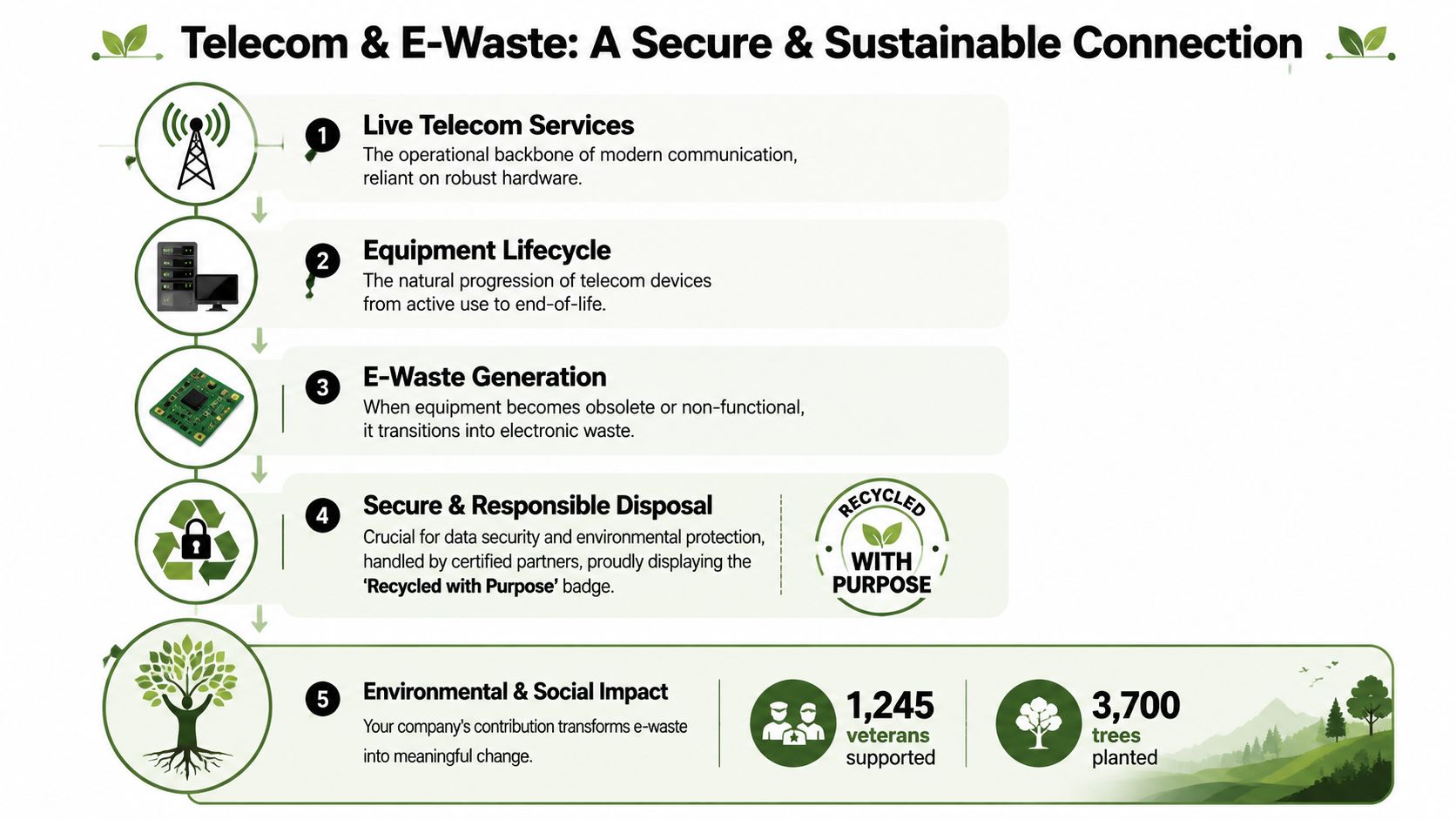
Old telecom gear can hold more than people assume. Local configs, VPN settings, logs, cached credentials, contact data, wireless profiles, and management access paths don't vanish because the hardware is out of production.
That creates a chain of responsibility:
- The device must be identified correctly
- The service relationship tied to it must be closed cleanly
- Any stored data or settings must be sanitized
- Pickup, transfer, and final disposition must be documented
- The business must be able to prove what happened
Telecom and IT asset disposition converge. If your managed provider has no process for supporting offboarding, they leave your team to figure out inventory reconciliation, disconnect timing, and hardware handling during a stressful project window.
Common failure patterns during decommissioning
I've seen the same mistakes repeat:
A branch closes, but the team only tracks the ISP disconnect. Nobody records which firewall was pulled, whether the switch stack was wiped, or where the wireless gear went after the move crew boxed it.
An office refresh replaces phones and network gear, but finance keeps paying for old lines because the billing inventory doesn't match the physical retirement list.
A hospital or school district stores retired equipment for months because nobody owns the handoff from telecom operations to secure recycling.
Those aren't separate admin issues. They're lifecycle control failures.
Retired telecom hardware is still part of your attack surface until it is sanitized, documented, and out of your custody.
Why your telecom partner should understand chain of custody
A mature provider doesn't need to perform disposal themselves to be useful here. They do need to understand the workflow well enough to support it.
That means they should be able to help with:
- Asset identification: matching hardware to locations, services, and owners
- Disconnect coordination: making sure lines and services are terminated in the right order
- Configuration retention decisions: preserving what must be archived before sanitization
- Removal planning: avoiding a scramble during office moves or data center work
- Documentation handoff: providing records that support audit, disposal, and financial closure
For local teams searching for telecom solutions near me, this is one of the best differentiators to test. Ask the provider what they do when a site closes and twenty devices come out of service on the same weekend. The answer will tell you whether they think like operators or just installers.
ESG and CSR belong in the disposal conversation
There's another reason this matters. End-of-life technology handling increasingly shows up in corporate sustainability and social impact conversations. If your organization already reports on ESG or CSR activity, telecom refresh cycles can contribute to those goals when disposal is documented and connected to a credible downstream program.
That's especially relevant for organizations that want a cause-based angle instead of treating recycling as a silent back-office task. A “Recycle for a Cause” model is easier to defend internally because it links secure disposal with visible outcomes. It gives procurement, IT, compliance, and marketing a shared story.
Two elements work well in practice:
- Impact visibility: internal reporting, certificates, and simple counters that show outcomes such as veteran support and tree planting
- Partner-ready recognition: a digital badge like Recycled with Purpose that companies can place on sustainability pages or CSR summaries
The emotional framing matters more than many IT leaders think. “Your old tech can house a veteran and grow a forest” is memorable because it turns disposal from a cost center into a documented action with social and environmental value. It's still an operations decision, but it's easier to support when leadership can connect it to both compliance and community impact.
Analyzing Total Cost and Maximizing Your Telecom ROI
The monthly invoice is the easiest number to compare and often the least useful one.
Real telecom cost lives in downtime, duplicate services, renewal mistakes, poor inventory, internal labor, delayed disconnects, and hardware that sits in a closet because nobody owns the final mile of retirement. If you're evaluating managed telecom services near me, price matters. Total lifecycle cost matters more.

Start with expense visibility
A Telecom Expense Management review is one of the fastest ways to expose hidden waste. According to Telco Solutions' telecom managed services article, TEM audits frequently uncover 15-20% in overspending on unused lines and data circuits, and MSPs often secure 10-25% better rates through bulk negotiation.
That doesn't mean every provider will produce those results. It does mean billing complexity is worth taking seriously, especially if your company has acquired locations, closed offices, changed carriers, or split ownership between IT and finance.
Build ROI around avoided friction
I don't build the business case around “outsourcing is cheaper.” Sometimes it is. Sometimes it isn't.
I build it around these questions:
- Does the provider reduce the time your internal team spends chasing carriers?
- Do they maintain enough inventory discipline to stop paying for dead services?
- Can they support office moves, refreshes, and decommissions without service confusion?
- Do they lower the compliance burden around device retirement and documentation?
- Can they connect live service management with reverse logistics when equipment leaves use?
That last point is often ignored. If your provider supports connectivity but leaves asset retirement disorganized, your organization pays twice. Once in operational friction and again in disposal risk.
For a broader way to think about this, the financial commitment of facility assets is a useful lens. Telecom gear, edge devices, and branch infrastructure behave like facility assets in one important way. Acquisition cost is only one slice of their real lifecycle burden.
Include reverse logistics in your telecom math
A mature cost model includes pickup coordination, packing, chain of custody, data destruction workflow, and the internal time required to manage retired hardware. Those costs show up during relocations, site closures, data center cleanouts, and refresh cycles.
That's why I prefer providers and processes that fit with structured reverse logistics solutions. When retirement logistics are planned instead of improvised, finance closes assets faster, IT keeps cleaner inventories, and compliance teams get better records.
ROI improves when you remove recurring operational drag, not just when you squeeze a rate card.
Conclusion Building a Resilient and Responsible Tech Strategy
The best answer to managed telecom services near me isn't the provider with the slickest proposal or the lowest monthly quote. It's the partner that can operate inside the reality of your business.
For an Atlanta IT leader, that reality usually includes multiple sites, mixed carriers, compliance obligations, limited staff time, and aging equipment that never disappears on its own. A smart selection process starts with a blunt internal audit, continues through hard questions about support and accountability, and gets finalized in a contract that defines what happens when service fails.
But the stronger strategy goes one step further. It recognizes that telecom responsibility doesn't end at deployment. It includes refresh cycles, removals, sanitization, documentation, chain of custody, and the financial cleanup that comes after hardware leaves production. That's where many providers still come up short.
The practical takeaway is simple. Choose a telecom partner that understands operations, not just connectivity. You want a team that can support the living environment of your network and also fit into the retirement process for the devices that make that network work.
That's a resilience decision. It's also a compliance decision.
It can become a brand decision too. When secure disposal is handled well, organizations can turn a routine back-office process into a visible ESG and CSR win. Cause-based recycling, seasonal drives tied to Veterans Day or Earth Day, impact reporting, and a recognizable Recycled with Purpose badge all make the work easier to explain internally and externally. They also make it easier for employees to care.
A telecom environment is healthy when service, security, finance, and lifecycle planning are aligned. If one of those pieces is missing, the cost shows up somewhere else.
If your Atlanta organization needs a practical partner for secure IT asset pickup, compliant electronics recycling, data destruction documentation, and end-of-life coordination that suits the circumstances of multi-site telecom operations, Atlanta Green Recycling is worth a direct conversation. Their work supports corporate IT teams, healthcare, schools, government agencies, and data center decommissioning efforts across metro Atlanta, with a mission-driven model that connects responsible recycling to veteran aid and tree planting.