
Top 7 Telecom Installation Company Chicago Picks for 2026


Your Chicago business runs on data. The phones, Wi Fi, access control panels, cameras, and cloud apps all depend on cabling and carrier handoffs that people usually notice only when something fails. The need for a trustworthy telecom installation company in Chicago often arises from one of three situations right now. An office move, a network upgrade, or a painful cleanup of someone else's messy install.
Chicago is a strong market for serious telecom work. The city has deep telecom roots. In 1977, AT&T installed the first optical telephone communication system under downtown Chicago, using optical fibers that transmitted information 65,000 times faster than traditional copper wires, according to Skybox Datacenters on Chicago's tech roots. That matters because Chicago buyers aren't shopping in a lightweight market. They're operating in a city shaped by dense buildings, legacy infrastructure, data centers, and constant upgrade pressure.
The vendor choice gets harder because many firms sound similar online. Most promise structured cabling, fiber, and low voltage work. Fewer explain how they handle rooftop access, outage windows, labeling standards, permit friction, subcontractors, and final documentation. That's where projects go right or wrong.
Below are seven Chicago-area companies worth shortlisting, plus the practical questions I'd ask before signing a proposal.
1. AIT Communication Group
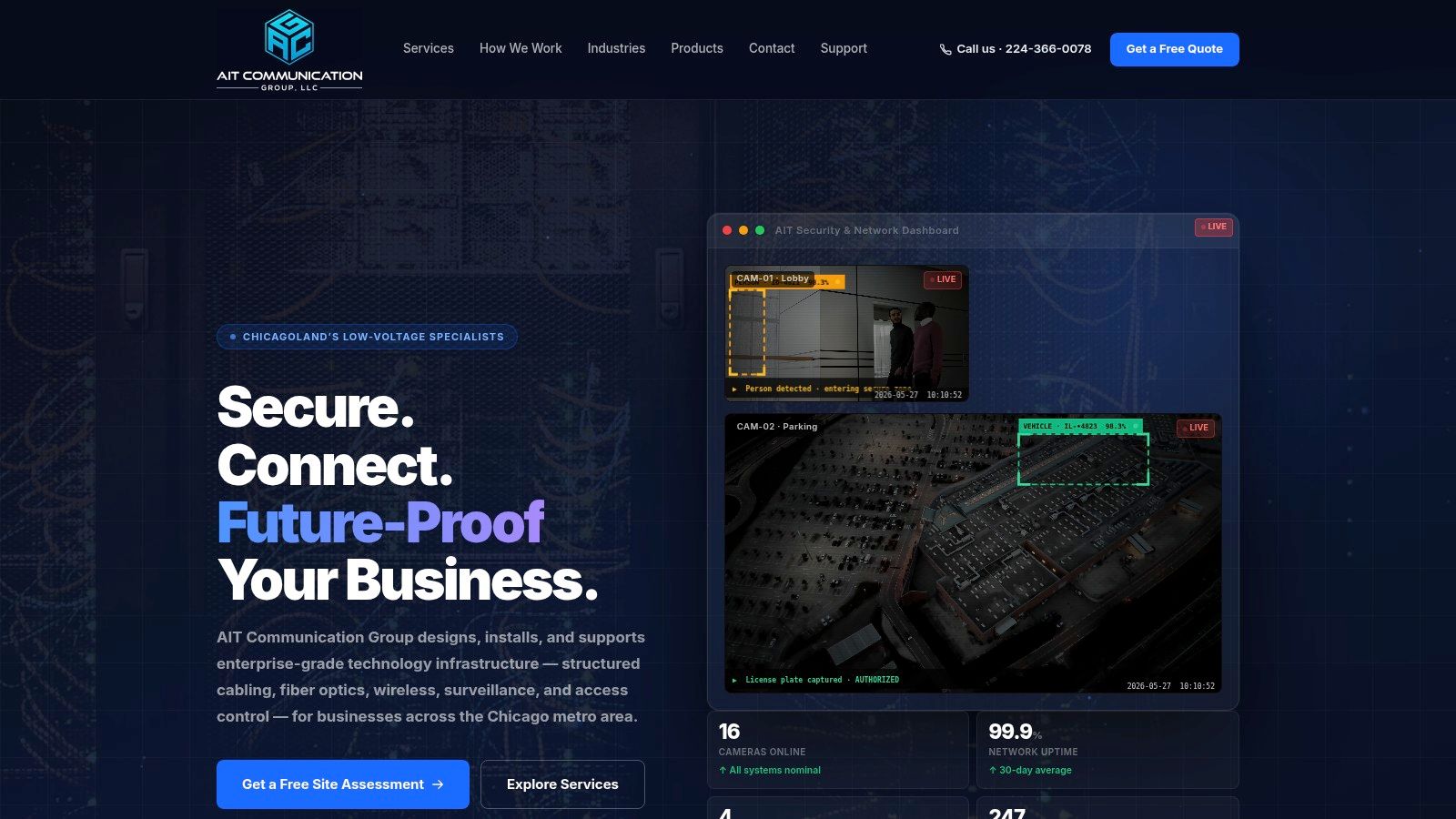
AIT Communication Group makes sense for buyers who care about handoff quality as much as installation speed. Their profile is closer to an enterprise low-voltage contractor than a bargain cabling crew. If you manage multiple locations, regulated spaces, or a network that will be audited later, that distinction matters.
Their stack is broad enough to reduce vendor sprawl. They handle structured cabling, fiber, Wi Fi, surveillance, and access control, which can simplify scope coordination when an office refresh touches more than data drops. That's usually better than hiring one vendor for cabling, another for doors, and a third for cameras, then trying to sort out who owns the punch list.
Where AIT stands out
The main advantage is documentation discipline. The listed capabilities include Cat6 and Cat6A structured cabling, fiber installs with OTDR testing, Fluke DSX-8000 copper certification reporting, and installs aligned with TIA/EIA-568 and UL 294 standards. For IT teams, that usually means fewer mysteries after turnover and a cleaner record when troubleshooting starts months later.
A few strengths stand out:
- Audit-friendly closeout: As-builts, labeling, and test reports make later moves, adds, and changes easier.
- Broader low-voltage scope: Security and wireless work can stay under one PM.
- Fixed-price style quoting: Site assessment plus written proposals tends to reduce mid-project drift.
Practical rule: If your team expects to inherit the system and support it internally, ask to see a sample closeout package before award. A clean rack photo is nice. Test results and as-builts are what actually save time later.
The trade-off is price positioning. AIT may be more than a very small office needs, especially if the job is just a handful of drops and a patch panel cleanup. But if your project includes compliance concerns or a planned decommission of retired network gear, it's smart to line up R2-certified telecom recycling in Chicago alongside the install scope so old equipment doesn't become an afterthought.
2. Chicago Network Cabling & Fiber Optic

Chicago Network Cabling & Fiber Optic is a practical fit for offices, retail spaces, and warehouses that want one vendor to cover day-to-day communications infrastructure. Their online positioning is straightforward. Voice and data cabling, business phone systems, VoIP, Wi Fi, CCTV, and fiber all sit under one roof.
That integrated scope is useful for smaller and mid-sized businesses because the telecom conversation usually starts with one pain point and quickly expands. You think you need cable drops. Then the phone system needs replacement, access points need relocation, and the camera network gets pulled into the same schedule. A vendor that can manage those dependencies can save coordination time.
Best fit for SMB environments
The feature set includes Cat5e, Cat6, and Cat6A installs with certification, single-mode and multimode fiber termination and testing, business phone support, Wi Fi, CCTV, and free site surveys with written estimates. For many SMB buyers, that's a solid package because it connects infrastructure work to actual user systems.
I'd rate them especially well for buyers who need telecom plus telephony guidance. If your internal team needs to validate switch setup after the physical install, a quick review of practical Cisco switch commands can help you ask better turnover questions.
A few cautions apply:
- Good SMB alignment: One team for phones, cabling, and Wi Fi can simplify branch office work.
- Free survey process: Helpful when you need scope clarity before budget approval.
- Verify credentials for larger jobs: The website mentions licensed technicians, but compliance-heavy buyers should ask deeper questions about testing standards, PM controls, and subcontractor use.
The underserved buyer question in Chicago isn't only price. It's labor quality and site-risk management. Indeed's Chicago telecommunications installer listings show 152 open jobs and emphasize rooftop and tower work, telecom wiring, LAN, RF, TCP/IP knowledge, and field-readiness. In other words, local buyers should screen for crews that can work safely and communicate clearly, not just pull cable.
If you're also planning disposal of retired handsets, switches, or legacy telecom hardware, pair the install conversation with telecommunications services in Chicago that cover end-of-life handling.
3. Elite Fiber Optics
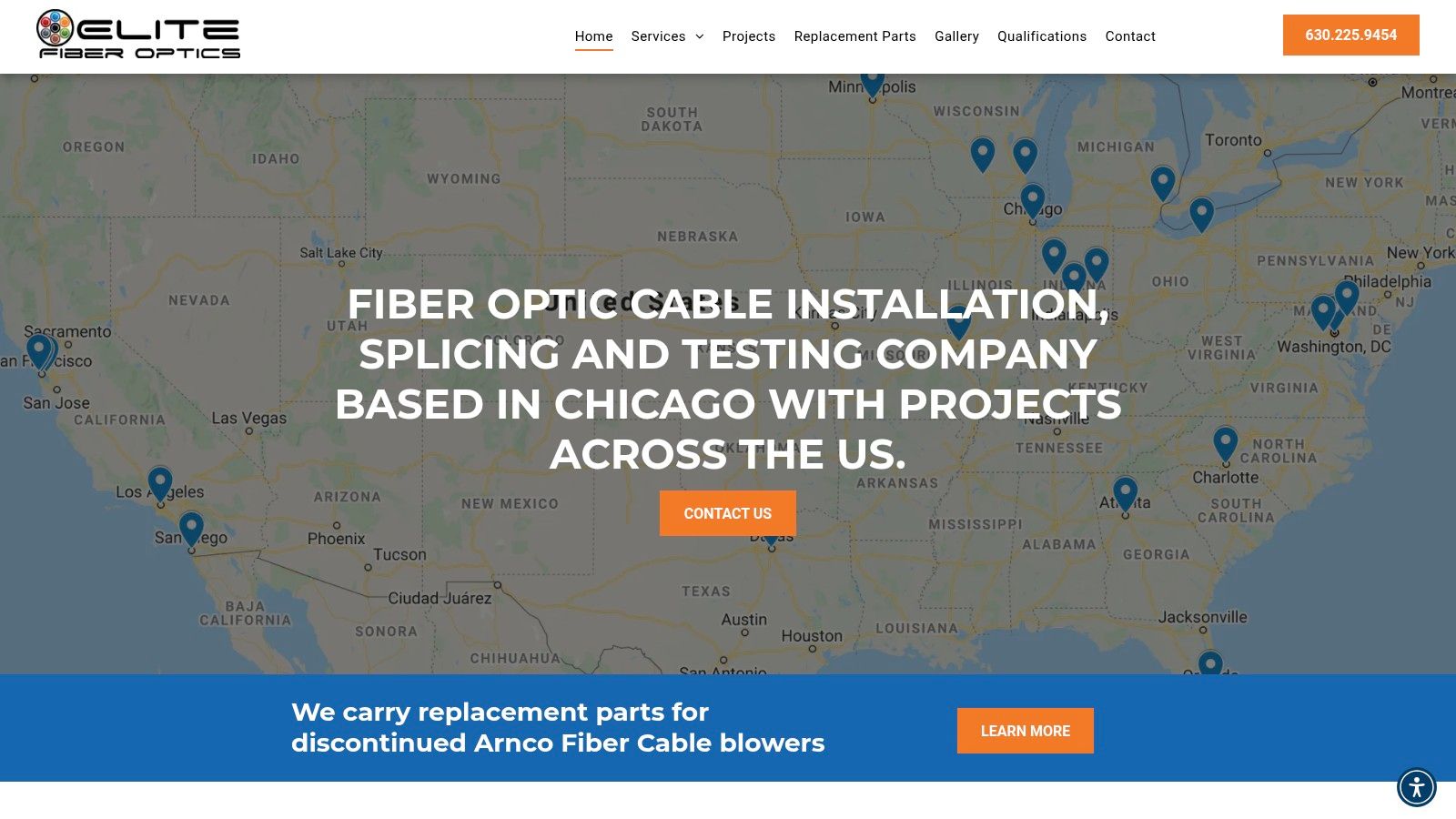
Some jobs don't need a generalist. They need a fiber specialist. Elite Fiber Optics belongs in that category.
If you're building or extending a backbone, interconnecting suites across a campus, supporting a data center environment, or fixing a fiber plant that has already been mishandled, specialization matters. Fiber work punishes shortcuts. A crew that mainly does copper and occasionally terminates fiber isn't the same as a contractor built around splicing, testing, and end-to-end fiber execution.
Why a fiber specialist can be the safer choice
Elite's listed focus is turnkey fiber installation, splicing, and testing. They also note experience with enterprise fiber projects and support for specific fiber-blowing systems and legacy equipment. That combination is useful in Chicago buildings where old pathways, constrained risers, and mixed infrastructure are common.
This is the kind of vendor I'd shortlist when downtime carries real business cost. Fiber faults can be subtle. The install may pass a visual inspection and still create headaches later if the testing discipline is weak or the routing choices were sloppy.
Fiber problems rarely announce themselves on day one. They show up later as intermittent pain, unexplained light loss, and support tickets nobody wants to own.
The limitation is scope. Elite appears fiber-centric, which is a strength and a constraint at the same time. If your project also includes VoIP phones, access control, surveillance, AV, or workstation cabling, you may need a second contractor or a GC who can coordinate trades cleanly.
That's not a deal breaker. It's just a buying decision. For pure fiber, narrow focus is often an advantage. For blended office builds, it can create extra management work. Buyers comparing providers in this lane may also want broader context on telecom infrastructure companies near me to decide whether they need a specialist or a full-scope integrator.
4. Sharlen Technologies
A common Chicago project goes sideways the same way. The cabling contractor finishes the drops, the electrician owns another piece, the security vendor is waiting on pathways, and the owner is left sorting out who is responsible for final coordination. Sharlen Technologies is a better fit for buyers trying to avoid that handoff problem from the start.
Because Sharlen operates under Sharlen Electric Company, the value here is not low bid pricing. It is trade coordination, union labor familiarity, and experience working inside facilities where shutdown windows, compliance requirements, and multiple dependent systems shape the schedule. That profile makes more sense for hospitals, institutional buildings, and larger commercial properties than for a small office that only needs a few data drops and a switch refresh.
Best suited to multi-system facilities
Sharlen lists fiber, VoIP, intercom, nurse call, integrated security, and fire-related coordination alongside network cabling. For a buyer, that changes the vetting process. The question is less about cable categories and more about scope ownership. If your telecom work touches life-safety-adjacent systems, clinical spaces, or occupied facilities, the installer needs a process for phasing, documentation, and cross-trade communication.
That matters in real projects. A clean install on paper can still create delays if pathways are shared, cutovers are staged poorly, or turnover documents do not match what was installed. Buyers planning fiber as part of a larger facility upgrade should also compare Sharlen's capabilities against specialist expectations for fiber optic installation services near you, especially if backbone work and horizontal cabling will be awarded together.
I would press Sharlen on a few points before awarding work:
- Field supervision: Ask who owns day-to-day decisions onsite and how issues get escalated when multiple trades are involved.
- Integration responsibility: Confirm whether Sharlen coordinates dependencies across voice, nurse call, security, and cabling, or whether your team still has to manage those handoffs.
- Documentation standards: Request sample closeout packages, including labeling conventions, test results, as-builts, and service records.
- Access and scheduling: Clarify how the union staffing model affects night work, phased occupancy, and restricted-area access.
The trade-off is straightforward. A broader, facility-grade contractor can reduce coordination risk, but smaller buyers may pay for capabilities they do not need. If your site has several systems that need to work together on day one, Sharlen deserves a place on the shortlist. If the job is a simple office cabling project, a narrower vendor may be easier to manage and easier on budget.
If your business operates in multiple cities, it may also help to compare requirements against network cabling services in Dallas or similar markets so your internal standards don't drift from one region to another.
5. Malko Communication Services
Malko Communication Services is worth a look when cellular coverage inside the building is part of the telecom problem. Many buyers search for a telecom installation company in Chicago and think only about data drops, MDF cleanups, and fiber extensions. Then employees complain that calls fail in stairwells, elevators, lower floors, or deep interior rooms. That's a different problem, and Malko's DAS capabilities put them in a stronger position than a basic cabling vendor.
The company combines distributed antenna system work with structured cabling, AV, and security. That makes sense for large commercial properties, public-facing facilities, and high-occupancy buildings where mobile coverage affects operations, visitor experience, and emergency communication.
When DAS changes the vendor shortlist
Malko's feature set includes design, installation, and testing of DAS, plus low-voltage voice and data cabling, and in-house AV and security divisions. For buyers dealing with both in-building wireless coverage and normal low-voltage scope, single-vendor coordination can be a real advantage.
Chicago service pages often stop at cable categories and fail to help buyers think through architecture. That's a weakness. The smarter question is whether the site will still work when Wi Fi density increases, IoT devices expand, or private network requirements show up later. Telco Technologies' market framing around private fiber networks and integrated telecom services reflects that shift toward converged infrastructure and end-to-end ownership.
The cheapest low-voltage bid can become the most expensive choice if it ignores in-building wireless coverage, backhaul capacity, or future system overlap.
Malko's likely downside is the same as other union and enterprise-oriented firms. Small office buyers may find the process heavier and the cost structure less attractive for micro projects. But if the building has wireless dead zones, public occupancy concerns, or combined AV-security-low-voltage scope, the extra rigor may be justified.
If fiber transport is part of the same project, keep a separate benchmark for fiber optic installation providers near you so DAS work doesn't distract from the backbone requirements.
6. Chicago Datacom
Chicago Datacom is the kind of contractor IT teams usually appreciate after the dust settles. The appeal isn't flashy marketing. It's serviceability. Clean racks, clear labels, documented drops, and handoff packages that don't leave the internal team guessing.
That focus sounds basic until you inherit a telecom room where patch panels aren't labeled, cable paths make no sense, and nobody knows which drops were tested. A lot of buyers learn this lesson the expensive way. For commercial interiors like offices, retail, and warehouses, Chicago Datacom's orientation toward clean, documented installs is a strong point.
Good choice for maintainable commercial networks
The listed capabilities include structured cabling with Fluke DSX-8000 certification reporting, TIA/EIA standards adherence, Wi Fi, access control, surveillance, and fiber or backbone work. This is a useful mix for companies that want one contractor to handle the interior low-voltage layer without turning the project into a giant enterprise engagement.
I'd put them on the shortlist when a maintainable environment is the priority. Some installers are fast but leave behind technical debt. Others move more deliberately and hand over a system your team can support.
Questions worth asking Chicago Datacom include:
- Labeling convention: Will they follow your standard or provide one?
- Closeout detail: Do they include certification reports, floor plans, and rack elevations?
- Growth planning: Can they reserve pathways, rack space, and patch capacity for later adds?
One practical differentiator is ownership experience. A veteran-owned contractor often understands chain of command, site discipline, and punch-list accountability in ways buyers notice during execution, even if that doesn't show up in a feature grid. The trade-off is reach. Their focus appears centered on metro and suburban Chicago, so multi-region clients may still need another partner outside the area.
7. A+ DataComm

A tenant buildout is already tight on schedule. The cabling vendor, camera installer, and fire alarm contractor all need ceiling access in the same week. In that situation, A+ DataComm stands out because its scope spans structured cabling, surveillance, and commercial fire alarm work, which can reduce coordination problems on smaller and mid-sized projects.
Their listed services cover Cat6, Cat6A, fiber, surveillance, and fire alarm installation. That mix makes them worth a look for offices, mixed-use commercial spaces, and facility upgrades where one low-voltage partner is easier to manage than several specialized subs.
One detail buyers should check closely is their Hubbell Premise Wiring Solutions Certified Installer status. That matters if your team wants a recognized component ecosystem, clearer standards alignment, and a defined path for manufacturer-backed warranty discussions. It is not a substitute for field quality, but it is a real buying factor.
Where A+ DataComm fits best
A+ DataComm makes the most sense when the project scope crosses categories. If cabling, cameras, and life-safety work need to stay on one schedule, a broader contractor can simplify site access, sequencing, and responsibility during punch-out. The trade-off is that larger buyers should verify project depth instead of assuming broad scope means enterprise-scale delivery.
Use this shortlist test during vendor review:
- Certified system details: Ask which Hubbell components they install, what testing they provide, and how warranty support is handled.
- Cross-trade coordination: Confirm whether one project manager oversees cabling, surveillance, and fire alarm milestones.
- Comparable project size: Request examples that match your environment, especially if you run multi-floor offices, regulated sites, or larger facility upgrades.
- Surveillance policy fit: If NDAA compliance matters, ask which camera lines they deploy and how they document compliance.
As noted earlier, telecom and security infrastructure purchases increasingly happen together as companies refresh spaces, upgrade networks, and standardize building systems. That trend makes integrated installers more relevant, especially for buyers using a checklist-based selection process instead of choosing on price alone.
For a business owner or IT manager, the practical question is simple. Do you need a specialist for one narrow scope, or do you need a contractor who can keep several low-voltage workstreams aligned without creating coordination risk? A+ DataComm is stronger in the second category.
Chicago Telecom Installers: 7-Company Comparison
| Provider | Implementation Complexity (🔄) | Resource & Speed (⚡) | Outcomes & Quality (📊 ⭐) | Ideal Use Cases (💡) | Key Advantages |
|---|---|---|---|---|---|
| AIT Communication Group | Moderate–High, standards-based, documentation-heavy installs | Enterprise tools (OTDR, Fluke DSX), fast quote turnaround | Audit-ready certified handoffs; high reliability ⭐⭐⭐⭐ | Multi-site, compliance-minded enterprises | Broad scope (cabling + security + wireless); strong documentation |
| Chicago Network Cabling & Fiber Optic | Low–Moderate, practical, straightforward deployments | Standard certification, free site surveys and written estimates | Reliable SMB-grade telecom + phone integration ⭐⭐⭐ | Small–medium offices and warehouses needing phones + cabling | One-source provider for telecom, phones, Wi‑Fi; free surveys |
| Elite Fiber Optics | High, specialized fiber splicing and testing workflows | Specialized crews, fiber-blowing support; project-based timelines | Top-tier fiber performance; minimal rework on critical links ⭐⭐⭐⭐ | Data centers, campuses, backbone/fiber-intensive projects | Deep fiber expertise and experienced field crews |
| Sharlen Technologies | Moderate–High, full lifecycle, union compliance considerations | Larger-contractor resources; quote-based project intake | Robust facility-grade installs; compliance-ready ⭐⭐⭐⭐ | Healthcare, large facilities, union-required sites | Union contractor; can bundle cabling with security/fire |
| Malko Communication Services | Moderate–High, DAS and integrated system complexity | In-house DAS/AV/security teams; multi-discipline resources | Strong in‑building cellular and integrated systems ⭐⭐⭐⭐ | High-occupancy buildings, venues needing DAS + AV/security | Longstanding local firm; single-contractor DAS + low-voltage |
| Chicago Datacom | Low–Moderate, commercial interiors focus with emphasis on serviceability | Fluke certification reporting and documented handoffs; quote-based | Clean, labeled, audit-ready cabling and handoffs ⭐⭐⭐⭐ | Offices, retail, warehouses needing tidy, serviceable installs | Emphasis on labeling, documentation, and serviceability |
| A+ DataComm | Low–Moderate, standard structured cabling with manufacturer practices | Hubbell-certified installer; integrates surveillance and fire alarms | Warranty-aligned cabling; compliant surveillance options ⭐⭐⭐ | Clients seeking manufacturer-backed warranties and integrated systems | Hubbell Premise Wiring certification; single-vendor cabling + safety systems |
Your Buyer's Checklist for Choosing an Installer
A Chicago office cutover can fail in ordinary ways. The crew finishes the pull on schedule, but ports are mislabeled, rack layouts do not match the drawings, and test results arrive after users are already trying to connect. Your IT staff then spends the first week fixing a handoff problem that should have been solved before installation began.
That is why a shortlist is only the start. The better buying decision comes from matching the installer to your site conditions, internal team capacity, and tolerance for downtime. A telecom installation company Chicago businesses hire should be able to explain how it handles access, supervision, documentation, change orders, and support after turnover, not just what cable or hardware it installs.
Start with project control. Ask who runs the job day to day, who is on site each shift, and who approves scope changes. In Chicago buildings, those details affect permits, riser access, elevator scheduling, rooftop coordination, after-hours work, and communication with property management. If a low bid stays vague on those points, expect delays, extras, or both.
Then review turnover standards. Request sample Fluke reports, labeling formats, as-builts, rack photos, and closeout packages from recent projects. A contractor may know cabling specs well and still create months of cleanup if records are incomplete or inconsistent.
Use this checklist during walkthroughs and bid reviews:
- Scope ownership: Confirm which systems the installer handles with its own crews and which are subcontracted, including structured cabling, fiber, Wi-Fi, voice, access control, DAS, surveillance, and fire alarm.
- Testing and closeout: Ask what gets tested, what certification tools are used, and what documents you receive at handoff.
- Site controls: Review permit responsibility, riser and rooftop access, outage planning, safety procedures, change-order approval, and building coordination.
- Growth fit: Check whether the design leaves capacity for more fiber strands, faster uplinks, additional APs, new IoT devices, or future carrier changes.
- Post-install support: Identify who handles punch-list items, warranty issues, MACs, and service calls after the install is complete.
If a contractor cannot describe how the work will be controlled, the project will be controlled on your site by trial and error.
A simple scoring sheet helps separate firms that sound similar in a proposal. Rate each bidder on technical fit, documentation quality, field supervision, change-order discipline, and post-turnover support. That comparison makes the trade-offs clearer. One firm may be the right choice for a data center or fiber-heavy backbone project. Another may fit a multi-floor office buildout better. A smaller, lower-cost contractor may be the right call for a straightforward SMB refresh with limited complexity.
Lifecycle planning also belongs in the vendor review. If the job includes retiring PBX hardware, switches, cameras, handsets, or old cabling, define who handles removal, chain of custody, and final disposition before work starts. That step matters in relocations, consolidations, and decommissions, especially when facilities, compliance, and procurement each need different paperwork. Alongside installation planning and decisions around choosing the right business phone system, some teams also include documented asset disposal through providers such as Atlanta Green Recycling.
Choose the installer based on the cost of failure in your environment. The seven companies above serve different project types, risk profiles, and support models. Use the comparison and this checklist to vet them like a buyer, not just a requester of quotes.