
Top 7 Telecom Contractor Los Angeles Options for 2026


Finding the right telecom contractor in Los Angeles usually starts when something is already at risk. A new office needs cabling before move-in. A hospital wing needs a clean cutover window. A school, warehouse, or municipal site has aging fiber, weak Wi-Fi coverage, or an MDF that nobody wants to touch because the labeling never matched reality.
In this market, a bad install doesn't stay contained to the telecom room. It spills into delayed openings, failed turn-ups, noisy change orders, and avoidable downtime. Los Angeles is a dense, interconnection-heavy environment, and that matters. Baxtel lists 79 Los Angeles data centers with 4,778,832 square feet and 358 MW of critical power, plus one facility under construction. That concentration changes the kind of contractor work that succeeds here. Most jobs aren't simple greenfield pulls. They're retrofits, turn-ups in live spaces, and tightly coordinated work around occupied facilities.
The labor side matters too. In the U.S. market that includes telecom contractor work, the median annual wage for telecommunications technicians was $64,310 in May 2024, or $30.92 per hour, and the occupation is projected to decline 3% from 2024 to 2034 while still generating about 23,200 openings per year on average. In practical terms, good field talent in Los Angeles isn't interchangeable. Buyers who assume every low-voltage crew can handle certification, live-environment coordination, and clean closeout usually learn that too late.
Below is a practical shortlist of telecom contractor Los Angeles options I'd put through a serious bid process, along with the trade-offs worth checking before award.
1. Lawrence Cable Service

Lawrence Cable Service is the kind of contractor I'd shortlist when the job needs structured cabling done cleanly from design through final test results. Their core value is straightforward. They handle copper, fiber, wireless LAN support, and voice-related work without forcing the client to coordinate three separate niche vendors for a mid-size rollout.
The practical appeal is their documented workflow. They don't just pull cable and disappear. They position around installation, testing, certification, and turnover, which matters when your internal IT team has to inherit the site and support it later.
Where Lawrence Cable Service fits best
This is a solid fit for offices, clinics, schools, and commercial sites that need Cat5e, Cat6, Cat6A, or fiber work with a clear closeout package. If your project includes single-mode or multimode backbone runs, patch panel cleanup, access point placement, or VoIP-related troubleshooting, they cover enough scope to keep the handoffs manageable.
That said, buyers should be realistic about the profile. Their website presents them as serving both residential and commercial customers. That doesn't automatically disqualify them. It just means enterprise buyers should confirm who will perform the work on the job, who manages the project, and whether the assigned crew routinely handles occupied commercial environments.
Practical rule: Ask to see one sample certification package before award. If the contractor hesitates, assume the closeout won't be strong.
A few things stand out in a positive way:
- Design through turnover: They appear to support the full path from initial layout to final test documentation.
- Wireless LAN support: That's useful when your project isn't only about copper drops, but also about AP placement, bridges, or point-to-point links.
- Troubleshooting capability: Contractors who can troubleshoot existing voice and cabling issues usually reduce finger-pointing during upgrades.
What to verify before signing
The main drawback is transparency. Public pricing isn't posted, so this is a quote-driven buy. That's normal in telecom contracting, but it puts more pressure on your scope document and your bid leveling process.
If I were vetting Lawrence Cable Service for a telecom contractor Los Angeles project, I'd ask for these specifics in writing:
- Crew assignment: Confirm whether your site gets a commercial-only crew.
- Testing standard: Confirm what copper and fiber test results are delivered at closeout.
- Change-order handling: Ask how field discoveries get documented before extra work starts.
If you're still gathering bids, it helps to compare local proposals against a broader telecom service quote framework so you're not evaluating each estimate on different assumptions.
2. Los Angeles Cabling
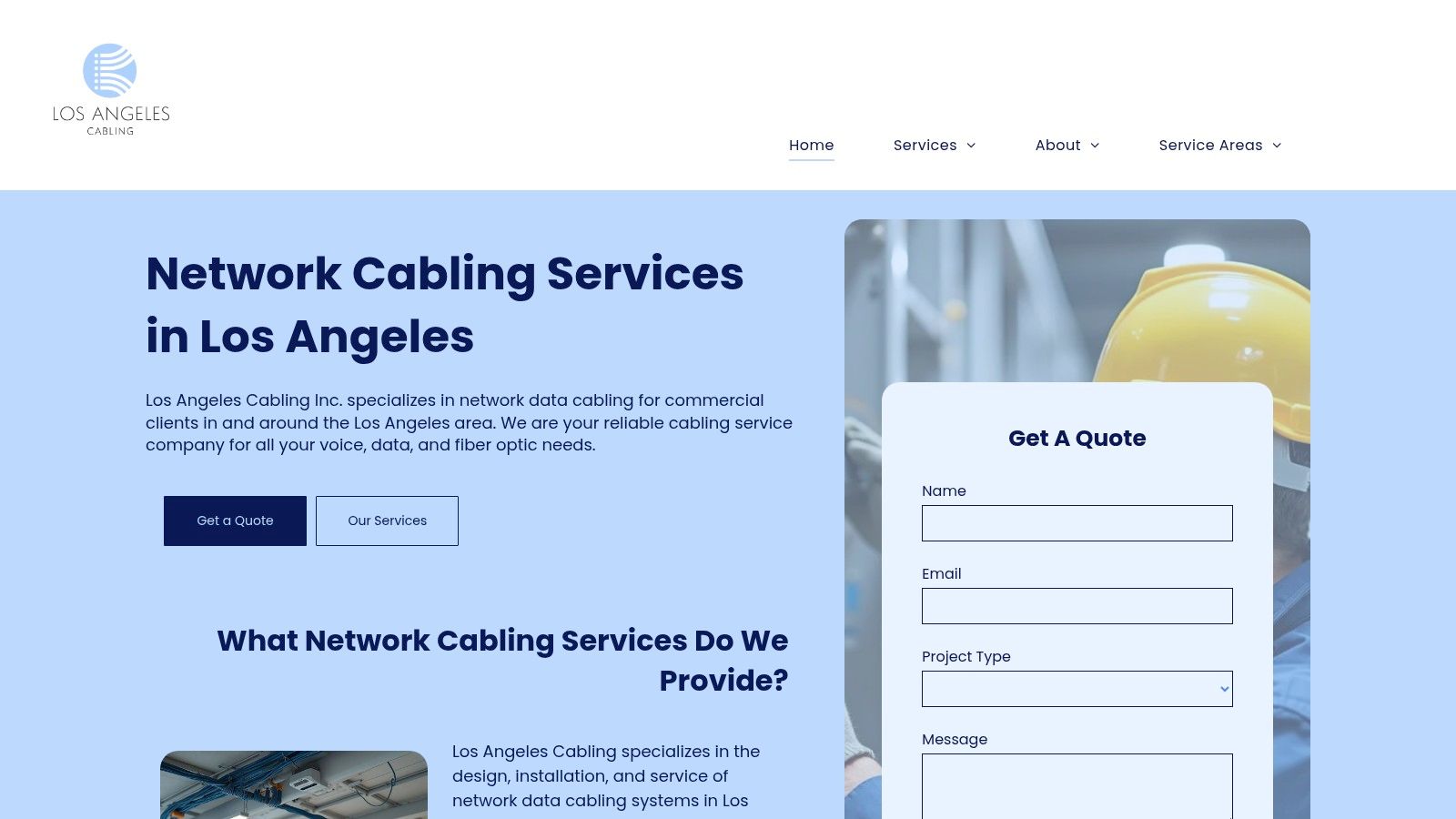
Los Angeles Cabling makes sense when your project sits at the messy intersection of low-voltage and electrical scope. Their active C-7 and C-10 licensure is the first thing I'd pay attention to because mixed-scope jobs are where change orders often get out of control if the contractor can't legally absorb adjacent work.
That matters more in Los Angeles than many buyers expect. Tenant improvements, IDF upgrades, and server room work often turn into pathway, grounding, power, and patching conversations all at once. A vendor that can stay inside both lanes usually keeps the paperwork cleaner.
Why this one stands out
Their service mix is broad in a useful way. Structured cabling, fiber optic splicing and testing, server room buildouts, and documentation-heavy closeout all sit inside the same offering. They also present experience with public works and prevailing wage environments, which is important if the buyer is a school, municipality, or agency buyer rather than a private office tenant.
In California, the broader wireless telecom market is large but mature. IBISWorld estimates California's wireless telecommunications carriers market at $41.1 billion in 2026, with 2,737 businesses and 39,907 employees, while revenue declines at an average annual rate of 1.5% from 2021 to 2026. For contractors, that usually means buyers care less about flashy sales language and more about speed, documentation, compliance, and labor efficiency. Los Angeles Cabling is positioned in a way that aligns with that reality.
The trade-offs to watch
This isn't an enterprise-only specialist. They also market residential, AV, and security work. Again, that's not in itself a problem. It just means your procurement questions should get sharper.
I'd press on three points before moving them to final award:
- Dedicated commercial supervision: Who runs the site every day, and what's their comparable project history?
- Closeout format: Ask for an example package for MDF/IDF turnover, including labels and test files.
- After-hours support: Confirm response expectations for occupied-site cutovers.
In public-sector and school work, documentation quality often matters as much as installation quality. Missing closeout paperwork can delay acceptance even when the physical work is fine.
If you want a useful comparison baseline for structured cabling scope, look at this outside-market reference on network cabling services and use it to tighten your own statement of work before bid review.
3. Fiber Techs Los Angeles
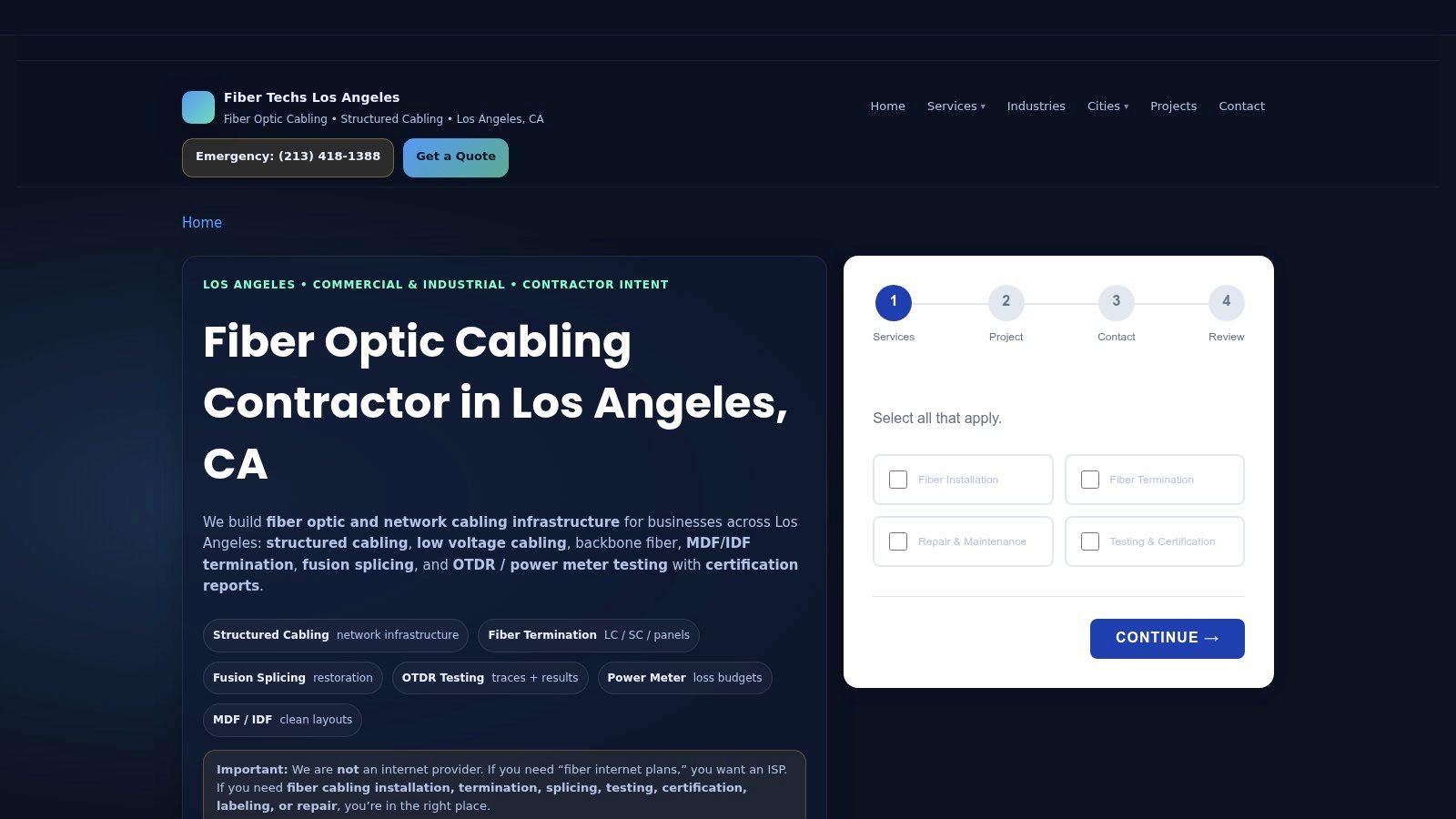
Some firms try to be everything. Fiber Techs Los Angeles doesn't seem to be playing that game. That's exactly why they belong on this list. If your job is fiber-first, backbone-heavy, or restoration-sensitive, a specialist can be the better choice than a broader low-voltage contractor with only occasional splicing capability.
Their positioning is useful because they present themselves as a cabling contractor rather than an ISP. That reduces confusion around roles. For internal IT teams and general contractors, that distinction makes coordination simpler. You know who owns physical plant work, who owns testing, and who owns carrier activation.
Best use cases
I'd look closely at Fiber Techs Los Angeles for commercial and industrial sites where the backbone matters more than the endpoint count. Think OS2, OM3, or OM4 runs between MDF and IDF, panel terminations, fusion splicing, OTDR testing, insertion-loss validation, and emergency restoration needs.
This type of contractor earns value in turnover quality. When a site has compliance requirements, a landlord handoff, or a mission-critical room that can't tolerate sloppy testing, fiber documentation becomes part of the deliverable, not an afterthought.
Los Angeles also sits inside a wider Southern California telecom-services environment serving multi-site organizations. One provider markets managed telecom services specifically across Los Angeles and Orange County, while Bain reported a $28 billion free cash flow gap for major U.S. telecom operators relative to aspirational share-price targets. That larger financial pressure is one reason buyers increasingly value contractors who can tighten installs, coordinate cleanly, and reduce operating friction rather than offering manpower alone.
Where the narrower scope can help, and where it can hurt
Specialization usually cuts both ways. The upside is sharper fiber execution, cleaner test packages, and stronger restoration capability. The downside is scope gaps.
If your project also needs telephony migration, integrated access control, broad AV scope, or electrical coordination, you may need partner trades. For some buyers, that's acceptable because the fiber backbone is the true risk item. For others, it creates too many handoffs.
- Strong fit: Backbone builds, fiber repair, certification-heavy turnover, industrial environments
- Potential gap: Unified communications, large integrated security scope, electrical tie-in
- Smart question: Ask whether they provide sample OTDR and loss-test closeout files before mobilization
For planning work that starts with fiber and expands into broader telecom infrastructure decisions, this fiber optic installation reference point is useful for framing what should sit inside contractor scope versus owner or carrier responsibility.
4. A Skyline Communications

A Skyline Communications is a practical option when a buyer wants one contractor to handle cabling, voice, access control, surveillance, and intercom without splitting the work across multiple subs. That kind of bundled scope isn't always the right answer, but for small and mid-size commercial sites it can reduce project drag.
Their local tenure goes back to 1996, which gives them credibility in a market where vendor continuity matters. Longstanding presence doesn't guarantee quality, but it usually means the company has seen enough retrofit conditions, landlord constraints, and live-site complications to avoid the obvious mistakes.
Why bundled low-voltage scope matters
A lot of telecom contractor Los Angeles searches come from buyers who don't need a pure telecom specialist. They need a low-voltage lead who can coordinate phone systems, network cabling, cameras, door access, and intercom at the same time. For clinics, schools, churches, office suites, and smaller campuses, that bundled approach can save serious coordination time.
The upside is simple. One vendor is responsible for pathways, rack space, endpoint coordination, and sequencing. That reduces the classic problem where the cabling crew blames the security vendor and the phone vendor blames the IT team.
The limitations are real
Buyers must exercise discipline. Their site emphasizes both residential and commercial work, so enterprise buyers should confirm that the assigned project team regularly handles commercial installations at the scale you need. A contractor can be perfectly competent and still be wrong for a multi-floor migration, a healthcare site, or a heavily documented public-sector environment.
The best single-vendor option isn't the one with the broadest website. It's the one that can show clean scope boundaries between cabling, security, voice, and handoff.
I'd specifically ask A Skyline Communications about:
- Commercial project mix: What building types dominate their current work?
- Network-security coordination: Who owns IP addressing, switch ports, and final device commissioning?
- Closeout discipline: Do they provide separate records for cabling and security systems?
If your organization is trying to decide whether one integrated vendor is better than multiple specialists, this external benchmark on telecom infrastructure companies can help frame the trade-off.
5. L.A. Electricom

L.A. Electricom belongs on the shortlist for one reason above all. They can combine communications cabling with commercial electrical work up to 600V. When your project touches both power and low-voltage, that can simplify scheduling, responsibility, and acceptance.
They're also an IBEW Local 11 signatory contractor, which matters for certain municipal, school, and public works jobs where labor structure and prevailing-wage alignment aren't optional procurement details. If you know your project is headed into a union-sensitive environment, that should shape the shortlist early instead of becoming a late-stage surprise.
Best fit for this contractor
I'd look at L.A. Electricom when the work includes electrical infrastructure, communications cabling, and public-agency style documentation under one roof. Panasonic telecom system relationships also suggest they can support some phone-system oriented environments where buyers don't want a separate voice dealer floating outside the install chain.
Their practical strength is coordination. On projects where power feeds, rack power, low-voltage pathways, and telecom system scope all move together, a combined contractor can cut down on finger-pointing.
California's broadband-buildout shift adds another layer to this. The statewide middle-mile network continues to expand, with active hut construction beginning at five Southern California sites in late 2025 and about 52 more expected by March 2026, while nearly 4,430 miles had moved into installation by that time. For buyers in schools, public agencies, and enterprise sites, the contractor's value increasingly comes from bridging building infrastructure to available fiber, managing handoff details, and reducing friction between construction and service activation. A firm that understands both utility-side realities and in-building scope has an advantage.
The caution flag
Their website appears lightly updated, and that's not something I'd ignore. An outdated website doesn't mean outdated field capability, but it does mean you should verify current certifications, recent references, and who's actively managing communications work today.
Ask these before award:
- Current project examples: Preferably recent work similar in occupancy and compliance profile
- Communications lead: Confirm who owns telecom scope versus electrical scope
- Labor plan: Clarify whether all field roles are in-house for your project
If your project overlaps telephony, collaboration, and site infrastructure decisions, this outside-market reference on unified communications providers in Los Angeles can help tighten your buying criteria.
6. National Data Cabling

National Data Cabling is the option I'd consider when the Los Angeles project is only one site inside a larger rollout. They're headquartered in Los Angeles, hold a California C-7 low-voltage license, and market nationwide deployment capability, which is useful for enterprises standardizing scope across multiple offices, clinics, retail locations, or warehouse sites.
That rollout capability matters because many local contractors do excellent single-site work but struggle when the client needs the same standards, closeout package, and escalation path across a regional or national program.
Why they can be a strong enterprise candidate
Their service catalog is broad enough to support structured cabling plus adjacent wireless and in-building coverage work. Fiber optic cabling, OSP capability, Wi-Fi, cellular DAS, public-safety BDA/ERRCS, CCTV, and access control all appear in the mix. For an enterprise buyer, that breadth can be an advantage if one PM and one standards package need to follow multiple site types.
This can also fit Los Angeles particularly well because resilience and live-environment coordination matter more than many buyers expect. Existing market content often overfocuses on installation speed while underexplaining carrier diversity, phased decommissioning, and outage tolerance. In Los Angeles, where building-level architecture still determines real reliability, contractor value increasingly comes from reducing single points of failure and handling migration without exposing the site to unnecessary outage risk, as reflected in broader discussion around telecommunications installation in Los Angeles.
What I'd push hard on in diligence
Broad marketing language is useful for lead generation, but it's not enough for award. With a company like this, I'd ask for evidence from recent Los Angeles jobs instead of accepting generic national capability claims.
My diligence list would be short and direct:
- Sample closeout package: Copper and fiber test output, labeling records, as-builts
- Recent LA references: Not just any references. Similar building types in the same region
- Scope ownership: Confirm who handles DAS, ERRCS, Wi-Fi, and cabling if multiple specialties are involved
If a contractor says they do everything, ask which crew does each part and who signs off on the handoff package. That answer tells you whether the breadth is real or just marketing.
7. United Fiber Comm., Inc.

United Fiber Comm., Inc. sits in a different lane from most of the firms above. This is the contractor I'd look at for aerial and underground outside-plant work, carrier-style upgrades, emergency restoration, and make-ready-heavy projects where permitting and engineering coordination can make or break the schedule.
If your need is mostly inside the suite, this probably isn't your first call. If your problem starts in the street, on poles, in conduit, or across a campus route, they become much more relevant.
Where they're strongest
Their profile points to OSP and ISP construction, fiber and coax splicing, make-ready engineering, traffic control planning, and round-the-clock emergency response. That's a strong fit for carriers, municipalities, utility-adjacent work, and enterprise campuses with real outside-plant complexity.
Los Angeles buyers increasingly need contractors who understand the line between public broadband expansion and actual building connectivity. The middle-mile network doesn't solve the final connection into the facility. A contractor who can manage handoff points, access, permitting, and service activation details often saves more time than a lower bid from a simpler cabling vendor.
The bigger Southern California telecom environment supports that view. Los Angeles and Orange County continue to attract managed telecom services for complex multi-site organizations, while operator cost pressure remains high. In a market like that, OSP-capable contractors have real value when the work involves infrastructure optimization instead of simple interior adds and changes.
What to verify
United Fiber Comm. is headquartered outside central Los Angeles, so I'd confirm dispatch expectations and labor-fit details early, especially if the project has union or agency constraints. I'd also want clarity on whether engineering, construction, and restoration sit under one accountable PM for your specific scope.
Three good questions for this contractor:
- Permitting path: Who owns submittals, traffic control coordination, and utility communication?
- Emergency process: What's the actual escalation path during an outage?
- Turnkey boundary: Where does their scope stop and the carrier or owner scope begin?
For the right project, those answers matter more than website polish.
Top 7 LA Telecom Contractors Compared
| Provider | Implementation complexity 🔄 | Resource requirements ⚡ | Expected outcomes 📊 | Ideal use cases 💡 | Key advantages ⭐ |
|---|---|---|---|---|---|
| Lawrence Cable Service | Moderate, copper + fiber + WLAN design/install | Skilled cabling crews, certification testers, local mobilization | Certified Cat & fiber installs; documented test reports | Local commercial/residential sites, WLAN and PBX rollouts | 25+ years local experience; end-to-end design→certification ⭐⭐⭐⭐ |
| Los Angeles Cabling | High, combined low-voltage & electrical scopes (C-7 & C-10) | Bonded/licensed crews, electrical and low-voltage resources, public-works compliance | Certified closeouts; compliant documentation for prevailing wage jobs | Public-sector, mixed ELV/electrical projects, MDF/IDF buildouts | Dual licensure simplifies mixed-scope change orders ⭐⭐⭐⭐ |
| Fiber Techs Los Angeles | Moderate, fiber-specialist backbone & restoration work | Fusion splicers, OTDR/power-meter testing gear, fiber crews | High-quality OTDR/insertion-loss reports and certified splices | Backbone fiber installs, emergency fiber restoration, compliance turnovers | Deep fiber testing/splicing specialization; clear cabling-only scope ⭐⭐⭐⭐ |
| A Skyline Communications | Moderate, multi-discipline (cabling + security + voice) | Multi-skilled technicians for cabling, access control, CCTV | Converged cabling + security/voice integration with closeout docs | SMBs, clinics, small campuses wanting single-vendor delivery | Long local tenure; single contractor for cabling & physical security ⭐⭐⭐ |
| L.A. Electricom | High, integrated electrical (up to 600V) + comms | Union (IBEW) workforce, electrical and comms crews, dealer partnerships | Combined power & comms installations; meets union/public-works specs | Municipal, schools, projects requiring prevailing-wage/union labor | IBEW signatory; streamlined power ↔ comms coordination ⭐⭐⭐⭐ |
| National Data Cabling | High, enterprise & multi-site programs; DAS/BDA capability | Nationwide rollout teams, wireless/DAS specialists, OSP capability | Program-level rollouts, NIST-level testing claims, broad wireless integration | Multi-site enterprise deployments, cellular DAS/BDA, Wi‑Fi rollouts | Nationwide scale plus wireless/DAS expertise for enterprise programs ⭐⭐⭐⭐ |
| United Fiber Comm., Inc. | High, OSP aerial/underground, make-ready and carrier work | OSP construction crews, traffic control/make-ready engineering, 24/7 restore teams | Carrier-grade OSP builds, make-ready engineering, rapid emergency restoration | Carrier, municipal OSP projects, complex permitting/make‑ready | Strong OSP & emergency restoration capability; carrier experience ⭐⭐⭐⭐ |
Your Blueprint for Choosing the Right Contractor
A shortlist is only the beginning. The key decision happens when you force each telecom contractor Los Angeles option to answer the same operational questions in the same format. That's how you avoid the classic trap where one bid looks cheaper only because it omitted testing, patching, closeout documents, demo, or after-hours work.
Start with legal and risk controls. Verify the license class that matches the work. Confirm general liability and workers' compensation coverage. If the project touches design responsibility, engineering, outside-plant routing, or public works compliance, don't assume those obligations are covered just because the contractor “has done similar jobs before.” Get current certificates, the exact contracting entity name, and the PM's contact details before price negotiations get too far.
Then move to field-fit questions. A contractor can be competent and still be wrong for your site type. Hospital work, occupied office cutovers, school calendars, municipal procurement, industrial retrofits, and colocation environments all behave differently. Ask for recent references that match your building type and job condition, not just generic “commercial” references. A polished project in an empty shell space doesn't tell you much about how the contractor performs during night work in an occupied building.
Here's the filter I use most often when leveling bids:
- Scope completeness: Does the proposal clearly state pathways, cable types, patch panels, labeling, testing, cleanup, and closeout?
- Crew fit: Is the assigned team experienced in your environment, or are you getting whoever is free?
- Testing and handoff: Will you receive certification reports, as-builts, labeling records, and punch-list resolution before final payment?
- Change-order discipline: Does the contractor document field discoveries before extra work starts?
- Coordination strength: Can they work effectively with landlord reps, carriers, IT, facilities, and other trades?
Pricing deserves a more disciplined look than most buyers give it. Telecom contractors usually quote by project scope, time and materials, unit pricing such as per-drop, or some hybrid of the three. None of those models is always better. The key is whether the scope is tight enough to compare bids fairly. A per-drop price sounds convenient until one contractor includes patch cords, labeling, certification, and pathway work while another excludes half of it. Time and materials can be perfectly reasonable for troubleshooting and uncertain retrofit conditions, but it needs not-to-exceed controls and written approval triggers.
Closeout documentation is where good contractors separate themselves from crews that only install. For copper work, that usually means certification results and labeling records. For fiber, it means splice records, OTDR or other testing output, and clear panel identification. For any serious office, healthcare, school, or government project, this is not optional. If your internal team can't support the system without calling the installer back to decode what was built, the handoff failed.
Union versus non-union is another question buyers often oversimplify. Union contractors can be the better fit when public works rules, prevailing wage, labor agreements, or large mixed electrical and communications scopes are involved. Non-union firms can be more agile on some private-sector projects, especially smaller and mid-size work where scheduling flexibility matters most. The right answer depends on procurement rules, building access constraints, schedule, and adjacent trades. It shouldn't be treated as an ideological decision.
One more point gets missed too often. Telecom projects create retirement work. Old switches, phones, servers, access points, structured cabling remnants, and storage media don't vanish when the new system goes live. Someone has to decommission, segregate, document, sanitize, and remove that equipment responsibly. If you don't build that into the project plan, the site ends up with closets full of retired gear and unnecessary data-handling risk.
The safest buying process is simple. Write a precise scope. Require sample closeout documents before award. Check references with sharp questions about missed scope, failed tests, and communication under pressure. Hold final payment until turnover is complete. That's the difference between hiring a contractor and managing project risk.
If your telecom upgrade, office move, or data center cleanup leaves you with retired switches, phones, servers, storage media, or other IT equipment to remove, Atlanta Green Recycling is worth keeping in your project plan. They handle secure electronics recycling, data destruction, de-installation, packing, and pickup for businesses that need compliance-minded closeout. They're also easy to position as an ESG and CSR win. Their mission-driven model connects responsible recycling with veteran support and tree planting, which gives companies a stronger story for internal sustainability reporting and community impact. For teams that want disposal handled professionally instead of treated like an afterthought, Atlanta Green Recycling offers a practical way to turn end-of-life IT assets into documented, secure, purpose-driven outcomes.