
Atlanta Smart City Initiatives and IT Growth: A 2026 Guide

If you manage IT in Atlanta right now, you're probably dealing with two timelines at once. One is public and visible: smart corridors, connected infrastructure, more sensors, more data, more expectations. The other is operational: aging laptops in a school lab, retired networking gear in a hospital closet, surveillance storage arrays at the end of support, and a procurement team asking what gets replaced next.
That gap matters. Atlanta's smart city momentum doesn't just create headlines about mobility and innovation. It creates a growing stream of equipment that has to be purchased, tracked, secured, refreshed, and eventually removed without exposing data or creating an e-waste problem.
For IT directors, facilities teams, school administrators, compliance officers, and healthcare leaders, Atlanta Smart City Initiatives and IT Growth isn't an abstract civic story. It's a daily asset management story. It affects budgets, device inventories, audit trails, vendor selection, and disposal workflows.
Understanding Atlanta's Smart City Vision
Atlanta has treated smart city development as infrastructure, not as a gadget showcase. That distinction matters because it changes how organizations across the metro area should think about risk, procurement, and long-term support.
The city's modern push was driven by a $250 million infrastructure bond and paired with institutional partnerships, including Georgia Tech, to address traffic congestion and improve public services. That tells you something important right away. Atlanta didn't frame this work as a limited trial. It framed it as a broad modernization effort tied to mobility, civic operations, and research capacity.

What smart city means in Atlanta
In practical terms, a smart city here means the city is layering digital systems onto physical infrastructure. Roads, signals, transit connections, public space, and service delivery all start to depend on shared connectivity and data.
That changes the operating environment for private and public organizations alike. A city that's building smarter transportation and more connected public systems also raises the baseline expectation for how buildings, campuses, offices, and institutions manage their own technology.
A facilities leader upgrading access control or environmental sensors isn't working in isolation anymore. That project sits inside a broader regional shift toward connected operations. The same is true for healthcare campuses, K-12 districts, universities, and companies running multi-site offices.
For teams planning around building automation, connected controls, and operational efficiency, it helps to look at how smart building technologies in Atlanta fit into the same wider ecosystem.
What works and what doesn't
What works is a shared civic objective. Atlanta's model ties together transportation, service improvement, and institutional collaboration. That usually leads to stronger vendor ecosystems, more technical experimentation, and more pressure to build systems that can scale.
What doesn't work is treating smart city language as if it automatically solves operational issues. New infrastructure still needs lifecycle planning. Sensors fail. Poles need maintenance. Edge devices age out. Storage fills up. Firmware creates support headaches. Every connected deployment becomes an asset management problem eventually.
Practical rule: If a project adds connectivity, it also adds end-of-life responsibility.
That's the part many organizations underestimate. They see the front-end gains first, then discover the back-end burden later. In Atlanta, the vision is ambitious and real. But the organizations that benefit most will be the ones that prepare for the full lifecycle of the technology, not just the rollout.
How Smart Initiatives Fuel Regional IT Growth
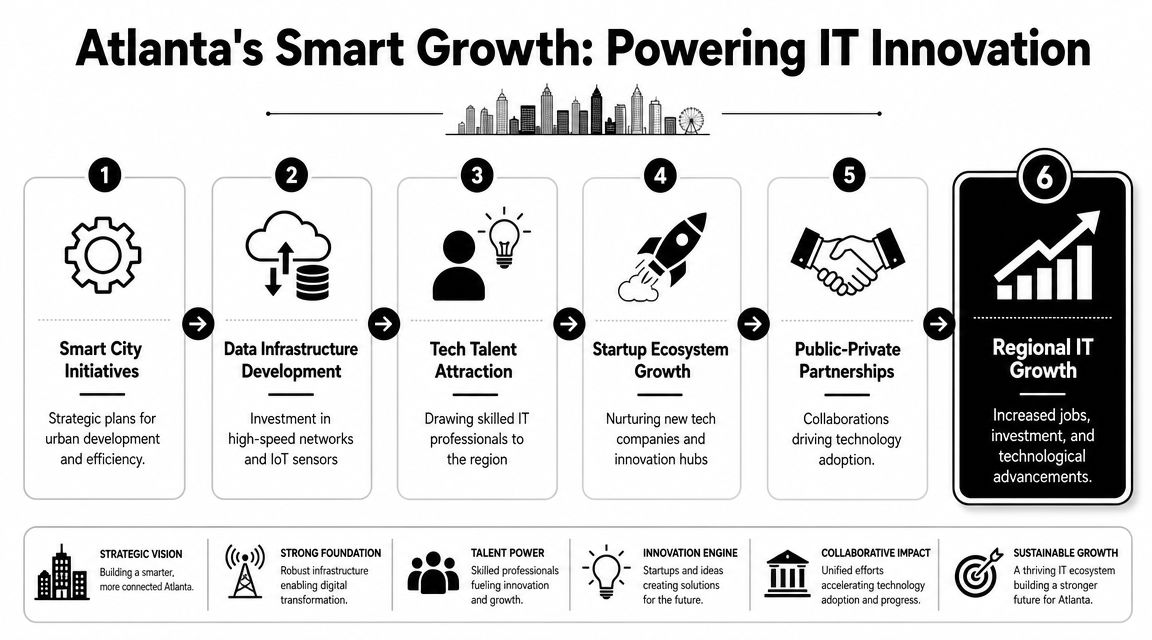
Atlanta's smart city buildout doesn't stop at intersections or municipal departments. It pushes demand outward into the regional IT economy. Once a city starts relying on connected infrastructure, more organizations need the hardware, software, storage, and support layers that make those systems usable.
The city's strategy explicitly uses new fiber deployment, smart poles, and Wi-Fi connectivity to create a shared communications backbone, according to the Atlanta Smart City Strategic Infrastructure Initiative summary from US Ignite. In the North Avenue Smart Corridor, that backbone supported a dense IoT deployment across 26 signalized intersections using AI and advanced sensors, as described in the same initiative overview.
How civic infrastructure turns into hardware demand
A smart corridor sounds like a transportation project. In practice, it's also a stack of equipment and services:
- Network hardware: fiber terminations, switches, routing equipment, wireless endpoints, and supporting power systems
- Field devices: cameras, sensors, controllers, smart poles, edge compute components, and signal hardware
- Back-end systems: storage arrays, analytics platforms, monitoring dashboards, backup infrastructure, and secure archives
- Operational support tools: asset tracking, maintenance systems, replacement planning, and vendor management workflows
That demand doesn't stay inside city hall. Integrators, healthcare systems, universities, logistics operators, commercial developers, and property managers all respond to the same environment. Once the city becomes more connected, everyone who plugs into that environment feels pressure to modernize too.
A regional IT team may not buy roadside sensors. But it may buy more wireless gear, replace legacy surveillance systems, expand storage retention, or upgrade structured cabling to support smarter facilities. Those are downstream effects of the same trend.
Why Atlanta organizations feel the pressure
The practical impact shows up in refresh cycles. Teams that used to replace standard office equipment now have to think about mixed fleets of laptops, tablets, access-control devices, digital signage players, VoIP phones, AV hardware, and IoT endpoints.
That's especially true in environments with multiple buildings or strict uptime needs. Hospitals add connected clinical and nonclinical systems. Schools add classroom devices and campus network gear. Office campuses add badge systems, cameras, and environmental controls.
A lot of leaders still think of IT growth as more hiring or more cloud adoption. In Atlanta, it also means more physical technology in more places.
Here's the pattern I see most often:
| Operational shift | What it usually adds |
|---|---|
| Smarter buildings | More controls, gateways, and retired legacy equipment |
| Connected campuses | More Wi-Fi hardware, switching, and endpoint turnover |
| Data-driven facilities | More sensors, more storage, more devices with embedded data |
| Faster response expectations | More monitoring tools and less tolerance for undocumented disposal |
Teams planning larger infrastructure transitions should also understand the local context around data center activity in Georgia, because the same growth pattern affects storage, decommissioning, and hardware retirement practices.
The front-end story is connectivity. The back-end story is asset volume.
That's why IT growth in Atlanta isn't just a hiring trend. It's a hardware lifecycle trend.
The Hidden Lifecycle of a Smart City's Technology
Most smart city coverage focuses on what gets installed. Very little attention goes to what has to be retired, wiped, documented, and recycled once those systems age out.
That omission is a problem for organizations carrying the largest device inventories. Public materials often highlight innovation districts and pilot programs, but they leave a basic operational question underexplored: how do hospitals, schools, universities, and agencies handle end-of-life technology safely when the region keeps adding more connected systems? The Atlanta Beltline smart-cities initiative page captures that broader equity and pilot-stage context, and it points to a gap around measurable downstream outcomes for institutions managing major IT asset volumes.
The risk isn't just e-waste
When organizations hear “disposal,” many still think about loading obsolete equipment onto pallets and clearing space. That's too narrow.
A retired asset can hold regulated data, credentials, network history, location records, cached files, security footage, patient information, or student records. The device may look dead from an operations standpoint and still be fully alive from a compliance standpoint.
For regulated sectors, disposal is part of risk management:
- Hospitals and clinics have to protect data-bearing devices tied to HIPAA-sensitive environments.
- Schools and universities have to account for student information and shared-device sprawl.
- Government entities need documented handling, controlled chain of custody, and sanitization practices that stand up to review.
- Private companies face contract obligations, internal security policies, and reputation risk if retired hardware leaks data.
Where teams usually get in trouble
The biggest failures are rarely dramatic. They're procedural.
A campus refresh ends, but nobody separates reusable assets from scrap. A closet fills with old laptops and access points because no one wants to sign off on disposal. Drives are pulled from service but not documented. A department uses an office move to get rid of legacy gear quickly, and chain-of-custody records become incomplete.
That's why IT asset disposition planning needs to start before the pickup date. By the time equipment is stacked in a loading dock area, most of the important decisions should already be made.
Old equipment becomes risky long before it leaves the building. Risk starts the moment support ends and ownership gets fuzzy.
What disciplined organizations do differently
They treat end-of-life handling as part of the deployment lifecycle, not as an afterthought. That usually includes clear ownership, documented inventory, a decision tree for redeploy versus retire, and approved methods for sanitization and downstream processing.
They also pay attention to hidden categories of smart city spillover equipment. Not every risky asset looks like a server. It might be a firewall appliance, a multifunction printer, a camera recorder, a digital kiosk controller, or a storage module inside another piece of equipment.
The smarter Atlanta becomes, the more important this gets. Growth in connected infrastructure is real. So is the pile of hardware that follows it.
E-Waste Opportunities for Atlanta Organizations
Smart infrastructure creates a disposal burden, but it also creates a chance to run cleaner operations. The best organizations don't treat retired equipment as junk. They treat it as an asset class that needs a controlled exit.
The North Avenue Smart Corridor is a useful reminder that these systems produce real operational value. Arcadis reports collision reductions of 20% to 35% and 11 seconds saved per intersection for emergency vehicles in that corridor after deployment of smart transportation systems, as described in the North Avenue Smart Corridor project overview. If technology is important enough to improve safety and response time in live operations, it's important enough to manage securely at end of life.
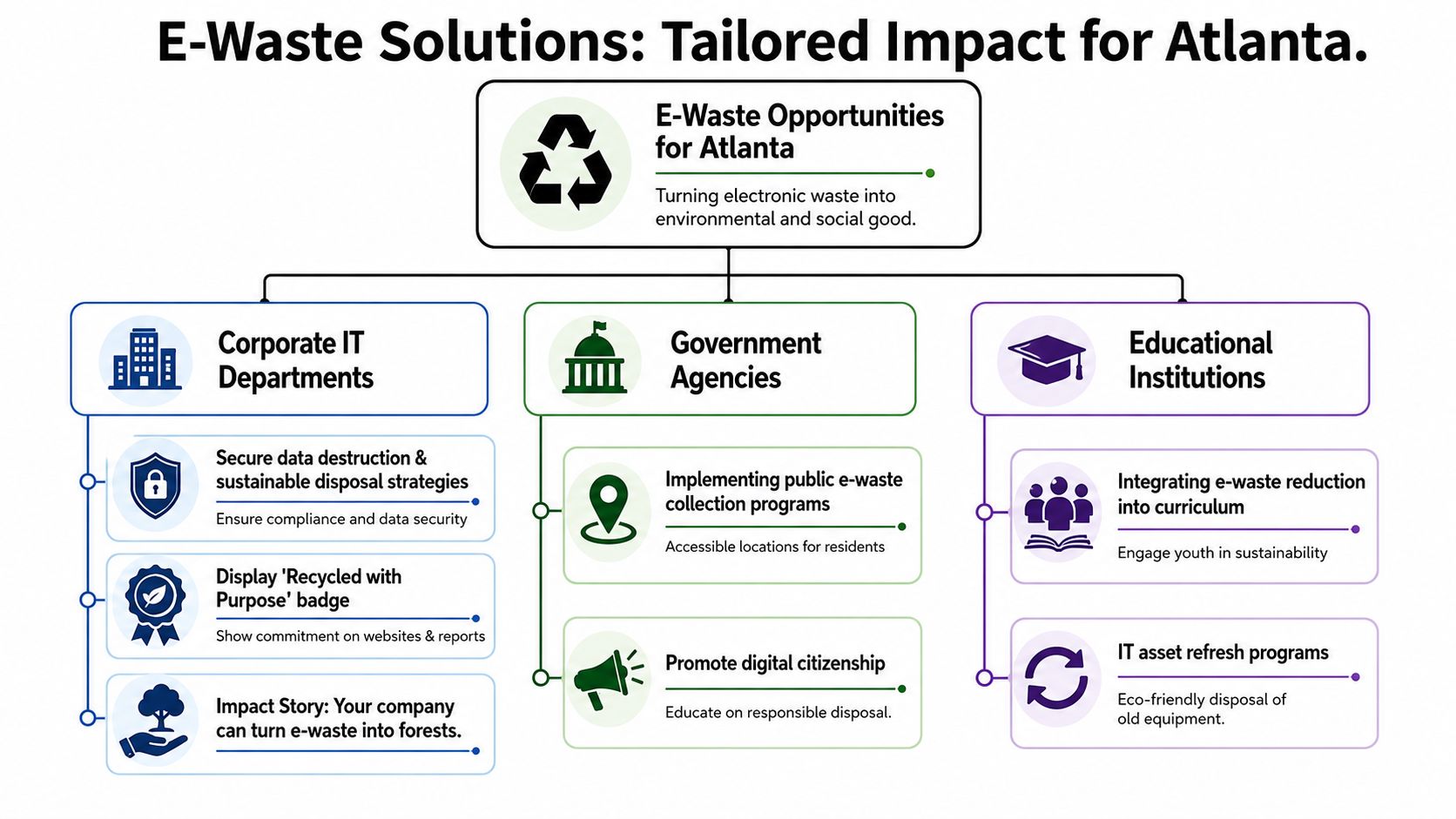
Corporate IT departments
For companies, the opportunity is to connect disposal with governance. Secure retirement of endpoints, networking gear, and office electronics supports security policy, legal defensibility, and sustainability reporting.
A workable corporate process usually includes:
- Inventory first: match serial numbers or asset tags before anything leaves the site
- Sanitization rules: define when wiping is acceptable and when shredding is required
- Chain of custody: document pickup, transfer, and final disposition
- ESG alignment: use recycling records in internal sustainability and social impact reporting
There's also a practical reuse lesson here. Not every retired device should be scrapped immediately. Secondary markets for equipment, including channels for refurbished iPhones, show why organizations should evaluate resale, redeployment, and refurbishment before defaulting to destruction. The key is to make that call under a controlled data-sanitization policy, not ad hoc.
Hospitals and healthcare systems
Hospitals face the hardest version of this problem because the environment is messy. Clinical devices, admin workstations, phones, printers, storage hardware, and network appliances often retire on different schedules.
A hospital should build disposal planning around three questions:
- Which assets contain or process regulated information?
- Who signs off on sanitization method by asset type?
- What documentation will satisfy compliance, audit, and internal security review?
If those answers aren't written down, the organization is relying on memory. That's where mistakes happen.
Schools and universities
Education environments tend to accumulate technology in waves. A district rolls out student devices. A university upgrades a lab. A campus replaces access points or classroom AV. Then old inventory sits in place because no one wants to disrupt instruction or sort through mixed-condition equipment.
What works better is a semester-based or term-based retirement process. Collect by site, reconcile by asset list, isolate data-bearing devices, and move equipment out on a schedule rather than waiting for storage rooms to overflow.
For institutions trying to recover value from aging devices, old electronics for cash in Atlanta can be part of the conversation, but only after data handling and documentation requirements are defined.
Government and public sector teams
Public agencies need more than environmental good intentions. They need a process that can survive scrutiny.
That usually means:
| Need | Operational response |
|---|---|
| Audit readiness | Maintain asset-level records and disposition paperwork |
| Security assurance | Use approved sanitization or destruction methods by media type |
| Public accountability | Show that equipment was handled responsibly, not dumped or informally cleared |
| Program continuity | Coordinate pickups and de-installation around service schedules |
A disposal vendor shouldn't create mystery. They should reduce it. If your records get weaker after pickup, the process failed.
Atlanta organizations have a real opening here. They can turn e-waste from a neglected cost center into a cleaner, more defensible operating practice.
Recycling That Restores Lives and Landscapes
Atlanta's rise as a tech-forward city raises the standard for what local organizations should do with their retired equipment. If the region wants the benefits of digital modernization, it should expect smarter disposal choices too.
That expectation only grows when a city earns national recognition. ProptechOS ranked Atlanta as America's smartest city for 2025, giving it 88/100 for smart-tech infrastructure and 82/100 for its tech job market, according to the ranking cited in this Arcadis North Avenue Smart Corridor page. A city with that profile shouldn't settle for recycling programs that only remove equipment. It should look for models that also create visible environmental and community value.

Why cause-based recycling stands out
Most recycling messages sound interchangeable. Pickup. Compliance. Certificates. Responsible disposal. Those are necessary, but they don't give employees, customers, or community partners much to connect with.
Cause-based recycling changes that. A campaign built around veteran aid and tree planting gives organizations a clearer story to tell. “Your old tech can house a veteran and grow a forest” is memorable because it connects a routine operational task to outcomes people care about.
That matters for internal engagement too. Employees are far more likely to participate in office collection drives or surplus cleanouts when the effort feels concrete and human, not administrative.
Where the model fits best
This kind of program has particular value in three settings:
- Corporate ESG and CSR programs: companies want disposal practices that are easy to explain in sustainability reports and internal communications
- School and university drives: administrators can connect recycling to civic responsibility, environmental stewardship, and local impact
- Community and seasonal campaigns: Veterans Day, Earth Day, and Arbor Day create natural moments for collection events and public-facing participation
The strongest versions also give participants something visible in return. Digital recognition such as a “Recycled with Purpose” badge, impact summaries for CSR documentation, or post-event reporting can help an organization show that disposal wasn't just compliant. It was constructive.
The operational side still matters
Cause marketing only works if the underlying process is solid. No hospital, school, or enterprise should trade documentation and secure handling for a good story.
That's why the best mission-driven programs still need the basics: inventory control, sanitization workflows, downstream accountability, and category-specific handling for items like printed circuit board disposal.
Goodwill doesn't replace controls. It gives well-run controls a purpose people can actually see.
When organizations combine secure disposition with a clear social mission, recycling stops being a back-office task. It becomes part of how the institution presents its values.
Building a Smarter and More Sustainable Atlanta
Atlanta's technology growth is real, visible, and consequential. But a smart city isn't defined only by what it installs. It's defined by how responsibly it manages the full lifecycle of those assets after deployment.
That's the operational reality behind Atlanta Smart City Initiatives and IT Growth. More connected infrastructure means more retired laptops, servers, network appliances, field devices, storage media, and embedded electronics. Every one of those assets needs a clear path out of service.
The organizations that handle this well won't treat disposal as a cleanup task. They'll treat it as part of security, compliance, sustainability, and public trust. That applies to hospitals protecting sensitive records, school systems retiring student devices, government offices documenting chain of custody, and companies trying to align IT operations with ESG goals.
A smarter Atlanta should also be a greener one. For organizations thinking beyond devices alone, practical resources like these Atlanta water-wise landscaping tips can support a broader sustainability mindset across facilities and operations.
The best time to design your end-of-life process is before the next refresh, office move, corridor upgrade, or campus overhaul. That's when technology growth becomes manageable instead of messy.
Atlanta organizations that need a practical partner for secure, compliant, and sustainability-focused electronics recycling can work with Atlanta Green Recycling. They help businesses, hospitals, schools, agencies, and data-heavy operations manage end-of-life IT responsibly, with services built around secure data destruction, documented handling, and mission-driven recycling that supports veterans and tree planting.