
Your Guide to 7 Top Telecom Services in Houston


A Houston operations team can feel the problem before it shows up on a report. Video calls start dropping between office staff and field crews. Cloud apps lag during peak hours. A second site comes online, and the old internet plan no longer fits the business. In a city built around energy, healthcare, logistics, education, and government, telecom is not just an IT line item. It shapes uptime, response time, and how confidently a company can grow.
Houston gives business buyers plenty of options, which is helpful and time-consuming at the same time. The market includes national carriers, regional fiber operators, neutral infrastructure providers, and fixed wireless options. That variety matters because a refinery support office, a medical practice, and a warehouse near the port often need different network designs. One may need dedicated internet access with strong SLA terms. Another may get better value from business fiber with wireless failover. A third may care most about path diversity and fast restoration after an outage.
The most common practical mistake I see is buying only on speed. Bandwidth is only one part of the decision. Install timelines, building access, carrier presence, last-mile type, failover design, voice requirements, cloud connectivity, and support responsiveness usually have more impact on day-to-day operations than an advertised Mbps figure. Businesses comparing providers across markets often start with a broader telecom providers near me directory and then narrow the list based on location-specific infrastructure.
Houston companies also have to match provider type to business risk. Energy firms and larger multi-site organizations often need fiber or DIA for predictable performance and stronger resilience. Healthcare groups may prioritize voice quality, uptime, and cleaner support for compliance-sensitive workflows. Logistics operators may value a mix of fiber at core sites and 5G backup at remote or fast-moving locations. The right provider choice depends less on who has the loudest marketing and more on who can support the way the business runs.
If your team already feels the strain, fix the root cause before signing a bigger circuit. Many companies first need to resolve network performance issues before they can choose the right carrier strategy.
1. AT&T Business
A Houston healthcare clinic adding a second location, an energy firm connecting field teams, and a logistics company standardizing service across warehouses do not buy connectivity for the same reason. They buy it to reduce operating risk, support specific applications, and avoid expensive workarounds later. AT&T Business stays on the shortlist because it can cover fiber, dedicated internet, mobility, voice, and WAN services under one provider. For buyers trying to align telecom with business growth, that matters more than a simple speed comparison.
AT&T is often the better fit when the question is bigger than office internet. A business with multiple sites, compliance pressure, mobile staff, or a need for wireless failover may prefer one carrier with a broad service catalog instead of piecing together separate vendors. Houston-specific options are outlined through AT&T Business in Houston.
Where AT&T fits best
AT&T usually makes the most sense for companies that need consistency across locations and a clear path from basic access to a more controlled network design. In Houston, that can mean fiber for a headquarters, DIA for a site running latency-sensitive apps, and 5G backup for branch resilience.
Common examples include:
- Energy and industrial operations: Sites that need dependable connectivity, mobility support, and better business continuity planning.
- Healthcare and regulated organizations: Dedicated internet, managed networking, and voice options can be easier to justify where uptime, auditability, and service accountability matter.
- Multi-site businesses: Central IT can standardize internet access, voice, failover, and mobility policies across offices and field locations.
One practical distinction deserves attention. Shared business broadband and dedicated internet solve different problems. If a site supports critical cloud applications, VoIP, ERP traffic, or customer-facing operations, compare AT&T's DIA offering against other dedicated services, not against lower-cost shared access.
Real trade-offs
AT&T's broad portfolio is a strength, but buyers still need to check each address carefully. One Houston building may be fiber-ready, while another may need construction, have limited entrance facilities, or support a different last-mile design. I see buyers miss this point often, especially when they assume a carrier's Houston presence means every building gets the same install timeline.
The second trade-off is process. AT&T can be a strong strategic choice for businesses that need structure, but customized enterprise quoting may take more coordination. That is usually worth it when the business needs SLA terms, static IPs, SD-WAN integration, voice migration planning, or wireless backup designed correctly from the start.
For companies benchmarking Houston options against other major markets, this comparison of telecom services in Atlanta is a useful reference point. It shows how carrier choice changes when local fiber density, building access, and enterprise demand shape the buying process.
AT&T is a strong option when the goal is operational consistency, not just internet access. For Houston businesses in energy, healthcare, logistics, and other multi-site environments, that can translate into fewer vendor gaps, better resilience planning, and a cleaner path to scale.
2. Comcast Business
Comcast Business earns attention for one reason that matters in practice. It can often solve today's connectivity problem before fiber solves next quarter's problem.
That's why Comcast is a common fit for businesses moving into a new Houston office, opening a branch, or needing a service turned up quickly while they evaluate a more reliable long-term design. The company's mix of cable-based business internet, dedicated internet, and Ethernet gives buyers a practical upgrade path. You can explore the portfolio at Comcast Business.

Why Comcast is often the fast-answer provider
Comcast's big advantage is flexibility. Some Houston businesses don't need private transport on day one. They need reliable enough connectivity now, a realistic path to dedicated internet later, and support that can handle business hours pressure.
That makes Comcast useful for:
- New offices and temporary spaces: Cable-based business internet can be simpler to activate than a custom fiber build.
- Growing companies: You can start with a practical service tier and move to Ethernet or dedicated internet as the site matures.
- Mixed environments: One location may justify fiber while another branch only needs standard business broadband.
The trade-off is that service class matters a lot. A coax-based business service and a fiber DIA circuit solve different problems. Buyers sometimes hear "business internet" and assume the back-end design is interchangeable. It isn't.
What to ask before signing
Ask two questions first. Is the building already serviceable for the class of service you want, and what's the path if your traffic profile changes?
Those questions are more important in Houston because the market includes everything from standard office users to bandwidth-heavy operations tied to cloud apps, large file movement, and voice. If you're comparing Comcast to other metro providers, it can help to also look at how businesses assess telecom services in Atlanta because the same buyer logic applies. Shared access, dedicated circuits, and Ethernet all fill different roles.
Comcast is a strong operational choice when speed-to-install matters almost as much as long-term network design.
For practical buying, Comcast tends to work best when you enter the conversation knowing whether you're buying rapid deployment, SLA-backed performance, or both on a phased timeline.
3. LOGIX Fiber Networks
A Houston company with three locations can outgrow standard business internet fast. One site needs clean access to cloud applications, another needs predictable voice quality, and a third may need a private path into a data center or partner facility. That is where LOGIX tends to enter the conversation.
LOGIX is often a strong fit for businesses that want a Texas-focused fiber provider instead of defaulting to a national carrier. That matters in Houston, where provider choice is often a business architecture decision tied to industry needs. Energy firms may care about site-to-site reliability and diverse routing. Healthcare groups may prioritize controlled traffic paths and data center access. Logistics operators may need low-friction connectivity between warehouses, offices, and cloud systems.
For enterprises evaluating symmetrical internet, Ethernet, voice, and high-capacity transport, LOGIX deserves a close look through LOGIX Fiber Networks.

A strong option for businesses that need more than internet access
LOGIX stands out when the network has to do more than connect office users to SaaS apps. Its value rises when the business also needs Ethernet between sites, transport into a data center, or a cleaner path to cloud and colocation environments.
That is relevant in Houston because interconnection density affects what a regional fiber provider can deliver. In its Houston market overview, Netrality describes 1301 Fannin as "one of the most network-dense, carrier-neutral colocation data centers in Texas" and notes that it supports "multi-vendor and multi-cloud connectivity with direct cloud on-ramps" in its Houston data center infrastructure overview. For a provider like LOGIX, access to that kind of ecosystem can improve design options for businesses that need cloud adjacency, vendor choice, or disaster recovery paths.
LOGIX is usually worth evaluating for:
- Healthcare, legal, and finance organizations: These buyers often need controlled connectivity options, predictable performance, and room for compliance-driven network design.
- Multi-site offices and campus environments: Ethernet and private transport can matter more than raw internet download speeds.
- Texas-based companies expanding in-state: A regional provider can be easier to work with when local building access, construction timelines, and route availability decide the project.
Where buyers get tripped up
The first issue is serviceability. LOGIX can be a great fit in an on-net building and a slower, more expensive fit where construction is required. I usually tell clients to ask for the actual install scenario early, not just the quoted monthly rate.
The second issue is buying too much circuit and not enough network design. A larger transport handoff will not fix poor switching, weak Wi-Fi, or badly planned cloud routing. Match the carrier to the application path, the site role, and the resilience requirement.
If you are comparing regional carriers in Texas and other metro markets, this overview of local telecom companies for business connectivity planning can help frame how local and regional providers differ from national incumbents.
A practical summary. LOGIX makes the most sense when Houston connectivity is part of a larger operating model, not just a monthly internet bill.
4. Crown Castle Fiber
Crown Castle Fiber isn't the first name every small office thinks of, but it should be on the radar for enterprises that need private networking more than generic broadband. For such needs, telecom buying becomes a business architecture decision, not just a connectivity purchase.
If your Houston operation depends on deterministic performance between sites, private transport, or clean segmentation for sensitive traffic, Crown Castle's enterprise focus is worth evaluating at Crown Castle Houston.
Best for private WAN needs
Crown Castle is a better fit for businesses asking questions like these:
- Can we isolate critical application traffic between sites?
- Can we support voice, operational systems, and cloud traffic on a more controlled transport layer?
- Can we avoid relying on the public internet for every branch-to-branch connection?
Those aren't niche concerns in Houston. Energy, healthcare, legal, and logistics organizations often need more than internet access. They need reliable movement of business-critical traffic between offices, campuses, and third-party facilities.
Private Ethernet is often the right answer when the business problem is consistency between locations, not just download speed at one office.
Practical buying view
Crown Castle can be overkill for a small office with ordinary SaaS use. If your entire workload lives in common cloud platforms and your users mainly need stable browsing, voice, and video, shared internet plus good failover may be enough.
But if your network team is designing around traffic separation, strict uptime expectations, or site-to-site performance, private transport becomes easier to justify. In enterprise-grade Houston deployments, providers increasingly target near-100% network uptime through failover capabilities, as noted in the earlier telecom market context. That broader market expectation is one reason private networking remains relevant.
Crown Castle also benefits from local familiarity. For buyers comparing enterprise-oriented providers, reviewing broader local telecom companies can help clarify whether you need a carrier built for SMB internet, or one built for transport-heavy enterprise design.
The downside is simple. It's typically a quote-driven conversation, and smaller organizations may find that the service model, complexity, or budget threshold is more than they need.
5. Zayo
A Houston business adds a second data center, opens a Gulf Coast operations hub, or starts moving large volumes of traffic between cloud environments. At that point, standard business internet stops being the primary buying question. The decision shifts to route control, interconnection, scaling headroom, and recovery options if a path fails.
That's the context where Zayo fits.
When Zayo makes sense
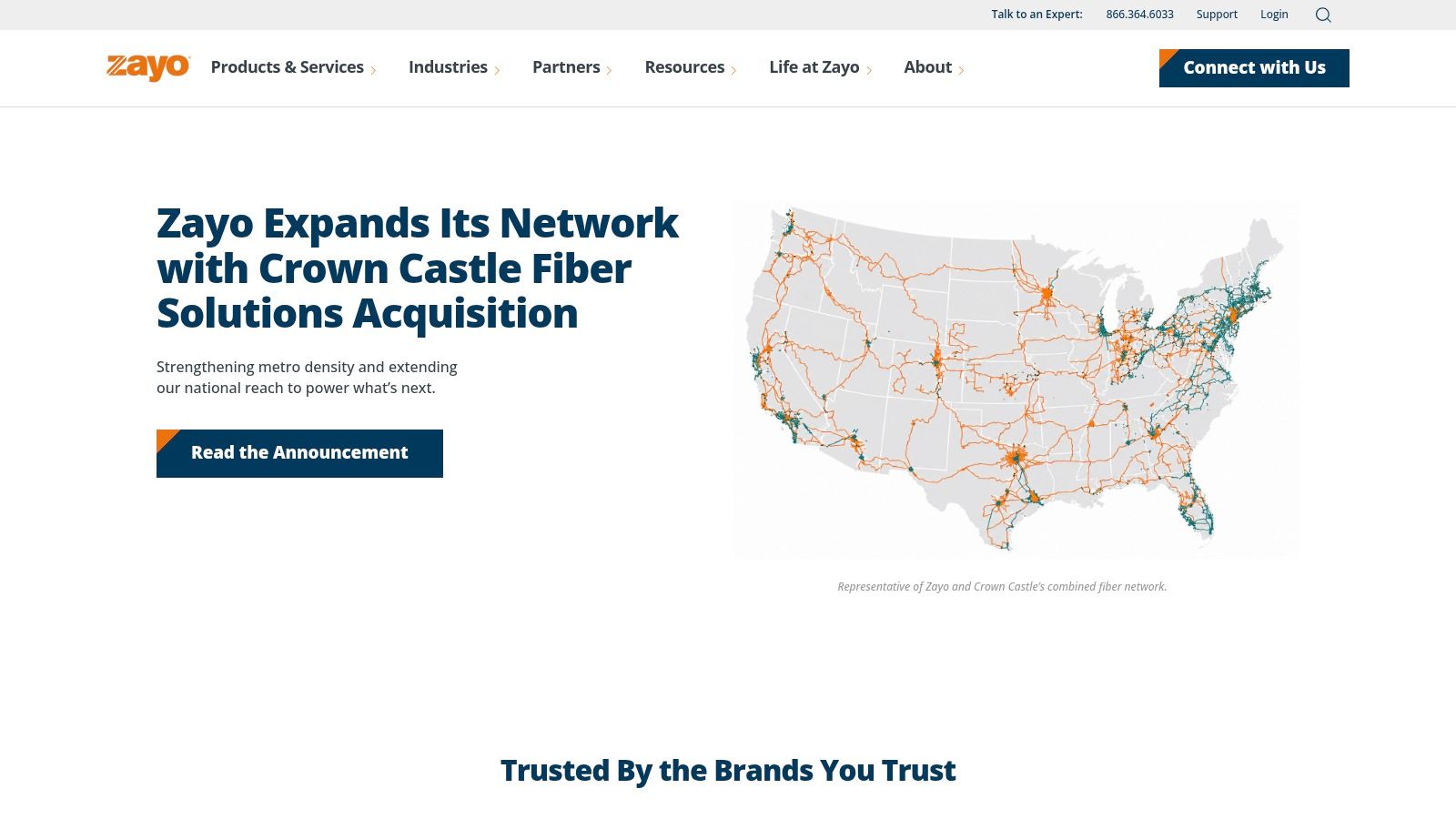
Zayo is a strong fit for organizations that need dark fiber, wavelengths, Ethernet, or dedicated internet designed around specific performance and interconnection goals. In Houston, that often lines up with energy companies moving data between field operations and core facilities, healthcare groups connecting clinics to centralized systems, and logistics firms tying distribution sites, ports, and carrier-neutral facilities together.
Houston's data center growth also supports that enterprise profile. Mordor Intelligence, in its Houston data center market report, projects continued expansion in the local market and describes buyer expectations such as low-latency connectivity, high uptime commitments, rapid repair windows, and failover planning for business-critical services. Those are the conditions where custom transport and high-capacity fiber become easier to justify.
For Houston buyers, Zayo usually stands out in three situations:
- Custom network design: The business needs specific routes, carrier hotel access, or interconnection between offices, data centers, and cloud on-ramps.
- Long-term capacity planning: Wavelengths and dark fiber make more sense than repeatedly upgrading smaller circuits as demand grows.
- Metro-to-long-haul coordination: Multi-site companies often need Houston access designed with regional or national transport in mind.
This is less about buying internet service and more about choosing network infrastructure that supports growth and resilience.
Where Zayo is less practical
Zayo is rarely the simplest option for a single office that mainly uses SaaS, VoIP, and video meetings. The sales process is typically more consultative, the solution can be more customized, and the buying cycle often takes longer than a straightforward broadband or standard fiber install.
That trade-off is not a flaw. It reflects the type of customer Zayo serves.
If your company needs exact route diversity, high-capacity optics, interconnection with third-party facilities, or infrastructure that can support aggressive expansion, Zayo deserves a serious look. If the goal is basic connectivity for a small team, a more standard provider will usually be easier to buy and easier to manage.
For companies sorting through that difference, comparing other telecommunications companies near me can help clarify whether you need branch-office internet or carrier-grade transport.
6. Verizon Business
A Houston company signs a lease, needs the office live in two weeks, and cannot wait on a full fiber construction cycle. In that situation, Verizon Business becomes less of a commodity ISP option and more of a timing and resilience decision. Its value is strongest when the business needs fast activation, wireless diversity, or a network design that supports mobile users and fixed locations under one provider.
You can evaluate Houston availability and services through Verizon Business in Houston.
Best fit for speed, backup, and distributed operations
For Houston buyers, Verizon usually makes the most sense when the network plan has to balance speed of deployment with operational continuity. That comes up often in logistics yards, temporary project sites, medical satellite offices, and growing teams opening space before the landlord's preferred fiber timeline is clear.
The strongest use cases tend to be:
- Rapid turn-up: New branches, temporary offices, field sites, and move-in periods where waiting on construction slows the business.
- Wireless failover: A secondary path that reduces dependence on the same local wireline plant as the primary circuit.
- Mobility-focused operations: Organizations that want business internet, smartphones, tablets, and connected devices managed through one vendor relationship.
That mix can be strategically useful in Houston. Energy firms may need connectivity at operational sites that do not fit a standard office install. Healthcare groups may need a short-term circuit while a permanent connection is still in process. Logistics companies often care less about theoretical top speed and more about getting a site online fast, then adding redundancy once traffic patterns are clear.
The trade-off with 5G and fixed wireless
Verizon's limitation is site variability. Two offices a few blocks apart can perform very differently because of building materials, tower placement, indoor signal conditions, and local congestion.
I usually advise clients to treat 5G as a specific tool in the WAN design. It can serve well as primary connectivity in the right building and an even better fit as backup for fiber or DIA. The wrong approach is assuming wireless will behave the same way at every Houston address.
For voice-heavy offices, compliance-sensitive workflows, or locations running steady high-volume traffic, test the exact site against the actual application mix before signing a long term agreement. That is the core buying decision. Verizon is often the right answer when speed, mobility, and path diversity matter more than getting the lowest-cost wired circuit.
7. Ezee Fiber
A Houston business opens a new site expecting internet to be the easy part. Then significant pressure appears. The clinic needs reliable uptime for patient systems, the logistics office needs a clean handoff to security and voice vendors, and leadership wants a provider that answers quickly when an install slips. That is where a local carrier can become a strategic choice instead of just another circuit quote.
For Houston organizations that value local accountability and dedicated connectivity, Ezee Fiber Enterprise is worth a look.
Where local support matters
Ezee Fiber stands out for buyers who want direct communication during construction, clearer escalation paths, and a provider that knows Houston buildings, property managers, and business corridors. That tends to matter most for growing small and midsize companies that do not have large internal network teams.
The strategic question is not just speed. It is whether the provider fits the operating model of the business. In Houston, that varies by industry. A healthcare practice may care about circuit reliability, documentation, and coordination with security controls. A logistics firm may prioritize a fast turn-up at a warehouse and a practical path to redundancy later. A professional office may want dedicated fiber with less vendor friction than a national carrier often brings.
Lightyear notes in its Houston dedicated internet access article that businesses often evaluate DIA based on performance, SLA terms, and site requirements, not just advertised bandwidth tiers. That is a useful lens here. Ezee Fiber is a stronger fit when local responsiveness and a simpler provider relationship have real business value, especially for companies choosing between shared broadband, dedicated fiber, and a future backup path such as 5G.
A practical trade-off to plan for
Local focus can be an advantage, but buyers should still test the provider against the full project scope. Confirm serviceability, construction timelines, handoff details, support hours, and what happens if the business adds a second site or needs diversity later. A provider can be a good fit for one Houston address and a weaker fit for a multi-location rollout.
There is also an operational issue many teams miss. Circuit upgrades often trigger hardware replacement at the same time. Firewalls, edge routers, switches, and wireless equipment can all change during the move. As noted in an article by Inseego, Houston connectivity projects often sit inside broader modernization efforts, which means IT leaders should also account for device lifecycle planning and disposition.
That is the decision with Ezee Fiber. Not just whether the circuit works, but whether the provider fits the business through install, growth, and the next round of network change.
Houston Telecom Services, 7-Provider Comparison
| Provider | Implementation Complexity 🔄 | Resource Requirements ⚡ | Expected Outcomes 📊⭐ | Ideal Use Cases 💡 | Key Advantages ⭐ |
|---|---|---|---|---|---|
| AT&T Business (Fiber and Dedicated Internet) | Medium, address-dependent fiber; DIA quote-based 🔄 | Moderate, on‑net fiber where available; add‑ons (SD‑WAN, voice) ⚡ | High, SLA-backed DIA, multi‑gig symmetric options 📊⭐ | Offices, healthcare, government, schools, multi‑site enterprises 💡 | Wide metro presence, mature SLAs, single‑vendor bundles ⭐ |
| Comcast Business (Dedicated Internet, Ethernet, and HFC) | Low–Medium, HFC quick; fiber DIA may need construction 🔄 | Moderate, fast coax installs; fiber upgrades require build ⚡ | Medium–High, rapid turn‑up on HFC; enterprise SLA on fiber 📊⭐ | Quick‑turn deployments, retail, large venues, hybrid rollouts 💡 | Fast activation via cable, nationwide support, mixed access options ⭐ |
| LOGIX Fiber Networks | Medium, strong on‑net footprint; off‑net builds possible 🔄 | Moderate–High, extensive on‑net capacity; possible build charges ⚡ | High, carrier‑grade SLAs; 10G/100G transport and DC peering 📊⭐ | Texas enterprises, campuses, data‑center connected sites 💡 | Local focus, deep Houston/DC peering, responsive builds ⭐ |
| Crown Castle Fiber (Enterprise Ethernet and Private Networking) | Medium–High, enterprise quotes and bespoke designs 🔄 | High, private WAN/E‑Line builds and dedicated metro fiber ⚡ | Very High, deterministic performance and strong SLAs 📊⭐ | Multi‑location enterprises, compliance‑sensitive workloads 💡 | Private transport options, enterprise SLAs, metro scale ⭐ |
| Zayo (Dark Fiber, Wavelengths, Ethernet, DIA) | High, custom dark‑fiber/wavelength builds; longer lead times 🔄 | Very High, optical engineering, dense fiber mileage, custom routes ⚡ | Very High, scalable 10/100/400G capacity; global reach 📊⭐ | Data centers, media, large tech firms, bespoke capacity needs 💡 | Highly customizable capacity, strong carrier interconnects ⭐ |
| Verizon Business (5G Business Internet, Wireless, and Fiber DIA) | Low, 5G fixed wireless quick to deploy; fiber limited by location 🔄 | Low–Moderate, wireless CPE; optional fiber via partners ⚡ | Medium, fast turn‑up; variable RF performance; good failover 📊⭐ | Temporary sites, fast turn‑up, wireless failover, IoT/mobility 💡 | Rapid installs, integrated mobility/IoT, resilient wireless option ⭐ |
| Ezee Fiber (Enterprise Dedicated Internet) | Medium, address/build dependent; may need construction 🔄 | Moderate, local fiber ops, dedicated symmetric circuits ⚡ | High, SLA-backed dedicated internet with consistent performance 📊⭐ | Local enterprises, government, customers preferring relationship support 💡 | Local support model, dedicated non‑contended capacity, rapid response ⭐ |
Making the Right Connection for Your Houston Business
The biggest advantage Houston buyers have is choice. The biggest risk is confusing choice with clarity. A long provider list doesn't make the decision easier unless you tie each service type to a real business requirement.
Start with the operating model, not the carrier brand. A law office with predictable SaaS use and a few hosted phones doesn't need the same design as a hospital department, an energy company with field operations, or a logistics firm moving data across multiple facilities. The right provider depends on whether your top priority is guaranteed uptime, quick deployment, private transport, cloud interconnection, or simple cost control.
In practice, most Houston businesses should narrow the shortlist by service class first.
- Choose dedicated fiber or DIA if the site supports revenue-critical operations, regulated workflows, or sustained cloud and voice dependence.
- Choose Ethernet or private WAN services if traffic between locations matters as much as internet access.
- Choose cable-based business internet when speed to install and budget efficiency matter more than premium SLA structure.
- Choose 5G business internet when you need fast activation, a temporary solution, or a diverse failover path.
- Choose a regional or local fiber specialist when local support, direct accountability, and data center access matter more than buying from the biggest national name.
Houston's infrastructure supports advanced designs. The city benefits from dense carrier-neutral interconnection, strong enterprise fiber competition, and a market where businesses can mix providers instead of relying on a single architecture. That's especially useful for healthcare, finance, and other environments where diverse paths, low latency, and cloud access aren't optional.
One point that deserves more attention is lifecycle planning. A telecom upgrade often triggers an equipment refresh. New internet circuits, edge appliances, firewalls, switches, and phones tend to push older hardware out of service. If your team is replacing telecom-related equipment during a move, branch rollout, or WAN redesign, build end-of-life planning into the project from the start. That means documenting retired assets, sanitizing data-bearing devices, and aligning disposal with internal policy and ESG reporting if your organization tracks those outcomes.
The provider decision should also account for what the business will need next, not just what's painful today. Ask every carrier about install intervals, path diversity, failover options, escalation process, support hours, and the exact SLA language tied to your address. Don't assume the service experience in one Houston building will match another. It often won't.
For many companies, the smart move is to shortlist two or three providers, request address-specific quotes, and compare not only monthly cost but operational fit. The cheapest circuit can become the most expensive decision if it slows cloud apps, weakens voice quality, or leaves a critical site without a realistic backup path.
If leadership wants outside help aligning network choices with broader growth goals, it can also help to work with an award-winning marketing firm based in Houston that understands how local business strategy and technology investment intersect. Connectivity supports more than IT. It affects customer experience, team productivity, and how confidently the business can expand.
The right telecom services in Houston aren't the ones with the loudest sales pitch. They're the ones that match your building, your applications, your risk tolerance, and your growth plan.
If your Houston telecom upgrade is replacing routers, switches, firewalls, phones, or other aging IT assets, Atlanta Green Recycling can help you handle the other half of the project responsibly. The company supports organizations with secure IT asset disposition, data destruction, de-installation, bulk equipment removal, and compliance-minded e-waste recycling. Their mission-driven approach also gives businesses a stronger ESG and CSR story through cause-based recycling tied to veteran support and tree planting, making every refresh project an opportunity to clear out old tech, reduce landfill waste, and show measurable community impact.