
Server Disposal Services for Businesses Atlanta GA

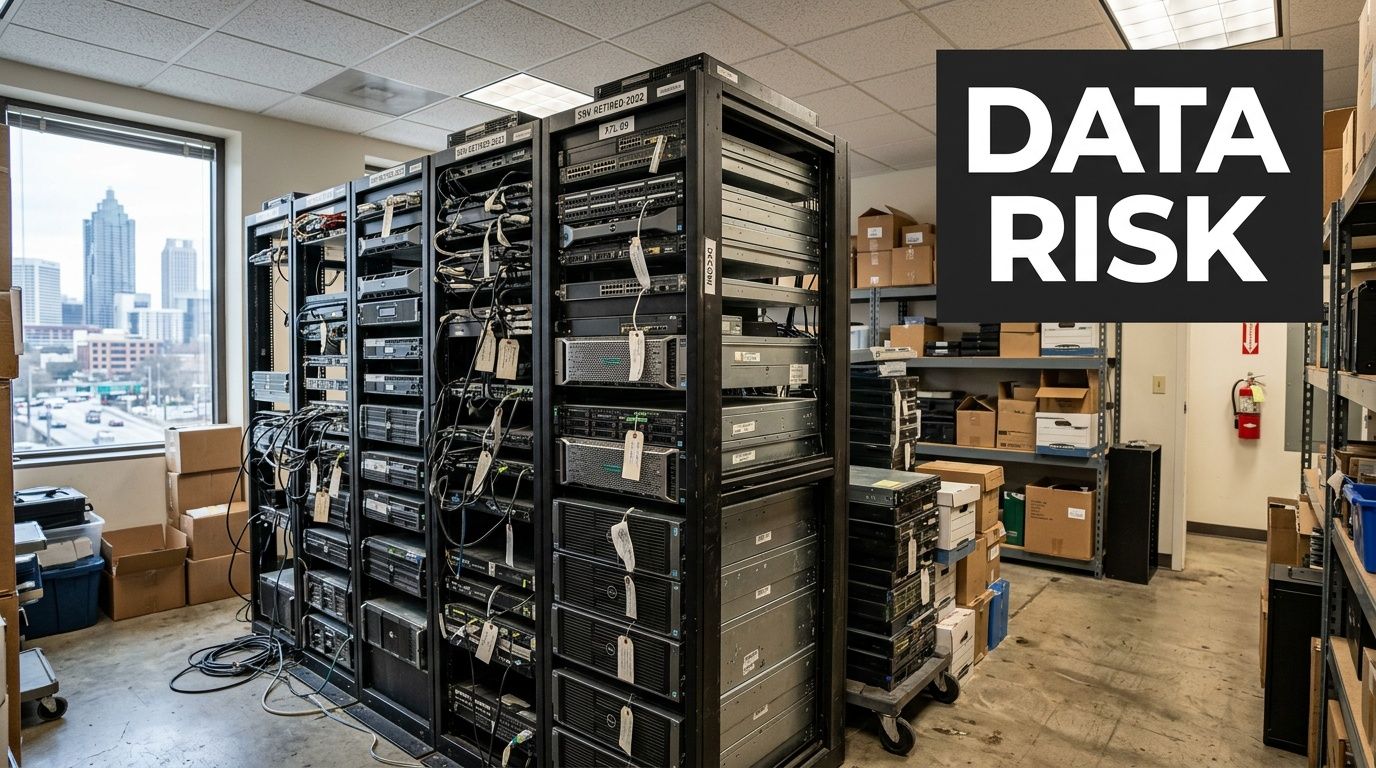
A lot of server disposal projects start the same way. An IT manager or procurement lead walks into a storage room, sees a row of decommissioned servers, loose drives, old UPS accessories, and asset tags from three refresh cycles ago, then realizes none of it can go directly into the trash.
That pile is more than clutter. It’s dormant corporate data, audit exposure, and regulated electronic waste sitting in one place. In a market as active as metro Atlanta, where companies upgrade infrastructure, consolidate offices, and retire aging racks on tight schedules, delay creates risk fast.
Why Proper Server Disposal Is a Critical Task for Atlanta Businesses
Retired servers don’t become harmless because they’re powered off. A server that’s no longer in production can still hold customer records, employee data, financial files, credentials, archived email, or system images. If procurement is managing an office closure, lease turnover, hardware refresh, or data center downsizing, those assets need a controlled exit path.
The scale of the problem is often underestimated. By 2007, the EPA reported that over 63 million computers were being discarded annually in the U.S. according to Atlanta computer recycling guidance. That’s why professional IT asset disposition isn’t a niche service anymore. It’s part of standard operational hygiene for businesses with real technology footprints.
For companies evaluating local vendors and service coverage, it also helps to understand the business environment across Atlanta, where healthcare systems, financial firms, schools, logistics companies, and public agencies all generate recurring streams of retired IT equipment.
The three risks most buyers have to manage
A good server disposal plan handles three issues at once:
- Data security: Drives and storage media have to be sanitized or destroyed in a way your security team can defend.
- Regulatory exposure: HIPAA, FACTA, internal retention policies, and procurement controls don’t end when hardware leaves production.
- Environmental responsibility: Electronics contain materials that shouldn’t end up in a landfill or mixed into general waste.
Teams that treat disposal as a simple hauling job usually miss one of those three. The most common mistake isn’t bad intent. It’s using a vendor that can move boxes but can’t document the chain of custody or separate reuse from destruction intelligently.
Practical rule: If a vendor can’t clearly explain what happens to each server, drive, and component after pickup, procurement shouldn’t sign the release.
Why this matters more in Atlanta
Atlanta businesses often manage mixed environments. One room may contain current-generation servers with residual resale value, while the next pallet holds failed drives, obsolete chassis, and unsupported equipment that should go straight to destruction and responsible recycling. That mix creates a decision problem, not just a disposal problem.
A disciplined process turns that problem into something useful. Assets with market value can be wiped and remarketed. Failed media can be shredded. Documentation can support audits. Sustainability reporting can reflect real operational action rather than generic policy language.
That’s where server disposal starts to shift from chore to strategy. Done well, it protects the business on the compliance side and gives leadership a credible ESG story on the reporting side. For a closer look at the wider business and environmental stakes, this overview of the environmental impact of electronic waste is a useful starting point.
Understanding Your Server Disposal Service Options in Atlanta
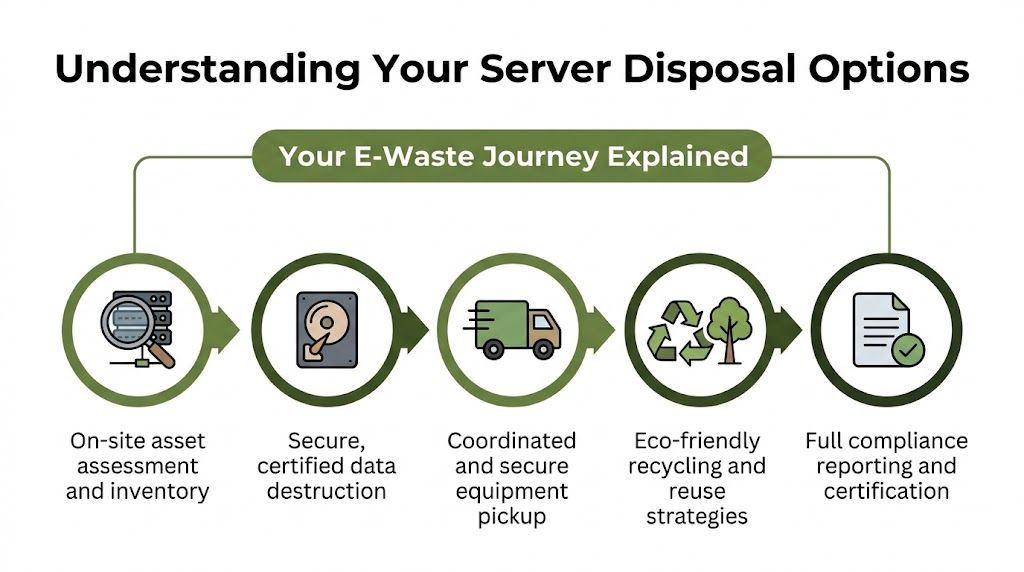
Most buyers don’t need “recycling.” They need a coordinated project with defined steps, clear custody, and the right handling method for each asset class. In practical terms, Server Disposal Services for Businesses Atlanta GA usually fall into three service buckets: decommissioning, data destruction, and logistics.
Onsite decommissioning
This is the hands-on work at your facility. It includes identifying assets, matching them to inventory, powering down according to your internal process, removing equipment from racks, and staging it for pickup.
For a procurement officer, the key question is simple. Are you asking the vendor to collect equipment that’s already disconnected, or are you asking them to participate in the physical de-install? Those are different scopes.
Onsite decommissioning is usually the right fit when:
- Your servers are still racked: The team needs structured removal rather than dockside pickup.
- You’re managing a move or closure: Timing matters and access windows are tight.
- Internal staff can’t spare the labor: Your IT team needs to stay focused on production systems.
A good decommissioning crew works methodically. They don’t yank cables, mix asset groups, or leave procurement guessing which serial numbers left the building.
Secure data destruction
Many projects are won or lost based on how data storage is managed. Not every drive should be handled the same way. Functional storage media may be eligible for software wiping. Dead or failing media usually belongs in a shred stream.
Think of wiping and shredding as two different tools, not competing philosophies. Wiping is for preserving reuse potential when the media is still operational and policy allows it. Shredding is for nonfunctional devices or situations where physical destruction is required by internal standards.
A mature service provider will typically help you sort assets into categories such as:
- Functional drives suitable for certified wiping
- Failed drives that require physical destruction
- Mixed devices needing review before final disposition
That distinction matters because it affects both risk and value recovery. If everything gets shredded automatically, you may destroy reusable value. If everything gets wiped automatically, you may expose the organization to unnecessary security risk.
The best disposal programs don’t ask one question. They ask two. “Is the data gone?” and “Did we preserve appropriate value where we could?”
Pickup, transport, and downstream handling
Once assets are off the floor, logistics becomes the control point. This includes packing, palletizing if needed, labeling, secure loading, transport, intake, processing, and final reporting.
The weakest programs often fail here. They may perform decent wiping or recycling but keep poor records during handoff. That creates uncertainty about who touched what, when it moved, and whether the serial list stayed intact.
Here’s what procurement should expect from a full-service process:
| Service area | What it includes | When you need it most |
|---|---|---|
| Onsite decommissioning | De-racking, disconnecting, staging, asset matching | Office moves, server room refreshes, data center reductions |
| Data destruction | Wiping, shredding, media segregation, destruction records | Regulated data, mixed drive conditions, audit-sensitive environments |
| Logistics | Packing, secure transport, intake verification, reporting | Multi-site pickups, large lots, loading dock coordination |
If your organization wants a single vendor to handle all three pieces under one workflow, review a local example of IT asset disposition services in Atlanta GA. It helps clarify what a turnkey scope should include.
What works and what doesn’t
What works is specificity. Asset lists. Pickup windows. Access instructions. Clear disposition rules for reusable versus destroy-only media. Named points of contact on both sides.
What doesn’t work is vague language like “remove old servers sometime next week” or “recycle everything.” That’s how projects drift, value gets lost, and reporting becomes incomplete.
Navigating Data Destruction and Regulatory Compliance
If your business handles sensitive information, server disposal is a compliance event. It isn’t just an operations ticket. The legal and financial exposure sits inside the drives, not the metal chassis.
The strongest programs start by deciding what standard the organization must satisfy, then matching the destruction method to the media condition and policy requirement. That sequence matters. Teams run into trouble when they choose the method first and try to justify it later.
Why sanitization standards matter
In server disposal work, DoD sanitization standards and NIST 800-88 are part of the language security teams expect to hear. According to Atlanta data center equipment disposal guidance, these methodologies are used to make data irrecoverable, and the same source notes that data breaches cost enterprises an average of $4.88 million per incident in 2025 IBM studies.
That financial risk is why “we deleted the files” isn’t a disposal strategy. It’s also why procurement should ask whether the provider uses certified software tools such as Blancco or KillDisk for approved wipe workflows, and when they shift to physical destruction instead.
The same guidance explains that providers use NIST 800-88 and DoD 5220.22-M methodologies with multiple overwrite passes, and pair that with physical shredding for non-functional drives to meet NSA/CSS specifications. In practice, that means a serious vendor has a decision tree for media condition, not a one-size-fits-all script.
Comparison of Data Destruction Methods
| Method | Security Level | Compliance | Asset Reusability | Best For |
|---|---|---|---|---|
| Software wiping | High when performed under recognized sanitization standards on functional media | Strong when documented under approved workflows | Preserved | Servers and drives with resale, redeployment, or donation potential |
| Physical shredding | Very high for nonfunctional or destroy-only media | Strong when paired with destruction records | Eliminated | Failed drives, damaged media, strict destruction mandates |
| Hybrid approach | High, because each asset gets the right method | Strongest for mixed environments with audit pressure | Preserved where appropriate | Hospitals, finance teams, government departments, data center projects |
Chain of custody is your proof
Compliance doesn’t end with the act of wiping or shredding. You need records that show custody from removal through final disposition. Many internal teams often underestimate the job at this point. If an auditor or legal team asks what happened to a retired storage device, “the recycler picked it up” isn’t enough.
Your records should show:
- Asset identification: Serial numbers, tags, and device types.
- Handling trail: Who removed the equipment, when it changed hands, and where it went.
- Disposition outcome: Wiped, shredded, recycled, or remarketed.
- Final documentation: Certificate of Data Destruction and related processing records.
A provider offering secure hard drive destruction services in Atlanta GA should be able to explain that paper trail clearly before pickup day.
If legal, compliance, and IT all read the same document and come away with different interpretations, the documentation is weak.
What regulated industries should watch closely
Different organizations carry different pressure points. Healthcare groups tend to focus on patient information and retention controls. Financial organizations look closely at consumer data handling and records discipline. Government entities often need strict procedural consistency and documented accountability.
The practical trade-off is this. The most secure-looking option isn’t always the most appropriate option for every device. Shredding every drive may satisfy a strict security instinct, but it can eliminate reuse value unnecessarily. Wiping every drive can preserve value, but only if the media is functional and your policy accepts that route.
That’s why the best practice for many Atlanta organizations is a hybrid workflow. Functional assets are sanitized under recognized standards and documented carefully. Failed or unsuitable media moves directly to physical destruction. Procurement gets defensible records. Security gets a clear control framework. Finance has a better shot at value recovery where policy allows it.
How Onsite Pickup and Logistics Work in Metro Atlanta
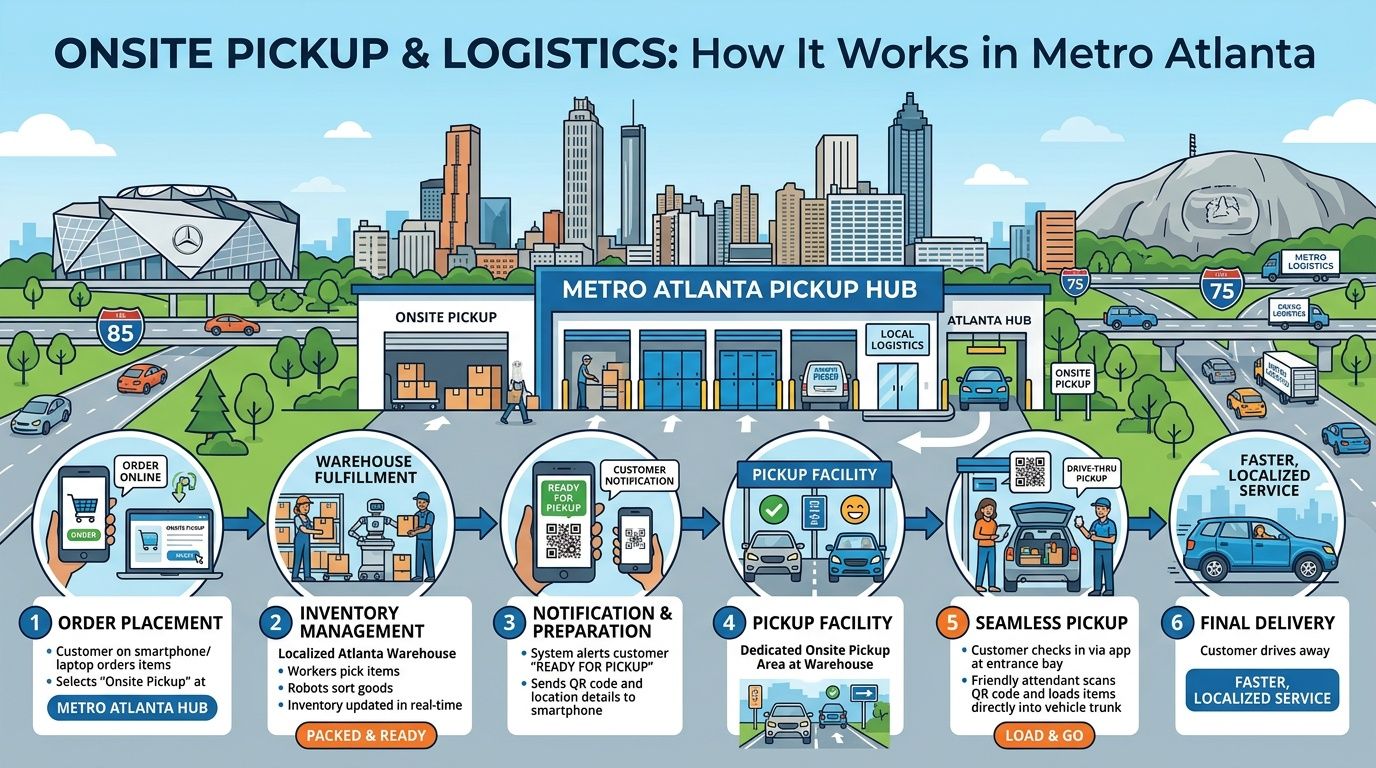
Most procurement teams want the same thing from a pickup day. They want it organized, fast, and quiet. No confusion at reception, no loose drives on carts, no debate at the dock about what was approved for removal.
The workflow usually starts before the truck arrives. Your team and the vendor confirm scope, building access, service elevators, loading dock rules, parking instructions, and whether equipment is already disconnected. If the project includes de-racking, that gets defined in advance too.
What happens before pickup day
A clean handoff starts with preparation inside your facility. That doesn’t mean your staff has to do all the labor, but they do need to clarify ownership and access.
A practical prep list looks like this:
- Confirm the asset group: Which servers, rails, drives, and peripherals are in scope.
- Flag anything excluded: Production gear, leased equipment, or devices awaiting internal approval.
- Coordinate access: Security desks, badges, dock appointments, and after-hours windows.
- Name one decision maker: Someone onsite who can approve changes if a surprise comes up.
When this is handled early, the pickup team can move in a straight line. When it isn’t, projects stall in hallways and server rooms.
What you should see onsite
A professional crew should inventory, stage, and load assets in a controlled sequence. They should know whether media is staying segregated for destruction, whether servers are going as whole units, and how your organization wants tags or internal identifiers handled.
The best pickup days are uneventful because the team follows a repeatable process. They don’t improvise chain of custody. They document it.
For operations teams that need to plan dock access and material flow, a local reference point for loading dock coordination can help frame what good pickup logistics should look like.
Why local logistics matter
Metro Atlanta projects often involve traffic constraints, building management rules, and mixed-site scheduling. That’s one reason local fleet control matters. When the same provider manages the pickup, transport, and intake chain, the documentation tends to be cleaner and disputes are easier to resolve.
One example in the local market is Atlanta Green Recycling, which handles business electronics pickup, server removal, data destruction workflows, and transport using its own fleet as part of broader IT asset disposition operations. For procurement, that kind of integrated handling can simplify scheduling and reduce handoff ambiguity.
Good logistics feels boring. That’s exactly what you want when sensitive hardware is leaving your building.
Transforming E-Waste into an ESG Win for Your Company
Most companies still frame server disposal as a back-end obligation. It’s budgeted as cleanup, delegated as a facilities task, and discussed only when assets are already stacked in a room. That leaves value on the table, especially for organizations under pressure to show credible ESG and CSR action.
Handled intentionally, retired technology can support both environmental reporting and community impact. Through this, a mission-driven disposal model becomes more than a compliance service. It becomes part of how the company demonstrates what it stands for.
From disposal event to brand statement
The strongest ESG stories are concrete. They tie a business process to a visible outcome. That’s why cause-based messaging around electronics recycling works so well when it’s specific and documented.
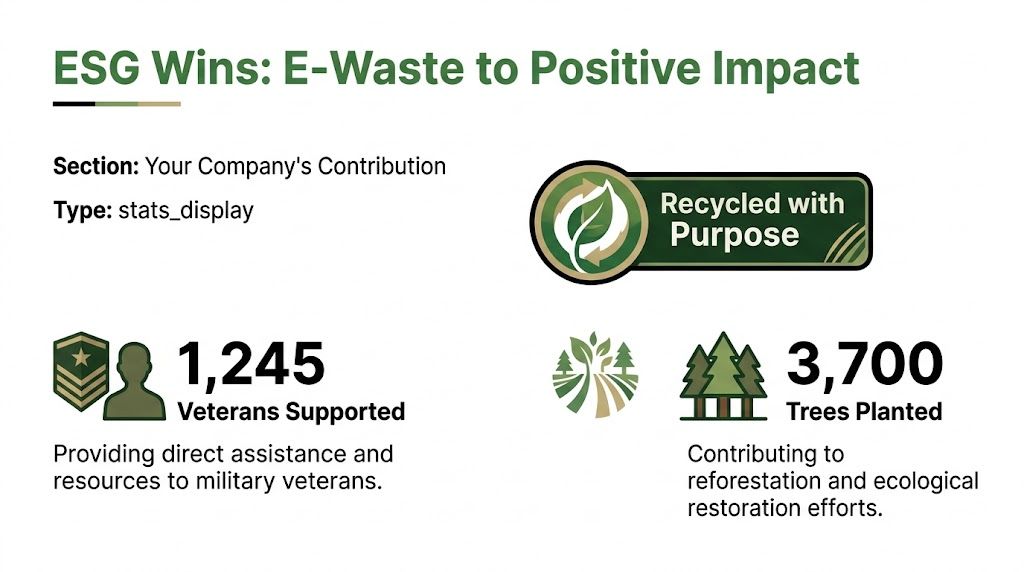
The clearest version of that message is simple: your old tech can house a veteran and grow a forest.
That idea resonates because it connects a familiar operational task to two outcomes people care about. Support for veterans carries immediate human meaning. Tree planting gives sustainability teams a visible, easy-to-communicate environmental benefit. Together they create a dual-impact model that’s easy for leadership, employees, and customers to understand.
Why the CSR angle matters financially too
Cost concerns often block action. A verified local data point helps explain why. A 2026 Deloitte ITAD study cited by Atlanta server and IT equipment recycling guidance states that 72% of Georgia SMBs avoid professional services due to unclear Total Cost of Ownership, while repurposing can yield 20 to 40% value recovery. The same source notes that providers are addressing this with free pickups for 50+ devices and CSR certificates for ESG reports.
That matters because ESG programs fail when they look detached from business reality. If a disposal partner can combine value recovery, documented recycling, and cause-based reporting, procurement doesn’t have to choose between responsible handling and financial discipline.
What useful ESG documentation looks like
A disposal project becomes more valuable internally when the outputs are reportable. That means giving sustainability, marketing, and procurement teams assets they can use.
Examples include:
- Plant-a-tree certificates: Useful for sustainability communications and employee engagement.
- Veteran support impact reports: Helpful for CSR files, partner updates, and internal storytelling.
- A digital eco-badge: A “Recycled with Purpose” mark that companies can place on a website or in a report.
- Campaign-ready language: Messaging for Earth Day, Arbor Day, Veterans Day, and internal green initiatives.
These tools work because they convert a closed-door back-office process into something visible. A corporate recycling drive can become a recruiting story, a customer-facing ESG proof point, or a contribution in an annual responsibility report.
“Recycling That Restores Lives and Landscapes” works because it says what most vendors leave unsaid. Disposal can repair more than a storage room.
Why this angle is especially strong in Atlanta
Atlanta businesses tend to participate in regional community initiatives, local partnerships, and public-facing sustainability efforts. That makes a dual-impact server disposal model especially practical here. Companies can align office cleanouts, data center refreshes, or end-of-year asset sweeps with broader CSR calendars.
The result is stronger than generic “green” language. It gives the business a reason to talk about what happened after the pickup. Not just that equipment was removed, but that the process supported veterans, contributed to reforestation, and kept electronics in a responsible downstream channel.
Evaluating the Costs and Value Recovery of Server Disposal
Procurement usually asks two questions first. What will this cost, and can any of it be offset?
The answer depends on scope. Server disposal pricing commonly reflects labor, pickup complexity, de-install requirements, data destruction method, transportation, and the condition of the equipment. A room full of disconnected tower servers is a different job from a live data center decommission with rack removal, segregated media handling, and strict access controls.
What tends to drive pricing
Some projects are quoted by item count. Others are priced as a project based on labor and logistics. If media destruction is involved, the method matters because software wiping, serialized tracking, and physical shredding don’t create the same handling steps.
Typical cost drivers include:
- Asset condition: Functional servers can move into reuse review. Damaged equipment often moves straight to recycling.
- Labor intensity: De-racking and packing on upper floors costs more than dockside transfer of staged pallets.
- Documentation needs: More detailed reporting usually means more handling and verification work.
- Pickup scale: Larger pickups can be more efficient, especially when devices are already centralized.
One reason buyers hesitate is lack of transparency. That hesitation is real in the Georgia market, and it often leads teams to postpone the project instead of structuring it properly.
Where value recovery changes the conversation
The smart question isn’t only “what is disposal going to cost?” It’s “which assets still have recoverable value if they’re sanitized and processed correctly?”
That’s where Asset Value Recovery matters. Functional servers, components, and related equipment may have resale or reuse potential after approved data handling. The more organized your inventory and segregation process is, the easier it becomes to separate value-bearing hardware from scrap-grade material.
This is also why blanket destruction is often wasteful. A mixed lot usually contains a combination of remarketable hardware, recyclable materials, and media that must be destroyed. Treating all three categories the same tends to produce the worst financial outcome.
If your team wants to understand whether retired equipment may still generate offsetting value, a local page on turning old electronics for cash provides a practical starting point.
What works in budgeting
What works is getting a scope-based quote tied to inventory quality and service requirements. What doesn’t work is asking for a generic “per server” number before anyone knows whether the servers are complete, wiped, racked, damaged, or accompanied by loose drives and accessories.
The better your internal list, the better your pricing discussion. In my experience, the fastest way to control cost is to sort assets early, define whether onsite labor is needed, and decide which items are eligible for reuse versus mandatory destruction.
Atlanta Server Disposal FAQs and How to Get Started
Can’t our IT team just wipe the drives ourselves
Sometimes they can. The key question is whether they can do it consistently, document it properly, and preserve chain of custody from removal through final disposition. Internal wiping often breaks down not because the team lacks technical skill, but because the project competes with production priorities and audit documentation ends up incomplete.
What if we only have a small number of servers
A smaller lot can still justify professional handling, especially if the assets contain regulated data or include failed drives. The threshold for action shouldn’t be volume alone. It should be data sensitivity, internal labor capacity, and how defensible your records need to be.
Should we wipe or shred
If the media is functional and your policy permits sanitization for reuse, wiping may preserve value. If the drive is failed, damaged, or subject to a destroy-only requirement, shredding is usually the safer path. Many organizations need both methods in the same project.
What should we prepare before requesting service
Have four things ready:
- A rough asset count
- Whether equipment is still installed or already staged
- Any data destruction requirements
- Building access details for pickup
That information usually gets you to a real conversation quickly.
How do we start without slowing down procurement
Start with a simple assessment. A good vendor should be able to review your asset mix, ask whether de-install is needed, identify likely data destruction paths, and outline what documentation you’ll receive. From there, procurement can compare scope, not just price.
If you’re evaluating options, move in this order:
- Inventory first: Even a rough list helps.
- Define risk level: HIPAA, finance data, internal-only, or mixed.
- Clarify logistics: Rack removal, dock access, scheduling window.
- Ask for sample documentation: Especially destruction and disposition records.
- Review ESG outputs if relevant: Certificates, impact reporting, or partner badges.
A lot of disposal problems come from waiting until move day or audit season. Starting earlier gives you better scheduling, better segregation, and a better shot at value recovery.
If your organization needs a practical next step, Atlanta Green Recycling offers business electronics recycling, server disposal, secure data destruction, pickup logistics, and documentation support for organizations across the metro area. It’s a straightforward place to request an assessment, confirm accepted equipment, and map out a compliant disposal plan that also supports your ESG and CSR goals.